Evaluate the following Limits
1. lim
𝑥→9
𝑥2
2. lim
𝑥→4
6𝑥
𝑥−2
3. lim
𝑥→2
𝑥4−16
𝑥−2
4. lim
𝑥→−2
1
2
+
1
𝑥
𝑥+2
5. lim
𝑥→3
1
𝑥2−
1
9
𝑥−3
Continuous functions, discontinuous
functions
A function is said to be continuous on
the interval when the function is
continuous at a number in that
interval. If c is a number in the
interval(a, b) and f is a function with
a domain containing the interval(a,b),
then f is said to be continuous at x = c
if all the following conditions are
satisfied:
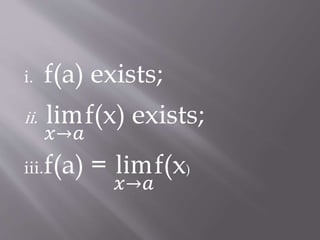
i. f(a) exists;
ii. lim
𝑥→𝑎
f(x) exists;
iii.f(a) = lim
𝑥→𝑎
f(x)
If one or more of these
three conditions fails to
hold at a, the function f
is said to be
discontinuous at a.
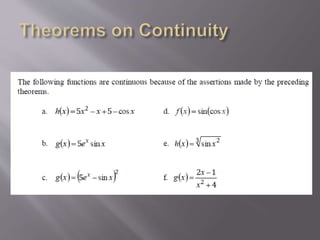
Any polynomial function
is continuous at all real
numbers
Any rational functions is
continuous at any real
number that makes the
denominator nonzero.
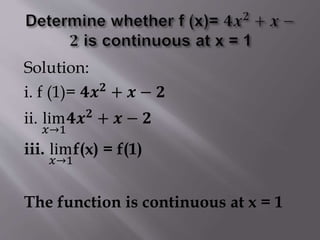
Solution:
i. f (1)= 𝟒𝒙𝟐
+ 𝒙 − 𝟐
ii. lim
𝑥→1
𝟒𝒙𝟐
+ 𝒙 − 𝟐
iii. lim
𝑥→1
f(x) = f(1)
The function is continuous at x = 1
Solution:
i. f (0)=
𝒙𝟐−𝟗
𝒙−𝟑
ii. lim
𝑥→0
𝒙𝟐−𝟗
𝒙−𝟑
iii. lim
𝑥→0
f(x) = f(x)
The function is continuous at x = 0
Solution:
i. f (3)=
𝒙𝟐−𝟗
𝒙−𝟑
ii. lim
𝑥→3
𝒙𝟐−𝟗
𝒙−𝟑
iii. lim
𝑥→3
f(x) = f(x)
The three function are not satisfied.
The function is discontinuous at x = 3
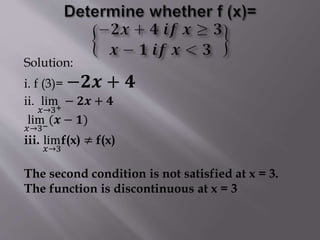
Solution:
i. f (3)= −𝟐𝒙 + 𝟒
ii. lim
𝑥→3+
− 𝟐𝒙 + 𝟒
lim
𝑥→3−
(𝒙 − 𝟏)
iii. lim
𝑥→3
f(x) ≠ f(x)
The second condition is not satisfied at x = 3.
The function is discontinuous at x = 3
Solution:
i. f (-1)= 3
ii. lim
𝑥→−1+
+ (𝑥 + 1)
lim
𝑥→−1−
− (𝑥 + 1)
iii. lim
𝑥→−1
f(x) ≠ f(-1)
The function is discontinuous at x = -1
Solution:
i. f (2)= 4𝑥 − 2
ii. lim
𝑥→2+
(−2𝑥 + 5)
lim
𝑥→2−
(4𝑥 − 2)
iii. lim
𝑥→2+
f(x) ≠ lim
𝑥→2
f(x)
The function is discontinuous at x = 2
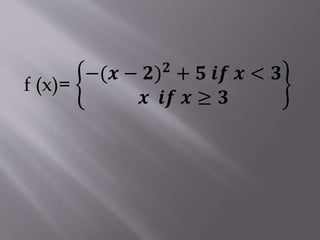
f (x)=
−(𝒙 − 𝟐)𝟐 + 𝟓 𝒊𝒇 𝒙 < 𝟑
𝒙 𝒊𝒇 𝒙 ≥ 𝟑
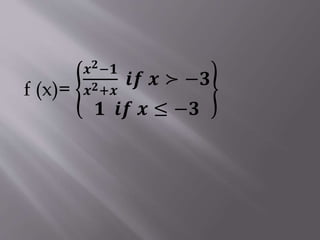
f (x)=
𝒙𝟐−𝟏
𝒙𝟐+𝒙
𝒊𝒇 𝒙 ≻ −𝟑
𝟏 𝒊𝒇 𝒙 ≤ −𝟑
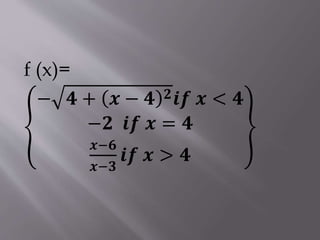
f (x)=
− 𝟒 + 𝒙 − 𝟒 𝟐𝒊𝒇 𝒙 < 𝟒
−𝟐 𝒊𝒇 𝒙 = 𝟒
𝒙−𝟔
𝒙−𝟑
𝒊𝒇 𝒙 > 𝟒
g (x)=
−𝟓𝒙 + 𝟏𝟑 𝒊𝒇 𝒙 ≤ −𝟐
𝒙𝟐
+ 𝟒𝒙 + 𝟕 𝒊𝒇 𝒙 ≻ 𝟐
1. f (x)=
𝒙𝟐 − 𝟒 𝒊𝒇 𝒙 < 𝟐
𝟒 𝒊𝒇 𝒙 = 𝟐
𝟒 − 𝒙𝟐𝒊𝒇𝒙 > 𝟐
2. f (x)=
−𝒙 𝒊𝒇 𝒙 < 𝟎
𝟑
𝒙 + 𝟏𝒊𝒇 𝒙 ≥ 𝟎
3. f (x)=
−𝟏 𝒊𝒇 𝒙 < 𝟎
𝟎 𝒊𝒇 𝒙 = 𝟎
𝒙𝒊𝒇 𝒙 > 𝟎
A removable discontinuity
if the limit of f(x) as x
approaches a exists, and not
equal to f(a).
lim
𝑥→𝑎
𝑓 𝑥 ≠ 𝑓(𝑥)
A jump discontinuity if the
limit of f(x) as x approaches to
a from the right is not equal to
the limit of f(x) as x
approaches to a from the left.
lim
𝑥→𝑎−
𝑓 𝑥 ≠ lim
𝑥→𝑎+
𝑓 𝑥
An Infinite discontinuity
at x = a, if the limit of f(x)
as x approaches to a is
infinite.
lim
𝑥→𝑎
𝑓 𝑥 = ∞
i. 𝑓 𝑎 exists.
The function is defined at a
The graph of the function contains 𝑎, 𝑓 𝑎
Examples of
functions not
continuous at
some x = a
ii. lim
𝑥→𝑎
𝑓 𝑥 exists
lim
𝑥→𝑎−
𝑓 𝑥 = lim
𝑥→𝑎+
𝑓 𝑥
Examples of
functions not
continuous at some
x = a
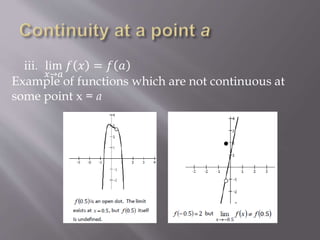
iii. lim
𝑥→𝑎
𝑓 𝑥 = 𝑓 𝑎
Example of functions which are not continuous at
some point x = a
A function which is not continuous at x = a is
discontinuous at that point.
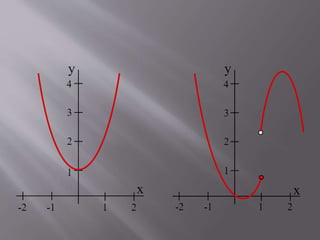
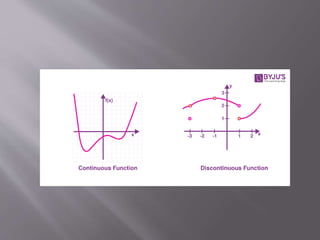
Graphically, a function is continuous in an
interval when its graph has no “breaks” or
“jumps”.
A function is continuous when one can trace its
graph without lifting the pencil from the paper.
Continuous functions
Fig 1.8 𝑓 𝑥 = 𝑥
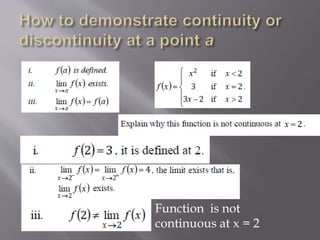
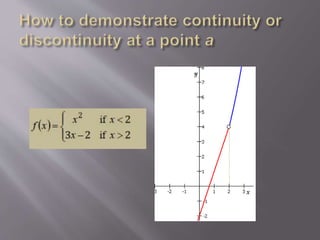
Function is not
continuous at x = 2
If a function has a removable discontinuity at a
point a, that discontinuity can be removed by
redefining the function to fit continuity, in
particular, by making lim
𝑥→𝑎
𝑓 𝑥 = 𝑓 𝑎
Sufficient conditions
for continuity Discontinuous at 𝑥 = 0,
𝑥 ≤ −1
It is undefined at these
values of x
Redefinition of a
new function
If the discontinuities cannot be removed, the
discontinuity is called essential discontinuity.
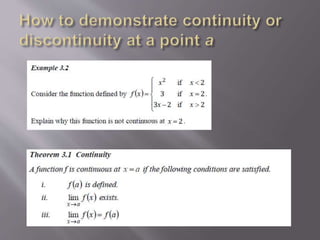
i. f(2) is undefined. The
function is discontinuous
at 2
ii. lim
𝑥→2
𝑓 𝑥 exists
iii. lim
𝑥→2
𝑓 𝑥 ≠ 𝑓 2
i. 𝑓 2 =?, f(2) does not exist
f is discontinuous at x = 2
ii. lim
𝑥→2−
𝑓 𝑥 = lim
𝑥→𝑎+
𝑓 𝑥 = 4
iii. lim
𝑥→2
𝑓 𝑥 ≠ 𝑓 2
Sufficient conditions
for continuity
Sufficient conditions
for continuity
Essentially discontinuous when 𝑥 ≤ −1. Why?
The discontinuity at x = 0 is removable because
lim
𝑥→0
𝑓 𝑥 = 2, 𝑖𝑡 𝑒𝑥𝑖𝑠𝑡𝑠
Redefined function
continuity Basic Calculus Grade 11 - Copy.pptx

continuity Basic Calculus Grade 11 - Copy.pptx

  • 3.
    Evaluate the followingLimits 1. lim 𝑥→9 𝑥2 2. lim 𝑥→4 6𝑥 𝑥−2 3. lim 𝑥→2 𝑥4−16 𝑥−2 4. lim 𝑥→−2 1 2 + 1 𝑥 𝑥+2 5. lim 𝑥→3 1 𝑥2− 1 9 𝑥−3
  • 4.
  • 5.
    A function issaid to be continuous on the interval when the function is continuous at a number in that interval. If c is a number in the interval(a, b) and f is a function with a domain containing the interval(a,b), then f is said to be continuous at x = c if all the following conditions are satisfied:
  • 6.
    i. f(a) exists; ii.lim 𝑥→𝑎 f(x) exists; iii.f(a) = lim 𝑥→𝑎 f(x)
  • 7.
    If one ormore of these three conditions fails to hold at a, the function f is said to be discontinuous at a.
  • 8.
    Any polynomial function iscontinuous at all real numbers
  • 9.
    Any rational functionsis continuous at any real number that makes the denominator nonzero.
  • 10.
    Solution: i. f (1)=𝟒𝒙𝟐 + 𝒙 − 𝟐 ii. lim 𝑥→1 𝟒𝒙𝟐 + 𝒙 − 𝟐 iii. lim 𝑥→1 f(x) = f(1) The function is continuous at x = 1
  • 11.
    Solution: i. f (0)= 𝒙𝟐−𝟗 𝒙−𝟑 ii.lim 𝑥→0 𝒙𝟐−𝟗 𝒙−𝟑 iii. lim 𝑥→0 f(x) = f(x) The function is continuous at x = 0
  • 12.
    Solution: i. f (3)= 𝒙𝟐−𝟗 𝒙−𝟑 ii.lim 𝑥→3 𝒙𝟐−𝟗 𝒙−𝟑 iii. lim 𝑥→3 f(x) = f(x) The three function are not satisfied. The function is discontinuous at x = 3
  • 13.
    Solution: i. f (3)=−𝟐𝒙 + 𝟒 ii. lim 𝑥→3+ − 𝟐𝒙 + 𝟒 lim 𝑥→3− (𝒙 − 𝟏) iii. lim 𝑥→3 f(x) ≠ f(x) The second condition is not satisfied at x = 3. The function is discontinuous at x = 3
  • 14.
    Solution: i. f (-1)=3 ii. lim 𝑥→−1+ + (𝑥 + 1) lim 𝑥→−1− − (𝑥 + 1) iii. lim 𝑥→−1 f(x) ≠ f(-1) The function is discontinuous at x = -1
  • 15.
    Solution: i. f (2)=4𝑥 − 2 ii. lim 𝑥→2+ (−2𝑥 + 5) lim 𝑥→2− (4𝑥 − 2) iii. lim 𝑥→2+ f(x) ≠ lim 𝑥→2 f(x) The function is discontinuous at x = 2
  • 16.
    f (x)= −(𝒙 −𝟐)𝟐 + 𝟓 𝒊𝒇 𝒙 < 𝟑 𝒙 𝒊𝒇 𝒙 ≥ 𝟑
  • 17.
    f (x)= 𝒙𝟐−𝟏 𝒙𝟐+𝒙 𝒊𝒇 𝒙≻ −𝟑 𝟏 𝒊𝒇 𝒙 ≤ −𝟑
  • 18.
    f (x)= − 𝟒+ 𝒙 − 𝟒 𝟐𝒊𝒇 𝒙 < 𝟒 −𝟐 𝒊𝒇 𝒙 = 𝟒 𝒙−𝟔 𝒙−𝟑 𝒊𝒇 𝒙 > 𝟒
  • 19.
    g (x)= −𝟓𝒙 +𝟏𝟑 𝒊𝒇 𝒙 ≤ −𝟐 𝒙𝟐 + 𝟒𝒙 + 𝟕 𝒊𝒇 𝒙 ≻ 𝟐
  • 20.
    1. f (x)= 𝒙𝟐− 𝟒 𝒊𝒇 𝒙 < 𝟐 𝟒 𝒊𝒇 𝒙 = 𝟐 𝟒 − 𝒙𝟐𝒊𝒇𝒙 > 𝟐
  • 21.
    2. f (x)= −𝒙𝒊𝒇 𝒙 < 𝟎 𝟑 𝒙 + 𝟏𝒊𝒇 𝒙 ≥ 𝟎
  • 22.
    3. f (x)= −𝟏𝒊𝒇 𝒙 < 𝟎 𝟎 𝒊𝒇 𝒙 = 𝟎 𝒙𝒊𝒇 𝒙 > 𝟎
  • 23.
    A removable discontinuity ifthe limit of f(x) as x approaches a exists, and not equal to f(a). lim 𝑥→𝑎 𝑓 𝑥 ≠ 𝑓(𝑥)
  • 24.
    A jump discontinuityif the limit of f(x) as x approaches to a from the right is not equal to the limit of f(x) as x approaches to a from the left. lim 𝑥→𝑎− 𝑓 𝑥 ≠ lim 𝑥→𝑎+ 𝑓 𝑥
  • 25.
    An Infinite discontinuity atx = a, if the limit of f(x) as x approaches to a is infinite. lim 𝑥→𝑎 𝑓 𝑥 = ∞
  • 27.
    i. 𝑓 𝑎exists. The function is defined at a The graph of the function contains 𝑎, 𝑓 𝑎 Examples of functions not continuous at some x = a
  • 28.
    ii. lim 𝑥→𝑎 𝑓 𝑥exists lim 𝑥→𝑎− 𝑓 𝑥 = lim 𝑥→𝑎+ 𝑓 𝑥 Examples of functions not continuous at some x = a
  • 29.
    iii. lim 𝑥→𝑎 𝑓 𝑥= 𝑓 𝑎 Example of functions which are not continuous at some point x = a
  • 30.
    A function whichis not continuous at x = a is discontinuous at that point.
  • 32.
    Graphically, a functionis continuous in an interval when its graph has no “breaks” or “jumps”. A function is continuous when one can trace its graph without lifting the pencil from the paper.
  • 33.
  • 36.
  • 38.
    If a functionhas a removable discontinuity at a point a, that discontinuity can be removed by redefining the function to fit continuity, in particular, by making lim 𝑥→𝑎 𝑓 𝑥 = 𝑓 𝑎
  • 39.
    Sufficient conditions for continuityDiscontinuous at 𝑥 = 0, 𝑥 ≤ −1 It is undefined at these values of x
  • 40.
  • 41.
    If the discontinuitiescannot be removed, the discontinuity is called essential discontinuity. i. f(2) is undefined. The function is discontinuous at 2 ii. lim 𝑥→2 𝑓 𝑥 exists iii. lim 𝑥→2 𝑓 𝑥 ≠ 𝑓 2
  • 42.
    i. 𝑓 2=?, f(2) does not exist f is discontinuous at x = 2 ii. lim 𝑥→2− 𝑓 𝑥 = lim 𝑥→𝑎+ 𝑓 𝑥 = 4 iii. lim 𝑥→2 𝑓 𝑥 ≠ 𝑓 2
  • 43.
  • 44.
    Sufficient conditions for continuity Essentiallydiscontinuous when 𝑥 ≤ −1. Why? The discontinuity at x = 0 is removable because lim 𝑥→0 𝑓 𝑥 = 2, 𝑖𝑡 𝑒𝑥𝑖𝑠𝑡𝑠
  • 45.