THE OWNER JOSEMERCADO, INVESTED PHP 10 000 AND BORROWED PHP 50
000 TO START HIS BUSINESS. HE PURCHASED PHOTOCOPYING MACHINE FOR
PHP 30 000 AND SUPPLIES FOR PHP 10 000, SALARY FOR PHP 4000, AND
BUSINESS PERMIT FOR PHP 2000. THE BUSINESS CONSUMED ELECTRICITY
FOR PHP 2 500 PAYABLE THE FOLLOWING MONTH. DURING THE FIRST
MONTH OF BUSINESS OPERATIONS, THE PHOTOCOPYING SERVICE
GENERATED PHP 10 000 REVENUE
WHICH OF THE AMOUNTS CITED ABOVE DO YOU THINK WILL BE INCLUDED
IN THE BUSINES’S FINANCIAL REPORTS? WHAT IS YOUR REASON FOR
INCLUDING SAID AMOUNTS?
OPENING CASE
3.
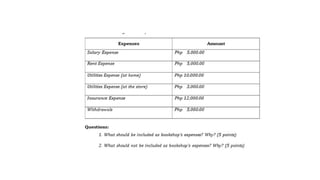
Rhea Gajopo dreamedto have her own bookshop when she was young. She
was a girl with big dreams even at a young age. She loves books so reading
became her escapade as shegrows. She finished her degree in Bachelor of
Sciencein Education major in English Literature and aced the LET 2019. Yet,
she felt incomplete and she wanted to pursue her childhood dream. So, she
launched her own bookshop business called Eyang Bookstore with the initial
investment of Php.500,000.00. During the firstyear of operation the books of
account reflected an income ofPhp 50,000.00 and expenses of Php. 30,000.00.
She was doubtful of the recorded expenses, so she reviewed the list of recorded
expenses. Observe the table below showing all her expenses
EYANG BOOKSTORE BY JUDITH TABUGAN
5.
• As accountingis considered as
language of business, it has rules or
concepts and principles to follow,
much like grammar of any
language. It communicates the
financial condition and performance
of a business to interested users for
decision making purposes
• A widely accepted set of rules,
concepts, and principles referred to as
the Generally Accepetd Accounting
Principles (GAAP) governs the
application of accounting procedures.
6.
• Examples: Mr.Alex, the owner of Bilis
Serbisyo Repair Shop, bought
supplies for the school project of his
son using his own money.
• It assumes that all of the business transactions are
separate from the business owner’s personal
transactions. A business is considered a distinct
entity from the owner and thereof the two should
be treated separately. Any personal transaction of
its owner should not be recorded in the company’s
accounting book, and vice versa, unless the
owner’s personal transactions investing or
withdrawing resources from t
1. ECONOMIC ENTITY ASSUMPTION
7.
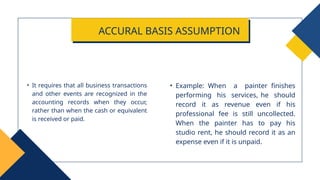
• Example: Whena painter finishes
performing his services, he should
record it as revenue even if his
professional fee is still uncollected.
When the painter has to pay his
studio rent, he should record it as an
expense even if it is unpaid.
• It requires that all business transactions
and other events are recognized in the
accounting records when they occur,
rather than when the cash or equivalent
is received or paid.
ACCURAL BASIS ASSUMPTION
8.
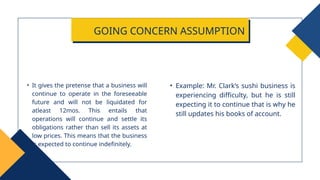
• Example: Mr.Clark’s sushi business is
experiencing difficulty, but he is still
expecting it to continue that is why he
still updates his books of account.
• It gives the pretense that a business will
continue to operate in the foreseeable
future and will not be liquidated for
atleast 12mos. This entails that
operations will continue and settle its
obligations rather than sell its assets at
low prices. This means that the business
is expected to continue indefinitely.
GOING CONCERN ASSUMPTION
9.
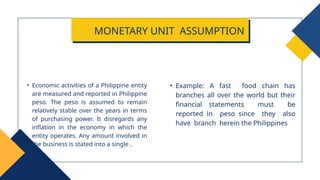
• Example: Afast food chain has
branches all over the world but their
financial statements must be
reported in peso since they also
have branch herein the Philippines
• Economic activities of a Philippine entity
are measured and reported in Philippine
peso. The peso is assumed to remain
relatively stable over the years in terms
of purchasing power. It disregards any
inflation in the economy in which the
entity operates. Any amount involved in
the business is stated into a single .
MONETARY UNIT ASSUMPTION
10.
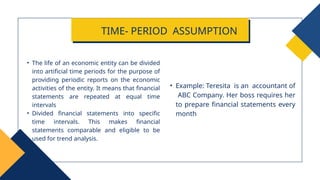
• Example: Teresitais an accountant of
ABC Company. Her boss requires her
to prepare financial statements every
month
• The life of an economic entity can be divided
into artificial time periods for the purpose of
providing periodic reports on the economic
activities of the entity. It means that financial
statements are repeated at equal time
intervals
• Divided financial statements into specific
time intervals. This makes financial
statements comparable and eligible to be
used for trend analysis.
TIME- PERIOD ASSUMPTION
11.
• The basicaccounting principles are detailed accounting
rules and guidelines that entities must follow when
measuring, recording and reporting financial data.
BASIC ACCOUNTING
PRINCIPLES
12.
Example, Bilis SerbisiyoRepair Shop
bought one computer unit for Php 42 000
but it could have been purchased at Php 40
000 from another vendor. The shop should
record the transaction at P 42 000 because
that is the amount given in exchange for
the computer unit.
Example: When the owner of a sari-sasari
store buys a calculator, it should be
recorded in the cash register at its price
when it was bought
refers to the amount spent (cash or
the cash equivalent). When an item
was originally obtained, whether that
purchase happened last year or ten
years ago; amounts are not adjusted
upward for inflation. The amounts
shown in financial statements are
referred to as historical cost amounts
Cost Principle
13.
• Example: Aleenabought a computer
for her computer shop. She made
sure that it was recorded on the
financial reports
The account should include sufficient
information. To permit the
stakeholders to make an informed
judgement about financial condition
of the enterprise
FULL DISCLOSURE PRINCIPLE
14.
• Example:Siony soldthe goods to her
customers, the revenue increases
and the inventories decrease. The
reduction of the inventories in
relation to revenues is called the cost
of goods sold and it should be
recorded in the period in which the
revenues were earned
Requires that expenses be matched
with revenues. It means that in given
accounting period, the revenue
recorded should have its
corresponding expense recorded in
order to show true profit of the
business
MATCHING PRINCIPLE
15.
Are recognized assoon as goods
have been sold or a service has been
rendered, regardless of when the
money is actually received. Revenue
is recognized when the earnings
process is virtually complete and an
exchange transaction has occurred
REVENUE RECOGNITION PRINCIPLE
16.
• Example: Robi,an accounting clerk,
purchased a friction pen. She
estimated it to have a useful life up
the three months. Since a friction pen
is immaterial relative to assets, it
should be recorded as an expense
Business transactions that may affect
the decisions of a user of financial
information are considered
important or material, and thus must
be reported properly
MATERIALITY PRINCIPLE
17.
• Example:Suppose anasset owned by Mico,
like inventory was bought for Php 20,000.00
but can now be bought for Php 15,000.00.
Then the company must immediately write
down the value of the asset to at Php
15,000.00 because of the lower cost in the
market. But if the inventory was bought for
Php 20,000.00 and now has a market value
of Php 25,000.00, it must still be shown a
Php 20,000.00 on the books because the
gain is only recorded when the inventory or
asset is sold
Focuses on the idea of prudence that
income assets should not be
overstated while liabilities and
expenses are not understands. Lower
revenue and higher expenses may
result to lower reported income.
Helps the accountant break a tie
while remaining unbiased and
objective.
CONSERVATISM PRINCIPLE
18.
This principle requiresbusiness
transactions to have so e form of
impartial supporting evidence or
documentation.
OBJECTIVITY PRINCIPLE






![Theory Base of Accounting [Autosaved].pptx](https://cdn.slidesharecdn.com/ss_thumbnails/theorybaseofaccountingautosaved-230923134922-7fdbd224-thumbnail.jpg?width=640&height=640&fit=bounds)


