BASIC
CALCULUS
Unit I
Limits and Continuity
REVIEW
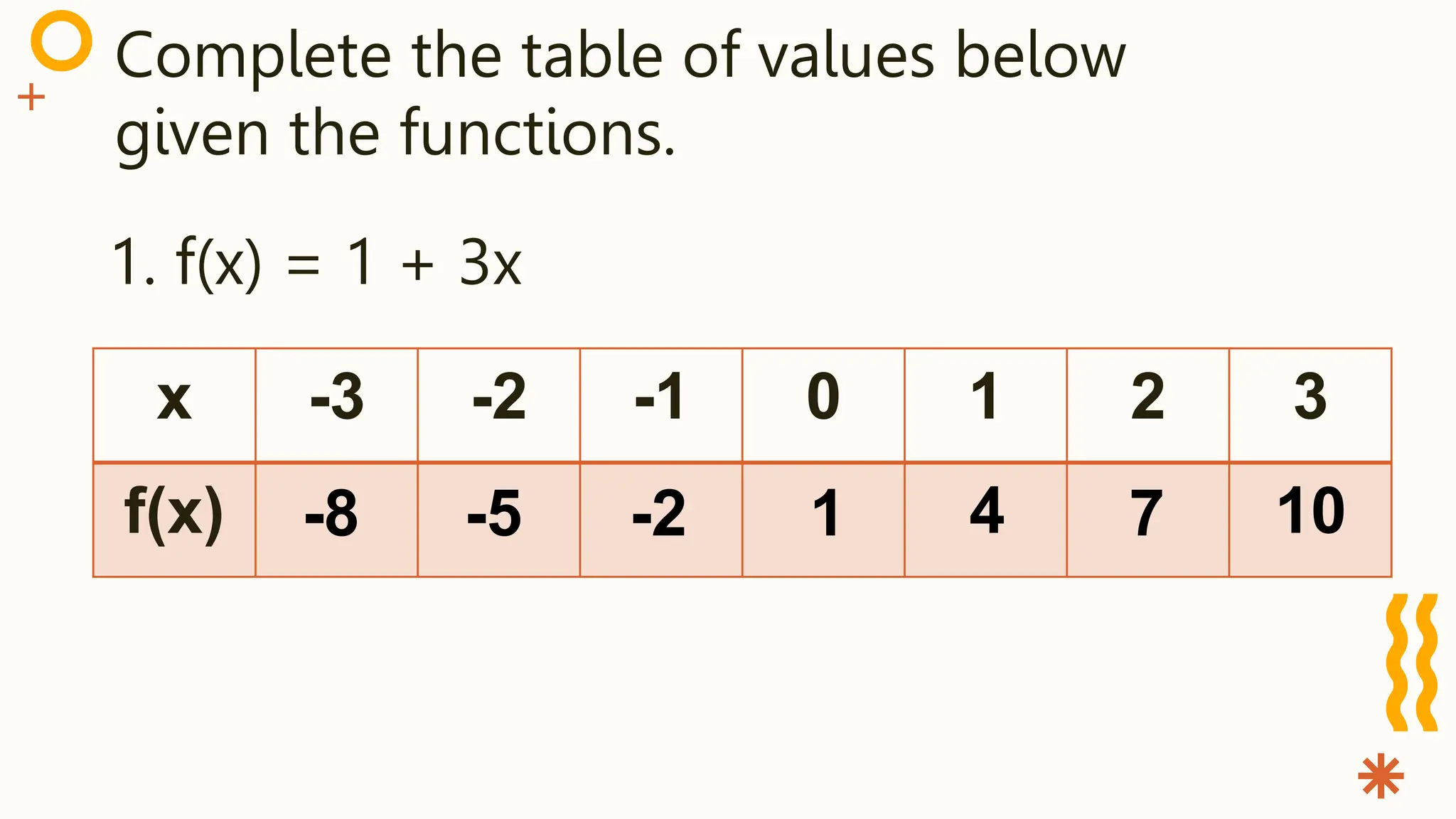
1. f(x) = 1 + 3x
Complete the table of values below
given the functions.
x -3 -2 -1 0 1 2 3
f(x) -8 -5 -2 1 4 7 10
a. Describe the limit of a function using
correct notation.
b. Estimate the limit of a function or to
identify when the limit does not exist using
a table of values.
c. Estimate the limit of a function or to
identify when the limit does not exist using
OBJECTIVES
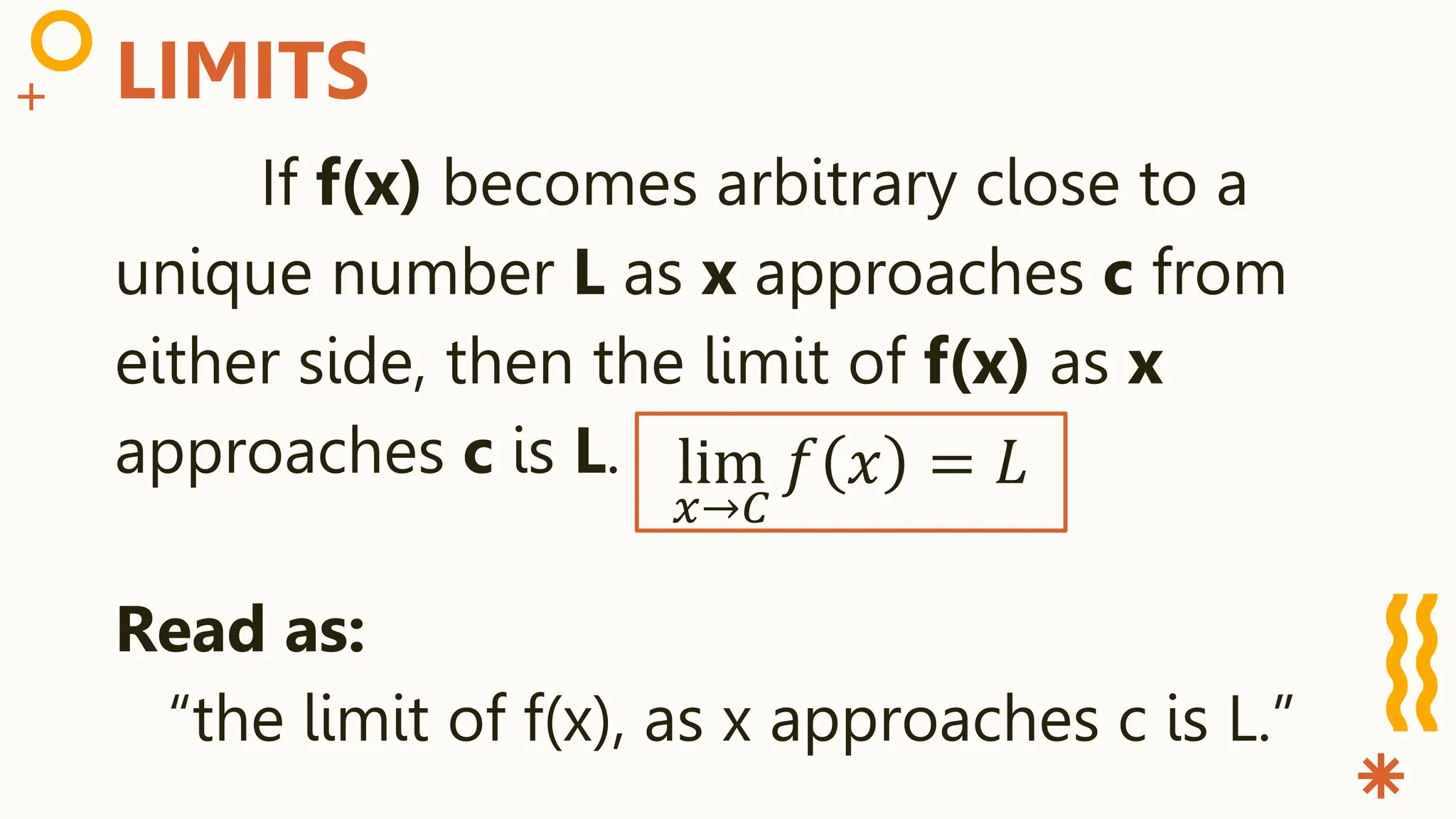
If f(x) becomes arbitrary close to a
unique number L as x approaches c from
either side, then the limit of f(x) as x
approaches c is L.
Read as:
“the limit of f(x), as x approaches c is L.”
LIMITS
lim
𝑥→𝐶
𝑓 𝑥 = 𝐿
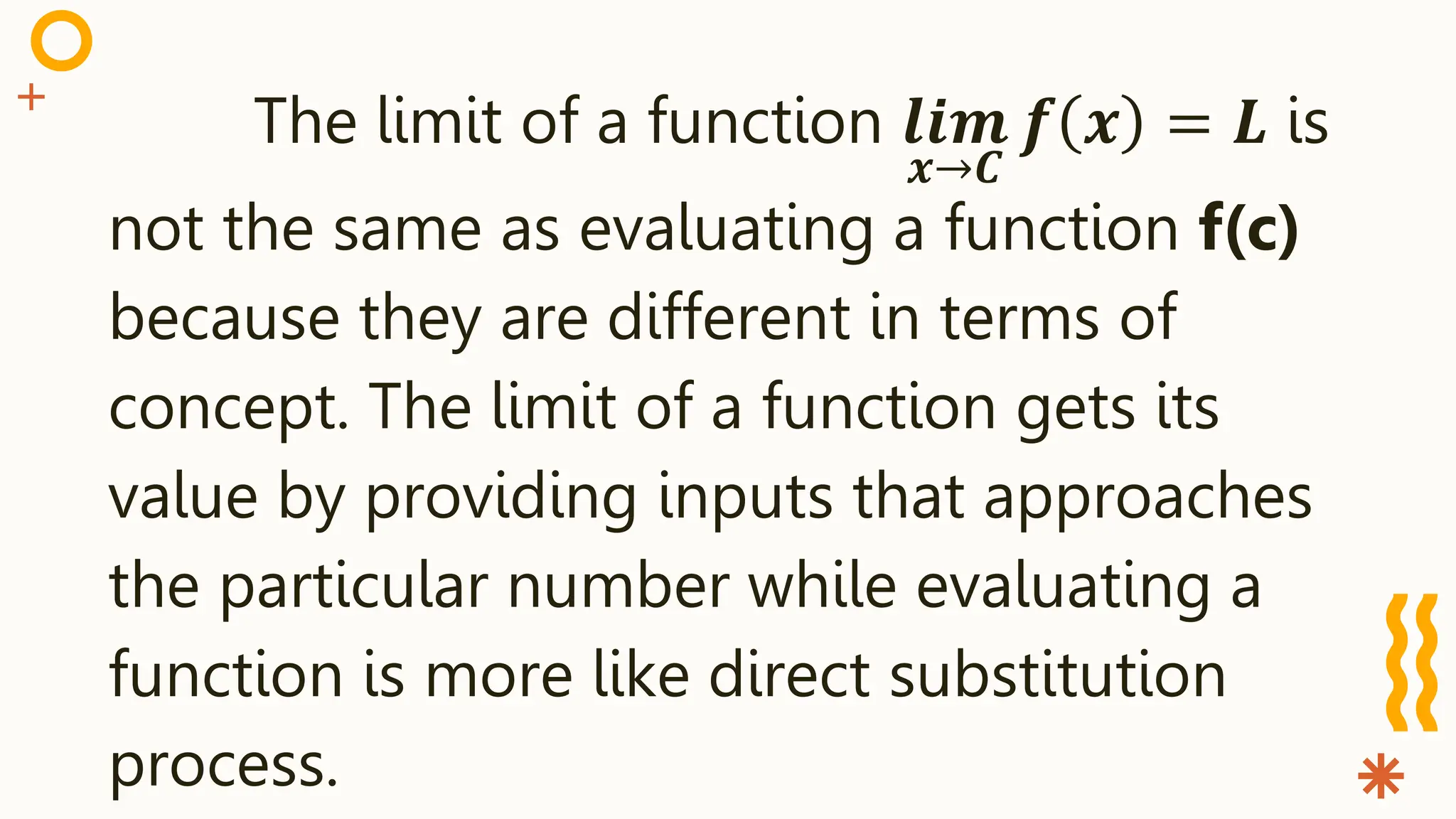
The limit of a function 𝒍𝒊𝒎
𝒙→𝑪
𝒇 𝒙 = 𝑳 is
not the same as evaluating a function f(c)
because they are different in terms of
concept. The limit of a function gets its
value by providing inputs that approaches
the particular number while evaluating a
function is more like direct substitution
process.
One sided limit
is the value (L) as the x value gets
closer and closer to a certain value c from
one side only (either from the left or from
the right side). In symbols,
lim
𝑥→𝑐+
𝑓 𝑥 = 𝐿 lim
𝑥→𝑐−
𝑓 𝑥 = 𝐿
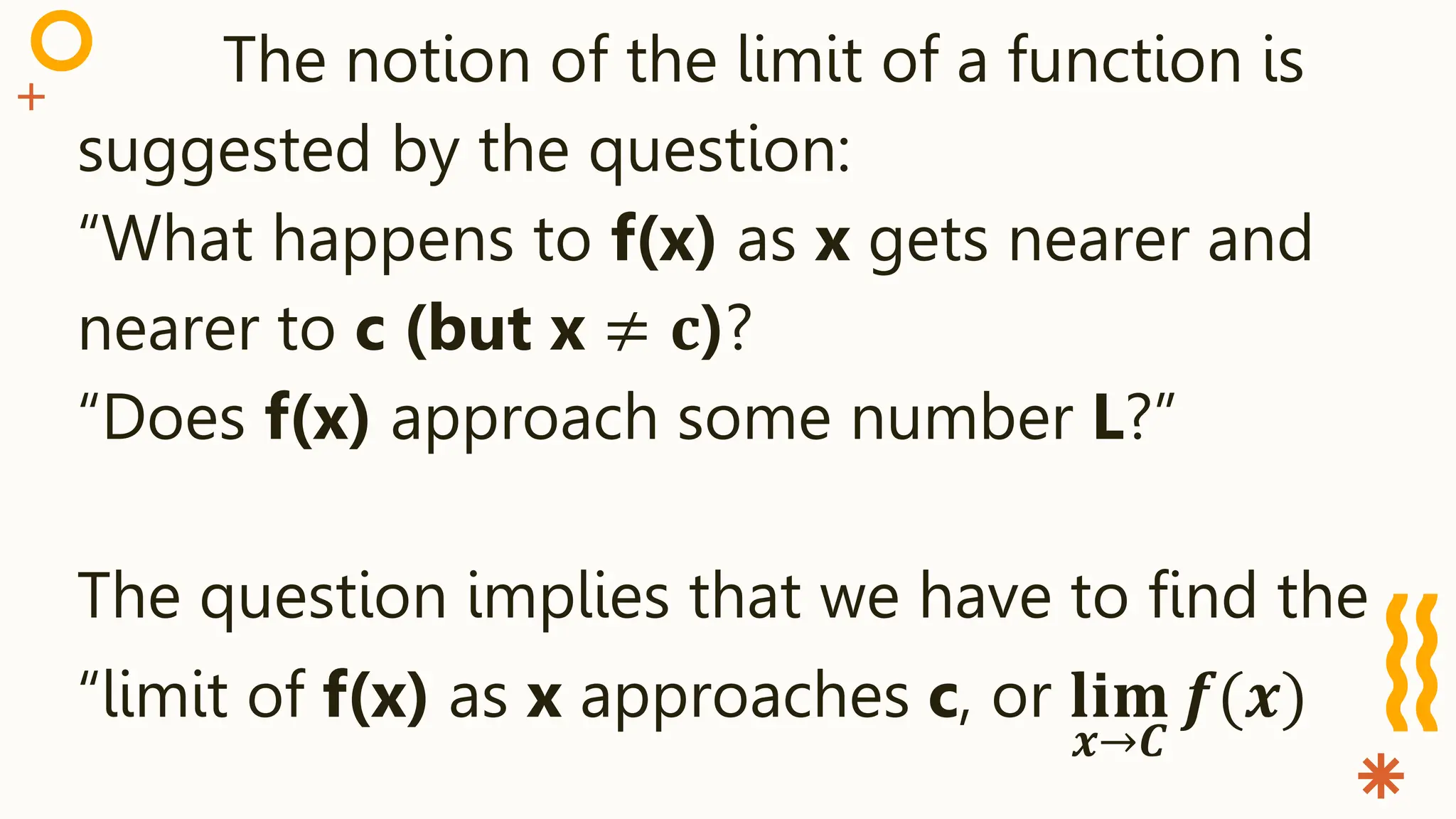
The notion of the limit of a function is
suggested by the question:
“What happens to f(x) as x gets nearer and
nearer to c (but x ≠ 𝐜)?
“Does f(x) approach some number L?”
The question implies that we have to find the
“limit of f(x) as x approaches c, or 𝐥𝐢𝐦
𝒙→𝑪
𝒇(𝒙)
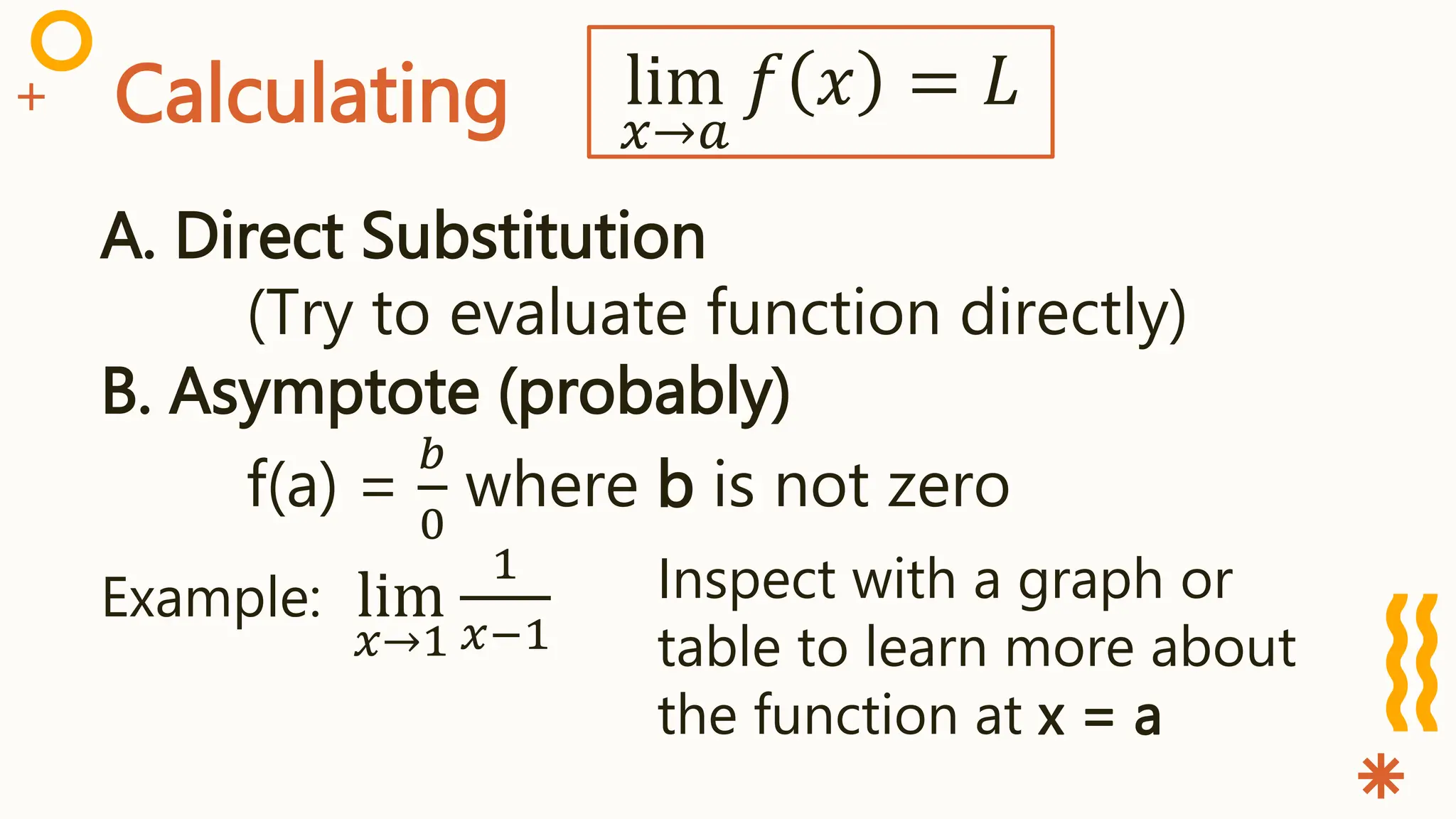
A. Direct Substitution
(Try to evaluate function directly)
B. Asymptote (probably)
f(a) =
𝑏
0
where b is not zero
Example: lim
𝑥→1
1
𝑥−1
Calculating lim
𝑥→𝑎
𝑓 𝑥 = 𝐿
Inspect with a graph or
table to learn more about
the function at x = a
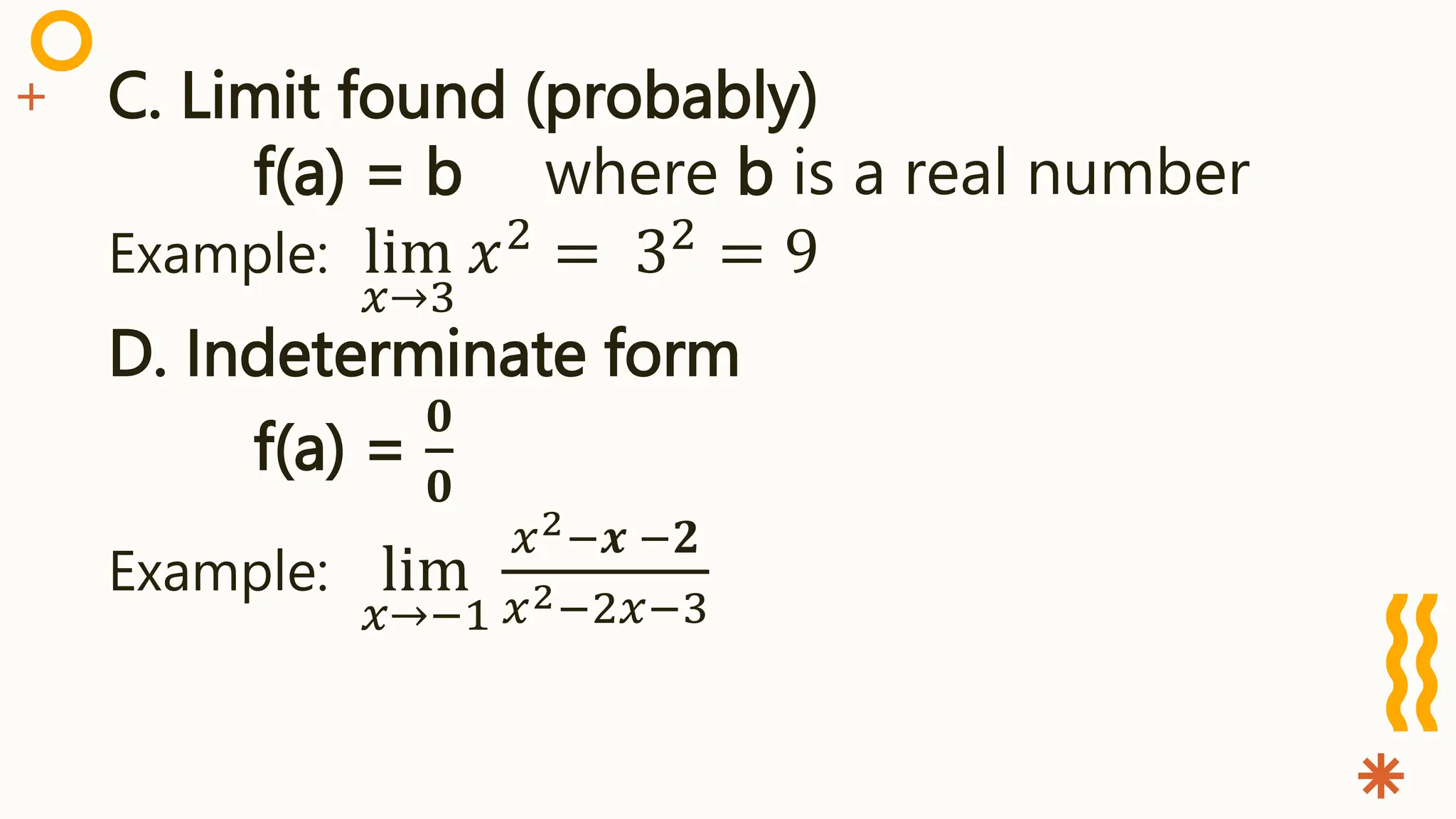
C. Limit found (probably)
f(a) = b where b is a real number
Example: lim
𝑥→3
𝑥2
= 32
= 9
D. Indeterminate form
f(a) =
𝟎
𝟎
Example: lim
𝑥→−1
𝑥2−𝒙 −𝟐
𝑥2−2𝑥−3
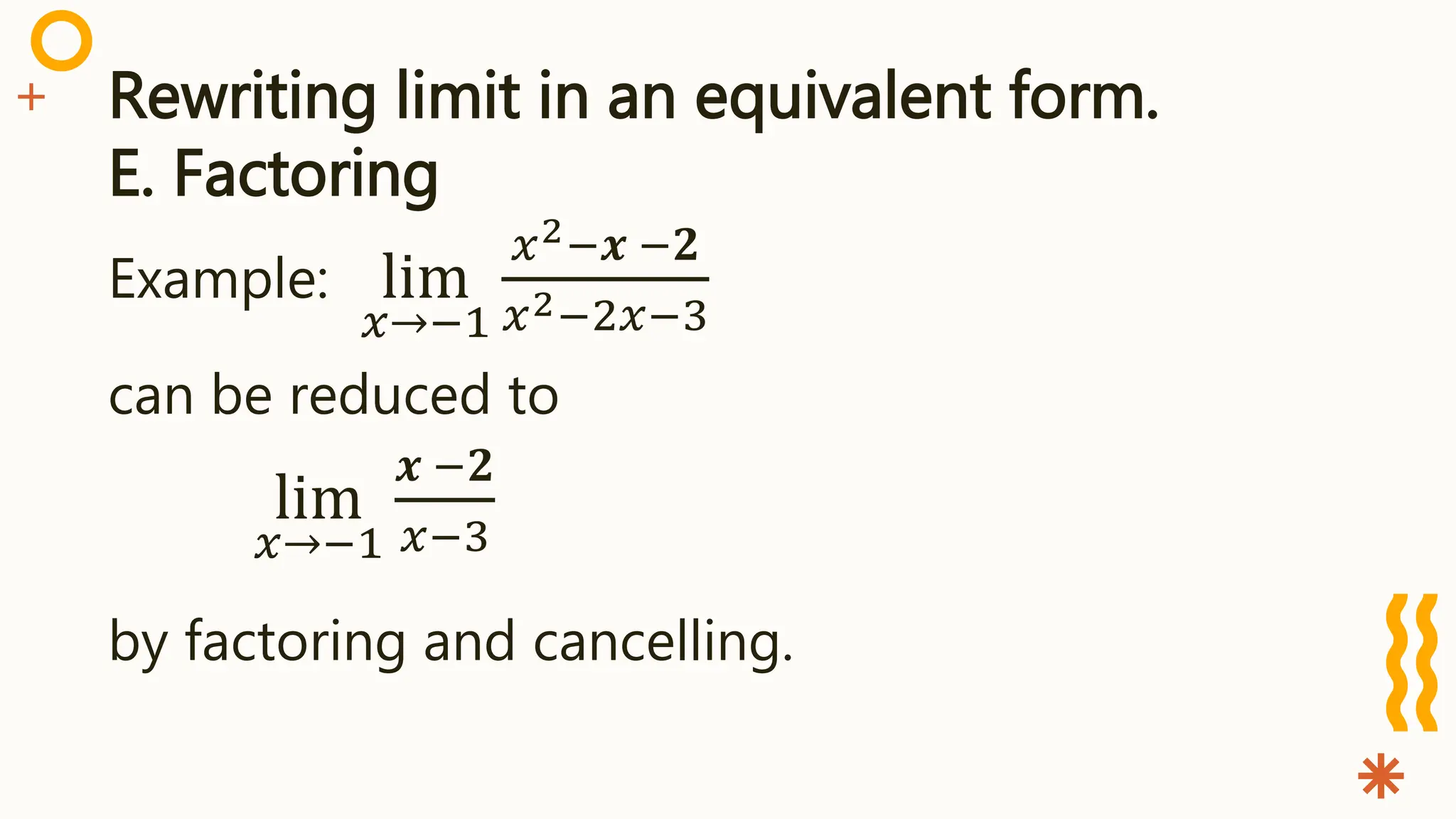
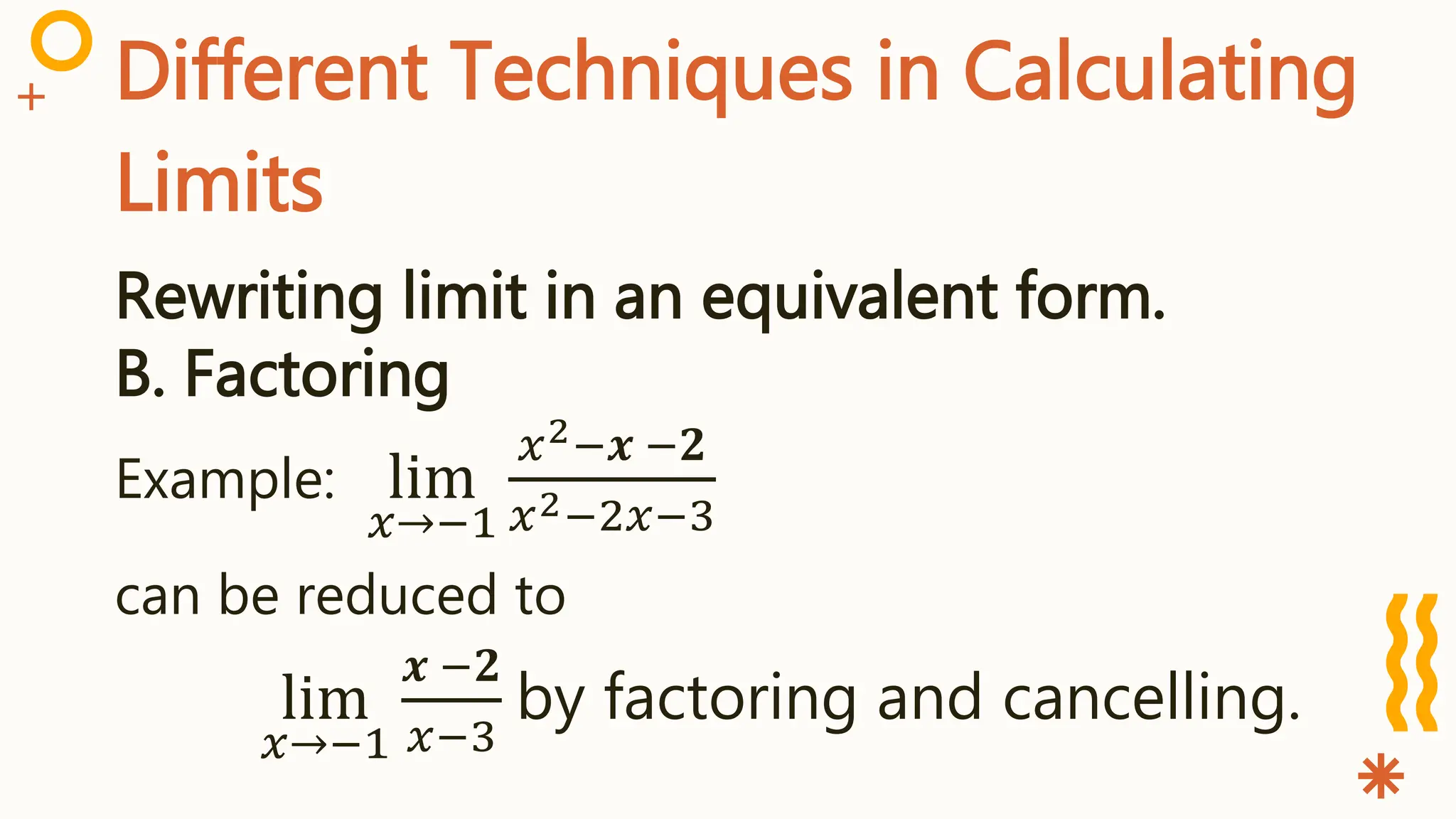
Rewriting limit in an equivalent form.
E. Factoring
Example: lim
𝑥→−1
𝑥2−𝒙 −𝟐
𝑥2−2𝑥−3
can be reduced to
lim
𝑥→−1
𝒙 −𝟐
𝑥−3
by factoring and cancelling.
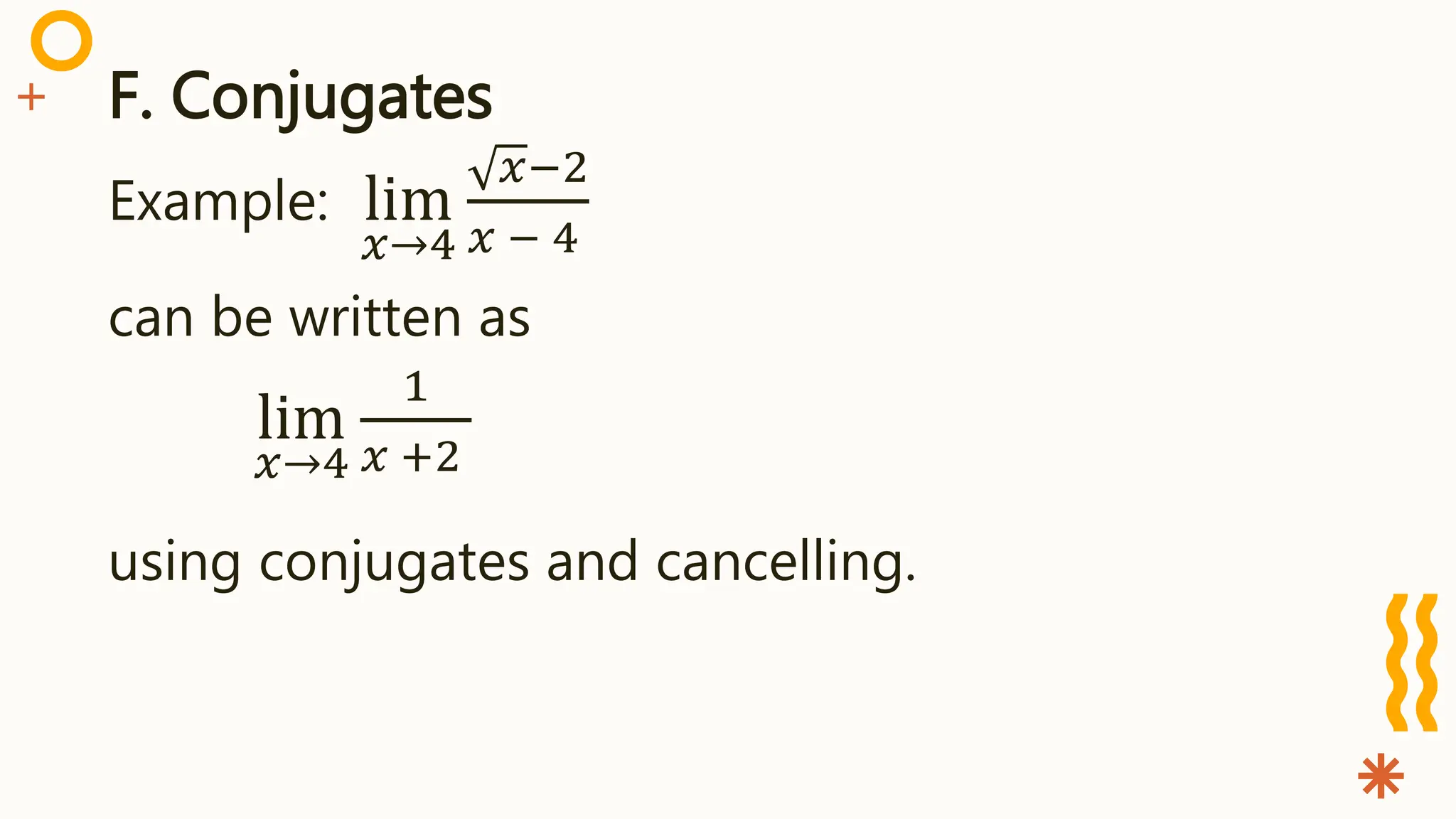
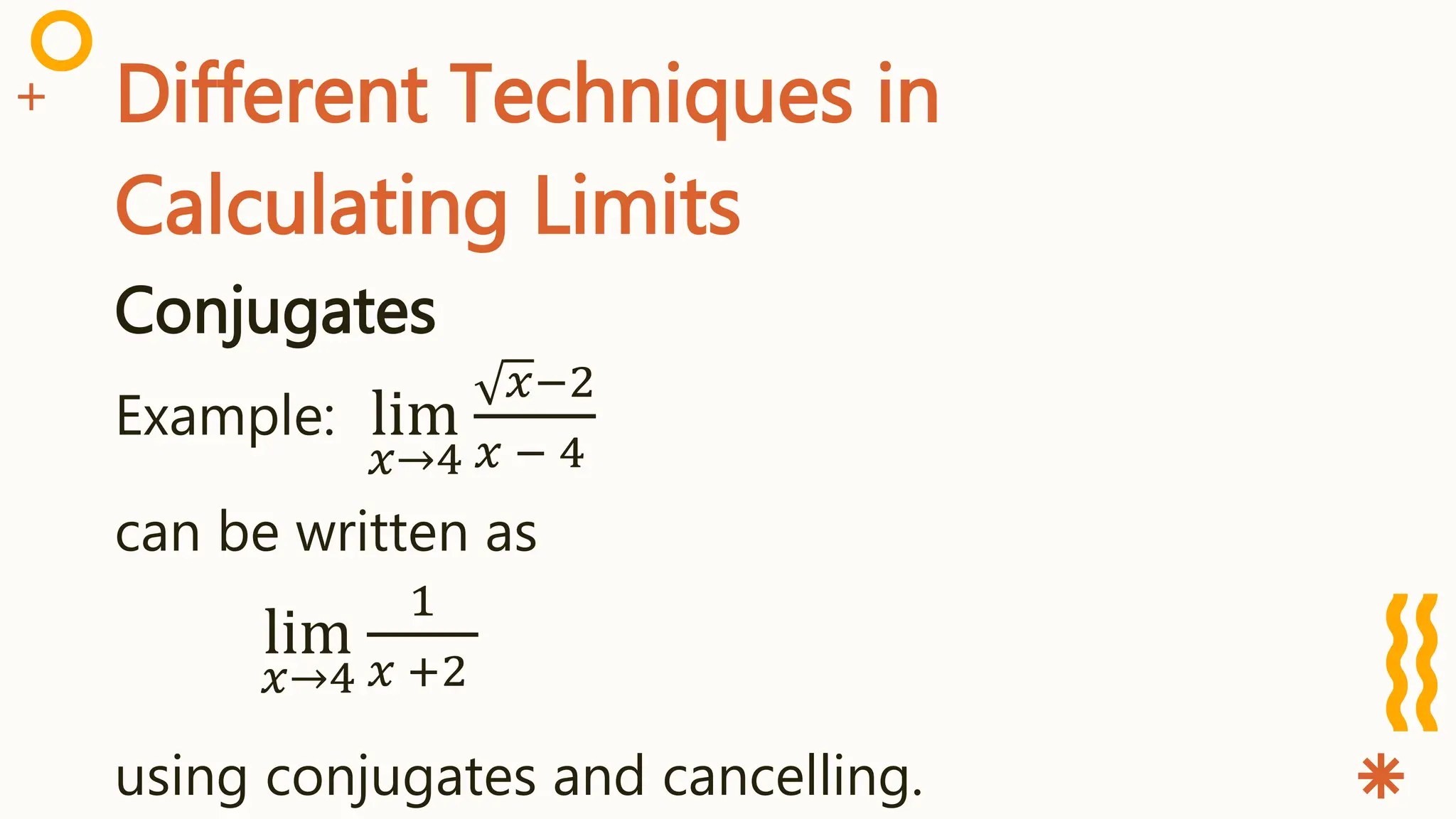
F. Conjugates
Example: lim
𝑥→4
𝑥−2
𝑥 − 4
can be written as
lim
𝑥→4
1
𝑥 +2
using conjugates and cancelling.
G. Trig Identities
Example: lim
𝑥→0
sin(𝑥)
sin(2𝑥)
can be written as
lim
𝑥→0
1
2cos(𝑥)
using trigonometric identities.
H. Approximation
When all else fails, graphs and tables
can help approximate limits.
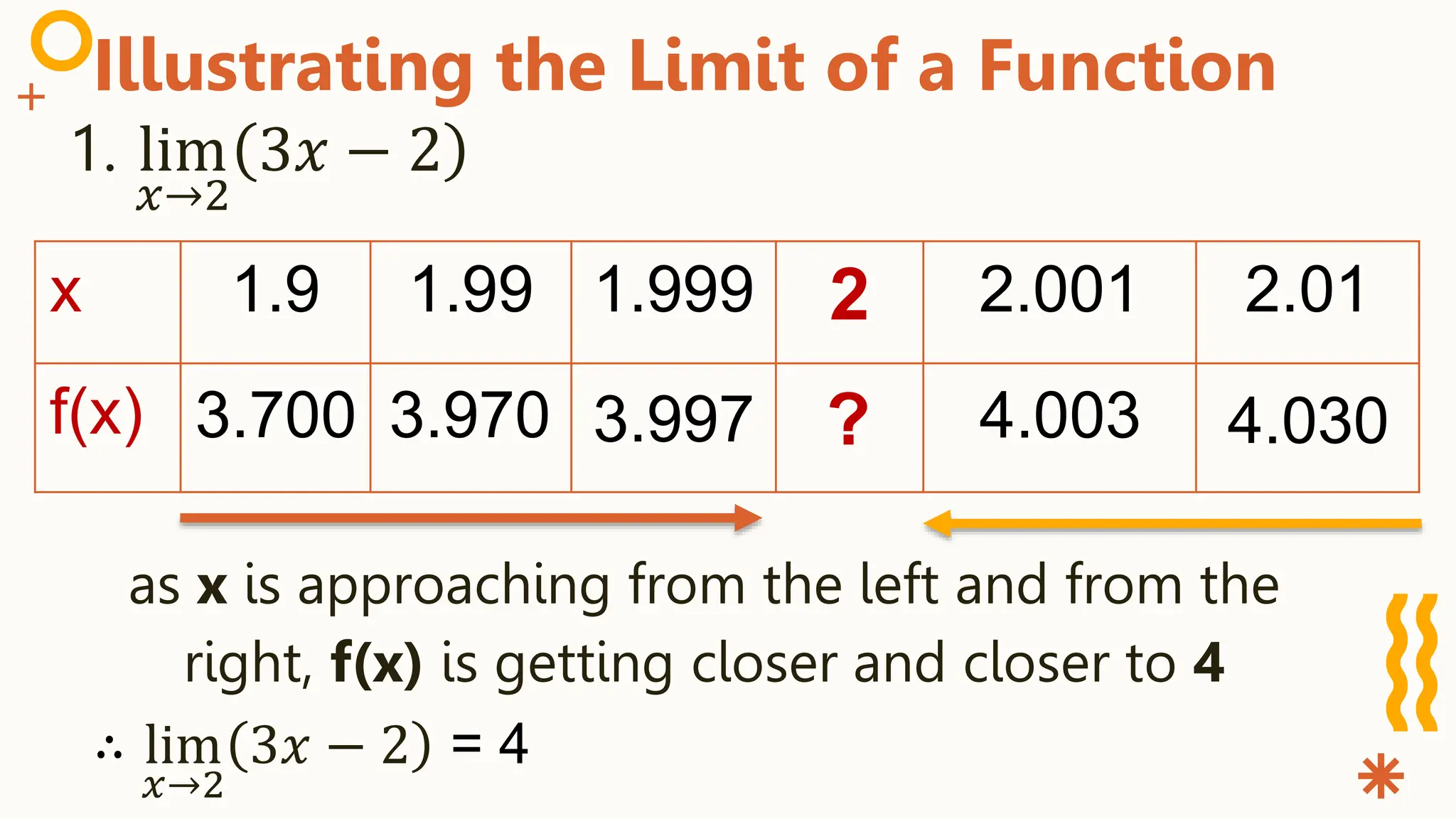
1. lim
𝑥→2
3𝑥 − 2
Illustrating the Limit of a Function
x 1.9 1.99 1.999 2 2.001 2.01
f(x) 3.700 3.970 3.997 4.003 4.030
?
as x is approaching from the left and from the
right, f(x) is getting closer and closer to 4
∴ lim
𝑥→2
3𝑥 − 2 = 4
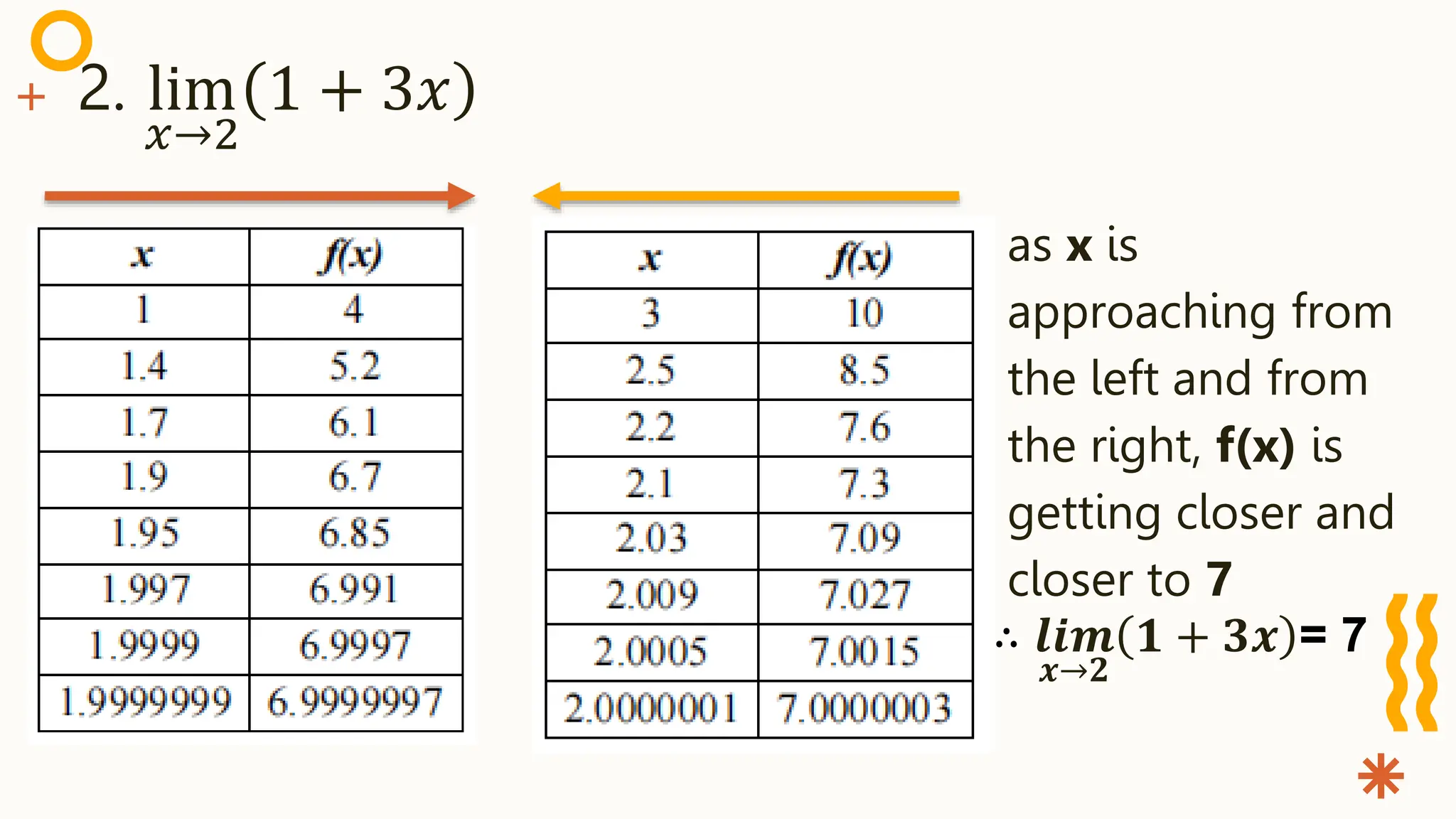
2. lim
𝑥→2
1 + 3𝑥
as x is
approaching from
the left and from
the right, f(x) is
getting closer and
closer to 7
∴ 𝒍𝒊𝒎
𝒙→𝟐
𝟏 + 𝟑𝒙 = 7
3. lim
𝑥→−1
(𝑥2
+ 1)
as x is
approaching from
the left and from
the right, f(x) is
getting closer and
closer to 2
∴ 𝒍𝒊𝒎
𝒙→𝟐
𝟏 + 𝟑𝒙 = 2
4. lim
𝑥→2
(𝑥 + 3) solve for its limit when x approaches 2
as x is
approaching from
the left and from
the right, f(x) is
getting closer and
closer to 2
∴ 𝒍𝒊𝒎
𝒙→𝟐
𝒙 + 𝟑 = 2
x<2 f(x)
0
1
1.5
1.9
1.99
1.999
x>2 f(x)
4
3
2.5
2.1
2.01
2.001
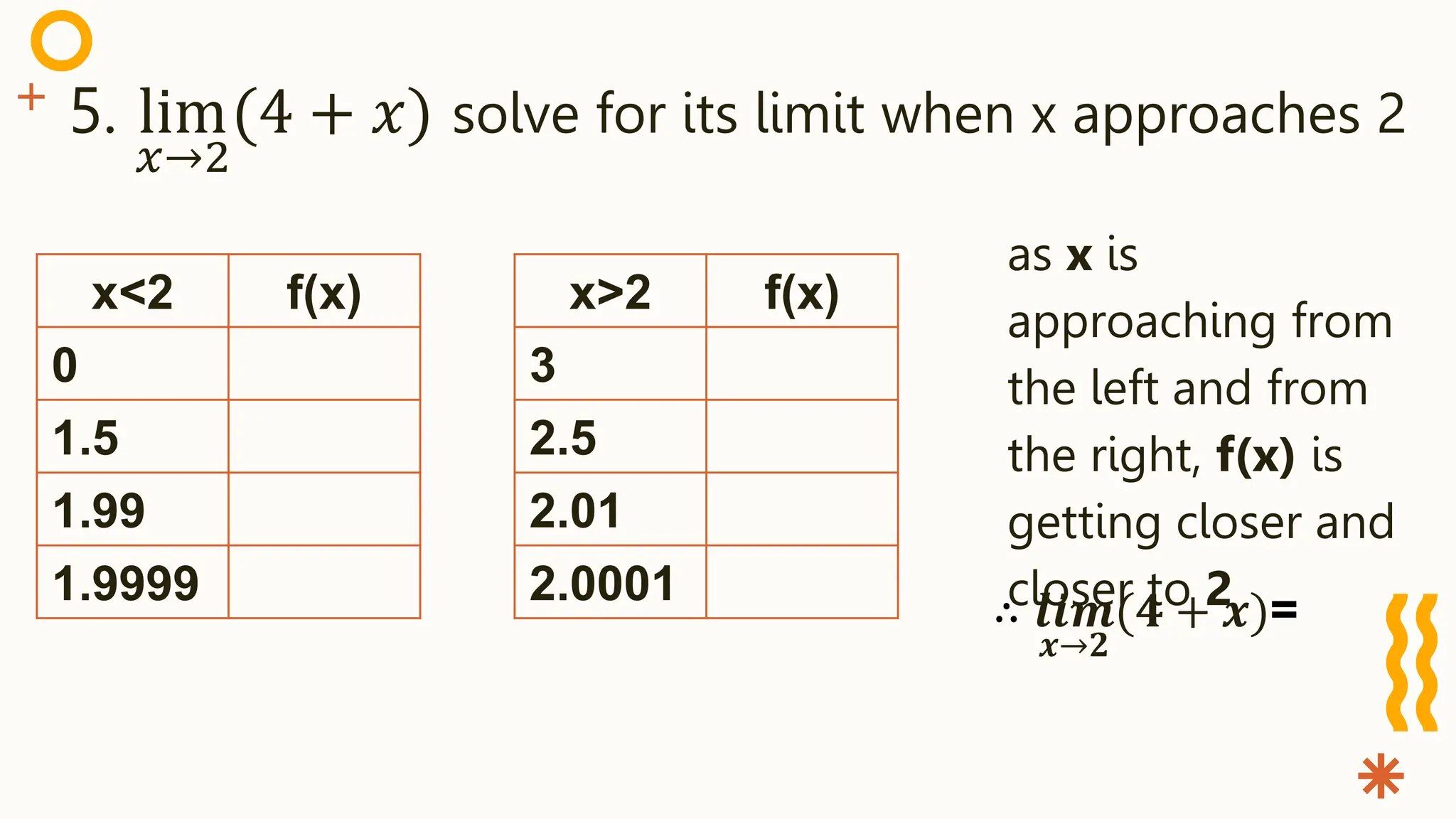
5. lim
𝑥→2
(4 + 𝑥) solve for its limit when x approaches 2
as x is
approaching from
the left and from
the right, f(x) is
getting closer and
closer to 2
∴ 𝒍𝒊𝒎
𝒙→𝟐
(𝟒 + 𝒙)=
x<2 f(x)
0
1.5
1.99
1.9999
x>2 f(x)
3
2.5
2.01
2.0001
A. Direct Substitution
(Try to evaluate function directly)
B. Asymptote (probably)
f(a) =
𝑏
0
where b is not zero
Example: lim
𝑥→1
1
𝑥−1
Techniques in Calculating Limits
lim
𝑥→𝑎
𝑓 𝑥 = 𝐿
Inspect with a graph or
table to learn more about
the function at x = a
A. Direct Substitution
(Try to evaluate function directly)
Different Techniques in Calculating
Limits
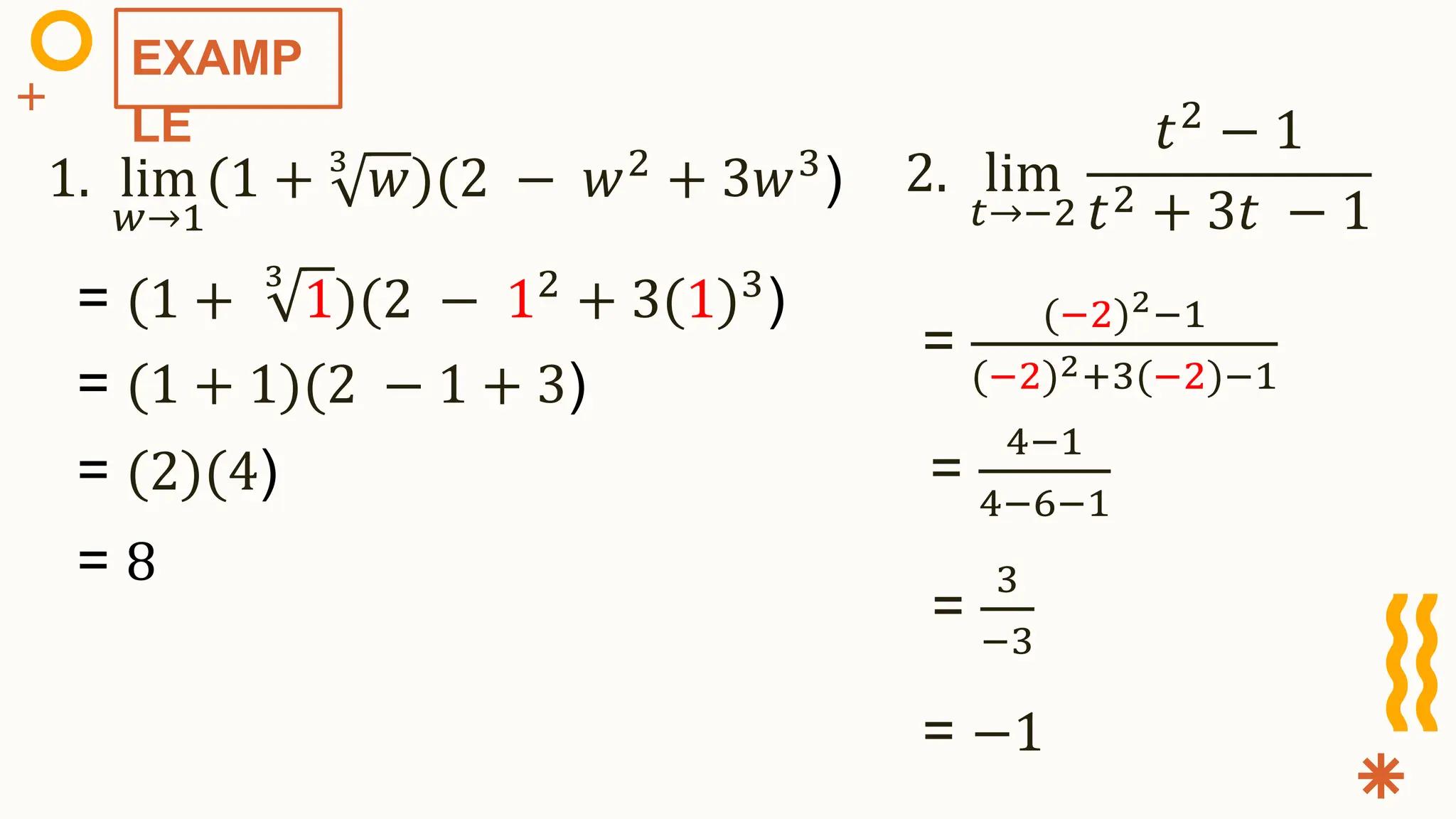
EXAMP
LE
1. lim
𝑤→1
(1 + 3
𝑤)(2 − 𝑤2
+ 3𝑤3
)
= (1 +
3
1)(2 − 12
+ 3(1)3
)
= (1 + 1)(2 − 1 + 3)
= (2)(4)
= 8
2. lim
𝑡→−2
𝑡2 − 1
𝑡2 + 3𝑡 − 1
=
(−2)2−1
(−2)2+3(−2)−1
=
4−1
4−6−1
=
3
−3
= −1
3. lim
𝑧→2
(
2𝑧 + 𝑧2
𝑧2 + 4
)3
= (
2(2)+ (2)2
(2)2+4
)3
= (
4 + 4
4 + 4
)3
= (
8
8
)3
= 1
4. lim
𝑥→0
𝑥2 − 𝑥 − 2
𝑥3 + 6𝑥2 − 7𝑥 + 1
=
02−0 −2
03+6(0)2−7(0)+1
=
−2
1
= −2
Boardwork!
1. lim
𝑦→−2
4 − 3𝑦2 − 𝑦3
6 − 𝑦 − 𝑦2
2. lim
𝑥→−1
𝑥3 − 7𝑥2 + 14𝑥 − 8
2𝑥2 + 3𝑥 − 4
3. lim
𝑥→−1
𝑥2 + 3 − 2
𝑥2 + 1
Different Techniques in Calculating
Limits
Rewriting limit in an equivalent form.
B. Factoring
Example: lim
𝑥→−1
𝑥2−𝒙 −𝟐
𝑥2−2𝑥−3
can be reduced to
lim
𝑥→−1
𝒙 −𝟐
𝑥−3
by factoring and cancelling.
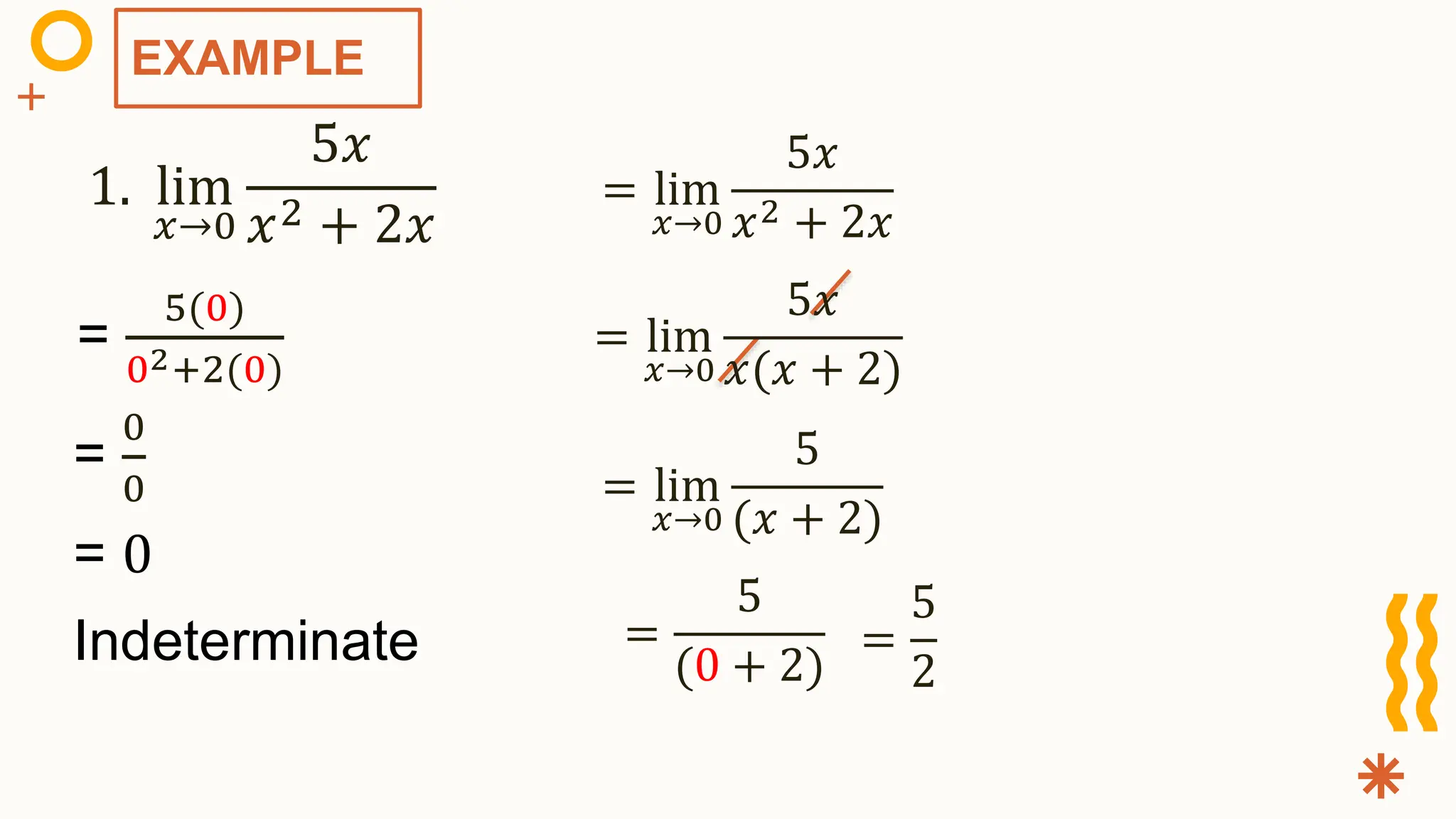
EXAMPLE
1. lim
𝑥→0
5𝑥
𝑥2 + 2𝑥
=
5(0)
02+2(0)
=
0
0
= 0
Indeterminate
= lim
𝑥→0
5𝑥
𝑥2 + 2𝑥
= lim
𝑥→0
5
(𝑥 + 2)
= lim
𝑥→0
5𝑥
𝑥(𝑥 + 2)
=
5
(0 + 2)
=
5
2
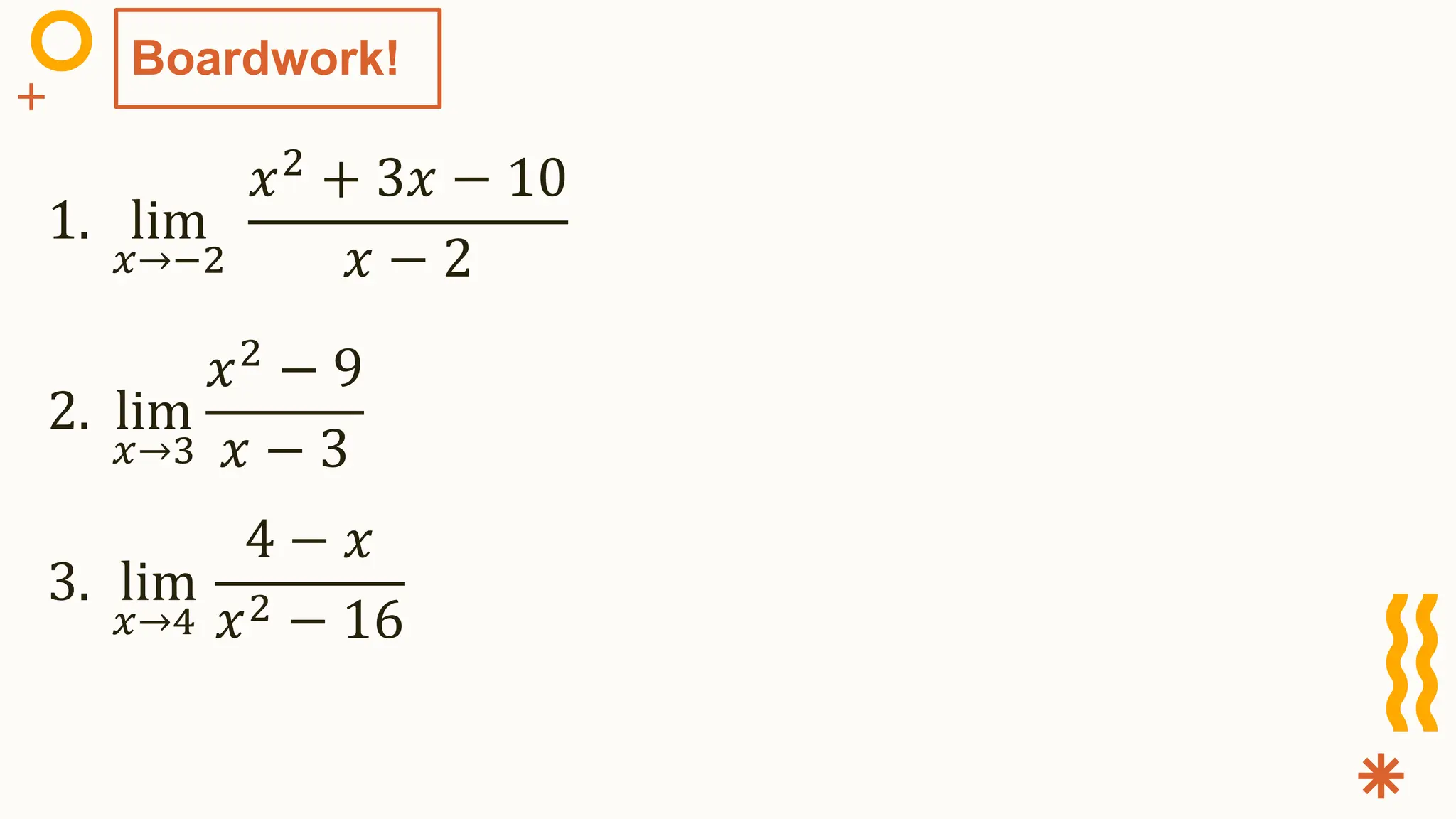
Boardwork!
1. lim
𝑥→−2
𝑥2 + 3𝑥 − 10
𝑥 − 2
2. lim
𝑥→3
𝑥2 − 9
𝑥 − 3
3. lim
𝑥→4
4 − 𝑥
𝑥2 − 16
Points to remember!
1. Substitute. Plug in the limit value into the
functuon. If the answer is a real number, that is a
limit.
2. If we substitute and we get indeterminate form
0/0, we need to simplify the fraction by
Different Techniques in
Calculating Limits
Conjugates
Example: lim
𝑥→4
𝑥−2
𝑥 − 4
can be written as
lim
𝑥→4
1
𝑥 +2
using conjugates and cancelling.
Limits that have sum or differences involving
square roots can be simplified by
conjugation

BASIC-CALCULUS-LESSON-Gr11 2024-2025.pptx

  • 1.
  • 2.
  • 3.
  • 4.
    1. f(x) =1 + 3x Complete the table of values below given the functions. x -3 -2 -1 0 1 2 3 f(x) -8 -5 -2 1 4 7 10
  • 5.
    a. Describe thelimit of a function using correct notation. b. Estimate the limit of a function or to identify when the limit does not exist using a table of values. c. Estimate the limit of a function or to identify when the limit does not exist using OBJECTIVES
  • 6.
    If f(x) becomesarbitrary close to a unique number L as x approaches c from either side, then the limit of f(x) as x approaches c is L. Read as: “the limit of f(x), as x approaches c is L.” LIMITS lim 𝑥→𝐶 𝑓 𝑥 = 𝐿
  • 7.
    The limit ofa function 𝒍𝒊𝒎 𝒙→𝑪 𝒇 𝒙 = 𝑳 is not the same as evaluating a function f(c) because they are different in terms of concept. The limit of a function gets its value by providing inputs that approaches the particular number while evaluating a function is more like direct substitution process.
  • 8.
    One sided limit isthe value (L) as the x value gets closer and closer to a certain value c from one side only (either from the left or from the right side). In symbols, lim 𝑥→𝑐+ 𝑓 𝑥 = 𝐿 lim 𝑥→𝑐− 𝑓 𝑥 = 𝐿
  • 9.
    The notion ofthe limit of a function is suggested by the question: “What happens to f(x) as x gets nearer and nearer to c (but x ≠ 𝐜)? “Does f(x) approach some number L?” The question implies that we have to find the “limit of f(x) as x approaches c, or 𝐥𝐢𝐦 𝒙→𝑪 𝒇(𝒙)
  • 10.
    A. Direct Substitution (Tryto evaluate function directly) B. Asymptote (probably) f(a) = 𝑏 0 where b is not zero Example: lim 𝑥→1 1 𝑥−1 Calculating lim 𝑥→𝑎 𝑓 𝑥 = 𝐿 Inspect with a graph or table to learn more about the function at x = a
  • 11.
    C. Limit found(probably) f(a) = b where b is a real number Example: lim 𝑥→3 𝑥2 = 32 = 9 D. Indeterminate form f(a) = 𝟎 𝟎 Example: lim 𝑥→−1 𝑥2−𝒙 −𝟐 𝑥2−2𝑥−3
  • 12.
    Rewriting limit inan equivalent form. E. Factoring Example: lim 𝑥→−1 𝑥2−𝒙 −𝟐 𝑥2−2𝑥−3 can be reduced to lim 𝑥→−1 𝒙 −𝟐 𝑥−3 by factoring and cancelling.
  • 13.
    F. Conjugates Example: lim 𝑥→4 𝑥−2 𝑥− 4 can be written as lim 𝑥→4 1 𝑥 +2 using conjugates and cancelling.
  • 14.
    G. Trig Identities Example:lim 𝑥→0 sin(𝑥) sin(2𝑥) can be written as lim 𝑥→0 1 2cos(𝑥) using trigonometric identities.
  • 15.
    H. Approximation When allelse fails, graphs and tables can help approximate limits.
  • 16.
    1. lim 𝑥→2 3𝑥 −2 Illustrating the Limit of a Function x 1.9 1.99 1.999 2 2.001 2.01 f(x) 3.700 3.970 3.997 4.003 4.030 ? as x is approaching from the left and from the right, f(x) is getting closer and closer to 4 ∴ lim 𝑥→2 3𝑥 − 2 = 4
  • 17.
    2. lim 𝑥→2 1 +3𝑥 as x is approaching from the left and from the right, f(x) is getting closer and closer to 7 ∴ 𝒍𝒊𝒎 𝒙→𝟐 𝟏 + 𝟑𝒙 = 7
  • 18.
    3. lim 𝑥→−1 (𝑥2 + 1) asx is approaching from the left and from the right, f(x) is getting closer and closer to 2 ∴ 𝒍𝒊𝒎 𝒙→𝟐 𝟏 + 𝟑𝒙 = 2
  • 19.
    4. lim 𝑥→2 (𝑥 +3) solve for its limit when x approaches 2 as x is approaching from the left and from the right, f(x) is getting closer and closer to 2 ∴ 𝒍𝒊𝒎 𝒙→𝟐 𝒙 + 𝟑 = 2 x<2 f(x) 0 1 1.5 1.9 1.99 1.999 x>2 f(x) 4 3 2.5 2.1 2.01 2.001
  • 20.
    5. lim 𝑥→2 (4 +𝑥) solve for its limit when x approaches 2 as x is approaching from the left and from the right, f(x) is getting closer and closer to 2 ∴ 𝒍𝒊𝒎 𝒙→𝟐 (𝟒 + 𝒙)= x<2 f(x) 0 1.5 1.99 1.9999 x>2 f(x) 3 2.5 2.01 2.0001
  • 21.
    A. Direct Substitution (Tryto evaluate function directly) B. Asymptote (probably) f(a) = 𝑏 0 where b is not zero Example: lim 𝑥→1 1 𝑥−1 Techniques in Calculating Limits lim 𝑥→𝑎 𝑓 𝑥 = 𝐿 Inspect with a graph or table to learn more about the function at x = a
  • 22.
    A. Direct Substitution (Tryto evaluate function directly) Different Techniques in Calculating Limits
  • 23.
    EXAMP LE 1. lim 𝑤→1 (1 +3 𝑤)(2 − 𝑤2 + 3𝑤3 ) = (1 + 3 1)(2 − 12 + 3(1)3 ) = (1 + 1)(2 − 1 + 3) = (2)(4) = 8 2. lim 𝑡→−2 𝑡2 − 1 𝑡2 + 3𝑡 − 1 = (−2)2−1 (−2)2+3(−2)−1 = 4−1 4−6−1 = 3 −3 = −1
  • 24.
    3. lim 𝑧→2 ( 2𝑧 +𝑧2 𝑧2 + 4 )3 = ( 2(2)+ (2)2 (2)2+4 )3 = ( 4 + 4 4 + 4 )3 = ( 8 8 )3 = 1 4. lim 𝑥→0 𝑥2 − 𝑥 − 2 𝑥3 + 6𝑥2 − 7𝑥 + 1 = 02−0 −2 03+6(0)2−7(0)+1 = −2 1 = −2
  • 25.
    Boardwork! 1. lim 𝑦→−2 4 −3𝑦2 − 𝑦3 6 − 𝑦 − 𝑦2 2. lim 𝑥→−1 𝑥3 − 7𝑥2 + 14𝑥 − 8 2𝑥2 + 3𝑥 − 4 3. lim 𝑥→−1 𝑥2 + 3 − 2 𝑥2 + 1
  • 26.
    Different Techniques inCalculating Limits Rewriting limit in an equivalent form. B. Factoring Example: lim 𝑥→−1 𝑥2−𝒙 −𝟐 𝑥2−2𝑥−3 can be reduced to lim 𝑥→−1 𝒙 −𝟐 𝑥−3 by factoring and cancelling.
  • 27.
    EXAMPLE 1. lim 𝑥→0 5𝑥 𝑥2 +2𝑥 = 5(0) 02+2(0) = 0 0 = 0 Indeterminate = lim 𝑥→0 5𝑥 𝑥2 + 2𝑥 = lim 𝑥→0 5 (𝑥 + 2) = lim 𝑥→0 5𝑥 𝑥(𝑥 + 2) = 5 (0 + 2) = 5 2
  • 29.
    Boardwork! 1. lim 𝑥→−2 𝑥2 +3𝑥 − 10 𝑥 − 2 2. lim 𝑥→3 𝑥2 − 9 𝑥 − 3 3. lim 𝑥→4 4 − 𝑥 𝑥2 − 16
  • 30.
    Points to remember! 1.Substitute. Plug in the limit value into the functuon. If the answer is a real number, that is a limit. 2. If we substitute and we get indeterminate form 0/0, we need to simplify the fraction by
  • 31.
    Different Techniques in CalculatingLimits Conjugates Example: lim 𝑥→4 𝑥−2 𝑥 − 4 can be written as lim 𝑥→4 1 𝑥 +2 using conjugates and cancelling.
  • 32.
    Limits that havesum or differences involving square roots can be simplified by conjugation