L/O/G/O
y
x
L1
L2
(x1,
y1)
x
1
y
1
BASIC
CALCULUS
𝜋
𝒌=𝟎
𝟐
𝟏
sin 𝛼 ± sin 𝛽 = 2 sin
1
2
𝛼 ± 𝛽 cos
1
2
𝛼 ∓ 𝛽
0
5
Imagine that you
are going to watch
a basketball game
or a concert of
your favorite band
or singer.
Where to you
want to take a
seat? Why?
a.Furthest
b.Middle/Center
c.Nearest
However, we cannot be on the stage
where our idols are performing.
The only thing that we can do is to
be as close as possible to the stage so
that’s why most of us will choose to be
seating nearest to them.
This is how limits of functions
works. We will consider functions of a
single variable and study the behavior of
the function as its variable approaches a
particular value (a constant).
The variable can only takes
values very, very close to the
constant, but it cannot equal the
constant itself. However, the limit will
be able to describe clearly what is
happening to the function near that
constant.
2nd 5th
3rd
1st 4th
Basic Calculus– Quarter
1
Week 1
Tchr. James Luck M. Valenzuela
- Upon joining the zoom meeting, change your name to your
real complete name
- Always turn your camera/video on
- Do not talk/ make noise unless you are called to answer.
- Always bring a notebook/ paper and pen so you can follow
in our discussions
- The use of mini-whiteboard and marker or 1/8 illustration
boards and chalk and the likes are highly recommended so
as the teacher can easily check your answer during
discussions.
Rules in our Online Classes
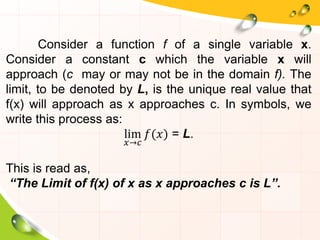
Consider a function f of a single variable x.
Consider a constant c which the variable x will
approach (c may or may not be in the domain f). The
limit, to be denoted by L, is the unique real value that
f(x) will approach as x approaches c. In symbols, we
write this process as:
lim
𝑥→𝑐
𝑓(𝑥) = L.
This is read as,
“The Limit of f(x) of x as x approaches c is L”.
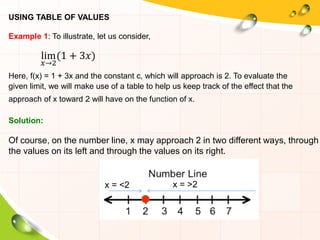
USING TABLE OF VALUES
Example 1: To illustrate, let us consider,
lim
𝑥→2
(1 + 3𝑥)
Here, f(x) = 1 + 3x and the constant c, which will approach is 2. To evaluate the
given limit, we will make use of a table to help us keep track of the effect that the
approach of x toward 2 will have on the function of x.
x = >2
x = <2
Solution:
Of course, on the number line, x may approach 2 in two different ways, through
the values on its left and through the values on its right.
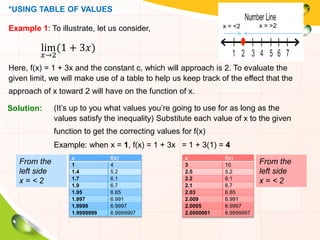
*USING TABLE OF VALUES
Example 1: To illustrate, let us consider,
lim
𝑥→2
(1 + 3𝑥)
Here, f(x) = 1 + 3x and the constant c, which will approach is 2. To evaluate the
given limit, we will make use of a table to help us keep track of the effect that the
approach of x toward 2 will have on the function of x.
x = >2
x = <2
Solution: (It’s up to you what values you’re going to use for as long as the
values satisfy the inequality) Substitute each value of x to the given
function to get the correcting values for f(x)
Example: when x = 1, f(x) = 1 + 3x = 1 + 3(1) = 4
x f(x)
1 4
1.4 5.2
1.7 6.1
1.9 6.7
1.95 6.85
1.997 6.991
1.9999 6.9997
1.9999999 6.9999997
x f(x)
3 10
2.5 5.2
2.2 6.1
2.1 6.7
2.03 6.85
2.009 6.991
2.0005 6.9997
2.0000001 6.9999997
From the
left side
x = < 2
From the
left side
x = < 2
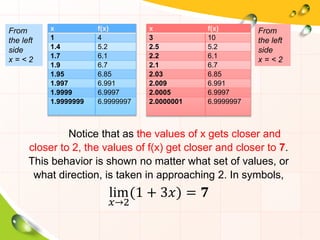
Notice that as the values of x gets closer and
closer to 2, the values of f(x) get closer and closer to 7.
This behavior is shown no matter what set of values, or
what direction, is taken in approaching 2. In symbols,
lim
𝑥→2
(1 + 3𝑥) = 𝟕
x f(x)
1 4
1.4 5.2
1.7 6.1
1.9 6.7
1.95 6.85
1.997 6.991
1.9999 6.9997
1.9999999 6.9999997
x f(x)
3 10
2.5 5.2
2.2 6.1
2.1 6.7
2.03 6.85
2.009 6.991
2.0005 6.9997
2.0000001 6.9999997
From
the left
side
x = < 2
From
the left
side
x = < 2
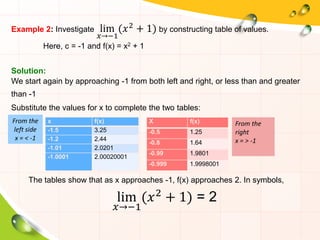
Example 2: Investigate lim
𝑥→−1
(𝑥2 + 1) by constructing table of values.
Here, c = -1 and f(x) = x2 + 1
Solution:
We start again by approaching -1 from both left and right, or less than and greater
than -1
Substitute the values for x to complete the two tables:
x f(x)
-1.5 3.25
-1.2 2.44
-1.01 2.0201
-1.0001 2.00020001
From the
left side
x = < -1
X f(x)
-0.5 1.25
-0.8 1.64
-0.99 1.9801
-0.999 1.9998001
From the
right
x = > -1
The tables show that as x approaches -1, f(x) approaches 2. In symbols,
lim
𝑥→−1
(𝑥2
+ 1) = 2
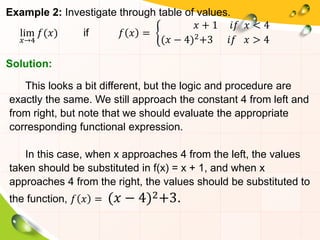
Example 2: Investigate through table of values.
lim
𝑥→4
𝑓(𝑥) if 𝑓 𝑥 =
𝑥 + 1 𝑖𝑓 𝑥 < 4
(𝑥 − 4)2+3 𝑖𝑓 𝑥 > 4
This looks a bit different, but the logic and procedure are
exactly the same. We still approach the constant 4 from left and
from right, but note that we should evaluate the appropriate
corresponding functional expression.
In this case, when x approaches 4 from the left, the values
taken should be substituted in f(x) = x + 1, and when x
approaches 4 from the right, the values should be substituted to
the function, 𝑓 𝑥 = (𝑥 − 4)2+3.
Solution:
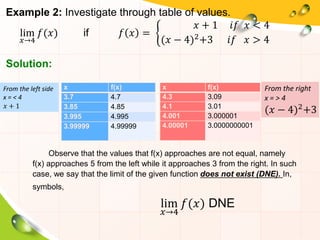
Example 2: Investigate through table of values.
lim
𝑥→4
𝑓(𝑥) if 𝑓 𝑥 =
𝑥 + 1 𝑖𝑓 𝑥 < 4
(𝑥 − 4)2+3 𝑖𝑓 𝑥 > 4
Solution:
x f(x)
3.7 4.7
3.85 4.85
3.995 4.995
3.99999 4.99999
x f(x)
4.3 3.09
4.1 3.01
4.001 3.000001
4.00001 3.0000000001
From the right
x = > 4
(𝑥 − 4)2+3
From the left side
x = < 4
𝑥 + 1
Observe that the values that f(x) approaches are not equal, namely
f(x) approaches 5 from the left while it approaches 3 from the right. In such
case, we say that the limit of the given function does not exist (DNE). In,
symbols,
lim
𝑥→4
𝑓(𝑥) DNE
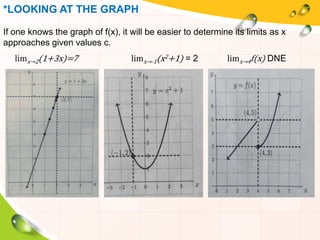
*LOOKING AT THE GRAPH
If one knows the graph of f(x), it will be easier to determine its limits as x
approaches given values c.
limx→2(1+3x)=7 limx→-1(x2+1) = 2 limx→4f(x) DNE
Another way and the easiest method to identify the limit of
a function is to substitute the value of c for every x in the
function in the f(x). However, this is not true for all general
functions.
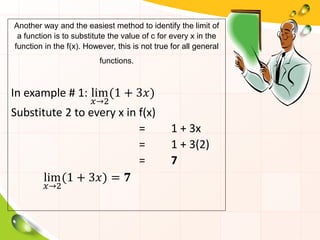
In example # 1: lim
𝑥→2
(1 + 3𝑥)
Substitute 2 to every x in f(x)
= 1 + 3x
= 1 + 3(2)
= 7
lim
𝑥→2
(1 + 3𝑥) = 𝟕
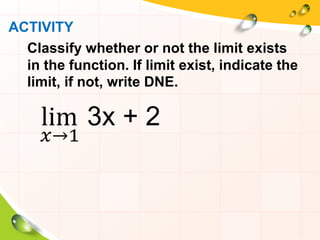
Classify whether or not the limit exists
in the function. If limit exist, indicate the
limit, if not, write DNE.
lim
𝑥→1
3x + 2
ACTIVITY
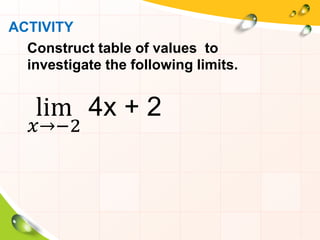
Construct table of values to
investigate the following limits.
lim
𝑥→−2
4x + 2
ACTIVITY
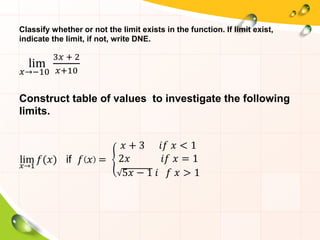
Classify whether or not the limit exists in the function. If limit exist,
indicate the limit, if not, write DNE.
lim
𝑥→−10
3𝑥 + 2
𝑥+10
Construct table of values to investigate the following
limits.
lim
𝑥→1
𝑓(𝑥) if 𝑓 𝑥 =
𝑥 + 3 𝑖𝑓 𝑥 < 1
2𝑥 𝑖𝑓 𝑥 = 1
5𝑥 − 1 𝑖 𝑓 𝑥 > 1
LAWS ON LIMITS
lim
𝑥→𝑐
𝑓(𝑥)
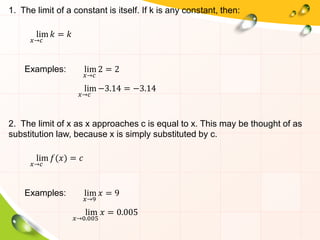
1. The limit of a constant is itself. If k is any constant, then:
lim
𝑥→𝑐
𝑘 = 𝑘
Examples: lim
𝑥→𝑐
2 = 2
lim
𝑥→𝑐
−3.14 = −3.14
2. The limit of x as x approaches c is equal to x. This may be thought of as
substitution law, because x is simply substituted by c.
lim
𝑥→𝑐
𝑓(𝑥) = 𝑐
Examples: lim
𝑥→9
𝑥 = 9
lim
𝑥→0.005
𝑥 = 0.005
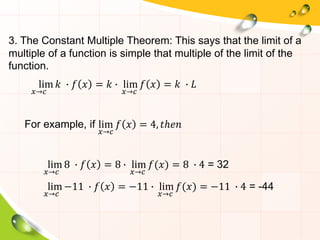
3. The Constant Multiple Theorem: This says that the limit of a
multiple of a function is simple that multiple of the limit of the
function.
lim
𝑥→𝑐
𝑘 ∙ 𝑓 𝑥 = 𝑘 ∙ lim
𝑥→𝑐
𝑓 𝑥 = 𝑘 ∙ 𝐿
For example, if lim
𝑥→𝑐
𝑓 𝑥 = 4, 𝑡ℎ𝑒𝑛
lim
𝑥→𝑐
8 ∙ 𝑓 𝑥 = 8 ∙ lim
𝑥→𝑐
𝑓(𝑥) = 8 ∙ 4 = 32
lim
𝑥→𝑐
−11 ∙ 𝑓 𝑥 = −11 ∙ lim
𝑥→𝑐
𝑓(𝑥) = −11 ∙ 4 = -44
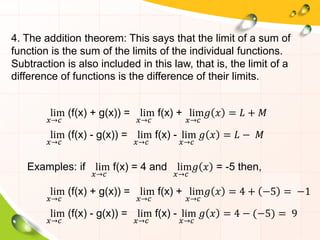
4. The addition theorem: This says that the limit of a sum of
function is the sum of the limits of the individual functions.
Subtraction is also included in this law, that is, the limit of a
difference of functions is the difference of their limits.
lim
𝑥→𝑐
(f(x) + g(x)) = lim
𝑥→𝑐
f(x) + lim
𝑥→𝑐
𝑔 𝑥 = 𝐿 + 𝑀
lim
𝑥→𝑐
(f(x) - g(x)) = lim
𝑥→𝑐
f(x) - lim
𝑥→𝑐
𝑔 𝑥 = 𝐿 − 𝑀
Examples: if lim
𝑥→𝑐
f(x) = 4 and lim
𝑥→𝑐
𝑔 𝑥 = -5 then,
lim
𝑥→𝑐
(f(x) + g(x)) = lim
𝑥→𝑐
f(x) + lim
𝑥→𝑐
𝑔 𝑥 = 4 + −5 = −1
lim
𝑥→𝑐
(f(x) - g(x)) = lim
𝑥→𝑐
f(x) - lim
𝑥→𝑐
𝑔 𝑥 = 4 − (−5) = 9
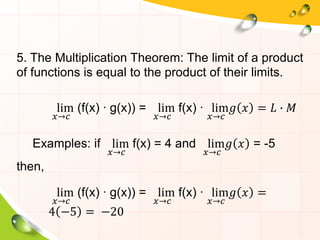
5. The Multiplication Theorem: The limit of a product
of functions is equal to the product of their limits.
lim
𝑥→𝑐
(f(x) ∙ g(x)) = lim
𝑥→𝑐
f(x) ∙ lim
𝑥→𝑐
𝑔 𝑥 = 𝐿 ∙ 𝑀
Examples: if lim
𝑥→𝑐
f(x) = 4 and lim
𝑥→𝑐
𝑔 𝑥 = -5
then,
lim
𝑥→𝑐
(f(x) ∙ g(x)) = lim
𝑥→𝑐
f(x) ∙ lim
𝑥→𝑐
𝑔 𝑥 =
4 −5 = −20
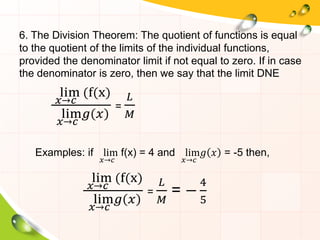
6. The Division Theorem: The quotient of functions is equal
to the quotient of the limits of the individual functions,
provided the denominator limit if not equal to zero. If in case
the denominator is zero, then we say that the limit DNE
lim
𝑥→𝑐
(f(x)
lim
𝑥→𝑐
𝑔 𝑥
=
𝐿
𝑀
Examples: if lim
𝑥→𝑐
f(x) = 4 and lim
𝑥→𝑐
𝑔 𝑥 = -5 then,
lim
𝑥→𝑐
(f(x)
lim
𝑥→𝑐
𝑔 𝑥
=
𝐿
𝑀
= −
4
5
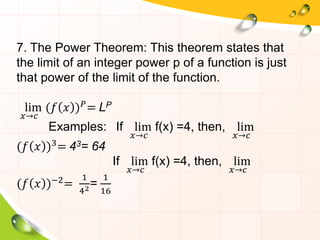
7. The Power Theorem: This theorem states that
the limit of an integer power p of a function is just
that power of the limit of the function.
lim
𝑥→𝑐
(𝑓 𝑥 )𝑃= LP
Examples: If lim
𝑥→𝑐
f(x) =4, then, lim
𝑥→𝑐
(𝑓 𝑥 )3= 43= 64
If lim
𝑥→𝑐
f(x) =4, then, lim
𝑥→𝑐
(𝑓 𝑥 )−2
=
1
42=
1
16
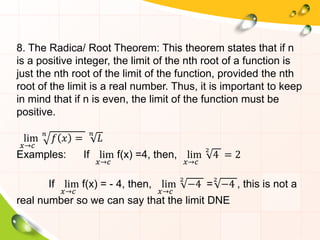
8. The Radica/ Root Theorem: This theorem states that if n
is a positive integer, the limit of the nth root of a function is
just the nth root of the limit of the function, provided the nth
root of the limit is a real number. Thus, it is important to keep
in mind that if n is even, the limit of the function must be
positive.
lim
𝑥→𝑐
𝑛
𝑓 𝑥 =
𝑛
𝐿
Examples: If lim
𝑥→𝑐
f(x) =4, then, lim
𝑥→𝑐
2
4 = 2
If lim
𝑥→𝑐
f(x) = - 4, then, lim
𝑥→𝑐
2
−4 =
2
−4 , this is not a
real number so we can say that the limit DNE
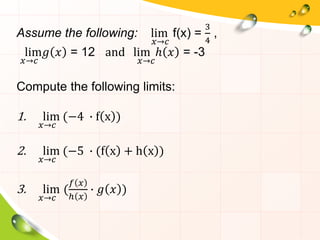
Assume the following: lim
𝑥→𝑐
f(x) =
3
4
,
lim
𝑥→𝑐
𝑔 𝑥 = 12 and lim
𝑥→𝑐
ℎ 𝑥 = -3
Compute the following limits:
1. lim
𝑥→𝑐
(−4 ∙ f x )
2. lim
𝑥→𝑐
(−5 ∙ (f x + h x )
3. lim
𝑥→𝑐
(
𝑓 𝑥
ℎ 𝑥
∙ 𝑔 𝑥 )
Basic Cal - Quarter 1 Week 1-2.pptx

Basic Cal - Quarter 1 Week 1-2.pptx

  • 1.
    L/O/G/O y x L1 L2 (x1, y1) x 1 y 1 BASIC CALCULUS 𝜋 𝒌=𝟎 𝟐 𝟏 sin 𝛼 ±sin 𝛽 = 2 sin 1 2 𝛼 ± 𝛽 cos 1 2 𝛼 ∓ 𝛽 0 5
  • 2.
    Imagine that you aregoing to watch a basketball game or a concert of your favorite band or singer.
  • 3.
    Where to you wantto take a seat? Why? a.Furthest b.Middle/Center c.Nearest
  • 4.
    However, we cannotbe on the stage where our idols are performing. The only thing that we can do is to be as close as possible to the stage so that’s why most of us will choose to be seating nearest to them.
  • 5.
    This is howlimits of functions works. We will consider functions of a single variable and study the behavior of the function as its variable approaches a particular value (a constant).
  • 6.
    The variable canonly takes values very, very close to the constant, but it cannot equal the constant itself. However, the limit will be able to describe clearly what is happening to the function near that constant.
  • 7.
    2nd 5th 3rd 1st 4th BasicCalculus– Quarter 1 Week 1 Tchr. James Luck M. Valenzuela
  • 8.
    - Upon joiningthe zoom meeting, change your name to your real complete name - Always turn your camera/video on - Do not talk/ make noise unless you are called to answer. - Always bring a notebook/ paper and pen so you can follow in our discussions - The use of mini-whiteboard and marker or 1/8 illustration boards and chalk and the likes are highly recommended so as the teacher can easily check your answer during discussions. Rules in our Online Classes
  • 9.
    Consider a functionf of a single variable x. Consider a constant c which the variable x will approach (c may or may not be in the domain f). The limit, to be denoted by L, is the unique real value that f(x) will approach as x approaches c. In symbols, we write this process as: lim 𝑥→𝑐 𝑓(𝑥) = L. This is read as, “The Limit of f(x) of x as x approaches c is L”.
  • 10.
    USING TABLE OFVALUES Example 1: To illustrate, let us consider, lim 𝑥→2 (1 + 3𝑥) Here, f(x) = 1 + 3x and the constant c, which will approach is 2. To evaluate the given limit, we will make use of a table to help us keep track of the effect that the approach of x toward 2 will have on the function of x. x = >2 x = <2 Solution: Of course, on the number line, x may approach 2 in two different ways, through the values on its left and through the values on its right.
  • 11.
    *USING TABLE OFVALUES Example 1: To illustrate, let us consider, lim 𝑥→2 (1 + 3𝑥) Here, f(x) = 1 + 3x and the constant c, which will approach is 2. To evaluate the given limit, we will make use of a table to help us keep track of the effect that the approach of x toward 2 will have on the function of x. x = >2 x = <2 Solution: (It’s up to you what values you’re going to use for as long as the values satisfy the inequality) Substitute each value of x to the given function to get the correcting values for f(x) Example: when x = 1, f(x) = 1 + 3x = 1 + 3(1) = 4 x f(x) 1 4 1.4 5.2 1.7 6.1 1.9 6.7 1.95 6.85 1.997 6.991 1.9999 6.9997 1.9999999 6.9999997 x f(x) 3 10 2.5 5.2 2.2 6.1 2.1 6.7 2.03 6.85 2.009 6.991 2.0005 6.9997 2.0000001 6.9999997 From the left side x = < 2 From the left side x = < 2
  • 12.
    Notice that asthe values of x gets closer and closer to 2, the values of f(x) get closer and closer to 7. This behavior is shown no matter what set of values, or what direction, is taken in approaching 2. In symbols, lim 𝑥→2 (1 + 3𝑥) = 𝟕 x f(x) 1 4 1.4 5.2 1.7 6.1 1.9 6.7 1.95 6.85 1.997 6.991 1.9999 6.9997 1.9999999 6.9999997 x f(x) 3 10 2.5 5.2 2.2 6.1 2.1 6.7 2.03 6.85 2.009 6.991 2.0005 6.9997 2.0000001 6.9999997 From the left side x = < 2 From the left side x = < 2
  • 13.
    Example 2: Investigatelim 𝑥→−1 (𝑥2 + 1) by constructing table of values. Here, c = -1 and f(x) = x2 + 1 Solution: We start again by approaching -1 from both left and right, or less than and greater than -1 Substitute the values for x to complete the two tables: x f(x) -1.5 3.25 -1.2 2.44 -1.01 2.0201 -1.0001 2.00020001 From the left side x = < -1 X f(x) -0.5 1.25 -0.8 1.64 -0.99 1.9801 -0.999 1.9998001 From the right x = > -1 The tables show that as x approaches -1, f(x) approaches 2. In symbols, lim 𝑥→−1 (𝑥2 + 1) = 2
  • 14.
    Example 2: Investigatethrough table of values. lim 𝑥→4 𝑓(𝑥) if 𝑓 𝑥 = 𝑥 + 1 𝑖𝑓 𝑥 < 4 (𝑥 − 4)2+3 𝑖𝑓 𝑥 > 4 This looks a bit different, but the logic and procedure are exactly the same. We still approach the constant 4 from left and from right, but note that we should evaluate the appropriate corresponding functional expression. In this case, when x approaches 4 from the left, the values taken should be substituted in f(x) = x + 1, and when x approaches 4 from the right, the values should be substituted to the function, 𝑓 𝑥 = (𝑥 − 4)2+3. Solution:
  • 15.
    Example 2: Investigatethrough table of values. lim 𝑥→4 𝑓(𝑥) if 𝑓 𝑥 = 𝑥 + 1 𝑖𝑓 𝑥 < 4 (𝑥 − 4)2+3 𝑖𝑓 𝑥 > 4 Solution: x f(x) 3.7 4.7 3.85 4.85 3.995 4.995 3.99999 4.99999 x f(x) 4.3 3.09 4.1 3.01 4.001 3.000001 4.00001 3.0000000001 From the right x = > 4 (𝑥 − 4)2+3 From the left side x = < 4 𝑥 + 1 Observe that the values that f(x) approaches are not equal, namely f(x) approaches 5 from the left while it approaches 3 from the right. In such case, we say that the limit of the given function does not exist (DNE). In, symbols, lim 𝑥→4 𝑓(𝑥) DNE
  • 16.
    *LOOKING AT THEGRAPH If one knows the graph of f(x), it will be easier to determine its limits as x approaches given values c. limx→2(1+3x)=7 limx→-1(x2+1) = 2 limx→4f(x) DNE
  • 17.
    Another way andthe easiest method to identify the limit of a function is to substitute the value of c for every x in the function in the f(x). However, this is not true for all general functions. In example # 1: lim 𝑥→2 (1 + 3𝑥) Substitute 2 to every x in f(x) = 1 + 3x = 1 + 3(2) = 7 lim 𝑥→2 (1 + 3𝑥) = 𝟕
  • 18.
    Classify whether ornot the limit exists in the function. If limit exist, indicate the limit, if not, write DNE. lim 𝑥→1 3x + 2 ACTIVITY
  • 19.
    Construct table ofvalues to investigate the following limits. lim 𝑥→−2 4x + 2 ACTIVITY
  • 20.
    Classify whether ornot the limit exists in the function. If limit exist, indicate the limit, if not, write DNE. lim 𝑥→−10 3𝑥 + 2 𝑥+10 Construct table of values to investigate the following limits. lim 𝑥→1 𝑓(𝑥) if 𝑓 𝑥 = 𝑥 + 3 𝑖𝑓 𝑥 < 1 2𝑥 𝑖𝑓 𝑥 = 1 5𝑥 − 1 𝑖 𝑓 𝑥 > 1
  • 23.
  • 24.
    1. The limitof a constant is itself. If k is any constant, then: lim 𝑥→𝑐 𝑘 = 𝑘 Examples: lim 𝑥→𝑐 2 = 2 lim 𝑥→𝑐 −3.14 = −3.14 2. The limit of x as x approaches c is equal to x. This may be thought of as substitution law, because x is simply substituted by c. lim 𝑥→𝑐 𝑓(𝑥) = 𝑐 Examples: lim 𝑥→9 𝑥 = 9 lim 𝑥→0.005 𝑥 = 0.005
  • 25.
    3. The ConstantMultiple Theorem: This says that the limit of a multiple of a function is simple that multiple of the limit of the function. lim 𝑥→𝑐 𝑘 ∙ 𝑓 𝑥 = 𝑘 ∙ lim 𝑥→𝑐 𝑓 𝑥 = 𝑘 ∙ 𝐿 For example, if lim 𝑥→𝑐 𝑓 𝑥 = 4, 𝑡ℎ𝑒𝑛 lim 𝑥→𝑐 8 ∙ 𝑓 𝑥 = 8 ∙ lim 𝑥→𝑐 𝑓(𝑥) = 8 ∙ 4 = 32 lim 𝑥→𝑐 −11 ∙ 𝑓 𝑥 = −11 ∙ lim 𝑥→𝑐 𝑓(𝑥) = −11 ∙ 4 = -44
  • 26.
    4. The additiontheorem: This says that the limit of a sum of function is the sum of the limits of the individual functions. Subtraction is also included in this law, that is, the limit of a difference of functions is the difference of their limits. lim 𝑥→𝑐 (f(x) + g(x)) = lim 𝑥→𝑐 f(x) + lim 𝑥→𝑐 𝑔 𝑥 = 𝐿 + 𝑀 lim 𝑥→𝑐 (f(x) - g(x)) = lim 𝑥→𝑐 f(x) - lim 𝑥→𝑐 𝑔 𝑥 = 𝐿 − 𝑀 Examples: if lim 𝑥→𝑐 f(x) = 4 and lim 𝑥→𝑐 𝑔 𝑥 = -5 then, lim 𝑥→𝑐 (f(x) + g(x)) = lim 𝑥→𝑐 f(x) + lim 𝑥→𝑐 𝑔 𝑥 = 4 + −5 = −1 lim 𝑥→𝑐 (f(x) - g(x)) = lim 𝑥→𝑐 f(x) - lim 𝑥→𝑐 𝑔 𝑥 = 4 − (−5) = 9

  • 27.
    5. The MultiplicationTheorem: The limit of a product of functions is equal to the product of their limits. lim 𝑥→𝑐 (f(x) ∙ g(x)) = lim 𝑥→𝑐 f(x) ∙ lim 𝑥→𝑐 𝑔 𝑥 = 𝐿 ∙ 𝑀 Examples: if lim 𝑥→𝑐 f(x) = 4 and lim 𝑥→𝑐 𝑔 𝑥 = -5 then, lim 𝑥→𝑐 (f(x) ∙ g(x)) = lim 𝑥→𝑐 f(x) ∙ lim 𝑥→𝑐 𝑔 𝑥 = 4 −5 = −20
  • 28.
    6. The DivisionTheorem: The quotient of functions is equal to the quotient of the limits of the individual functions, provided the denominator limit if not equal to zero. If in case the denominator is zero, then we say that the limit DNE lim 𝑥→𝑐 (f(x) lim 𝑥→𝑐 𝑔 𝑥 = 𝐿 𝑀 Examples: if lim 𝑥→𝑐 f(x) = 4 and lim 𝑥→𝑐 𝑔 𝑥 = -5 then, lim 𝑥→𝑐 (f(x) lim 𝑥→𝑐 𝑔 𝑥 = 𝐿 𝑀 = − 4 5
  • 29.
    7. The PowerTheorem: This theorem states that the limit of an integer power p of a function is just that power of the limit of the function. lim 𝑥→𝑐 (𝑓 𝑥 )𝑃= LP Examples: If lim 𝑥→𝑐 f(x) =4, then, lim 𝑥→𝑐 (𝑓 𝑥 )3= 43= 64 If lim 𝑥→𝑐 f(x) =4, then, lim 𝑥→𝑐 (𝑓 𝑥 )−2 = 1 42= 1 16
  • 30.
    8. The Radica/Root Theorem: This theorem states that if n is a positive integer, the limit of the nth root of a function is just the nth root of the limit of the function, provided the nth root of the limit is a real number. Thus, it is important to keep in mind that if n is even, the limit of the function must be positive. lim 𝑥→𝑐 𝑛 𝑓 𝑥 = 𝑛 𝐿 Examples: If lim 𝑥→𝑐 f(x) =4, then, lim 𝑥→𝑐 2 4 = 2 If lim 𝑥→𝑐 f(x) = - 4, then, lim 𝑥→𝑐 2 −4 = 2 −4 , this is not a real number so we can say that the limit DNE
  • 31.
    Assume the following:lim 𝑥→𝑐 f(x) = 3 4 , lim 𝑥→𝑐 𝑔 𝑥 = 12 and lim 𝑥→𝑐 ℎ 𝑥 = -3 Compute the following limits: 1. lim 𝑥→𝑐 (−4 ∙ f x ) 2. lim 𝑥→𝑐 (−5 ∙ (f x + h x ) 3. lim 𝑥→𝑐 ( 𝑓 𝑥 ℎ 𝑥 ∙ 𝑔 𝑥 )

Editor's Notes

  • #2 Look at the Unit assessment Matrix. What does it contain? In the OHSP, KPUP questions are all in Multiple Choice. In the Non-online, we can still make use of Multiple Choice but only for the KTS and P only. Understanding Test item should be in constructed-response form. How do we design it? (Review) What practice assessments would be needed to help students do well in the summative assessments?