Limit, Continuity and Differentiability
Limits
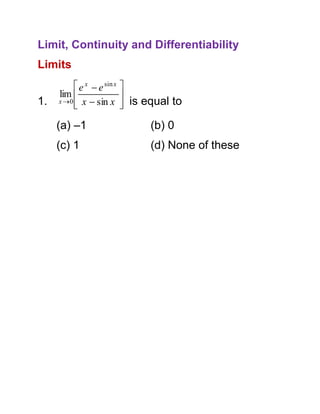
1.

 e x  e sin x 
lim 

x  0  x  sin x  is equal to



(a) –1

(b) 0

(c) 1

(d) None of these
Ans:
(c) 1
 e x  e sin x
lim 
x 0  x  sin x




,


0

 form 
0


Using L-Hospital’s rule three times, then
e x  e sin x . cos x
e x  e sin x cos 2 x  sin x .e sin x
lim
 lim
x 0
x 0
1  cos x
sin x

e x  e sin x . cos 3 x  e sin x 2 cos x sin x  e sin x . cos x sin x  e sin x . cos x
 lim
x 0
cos x

= 1.
2. The value of the constant α and β such that
 x2 1

lim 
 x     0

x   x  1



are respectively

(a) (1, 1)

(b) (–1, 1)

(c) (1, –1)

(d) (0, 1)
Ans:
(c) (1, –1)
 x2 1


lim 
 2x     0

x  x  1



x 2 (1   )  x (   )  1  b
lim
0
x 
x 1

Since the limit of the given expression is
zero, therefore degree of the polynomial in
numerator must be less than denominator.
 1 – α = 0 and α + β = 0 , α = 1 and β = 1.
3. Let f: RR be a differentiable function
f (x )
 1 
4 t3
f (2)  6, f ' (2)   .
having
Then xlim2  x  2 dt

 48 
6

equals
(a) 12

(b) 18

(c) 24

(d) 36
Ans:
(b) 18
f (x )



lim

x 2

6

4 t 3 dt

x 2

4( f (x ))3  f ' (x )
(0 / 0 form)  lim
x 2
1

= 4 (f(2))3 × f(2) = 18.
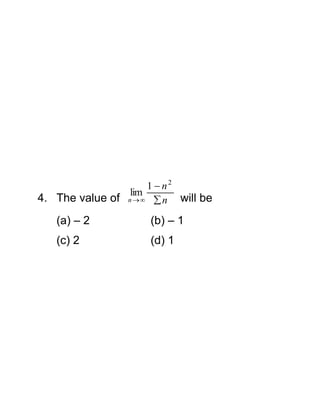
1  n2
lim
4. The value of n    n will be

(a) – 2

(b) – 1

(c) 2

(d) 1
Ans:
(a) – 2

1  n 2  lim (1  n)(1  n)
2 (1  n)
lim
n 1
 lim
n(n  1)
n n
n
n
2

1

 lim 2   1 
n  n
 =2(0 – 1) = -2
1  2  3  ....n
5. The value of n  n 2  100
is equal
lim

(a) ∞

(b) 1/2

(c) 2

(d) 0
Ans:
1  2  3  .....  n
We have, n
n 2  100
lim

1

n 2 1  
n
n(n  1)
1

 lim
 lim

n  2(n 2  100 )
n 
100  2 .

2n 2  1  2 
n 

Continuity
Introduction
The word ‘Continuous’ means without any
break or gap. If the graph of a function has no
break, or gap or jump, then it is said to be
continuous.
A function which is not continuous is called a
discontinuous function.
While studying graphs of functions, we see that
graphs of functions sin x, x, cos x, ex etc. are
continuous but greatest integer function [x] has
break at every integral point, so it is not
continuous.
1
Similarly tan x, cot x, sec x,
etc. are also
x
discontinuous function.
Continuity of a Function at a Point
A function f(x) is said to be continuous at a
point x = a of its domain iff.

lim f (x)  f (a)

xa

i.e. a function f(x) is continuous at x = a if and
only if it satisfies the following three conditions :
1. f(a) exists. (‘a’ lies in the domain of f)
2. lim f (x) exist i.e. lim f (x)  lim f (x) or
xa

R.H.S. = L.H.S.

xa

xa
3. lim f (x)  f (a)
xa

function).

(limit equals the value of
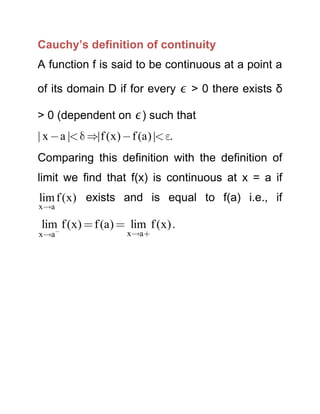
Cauchy’s definition of continuity
A function f is said to be continuous at a point a
of its domain D if for every ∊ > 0 there exists δ
> 0 (dependent on ∊) such that

| x  a |  |f (x)  f (a) | .
Comparing this definition with the definition of
limit we find that f(x) is continuous at x = a if

lim f (x) exists and is equal to f(a) i.e., if

xa

lim f (x)  f (a)  lim f (x) .

xa

xa 
Heine’s definition of continuity
A function f is said to be continuous at a point a
of its domain D, converging to a, the sequence
<an> of the points in D converging to a, the
sequence <f(an)> converges to f(a) i.e. lim an =
a ⇒ lim f(an) = f(a).
This definition is mainly used to prove the
discontinuity to a function.
Continuity of a function at a point, we find its
limit and value at that point, if these two exist
and are equal, then function is continuous at
that point.
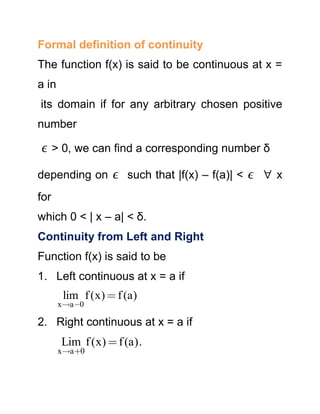
Formal definition of continuity
The function f(x) is said to be continuous at x =
a in
its domain if for any arbitrary chosen positive
number
∊ > 0, we can find a corresponding number δ
depending on ∊ such that |f(x) – f(a)| < ∊ ∀ x
for
which 0 < | x – a| < δ.
Continuity from Left and Right
Function f(x) is said to be
1. Left continuous at x = a if

lim f (x)  f (a)

xa0

2. Right continuous at x = a if

Lim f (x)  f (a) .

xa 0
Thus a function f(x) is continuous at a point x =
a
if it is left continuous as well as right continuous
at
x = a.

For more please visit www.ednexa.com
Or you can call 9011041155 for any help.
-Team Ednexa

Limit, Continuity and Differentiability for JEE Main 2014

  • 1.
    Limit, Continuity andDifferentiability Limits 1.  e x  e sin x  lim   x  0  x  sin x  is equal to   (a) –1 (b) 0 (c) 1 (d) None of these
  • 2.
    Ans: (c) 1  ex  e sin x lim  x 0  x  sin x    ,  0   form  0  Using L-Hospital’s rule three times, then e x  e sin x . cos x e x  e sin x cos 2 x  sin x .e sin x lim  lim x 0 x 0 1  cos x sin x e x  e sin x . cos 3 x  e sin x 2 cos x sin x  e sin x . cos x sin x  e sin x . cos x  lim x 0 cos x = 1.
  • 3.
    2. The valueof the constant α and β such that  x2 1  lim   x     0  x   x  1   are respectively (a) (1, 1) (b) (–1, 1) (c) (1, –1) (d) (0, 1)
  • 4.
    Ans: (c) (1, –1) x2 1   lim   2x     0  x  x  1   x 2 (1   )  x (   )  1  b lim 0 x  x 1 Since the limit of the given expression is zero, therefore degree of the polynomial in numerator must be less than denominator.  1 – α = 0 and α + β = 0 , α = 1 and β = 1.
  • 5.
    3. Let f:RR be a differentiable function f (x )  1  4 t3 f (2)  6, f ' (2)   . having Then xlim2  x  2 dt   48  6 equals (a) 12 (b) 18 (c) 24 (d) 36
  • 6.
    Ans: (b) 18 f (x)  lim x 2 6 4 t 3 dt x 2 4( f (x ))3  f ' (x ) (0 / 0 form)  lim x 2 1 = 4 (f(2))3 × f(2) = 18.
  • 7.
    1  n2 lim 4.The value of n    n will be (a) – 2 (b) – 1 (c) 2 (d) 1
  • 8.
    Ans: (a) – 2 1 n 2  lim (1  n)(1  n) 2 (1  n) lim n 1  lim n(n  1) n n n n 2 1   lim 2   1  n  n  =2(0 – 1) = -2
  • 9.
    1  2 3  ....n 5. The value of n  n 2  100 is equal lim (a) ∞ (b) 1/2 (c) 2 (d) 0
  • 10.
    Ans: 1  2 3  .....  n We have, n n 2  100 lim 1  n 2 1   n n(n  1) 1   lim  lim  n  2(n 2  100 ) n  100  2 .  2n 2  1  2  n  
  • 11.
    Continuity Introduction The word ‘Continuous’means without any break or gap. If the graph of a function has no break, or gap or jump, then it is said to be continuous. A function which is not continuous is called a discontinuous function. While studying graphs of functions, we see that graphs of functions sin x, x, cos x, ex etc. are continuous but greatest integer function [x] has break at every integral point, so it is not continuous.
  • 12.
    1 Similarly tan x,cot x, sec x, etc. are also x discontinuous function.
  • 13.
    Continuity of aFunction at a Point A function f(x) is said to be continuous at a point x = a of its domain iff. lim f (x)  f (a) xa i.e. a function f(x) is continuous at x = a if and only if it satisfies the following three conditions : 1. f(a) exists. (‘a’ lies in the domain of f) 2. lim f (x) exist i.e. lim f (x)  lim f (x) or xa R.H.S. = L.H.S. xa xa
  • 14.
    3. lim f(x)  f (a) xa function). (limit equals the value of
  • 15.
    Cauchy’s definition ofcontinuity A function f is said to be continuous at a point a of its domain D if for every ∊ > 0 there exists δ > 0 (dependent on ∊) such that | x  a |  |f (x)  f (a) | . Comparing this definition with the definition of limit we find that f(x) is continuous at x = a if lim f (x) exists and is equal to f(a) i.e., if xa lim f (x)  f (a)  lim f (x) . xa xa 
  • 16.
    Heine’s definition ofcontinuity A function f is said to be continuous at a point a of its domain D, converging to a, the sequence <an> of the points in D converging to a, the sequence <f(an)> converges to f(a) i.e. lim an = a ⇒ lim f(an) = f(a). This definition is mainly used to prove the discontinuity to a function. Continuity of a function at a point, we find its limit and value at that point, if these two exist and are equal, then function is continuous at that point.
  • 17.
    Formal definition ofcontinuity The function f(x) is said to be continuous at x = a in its domain if for any arbitrary chosen positive number ∊ > 0, we can find a corresponding number δ depending on ∊ such that |f(x) – f(a)| < ∊ ∀ x for which 0 < | x – a| < δ. Continuity from Left and Right Function f(x) is said to be 1. Left continuous at x = a if lim f (x)  f (a) xa0 2. Right continuous at x = a if Lim f (x)  f (a) . xa 0
  • 18.
    Thus a functionf(x) is continuous at a point x = a if it is left continuous as well as right continuous at x = a. For more please visit www.ednexa.com Or you can call 9011041155 for any help. -Team Ednexa