Section 2.5 Continuity
Learning outcomes
After completing this section, you will inshaAllah be able to
1. get an idea about the meaning of a continuous function
2. check whether a function is continuous or discontinuous at a point
3. use basic properties of continuous functions
4. know important examples of continuous functions
5. explain difference between different types of discontinuities
a. removable discontinuity
b. jump discontinuity
c. infinite discontinuity
6. explain and apply intermediate value theorem
12.5
Meaning of continuous function
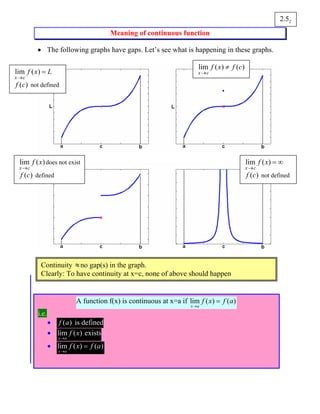
• The following graphs have gaps. Let’s see what is happening in these graphs.
22.5
Continuity ≈no gap(s) in the graph.
Clearly: To have continuity at x=c, none of above should happen
)()(lim cfxf
cx
≠
→Lxf
cx
=
→
)(lim
)(cf not defined
)(lim xf
cx→
does not exist
)(cf defined
∞=
→
)(lim xf
cx
)(cf not defined
A function f(x) is continuous at x=a if lim ( ) ( )
x a
f x f a
→
=
i.e.
• ( )f a is defined
• lim ( )
x a
f x
→
exists
• lim ( ) ( )
x a
f x f a
→
=
Computations related to continuity
32.5
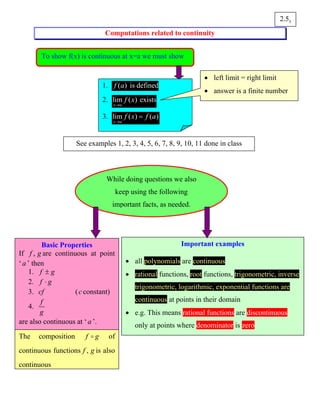
To show f(x) is continuous at x=a we must show
1. ( )f a is defined
2. lim ( )
x a
f x
→
exists
3. lim ( ) ( )
x a
f x f a
→
=
• left limit = right limit
• answer is a finite number
See examples 1, 2, 3, 4, 5, 6, 7, 8, 9, 10, 11 done in class
Important examples
• all polynomials are continuous
• rational functions, root functions, trigonometric, inverse
trigonometric, logarithmic, exponential functions are
continuous at points in their domain
• e.g. This means rational functions are discontinuous
only at points where denominator is zero
Basic Properties
If ,f g are continuous at point
‘a ’ then
1. f g±
2. f g⋅
3. cf (c constant)
4.
f
g
are also continuous at ‘a ’.
While doing questions we also
keep using the following
important facts, as needed.
The composition f g of
continuous functions ,f g is also
continuous
What are different types of discontinuities that can occur?
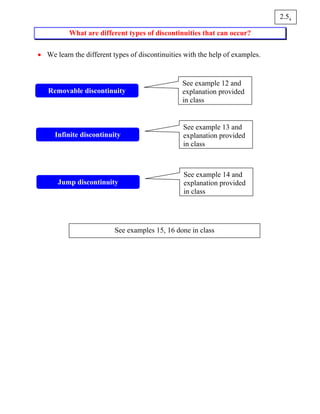
• We learn the different types of discontinuities with the help of examples.
42.5
Removable discontinuity
See example 12 and
explanation provided
in class
Infinite discontinuity
See example 13 and
explanation provided
in class
Jump discontinuity
See example 14 and
explanation provided
in class
See examples 15, 16 done in class
How to check continuity at end points of a closed interval [a,b]
• Look at following graphs for left end point x=a
52.5
)()(lim afxf
ax
≠
+
→
Lxf
ax
=
+
→
)(lim
)(af not defined
∞=
+
→
)(lim xf
ax
f(a) undefined
∞=
+
→
)(lim xf
ax
f(a) defined
Continuity ≈no gap(s) in the graph.
Clearly: To have continuity at x=c, none of above should happen
f(x) is continuous at left end point x=a of [a,b] if lim ( ) ( )
x a
f x f a+
→
=
i.e.
• ( )f a is defined
• lim ( )
x a
f x+
→
exists (i.e finite)
• lim ( ) ( )
x a
f x f a+
→
=
Similarly
f(x) is continuous at right end point x=b of [a,b] if lim ( ) ( )
x b
f x f b−
→
=
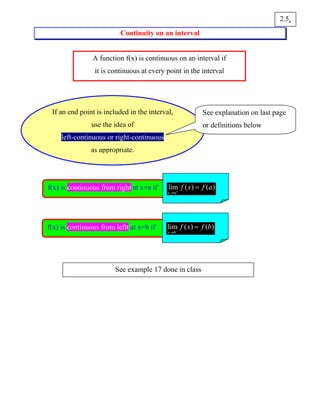
Continuity on an interval
62.5
A function f(x) is continuous on an interval if
it is continuous at every point in the interval
If an end point is included in the interval,
use the idea of
left-continuous or right-continuous
as appropriate.
See explanation on last page
or definitions below
f(x) is continuous from right at x=a if lim ( ) ( )
x a
f x f a+
→
=
f(x) is continuous from leftt at x=b if lim ( ) ( )
x b
f x f b−
→
=
See example 17 done in class
Some applications
( ) ( )lim ( ) lim ( )
x a x a
f g x f g x
→ →
=
End of 2.5
72.5
Limits of composition of continuous functions
Intermediate value theorem & applications
See example 18 done in class
Very useful tool
for calculating
complicated limits
If ( )f x is continuous on [ , ]a b and
N is any number between ( )f a and ( )f b
then
there is a number c in ( , )a b such that ( )f c N=
See class
explanation
See examples 19, 20, 21 done in class

3 handouts section2-5

  • 1.
    Section 2.5 Continuity Learningoutcomes After completing this section, you will inshaAllah be able to 1. get an idea about the meaning of a continuous function 2. check whether a function is continuous or discontinuous at a point 3. use basic properties of continuous functions 4. know important examples of continuous functions 5. explain difference between different types of discontinuities a. removable discontinuity b. jump discontinuity c. infinite discontinuity 6. explain and apply intermediate value theorem 12.5
  • 2.
    Meaning of continuousfunction • The following graphs have gaps. Let’s see what is happening in these graphs. 22.5 Continuity ≈no gap(s) in the graph. Clearly: To have continuity at x=c, none of above should happen )()(lim cfxf cx ≠ →Lxf cx = → )(lim )(cf not defined )(lim xf cx→ does not exist )(cf defined ∞= → )(lim xf cx )(cf not defined A function f(x) is continuous at x=a if lim ( ) ( ) x a f x f a → = i.e. • ( )f a is defined • lim ( ) x a f x → exists • lim ( ) ( ) x a f x f a → =
  • 3.
    Computations related tocontinuity 32.5 To show f(x) is continuous at x=a we must show 1. ( )f a is defined 2. lim ( ) x a f x → exists 3. lim ( ) ( ) x a f x f a → = • left limit = right limit • answer is a finite number See examples 1, 2, 3, 4, 5, 6, 7, 8, 9, 10, 11 done in class Important examples • all polynomials are continuous • rational functions, root functions, trigonometric, inverse trigonometric, logarithmic, exponential functions are continuous at points in their domain • e.g. This means rational functions are discontinuous only at points where denominator is zero Basic Properties If ,f g are continuous at point ‘a ’ then 1. f g± 2. f g⋅ 3. cf (c constant) 4. f g are also continuous at ‘a ’. While doing questions we also keep using the following important facts, as needed. The composition f g of continuous functions ,f g is also continuous
  • 4.
    What are differenttypes of discontinuities that can occur? • We learn the different types of discontinuities with the help of examples. 42.5 Removable discontinuity See example 12 and explanation provided in class Infinite discontinuity See example 13 and explanation provided in class Jump discontinuity See example 14 and explanation provided in class See examples 15, 16 done in class
  • 5.
    How to checkcontinuity at end points of a closed interval [a,b] • Look at following graphs for left end point x=a 52.5 )()(lim afxf ax ≠ + → Lxf ax = + → )(lim )(af not defined ∞= + → )(lim xf ax f(a) undefined ∞= + → )(lim xf ax f(a) defined Continuity ≈no gap(s) in the graph. Clearly: To have continuity at x=c, none of above should happen f(x) is continuous at left end point x=a of [a,b] if lim ( ) ( ) x a f x f a+ → = i.e. • ( )f a is defined • lim ( ) x a f x+ → exists (i.e finite) • lim ( ) ( ) x a f x f a+ → = Similarly f(x) is continuous at right end point x=b of [a,b] if lim ( ) ( ) x b f x f b− → =
  • 6.
    Continuity on aninterval 62.5 A function f(x) is continuous on an interval if it is continuous at every point in the interval If an end point is included in the interval, use the idea of left-continuous or right-continuous as appropriate. See explanation on last page or definitions below f(x) is continuous from right at x=a if lim ( ) ( ) x a f x f a+ → = f(x) is continuous from leftt at x=b if lim ( ) ( ) x b f x f b− → = See example 17 done in class
  • 7.
    Some applications ( )( )lim ( ) lim ( ) x a x a f g x f g x → → = End of 2.5 72.5 Limits of composition of continuous functions Intermediate value theorem & applications See example 18 done in class Very useful tool for calculating complicated limits If ( )f x is continuous on [ , ]a b and N is any number between ( )f a and ( )f b then there is a number c in ( , )a b such that ( )f c N= See class explanation See examples 19, 20, 21 done in class