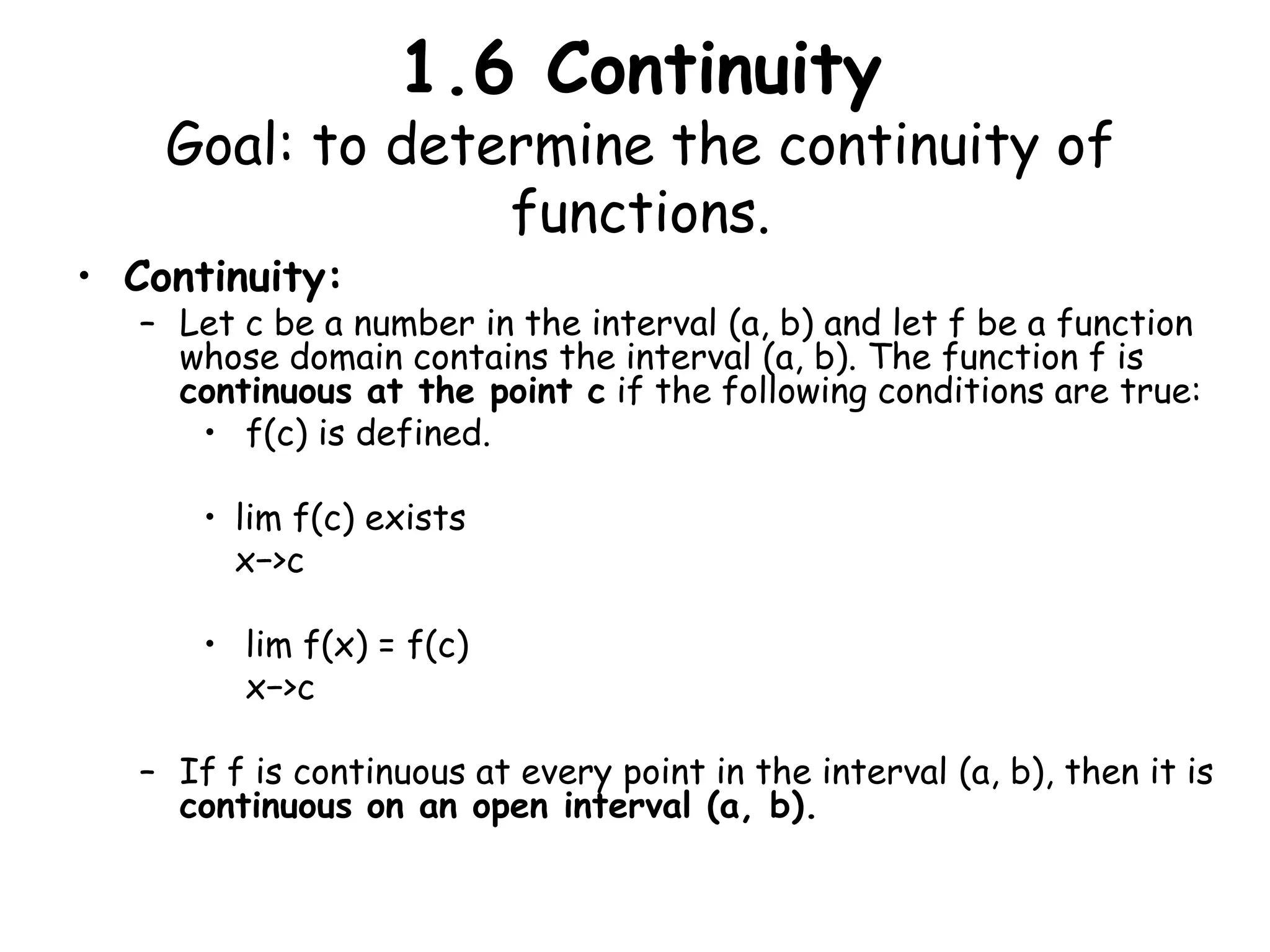
1.6 ContinuityGoal: to determine the continuity of functions.Continuity:Let c be a number in the interval (a, b) and let f be a function whose domain contains the interval (a, b). The function f is continuous at the point c if the following conditions are true: f(c) is defined.lim f(c) exists	   x−>clim f(x) = f(c)	    x−>cIf f is continuous at every point in the interval (a, b), then it is continuous on an open interval (a, b).
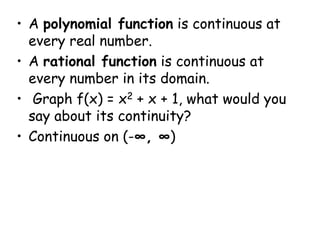
A polynomial function is continuous at every real number.A rational function is continuous at every number in its domain.	 Graph f(x) = x2 + x + 1, what would you say about its continuity?Continuous on (-∞, ∞)
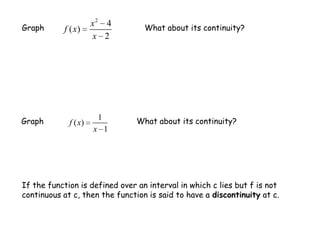
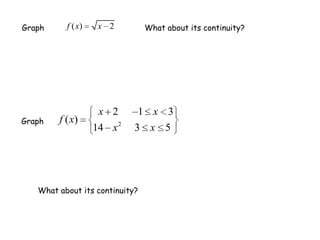
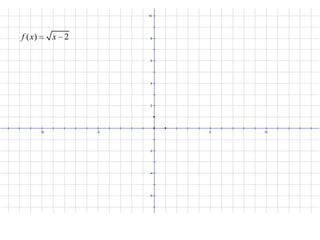
Graph What about its continuity?Graph What about its continuity?If the function is defined over an interval in which c lies but f is not continuous at c, then the function is said to have a discontinuity at c.
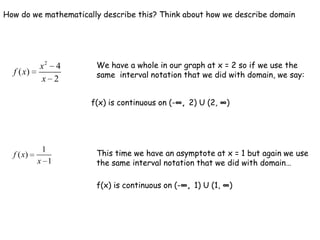
How do we mathematically describe this? Think about how we describe domain  We have a whole in our graph at x = 2 so if we use the same  interval notation that we did with domain, we say:f(x) is continuous on (-∞, 2) U (2, ∞)This time we have an asymptote at x = 1 but again we use the same interval notation that we did with domain…f(x) is continuous on (-∞, 1) U (1, ∞)
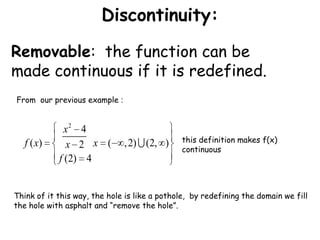
Discontinuity:Removable:  the function can be made continuous if it is redefined.From  our previous example :this definition makes f(x) continuous Think of it this way, the hole is like a pothole,  by redefining the domain we fill the hole with asphalt and “remove the hole”.
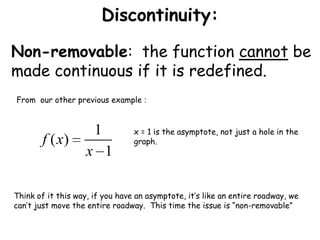
Discontinuity:Non-removable:  the function cannot be made continuous if it is redefined. From  our other previous example :x = 1 is the asymptote, not just a hole in the graph.Think of it this way, if you have an asymptote, it’s like an entire roadway, we can’t just move the entire roadway.  This time the issue is “non-removable”
Continuity on a Closed Interval:Let f be defined on a closed interval [a, b]. If f is continuous on the open interval (a, b) and lim f(x) = f(a) 	x−>a+andlim f(x) = f(b)x−>b-then f is continuous on the closed interval [a, b]. Moreover, f is continuous from the right at a and continuous from the left at b.
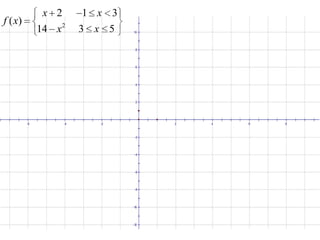
Graph What about its continuity?Graph What about its continuity?
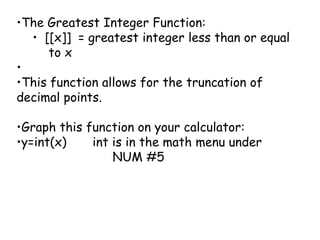
The Greatest Integer Function:
  [[x]]  = greatest integer less than or equal 	to x
This function allows for the truncation of decimal points.
Graph this function on your calculator:

1.6 all notes

  • 1.
    1.6 ContinuityGoal: todetermine the continuity of functions.Continuity:Let c be a number in the interval (a, b) and let f be a function whose domain contains the interval (a, b). The function f is continuous at the point c if the following conditions are true: f(c) is defined.lim f(c) exists x−>clim f(x) = f(c) x−>cIf f is continuous at every point in the interval (a, b), then it is continuous on an open interval (a, b).
  • 2.
    A polynomial functionis continuous at every real number.A rational function is continuous at every number in its domain. Graph f(x) = x2 + x + 1, what would you say about its continuity?Continuous on (-∞, ∞)
  • 3.
    Graph What aboutits continuity?Graph What about its continuity?If the function is defined over an interval in which c lies but f is not continuous at c, then the function is said to have a discontinuity at c.
  • 4.
    How do wemathematically describe this? Think about how we describe domain We have a whole in our graph at x = 2 so if we use the same interval notation that we did with domain, we say:f(x) is continuous on (-∞, 2) U (2, ∞)This time we have an asymptote at x = 1 but again we use the same interval notation that we did with domain…f(x) is continuous on (-∞, 1) U (1, ∞)
  • 5.
    Discontinuity:Removable: thefunction can be made continuous if it is redefined.From our previous example :this definition makes f(x) continuous Think of it this way, the hole is like a pothole, by redefining the domain we fill the hole with asphalt and “remove the hole”.
  • 6.
    Discontinuity:Non-removable: thefunction cannot be made continuous if it is redefined. From our other previous example :x = 1 is the asymptote, not just a hole in the graph.Think of it this way, if you have an asymptote, it’s like an entire roadway, we can’t just move the entire roadway. This time the issue is “non-removable”
  • 7.
    Continuity on aClosed Interval:Let f be defined on a closed interval [a, b]. If f is continuous on the open interval (a, b) and lim f(x) = f(a) x−>a+andlim f(x) = f(b)x−>b-then f is continuous on the closed interval [a, b]. Moreover, f is continuous from the right at a and continuous from the left at b.
  • 8.
    Graph What aboutits continuity?Graph What about its continuity?
  • 11.
  • 12.
    [[x]] = greatest integer less than or equal to x
  • 13.
    This function allowsfor the truncation of decimal points.
  • 14.
    Graph this functionon your calculator: