Quadratic Inequalities
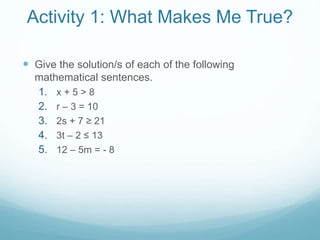
Activity 1: What Makes Me True? 
 Give the solution/s of each of the following 
mathematical sentences. 
1. x + 5 > 8 
2. r – 3 = 10 
3. 2s + 7 ≥ 21 
4. 3t – 2 ≤ 13 
5. 12 – 5m = - 8
Guide Questions 
 How did you find the solution/s of each mathematical 
statements? 
 What mathematical concepts or principles did you 
apply to come up with the solution/s? 
 Which mathematical sentences has only one solution? 
More than one solution? Describe these sentences.
Activity 2: Which are Not 
Quadratic Equations? 
x2 + 9z + 20 = 0 2r2 < 21 - 9t 2x2 + 2 = 10x 
r2 + 10r ≤ - 16 m2 = 6m - 7 4x2 – 25 = 0 
15 – 6h2 = 10 3w2 + 12w ≥ 0 2s2 + 7s + 5 > 0
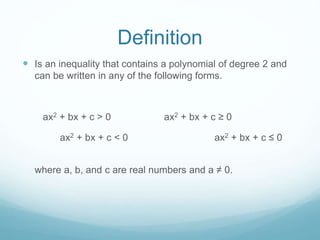
Definition 
 Is an inequality that contains a polynomial of degree 2 and 
can be written in any of the following forms. 
ax2 + bx + c > 0 ax2 + bx + c ≥ 0 
ax2 + bx + c < 0 ax2 + bx + c ≤ 0 
where a, b, and c are real numbers and a ≠ 0.
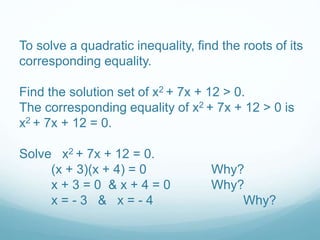
To solve a quadratic inequality, find the roots of its 
corresponding equality. 
Find the solution set of x2 + 7x + 12 > 0. 
The corresponding equality of x2 + 7x + 12 > 0 is 
x2 + 7x + 12 = 0. 
Solve x2 + 7x + 12 = 0. 
(x + 3)(x + 4) = 0 Why? 
x + 3 = 0 & x + 4 = 0 Why? 
x = - 3 & x = - 4 Why?
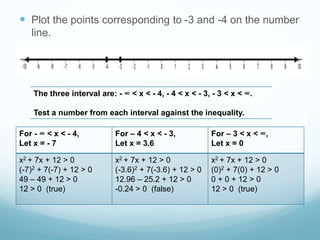
 Plot the points corresponding to -3 and -4 on the number 
line. 
The three interval are: - ∞ < x < - 4, - 4 < x < - 3, - 3 < x < ∞. 
Test a number from each interval against the inequality. 
For - ∞ < x < - 4, 
Let x = - 7 
For – 4 < x < - 3, 
Let x = 3.6 
For – 3 < x < ∞, 
Let x = 0 
x2 + 7x + 12 > 0 
(-7)2 + 7(-7) + 12 > 0 
49 – 49 + 12 > 0 
12 > 0 (true) 
x2 + 7x + 12 > 0 
(-3.6)2 + 7(-3.6) + 12 > 0 
12.96 – 25.2 + 12 > 0 
-0.24 > 0 (false) 
x2 + 7x + 12 > 0 
(0)2 + 7(0) + 12 > 0 
0 + 0 + 12 > 0 
12 > 0 (true)
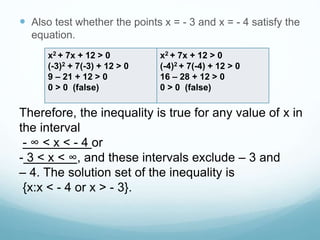
 Also test whether the points x = - 3 and x = - 4 satisfy the 
equation. 
x2 + 7x + 12 > 0 
(-3)2 + 7(-3) + 12 > 0 
9 – 21 + 12 > 0 
0 > 0 (false) 
x2 + 7x + 12 > 0 
(-4)2 + 7(-4) + 12 > 0 
16 – 28 + 12 > 0 
0 > 0 (false) 
Therefore, the inequality is true for any value of x in 
the interval 
- ∞ < x < - 4 or 
- 3 < x < ∞, and these intervals exclude – 3 and 
– 4. The solution set of the inequality is 
{x:x < - 4 or x > - 3}.
Quadratic Inequalities In Two 
Variables 
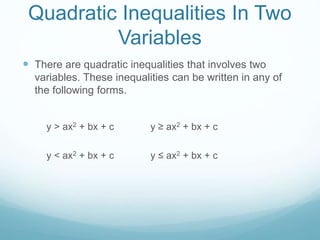
 There are quadratic inequalities that involves two 
variables. These inequalities can be written in any of 
the following forms. 
y > ax2 + bx + c y ≥ ax2 + bx + c 
y < ax2 + bx + c y ≤ ax2 + bx + c