Prepared by:
Maricel T. Mas
Lipay High School
Strategic Intervention Material
in Mathematics-IX
The Nature of the Roots
and The Discriminant
Guide Card
Least Mastered Skill:
• Identify the Nature of the Roots
Sub tasks:
 Identify values of a, b and c of a quadratic
equation,
 Find the discriminant; and
 Describe the nature of roots of quadratic
equation.
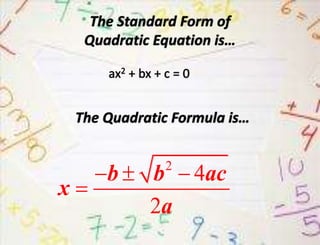
The Standard Form of
Quadratic Equation is…
ax2 + bx + c = 0
The Quadratic Formula is…
2
4
2
b b ac
x
a
  

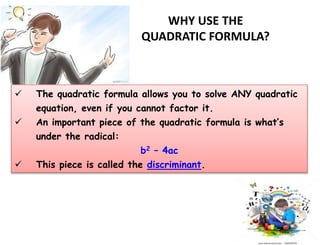
WHY USE THE
QUADRATIC FORMULA?
 The quadratic formula allows you to solve ANY quadratic
equation, even if you cannot factor it.
 An important piece of the quadratic formula is what’s
under the radical:
b2 – 4ac
 This piece is called the discriminant.
WHY IS THE DISCRIMINANT
IMPORTANT?
The discriminant tells you the number and types of answers
(roots) you will get. The discriminant can be +, –, or 0
which actually tells you a lot! Since the discriminant is
under a radical, think about what it means if you have
a positive or negative number or 0 under the radical.
???
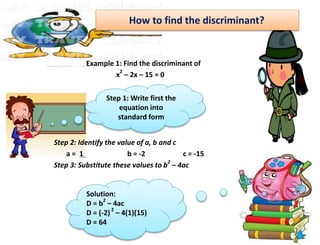
How to find the discriminant?
Example 1: Find the discriminant of
x
2
– 2x – 15 = 0
Step 2: Identify the value of a, b and c
a = 1 b = -2 c = -15
Step 3: Substitute these values to b
2
– 4ac
Step 1: Write first the
equation into
standard form
Solution:
D = b
2
– 4ac
D = (-2)
2
– 4(1)(15)
D = 64
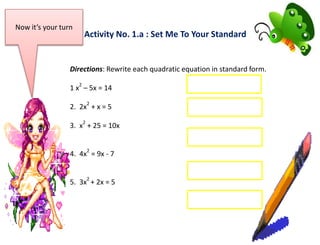
Activity No. 1.a : Set Me To Your Standard
Now it’s your turn
Directions: Rewrite each quadratic equation in standard form.
1 x
2
– 5x = 14
2. 2x
2
+ x = 5
3. x
2
+ 25 = 10x
4. 4x
2
= 9x - 7
5. 3x
2
+ 2x = 5
Activity No. 1.b
Now it’s your turn
Directions: Using the given quadratic equations on activity no
1.b, identify the values of a, b, and c.
1. x
2
– 5x – 14 = 0
2. 2x
2
+ x = 5
3. x
2
+ 25 = 10x
4. 4x
2
– 9x + 7 = 0
5. 3x
2
+ 2x - 5 = 0
a = ___ b = ___ c = ___
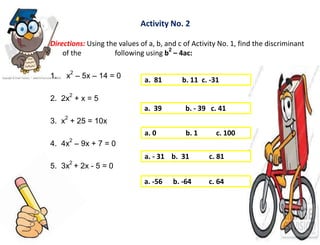
Activity No. 2
Directions: Using the values of a, b, and c of Activity No. 1, find the discriminant
of the following using b
2
– 4ac:
1. x
2
– 5x – 14 = 0
2. 2x
2
+ x = 5
3. x
2
+ 25 = 10x
4. 4x
2
– 9x + 7 = 0
5. 3x
2
+ 2x - 5 = 0
a. 81 b. 11 c. -31
a. 39 b. - 39 c. 41
a. 0 b. 1 c. 100
a. - 31 b. 31 c. 81
a. -56 b. -64 c. 64
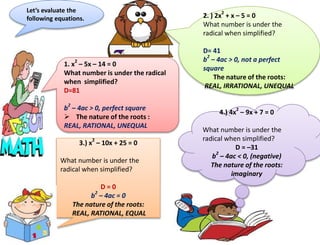
Let’s evaluate the
following equations.
1. x2
– 5x – 14 = 0
What number is under the radical
when simplified?
D=81
b2
– 4ac > 0, perfect square
 The nature of the roots :
REAL, RATIONAL, UNEQUAL
2. ) 2x2
+ x – 5 = 0
What number is under the
radical when simplified?
D= 41
b2
– 4ac > 0, not a perfect
square
The nature of the roots:
REAL, IRRATIONAL, UNEQUAL
4.) 4x2
– 9x + 7 = 0
What number is under the
radical when simplified?
D = –31
b2
– 4ac < 0, (negative)
The nature of the roots:
imaginary
3.) x2
– 10x + 25 = 0
What number is under the
radical when simplified?
D = 0
b2
– 4ac = 0
The nature of the roots:
REAL, RATIONAL, EQUAL
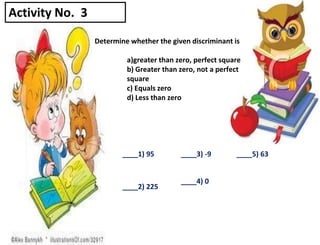
Determine whether the given discriminant is
a)greater than zero, perfect square
b) Greater than zero, not a perfect
square
c) Equals zero
d) Less than zero
____1) 95
____2) 225
____3) -9
____4) 0
____5) 63
Activity No. 3
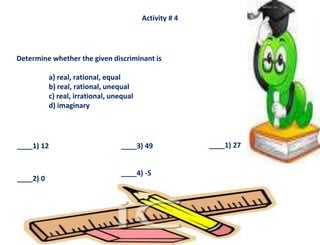
Activity # 4
Determine whether the given discriminant is
a) real, rational, equal
b) real, rational, unequal
c) real, irrational, unequal
d) imaginary
____1) 12
____2) 0
____3) 49
____4) -5
____1) 27
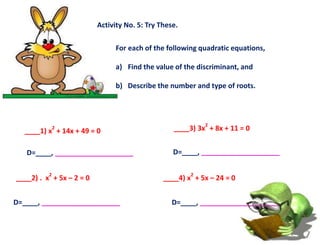
Activity No. 5: Try These.
For each of the following quadratic equations,
a) Find the value of the discriminant, and
b) Describe the number and type of roots.
____1) x
2
+ 14x + 49 = 0
____2) . x
2
+ 5x – 2 = 0
____3) 3x
2
+ 8x + 11 = 0
____4) x
2
+ 5x – 24 = 0
D=____, ____________________
D=____, ____________________D=____, ____________________
D=____, ____________________
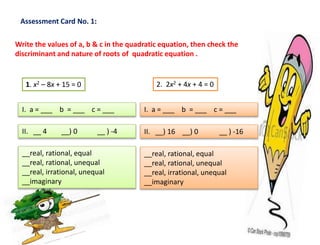
Assessment Card No. 1:
Write the values of a, b & c in the quadratic equation, then check the
discriminant and nature of roots of quadratic equation .
1. x2 – 8x + 15 = 0
I. a = ___ b = ___ c = ___
II. __ 4 __) 0 __ ) -4
__real, rational, equal
__real, rational, unequal
__real, irrational, unequal
__imaginary
2. 2x2 + 4x + 4 = 0
I. a = ___ b = ___ c = ___
II. __) 16 __) 0 __ ) -16
__real, rational, equal
__real, rational, unequal
__real, irrational, unequal
__imaginary
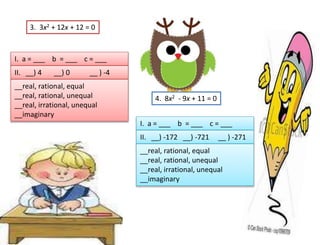
3. 3x2 + 12x + 12 = 0
I. a = ___ b = ___ c = ___
II. __) 4 __) 0 __ ) -4
__real, rational, equal
__real, rational, unequal
__real, irrational, unequal
__imaginary
4. 8x2 - 9x + 11 = 0
I. a = ___ b = ___ c = ___
II. __) -172 __) -721 __ ) -271
__real, rational, equal
__real, rational, unequal
__real, irrational, unequal
__imaginary
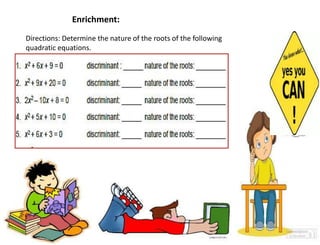
Enrichment:
Directions: Determine the nature of the roots of the following
quadratic equations.
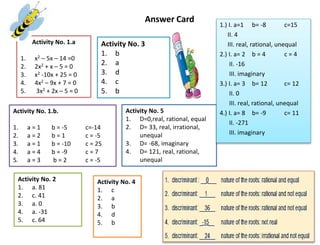
Answer Card
Activity No. 1.a
1. x2 – 5x – 14 =0
2. 2x2 + x – 5 = 0
3. x2 -10x + 25 = 0
4. 4x2 – 9x + 7 = 0
5. 3x2 + 2x – 5 = 0
Activity No. 1.b.
1. a = 1 b = -5 c=-14
2. a = 2 b = 1 c = -5
3. a = 1 b = -10 c = 25
4. a = 4 b = -9 c = 7
5. a = 3 b = 2 c = -5
Activity No. 2
1. a. 81
2. c. 41
3. a. 0
4. a. -31
5. c. 64
Activity No. 3
1. b
2. a
3. d
4. c
5. b
Activity No. 4
1. c
2. a
3. b
4. d
5. b
Activity No. 5
1. D=0,real, rational, equal
2. D= 33, real, irrational,
unequal
3. D= -68, imaginary
4. D= 121, real, rational,
unequal
1.) I. a=1 b= -8 c=15
II. 4
III. real, rational, unequal
2.) I. a= 2 b = 4 c = 4
II. -16
III. imaginary
3.) I. a= 3 b= 12 c= 12
II. 0
III. real, rational, unequal
4.) I. a= 8 b= -9 c= 11
II. -271
III. imaginary
References
Jose-Dilao, Soledad, Orines, and Bernabe,
Julieta G. Advanced Algebra, Trigonometry
and Statistics IV, SD Publications, Inc, 2009, p.
73
Learner’s Material Mathematics – Grade 9
First Edition, 2014 pp. 65-70.

nature of the roots and discriminant

  • 1.
    Prepared by: Maricel T.Mas Lipay High School Strategic Intervention Material in Mathematics-IX The Nature of the Roots and The Discriminant
  • 2.
    Guide Card Least MasteredSkill: • Identify the Nature of the Roots Sub tasks:  Identify values of a, b and c of a quadratic equation,  Find the discriminant; and  Describe the nature of roots of quadratic equation.
  • 3.
    The Standard Formof Quadratic Equation is… ax2 + bx + c = 0 The Quadratic Formula is… 2 4 2 b b ac x a    
  • 4.
    WHY USE THE QUADRATICFORMULA?  The quadratic formula allows you to solve ANY quadratic equation, even if you cannot factor it.  An important piece of the quadratic formula is what’s under the radical: b2 – 4ac  This piece is called the discriminant.
  • 5.
    WHY IS THEDISCRIMINANT IMPORTANT? The discriminant tells you the number and types of answers (roots) you will get. The discriminant can be +, –, or 0 which actually tells you a lot! Since the discriminant is under a radical, think about what it means if you have a positive or negative number or 0 under the radical. ???
  • 6.
    How to findthe discriminant? Example 1: Find the discriminant of x 2 – 2x – 15 = 0 Step 2: Identify the value of a, b and c a = 1 b = -2 c = -15 Step 3: Substitute these values to b 2 – 4ac Step 1: Write first the equation into standard form Solution: D = b 2 – 4ac D = (-2) 2 – 4(1)(15) D = 64
  • 7.
    Activity No. 1.a: Set Me To Your Standard Now it’s your turn Directions: Rewrite each quadratic equation in standard form. 1 x 2 – 5x = 14 2. 2x 2 + x = 5 3. x 2 + 25 = 10x 4. 4x 2 = 9x - 7 5. 3x 2 + 2x = 5
  • 8.
    Activity No. 1.b Nowit’s your turn Directions: Using the given quadratic equations on activity no 1.b, identify the values of a, b, and c. 1. x 2 – 5x – 14 = 0 2. 2x 2 + x = 5 3. x 2 + 25 = 10x 4. 4x 2 – 9x + 7 = 0 5. 3x 2 + 2x - 5 = 0 a = ___ b = ___ c = ___ a = ___ b = ___ c = ___ a = ___ b = ___ c = ___ a = ___ b = ___ c = ___ a = ___ b = ___ c = ___
  • 9.
    Activity No. 2 Directions:Using the values of a, b, and c of Activity No. 1, find the discriminant of the following using b 2 – 4ac: 1. x 2 – 5x – 14 = 0 2. 2x 2 + x = 5 3. x 2 + 25 = 10x 4. 4x 2 – 9x + 7 = 0 5. 3x 2 + 2x - 5 = 0 a. 81 b. 11 c. -31 a. 39 b. - 39 c. 41 a. 0 b. 1 c. 100 a. - 31 b. 31 c. 81 a. -56 b. -64 c. 64
  • 10.
    Let’s evaluate the followingequations. 1. x2 – 5x – 14 = 0 What number is under the radical when simplified? D=81 b2 – 4ac > 0, perfect square  The nature of the roots : REAL, RATIONAL, UNEQUAL 2. ) 2x2 + x – 5 = 0 What number is under the radical when simplified? D= 41 b2 – 4ac > 0, not a perfect square The nature of the roots: REAL, IRRATIONAL, UNEQUAL 4.) 4x2 – 9x + 7 = 0 What number is under the radical when simplified? D = –31 b2 – 4ac < 0, (negative) The nature of the roots: imaginary 3.) x2 – 10x + 25 = 0 What number is under the radical when simplified? D = 0 b2 – 4ac = 0 The nature of the roots: REAL, RATIONAL, EQUAL
  • 11.
    Determine whether thegiven discriminant is a)greater than zero, perfect square b) Greater than zero, not a perfect square c) Equals zero d) Less than zero ____1) 95 ____2) 225 ____3) -9 ____4) 0 ____5) 63 Activity No. 3
  • 12.
    Activity # 4 Determinewhether the given discriminant is a) real, rational, equal b) real, rational, unequal c) real, irrational, unequal d) imaginary ____1) 12 ____2) 0 ____3) 49 ____4) -5 ____1) 27
  • 13.
    Activity No. 5:Try These. For each of the following quadratic equations, a) Find the value of the discriminant, and b) Describe the number and type of roots. ____1) x 2 + 14x + 49 = 0 ____2) . x 2 + 5x – 2 = 0 ____3) 3x 2 + 8x + 11 = 0 ____4) x 2 + 5x – 24 = 0 D=____, ____________________ D=____, ____________________D=____, ____________________ D=____, ____________________
  • 14.
    Assessment Card No.1: Write the values of a, b & c in the quadratic equation, then check the discriminant and nature of roots of quadratic equation . 1. x2 – 8x + 15 = 0 I. a = ___ b = ___ c = ___ II. __ 4 __) 0 __ ) -4 __real, rational, equal __real, rational, unequal __real, irrational, unequal __imaginary 2. 2x2 + 4x + 4 = 0 I. a = ___ b = ___ c = ___ II. __) 16 __) 0 __ ) -16 __real, rational, equal __real, rational, unequal __real, irrational, unequal __imaginary
  • 15.
    3. 3x2 +12x + 12 = 0 I. a = ___ b = ___ c = ___ II. __) 4 __) 0 __ ) -4 __real, rational, equal __real, rational, unequal __real, irrational, unequal __imaginary 4. 8x2 - 9x + 11 = 0 I. a = ___ b = ___ c = ___ II. __) -172 __) -721 __ ) -271 __real, rational, equal __real, rational, unequal __real, irrational, unequal __imaginary
  • 16.
    Enrichment: Directions: Determine thenature of the roots of the following quadratic equations.
  • 17.
    Answer Card Activity No.1.a 1. x2 – 5x – 14 =0 2. 2x2 + x – 5 = 0 3. x2 -10x + 25 = 0 4. 4x2 – 9x + 7 = 0 5. 3x2 + 2x – 5 = 0 Activity No. 1.b. 1. a = 1 b = -5 c=-14 2. a = 2 b = 1 c = -5 3. a = 1 b = -10 c = 25 4. a = 4 b = -9 c = 7 5. a = 3 b = 2 c = -5 Activity No. 2 1. a. 81 2. c. 41 3. a. 0 4. a. -31 5. c. 64 Activity No. 3 1. b 2. a 3. d 4. c 5. b Activity No. 4 1. c 2. a 3. b 4. d 5. b Activity No. 5 1. D=0,real, rational, equal 2. D= 33, real, irrational, unequal 3. D= -68, imaginary 4. D= 121, real, rational, unequal 1.) I. a=1 b= -8 c=15 II. 4 III. real, rational, unequal 2.) I. a= 2 b = 4 c = 4 II. -16 III. imaginary 3.) I. a= 3 b= 12 c= 12 II. 0 III. real, rational, unequal 4.) I. a= 8 b= -9 c= 11 II. -271 III. imaginary
  • 18.
    References Jose-Dilao, Soledad, Orines,and Bernabe, Julieta G. Advanced Algebra, Trigonometry and Statistics IV, SD Publications, Inc, 2009, p. 73 Learner’s Material Mathematics – Grade 9 First Edition, 2014 pp. 65-70.