CONTINUITYANDDIFFERENTIABILITY
In Chapter Examples 14
Solved Examples 17
Total No. of questions................................................ 31
Total No. of questions in Continuity and Differentiability are-
1. INTRODUCTION
The word 'Continuous' means without any break
or gap. If the graph of a function has no break
or gap or jump, then it is said to be continuous.
A function which is not continuous is called a
discontinuous function.
In other words,
If there is slight (finite) change in the value of a
function by slightly changing the value of x then
function is continuous, otherwise discontinuous,
while studying graphs of functions, we see that
graphs of functions sin x, x, cos x, ex etc. are
continuous but greatest integer function [x] has
break at every integral point, so it is not continu-
ous. Similarly tan x, cot x, secx, 1/x etc. are
also discontinuous function.
Ex.
(Continuous function)
Y
X
O
f(x)= 1/x
(Discontinuous at x = 0)
(Discontinuous)
For examining continuity of a function at a point,
we find its limit and value at that point, If these
two exist and are equal, then function is continu-
ous at that point.
2. CONTINUITY OF A FUNCTION AT A POINT
A function f(x) is said to be continuous at a point
x = a if
(i) f (a) exists
(ii) x a
Lim
 f(x) exists and finite
so x a
Lim
  f(x) = x a
Lim
  f(x)
(iii) x a
Lim
 f(x) = f(a) .
or function f(x) is continuous at x = a.
If x a
Lim
  f(x) = x a
Lim
  f(x) = f(a).
i.e. If right hand limit at 'a' = left hand limit
at 'a'= value of the function at 'a'.
If x a
Lim
 f(x) does not exist or x a
Lim
 f(x)  f(a),
then f(x) is said to be discontinuous at x= a.
Continuity of a function at a point
Ex.1 Examine the continuity of the function
f (x) =
x
x
when x
when x
2
9
3
3
6 3




R
S
|
T
|
,
,
at x = 3.
Sol. f (3) = 6 ( given)
x
Lim
 3 f(x) = x
Lim
 3
x x
x
 

3 3
3
b g
b g
b g = 6
 x
Lim
 3 f(x) = f(3)
 f (x) is continuous at x = 3.
Ex.2 If f(x) =
log ( ) log
,
1 2 1
0
0
  


R
S
|
T
|
ax bx
x
x
k x
b g
If function is continuous at x = 0 then the
value of k is –
(A) a + b (B) 2a +b
(C) a – b (D) 0
Sol. x
Lim
 0
log
1 2
1


F
H
G I
K
J
ax
bx
x
= x
Lim
 0
1
1 2


F
H
G I
K
J
bx
ax
.
1 2 1 2
1
2
   

bx a ax b
bx
b g
b gb g
b g
b g
 x
Lim
 0
2
1 1 2
a b
bx ax

 
b g
b g
=
2
1 1
a b

b g
b
g
bg= 2a + b
Ans.[B]
Ex.3 If f(x) =
1 4
0
0
2



R
S
|
T
|
cos
,
,
x
x
x
a x
is continuous then
the value of a is equal to –
(A) 0 (B) 1
(C) 4 (D) 8
Sol. Since the given function is continuous at x= 0
x
Lim
 0
1 4
2
 cos x
x
= a
x
Lim
 0
2 2
2
2
sin x
x
x
4
4
= a
x
Lim
 0 2
sin 2
2
2
x
x
F
H
G I
K
Jx 4 = a
 2 x 1 x 4 = a
 8 = a Ans.[4]
3. CONTINUITY FROM LEFT AND RIGHT
Function f(x) is said to be
(i) Left continuous at x= a if
x a
Lim
  0 f(x) = f(a)
(ii) right continuous at x = a if
x a
Lim
  0 f(x) = f(a)
Thus a function f(x) is continuous at a point
x = a if it is left continuous as well as right
continuous at x = a.
Continuity From Left and Right
Ex.4 Examine the continuity of the function
f(x) =
x when x
x when x
2
1 2
2 2
 

R
S
|
T
|
,
,
at the point x = 2.
Sol. f(2) = 22 + 1 = 5
f(2– 0) = h
Lim
 0
2 1
2
 
h
b g = 5
 f (2+ 0) = h
Lim
 0 2( 2+ h) = 4
f(2– 0)  f(2+ 0)  f(2)
 f(x) is not continuous at x = 2.
Ex.5 Check the continuity of the function
f(x) =
x x
x
x x
 

 
R
S
|
T
|
2 3
5 3
8 3
at x = 3.
Sol. f (3) = 5
Left hand limit x
Lim
 
3 (3+h) + 2
h
Lim
 0 5+ h = 5
Right hand limit x
Lim
 
3 8–(3–h)
h
Lim
 0 5+ h = 5 = LHL
 f(3) = RHL = LHL
 function is continuous.
Ex.6 If f(x) =
| |
| |
x
x
a x
a b x
x
x
b x


 
 


 
R
S
|
|
T
|
|
1
1
1
1
1
1
1
is continuous at
x = 1 then the value of a & b are respectively-
(A) 1,1 (B) 1,–1
(C) 2,3 (D) None of these
Sol. f(1) = a+ b
f(1+h) =
| |
1 1
1 1
1
 
 
   
h
h
a a
b g
 given function is continuous
 f(1) = f (1+h)
= a+b = – 1+a  b= –1
Now f(1-h) =
| |
1 1
1 1
 
 
h
h
b g
+ b =
h
h
b
 = 1+ b
 a+ b = 1+ b  a= 1 Ans.[B]
Ex.7 Function f(x) = [x] is a greatest integer func-
tion which is right continuous at x = 1 but
not left continuous.
Sol.  f (1) = [1] = 1
[1+0] = 1 and [1-0] =0
 x
Lim
 
1 f(x) = f(1) = 1,
and x
Lim
 
1 f(x) = 0  f(1)
so function f(x) = [x] is right continuous but
not left continuous.
4. CONTINUITY OF A FUNCTION IN AN INTERVAL
(a) A function f(x) is said to be continuous in an
open interval (a,b) if it is continuous at every
point in (a, b).
For example function y = sin x, y = cos x ,
y = ex are continuous in (– , ).
(b) A function f(x) is said to be continuous in the
closed interval [a, b] if it is-
(i) Continuous at every point of the open
interval (a, b).
(ii) Right continuous at x = a.
(iii) Left continuous at x = b.
continuity of a function in
an interval
Question
based on
Ex.8 Check the continuity of the function
f(x) =
5 4 0 1
4 3 1 2
2
x x
x x x
  
  
R
S
T
,
,
in an interval [0,2]
Sol. The given function is continuous in the interval
[0, 2] because it is right continuous at x = 0
and left continuous at x = 2 and is continuous
at every point of the interval (0, 2).
Ex.9 For what value of a and b the function
f(x) =
x a x x
x x b x
a x b x x
  
  
  
R
S
|
T
|
2 0 4
2 4 2
2 2
sin , /
cot , / /
cos sin , /

 
 
is
continuous in an interval [0,  ].
Sol.  f(x) is continuous in an interval [0,  ]
So it is also continuous at x =  / 4 ,x=  / 2 .

x
Lim
 
 / 4
f(x) =
x
Lim
 
 / 4
f(x)
  / 4 + a =  / 2 + b ...(1)
and
x
Lim
 
 / 2
f(x) =
x
Lim
 
 / 2
. f(x)
 0+b = –a– b ...(2)
Solving (1) and (2)  a =  / 6 , b = –  / 12 .
5. CONTINUOUS FUNCTIONS
A function is said to be continuous function if it
is continuous at every point in its domain. Fol-
lowing are examples of some continuous func-
tion.
(i) f (x) = x (Identity function)
(ii) f(x) = C (Constant function)
(iii) f(x) = x2
(iv) f(x) = a 0xn + a1xn-1+ ....+ an
(Polynomial).
(v) f(x) = |x|, x+ |x|, x-|x|, x|x|
(vi) f(x) = sin x, f(x) = cos x
(vii) f(x) = ex, f(x) = ax, a> 0
(viii) f(x) = log x, f(x) = logax a> 0
(ix) f(x) = sinh x, cosh x, tanh x
(x) f(x) = xm sin (1/x), m> 0
f(x) = xm cos (1/x), m> 0
6. DISCONTINUOUS FUNCTIONS
A function is said to be a discontinuous function
if it is discontinuous at at least one point in its
domain. Following are examples of some discon-
tinuous function-
(i) f(x) = 1/x at x = 0
(ii) f(x) = e1/x at x = 0
(iii) f(x) = sin 1/x, f(x) = cos 1/x at x = 0
(iv) f(x) = [x] at every integer
(v) f(x) = x– [x] at every integer
(vi) f(x) = tan x, f(x) = sec x
when x =(2n+1)  / 2 , nZ.
(vii) f(x) = cot x, f(x) = cosec x when x = n  ,
nZ.
(viii) f(x) = coth x, f(x) = cosech x at x = 0.
7. PROPERTIES OF CONTINUOUS FUNCTION
The sum, difference, product, quotient (If Dr  0)
and composite of two continuous functions are
always continuous functions. Thus if f(x) and g(x)
are continuous functions then following are also
continuous functions:
(a) f(x) + g(x)
(b) f(x) – g(x)
(c) f(x) . g(x)
(d)  f(x) , where  is a constant
(e) f(x) /g(x), if g(x)  0
(f) f [g(x)]
For example -
(i) e2x + sin x is a continuous function be-
cause it is the sum of two continuous func-
tion e2x and sin x.
(ii) sin (x2 +2) is a continuous function because
it is the composite of two continuous func-
tions sin x and x2+2.
Note :
The product of one continuous and one discon-
tinuous function may or may not be continuous.
For example-
(i) f(x) = x is continuous and g(x) = cos 1/x is
discontinuous whereas their product
x cos 1/x is continuous.
(ii) f(x) = C is continuous and g(x) = sin 1/x is
discontinuous whereas their product
C sin 1/x is discontinuous.
DIFFERENTIABILITY
8. DIFFERENTIABILITY OF A FUNCTION
A function f(x) is said to be differentiable at a
point of its domain if it has a finite derivative at
that point. Thus f(x) is differentiable at x = a
 lim
x a

f x f a
x a
( ) ( )


exists finitely
 lim
h0
f a h f a
h
( ) ( )
 

= lim
h0
f a h f a
h
( ) ( )
 
 f' (a – 0) = f'(a+ 0)
 left- hand derivative = Right-hand derivative.
Generally derivative of f(x) at x = a is denoted by
f'(a) . So f' (a) = lim
x a

f x f a
x a
( ) ( )


Note : (i) Every differentiable function is necessarily
continuous but every continuous function
is not necessarily differentiable i.e.
Differentiability  continuity
but continuity 
 differentiability
8.1 Differentiability in an interval
(a) A function f(x) is said to be differentiable in
an open interval (a,b), if it is differentiable at
every point of the interval.
(b) A function f(x) is differentiable in a closed
interval [a,b] if it is –
(i) Differentiable at every point of interval (a,b)
(ii) Right derivative exists at x = a
(iii) Left derivative exists at x = b.
8.2 Differentiable function & their properties
A function is said to be a differentiable function
if it is differentiable at every point of its domain.
(a) Example of some differentiable functions:–
(i) Every polynomial function
(ii) Exponential function : ax, ex, e–x......
(iii) logarithmic functions : log ax, logex ,......
(iv) Trigonometrical functions : sin x, cos x,
(v) Hyperbolic functions : sinhx, coshx,......
(b) Examples of some non– differentiable
functions:
(i) |x | at x = 0
(ii) x  |x| at x = 0
(iii) [x], x  [x] at every n Z
(iv) x sin
1
x
F
H
GI
K
J, at x = 0
(v) cos
1
x
F
H
GI
K
J, at x = 0
(c) The sum, difference, product, quoteint
(Dr  0) and composite of two differentiable
functions is always a differentiable function.
Differentiability of function
Ex.10 The function f(x) = x2 – 2x is differentiable
at x = 2 because
Sol.  lim
x2
f x f
x
( ) ( )


2
2
= lim
x2
x x
x
2
2 0
2
 

 lim
x2
x = 2
Ex.11 Check the differentiability of the function
f(x) =
x x
x
x x
 

 
R
S
|
T
|
2 3
5 3
8 3
,
,
,
at x = 3.
Sol. For function to be differentiable
f'(3+h) = f' (3–h)
f' (3+h) = lim
h0
f h f
h
( ) ( )
3 3
 
 lim
h0
( )
3 2 5
  
h
h
= lim
h0
h
h
= 1
f' (3–h) = lim
h0
f h f
h
( ) ( )
3 3
 

= lim
h0
8 3 5
  

( )
h
h
=
h
h

= – 1
 f' (3+ h)  f' (3–h)
So function is not differentiable.
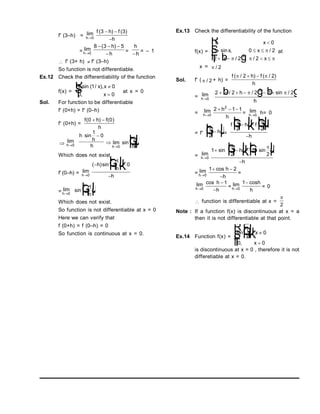
Ex.12 Check the differentiability of the function
f(x) =
x x x
x
sin ( / ),
,
1 0
0 0


R
S
T at x = 0
Sol. For function to be differentiable
f' (0+h) = f' (0–h)
f' (0+h) =
f h f
h
( ) ( )
0 0
 
 lim
h0
h
h
h
sin
1
0



lim
h 0
sin
1
h
F
H
GI
K
J
Which does not exist.
f' (0–h) = lim
h0
( )sin
 
F
H
G I
K
J

h
h
h
1
0
= lim
h0
sin 
F
H
G I
K
J
1
h
Which does not exist.
So function is not differentiable at x = 0
Here we can verify that
f (0+h) = f (0–h) = 0
So function is continuous at x = 0.
Ex.13 Check the differentiability of the function
f(x) =
1 0
1 0 2
2 2 2
2
,
sin , /
/ , /
x
x x
x x

  
   
R
S
|
T
|

  
b g
at
x =  / 2
Sol. f' (  / 2 + h) =
f h f
h
( / ) ( / )
 
2 2
 
= lim
h0
2 2 2 1 2
2
    
  
/ / sin /
h
h
b g b g
= lim
h0
2 1 1
2
  
h
h
= lim
h0
h= 0
= f'

2

F
H
G I
K
J
h =
f h f
h
 
2 2

F
H
G I
K
J
F
H
GI
K
J

= lim
h0
1
2
1
2
 
F
H
G I
K
J 
F
H
G I
K
J

sin sin
 
h
h
= lim
h0
1 2
 

cos h
h
=
lim
h0
cos h
h


1
= lim
h0
1 cosh
h
= 0
 function is differentiable at x =

2
Note : If a function f(x) is discontinuous at x = a
then it is not differentiable at that point.
Ex.14 Function f(x) =
sin ,
,
1
0
0 0
x
x
x
F
H
G
I
K
J 

R
S
|
T
|
is discontinuous at x = 0 , therefore it is not
differetiable at x = 0.
Ex.1 Function f(x) =
  
   

R
S
|
T
|
1 1
1 1
1 1
,
,
,
when x
x when x
when x
is con-
tinuous-
(A) Only at x = 1
(B) Only at x = – 1
(C) At both x = 1 and x = – 1
(D) Neither at x = 1 nor at x = – 1
Sol. f(–1–0) = –1, f(–1) = – (–1) = 1
 f( –1–0)  f(–1)
 f(x) is not continuous at x = –1
Further , f(1) = –1
f (1+0) = 1  f (1)  f(1+0)
 f(x) is not continuous at x = 1.
Ans.[D]
Ex.2 If f(x) =
x x x
x
k
cos( / ),
,
1 0
0 0


R
S
T
is continuous at x = 0, then-
(A) k < 0 (B) k > 0
(C) k = 0 (D) k 0
Sol. Since f(x) is continuous at x = 0
 x  0
lim
f(x) = f(0)
but f(0)= 0 ( given)
 x  0
lim
f(x) = x  0
lim
xk cos (1/x)
= 0, if k > 0. Ans.[B]
Ex.3 If f(x) =
1
2
0
1
2
0 0
1
2
1
2
3
2
1
2
1
1 1
  


  

R
S
|
|
|
|
T
|
|
|
|
x x
x
x
x x
x
,
,
,
,
,
then wrong statement is-
(A) f(x) is discontinuous at x = 0
(B) f(x) is continuous at x = 1/2
(C) f(x) is discontinuous at x= 1
(D) f(x) is continuous at x = 1/4
SOLVED EXAMPLES
Sol. Obviously function f(x) is discontinuous at x = 0
and x= 1 because the function is not defined,
when x< 0 and x> 1 , therefore f(0–0) and f(1+0)
do not exist. Again
f
1
2
0

F
H
G I
K
J=
Lim
x
1
2
3
2

F
H
G I
K
J
x = 1
f
1
2
0

F
H
G I
K
J=
Lim
x
1
2
1
2

F
H
G I
K
J
x = 0
 f
1
2
0

F
H
G I
K
J f
1
2
0

F
H
G I
K
J
 function f(x) is discontinuous at x=
1
2
.
Ans.[B]
Ex.4 If f(x) =
x x x
x
x
k x
3 2
2
16 20
2
2
2
  



R
S
|
T
| b g
,
,
is continu-
ous for all values of x, then the value of k is-
(A) 5 (B) 6
(C) 7 (D) 8
Sol.  f(x) is continuous at x =2
 f(2–0) = f(2+0) = f(2) = k
But f(2+0)
= h
Lim
 0
2 2 16 2 20
2 2
3 2
2
     
 
h h h
h
b g b g b g
b g
= h
Lim
 0
h h
h
3 2
2
7

= 7 Ans. [C]
Ex.5 If the function f(x) =
1 2
2 4
7 4
,
,
,
x
ax b x
x

  

R
S
|
T
|
is continuous at x= 2 and 4, then the values of
a and b are-
(A) 3,5 (B) 3,–5
(C) 0,3 (D) 0,5
Sol. Since f(x) is continuous at x= 2
 f(2) = Lim
x 
2
f(x)
 1 = Lim
x 
2
(ax+ b)
 1= 2a + b ...(1)
Again f(x) is continuous at x = 4,
 f(4) = Lim
x 
4
f(x)
 7 = Lim
x4
(ax+ b)
 7 = 4a + b ...(2)
Solving (1) and (2) , we get a= 3, b = –5.
Ans.[B]
Ex.6 If f(x) =
x when x Q
x when x Q
,
,

 
R
S
T , then f(x) is
continuous at-
(A) All rational numbers
(B) Zero only
(C) Zero and 1 only
(D) No where
Sol. Let us first examine continuity at x = 0.
f (0) = 0 ( 0 Q)
= f (0–0) = h
Lim
 0 f( 0- h) = h
Lim
 0 f(–h)
= h
Lim
 0 {–horhaccordingas–h Q or–h Q)
= 0
f( 0+0) = h
Lim
 0 f(0+h) = h
Lim
 0 f(h)
= h
Lim
 0 { h or –h} = 0
f(0) = f(0–0) = f(0+0)
 f(x) is continuous at x= 0.
Now let a  R, a  0, then
f(a–0) = h
Lim
 0 f( a–h)
= h
Lim
 0 {(a–h) or – (a–h) }
= a or –a, which is not unique.
 f(a–0) does not exist
 f(x) is not continuous at a  R0.
Hence f(x) is continuous only at x = 0.
Ans.[B]
Ex.7 f(x) = x –[x] is continuous at -
(A) x = 0 (B) x = –1
(C) x = 1 (D) x = 1/2
Sol. We know that [x] is discontinuous at every
integer. Therefore it is continuous only at
x = 1/2, while the function x is continuous at all
points x= 0, –1, 1, 1/2. Thus the given function
is continuous only at x = 1/2.
Ans.[D]
Ex.8 If f(x) =
1
3
2
2
1
2
2
3
2
2






R
S
|
|
|
T
|
|
|
sin
cos
, /
, /
sin
, /
x
x
x
a x
b x
x
x




b g
b g
is continuous at
x =  / 2, then value of a and b are-
(A) 1/2, 1/4 (B) 2,4
(C) 1/2,4 (D) 1/4,2
Sol. f

2
0

F
H
G I
K
J= h
Lim
 0
1
2
3
2
3
2
 
F
H
G I
K
J

F
H
G I
K
J
sin
cos


h
h
= h
Lim
 0
1
3
3
2
 cos
sin
h
h
= h
Lim
 0
1 1
3 1 1
2
  
 
cos cos cos
cos cos
h h h
h h
b g
e j
b g
b g
= 1/2
f

2
0

F
H
G I
K
J= h
Lim
 0
b h
h
1
2
2
2
2
 
F
H
G I
K
J
L
N
M O
Q
P
 
F
H
G I
K
J
L
N
M O
Q
P
sin



= h
Lim
 0
b h
h
1
4 2
 cos
b g
= h
Lim
 0
2 2
4
2
2
b h
h
sin /
=
b
8
Now f(x) is continuous at x=

2
 f

2
0

F
H
G I
K
J= f

2
0

F
H
G I
K
J= f

2
F
H
GI
K
J

1
2
=
b
8
= a
 a = 1/2, b = 4
Ans.[C]
Ex.9 If the function
f(x) =
1
2
1
1 3
6
12
3 6
    
  
 
R
S
|
|
T
|
|
sin
tan


x for x
ax b for x
x
for x
is continuous in the interval (– , 6), then the
value of a and b are respectively-
(A) 0,2 (B) 1,1
(C) 2,0 (D) 2,1
Sol. Obviously the function f(x) is continuous at
x= 1 and 3. Therefore Lim
x 
1
f(x) = f(1)
 a+ b = 2 ...(1)
and Lim
x 
3
f(x) = f(3)
 3a + b = 6 ...(2)
Solving (1) and (2) , we get a = 2, b = 0.
Ans.[C]
Ex.10 If f(x) =
1 4
0
0
16 4
0
2



 

R
S
|
|
|
T
|
|
|
cos
,
,
,
x
x
x
a x
x
x
x
then at x= 0 -
(A) f(x) is continuous, when a = 0
(B) f(x) is continuous, when a= 8
(C) f(x) is discontinuous for every value of a
(D) None of these
Sol. f(0–0) = Lim
x0
1 4
2
 cos x
x
=
2 2
2
2
sin x
x
= 8
f(0+0) =
Lim
x0
x
x
16 4
 
e j
×
16 4
16 4
 
 
x
x
= Lim
x0
x x
x
16 4
16 16
 
F
H
I
K
 
= 8
 f(0+0) = f(0–0)
 f(x) can be continuous at x = 0, if
f (0) = a = 8.
Ans.[B]
Ex.11 If f(x) =
sin
,
cos
,
,
x
x
x
x
x
x
x
k x




R
S
|
|
|
|
|
T
|
|
|
|
|
1
0
2
0
0
( Where [x] = greatest integer  x) is continu-
ous at x = 0, then k is equal to-
(A) 0 (B) 1 (C) –1 (D)Indeterminate
Sol. As given f(0–0) = f(0+0) = k
Now f(0–0) = h
Lim
 0
cos



h
h
h
b g
2
= h
Lim
 0
cos


F
H
G
I
K
J

h
2 1
1
bg= – 1
f (0+0) = h
Lim
 0
sin h
h 1 = h
Lim
 0
sin 0
0 1

= 0
 f(0–0)  f(0+0), so k is indeterminate.
Ans.[D]
Ex.12 If f(x) =
1 6 0
0
0 6
2 3
   

 
R
S
|
|
T
|
|
|sin | , /
,
, /
/|sin |
tan /tan
x x
b x
e x
a x
x x
b g 

is continuous at x= 0, then value of a,b are-
(A) 2/3, e2/3 (B) 1/3, e1/3
(C) 2/3, 1/3 (D) None of these
Sol. f (0–0) = h
Lim
 0 (1+ | sin (–h)|)a/|sin (–h)|
= h
Lim
 0 (1+ sinh)a/ sin h =ea
f(0+0) = h
Lim
 0 e
h
h
tan
tan
2
3 =
eh
h
h

F
H
G I
K
J
0
2
3
lim tan
tan
=
eh
h
h
0
2 2 2
3 2 3
lim sec
sec = e2/3
Now f(x) is continuous at x = 0
 f(0-0) = f(0+0) = f(0)
 ea = e2/3 = b
 a = 2/3, b= e2/3
Ans.[A]
Ex.13 f(x) = |x| is not differentiable at-
(A) x = –1 (B) x = 0
(C) x = 1 (D) None of these
Sol. at x = 0:
f'(0–0) = lim
h0
| |
0 0
 

h
h
= –1
f'(0+ 0) = lim
h0
| |
0 0
 
h
h
= 1
Now, since f' (0–0)  f'(0+0)
 f(x) is not differentiable at x= 0.
Ans.[B]
Ex.14 Function f(x) =
 
 
  
R
S
|
T
|
x if x
x if x
x x if x
,
,
,
0
0 1
1 1
2
3
, is
differentiable at -
(A) x = 0 but not at x = 1
(B) x = 1 but not at x = 0
(C) x = 0 and x = 1 both
(D) neither x = 0 nor x = 1
Sol. Differentiability at x = 0
R [f'(0)] = Lim
h0
f h f
h
( ) ( )
0 0
 
= Lim
h0
( )
0 0
2
 
h
h
= Lim
h0
h = 0
L [f'(0)] = Lim
h0
f h f
h
( ) ( )
0 0
 

= Lim
h0
  

( )
0 0
h
h
= – 1
 R [f' (0) ]  L [f'(0)]
 f(x) is not differentiable at x = 0
Differentiability at x = 1
R [f'(1)] =Lim
h0
f h f
h
( ) ( )
1 1
 
= Lim
h0
1 1 1 1
3
    
h h
h
b g b g
= Lim
h0
2 3 2 3
h h h
h
 
= 2
L [f'(1)] = Lim
h0
f h f
h
1 1
 

b g ( )
= Lim
h0
1 1
 

h
h
b g
= Lim
h0
 

2 2
h h
h
= 2
Thus R [f' (1) ] = L f'(1)]
 function f(x) is differentiable at x = 1
Ans.[B]
Ex.15 If f(x) =
3 1 1
4 1 4
x
x
x x
,
,
  
  
R
S
|
T
|
then at x = 1, f(x) is -
(A) Continuous but not differentiable
(B) Neither continuous nor differentiable
(C) Continuous and differentiable
(D) Differentiable but not continuous
Sol. Since f(1–0) = lim
x1
3x = 3
f(1+ 0) = lim
x1
(4–x) = 3
and f(1) = 31 = 3
 f(1–0) = f(1+0) = f(1)
 f(x) is continuous at x = 1
Again f' (1+ 0) = lim
x 
1
f x f
x
( ) ( )


1
1
= lim
x1
3 3
1
x
x


= lim
h0
3 3
1

h
h
= 3 lim
h0
3 1
h
h

= 3 log 3
and f'(1+ 0) = lim
x 
1
f x f
x
( ) ( )


1
1
= lim
x1
4 3
1
 

x
x
= – 1
 f' (1+0)  f'(1–0)
 f(x) is not differentiable at x = 1.
Ans.[A]
Ex.16 Function f(x) =
x
x
1  | |
is differentiable in
the set-
(A) (–  ,  ) (B) (–  ,0)
(C) (–  ,0)  (0,  ) (D) (0,  )
Sol. When x < 0, f(x) =
x
x
1
 f'(x) =
1
1 2
( )
 x
...(1)
which exists finitely for all x< 0
Also when x > 0, f(x) =
x
x
1
 f' (x) =
1
1 2
( )
 x
...(2)
which exists finitely for all x > 0. Also from
(1) and (2) we have
f
f
'( )
'( )
0 0 1
0 0 1
 
 
R
S
T  f'(0) = 1
Hence f(x) is differentiable  x R
Ans.[A]
Ex.17 If f(x) =
x
x
x
x
2 1
0
0 0
sin ,
,


R
S
|
T
|
, then
(A) f and f' are continuous at x = 0
(B) f is derivable at x = 0
(C) f and f' are derivable at x = 0
(D) f is derivable at x = 0 and f' is continuous
at x = 0
Sol. When x  0
f' (x) = 2x sin
1
x
+ x2 cos
1
x
. 
F
H
G I
K
J
1
2
x
= 2x sin
1
x
– cos
1
x
F
H
G
I
K
J
which exists finitely for all x  0
and f'(0) = lim
x0
f x f
x
( ) ( )


0
0
= lim
x0
x x
x
2
1
sin /
= 0
 f is also derivable at x = 0. Thus
f'(x) = 2
1 1
0
0 0
x
x x
x
x
sin cos ,
,
 

R
S
|
T
|
Also lim
x0
f'(x) = lim
x0
2
1 1
x
x x
sin cos

F
H
G I
K
J
=2– lim
x0
cos
1
x
But lim
x0
cos
1
x
does not exist, so lim
x0
f'(x)
does not exist. Hence f' is not continuous
(so not derivable) at x = 0.
Ans.[B]

Continuity & Differentibilitytheory & solved & exercise. Module-4 pdf

  • 1.
    CONTINUITYANDDIFFERENTIABILITY In Chapter Examples14 Solved Examples 17 Total No. of questions................................................ 31 Total No. of questions in Continuity and Differentiability are-
  • 2.
    1. INTRODUCTION The word'Continuous' means without any break or gap. If the graph of a function has no break or gap or jump, then it is said to be continuous. A function which is not continuous is called a discontinuous function. In other words, If there is slight (finite) change in the value of a function by slightly changing the value of x then function is continuous, otherwise discontinuous, while studying graphs of functions, we see that graphs of functions sin x, x, cos x, ex etc. are continuous but greatest integer function [x] has break at every integral point, so it is not continu- ous. Similarly tan x, cot x, secx, 1/x etc. are also discontinuous function. Ex. (Continuous function) Y X O f(x)= 1/x (Discontinuous at x = 0) (Discontinuous) For examining continuity of a function at a point, we find its limit and value at that point, If these two exist and are equal, then function is continu- ous at that point. 2. CONTINUITY OF A FUNCTION AT A POINT A function f(x) is said to be continuous at a point x = a if (i) f (a) exists (ii) x a Lim  f(x) exists and finite so x a Lim   f(x) = x a Lim   f(x) (iii) x a Lim  f(x) = f(a) . or function f(x) is continuous at x = a. If x a Lim   f(x) = x a Lim   f(x) = f(a). i.e. If right hand limit at 'a' = left hand limit at 'a'= value of the function at 'a'. If x a Lim  f(x) does not exist or x a Lim  f(x)  f(a), then f(x) is said to be discontinuous at x= a. Continuity of a function at a point Ex.1 Examine the continuity of the function f (x) = x x when x when x 2 9 3 3 6 3     R S | T | , , at x = 3. Sol. f (3) = 6 ( given) x Lim  3 f(x) = x Lim  3 x x x    3 3 3 b g b g b g = 6  x Lim  3 f(x) = f(3)  f (x) is continuous at x = 3.
  • 3.
    Ex.2 If f(x)= log ( ) log , 1 2 1 0 0      R S | T | ax bx x x k x b g If function is continuous at x = 0 then the value of k is – (A) a + b (B) 2a +b (C) a – b (D) 0 Sol. x Lim  0 log 1 2 1   F H G I K J ax bx x = x Lim  0 1 1 2   F H G I K J bx ax . 1 2 1 2 1 2      bx a ax b bx b g b gb g b g b g  x Lim  0 2 1 1 2 a b bx ax    b g b g = 2 1 1 a b  b g b g bg= 2a + b Ans.[B] Ex.3 If f(x) = 1 4 0 0 2    R S | T | cos , , x x x a x is continuous then the value of a is equal to – (A) 0 (B) 1 (C) 4 (D) 8 Sol. Since the given function is continuous at x= 0 x Lim  0 1 4 2  cos x x = a x Lim  0 2 2 2 2 sin x x x 4 4 = a x Lim  0 2 sin 2 2 2 x x F H G I K Jx 4 = a  2 x 1 x 4 = a  8 = a Ans.[4] 3. CONTINUITY FROM LEFT AND RIGHT Function f(x) is said to be (i) Left continuous at x= a if x a Lim   0 f(x) = f(a) (ii) right continuous at x = a if x a Lim   0 f(x) = f(a) Thus a function f(x) is continuous at a point x = a if it is left continuous as well as right continuous at x = a. Continuity From Left and Right Ex.4 Examine the continuity of the function f(x) = x when x x when x 2 1 2 2 2    R S | T | , , at the point x = 2. Sol. f(2) = 22 + 1 = 5 f(2– 0) = h Lim  0 2 1 2   h b g = 5  f (2+ 0) = h Lim  0 2( 2+ h) = 4 f(2– 0)  f(2+ 0)  f(2)  f(x) is not continuous at x = 2. Ex.5 Check the continuity of the function f(x) = x x x x x      R S | T | 2 3 5 3 8 3 at x = 3. Sol. f (3) = 5 Left hand limit x Lim   3 (3+h) + 2 h Lim  0 5+ h = 5 Right hand limit x Lim   3 8–(3–h) h Lim  0 5+ h = 5 = LHL  f(3) = RHL = LHL  function is continuous. Ex.6 If f(x) = | | | | x x a x a b x x x b x           R S | | T | | 1 1 1 1 1 1 1 is continuous at x = 1 then the value of a & b are respectively- (A) 1,1 (B) 1,–1 (C) 2,3 (D) None of these Sol. f(1) = a+ b f(1+h) = | | 1 1 1 1 1         h h a a b g
  • 4.
     given functionis continuous  f(1) = f (1+h) = a+b = – 1+a  b= –1 Now f(1-h) = | | 1 1 1 1     h h b g + b = h h b  = 1+ b  a+ b = 1+ b  a= 1 Ans.[B] Ex.7 Function f(x) = [x] is a greatest integer func- tion which is right continuous at x = 1 but not left continuous. Sol.  f (1) = [1] = 1 [1+0] = 1 and [1-0] =0  x Lim   1 f(x) = f(1) = 1, and x Lim   1 f(x) = 0  f(1) so function f(x) = [x] is right continuous but not left continuous. 4. CONTINUITY OF A FUNCTION IN AN INTERVAL (a) A function f(x) is said to be continuous in an open interval (a,b) if it is continuous at every point in (a, b). For example function y = sin x, y = cos x , y = ex are continuous in (– , ). (b) A function f(x) is said to be continuous in the closed interval [a, b] if it is- (i) Continuous at every point of the open interval (a, b). (ii) Right continuous at x = a. (iii) Left continuous at x = b. continuity of a function in an interval Question based on Ex.8 Check the continuity of the function f(x) = 5 4 0 1 4 3 1 2 2 x x x x x       R S T , , in an interval [0,2] Sol. The given function is continuous in the interval [0, 2] because it is right continuous at x = 0 and left continuous at x = 2 and is continuous at every point of the interval (0, 2). Ex.9 For what value of a and b the function f(x) = x a x x x x b x a x b x x          R S | T | 2 0 4 2 4 2 2 2 sin , / cot , / / cos sin , /      is continuous in an interval [0,  ]. Sol.  f(x) is continuous in an interval [0,  ] So it is also continuous at x =  / 4 ,x=  / 2 .  x Lim    / 4 f(x) = x Lim    / 4 f(x)   / 4 + a =  / 2 + b ...(1) and x Lim    / 2 f(x) = x Lim    / 2 . f(x)  0+b = –a– b ...(2) Solving (1) and (2)  a =  / 6 , b = –  / 12 . 5. CONTINUOUS FUNCTIONS A function is said to be continuous function if it is continuous at every point in its domain. Fol- lowing are examples of some continuous func- tion. (i) f (x) = x (Identity function) (ii) f(x) = C (Constant function) (iii) f(x) = x2 (iv) f(x) = a 0xn + a1xn-1+ ....+ an (Polynomial). (v) f(x) = |x|, x+ |x|, x-|x|, x|x| (vi) f(x) = sin x, f(x) = cos x (vii) f(x) = ex, f(x) = ax, a> 0 (viii) f(x) = log x, f(x) = logax a> 0 (ix) f(x) = sinh x, cosh x, tanh x (x) f(x) = xm sin (1/x), m> 0 f(x) = xm cos (1/x), m> 0 6. DISCONTINUOUS FUNCTIONS A function is said to be a discontinuous function if it is discontinuous at at least one point in its domain. Following are examples of some discon- tinuous function- (i) f(x) = 1/x at x = 0 (ii) f(x) = e1/x at x = 0 (iii) f(x) = sin 1/x, f(x) = cos 1/x at x = 0 (iv) f(x) = [x] at every integer (v) f(x) = x– [x] at every integer (vi) f(x) = tan x, f(x) = sec x when x =(2n+1)  / 2 , nZ. (vii) f(x) = cot x, f(x) = cosec x when x = n  , nZ. (viii) f(x) = coth x, f(x) = cosech x at x = 0.
  • 5.
    7. PROPERTIES OFCONTINUOUS FUNCTION The sum, difference, product, quotient (If Dr  0) and composite of two continuous functions are always continuous functions. Thus if f(x) and g(x) are continuous functions then following are also continuous functions: (a) f(x) + g(x) (b) f(x) – g(x) (c) f(x) . g(x) (d)  f(x) , where  is a constant (e) f(x) /g(x), if g(x)  0 (f) f [g(x)] For example - (i) e2x + sin x is a continuous function be- cause it is the sum of two continuous func- tion e2x and sin x. (ii) sin (x2 +2) is a continuous function because it is the composite of two continuous func- tions sin x and x2+2. Note : The product of one continuous and one discon- tinuous function may or may not be continuous. For example- (i) f(x) = x is continuous and g(x) = cos 1/x is discontinuous whereas their product x cos 1/x is continuous. (ii) f(x) = C is continuous and g(x) = sin 1/x is discontinuous whereas their product C sin 1/x is discontinuous. DIFFERENTIABILITY 8. DIFFERENTIABILITY OF A FUNCTION A function f(x) is said to be differentiable at a point of its domain if it has a finite derivative at that point. Thus f(x) is differentiable at x = a  lim x a  f x f a x a ( ) ( )   exists finitely  lim h0 f a h f a h ( ) ( )    = lim h0 f a h f a h ( ) ( )    f' (a – 0) = f'(a+ 0)  left- hand derivative = Right-hand derivative. Generally derivative of f(x) at x = a is denoted by f'(a) . So f' (a) = lim x a  f x f a x a ( ) ( )   Note : (i) Every differentiable function is necessarily continuous but every continuous function is not necessarily differentiable i.e. Differentiability  continuity but continuity   differentiability 8.1 Differentiability in an interval (a) A function f(x) is said to be differentiable in an open interval (a,b), if it is differentiable at every point of the interval. (b) A function f(x) is differentiable in a closed interval [a,b] if it is – (i) Differentiable at every point of interval (a,b) (ii) Right derivative exists at x = a (iii) Left derivative exists at x = b. 8.2 Differentiable function & their properties A function is said to be a differentiable function if it is differentiable at every point of its domain. (a) Example of some differentiable functions:– (i) Every polynomial function (ii) Exponential function : ax, ex, e–x...... (iii) logarithmic functions : log ax, logex ,...... (iv) Trigonometrical functions : sin x, cos x, (v) Hyperbolic functions : sinhx, coshx,...... (b) Examples of some non– differentiable functions: (i) |x | at x = 0 (ii) x  |x| at x = 0 (iii) [x], x  [x] at every n Z (iv) x sin 1 x F H GI K J, at x = 0 (v) cos 1 x F H GI K J, at x = 0 (c) The sum, difference, product, quoteint (Dr  0) and composite of two differentiable functions is always a differentiable function. Differentiability of function Ex.10 The function f(x) = x2 – 2x is differentiable at x = 2 because Sol.  lim x2 f x f x ( ) ( )   2 2 = lim x2 x x x 2 2 0 2     lim x2 x = 2 Ex.11 Check the differentiability of the function f(x) = x x x x x      R S | T | 2 3 5 3 8 3 , , , at x = 3. Sol. For function to be differentiable f'(3+h) = f' (3–h) f' (3+h) = lim h0 f h f h ( ) ( ) 3 3    lim h0 ( ) 3 2 5    h h = lim h0 h h = 1
  • 6.
    f' (3–h) =lim h0 f h f h ( ) ( ) 3 3    = lim h0 8 3 5     ( ) h h = h h  = – 1  f' (3+ h)  f' (3–h) So function is not differentiable. Ex.12 Check the differentiability of the function f(x) = x x x x sin ( / ), , 1 0 0 0   R S T at x = 0 Sol. For function to be differentiable f' (0+h) = f' (0–h) f' (0+h) = f h f h ( ) ( ) 0 0    lim h0 h h h sin 1 0    lim h 0 sin 1 h F H GI K J Which does not exist. f' (0–h) = lim h0 ( )sin   F H G I K J  h h h 1 0 = lim h0 sin  F H G I K J 1 h Which does not exist. So function is not differentiable at x = 0 Here we can verify that f (0+h) = f (0–h) = 0 So function is continuous at x = 0. Ex.13 Check the differentiability of the function f(x) = 1 0 1 0 2 2 2 2 2 , sin , / / , / x x x x x         R S | T |     b g at x =  / 2 Sol. f' (  / 2 + h) = f h f h ( / ) ( / )   2 2   = lim h0 2 2 2 1 2 2         / / sin / h h b g b g = lim h0 2 1 1 2    h h = lim h0 h= 0 = f'  2  F H G I K J h = f h f h   2 2  F H G I K J F H GI K J  = lim h0 1 2 1 2   F H G I K J  F H G I K J  sin sin   h h = lim h0 1 2    cos h h = lim h0 cos h h   1 = lim h0 1 cosh h = 0  function is differentiable at x =  2 Note : If a function f(x) is discontinuous at x = a then it is not differentiable at that point. Ex.14 Function f(x) = sin , , 1 0 0 0 x x x F H G I K J   R S | T | is discontinuous at x = 0 , therefore it is not differetiable at x = 0.
  • 7.
    Ex.1 Function f(x)=         R S | T | 1 1 1 1 1 1 , , , when x x when x when x is con- tinuous- (A) Only at x = 1 (B) Only at x = – 1 (C) At both x = 1 and x = – 1 (D) Neither at x = 1 nor at x = – 1 Sol. f(–1–0) = –1, f(–1) = – (–1) = 1  f( –1–0)  f(–1)  f(x) is not continuous at x = –1 Further , f(1) = –1 f (1+0) = 1  f (1)  f(1+0)  f(x) is not continuous at x = 1. Ans.[D] Ex.2 If f(x) = x x x x k cos( / ), , 1 0 0 0   R S T is continuous at x = 0, then- (A) k < 0 (B) k > 0 (C) k = 0 (D) k 0 Sol. Since f(x) is continuous at x = 0  x  0 lim f(x) = f(0) but f(0)= 0 ( given)  x  0 lim f(x) = x  0 lim xk cos (1/x) = 0, if k > 0. Ans.[B] Ex.3 If f(x) = 1 2 0 1 2 0 0 1 2 1 2 3 2 1 2 1 1 1          R S | | | | T | | | | x x x x x x x , , , , , then wrong statement is- (A) f(x) is discontinuous at x = 0 (B) f(x) is continuous at x = 1/2 (C) f(x) is discontinuous at x= 1 (D) f(x) is continuous at x = 1/4 SOLVED EXAMPLES Sol. Obviously function f(x) is discontinuous at x = 0 and x= 1 because the function is not defined, when x< 0 and x> 1 , therefore f(0–0) and f(1+0) do not exist. Again f 1 2 0  F H G I K J= Lim x 1 2 3 2  F H G I K J x = 1 f 1 2 0  F H G I K J= Lim x 1 2 1 2  F H G I K J x = 0  f 1 2 0  F H G I K J f 1 2 0  F H G I K J  function f(x) is discontinuous at x= 1 2 . Ans.[B] Ex.4 If f(x) = x x x x x k x 3 2 2 16 20 2 2 2       R S | T | b g , , is continu- ous for all values of x, then the value of k is- (A) 5 (B) 6 (C) 7 (D) 8 Sol.  f(x) is continuous at x =2  f(2–0) = f(2+0) = f(2) = k But f(2+0) = h Lim  0 2 2 16 2 20 2 2 3 2 2         h h h h b g b g b g b g = h Lim  0 h h h 3 2 2 7  = 7 Ans. [C] Ex.5 If the function f(x) = 1 2 2 4 7 4 , , , x ax b x x      R S | T | is continuous at x= 2 and 4, then the values of a and b are- (A) 3,5 (B) 3,–5 (C) 0,3 (D) 0,5 Sol. Since f(x) is continuous at x= 2  f(2) = Lim x  2 f(x)  1 = Lim x  2 (ax+ b)  1= 2a + b ...(1)
  • 8.
    Again f(x) iscontinuous at x = 4,  f(4) = Lim x  4 f(x)  7 = Lim x4 (ax+ b)  7 = 4a + b ...(2) Solving (1) and (2) , we get a= 3, b = –5. Ans.[B] Ex.6 If f(x) = x when x Q x when x Q , ,    R S T , then f(x) is continuous at- (A) All rational numbers (B) Zero only (C) Zero and 1 only (D) No where Sol. Let us first examine continuity at x = 0. f (0) = 0 ( 0 Q) = f (0–0) = h Lim  0 f( 0- h) = h Lim  0 f(–h) = h Lim  0 {–horhaccordingas–h Q or–h Q) = 0 f( 0+0) = h Lim  0 f(0+h) = h Lim  0 f(h) = h Lim  0 { h or –h} = 0 f(0) = f(0–0) = f(0+0)  f(x) is continuous at x= 0. Now let a  R, a  0, then f(a–0) = h Lim  0 f( a–h) = h Lim  0 {(a–h) or – (a–h) } = a or –a, which is not unique.  f(a–0) does not exist  f(x) is not continuous at a  R0. Hence f(x) is continuous only at x = 0. Ans.[B] Ex.7 f(x) = x –[x] is continuous at - (A) x = 0 (B) x = –1 (C) x = 1 (D) x = 1/2 Sol. We know that [x] is discontinuous at every integer. Therefore it is continuous only at x = 1/2, while the function x is continuous at all points x= 0, –1, 1, 1/2. Thus the given function is continuous only at x = 1/2. Ans.[D] Ex.8 If f(x) = 1 3 2 2 1 2 2 3 2 2       R S | | | T | | | sin cos , / , / sin , / x x x a x b x x x     b g b g is continuous at x =  / 2, then value of a and b are- (A) 1/2, 1/4 (B) 2,4 (C) 1/2,4 (D) 1/4,2 Sol. f  2 0  F H G I K J= h Lim  0 1 2 3 2 3 2   F H G I K J  F H G I K J sin cos   h h = h Lim  0 1 3 3 2  cos sin h h = h Lim  0 1 1 3 1 1 2      cos cos cos cos cos h h h h h b g e j b g b g = 1/2 f  2 0  F H G I K J= h Lim  0 b h h 1 2 2 2 2   F H G I K J L N M O Q P   F H G I K J L N M O Q P sin    = h Lim  0 b h h 1 4 2  cos b g = h Lim  0 2 2 4 2 2 b h h sin / = b 8 Now f(x) is continuous at x=  2  f  2 0  F H G I K J= f  2 0  F H G I K J= f  2 F H GI K J  1 2 = b 8 = a  a = 1/2, b = 4 Ans.[C] Ex.9 If the function f(x) = 1 2 1 1 3 6 12 3 6           R S | | T | | sin tan   x for x ax b for x x for x is continuous in the interval (– , 6), then the value of a and b are respectively- (A) 0,2 (B) 1,1 (C) 2,0 (D) 2,1
  • 9.
    Sol. Obviously thefunction f(x) is continuous at x= 1 and 3. Therefore Lim x  1 f(x) = f(1)  a+ b = 2 ...(1) and Lim x  3 f(x) = f(3)  3a + b = 6 ...(2) Solving (1) and (2) , we get a = 2, b = 0. Ans.[C] Ex.10 If f(x) = 1 4 0 0 16 4 0 2       R S | | | T | | | cos , , , x x x a x x x x then at x= 0 - (A) f(x) is continuous, when a = 0 (B) f(x) is continuous, when a= 8 (C) f(x) is discontinuous for every value of a (D) None of these Sol. f(0–0) = Lim x0 1 4 2  cos x x = 2 2 2 2 sin x x = 8 f(0+0) = Lim x0 x x 16 4   e j × 16 4 16 4     x x = Lim x0 x x x 16 4 16 16   F H I K   = 8  f(0+0) = f(0–0)  f(x) can be continuous at x = 0, if f (0) = a = 8. Ans.[B] Ex.11 If f(x) = sin , cos , , x x x x x x x k x     R S | | | | | T | | | | | 1 0 2 0 0 ( Where [x] = greatest integer  x) is continu- ous at x = 0, then k is equal to- (A) 0 (B) 1 (C) –1 (D)Indeterminate Sol. As given f(0–0) = f(0+0) = k Now f(0–0) = h Lim  0 cos    h h h b g 2 = h Lim  0 cos   F H G I K J  h 2 1 1 bg= – 1 f (0+0) = h Lim  0 sin h h 1 = h Lim  0 sin 0 0 1  = 0  f(0–0)  f(0+0), so k is indeterminate. Ans.[D] Ex.12 If f(x) = 1 6 0 0 0 6 2 3        R S | | T | | |sin | , / , , / /|sin | tan /tan x x b x e x a x x x b g   is continuous at x= 0, then value of a,b are- (A) 2/3, e2/3 (B) 1/3, e1/3 (C) 2/3, 1/3 (D) None of these Sol. f (0–0) = h Lim  0 (1+ | sin (–h)|)a/|sin (–h)| = h Lim  0 (1+ sinh)a/ sin h =ea f(0+0) = h Lim  0 e h h tan tan 2 3 = eh h h  F H G I K J 0 2 3 lim tan tan = eh h h 0 2 2 2 3 2 3 lim sec sec = e2/3 Now f(x) is continuous at x = 0  f(0-0) = f(0+0) = f(0)  ea = e2/3 = b  a = 2/3, b= e2/3 Ans.[A] Ex.13 f(x) = |x| is not differentiable at- (A) x = –1 (B) x = 0 (C) x = 1 (D) None of these Sol. at x = 0: f'(0–0) = lim h0 | | 0 0    h h = –1 f'(0+ 0) = lim h0 | | 0 0   h h = 1 Now, since f' (0–0)  f'(0+0)  f(x) is not differentiable at x= 0. Ans.[B]
  • 10.
    Ex.14 Function f(x)=        R S | T | x if x x if x x x if x , , , 0 0 1 1 1 2 3 , is differentiable at - (A) x = 0 but not at x = 1 (B) x = 1 but not at x = 0 (C) x = 0 and x = 1 both (D) neither x = 0 nor x = 1 Sol. Differentiability at x = 0 R [f'(0)] = Lim h0 f h f h ( ) ( ) 0 0   = Lim h0 ( ) 0 0 2   h h = Lim h0 h = 0 L [f'(0)] = Lim h0 f h f h ( ) ( ) 0 0    = Lim h0     ( ) 0 0 h h = – 1  R [f' (0) ]  L [f'(0)]  f(x) is not differentiable at x = 0 Differentiability at x = 1 R [f'(1)] =Lim h0 f h f h ( ) ( ) 1 1   = Lim h0 1 1 1 1 3      h h h b g b g = Lim h0 2 3 2 3 h h h h   = 2 L [f'(1)] = Lim h0 f h f h 1 1    b g ( ) = Lim h0 1 1    h h b g = Lim h0    2 2 h h h = 2 Thus R [f' (1) ] = L f'(1)]  function f(x) is differentiable at x = 1 Ans.[B] Ex.15 If f(x) = 3 1 1 4 1 4 x x x x , ,       R S | T | then at x = 1, f(x) is - (A) Continuous but not differentiable (B) Neither continuous nor differentiable (C) Continuous and differentiable (D) Differentiable but not continuous Sol. Since f(1–0) = lim x1 3x = 3 f(1+ 0) = lim x1 (4–x) = 3 and f(1) = 31 = 3  f(1–0) = f(1+0) = f(1)  f(x) is continuous at x = 1 Again f' (1+ 0) = lim x  1 f x f x ( ) ( )   1 1 = lim x1 3 3 1 x x   = lim h0 3 3 1  h h = 3 lim h0 3 1 h h  = 3 log 3 and f'(1+ 0) = lim x  1 f x f x ( ) ( )   1 1 = lim x1 4 3 1    x x = – 1  f' (1+0)  f'(1–0)  f(x) is not differentiable at x = 1. Ans.[A] Ex.16 Function f(x) = x x 1  | | is differentiable in the set- (A) (–  ,  ) (B) (–  ,0) (C) (–  ,0)  (0,  ) (D) (0,  ) Sol. When x < 0, f(x) = x x 1  f'(x) = 1 1 2 ( )  x ...(1) which exists finitely for all x< 0 Also when x > 0, f(x) = x x 1  f' (x) = 1 1 2 ( )  x ...(2) which exists finitely for all x > 0. Also from (1) and (2) we have f f '( ) '( ) 0 0 1 0 0 1     R S T  f'(0) = 1 Hence f(x) is differentiable  x R Ans.[A] Ex.17 If f(x) = x x x x 2 1 0 0 0 sin , ,   R S | T | , then (A) f and f' are continuous at x = 0 (B) f is derivable at x = 0 (C) f and f' are derivable at x = 0 (D) f is derivable at x = 0 and f' is continuous at x = 0
  • 11.
    Sol. When x 0 f' (x) = 2x sin 1 x + x2 cos 1 x .  F H G I K J 1 2 x = 2x sin 1 x – cos 1 x F H G I K J which exists finitely for all x  0 and f'(0) = lim x0 f x f x ( ) ( )   0 0 = lim x0 x x x 2 1 sin / = 0  f is also derivable at x = 0. Thus f'(x) = 2 1 1 0 0 0 x x x x x sin cos , ,    R S | T | Also lim x0 f'(x) = lim x0 2 1 1 x x x sin cos  F H G I K J =2– lim x0 cos 1 x But lim x0 cos 1 x does not exist, so lim x0 f'(x) does not exist. Hence f' is not continuous (so not derivable) at x = 0. Ans.[B]