Conjunctival Foreign Body


Presentation

Low-velocity projectiles, like wind blown dust particles, can be loose in the tear film or
lodged in a conjunctival sac. The patient may not be very accurate in locating the
foreign body by sensation alone. On exam, normally occurring white papules inside lids
can be mistaken for foreign bodies, and transparent foreign bodies can be invisible in
the tear film (until outlined by fluorescein dye).

What to do:

   •   Instill topical anesthetic drops.
   •   Perform visual acuity and funduscopy, examine the anterior chamber and tear
       film with a bright light (best done with a slit lamp) and examine the conjunctival
       sacs.
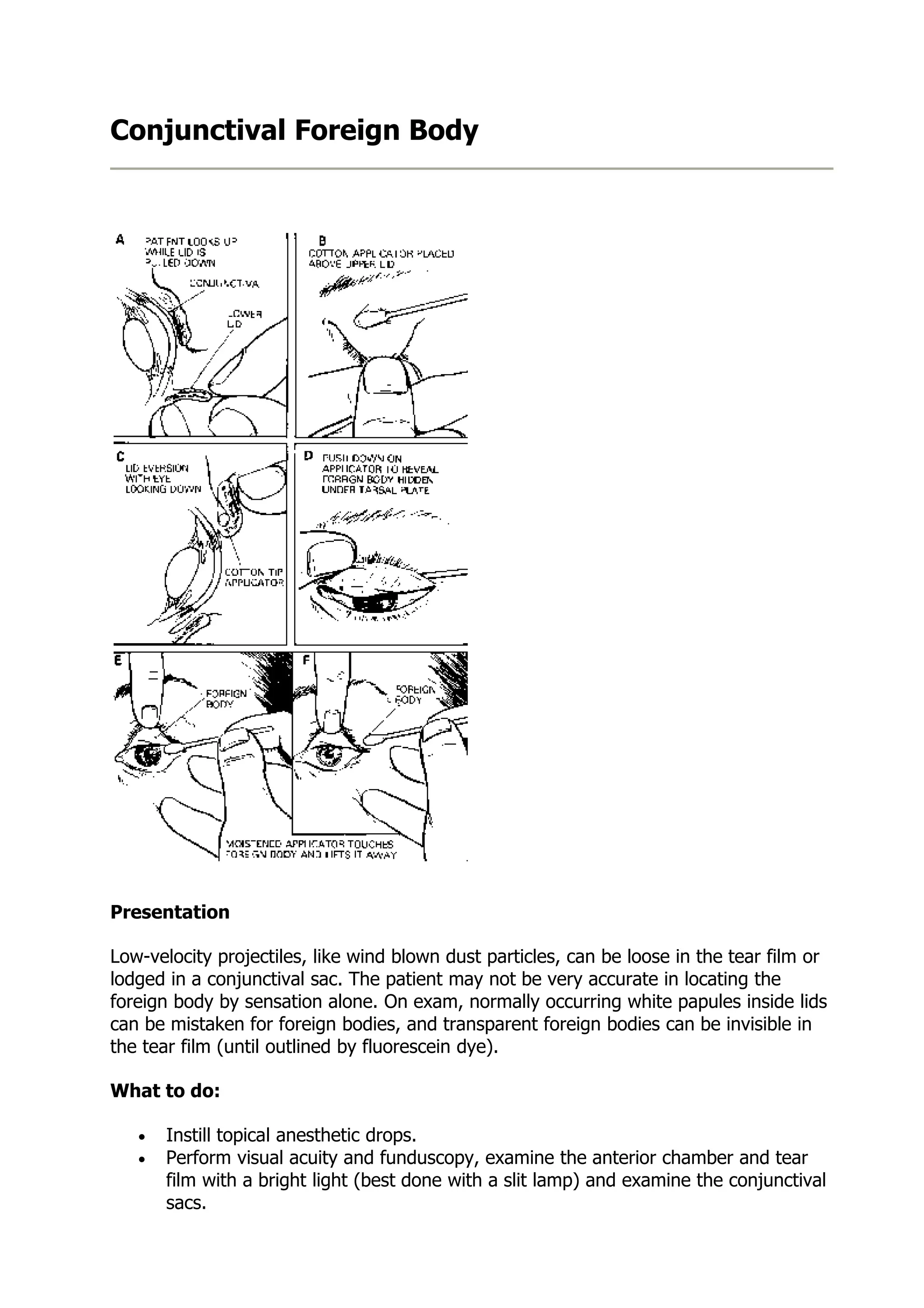
•   To examine the lower sac, pull the lower lid down with your finger while the
       patient looks up.
   •   To examine the upper sac, hold the proximal portion of the upper lid down with
       a cotton-tipped swab while pulling the lid out and up by its lashes, everting most
       of the lid, as the patient looks down. Push the cotton swab downward to help
       turn the upper conjunctival sac "inside out." The stiff tarsal plate usually keeps
       the upper lid everted after the swab is removed, and as long as the patient
       continues looking down. Looking up reduces the lid to its usual position.
   •   A loose foreign body usually adheres to a swab lightly touched to the surface of
       the conjunctiva, or will be washed out by copious irrigation with saline.
   •   Perform a fluorescein exam to disclose any corneal abrasion caused by the
       foreign body. These vertical scratches occur when the lid blinks over a coarse
       object and should be treated as described under "Corneal Abrasion."
   •   Follow with saline irrigation for possible fragments.

What not to do:

   •   Do not overlook a foreign body in the deep recesses of the upper conjunctival
       sac.
   •   Do not overlook an eyelash that has turned in and is rubbing on the surface of
       the eye. Sometimes you may see a lash sticking out of the inferior lacrimal
       punctum. Extract any such lashes.
   •   Do not overlook an embedded or penetrating foreign body.
   •   Do not overlook a corneal abrasion.

Discussion

Good first aid (copious irrigation and not rubbing eyes) will take care of most ocular
foreign bodies. The history of injury with a high velocity fragment such as a metal shard
chipped off a hammer or chisel should raise the question of a penetrating foreign body,
and x rays should be obtained. Techniques for conjunctival foreign body removal can
also be applied to locating a displaced contact lens, (see) but be aware that fluorescein
dye absorbed by soft contact lenses fades slowly.

Conjunctival Foreign Body

  • 1.
    Conjunctival Foreign Body Presentation Low-velocityprojectiles, like wind blown dust particles, can be loose in the tear film or lodged in a conjunctival sac. The patient may not be very accurate in locating the foreign body by sensation alone. On exam, normally occurring white papules inside lids can be mistaken for foreign bodies, and transparent foreign bodies can be invisible in the tear film (until outlined by fluorescein dye). What to do: • Instill topical anesthetic drops. • Perform visual acuity and funduscopy, examine the anterior chamber and tear film with a bright light (best done with a slit lamp) and examine the conjunctival sacs.
  • 2.
    To examine the lower sac, pull the lower lid down with your finger while the patient looks up. • To examine the upper sac, hold the proximal portion of the upper lid down with a cotton-tipped swab while pulling the lid out and up by its lashes, everting most of the lid, as the patient looks down. Push the cotton swab downward to help turn the upper conjunctival sac "inside out." The stiff tarsal plate usually keeps the upper lid everted after the swab is removed, and as long as the patient continues looking down. Looking up reduces the lid to its usual position. • A loose foreign body usually adheres to a swab lightly touched to the surface of the conjunctiva, or will be washed out by copious irrigation with saline. • Perform a fluorescein exam to disclose any corneal abrasion caused by the foreign body. These vertical scratches occur when the lid blinks over a coarse object and should be treated as described under "Corneal Abrasion." • Follow with saline irrigation for possible fragments. What not to do: • Do not overlook a foreign body in the deep recesses of the upper conjunctival sac. • Do not overlook an eyelash that has turned in and is rubbing on the surface of the eye. Sometimes you may see a lash sticking out of the inferior lacrimal punctum. Extract any such lashes. • Do not overlook an embedded or penetrating foreign body. • Do not overlook a corneal abrasion. Discussion Good first aid (copious irrigation and not rubbing eyes) will take care of most ocular foreign bodies. The history of injury with a high velocity fragment such as a metal shard chipped off a hammer or chisel should raise the question of a penetrating foreign body, and x rays should be obtained. Techniques for conjunctival foreign body removal can also be applied to locating a displaced contact lens, (see) but be aware that fluorescein dye absorbed by soft contact lenses fades slowly.