Thyroid Nodules
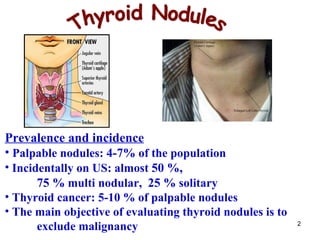
Thyroid Nodules Prevalence and incidence Palpable nodules:  4-7 %  of the population Incidentally on US: almost  50  %,   75  %  multi nodular,  25  %  solitary  Thyroid cancer:  5-10  % of palpable nodules The main objective of evaluating thyroid nodules is to  exclude malignancy
Type of thyroid nodules  Cyst : simple cyst, mixed cystic-solid  Colloid nudule : dominant nodule in MNG Adenoma : Follicular, Hurthle cell, Atypical  Thyroiditis : Hashimoto’s, subacute  Infection : Granulomatous disease, Abscess  Developmental anomalies : unilateral lobe agenesis,  cystic hygroma, Dermoid, Teratoma Carcinoma : papillary  ( 75 %),  follicular (  5-10 %),  medullary  ( 5-10 %) ,  anaplastic  ( 5 %), lymphoma  ( 5 %),  metastatic
Factors associated with increase risk for  malignant thyroid nodule  History  (moderate increase risk) Age  <  20  or  >  60  years Male sex Exposure of RT (especially in childhood) F.Hx of thyroid cancer or polyposis   Physical finding  (highly increase risk) larger than   3  cm Rapid tumor growth  Very firm nodule, irregular surface Fixation to adjacent structure Symptom of local invasion: dysphagia, hoarseness  Cervical lymphadenopathy Cold nodule on thyroid scan Solid or complex cyst on US
Factors suggesting benign thyroid nodule F.Hx of autoimmune disease (Hashimoto’s thyroiditis) F.Hx of benign thyroid nodule or goiter Presense of thyroid hormone dysfunction,  hypothyroid or hyperthyroid  Pain or tenderness associated with nodule Soft, smooth, mobile  MNG without a predominant nodule Warm nodule on thyroid scan Simple cyst on US
Investigation Laboratory evaluation TSH: screening for hyper or hypothyroid T 3,  T 4  : when TSH are low normal or high normal Serum antithyroid peroxidase (anti-TPO), antithyroglobulin (anti-Tg) if suspected thyroiditis  Imaging study CT, MRI, PET: not cost-effective in initial evaluation of  thyroid nodule  Ultrasound: characters that increase risk for malignant;  ill defined margin, irregular shape, solid echo, hypoechoic , calcification (fine): sensitivity   75  %,   specificity   61  % Thyroid isotope scanning :   131   I ,  123 I ,  99 TC   cold nodule  ( 84 %):   cancer risk   15 % warm nodule   ( 10.5 %):   cancer risk   9 % hot nodule   ( 5.5 %):   cancer risk   1 % T hyroxine suppression therapy with US follow up   sensitivity   83 %,   specificity   33 %
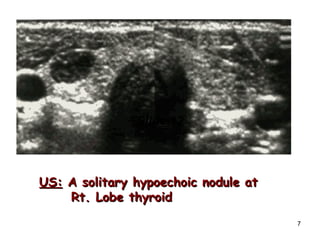
US:  A solitary hypoechoic nodule at Rt. Lobe thyroid Slide 12 Slide 12
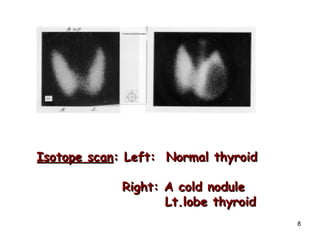
Isotope scan : Left:  Normal thyroid   Right: A cold nodule    Lt.lobe thyroid
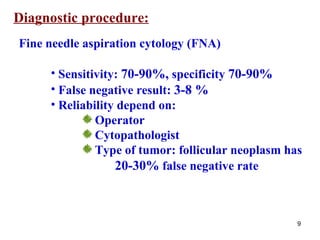
Diagnostic procedure: Fine needle aspiration cytology (FNA) Sensitivity:  70-90 %,  specificity  70-90 % False negative result:  3-8  % Reliability depend on:  Operator Cytopathologist Type of tumor: follicular neoplasm has 20-30 %  false negative rate
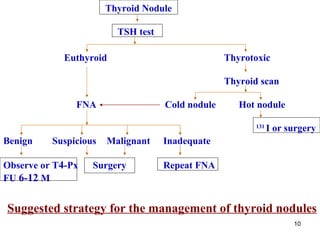
Thyroid Nodule TSH test Euthyroid Thyrotoxic Thyroid scan FNA   Cold nodule    Hot nodule 131  I or surgery Benign  Suspicious   Malignant Inadequate Observe or T 4 - Px  Surgery Repeat FNA FU  6-12   M Suggested strategy for the management of thyroid nodules
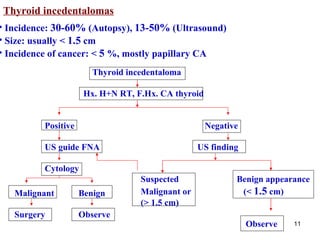
Thyroid incedentalomas Incidence:  30-60 %  (Autopsy),  13-50 %  (Ultrasound) Size: usually <  1.5   cm Incidence of cancer: <  5   %, mostly papillary CA  Thyroid incedentaloma Hx. H+N RT, F.Hx. CA thyroid Positive Negative US guide FNA   US finding Cytology Suspected  Benign appearance Malignant or   (<  1.5   cm) ( >  1.5  cm )   Observe Malignant  Benign Surgery Observe
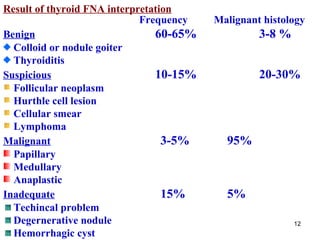
  Frequency   Malignant histology Benign   60-65 % 3-8  % Colloid or nodule goiter Thyroiditis Suspicious   10-15 % 20-30 % Follicular neoplasm Hurthle cell lesion Cellular smear Lymphoma Malignant   3-5 % 95 % Papillary Medullary Anaplastic Inadequate   15 % 5 % Techincal problem Degernerative nodule Hemorrhagic cyst Result of thyroid FNA interpretation
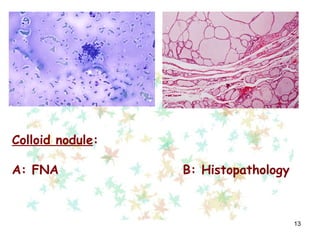
Colloid nodule : A: FNA   B: Histopathology
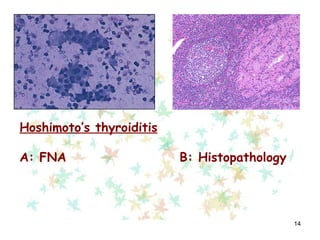
Hoshimoto’s thyroiditis A: FNA B: Histopathology
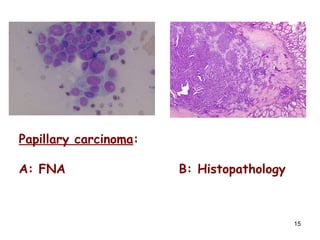
Papillary carcinoma :  A: FNA B: Histopathology
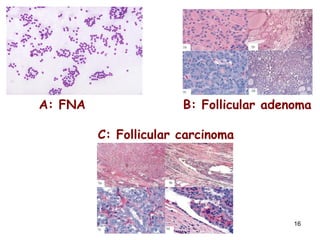
A: FNA    B: Follicular adenoma   C: Follicular carcinoma

Thyroid Noudle

  • 1.
  • 2.
    Thyroid Nodules Prevalenceand incidence Palpable nodules: 4-7 % of the population Incidentally on US: almost 50 %, 75 % multi nodular, 25 % solitary Thyroid cancer: 5-10 % of palpable nodules The main objective of evaluating thyroid nodules is to exclude malignancy
  • 3.
    Type of thyroidnodules Cyst : simple cyst, mixed cystic-solid Colloid nudule : dominant nodule in MNG Adenoma : Follicular, Hurthle cell, Atypical Thyroiditis : Hashimoto’s, subacute Infection : Granulomatous disease, Abscess Developmental anomalies : unilateral lobe agenesis, cystic hygroma, Dermoid, Teratoma Carcinoma : papillary ( 75 %), follicular ( 5-10 %), medullary ( 5-10 %) , anaplastic ( 5 %), lymphoma ( 5 %), metastatic
  • 4.
    Factors associated withincrease risk for malignant thyroid nodule History (moderate increase risk) Age < 20 or > 60 years Male sex Exposure of RT (especially in childhood) F.Hx of thyroid cancer or polyposis Physical finding (highly increase risk) larger than 3 cm Rapid tumor growth Very firm nodule, irregular surface Fixation to adjacent structure Symptom of local invasion: dysphagia, hoarseness Cervical lymphadenopathy Cold nodule on thyroid scan Solid or complex cyst on US
  • 5.
    Factors suggesting benignthyroid nodule F.Hx of autoimmune disease (Hashimoto’s thyroiditis) F.Hx of benign thyroid nodule or goiter Presense of thyroid hormone dysfunction, hypothyroid or hyperthyroid Pain or tenderness associated with nodule Soft, smooth, mobile MNG without a predominant nodule Warm nodule on thyroid scan Simple cyst on US
  • 6.
    Investigation Laboratory evaluationTSH: screening for hyper or hypothyroid T 3, T 4 : when TSH are low normal or high normal Serum antithyroid peroxidase (anti-TPO), antithyroglobulin (anti-Tg) if suspected thyroiditis Imaging study CT, MRI, PET: not cost-effective in initial evaluation of thyroid nodule Ultrasound: characters that increase risk for malignant; ill defined margin, irregular shape, solid echo, hypoechoic , calcification (fine): sensitivity 75 %, specificity 61 % Thyroid isotope scanning : 131 I , 123 I , 99 TC cold nodule ( 84 %): cancer risk 15 % warm nodule ( 10.5 %): cancer risk 9 % hot nodule ( 5.5 %): cancer risk 1 % T hyroxine suppression therapy with US follow up sensitivity 83 %, specificity 33 %
  • 7.
    US: Asolitary hypoechoic nodule at Rt. Lobe thyroid Slide 12 Slide 12
  • 8.
    Isotope scan :Left: Normal thyroid Right: A cold nodule Lt.lobe thyroid
  • 9.
    Diagnostic procedure: Fineneedle aspiration cytology (FNA) Sensitivity: 70-90 %, specificity 70-90 % False negative result: 3-8 % Reliability depend on: Operator Cytopathologist Type of tumor: follicular neoplasm has 20-30 % false negative rate
  • 10.
    Thyroid Nodule TSHtest Euthyroid Thyrotoxic Thyroid scan FNA Cold nodule Hot nodule 131 I or surgery Benign Suspicious Malignant Inadequate Observe or T 4 - Px Surgery Repeat FNA FU 6-12 M Suggested strategy for the management of thyroid nodules
  • 11.
    Thyroid incedentalomas Incidence: 30-60 % (Autopsy), 13-50 % (Ultrasound) Size: usually < 1.5 cm Incidence of cancer: < 5 %, mostly papillary CA Thyroid incedentaloma Hx. H+N RT, F.Hx. CA thyroid Positive Negative US guide FNA US finding Cytology Suspected Benign appearance Malignant or (< 1.5 cm) ( > 1.5 cm ) Observe Malignant Benign Surgery Observe
  • 12.
    Frequency Malignant histology Benign 60-65 % 3-8 % Colloid or nodule goiter Thyroiditis Suspicious 10-15 % 20-30 % Follicular neoplasm Hurthle cell lesion Cellular smear Lymphoma Malignant 3-5 % 95 % Papillary Medullary Anaplastic Inadequate 15 % 5 % Techincal problem Degernerative nodule Hemorrhagic cyst Result of thyroid FNA interpretation
  • 13.
    Colloid nodule :A: FNA B: Histopathology
  • 14.
    Hoshimoto’s thyroiditis A:FNA B: Histopathology
  • 15.
    Papillary carcinoma : A: FNA B: Histopathology
  • 16.
    A: FNA B: Follicular adenoma C: Follicular carcinoma