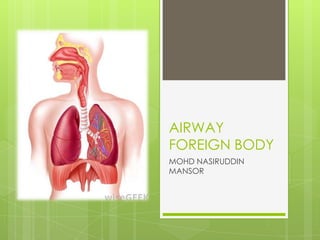
AIRWAY
FOREIGN BODY
MOHD NASIRUDDIN
MANSOR
EPIDIMIOLOGY
 Most

airway foreign body aspirations
occur in children younger than 15 years.
 Children aged 1-3 years are the most
susceptible.
ETIOLOGY
Young children are susceptible because:






They lack molars for proper grinding of
food.
They tend to be running or playing at the
time of aspiration.
They tend to put objects in their mouth
more frequently.
They lack coordination of swallowing and
glottic closure.
PATHOPHYSIOLOGY
 Food

items are aspirated most commonly;
 Peanuts are the most frequently aspirated
food
 After foreign body aspiration occurs, the
foreign body can settle into 3 anatomic
sites, the larynx, trachea, or bronchus.
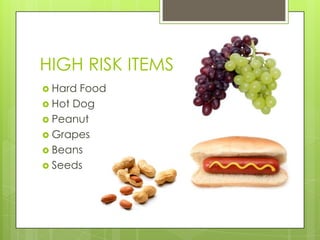
HIGH RISK ITEMS
 Hard

Food
 Hot Dog
 Peanut
 Grapes
 Beans
 Seeds
STAGES/PHASES OF FOREIGN
BODY ASPIRATION






Initial phase - Choking and
gasping, coughing, or airway obstruction at
the time of aspiration
Asymptomatic phase - Subsequent lodging of
the object with relaxation of reflexes that
often results in a reduction or cessation of
symptoms, lasting hours to weeks
Complications phase - Foreign body
producing erosion or obstruction leading to
pneumonia, atelectasis, or abscess
FOREIGN BODY IN THE NOSE
 Symptoms:
•

•
•
•
•
•

Difficulty breathing through the affected
nostril.
Feeling of something in the nose
Foul-smelling
Bloody nasal discharge
Irritability, particularly in infants
Irritation or pain in the nose
DIAGNOSIS
 Patient

history
 Rhinoscopy
 Radiograph
METHOD OF REMOVAL
1. Give anaesthesia – general or local
2. Visualization
3. Removal
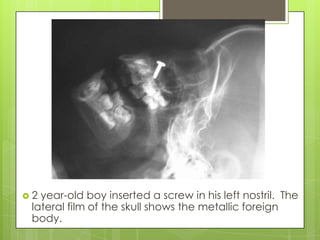
2

year-old boy inserted a screw in his left nostril. The
lateral film of the skull shows the metallic foreign
body.
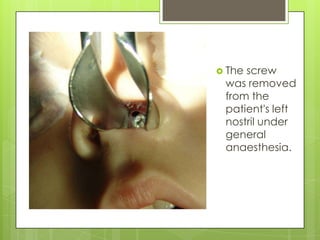
 The

screw
was removed
from the
patient's left
nostril under
general
anaesthesia.
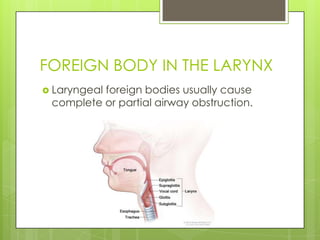
FOREIGN BODY IN THE LARYNX
 Laryngeal

foreign bodies usually cause
complete or partial airway obstruction.
LARYNGEAL FOREIGN BODY
SYMPTOMS
 Croup(laryngotracheobronchitis)
 Stridor(abnormal,

high-pitched, musical

breathing sound)
 Cough
 Hoarseness
 Dyspnoea
 Odynophagia(painful swallowing)
 Aphonia
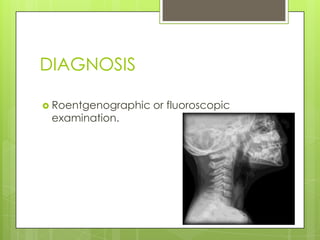
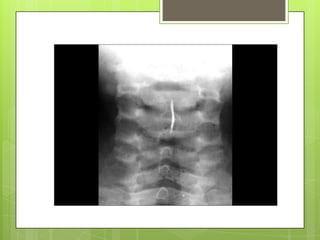
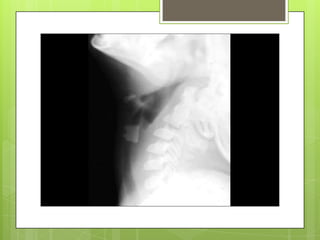
DIAGNOSIS
 Roentgenographic

examination.

or fluoroscopic
MANAGEMENT
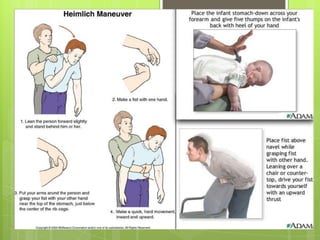
 Heimlich

manoeuvre
 Tracheotomy
 Laryngoscopy
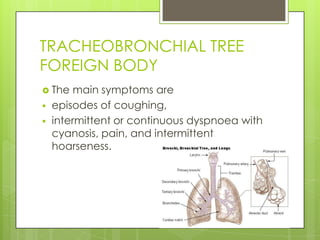
TRACHEOBRONCHIAL TREE
FOREIGN BODY
 The



main symptoms are
episodes of coughing,
intermittent or continuous dyspnoea with
cyanosis, pain, and intermittent
hoarseness.
SITE
 This

depends on the size and shape of the
foreign body.
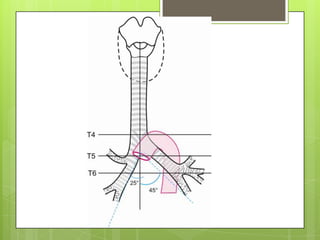
 The most common site is the right main
bronchus because of its straighter angle
of origin from the trachea.
SITE


1.
2.
3.
4.
5.
6.
7.

If the foreign body is retained for a longer
period the following occur depending on the
type of foreign body and duration:
accumulation of secretions;
tracheitis or bronchitis with edema,
swelling, and granulations;
bleeding and bloodstained secretions;
inspiratory and expiratory valvular stenoses;
partial obstruction of the lower airway or
emphysema;
atelectasis or overinflation of the
poststenotic part of the lung.
DIAGNOSIS
 Roentgenographic

examination.

or fluoroscopic
TREATMENT
 Bronchoscopy(under

general anesthesia)
Airway foreign body

Airway foreign body