Nephrotic Syndrome (NS)
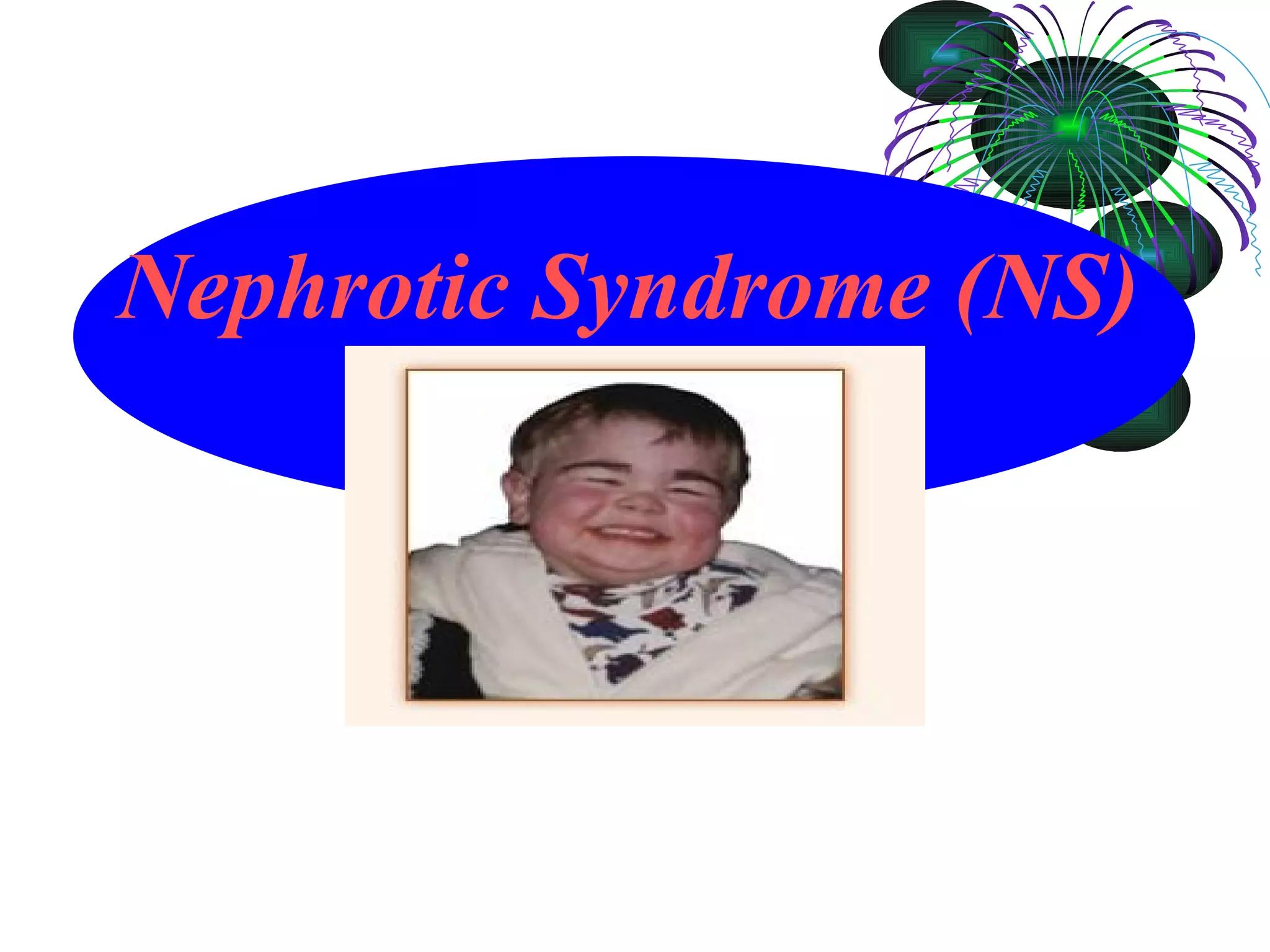
Definition NS is an accumulation of  symptoms and signs and is characterized by proteinuria, hypoproteinemia,  edema, and  hyperlipidemia. In children under age 5 years the disease usually takes the form of idiopathic (primary) NS of childhood
 
 
Pathogenesis   The primary disorder is an increase in glomerular permea- bility to plasma proteins.   *Foot processes of the visceral epithelium of the GBM. 1. The construction of the glomerular basement membrane has changed.  2. The loss of the negative charges on the GBM.   * The underlying pathogenesis is unknown, but evidence strongly supports the importance of immune mechanisms.
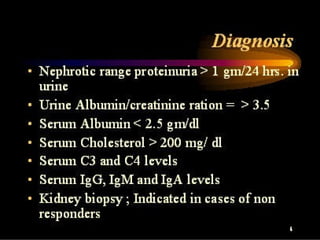
Pathophysiology   1. Proteinuria: Fundamental and highly important change of pathophysiology. 2. Hypoproteinemia (mainly albumin)  3. Edema: Nephrotic edema  (pitting edema) 4.   Hyperlipidemia (Hypercholesterolemia)   Ch↑, TG↑, LDL-ch↑,VLDL-ch↑.
  Clinical Manifestations There is a male preponderance of 2:1.   1. Main manifestations: Edema (varying degrees) is the common symptom. Periorbital swelling and perhaps oliguria are noticed->increasing edema->anasarca evident.  2. General symptoms:  Pallid, anorexia, fatigue,abdominal pain, diarrhea.
  Laboratory Exam 1. Urinary protein: 2 + ~ 4 +   24hr total urinary protein  > 0.1g/kg.( The most are selective  proteinuria. )May occur granular and red cell casts. 2. Total serum protein↓, < 30g/L .Albumin levels are low ( < 20g/L).  3. Serum   cholesterol and  triglycerides:   Cholesterol  > 5.7mmol/L (220mg/dl). 4.   ESR↑ > 100mm/hr.
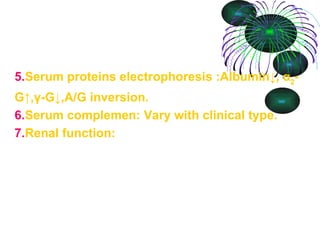
5. Serum proteins electrophoresis :Albumin↓, α 2 -G↑,γ-G↓,A/G inversion. 6. Serum complemen: Vary with clinical type. 7. Renal function:
 
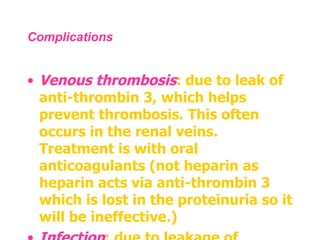
Complications  Venous thrombosis : due to leak of anti-thrombin 3, which helps prevent thrombosis. This often occurs in the renal veins. Treatment is with oral anticoagulants (not heparin as heparin acts via anti-thrombin 3 which is lost in the proteinuria so it will be ineffective.)  Infection : due to leakage of immunoglobulins, encapsulated bacteria such as  Haemophilus influenzae  and  Streptococcus pneumonia  can cause infection .
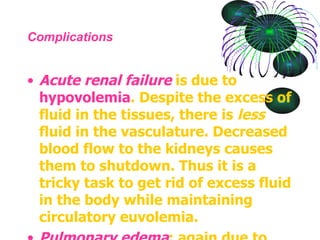
Complications Acute renal failure  is due to  hypovolemia . Despite the excess of fluid in the tissues, there is  less  fluid in the vasculature. Decreased blood flow to the kidneys causes them to shutdown. Thus it is a tricky task to get rid of excess fluid in the body while maintaining circulatory euvolemia.  Pulmonary edema : again due to fluid leak, sometimes it leaks into lungs causing  hypoxia  and  dyspnoea .
Complications Growth retardation : does not occur in MCNS.It occurs in cases of relapses or resistance to therapy. Causes of growth retardation are protein deficiency from the loss of protein in urine,  anorexia  (reduced protein intake), and steroid therapy (catabolism).  Vitamin D deficiency  can occur. Thyroxine is reduced due to decreased thyroid binding globulin.  Microcytic  hypochromic  anaemia is typical. It is iron-therapy resistant.
Principle of therapy (1) Salt and free water restriction Diuretics –  Thiazide or loop diuretics. –  Caution for dehydration that can cause ARF Modest protein restriction –  0.5-0.6 g/kg/day Hyperlipidemia treatment Vitamin D suppliment
Principle of therapy (2) Modest protein restriciton High protein diet increases urinary protein excretion rate => worsen glomerular lesion If proteinuria >10g/day –  (-) nitrogen balance & protein malnutrition •   Need supplimental dietary protein
General measures (supportive) Monitoring and maintaining euvolemia (the correct amount of fluid in the body):  monitoring urine output, BP regularly  fluid restrict to 1L  diuretics (IV furosemide)  Monitoring kidney function:  do EUCs daily and calculating GFR  Prevent and treat any complications [see below]  Albumin infusions are generally not used because their effect lasts only transiently.  Prophylactic anticoagulation may be appropriate in some circumstances. [4]
Specific treatment of underlying cause   Immunosuppression for the glomerulonephritides ( corticosteroids [5] ,  ciclosporin ).  Standard ISKDC regime for first episode:  prednisolone  -60 mg/m2/day in 3 divided doses for 4 weeks followed by 40 mg/m2/day in a single dose on every alternate day for 4 weeks.  Relapses by prednisolone 2 mg/kg/day till urine becomes negative for protein. Then, 1.5 mg/kg/day for 4 weeks.  Frequent relapses treated by:  cyclophosphamide  or nitrogen mustard or ciclosporin or  levamisole .  Achieving stricter blood glucose control if diabetic.  Blood pressure  control.  ACE inhibitors  are the drug of choice. Independent of their blood pressure lowering effect, they have been shown to decrease protein loss.
Dietary recommendations   Reduce sodium intake to 1000-2000 milligrams daily. Foods high in sodium include salt used in cooking and at the table, seasoning blends (garlic salt, Adobo, season salt, etc.) canned soups, canned vegetables containing salt, luncheon meats including turkey, ham, bologna, and salami, prepared foods, fast foods, soy sauce, ketchup, and salad dressings.
Dietary recommendations On food labels, compare milligrams of sodium to calories per serving. Sodium should be less than or equal to calories per serving. Eat a moderate amount of high protein animal food: 3-5 oz per meal (preferably lean cuts of meat, fish, and poultry) Avoid saturated fats such as butter, cheese, fried foods, fatty cuts of red meat, egg yolks, and poultry skin. Increase unsaturated fat intake, including olive oil, canola oil, peanut butter, avocadoes, fish and nuts. Eat low-fat desserts. Increase intake of fruits and vegetables. There is no potassium or phosphorus restriction necessary. Monitor fluid intake, which includes all fluids and foods that are liquid at room temperature. Fluid management in nephrotic syndrome is tenuous, especially during an acute flare.
Prognosis The prognosis depends on the cause of nephrotic syndrome. It is usually good in children, because  minimal change disease  responds very well to  steroids  and does not cause  chronic renal failure . However other causes such as  focal segmental  glomerulosclerosis  frequently lead to  end stage renal disease . Factors associated with a poorer prognosis in these cases include level of  proteinuria ,  blood pressure  control and kidney function ( GFR ).

Nephrotic Syndrome

  • 1.
  • 2.
    Definition NS isan accumulation of symptoms and signs and is characterized by proteinuria, hypoproteinemia, edema, and hyperlipidemia. In children under age 5 years the disease usually takes the form of idiopathic (primary) NS of childhood
  • 3.
  • 4.
  • 5.
    Pathogenesis The primary disorder is an increase in glomerular permea- bility to plasma proteins. *Foot processes of the visceral epithelium of the GBM. 1. The construction of the glomerular basement membrane has changed. 2. The loss of the negative charges on the GBM. * The underlying pathogenesis is unknown, but evidence strongly supports the importance of immune mechanisms.
  • 6.
    Pathophysiology 1. Proteinuria: Fundamental and highly important change of pathophysiology. 2. Hypoproteinemia (mainly albumin) 3. Edema: Nephrotic edema (pitting edema) 4.   Hyperlipidemia (Hypercholesterolemia) Ch↑, TG↑, LDL-ch↑,VLDL-ch↑.
  • 7.
    ClinicalManifestations There is a male preponderance of 2:1. 1. Main manifestations: Edema (varying degrees) is the common symptom. Periorbital swelling and perhaps oliguria are noticed->increasing edema->anasarca evident. 2. General symptoms: Pallid, anorexia, fatigue,abdominal pain, diarrhea.
  • 8.
    LaboratoryExam 1. Urinary protein: 2 + ~ 4 + 24hr total urinary protein > 0.1g/kg.( The most are selective proteinuria. )May occur granular and red cell casts. 2. Total serum protein↓, < 30g/L .Albumin levels are low ( < 20g/L). 3. Serum cholesterol and triglycerides: Cholesterol > 5.7mmol/L (220mg/dl). 4. ESR↑ > 100mm/hr.
  • 9.
    5. Serum proteinselectrophoresis :Albumin↓, α 2 -G↑,γ-G↓,A/G inversion. 6. Serum complemen: Vary with clinical type. 7. Renal function:
  • 10.
  • 11.
    Complications Venousthrombosis : due to leak of anti-thrombin 3, which helps prevent thrombosis. This often occurs in the renal veins. Treatment is with oral anticoagulants (not heparin as heparin acts via anti-thrombin 3 which is lost in the proteinuria so it will be ineffective.) Infection : due to leakage of immunoglobulins, encapsulated bacteria such as Haemophilus influenzae and Streptococcus pneumonia can cause infection .
  • 12.
    Complications Acute renalfailure is due to hypovolemia . Despite the excess of fluid in the tissues, there is less fluid in the vasculature. Decreased blood flow to the kidneys causes them to shutdown. Thus it is a tricky task to get rid of excess fluid in the body while maintaining circulatory euvolemia. Pulmonary edema : again due to fluid leak, sometimes it leaks into lungs causing hypoxia and dyspnoea .
  • 13.
    Complications Growth retardation: does not occur in MCNS.It occurs in cases of relapses or resistance to therapy. Causes of growth retardation are protein deficiency from the loss of protein in urine, anorexia (reduced protein intake), and steroid therapy (catabolism). Vitamin D deficiency can occur. Thyroxine is reduced due to decreased thyroid binding globulin. Microcytic hypochromic anaemia is typical. It is iron-therapy resistant.
  • 14.
    Principle of therapy(1) Salt and free water restriction Diuretics – Thiazide or loop diuretics. – Caution for dehydration that can cause ARF Modest protein restriction – 0.5-0.6 g/kg/day Hyperlipidemia treatment Vitamin D suppliment
  • 15.
    Principle of therapy(2) Modest protein restriciton High protein diet increases urinary protein excretion rate => worsen glomerular lesion If proteinuria >10g/day – (-) nitrogen balance & protein malnutrition • Need supplimental dietary protein
  • 16.
    General measures (supportive)Monitoring and maintaining euvolemia (the correct amount of fluid in the body): monitoring urine output, BP regularly fluid restrict to 1L diuretics (IV furosemide) Monitoring kidney function: do EUCs daily and calculating GFR Prevent and treat any complications [see below] Albumin infusions are generally not used because their effect lasts only transiently. Prophylactic anticoagulation may be appropriate in some circumstances. [4]
  • 17.
    Specific treatment ofunderlying cause Immunosuppression for the glomerulonephritides ( corticosteroids [5] , ciclosporin ). Standard ISKDC regime for first episode: prednisolone -60 mg/m2/day in 3 divided doses for 4 weeks followed by 40 mg/m2/day in a single dose on every alternate day for 4 weeks. Relapses by prednisolone 2 mg/kg/day till urine becomes negative for protein. Then, 1.5 mg/kg/day for 4 weeks. Frequent relapses treated by: cyclophosphamide or nitrogen mustard or ciclosporin or levamisole . Achieving stricter blood glucose control if diabetic. Blood pressure control. ACE inhibitors are the drug of choice. Independent of their blood pressure lowering effect, they have been shown to decrease protein loss.
  • 18.
    Dietary recommendations Reduce sodium intake to 1000-2000 milligrams daily. Foods high in sodium include salt used in cooking and at the table, seasoning blends (garlic salt, Adobo, season salt, etc.) canned soups, canned vegetables containing salt, luncheon meats including turkey, ham, bologna, and salami, prepared foods, fast foods, soy sauce, ketchup, and salad dressings.
  • 19.
    Dietary recommendations Onfood labels, compare milligrams of sodium to calories per serving. Sodium should be less than or equal to calories per serving. Eat a moderate amount of high protein animal food: 3-5 oz per meal (preferably lean cuts of meat, fish, and poultry) Avoid saturated fats such as butter, cheese, fried foods, fatty cuts of red meat, egg yolks, and poultry skin. Increase unsaturated fat intake, including olive oil, canola oil, peanut butter, avocadoes, fish and nuts. Eat low-fat desserts. Increase intake of fruits and vegetables. There is no potassium or phosphorus restriction necessary. Monitor fluid intake, which includes all fluids and foods that are liquid at room temperature. Fluid management in nephrotic syndrome is tenuous, especially during an acute flare.
  • 20.
    Prognosis The prognosisdepends on the cause of nephrotic syndrome. It is usually good in children, because minimal change disease responds very well to steroids and does not cause chronic renal failure . However other causes such as focal segmental glomerulosclerosis frequently lead to end stage renal disease . Factors associated with a poorer prognosis in these cases include level of proteinuria , blood pressure control and kidney function ( GFR ).