Acute  Append icitis
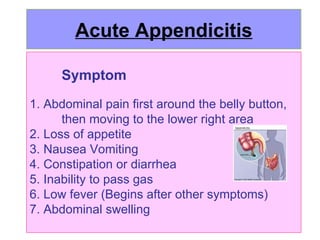
Acute  Append icitis Symptom  1. Abdominal pain first around the belly button,  then moving to the lower right area  2. Loss of appetite  3. Nause a  Vomiting  4. Constipation or diarrhea  5. Inability to pass gas  6. Low fever ( Begins after other symptoms ) 7. Abdominal swelling
Diagnosing Appendicitis 1. Symptoms ** 2. PE ** 3. Blood tests (dehydration or fluid and electrolyte ) 4. Abdominal X-Ray 5. Complete blood count  6. Urinalysis 7. Ultrasound  8.  Chest X-ray
Physical examination   Rebound tenderness and Guarding.  PR The doctor may also move the patient's legs to test for pain on flexion of the hip  ( P soas sign),  pain on internal rotation of the hip  (obturator sign),  or pain on the right side when pressing on the left  (Rovsing's sign).
Indication for admission 1.  D iagnose appendicitis  2.  Clinical sign R/O A ppendicitis
Other conditions can mimic   appendicitis ?   - Meckel's diverticulitis - Pelvic inflammatory disease - Right-sided diverticulitis - Kidney diseases. Inflammatory disease of right upper abdomen
The Surgical   Procedure Open operation Laparoscopic technique.
Recovery from the Operation - Open Appendectomy Will be up and walking within six hours.  Expect to be discharged barring complications in 1 – 2 days. - Laparoscopy Will most likely be discharged on the day of your  operation.
Indication for Antibiotic 1 .D iagnosis is uncertain =>NPO & Non treat antibiotics 2.  Non  Ruptures  appendicitis  =>   Non treat or treat   A ntibiotic Pre– O peration  only 3.   Rupture  (Peritonitis)  =>  Treat antibiotic  to control the infection  at  surgery &  P ost- op   1-3  days.
Appendiceal phlegmon   or Abcess PE  => Right lower quadrant – RLQ Rx. =>  Conservative  treatment with antibiotic   next 6 wk.- 3 month to elective      appendectomy  but non respond antibiotic   - severe => Drain   - non severe => surgery
People with Special Concerns 1. Immunosuppressive therapy such as steroids 2. Received a transplanted organ  3. Infected with the HIV virus  4. People with diabetes 5. Cancer or Receiving chemotherapy  6.  Obese people, Pregnant women ,Infants,  Young children and the elderly have particular issues

Appendicitis

  • 1.
  • 2.
    Acute Appendicitis Symptom 1. Abdominal pain first around the belly button, then moving to the lower right area 2. Loss of appetite 3. Nause a Vomiting 4. Constipation or diarrhea 5. Inability to pass gas 6. Low fever ( Begins after other symptoms ) 7. Abdominal swelling
  • 3.
    Diagnosing Appendicitis 1.Symptoms ** 2. PE ** 3. Blood tests (dehydration or fluid and electrolyte ) 4. Abdominal X-Ray 5. Complete blood count 6. Urinalysis 7. Ultrasound 8. Chest X-ray
  • 4.
    Physical examination Rebound tenderness and Guarding. PR The doctor may also move the patient's legs to test for pain on flexion of the hip ( P soas sign), pain on internal rotation of the hip (obturator sign), or pain on the right side when pressing on the left (Rovsing's sign).
  • 5.
    Indication for admission1. D iagnose appendicitis 2. Clinical sign R/O A ppendicitis
  • 6.
    Other conditions canmimic appendicitis ? - Meckel's diverticulitis - Pelvic inflammatory disease - Right-sided diverticulitis - Kidney diseases. Inflammatory disease of right upper abdomen
  • 7.
    The Surgical Procedure Open operation Laparoscopic technique.
  • 8.
    Recovery from theOperation - Open Appendectomy Will be up and walking within six hours. Expect to be discharged barring complications in 1 – 2 days. - Laparoscopy Will most likely be discharged on the day of your operation.
  • 9.
    Indication for Antibiotic1 .D iagnosis is uncertain =>NPO & Non treat antibiotics 2. Non Ruptures appendicitis => Non treat or treat A ntibiotic Pre– O peration only 3. Rupture (Peritonitis) => Treat antibiotic to control the infection at surgery & P ost- op 1-3 days.
  • 10.
    Appendiceal phlegmon or Abcess PE => Right lower quadrant – RLQ Rx. => Conservative treatment with antibiotic next 6 wk.- 3 month to elective appendectomy but non respond antibiotic - severe => Drain - non severe => surgery
  • 11.
    People with SpecialConcerns 1. Immunosuppressive therapy such as steroids 2. Received a transplanted organ 3. Infected with the HIV virus 4. People with diabetes 5. Cancer or Receiving chemotherapy 6. Obese people, Pregnant women ,Infants, Young children and the elderly have particular issues