Dysfunctional Uterine Bleeding
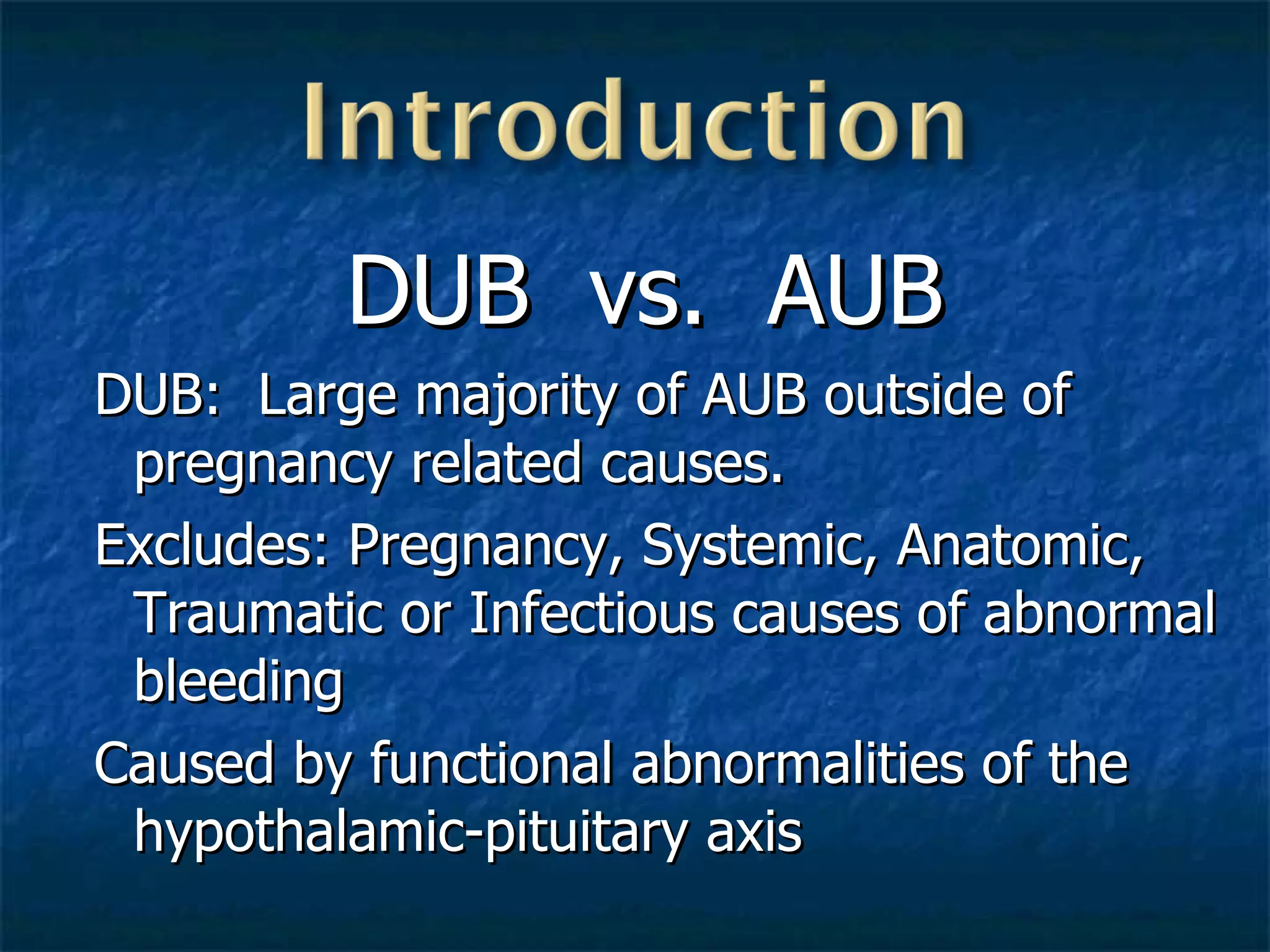
DUB  vs.  AUB DUB:  Large majority of AUB outside of pregnancy related causes. Excludes: Pregnancy, Systemic, Anatomic, Traumatic or Infectious causes of abnormal bleeding Caused by functional abnormalities of the hypothalamic-pituitary axis
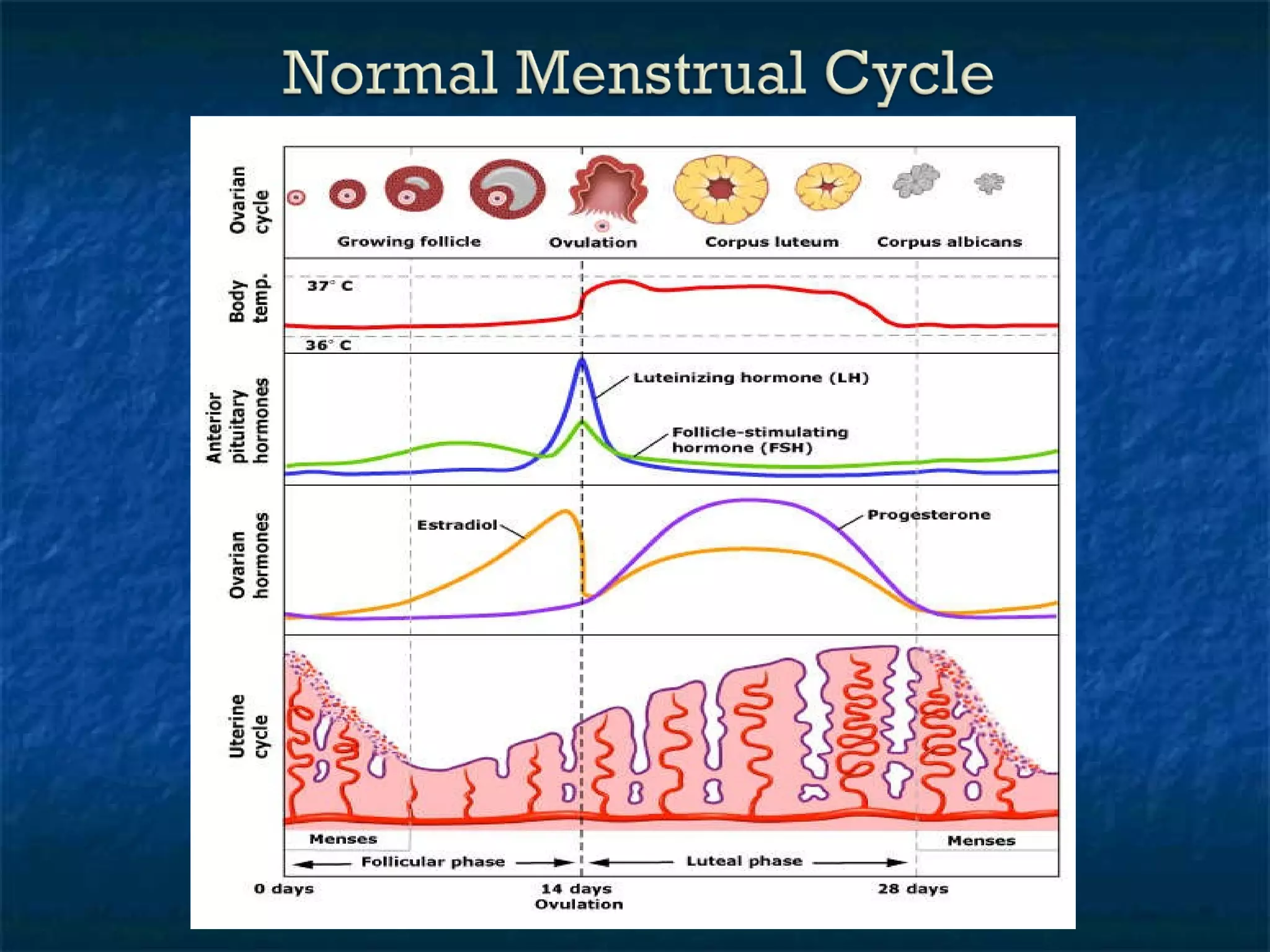
How do hormones work?
 
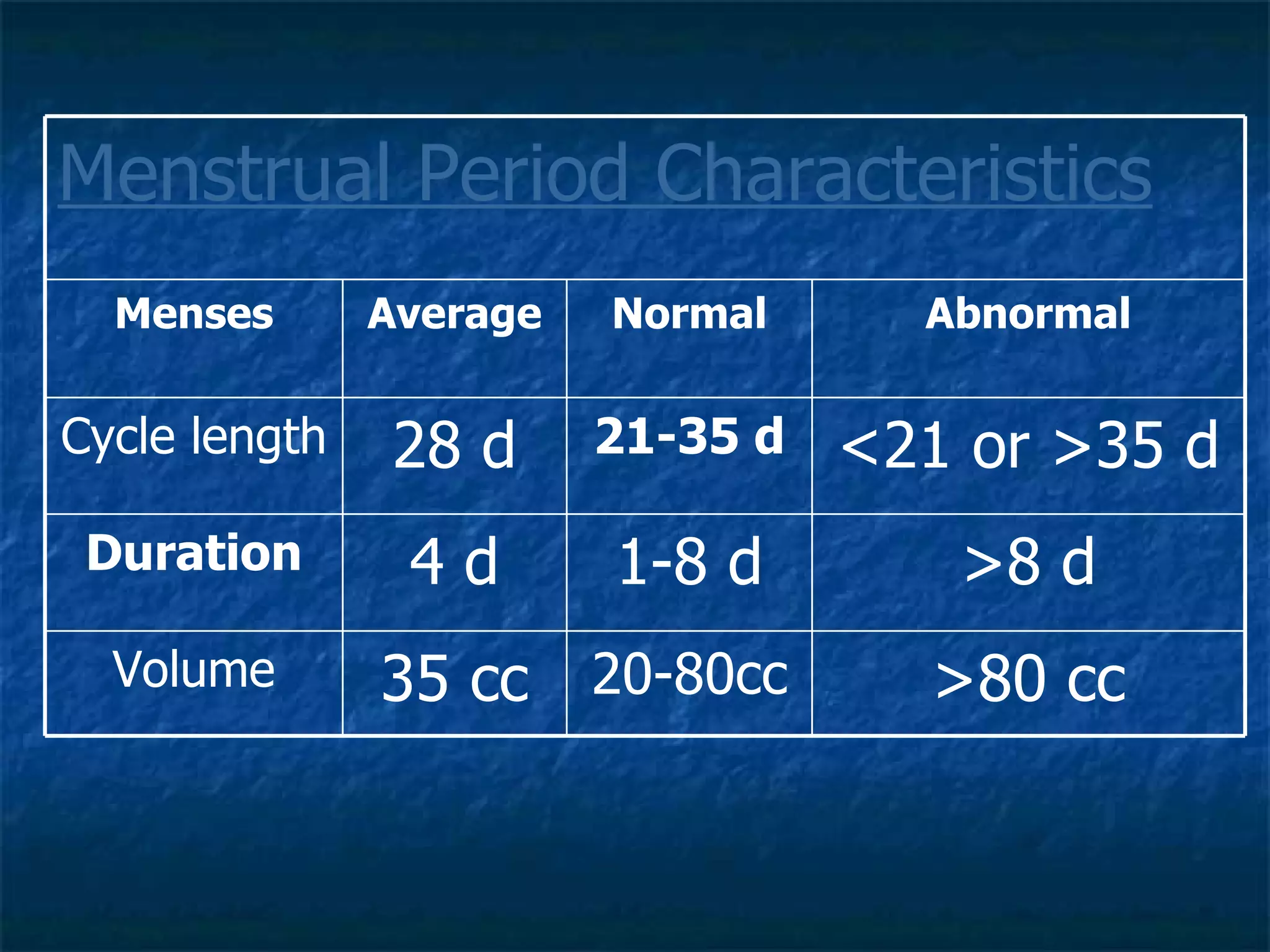
Menstrual Period Characteristics >80 cc 20-80cc 35   cc Volume >8   d 1-8   d 4   d Duration <21 or >35   d 21-35 d 28 d Cycle length Abnormal Normal Average M enses
Menorrhagia Prolonged (> 7 days) or excessive (> 80mL) uterine bleeding occurring at regular intervals Metrorrhagia Uterine bleeding occurring at irregular intervals or between periods Menometrorrhagia Uterine bleeding occurring at irregular intervals, with heavy (> 80mL) or prolonged (> 7 days) menstrual flow Polymenhorrhea Uterine bleeding occurring at regular intervals of < 21 days Oligomenorrhea Uterine bleeding occurring at intervals of 35 days or longer Amenorrhea Absence of uterine bleeding for 6 months or longer in a non-menopausal woman
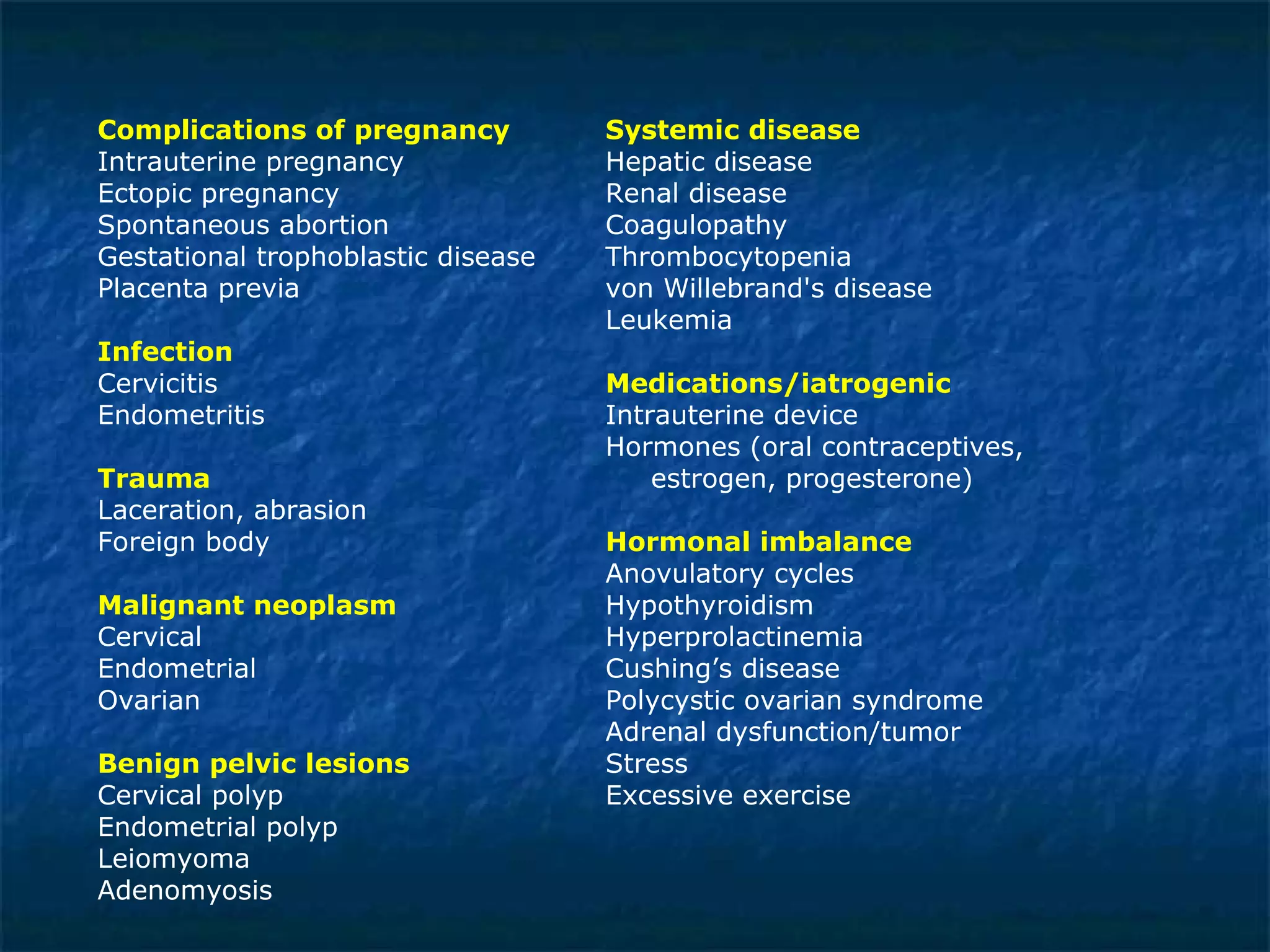
Complications of pregnancy Systemic disease   Intrauterine pregnancy Hepatic disease  Ectopic pregnancy Renal disease  Spontaneous abortion Coagulopathy  Gestational trophoblastic disease Thrombocytopenia  Placenta previa von Willebrand's disease  Leukemia Infection Cervicitis Medications/iatrogenic Endometritis Intrauterine device Hormones (oral contraceptives,  Trauma    estrogen, progesterone)  Laceration, abrasion  Foreign body  Hormonal imbalance Anovulatory cycles  Malignant neoplasm   Hypothyroidism     Cervical  Hyperprolactinemia  Endometrial   Cushing’s disease Ovarian  Polycystic ovarian syndrome  Adrenal dysfunction/tumor Benign pelvic lesions   Stress Cervical polyp Excessive exercise Endometrial polyp Leiomyoma  Adenomyosis
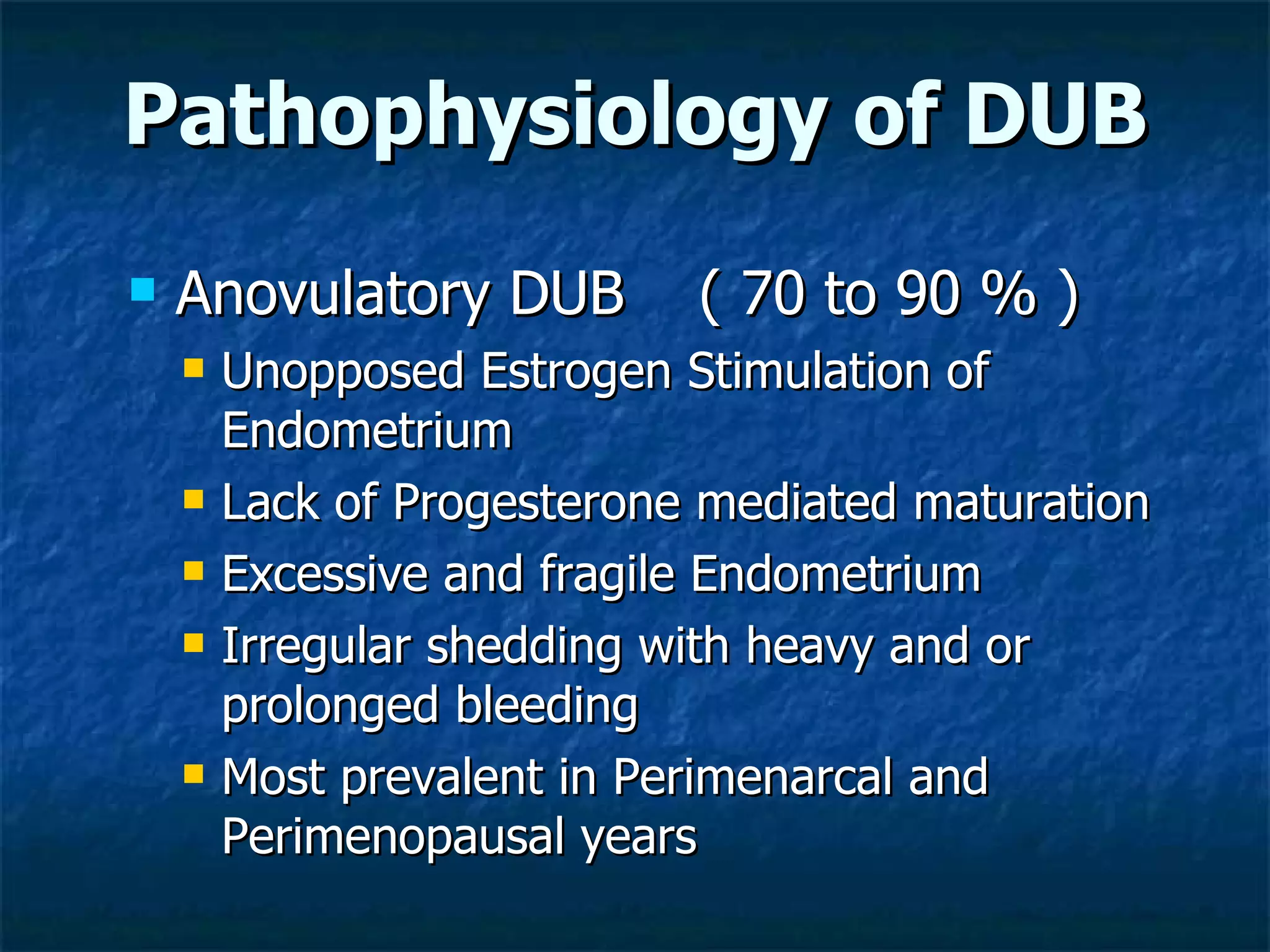
Pathophysiology of DUB Anovulatory DUB  ( 70 to 90 % ) Unopposed Estrogen Stimulation of Endometrium Lack of Progesterone mediated maturation Excessive and fragile Endometrium  Irregular shedding with heavy and or prolonged bleeding Most prevalent in Perimenarcal and Perimenopausal years
Pathophysiology  of DUB Ovulatory DUB  ( 10 to 30 % ) Some are from Luteal Phase deficiency Diminished progesterone with low, normal or high estrogen Prolonged progesterone secretion  Diminished potency of estrogen Lack of hypothalamic feedback and withdrawal
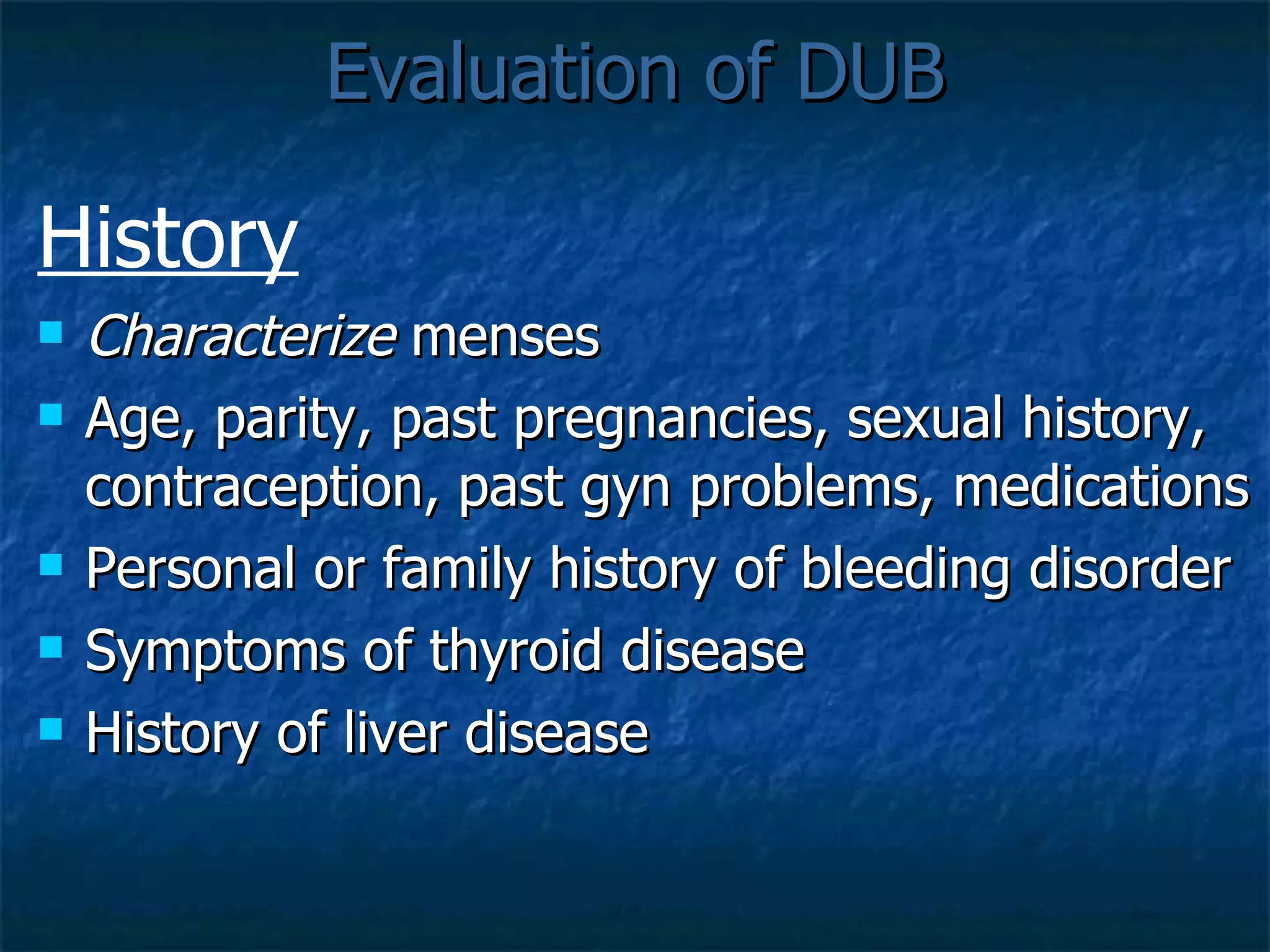
Evaluation of DUB History Characterize  menses Age, parity, past pregnancies, sexual history, contraception, past gyn problems, medications Personal or family history of bleeding disorder Symptoms of thyroid disease History of liver disease
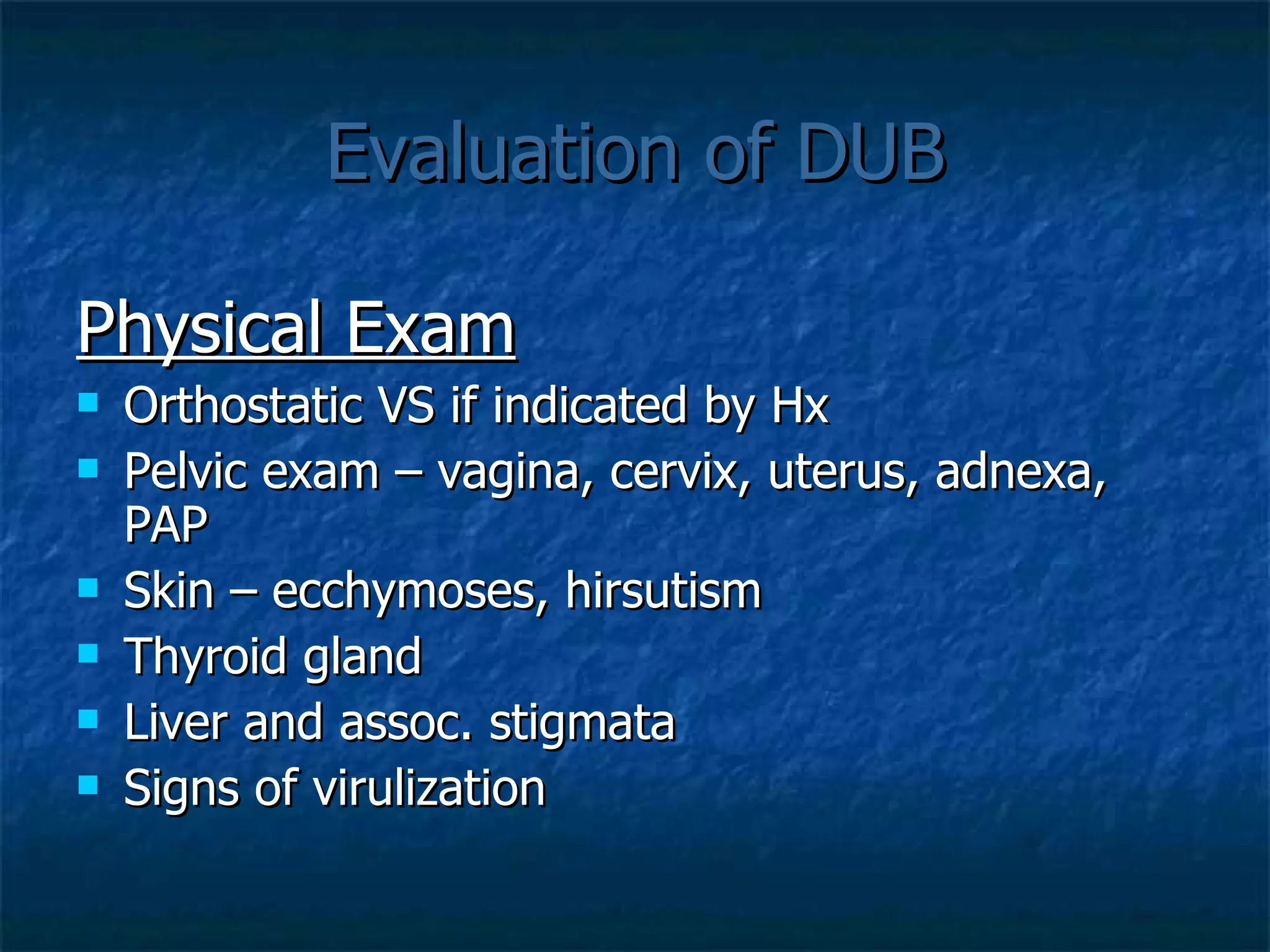
Evaluation of DUB Physical Exam Orthostatic VS if indicated by Hx Pelvic exam – vagina, cervix, uterus, adnexa, PAP Skin – ecchymoses, hirsutism Thyroid gland Liver and assoc. stigmata Signs of virulization
Evaluation of DUB
TVUS Simple in office procedure Equipment issues Experience issues Able to identify pathology of  endometrium as well as other pelvic abnormalities Thickened  (>5mm)  endometrial stripe in postmenopause ALWAYS needs further evaluation. Usually does NOT replace endometrial sampling in eval of DUB
Enhanced contrast/relief of endometrial lesions: fibroids, polyps CA Sensitivity/Specificity at 93 to 94 %  for focal lesions ( vs 75% for TVUS alone) Combined with EB:  very high rate of Dx Focal lesions then result in Hysteroscopy
Evaluation of DUB 4.Endometrial Suction Curette Pippelle :  most commonly  used, least discomfort Vabra Aspirator and  Karman Cannula 5.Endometrial Brush Superior in Post-Menopausal Same as Pipelle in Pre-Menop. (A) Pipelle endometrial suction curette. (B) Vabra aspirator. Tao Endometrial Brush
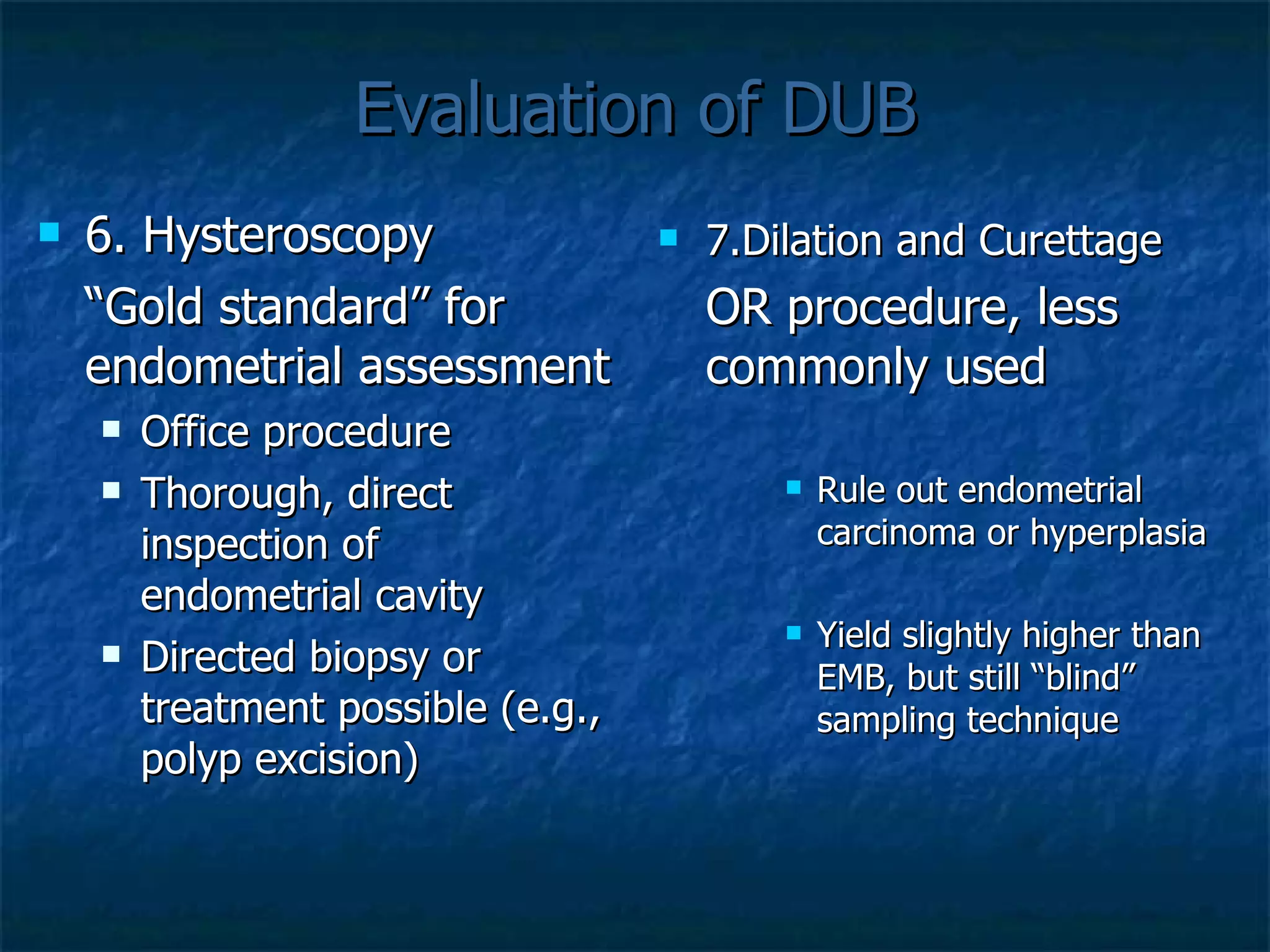
Evaluation of DUB 6. Hysteroscopy “ Gold standard” for endometrial assessment Office procedure Thorough, direct inspection of endometrial cavity Directed biopsy or treatment possible (e.g., polyp excision)  7.Dilation and Curettage OR procedure, less commonly used   Rule out endometrial carcinoma or hyperplasia Yield slightly higher than EMB, but still “blind” sampling technique
Medical treatment of DUB 1.Stop bleed Conjugated equine estrogen(CEE or Premarin) 25 mg iv q 4 hr,not more than 24 hr Oral combined contraceptive pill 2 tab daily for 5-7 day 2.Prevention of re-bleeding CEE 1.25 mg plus MPA 2.5 mg PO daily for 2-3 wk Other combination of estrogen and progestin in equivalent dose of the above Oral combined contraceptive pill in regular dosage
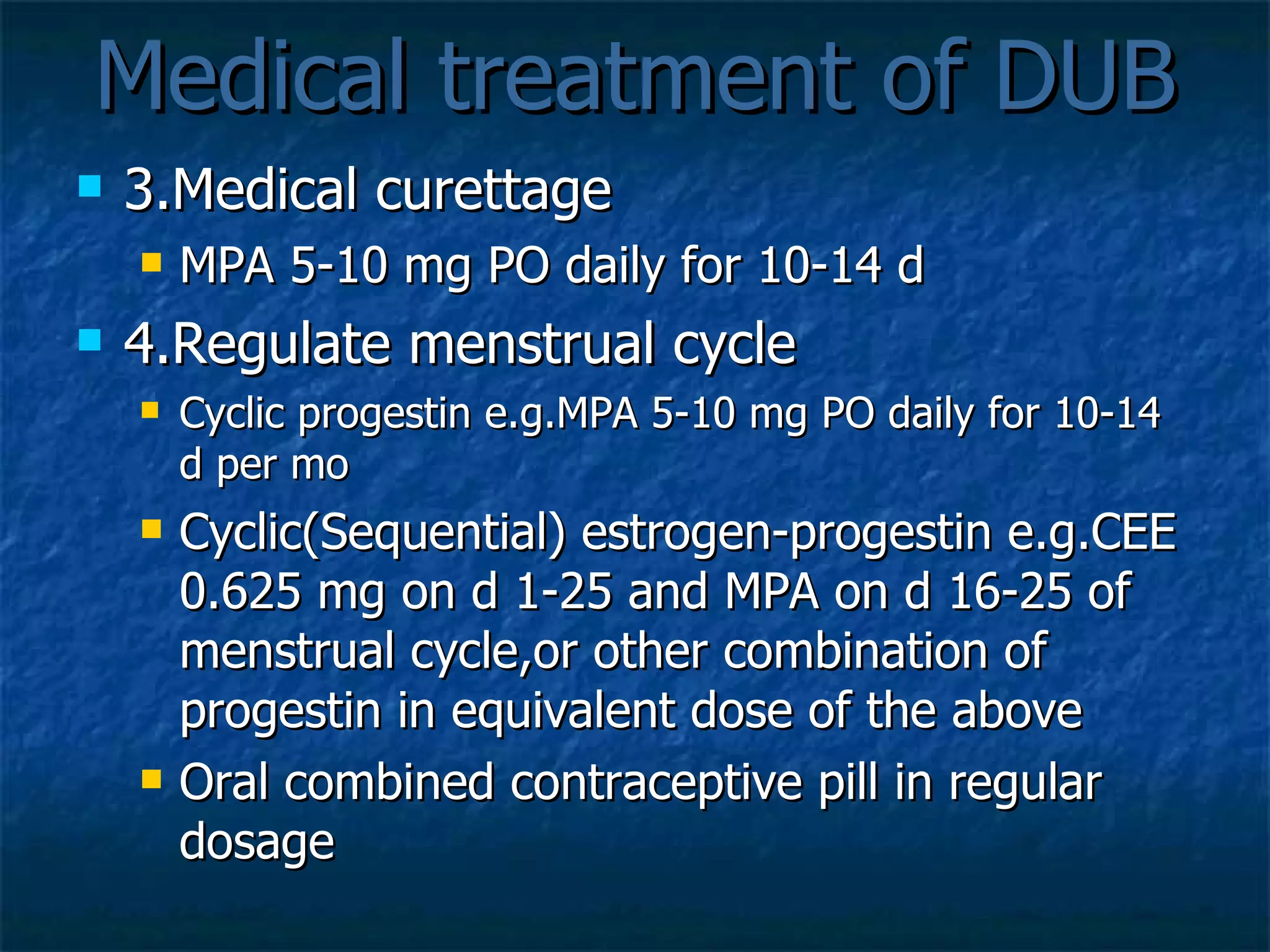
Medical treatment of DUB 3.Medical curettage MPA 5-10 mg PO daily for 10-14 d 4.Regulate menstrual cycle Cyclic progestin e.g.MPA 5-10 mg PO daily for 10-14 d per mo Cyclic(Sequential) estrogen-progestin e.g.CEE 0.625 mg on d 1-25 and MPA on d 16-25 of menstrual cycle,or other combination of progestin in equivalent dose of the above Oral combined contraceptive pill in regular dosage
Medical treatment of DUB 5.Reduce menstrual blood loss Long acting progestin e.g. progestin medicated IUD(Minera) Danazol 200 mg PO daily continuously Antifibrinolytic agent e.g.Tranexamic acid 250-1000 mg PO daily during   mens NSAID d 1-5 of cycle(can be upto 7 d) Mefenamic acid 500 mg PO at the onset of mens then 250-500 mg tid Naproxen 500 mg PO at the onset of mens then 250-500 mg bid Ibuprofen200-400 mg PO tid Oral combined contraceptive pill in regular dosage GnRH analogue
Medical treatment of DUB 6.High dose progestins MPA 200 mg PO daily,or Megace 500 mg PO daily,or DMPA 1000 mg IM weekly
Surgery treatment of DUB 1.Dilation and Curettage quickest way to stop bleeding in patients who are hypovolemic appropriate in older women (>35)to exclude malignancy but is inferior to hysteroscopy follow with medroxyprogesterone acetate, OCP’s, or NSAID’s  to prevent recurrence
Surgery treatment of DUB 2.Endometrial ablation Hysteroscopic methods Endometrial laser ablation Electrosurgical endometrial ablation Loop endometrial ablation Roller-ball endometriaal ablation usting resectoscope Nonhysteroscopic methods Radio-frequency-induced thermal endometrial ablation Microwave  endometrial ablation Uterine balloon therapy 3.Hysterectomy
Surgery treatment of DUB Uterine balloon therapy Roller-ball endometriaal ablation usting resectoscope
DUB is a common disorder in FM Evaluation and workup varies with age and risk factors Endometrial imaging and sampling is critical in women over 35 and those younger who are higher risk Multiple options for treatment exist for both medical and surgical modalities.

DUB

  • 1.
  • 2.
    DUB vs. AUB DUB: Large majority of AUB outside of pregnancy related causes. Excludes: Pregnancy, Systemic, Anatomic, Traumatic or Infectious causes of abnormal bleeding Caused by functional abnormalities of the hypothalamic-pituitary axis
  • 3.
  • 4.
  • 5.
    Menstrual Period Characteristics>80 cc 20-80cc 35 cc Volume >8 d 1-8 d 4 d Duration <21 or >35 d 21-35 d 28 d Cycle length Abnormal Normal Average M enses
  • 6.
    Menorrhagia Prolonged (>7 days) or excessive (> 80mL) uterine bleeding occurring at regular intervals Metrorrhagia Uterine bleeding occurring at irregular intervals or between periods Menometrorrhagia Uterine bleeding occurring at irregular intervals, with heavy (> 80mL) or prolonged (> 7 days) menstrual flow Polymenhorrhea Uterine bleeding occurring at regular intervals of < 21 days Oligomenorrhea Uterine bleeding occurring at intervals of 35 days or longer Amenorrhea Absence of uterine bleeding for 6 months or longer in a non-menopausal woman
  • 7.
    Complications of pregnancySystemic disease Intrauterine pregnancy Hepatic disease Ectopic pregnancy Renal disease Spontaneous abortion Coagulopathy Gestational trophoblastic disease Thrombocytopenia Placenta previa von Willebrand's disease Leukemia Infection Cervicitis Medications/iatrogenic Endometritis Intrauterine device Hormones (oral contraceptives, Trauma estrogen, progesterone) Laceration, abrasion Foreign body Hormonal imbalance Anovulatory cycles Malignant neoplasm Hypothyroidism Cervical Hyperprolactinemia Endometrial Cushing’s disease Ovarian Polycystic ovarian syndrome Adrenal dysfunction/tumor Benign pelvic lesions Stress Cervical polyp Excessive exercise Endometrial polyp Leiomyoma Adenomyosis
  • 8.
    Pathophysiology of DUBAnovulatory DUB ( 70 to 90 % ) Unopposed Estrogen Stimulation of Endometrium Lack of Progesterone mediated maturation Excessive and fragile Endometrium Irregular shedding with heavy and or prolonged bleeding Most prevalent in Perimenarcal and Perimenopausal years
  • 9.
    Pathophysiology ofDUB Ovulatory DUB ( 10 to 30 % ) Some are from Luteal Phase deficiency Diminished progesterone with low, normal or high estrogen Prolonged progesterone secretion Diminished potency of estrogen Lack of hypothalamic feedback and withdrawal
  • 10.
    Evaluation of DUBHistory Characterize menses Age, parity, past pregnancies, sexual history, contraception, past gyn problems, medications Personal or family history of bleeding disorder Symptoms of thyroid disease History of liver disease
  • 11.
    Evaluation of DUBPhysical Exam Orthostatic VS if indicated by Hx Pelvic exam – vagina, cervix, uterus, adnexa, PAP Skin – ecchymoses, hirsutism Thyroid gland Liver and assoc. stigmata Signs of virulization
  • 12.
  • 13.
    TVUS Simple inoffice procedure Equipment issues Experience issues Able to identify pathology of endometrium as well as other pelvic abnormalities Thickened (>5mm) endometrial stripe in postmenopause ALWAYS needs further evaluation. Usually does NOT replace endometrial sampling in eval of DUB
  • 14.
    Enhanced contrast/relief ofendometrial lesions: fibroids, polyps CA Sensitivity/Specificity at 93 to 94 % for focal lesions ( vs 75% for TVUS alone) Combined with EB: very high rate of Dx Focal lesions then result in Hysteroscopy
  • 15.
    Evaluation of DUB4.Endometrial Suction Curette Pippelle : most commonly used, least discomfort Vabra Aspirator and Karman Cannula 5.Endometrial Brush Superior in Post-Menopausal Same as Pipelle in Pre-Menop. (A) Pipelle endometrial suction curette. (B) Vabra aspirator. Tao Endometrial Brush
  • 16.
    Evaluation of DUB6. Hysteroscopy “ Gold standard” for endometrial assessment Office procedure Thorough, direct inspection of endometrial cavity Directed biopsy or treatment possible (e.g., polyp excision) 7.Dilation and Curettage OR procedure, less commonly used Rule out endometrial carcinoma or hyperplasia Yield slightly higher than EMB, but still “blind” sampling technique
  • 17.
    Medical treatment ofDUB 1.Stop bleed Conjugated equine estrogen(CEE or Premarin) 25 mg iv q 4 hr,not more than 24 hr Oral combined contraceptive pill 2 tab daily for 5-7 day 2.Prevention of re-bleeding CEE 1.25 mg plus MPA 2.5 mg PO daily for 2-3 wk Other combination of estrogen and progestin in equivalent dose of the above Oral combined contraceptive pill in regular dosage
  • 18.
    Medical treatment ofDUB 3.Medical curettage MPA 5-10 mg PO daily for 10-14 d 4.Regulate menstrual cycle Cyclic progestin e.g.MPA 5-10 mg PO daily for 10-14 d per mo Cyclic(Sequential) estrogen-progestin e.g.CEE 0.625 mg on d 1-25 and MPA on d 16-25 of menstrual cycle,or other combination of progestin in equivalent dose of the above Oral combined contraceptive pill in regular dosage
  • 19.
    Medical treatment ofDUB 5.Reduce menstrual blood loss Long acting progestin e.g. progestin medicated IUD(Minera) Danazol 200 mg PO daily continuously Antifibrinolytic agent e.g.Tranexamic acid 250-1000 mg PO daily during mens NSAID d 1-5 of cycle(can be upto 7 d) Mefenamic acid 500 mg PO at the onset of mens then 250-500 mg tid Naproxen 500 mg PO at the onset of mens then 250-500 mg bid Ibuprofen200-400 mg PO tid Oral combined contraceptive pill in regular dosage GnRH analogue
  • 20.
    Medical treatment ofDUB 6.High dose progestins MPA 200 mg PO daily,or Megace 500 mg PO daily,or DMPA 1000 mg IM weekly
  • 21.
    Surgery treatment ofDUB 1.Dilation and Curettage quickest way to stop bleeding in patients who are hypovolemic appropriate in older women (>35)to exclude malignancy but is inferior to hysteroscopy follow with medroxyprogesterone acetate, OCP’s, or NSAID’s to prevent recurrence
  • 22.
    Surgery treatment ofDUB 2.Endometrial ablation Hysteroscopic methods Endometrial laser ablation Electrosurgical endometrial ablation Loop endometrial ablation Roller-ball endometriaal ablation usting resectoscope Nonhysteroscopic methods Radio-frequency-induced thermal endometrial ablation Microwave endometrial ablation Uterine balloon therapy 3.Hysterectomy
  • 23.
    Surgery treatment ofDUB Uterine balloon therapy Roller-ball endometriaal ablation usting resectoscope
  • 24.
    DUB is acommon disorder in FM Evaluation and workup varies with age and risk factors Endometrial imaging and sampling is critical in women over 35 and those younger who are higher risk Multiple options for treatment exist for both medical and surgical modalities.