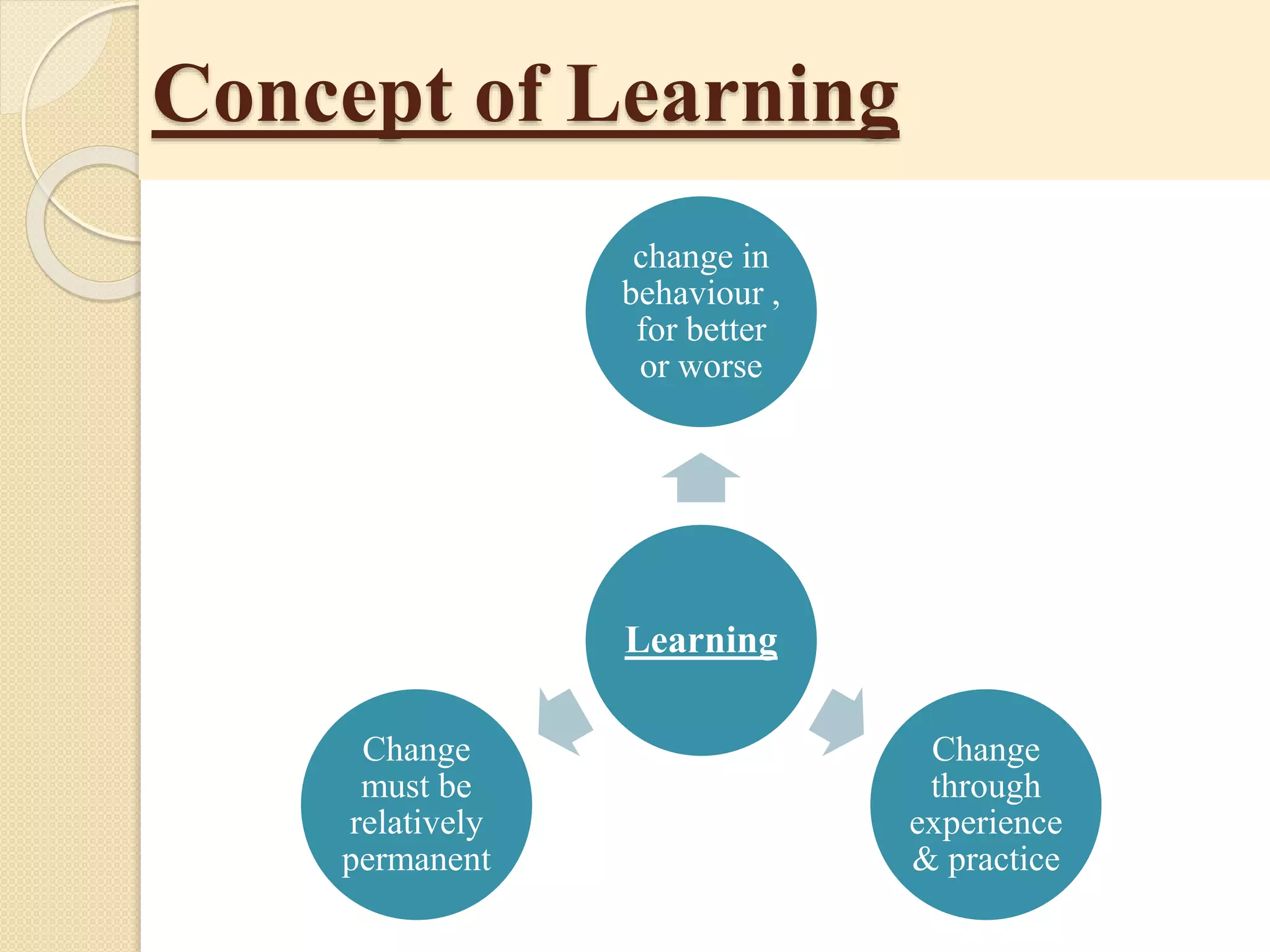
The document discusses the concept of learning and the learning process. It defines learning as a change in behavior, for better or worse, that occurs through experience and practice and must be relatively permanent. It describes several types of learning, including conditioning, motor learning, discrimination learning, verbal learning, problem solving, concept learning, and attitude learning. It outlines the steps in the learning process as motivation, goal, exploration of the situation, response, reinforcement, and integration. The document provides examples for each type of learning and step in the process.
Overview of the Arihant Institute of Teacher Training and presenter Rupali Shendkar.
Learning is a behavioral change through experience. It must be relatively permanent and is a formal process.
Different types of learning include conditioning, motor, verbal, problem-solving, discrimination, concept, and attitude learning. The learning process involves motivation, goal setting, exploration, response, reinforcement, and integration.
A recap of the various types of learning: motor, discrimination, verbal, problem-solving, concept, and attitude learning.
Exploration of multiple intelligences linked with the types of learning: conditioning, motor, discrimination, etc.
Conclusion and appreciation for the audience with a thank you note.
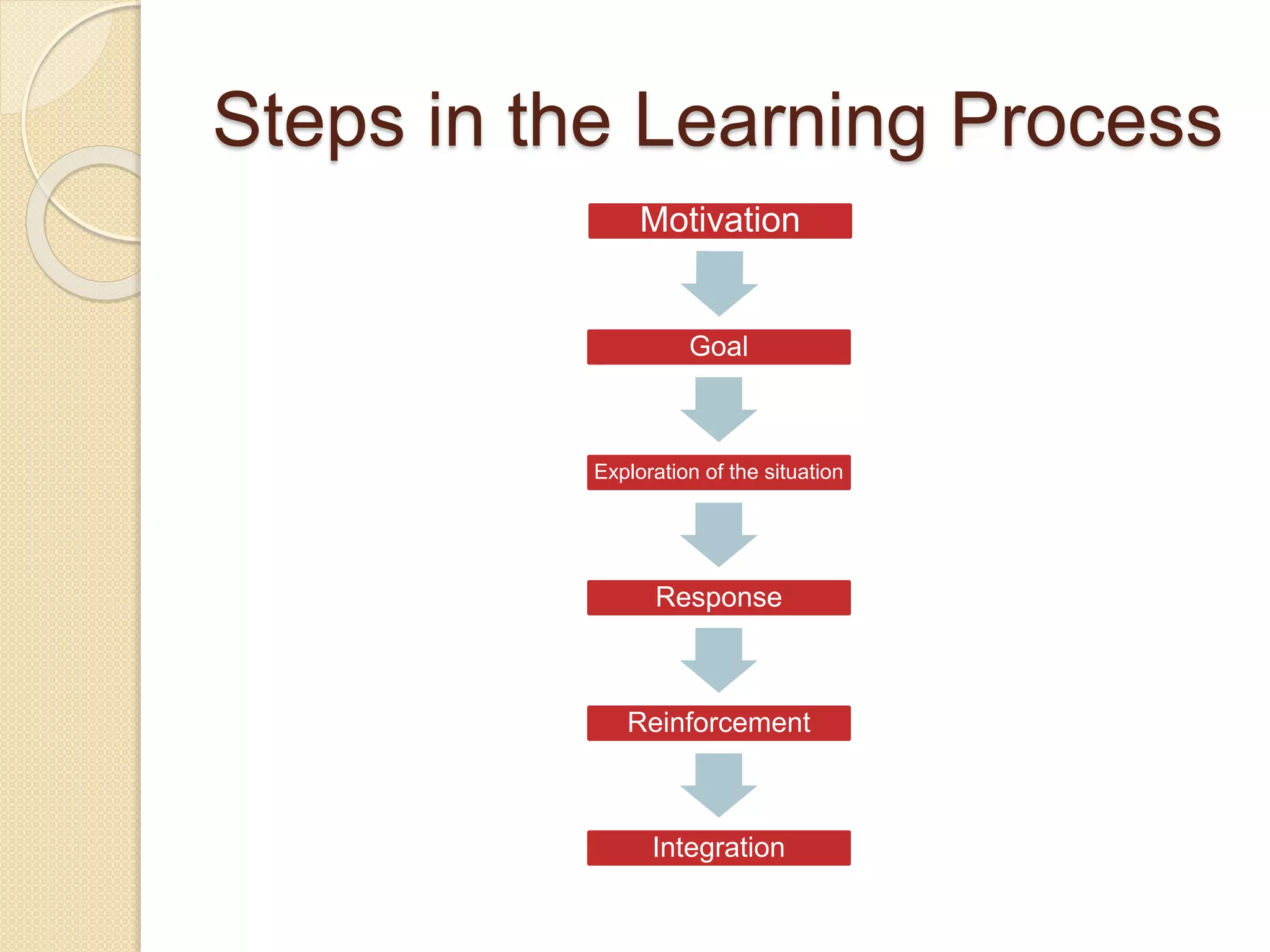
Steps in theLearning Process
Motivation
Goal
Exploration of the situation
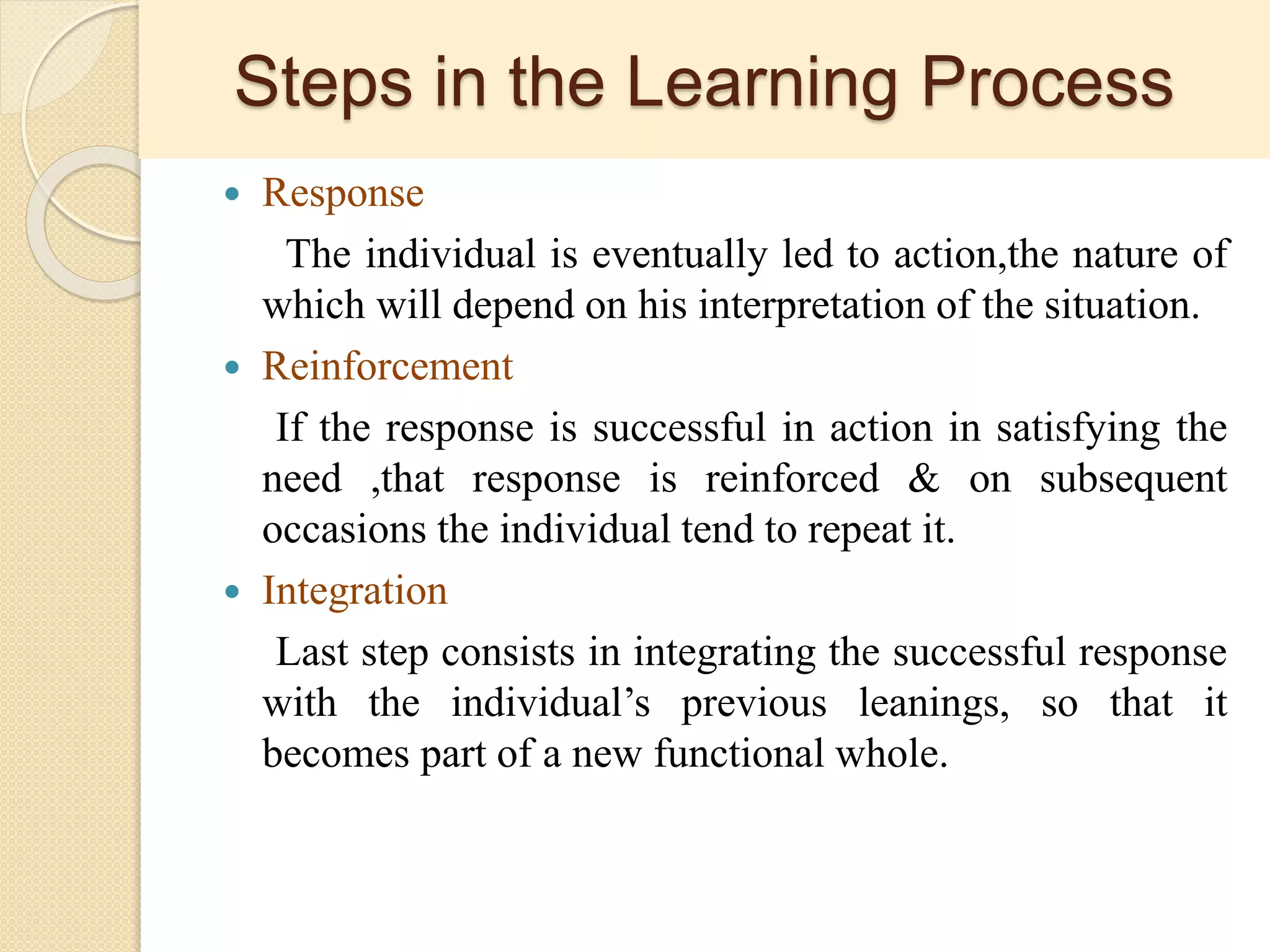
Response
Reinforcement
Integration
6.
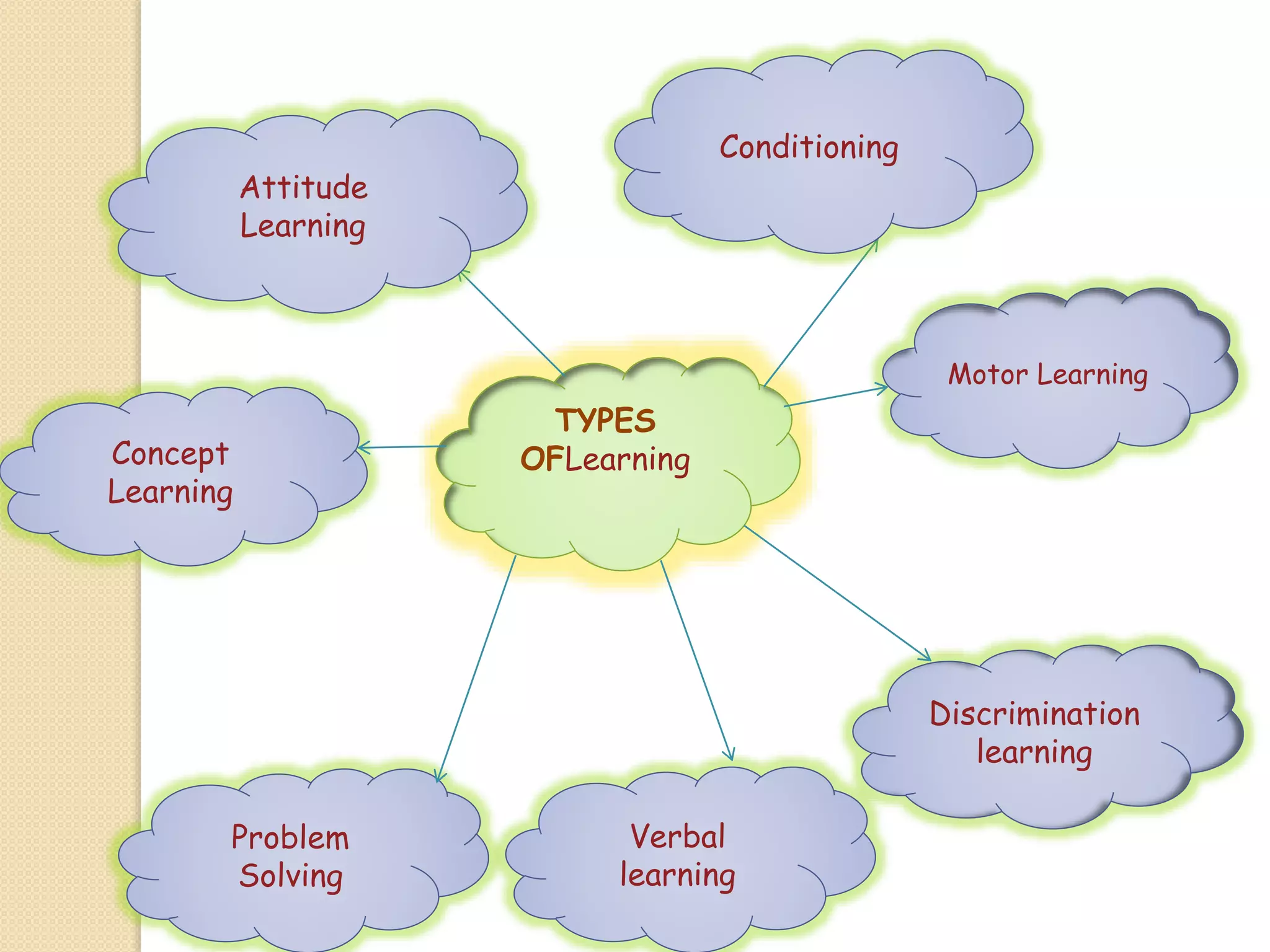
Types of Learning
Conditioning
Fundamental form of Learning
e.g. Child sucks nipple-withdraws from painful stimuli
Motor Learning
The use of muscles.
e.g.to walk , swim , play hockey
Discrimination Learning
Subject is presented with two or more stimuli which
differ in some detail
e.g. An enfant distinguish between mother & aunt
Verbal Learning
Learning in formal education
7.
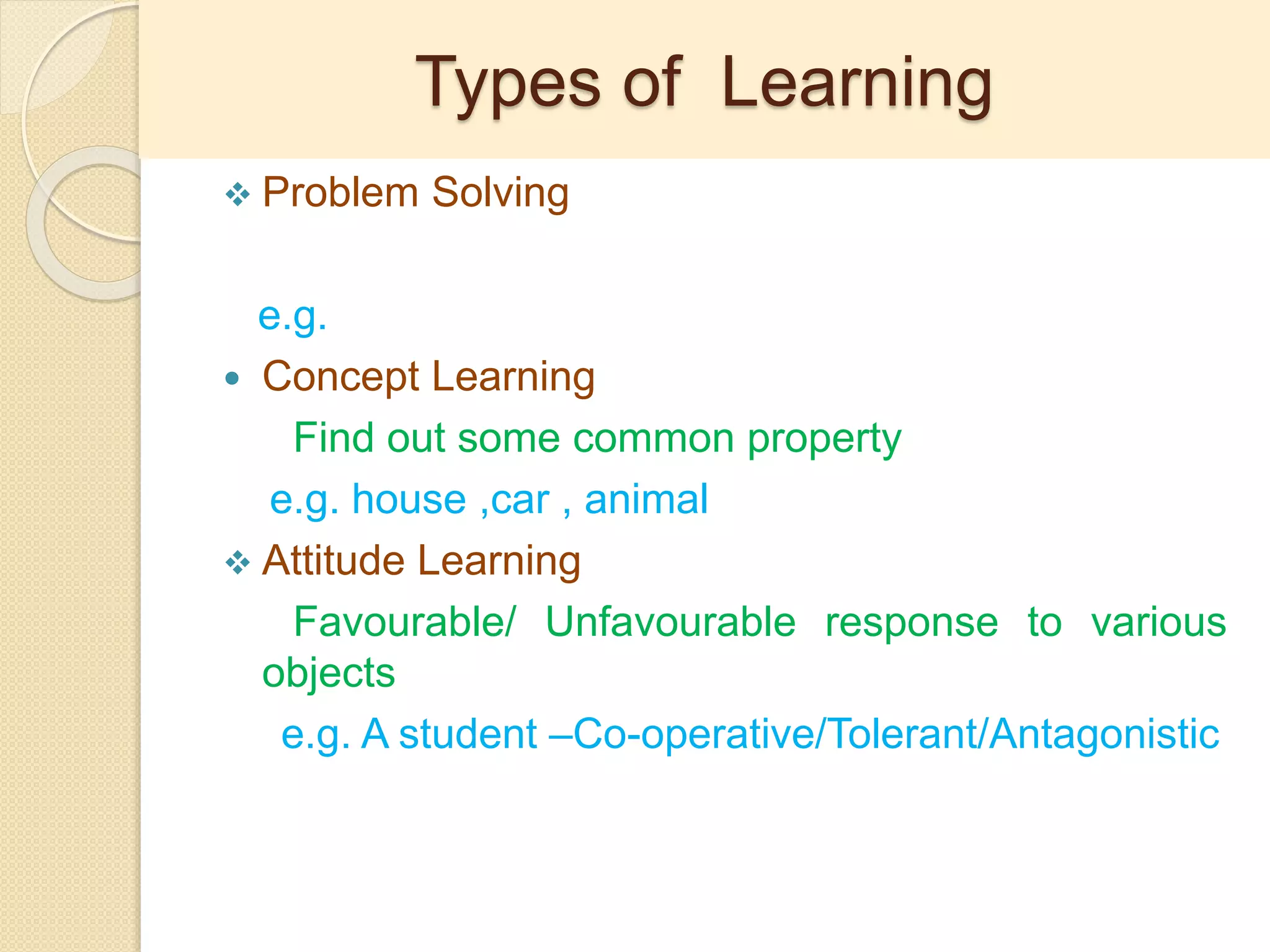
Types of Learning
Problem Solving
e.g.
Concept Learning
Find out some common property
e.g. house ,car , animal
Attitude Learning
Favourable/ Unfavourable response to various
objects
e.g. A student –Co-operative/Tolerant/Antagonistic
8.
Steps in theLearning Process
Motivation
response to stimuli
Unsatisfied need causes to act to satisfy the need
Goal
Behaviour caused by some needs –oriented towards
goal
e.g. reward of various kinds towatrds which the child is
to strive, the goals of course ,must be the learner’s goals.
Exploration of the situation
The correct responses cannot be determined at once
They require to be thought over ,the whole situation
need to be explored.
9.
Steps in theLearning Process
Response
The individual is eventually led to action,the nature of
which will depend on his interpretation of the situation.
Reinforcement
If the response is successful in action in satisfying the
need ,that response is reinforced & on subsequent
occasions the individual tend to repeat it.
Integration
Last step consists in integrating the successful response
with the individual’s previous leanings, so that it
becomes part of a new functional whole.






![Concept learning strategies [autosaved]](https://cdn.slidesharecdn.com/ss_thumbnails/conceptlearningstrategiesautosaved-130704195409-phpapp01-thumbnail.jpg?width=640&height=640&fit=bounds)


