Psychology
LEARNING
B.Ed. 2015-16
M.Vijayalakshmi
Guest Lecturer
Unit III
LEARNING
Learning: Concept, principles and factors
affecting learning – Theories of learning:
Thorndike’s Connectionism, Pavlov’s Classical
and Skinners Operant Conditioning, Learning
by Insight, Hull’s Reinforcement theory –
Transfer of training and its theories and their
educational implications – Metacognition:
Meaning, Elements and its Instructional
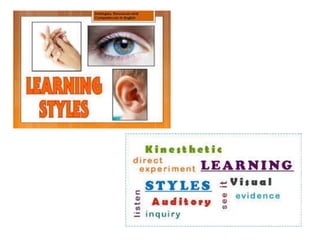
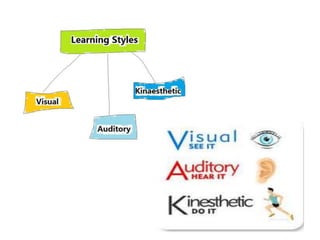
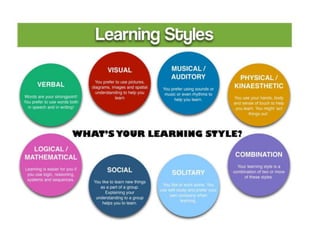
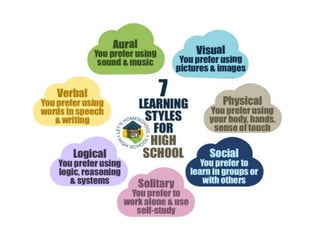
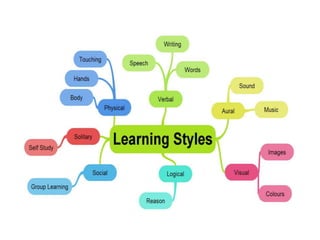
strategies – Learning Styles: Audio, Visual and
Kinesthetic – Teacher’s role in changing,
strengthening and sustaining learning styles.
Learning - Meaning
A relatively permanent
change in behaviour,
which occurs as a result of
activity, training, practice
or experience
Definition
• Gardner Murphy -
“The term Learning comes
every modification of
behaviour to meet
environment requirements”
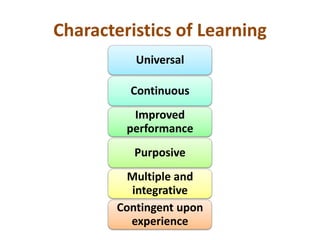
Characteristics of Learning
Universal
Continuous
Improved
performance
Purposive
Multiple and
integrative
Contingent upon
experience
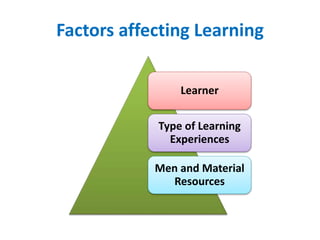
Factors affecting Learning
Learner
Type of Learning
Experiences
Men and Material
Resources
Factors Associated with Learner
Learner’s physical and mental health
The basic potential of the learner
The level of aspiration and achievement
motivation
Goals of life
Readiness and well power
Factors Associated with the
Type of Learning Experiences
• Nature of learning experience
• Methodology of learning
i. Linking the recent learnings with those of the
past
ii. Correlating learning in one area with that of
another
iii. Utilization of maximum number of sense
iv. Revision and practice
v. Provision of proper feedback and
reinforcement
vi. The selection of the suitable learning methods
and teaching
Factors Associated with the
Men and Material Resources
• Quality of the teacher
• Socio-emotional climate
• Availability of learning material and
facilities
• Availability of conducive environment
Factors influencing Learning
• Motivation
• Needs
• Maturation
• Feedback
• The level of intelligence
• Attention
• Use of audio-visual aids
• Field of learning suits one’s aptitude
• Guidance
• Positive and Negative attitudes
• Distributed practice
• Perception
• Correlate present and past
knowledge
• Rewards and punishments
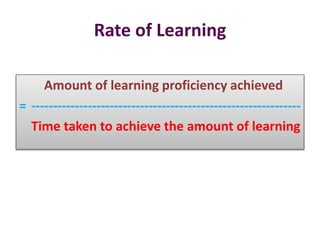
Rate of Learning
Amount of learning proficiency achieved
= --------------------------------------------------------------
Time taken to achieve the amount of learning
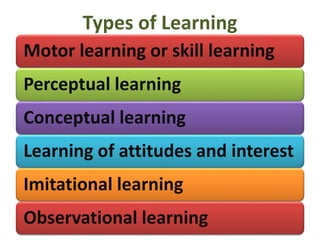
Types of Learning
Motor learning or skill learning
Perceptual learning
Conceptual learning
Learning of attitudes and interest
Imitational learning
Observational learning
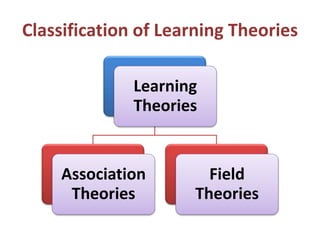
Classification of Learning Theories
Learning
Theories
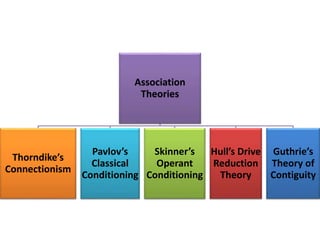
Association
Theories
Field
Theories
Association
Theories
Thorndike’s
Connectionism
Pavlov’s
Classical
Conditioning
Skinner’s
Operant
Conditioning
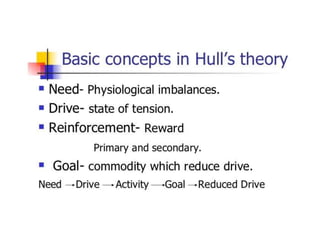
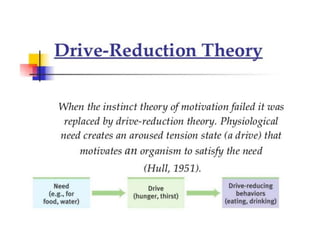
Hull’s Drive
Reduction
Theory
Guthrie’s
Theory of
Contiguity
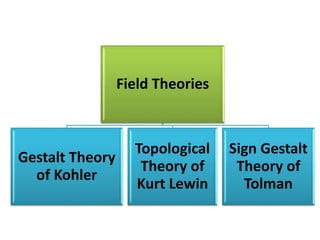
Field Theories
Gestalt Theory
of Kohler
Topological
Theory of
Kurt Lewin
Sign Gestalt
Theory of
Tolman
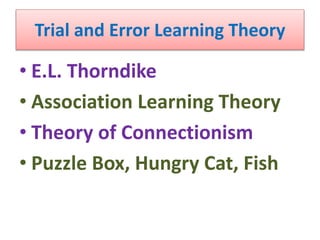
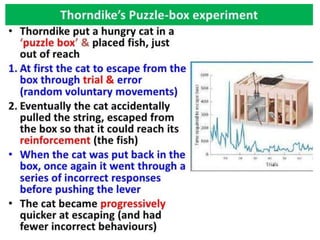
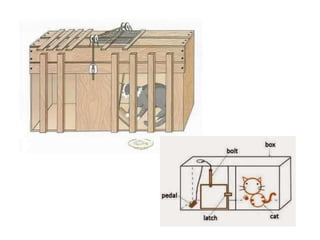
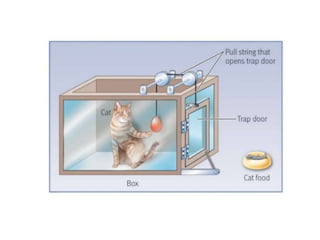
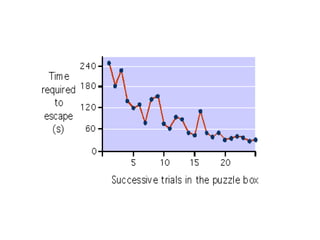
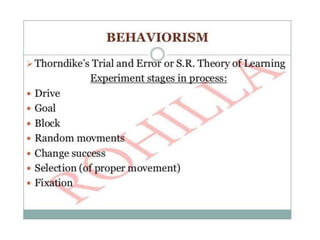
Trial and Error Learning Theory
• E.L. Thorndike
• Association Learning Theory
• Theory of Connectionism
• Puzzle Box, Hungry Cat, Fish
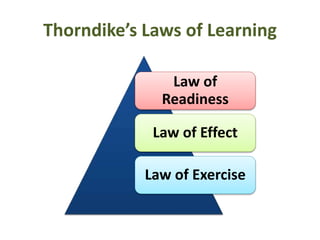
Thorndike’s Laws of Learning
Law of
Readiness
Law of Effect
Law of Exercise
Revised Law of Exercise
Law of multiple response or varied
reactions
Law of attitude
Law of analogy
Law of associative shifting
Educational Significance of the Theory
• Childhood level – trial and error method of
learning
• Motivation
• Working of Arithmetic problems
• Rewards and punishments
• Practice or periodical review is must
• Specialized courses – Entry behaviour – Interest
Inventories and Aptitude tests
• Continuous feedback
• Bad habits – disuse – Atrophy or forgetting
• Success leads to further success
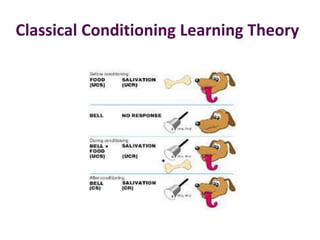
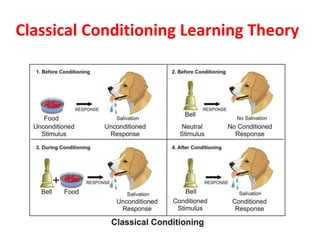
Classical Conditioning Learning Theory
• Ivan Petrovich Pavlov
• Hungry Dog, Food, Bell, Saliva
Classical Conditioning Learning Theory
Educational Significance of the Theory
o Language learning by associating words with
pictures or meanings and audio-visual aids
o To develop favorable attitude towards learning,
teachers, subjects, school etc
o Developing good habits
o Breaking of bad habits – deconditioning process
o Montessori system
o New experiences – associate with past
experiences
o Emphasizes the idea of continuity, similarity and
contrast
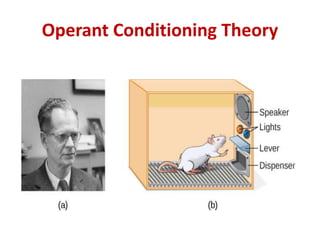
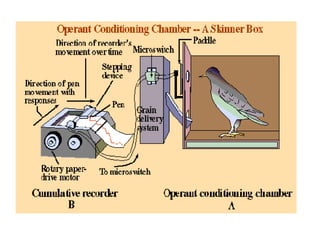
Operant Conditioning Theory
 B.F.Skinner
 Popularly accepted theory of learning
 Reinforcement theory
 Operant Conditioning or Instrumental
Conditioning Theory
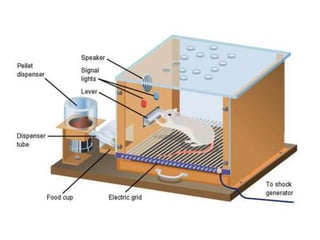
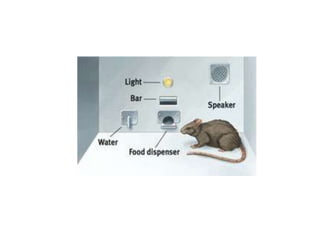
 Puzzle box, Rats, Pigeons, Pellets
Operant Conditioning Theory
Educational Significance of the Theory
Individualization of instruction
- Programmed learning, teaching machines,
CAI etc
Behaviour modification techniques
- Use of instructional objectives
- Performance contracting
- Teacher Effective Training (T.E.T.)
Positive Reinforcement
Each step – Reinforced
Desired behaviours of students - reinforced
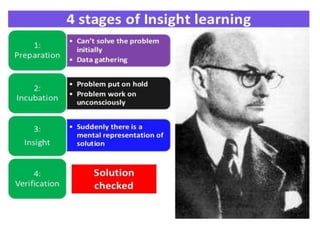
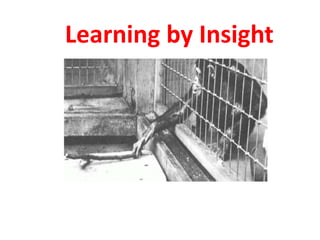
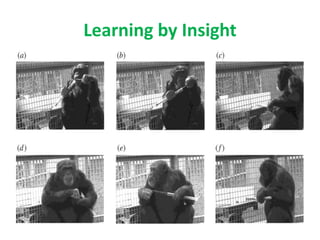
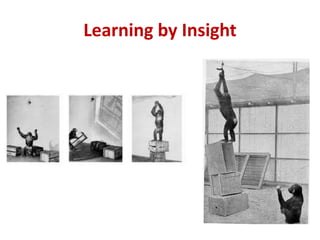
Learning by Insight
• Gestalt Psychologists
• Wolfgang Kohler, Kurt Koffka and Max
Wertheimer
• Gestalt – German Word – Whole, Pattern or
Configuration – (Human Face)
• Wolfgang Kohler – Tenerife Islands – Experiment
– Chimpanzees
• Chimpanzee, Banana, Stick and Wooden box
• Sudden Insight – Brain wave - Flash of Idea -
Intelligence
Learning by Insight
Learning by Insight
Learning by Insight
Educational Significance of the Theory
• Learning and Teaching – in total – not in parts
• Inter-disciplinary approach
• Intelligent form – not mechanical form
• Result of meaning experience
• Exhibited by higher intelligence organisms
• Reorganization of the field of perception
Reinforcement Theory
• Clark L. Hull
• Systematic Behaviour Theory
• Original orientation - Pavlovian
• Based on
- Association theory of Stimulus – Response
- Survival mode of life
- Biological needs and their fulfilment
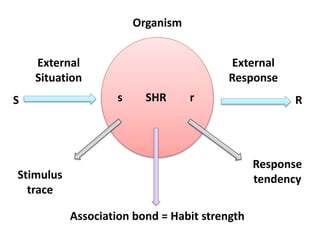
Hull’s Reinforcement Theory
• Change in the traditional S-R
notion
• The concept of reinforcement
and drive-stimuli reduction
Organism
External
Situation
External
Response
RS s rSHR
Response
tendencyStimulus
trace
Association bond = Habit strength
Educational Significance of the Theory
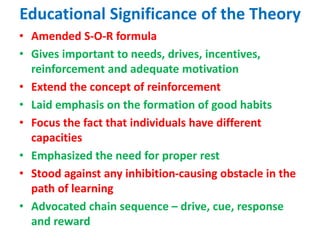
• Amended S-O-R formula
• Gives important to needs, drives, incentives,
reinforcement and adequate motivation
• Extend the concept of reinforcement
• Laid emphasis on the formation of good habits
• Focus the fact that individuals have different
capacities
• Emphasized the need for proper rest
• Stood against any inhibition-causing obstacle in the
path of learning
• Advocated chain sequence – drive, cue, response
and reward
Definition
• Application or carry over of knowledge,
skills, habits, attitudes etc. acquired in
one situation to some other situation
for which they were not specially learnt
• Carry over of experiences obtained in a
learning situation to the learning of an
another task is termed as ‘Transfer of
learning’ or ‘Transfer of Training’
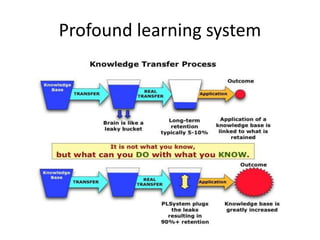
Profound learning system
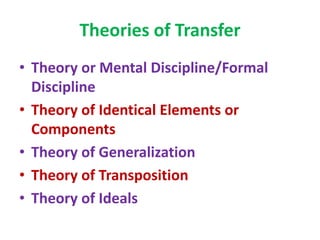
Theories of Transfer
• Theory or Mental Discipline/Formal
Discipline
• Theory of Identical Elements or
Components
• Theory of Generalization
• Theory of Transposition
• Theory of Ideals
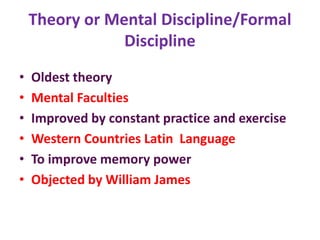
Theory or Mental Discipline/Formal
Discipline
• Oldest theory
• Mental Faculties
• Improved by constant practice and exercise
• Western Countries Latin Language
• To improve memory power
• Objected by William James
Theory of Identical Elements or
Components
• Profounder – E.L.Thorndike
• Common or identical elements
• Maths and Physics – symbols,
formulae and equations
• Accepted by all
Theory of Generalization
• Profounder – Charles H. Judd
• Generalization – principle, law or rule
• Two group of students – Control and
experiment
• Group A and B
• Group A – proper training – perform better
• Group B – no training – poor performance
Theory of Transposition
• Gestalt Psychologists – environment
related
• Kohler – Hen – Darker paper – food
• Gagne –
• Lateral Transfer – same type
• Vertical Transfer – for new type – Ex:
L.C.M.
Theory of Ideals
• W.C. Bagley
• Ideas and are desirable
• Ex: Neatness – Arithmetic sums -
followed in other subjects
Educational Significance of the Theory
• Suitable curriculum
• Methods of instruction
• Preparation of the part of the
learner
• Preparation on the part of the
teacher
Metacognition
•Higher order thinking
•Thinking about thinking or
learning to learn
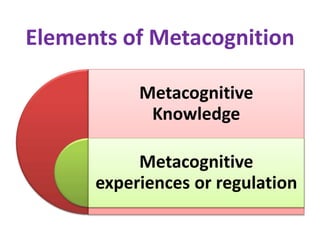
Elements of Metacognition
Metacognitive
Knowledge
Metacognitive
experiences or regulation
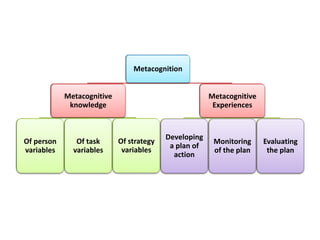
Metacognition
Metacognitive
knowledge
Of person
variables
Of task
variables
Of strategy
variables
Metacognitive
Experiences
Developing
a plan of
action
Monitoring
of the plan
Evaluating
the plan
Credit Sources
Images are taken from
INTERNET Sources
Learning

Learning

  • 1.
  • 2.
  • 3.
    Learning: Concept, principlesand factors affecting learning – Theories of learning: Thorndike’s Connectionism, Pavlov’s Classical and Skinners Operant Conditioning, Learning by Insight, Hull’s Reinforcement theory – Transfer of training and its theories and their educational implications – Metacognition: Meaning, Elements and its Instructional strategies – Learning Styles: Audio, Visual and Kinesthetic – Teacher’s role in changing, strengthening and sustaining learning styles.
  • 4.
    Learning - Meaning Arelatively permanent change in behaviour, which occurs as a result of activity, training, practice or experience
  • 5.
    Definition • Gardner Murphy- “The term Learning comes every modification of behaviour to meet environment requirements”
  • 6.
  • 7.
    Factors affecting Learning Learner Typeof Learning Experiences Men and Material Resources
  • 8.
    Factors Associated withLearner Learner’s physical and mental health The basic potential of the learner The level of aspiration and achievement motivation Goals of life Readiness and well power
  • 9.
    Factors Associated withthe Type of Learning Experiences • Nature of learning experience • Methodology of learning i. Linking the recent learnings with those of the past ii. Correlating learning in one area with that of another iii. Utilization of maximum number of sense iv. Revision and practice v. Provision of proper feedback and reinforcement vi. The selection of the suitable learning methods and teaching
  • 10.
    Factors Associated withthe Men and Material Resources • Quality of the teacher • Socio-emotional climate • Availability of learning material and facilities • Availability of conducive environment
  • 11.
    Factors influencing Learning •Motivation • Needs • Maturation • Feedback • The level of intelligence • Attention • Use of audio-visual aids
  • 12.
    • Field oflearning suits one’s aptitude • Guidance • Positive and Negative attitudes • Distributed practice • Perception • Correlate present and past knowledge • Rewards and punishments
  • 13.
    Rate of Learning Amountof learning proficiency achieved = -------------------------------------------------------------- Time taken to achieve the amount of learning
  • 14.
    Types of Learning Motorlearning or skill learning Perceptual learning Conceptual learning Learning of attitudes and interest Imitational learning Observational learning
  • 15.
    Classification of LearningTheories Learning Theories Association Theories Field Theories
  • 16.
  • 17.
    Field Theories Gestalt Theory ofKohler Topological Theory of Kurt Lewin Sign Gestalt Theory of Tolman
  • 18.
    Trial and ErrorLearning Theory • E.L. Thorndike • Association Learning Theory • Theory of Connectionism • Puzzle Box, Hungry Cat, Fish
  • 24.
    Thorndike’s Laws ofLearning Law of Readiness Law of Effect Law of Exercise
  • 25.
    Revised Law ofExercise Law of multiple response or varied reactions Law of attitude Law of analogy Law of associative shifting
  • 26.
    Educational Significance ofthe Theory • Childhood level – trial and error method of learning • Motivation • Working of Arithmetic problems • Rewards and punishments • Practice or periodical review is must • Specialized courses – Entry behaviour – Interest Inventories and Aptitude tests • Continuous feedback • Bad habits – disuse – Atrophy or forgetting • Success leads to further success
  • 27.
    Classical Conditioning LearningTheory • Ivan Petrovich Pavlov • Hungry Dog, Food, Bell, Saliva
  • 29.
  • 30.
  • 31.
    Educational Significance ofthe Theory o Language learning by associating words with pictures or meanings and audio-visual aids o To develop favorable attitude towards learning, teachers, subjects, school etc o Developing good habits o Breaking of bad habits – deconditioning process o Montessori system o New experiences – associate with past experiences o Emphasizes the idea of continuity, similarity and contrast
  • 32.
    Operant Conditioning Theory B.F.Skinner  Popularly accepted theory of learning  Reinforcement theory  Operant Conditioning or Instrumental Conditioning Theory  Puzzle box, Rats, Pigeons, Pellets
  • 33.
  • 37.
    Educational Significance ofthe Theory Individualization of instruction - Programmed learning, teaching machines, CAI etc Behaviour modification techniques - Use of instructional objectives - Performance contracting - Teacher Effective Training (T.E.T.) Positive Reinforcement Each step – Reinforced Desired behaviours of students - reinforced
  • 38.
    Learning by Insight •Gestalt Psychologists • Wolfgang Kohler, Kurt Koffka and Max Wertheimer • Gestalt – German Word – Whole, Pattern or Configuration – (Human Face) • Wolfgang Kohler – Tenerife Islands – Experiment – Chimpanzees • Chimpanzee, Banana, Stick and Wooden box • Sudden Insight – Brain wave - Flash of Idea - Intelligence
  • 40.
  • 41.
  • 42.
  • 43.
    Educational Significance ofthe Theory • Learning and Teaching – in total – not in parts • Inter-disciplinary approach • Intelligent form – not mechanical form • Result of meaning experience • Exhibited by higher intelligence organisms • Reorganization of the field of perception
  • 44.
    Reinforcement Theory • ClarkL. Hull • Systematic Behaviour Theory • Original orientation - Pavlovian • Based on - Association theory of Stimulus – Response - Survival mode of life - Biological needs and their fulfilment
  • 47.
    Hull’s Reinforcement Theory •Change in the traditional S-R notion • The concept of reinforcement and drive-stimuli reduction
  • 48.
  • 49.
    Educational Significance ofthe Theory • Amended S-O-R formula • Gives important to needs, drives, incentives, reinforcement and adequate motivation • Extend the concept of reinforcement • Laid emphasis on the formation of good habits • Focus the fact that individuals have different capacities • Emphasized the need for proper rest • Stood against any inhibition-causing obstacle in the path of learning • Advocated chain sequence – drive, cue, response and reward
  • 51.
    Definition • Application orcarry over of knowledge, skills, habits, attitudes etc. acquired in one situation to some other situation for which they were not specially learnt • Carry over of experiences obtained in a learning situation to the learning of an another task is termed as ‘Transfer of learning’ or ‘Transfer of Training’
  • 54.
  • 55.
    Theories of Transfer •Theory or Mental Discipline/Formal Discipline • Theory of Identical Elements or Components • Theory of Generalization • Theory of Transposition • Theory of Ideals
  • 56.
    Theory or MentalDiscipline/Formal Discipline • Oldest theory • Mental Faculties • Improved by constant practice and exercise • Western Countries Latin Language • To improve memory power • Objected by William James
  • 57.
    Theory of IdenticalElements or Components • Profounder – E.L.Thorndike • Common or identical elements • Maths and Physics – symbols, formulae and equations • Accepted by all
  • 58.
    Theory of Generalization •Profounder – Charles H. Judd • Generalization – principle, law or rule • Two group of students – Control and experiment • Group A and B • Group A – proper training – perform better • Group B – no training – poor performance
  • 59.
    Theory of Transposition •Gestalt Psychologists – environment related • Kohler – Hen – Darker paper – food • Gagne – • Lateral Transfer – same type • Vertical Transfer – for new type – Ex: L.C.M.
  • 60.
    Theory of Ideals •W.C. Bagley • Ideas and are desirable • Ex: Neatness – Arithmetic sums - followed in other subjects
  • 61.
    Educational Significance ofthe Theory • Suitable curriculum • Methods of instruction • Preparation of the part of the learner • Preparation on the part of the teacher
  • 63.
    Metacognition •Higher order thinking •Thinkingabout thinking or learning to learn
  • 64.
  • 65.
    Metacognition Metacognitive knowledge Of person variables Of task variables Ofstrategy variables Metacognitive Experiences Developing a plan of action Monitoring of the plan Evaluating the plan
  • 77.
    Credit Sources Images aretaken from INTERNET Sources