



Learning
By Sushil Humane
MSc nursing (Psychiatric/mental health nursing)
Concept and
definition
• Learning is the acquisition of habits, knowledge and
attitude.
• It involves new ways of doing things and it
operates on an individual attempts to overcome
obstacles or to adjust to new situation.
• It represent progressive changes in behaviour.
• It enables him to satisfy interest to attain a goal.
Nature of learning
• Learning is a process and not a product
• Starts from birth and it produce change in behaviour
• Learning prepare the person for the necessary
adjustment and adaptation
• It is purposeful and goal oriented
• It is continuous and universal
• It is transferable from one situation to another
• It helps In proper growth and development
Learning process
Steps in learning process
• Learning process is carried over through
various steps according to HP smith
• A motive or drive
• An attractive goal
• And a block to the attainment of goal.
Learning process
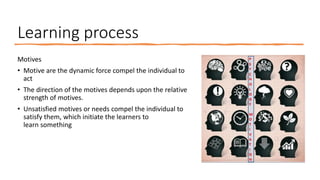
Motives
• Motive are the dynamic force compel the individual to
act
• The direction of the motives depends upon the relative
strength of motives.
• Unsatisfied motives or needs compel the individual to
satisfy them, which initiate the learners to
learn something
Learning process
An attractive goal
• For the satisfaction of the needs the individual sets
definite goals for achievement.
• The setting of the goal helps in making the learning
purposeful and interesting.
Learning process
A block to the attainment of the goal:
• If the individual faces no difficulty in attending the goal, he
will not change his present behaviour, this means there is
no necessity to learn.
• If block or barrier obstruct the individual to reach a goal
then the individual will try to change his behaviour.
• Means something to change his behaviour to reach goal.
Learning process
Some other steps involved in learning are
• Reinforcement
• Integration
• And learning situation.
Reinforcement:
• If the responses is successful in action and satisfied the needs, on the subsequent occasions the individual will
tend to repeat it.
Integration: (Addition)
• The individual integrate the successful responses with individual previous learning, so that it becomes a part of
new functional whole.
Learning process
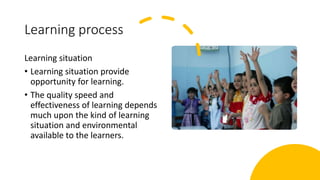
Learning situation
• Learning situation provide
opportunity for learning.
• The quality speed and
effectiveness of learning depends
much upon the kind of learning
situation and environmental
available to the learners.
Learning
process in
different steps
Perception learning:
• Sight, hearing, taste, smell and touch are
considered as the five gateway of knowledge. All
the knowledge is based on the sense of
perception.
Conceptual learning:
• The learning implies that the individual start to
think in an abstract terms.
Association learning:
• The individual has some mental pictures of his
previous observations. He try to link up his new
association with his previous mental picture and
he learns.
Learning
process in
different steps
Appreciation learning:
• The feeling make the individual to learn
more.
Attitudinal learning:
• These attitudes confirmed as the individual
acquires more and more knowledge.
Theories of
learning
Theories of learning
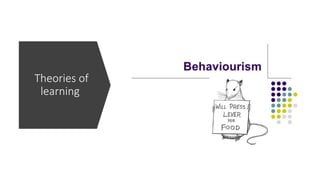
Behaviourism
• All things should be looked at from the
perspective of behaviour
• And it doesn’t matter what is going on in the
mind, it just matter what the behaviour
• So there is no difference in the behaviourist
mind between external behaviour and internal
thought
Behaviourists
• Ivan Pavlov
• Edward lee Thorndike
• John b. Watson
• B. F. skinner
Theories of learning
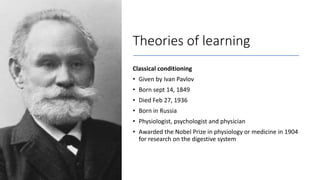
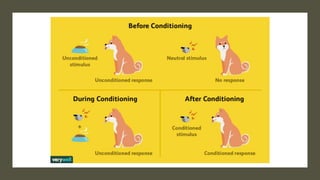
Classical conditioning
• Given by Ivan Pavlov
• Born sept 14, 1849
• Died Feb 27, 1936
• Born in Russia
• Physiologist, psychologist and physician
• Awarded the Nobel Prize in physiology or medicine in 1904
for research on the digestive system
Theories of learning
Educational implication of classical conditioning theory
• Fear, love towards a particular subject is created through
conditioning.
• A teacher, method of teaching or harsh treatment of his students,
create strong dislike among them towards subject.
• The theory of classical conditioning emphasizes that the students
should be exposed to positive stimuli in order to develop desirable
habits, interest and attitudes in them.
Theories of learning
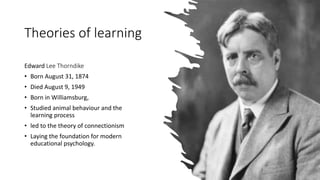
Edward Lee Thorndike
• Born August 31, 1874
• Died August 9, 1949
• Born in Williamsburg,
• Studied animal behaviour and the
learning process
• led to the theory of connectionism
• Laying the foundation for modern
educational psychology.
Theories of learning
Trial and error theory of learning
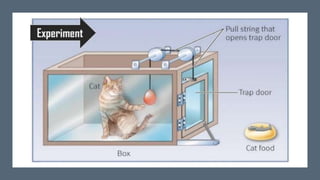
• Thorndike looked at how cats learned to escape from puzzle boxes
• The puzzle box experiments were motivated by Thorndike's dislike for
statements that animals made use of extraordinary faculties such as insight in
their problem solving.
Theories of learning
• Thorndike's instruments in answering this question were learning curves
revealed by plotting the time it took for an animal to escape the box each time
it was in the box
• If the animals were showing insight, then their time to escape would suddenly
drop to a negligible period, which would also be shown in the learning curve
as an abrupt drop;
• while animals using a more ordinary method of trial and error would show
gradual curves.
• His finding was that cats consistently showed gradual learning.
Theories of
learning
Educational implication of Thorndike’s theory
• According to him, when the child is ready to
learn, he learns more quickly and effectively. He
warns that the child should not force to learn.
• And teacher must provide learning
environment.
• The task of the teacher is to motivate the
students by arousing interest.
• Learners should be encouraged to perform his
task independently.
• He must try various solutions to the problem
before arriving at the correct time.
Theories of
learning
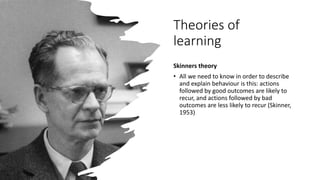
Skinners theory
• All we need to know in order to describe
and explain behaviour is this: actions
followed by good outcomes are likely to
recur, and actions followed by bad
outcomes are less likely to recur (Skinner,
1953)
Theories of
learning
B. F. Skinner
• Science of behaviour: study of conditioning
and extinction of operants
• Dependent variable in the 'Skinner box': rate
of response
Law of acquisition
• Key variable: reinforcement
• Practice provides opportunities for
additional reinforcement
Theories of learning
Law of effect
• Behaviour – better state of affaire – increased probability of
behaviour occurring again
• Behaviour – worse state of affairs – decreased probability of
behaviour occurring again
Theories of
learning
Operant conditioning technique
• Positive reinforcement = increase a
behaviour by administering a reward
• Negative behaviour = increasing a behaviour
by removing an aversive stimulus when a
behaviour occurs
• Punishment = decreasing a behaviour by
administering an aversive stimulus following
a behaviour or by removing a positive
stimulus
• Extinction = decreasing a behaviour by not
rewarding it
Theories of learning
• Theory of insightful learning
(Gestalt psychology)
• Gestalt psychology was found in
Germany in 1912 by max
Wertheimer and his colleagues.
• The word 'Gestalt' means form or
shape or a particular
arrangement of element.
Theories of
learning
• Gestalt theory
• The Gestalt Theory believes individuals use insight
and their prior experiences to determine their
responses to stimuli.
• They also use the laws of Gestalt Theory to try to
make sense of, and provide order to, information in
their perception. This information leaves a trace in
memory; traces link together to form connections of
information.
• The Gestalt theory is closely related to the present
day cognitive constructivist view of learning.
Problem solving is a good choice of instructional
methods to use to incorporate the beliefs of the
Gestalt theory.
Theories of
learning
Educational implication of gestalt theory
• The organization of the syllabus and
planning of the curriculum should give
plenty of opportunity to use the mental
abilities.
Theories of learning
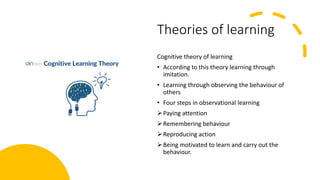
Cognitive theory of learning
• According to this theory learning through
imitation.
• Learning through observing the behaviour of
others
• Four steps in observational learning
Paying attention
Remembering behaviour
Reproducing action
Being motivated to learn and carry out the
behaviour.
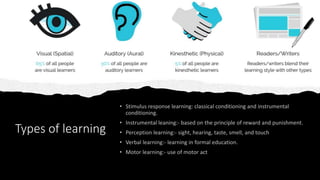
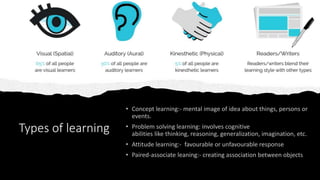
Types of learning
Types of learning
Laws of learning
• Law of readiness
• Effect
• Exercise
• Frequency
• Disuse
• Recency
• Primary
• Purpose
• Association
Factors affecting
learning
Factors associated
with learner
• Learners physical health
• Learners mental health
• Level of motivation
• Goals of life
• Readiness and willpower
• Maturation
• Age
• Emotions
• Sex/gender
Factors associated
with type of
learning experiences.
Factors associated with men and
material.
Transfer of learning
Definition
• Transfer refers to the transfer of
knowledge, training and habits
acquired in one situation to the
another situation.
Types of
learning
trasnfer
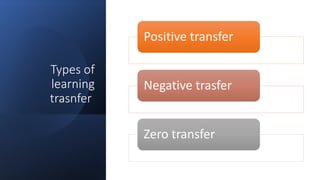
Positive transfer
Negative trasfer
Zero transfer
Types of
learning
trasnfer
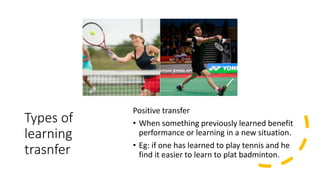
Positive transfer
• When something previously learned benefit
performance or learning in a new situation.
• Eg: if one has learned to play tennis and he
find it easier to learn to plat badminton.
Types of learning trasnfer
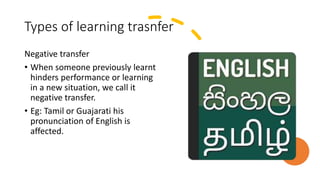
Negative transfer
• When someone previously learnt
hinders performance or learning
in a new situation, we call it
negative transfer.
• Eg: Tamil or Guajarati his
pronunciation of English is
affected.
Types of learning
trasnfer
Zero transfer
• Previous learning makes no
difference at all to the
performance or learning in a new
situation.
• Eg: learning history may neither
help nor hinder the learning.
Learning

Learning

  • 1.
    Learning By Sushil Humane MScnursing (Psychiatric/mental health nursing)
  • 2.
    Concept and definition • Learningis the acquisition of habits, knowledge and attitude. • It involves new ways of doing things and it operates on an individual attempts to overcome obstacles or to adjust to new situation. • It represent progressive changes in behaviour. • It enables him to satisfy interest to attain a goal.
  • 3.
    Nature of learning •Learning is a process and not a product • Starts from birth and it produce change in behaviour • Learning prepare the person for the necessary adjustment and adaptation • It is purposeful and goal oriented • It is continuous and universal • It is transferable from one situation to another • It helps In proper growth and development
  • 4.
    Learning process Steps inlearning process • Learning process is carried over through various steps according to HP smith • A motive or drive • An attractive goal • And a block to the attainment of goal.
  • 5.
    Learning process Motives • Motiveare the dynamic force compel the individual to act • The direction of the motives depends upon the relative strength of motives. • Unsatisfied motives or needs compel the individual to satisfy them, which initiate the learners to learn something
  • 6.
    Learning process An attractivegoal • For the satisfaction of the needs the individual sets definite goals for achievement. • The setting of the goal helps in making the learning purposeful and interesting.
  • 7.
    Learning process A blockto the attainment of the goal: • If the individual faces no difficulty in attending the goal, he will not change his present behaviour, this means there is no necessity to learn. • If block or barrier obstruct the individual to reach a goal then the individual will try to change his behaviour. • Means something to change his behaviour to reach goal.
  • 8.
    Learning process Some othersteps involved in learning are • Reinforcement • Integration • And learning situation. Reinforcement: • If the responses is successful in action and satisfied the needs, on the subsequent occasions the individual will tend to repeat it. Integration: (Addition) • The individual integrate the successful responses with individual previous learning, so that it becomes a part of new functional whole.
  • 9.
    Learning process Learning situation •Learning situation provide opportunity for learning. • The quality speed and effectiveness of learning depends much upon the kind of learning situation and environmental available to the learners.
  • 10.
    Learning process in different steps Perceptionlearning: • Sight, hearing, taste, smell and touch are considered as the five gateway of knowledge. All the knowledge is based on the sense of perception. Conceptual learning: • The learning implies that the individual start to think in an abstract terms. Association learning: • The individual has some mental pictures of his previous observations. He try to link up his new association with his previous mental picture and he learns.
  • 11.
    Learning process in different steps Appreciationlearning: • The feeling make the individual to learn more. Attitudinal learning: • These attitudes confirmed as the individual acquires more and more knowledge.
  • 12.
  • 13.
    Theories of learning Behaviourism •All things should be looked at from the perspective of behaviour • And it doesn’t matter what is going on in the mind, it just matter what the behaviour • So there is no difference in the behaviourist mind between external behaviour and internal thought
  • 14.
    Behaviourists • Ivan Pavlov •Edward lee Thorndike • John b. Watson • B. F. skinner
  • 15.
    Theories of learning Classicalconditioning • Given by Ivan Pavlov • Born sept 14, 1849 • Died Feb 27, 1936 • Born in Russia • Physiologist, psychologist and physician • Awarded the Nobel Prize in physiology or medicine in 1904 for research on the digestive system
  • 16.
    Theories of learning Educationalimplication of classical conditioning theory • Fear, love towards a particular subject is created through conditioning. • A teacher, method of teaching or harsh treatment of his students, create strong dislike among them towards subject. • The theory of classical conditioning emphasizes that the students should be exposed to positive stimuli in order to develop desirable habits, interest and attitudes in them.
  • 19.
    Theories of learning EdwardLee Thorndike • Born August 31, 1874 • Died August 9, 1949 • Born in Williamsburg, • Studied animal behaviour and the learning process • led to the theory of connectionism • Laying the foundation for modern educational psychology.
  • 20.
    Theories of learning Trialand error theory of learning • Thorndike looked at how cats learned to escape from puzzle boxes • The puzzle box experiments were motivated by Thorndike's dislike for statements that animals made use of extraordinary faculties such as insight in their problem solving.
  • 22.
    Theories of learning •Thorndike's instruments in answering this question were learning curves revealed by plotting the time it took for an animal to escape the box each time it was in the box • If the animals were showing insight, then their time to escape would suddenly drop to a negligible period, which would also be shown in the learning curve as an abrupt drop; • while animals using a more ordinary method of trial and error would show gradual curves. • His finding was that cats consistently showed gradual learning.
  • 23.
    Theories of learning Educational implicationof Thorndike’s theory • According to him, when the child is ready to learn, he learns more quickly and effectively. He warns that the child should not force to learn. • And teacher must provide learning environment. • The task of the teacher is to motivate the students by arousing interest. • Learners should be encouraged to perform his task independently. • He must try various solutions to the problem before arriving at the correct time.
  • 24.
    Theories of learning Skinners theory •All we need to know in order to describe and explain behaviour is this: actions followed by good outcomes are likely to recur, and actions followed by bad outcomes are less likely to recur (Skinner, 1953)
  • 25.
    Theories of learning B. F.Skinner • Science of behaviour: study of conditioning and extinction of operants • Dependent variable in the 'Skinner box': rate of response Law of acquisition • Key variable: reinforcement • Practice provides opportunities for additional reinforcement
  • 26.
    Theories of learning Lawof effect • Behaviour – better state of affaire – increased probability of behaviour occurring again • Behaviour – worse state of affairs – decreased probability of behaviour occurring again
  • 27.
    Theories of learning Operant conditioningtechnique • Positive reinforcement = increase a behaviour by administering a reward • Negative behaviour = increasing a behaviour by removing an aversive stimulus when a behaviour occurs • Punishment = decreasing a behaviour by administering an aversive stimulus following a behaviour or by removing a positive stimulus • Extinction = decreasing a behaviour by not rewarding it
  • 28.
    Theories of learning •Theory of insightful learning (Gestalt psychology) • Gestalt psychology was found in Germany in 1912 by max Wertheimer and his colleagues. • The word 'Gestalt' means form or shape or a particular arrangement of element.
  • 29.
    Theories of learning • Gestalttheory • The Gestalt Theory believes individuals use insight and their prior experiences to determine their responses to stimuli. • They also use the laws of Gestalt Theory to try to make sense of, and provide order to, information in their perception. This information leaves a trace in memory; traces link together to form connections of information. • The Gestalt theory is closely related to the present day cognitive constructivist view of learning. Problem solving is a good choice of instructional methods to use to incorporate the beliefs of the Gestalt theory.
  • 30.
    Theories of learning Educational implicationof gestalt theory • The organization of the syllabus and planning of the curriculum should give plenty of opportunity to use the mental abilities.
  • 31.
    Theories of learning Cognitivetheory of learning • According to this theory learning through imitation. • Learning through observing the behaviour of others • Four steps in observational learning Paying attention Remembering behaviour Reproducing action Being motivated to learn and carry out the behaviour.
  • 32.
  • 33.
  • 34.
    Laws of learning •Law of readiness • Effect • Exercise • Frequency • Disuse • Recency • Primary • Purpose • Association
  • 35.
  • 36.
    Factors associated with learner •Learners physical health • Learners mental health • Level of motivation • Goals of life • Readiness and willpower • Maturation • Age • Emotions • Sex/gender
  • 37.
    Factors associated with typeof learning experiences.
  • 38.
    Factors associated withmen and material.
  • 39.
    Transfer of learning Definition •Transfer refers to the transfer of knowledge, training and habits acquired in one situation to the another situation.
  • 40.
  • 41.
    Types of learning trasnfer Positive transfer •When something previously learned benefit performance or learning in a new situation. • Eg: if one has learned to play tennis and he find it easier to learn to plat badminton.
  • 42.
    Types of learningtrasnfer Negative transfer • When someone previously learnt hinders performance or learning in a new situation, we call it negative transfer. • Eg: Tamil or Guajarati his pronunciation of English is affected.
  • 43.
    Types of learning trasnfer Zerotransfer • Previous learning makes no difference at all to the performance or learning in a new situation. • Eg: learning history may neither help nor hinder the learning.