ARIHANT INSTITUTE
OF TEACHERS
TRAINING
NAME: Shendkar Rupali P.
COURSE NO: 103
Teaching and Learning
UNIT: Learning Curve
Learning Curve
 A learning curve is a graphical representation of the increase of learning
(vertical axis) with experience (horizontal axis) graph that depicts rate of
learning, especially a graph of progress in the mastery of a skill against the
time required for such mastery.
. A concept that describes how new skills or knowledge can be
quickly acquired initially, but subsequent learning becomes much slower.
In a visual representation of a learning curve, a steeper curve indicates faster,
easier learning and a flatter curve indicates slower, more difficult learning.
Process of slow progress
 Generally when a person has to start the learning of a
given activity from scratch, his early progress will be
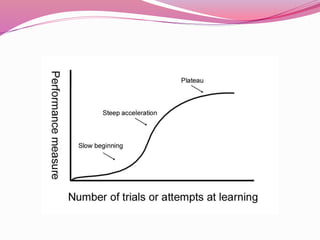
slow( portion of slow progress in fig). This may be due
to the fact that the learner has to master sub-skills
before he can put them together into a complete
performance.
 For example- learning to type.
Period of rapid progress
In this stage the learner’s output rises rapidly.it
ordinarily represents learner’s catching on to the
purpose and nature of the task .
( steep accelartion in fig)
Period of apparent progress
Learning curves frequently display what is known as
a plateau or a period of no apparent progress which is
then followed by further gains. Period of no visible
learning progress,preceded and followed by
improvement are called plateaus.
example- in typing a person after having made rather
consistent progress for some time may reach a point
where perhaps no progress is made. a child does not
show improvement in his reading
Period of apparent progress
Period of sudden rise
It depends on child capability and ability.
 At the end of a plateau there is generally a spurt in
achievement. While on the plateau, the learner
acquires better techniques. Which help him later on to
show rapid progress( portion d in fig).
 The ups and downs may continue because of changes
in motivation.
Leveling off
 All learning will finally slow down to such an extent that it will
ultimately reach a period of no improvement; no one can continue to
improve indefinitely in any given situation. The learning curve will
eventually reach a limit, where no further improvement is possible.
This limit is known as the physiological limit.
 The shape of the curve depends upon the rate of learning which in turn
depends upon the age, capacity and motivation of the learner, the
nature of the material and the conditions under which learning takes
place.
 The three basic factors in learning are the learner, process and the
material.
 4. Occurrence of plateaus can be minimized by using superior teaching
methods. Pacing the learner one of the devices.
 Let the child consolidate what he has learned and then proceed further.
Avoid introducing new material in a hurried fashion. Such material is
likely to interfere with the barely learned previous material.
Causes of plateau
 A plateau may be a period when the learner is
acquiring a higher form if response, there may be a
need to reorganize the previous learning into a new
pattern before further progress is possible.
 the learner may have hit upon bad habits which must
be replaced before he can advance to a higher level of
achievement. Example- in writing, a pupil may
develop an unfavorable sitting position or too firm a
grip of the pencil which impedes progress.
 Lack of progress due to decreased motivation. T he
learner then falls into a mechanical routine.
 The task may not be uniform difficulty througout.
 Undue attention to one part of the task may throw
the total performance out of gear. Progress is not
reflected in the total performance.
Onset of fatigue os also one of the causes of a plateau.
Period of sudden rise
Its depends on child capability and ability.
 At the end of a plateau there is generally a spurt in
achievement. While on the plateau, the learner
acquires better techniques. Which help him later on to
show rapid progress( portion ‘d’ in fig). The ups and
downs may continue because of changes in motivation
Leveling off
 All learning will finally slow down to such an extent that it
will ultimately reach a period of no improvement. T he
learning curve will eventually reach a limit, where no
further improvement is possible.
This limit is known as the Physiological limit.
 Physiological limit-
The physiological limit is that degree of ability
which a particular person cannot surpass because of
absolute inherited limits in the speed of motor or mental
response.eg- in complex performances such as typing,
drawing, playing, on the piano, carpentry and surgery, the
limit is very seldom reached.
Leveling off
Example-
The typist reaches a point where no matter
how active his fingers and how hard he tries he cannot
type more rapidly.
The musician reaches a point where he does
not improve , he can learn new pieces but he quality of
his playing does not become better
 Different individuals naturally have different upper
limit due to inherent limitations.
The shape of the curve depends upon the rate
of learning which in turn depends upon the age,
capacity and motivation of the learner, the nature of
the material and the conditions under which learning
takes place.
The three basic factors in learning are the
learner, process and the material.

Occurrence of plateaus can be minimized by using
superior teaching methods.
Pacing the learner one of the devices.
Let the child consolidate what he has learned and
then proceed further.
Avoid introducing new material in a hurried
fashion. Such material is likely to interfere with the
barely learned previous material.
Educational importance of the
learning curve
 In acquiring basic skills in various subjects the
learner at times appears to mark time and shows no
progress.
 He may feel discouraged at such a stage namely
the plateau. The teacher can be of great help to the
students at such moments. It is time for the teacher to
diagnose the reasons.
The plateau might be due to lack of motivation-
Teacher should provide encouragement in order
to maintain motivation at high level.
 learning curves give a graphic evidence of
one’s progress which is an effective motivational device
for the learner.
 When progress is slow, the learner may be
discouraged, he can then compare his curve with eh
curves of previous learners and convince himself that
occasional slow is typical of all learning.
 Most of our powers are exercised on a comparatively
low plane. We acquire some skill and remain satisfied
with it. But motivation dies a miracle.
 We find that professional, musicians,athletes,players
who are highly motivated,continue their practice in
order to beat their previous days record.
 Teachers can make use of this miraculous device of
motivation.
•THANK YOU

Learningcurve

  • 1.
  • 2.
    NAME: Shendkar RupaliP. COURSE NO: 103 Teaching and Learning UNIT: Learning Curve
  • 3.
    Learning Curve  Alearning curve is a graphical representation of the increase of learning (vertical axis) with experience (horizontal axis) graph that depicts rate of learning, especially a graph of progress in the mastery of a skill against the time required for such mastery. . A concept that describes how new skills or knowledge can be quickly acquired initially, but subsequent learning becomes much slower. In a visual representation of a learning curve, a steeper curve indicates faster, easier learning and a flatter curve indicates slower, more difficult learning.
  • 5.
    Process of slowprogress  Generally when a person has to start the learning of a given activity from scratch, his early progress will be slow( portion of slow progress in fig). This may be due to the fact that the learner has to master sub-skills before he can put them together into a complete performance.  For example- learning to type.
  • 6.
    Period of rapidprogress In this stage the learner’s output rises rapidly.it ordinarily represents learner’s catching on to the purpose and nature of the task . ( steep accelartion in fig)
  • 7.
    Period of apparentprogress Learning curves frequently display what is known as a plateau or a period of no apparent progress which is then followed by further gains. Period of no visible learning progress,preceded and followed by improvement are called plateaus. example- in typing a person after having made rather consistent progress for some time may reach a point where perhaps no progress is made. a child does not show improvement in his reading Period of apparent progress
  • 8.
    Period of suddenrise It depends on child capability and ability.  At the end of a plateau there is generally a spurt in achievement. While on the plateau, the learner acquires better techniques. Which help him later on to show rapid progress( portion d in fig).  The ups and downs may continue because of changes in motivation.
  • 9.
    Leveling off  Alllearning will finally slow down to such an extent that it will ultimately reach a period of no improvement; no one can continue to improve indefinitely in any given situation. The learning curve will eventually reach a limit, where no further improvement is possible. This limit is known as the physiological limit.  The shape of the curve depends upon the rate of learning which in turn depends upon the age, capacity and motivation of the learner, the nature of the material and the conditions under which learning takes place.  The three basic factors in learning are the learner, process and the material.  4. Occurrence of plateaus can be minimized by using superior teaching methods. Pacing the learner one of the devices.  Let the child consolidate what he has learned and then proceed further. Avoid introducing new material in a hurried fashion. Such material is likely to interfere with the barely learned previous material.
  • 10.
    Causes of plateau A plateau may be a period when the learner is acquiring a higher form if response, there may be a need to reorganize the previous learning into a new pattern before further progress is possible.  the learner may have hit upon bad habits which must be replaced before he can advance to a higher level of achievement. Example- in writing, a pupil may develop an unfavorable sitting position or too firm a grip of the pencil which impedes progress.
  • 11.
     Lack ofprogress due to decreased motivation. T he learner then falls into a mechanical routine.  The task may not be uniform difficulty througout.  Undue attention to one part of the task may throw the total performance out of gear. Progress is not reflected in the total performance. Onset of fatigue os also one of the causes of a plateau.
  • 12.
    Period of suddenrise Its depends on child capability and ability.  At the end of a plateau there is generally a spurt in achievement. While on the plateau, the learner acquires better techniques. Which help him later on to show rapid progress( portion ‘d’ in fig). The ups and downs may continue because of changes in motivation
  • 13.
    Leveling off  Alllearning will finally slow down to such an extent that it will ultimately reach a period of no improvement. T he learning curve will eventually reach a limit, where no further improvement is possible. This limit is known as the Physiological limit.  Physiological limit- The physiological limit is that degree of ability which a particular person cannot surpass because of absolute inherited limits in the speed of motor or mental response.eg- in complex performances such as typing, drawing, playing, on the piano, carpentry and surgery, the limit is very seldom reached.
  • 14.
    Leveling off Example- The typistreaches a point where no matter how active his fingers and how hard he tries he cannot type more rapidly. The musician reaches a point where he does not improve , he can learn new pieces but he quality of his playing does not become better  Different individuals naturally have different upper limit due to inherent limitations.
  • 15.
    The shape ofthe curve depends upon the rate of learning which in turn depends upon the age, capacity and motivation of the learner, the nature of the material and the conditions under which learning takes place. The three basic factors in learning are the learner, process and the material. 
  • 16.
    Occurrence of plateauscan be minimized by using superior teaching methods. Pacing the learner one of the devices. Let the child consolidate what he has learned and then proceed further. Avoid introducing new material in a hurried fashion. Such material is likely to interfere with the barely learned previous material.
  • 17.
    Educational importance ofthe learning curve  In acquiring basic skills in various subjects the learner at times appears to mark time and shows no progress.  He may feel discouraged at such a stage namely the plateau. The teacher can be of great help to the students at such moments. It is time for the teacher to diagnose the reasons. The plateau might be due to lack of motivation- Teacher should provide encouragement in order to maintain motivation at high level.
  • 18.
     learning curvesgive a graphic evidence of one’s progress which is an effective motivational device for the learner.  When progress is slow, the learner may be discouraged, he can then compare his curve with eh curves of previous learners and convince himself that occasional slow is typical of all learning.
  • 19.
     Most ofour powers are exercised on a comparatively low plane. We acquire some skill and remain satisfied with it. But motivation dies a miracle.  We find that professional, musicians,athletes,players who are highly motivated,continue their practice in order to beat their previous days record.  Teachers can make use of this miraculous device of motivation.
  • 20.