MASLOW’S SELF ACTUALISATION
THEORY
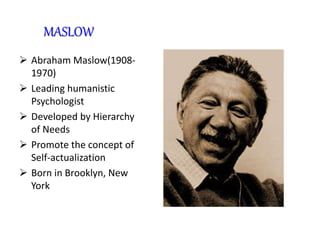
MASLOW
 Abraham Maslow(1908-
1970)
 Leading humanistic
Psychologist
 Developed by Hierarchy
of Needs
 Promote the concept of
Self-actualization
 Born in Brooklyn, New
York
MASLOW THEORIES
 Everyone strives throughout his life to enhance
his knowledge and skills , know and discover
many things.
 Everyone of us want to become a better.
 Each person has his own individuality, motives
foe self actualization drives everyone in
various directions.
 Self actualization of a person is revealed by the
pride one feels that he has achieved something
great in his life.
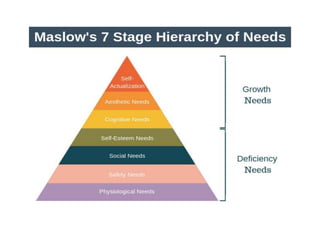
MASLOW’S HIERARCHY OF NEEDS
 Motives are included need gratification and
growth gratification.
 Motives are not same in their level, quality and
intensity.
 Maslow arranged these motives hierarchically
based on the importance of human beings.
 Only after lower order needs and motives are
satisfied ,the next higher level needs arise.
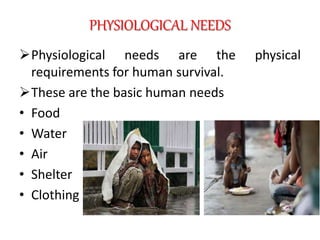
PHYSIOLOGICAL NEEDS
Physiological needs are the physical
requirements for human survival.
These are the basic human needs
• Food
• Water
• Air
• Shelter
• Clothing
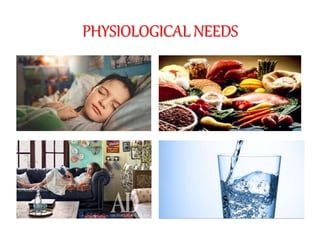
PHYSIOLOGICAL NEEDS
SAFETY AND SECURITY NEEDS
Safety and security needs include:
• Shelter
• Clothing
• Personal safety
• Security of the future
• Regularity
SAFETY AND SECURITY NEEDS
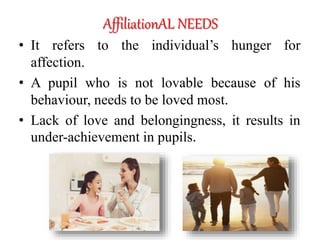
AffiliationAL NEEDS
• It refers to the individual’s hunger for
affection.
• A pupil who is not lovable because of his
behaviour, needs to be loved most.
• Lack of love and belongingness, it results in
under-achievement in pupils.
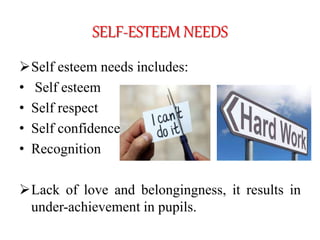
SELF-ESTEEM NEEDS
Self esteem needs includes:
• Self esteem
• Self respect
• Self confidence
• Recognition
Lack of love and belongingness, it results in
under-achievement in pupils.
ACHIEVEMENT NEEDS
Classified into two:
1. Need for knowledge
2. Need for understanding
Need for knowledge is satisfied where there is
access for information, knowing how to do
things, events, symbols.
 Need for understanding implies knowledge of
relationships,process
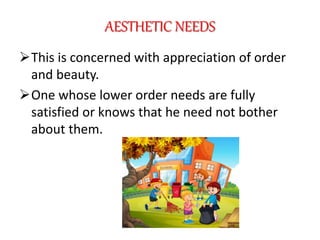
AESTHETIC NEEDS
This is concerned with appreciation of order
and beauty.
One whose lower order needs are fully
satisfied or knows that he need not bother
about them.
SELF-ACTUALISATION NEEDS
• Self actualization means to fulfil one’s
individual nature in all its aspects.
• First three lower order needs are known as
‘Deficiency needs’ which everyman strives to
fulfil.
• Next four other needs are known as ‘Growth
needs 'or ‘Being needs’.
SELF ACTUALIZATION
• Self actualization means an individual gaining
the ability to do that which he considered will
make his life meaningful and worthwhile and
that too doing it with free will, without any
compulsion.
• Two important elements of self-actualization
1. Acting with free
2. The values that is of highest worth accroding
to a person
CHARACTERISTICS OF SELF-ACTUALIZED PERSON
 He has a sense of detachment
 He accepts himself and others
 He is democratic in outlook
 His behaviour is problem – centred
 He shows a high degree of spontaneity
 At times he shows mysticism
 He identifies with mankind
CHARACTERISTICS OF SELF ACTUALIZED PERSON
• He discriminates between ends and means
• He appreciates ‘basic goods of life’ with
continued freshness and pleasure
• He is creative
• He has a sense of humour
• He is a non-conformist
• He shows sufficient perception of reality and
acceptance of it.
EDUCATIONAL IMPLICATIONS
 The deficiency needs of pupils are to be
satisfied to enable them to function at a higher
level of motivation has to be borne in mind
when dealing with economically an culturally
disadvantaged children.
 Looking the after ventilation,
Lighting,furniture,blackboard,proision and
psychological safety and showing interest in
every pupil so that he feels that he belongs to
the class are vital.
• An individual tends to raise his goals
after success and lower them after failure.
• The teacher should enhance the attraction
and minimize the dangers of growth
needs.
• The curriculum should be drastically
changed and revised periodically so that
it serves the vocational needs of pupils.
• Teacher should provide immediate feedback to
students
• Educational goals should be challenging to
students and at the same time within their
reach to achieve as well as related to their
growth needs.
• In teaching different categories of students as
well as different subjects, the teacher should
make use of different kinds of motives.
Self Actualization Theory

Self Actualization Theory

  • 2.
  • 3.
    MASLOW  Abraham Maslow(1908- 1970) Leading humanistic Psychologist  Developed by Hierarchy of Needs  Promote the concept of Self-actualization  Born in Brooklyn, New York
  • 4.
    MASLOW THEORIES  Everyonestrives throughout his life to enhance his knowledge and skills , know and discover many things.  Everyone of us want to become a better.  Each person has his own individuality, motives foe self actualization drives everyone in various directions.  Self actualization of a person is revealed by the pride one feels that he has achieved something great in his life.
  • 6.
    MASLOW’S HIERARCHY OFNEEDS  Motives are included need gratification and growth gratification.  Motives are not same in their level, quality and intensity.  Maslow arranged these motives hierarchically based on the importance of human beings.  Only after lower order needs and motives are satisfied ,the next higher level needs arise.
  • 8.
    PHYSIOLOGICAL NEEDS Physiological needsare the physical requirements for human survival. These are the basic human needs • Food • Water • Air • Shelter • Clothing
  • 9.
  • 10.
    SAFETY AND SECURITYNEEDS Safety and security needs include: • Shelter • Clothing • Personal safety • Security of the future • Regularity
  • 11.
  • 12.
    AffiliationAL NEEDS • Itrefers to the individual’s hunger for affection. • A pupil who is not lovable because of his behaviour, needs to be loved most. • Lack of love and belongingness, it results in under-achievement in pupils.
  • 13.
    SELF-ESTEEM NEEDS Self esteemneeds includes: • Self esteem • Self respect • Self confidence • Recognition Lack of love and belongingness, it results in under-achievement in pupils.
  • 14.
    ACHIEVEMENT NEEDS Classified intotwo: 1. Need for knowledge 2. Need for understanding Need for knowledge is satisfied where there is access for information, knowing how to do things, events, symbols.  Need for understanding implies knowledge of relationships,process
  • 15.
    AESTHETIC NEEDS This isconcerned with appreciation of order and beauty. One whose lower order needs are fully satisfied or knows that he need not bother about them.
  • 16.
    SELF-ACTUALISATION NEEDS • Selfactualization means to fulfil one’s individual nature in all its aspects. • First three lower order needs are known as ‘Deficiency needs’ which everyman strives to fulfil. • Next four other needs are known as ‘Growth needs 'or ‘Being needs’.
  • 17.
    SELF ACTUALIZATION • Selfactualization means an individual gaining the ability to do that which he considered will make his life meaningful and worthwhile and that too doing it with free will, without any compulsion. • Two important elements of self-actualization 1. Acting with free 2. The values that is of highest worth accroding to a person
  • 18.
    CHARACTERISTICS OF SELF-ACTUALIZEDPERSON  He has a sense of detachment  He accepts himself and others  He is democratic in outlook  His behaviour is problem – centred  He shows a high degree of spontaneity  At times he shows mysticism  He identifies with mankind
  • 19.
    CHARACTERISTICS OF SELFACTUALIZED PERSON • He discriminates between ends and means • He appreciates ‘basic goods of life’ with continued freshness and pleasure • He is creative • He has a sense of humour • He is a non-conformist • He shows sufficient perception of reality and acceptance of it.
  • 20.
    EDUCATIONAL IMPLICATIONS  Thedeficiency needs of pupils are to be satisfied to enable them to function at a higher level of motivation has to be borne in mind when dealing with economically an culturally disadvantaged children.  Looking the after ventilation, Lighting,furniture,blackboard,proision and psychological safety and showing interest in every pupil so that he feels that he belongs to the class are vital.
  • 21.
    • An individualtends to raise his goals after success and lower them after failure. • The teacher should enhance the attraction and minimize the dangers of growth needs. • The curriculum should be drastically changed and revised periodically so that it serves the vocational needs of pupils.
  • 22.
    • Teacher shouldprovide immediate feedback to students • Educational goals should be challenging to students and at the same time within their reach to achieve as well as related to their growth needs. • In teaching different categories of students as well as different subjects, the teacher should make use of different kinds of motives.