Concept Learning Strategies
Instructional Design
By:
Cassandra Mobley
July 2, 2013
CONCEPT LEARNING
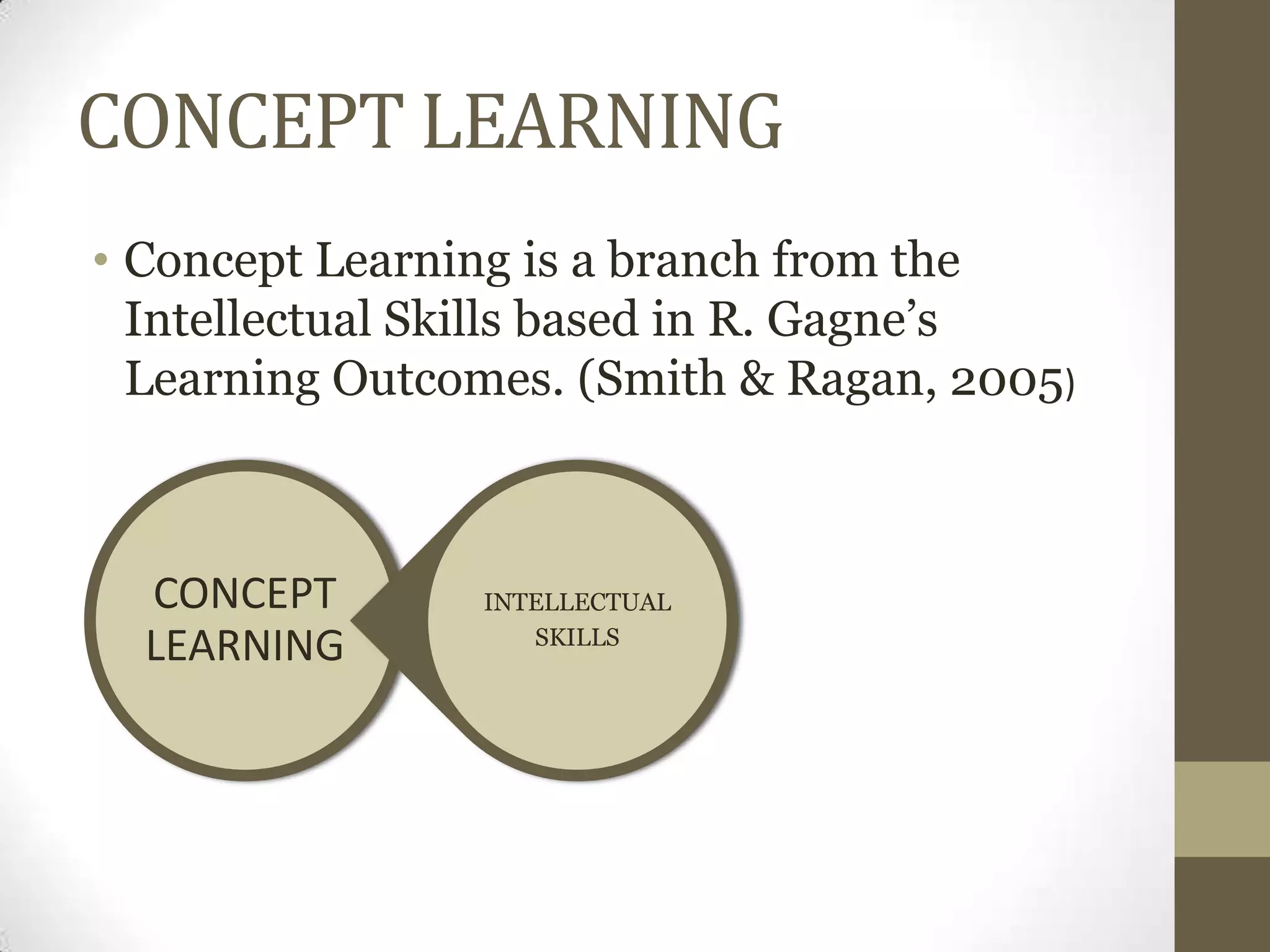
• Concept Learning is a branch from the
Intellectual Skills based in R. Gagne’s
Learning Outcomes. (Smith & Ragan, 2005)
CONCEPT
LEARNING
INTELLECTUAL
SKILLS
Gagne’s Learning Outcome
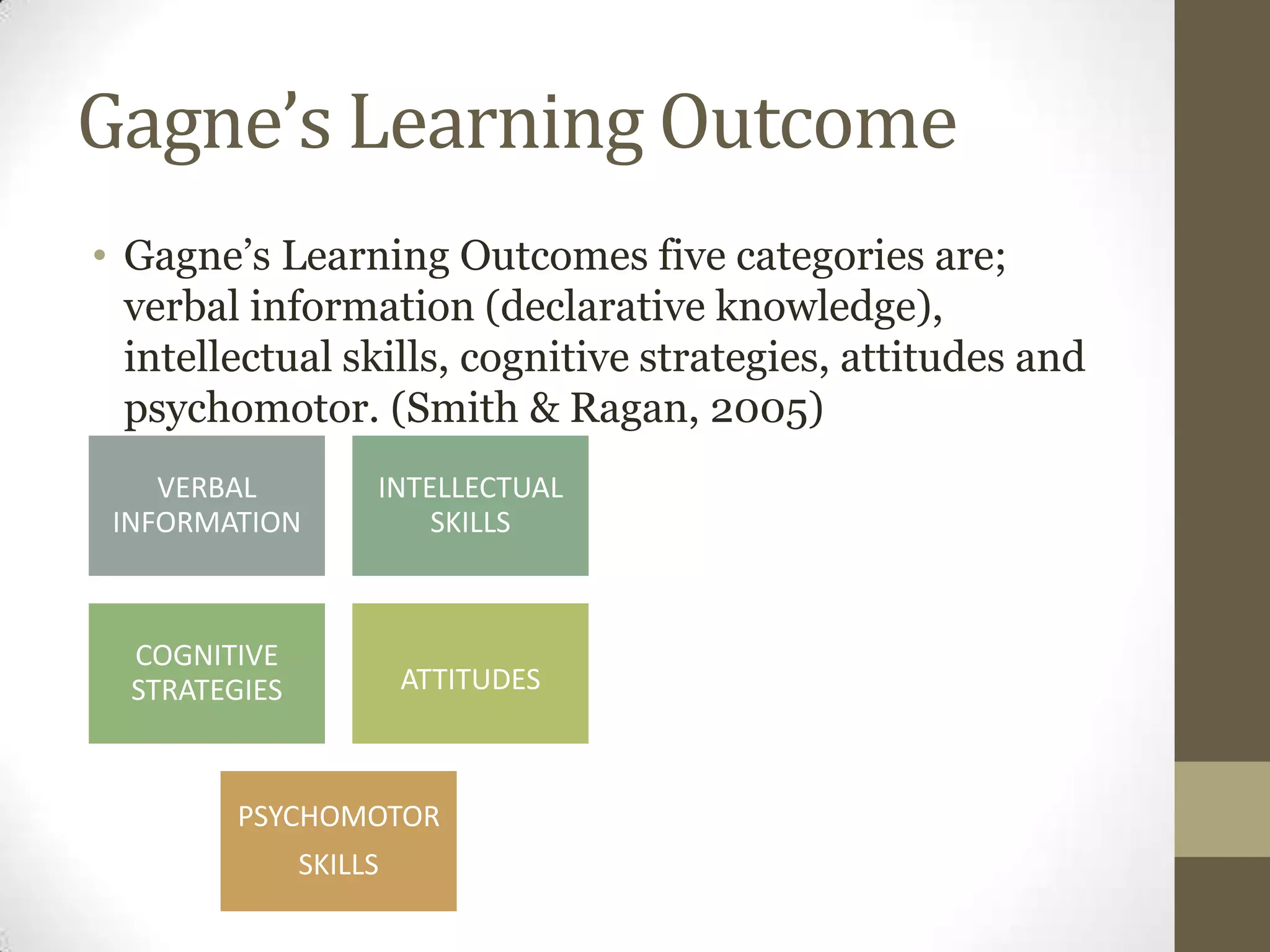
• Gagne’s Learning Outcomes five categories are;
verbal information (declarative knowledge),
intellectual skills, cognitive strategies, attitudes and
psychomotor. (Smith & Ragan, 2005)
VERBAL
INFORMATION
INTELLECTUAL
SKILLS
COGNITIVE
STRATEGIES ATTITUDES
PSYCHOMOTOR
SKILLS
INTELLECTUAL SKILLS
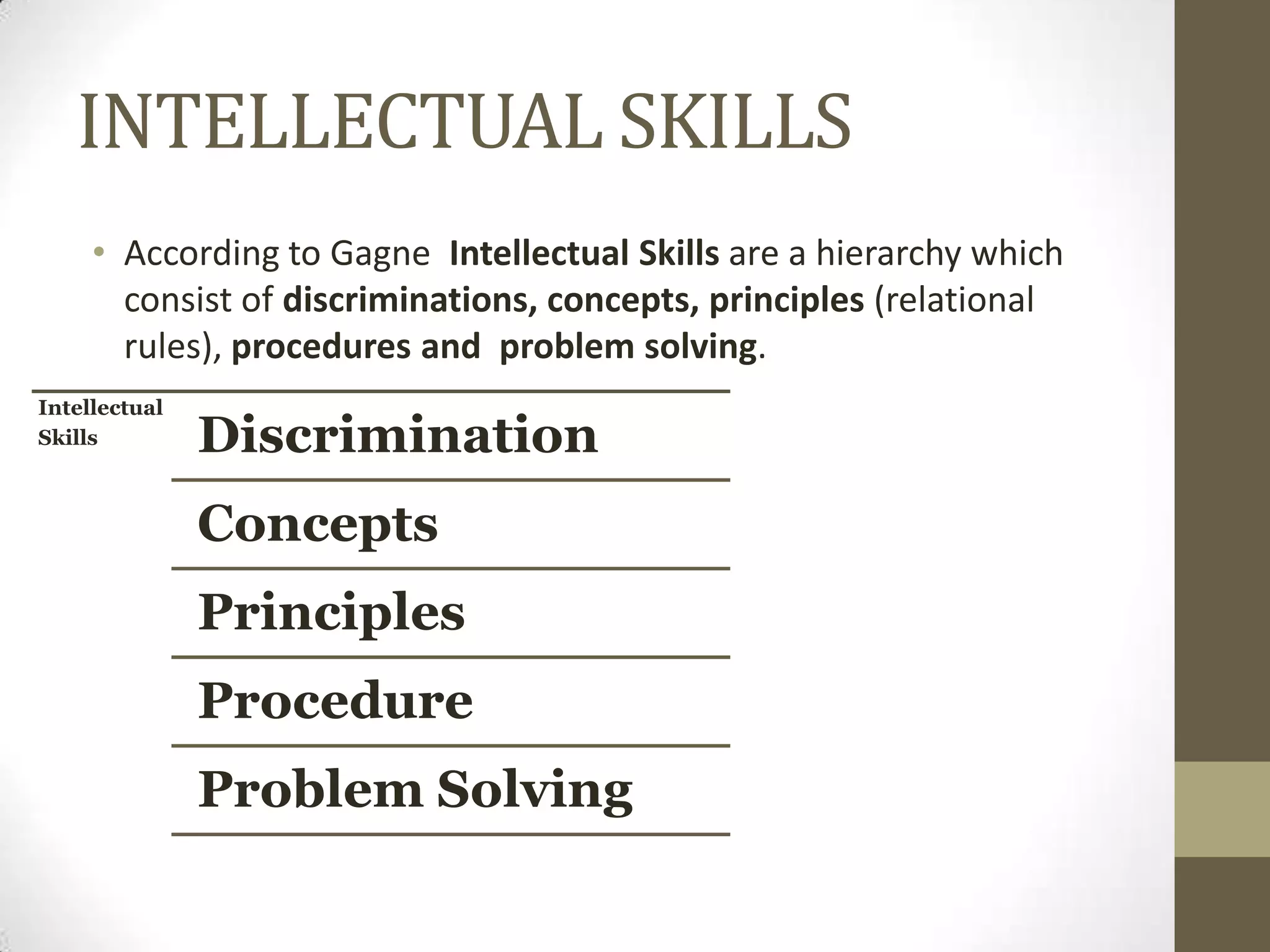
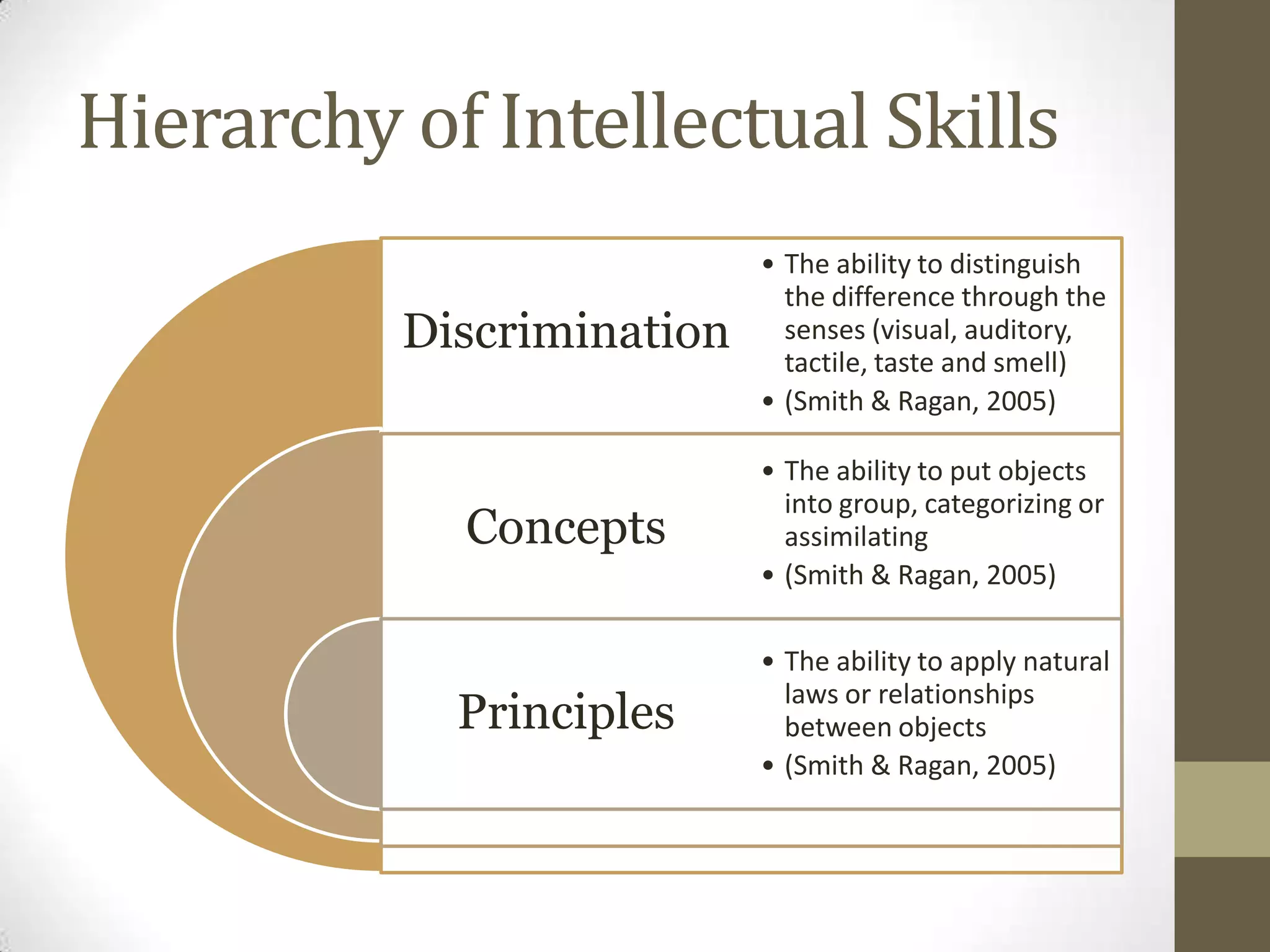
• According to Gagne Intellectual Skills are a hierarchy which
consist of discriminations, concepts, principles (relational
rules), procedures and problem solving.
Intellectual
Skills Discrimination
Concepts
Principles
Procedure
Problem Solving
Hierarchy of Intellectual Skills
Discrimination
Concepts
Principles
• The ability to distinguish
the difference through the
senses (visual, auditory,
tactile, taste and smell)
• (Smith & Ragan, 2005)
• The ability to put objects
into group, categorizing or
assimilating
• (Smith & Ragan, 2005)
• The ability to apply natural
laws or relationships
between objects
• (Smith & Ragan, 2005)
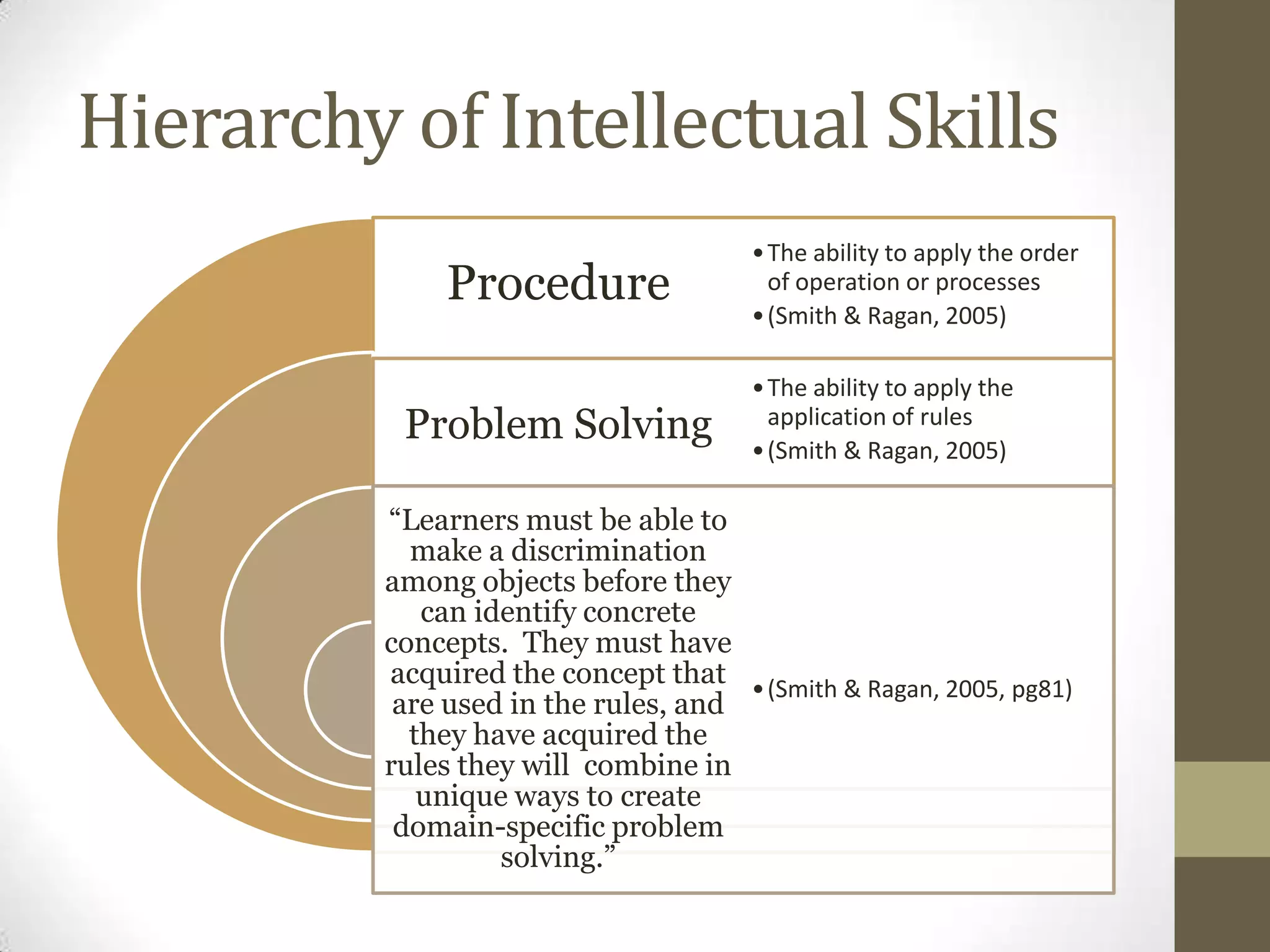
Hierarchy of Intellectual Skills
Procedure
Problem Solving
“Learners must be able to
make a discrimination
among objects before they
can identify concrete
concepts. They must have
acquired the concept that
are used in the rules, and
they have acquired the
rules they will combine in
unique ways to create
domain-specific problem
solving.”
•The ability to apply the order
of operation or processes
•(Smith & Ragan, 2005)
•The ability to apply the
application of rules
•(Smith & Ragan, 2005)
•(Smith & Ragan, 2005, pg81)
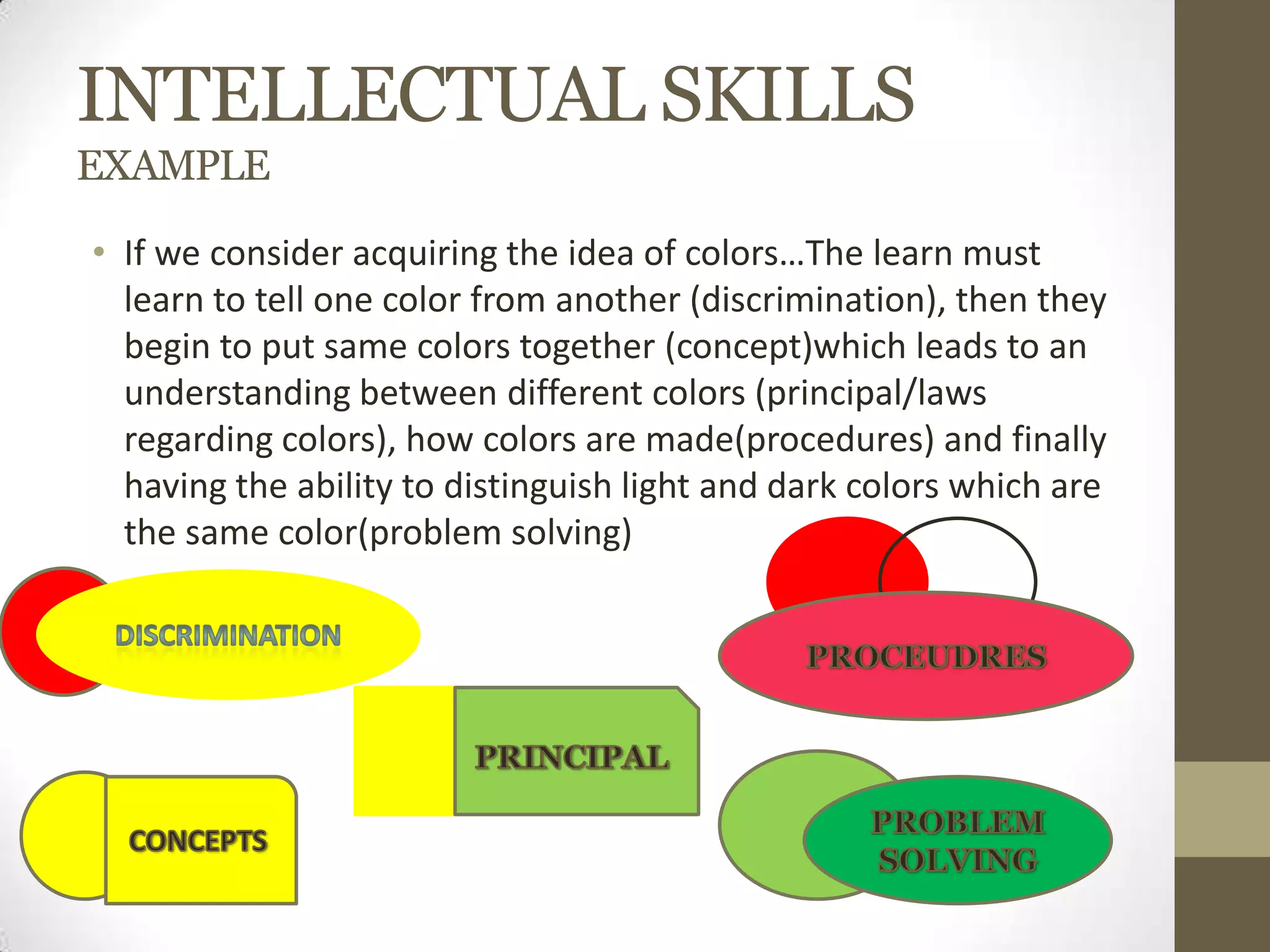
INTELLECTUAL SKILLS
EXAMPLE
• If we consider acquiring the idea of colors…The learn must
learn to tell one color from another (discrimination), then they
begin to put same colors together (concept)which leads to an
understanding between different colors (principal/laws
regarding colors), how colors are made(procedures) and finally
having the ability to distinguish light and dark colors which are
the same color(problem solving)
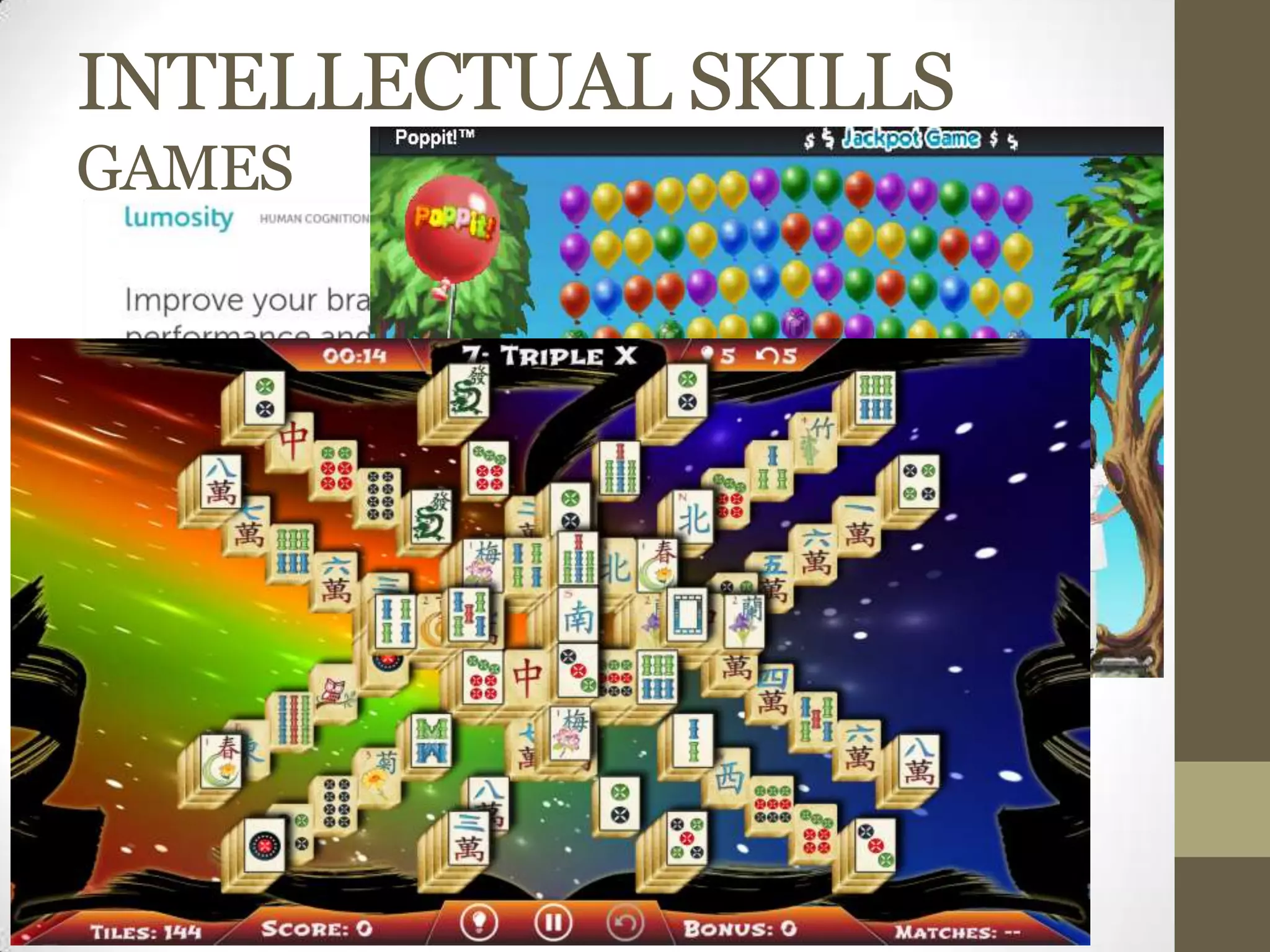
INTELLECTUAL SKILLS
GAMES
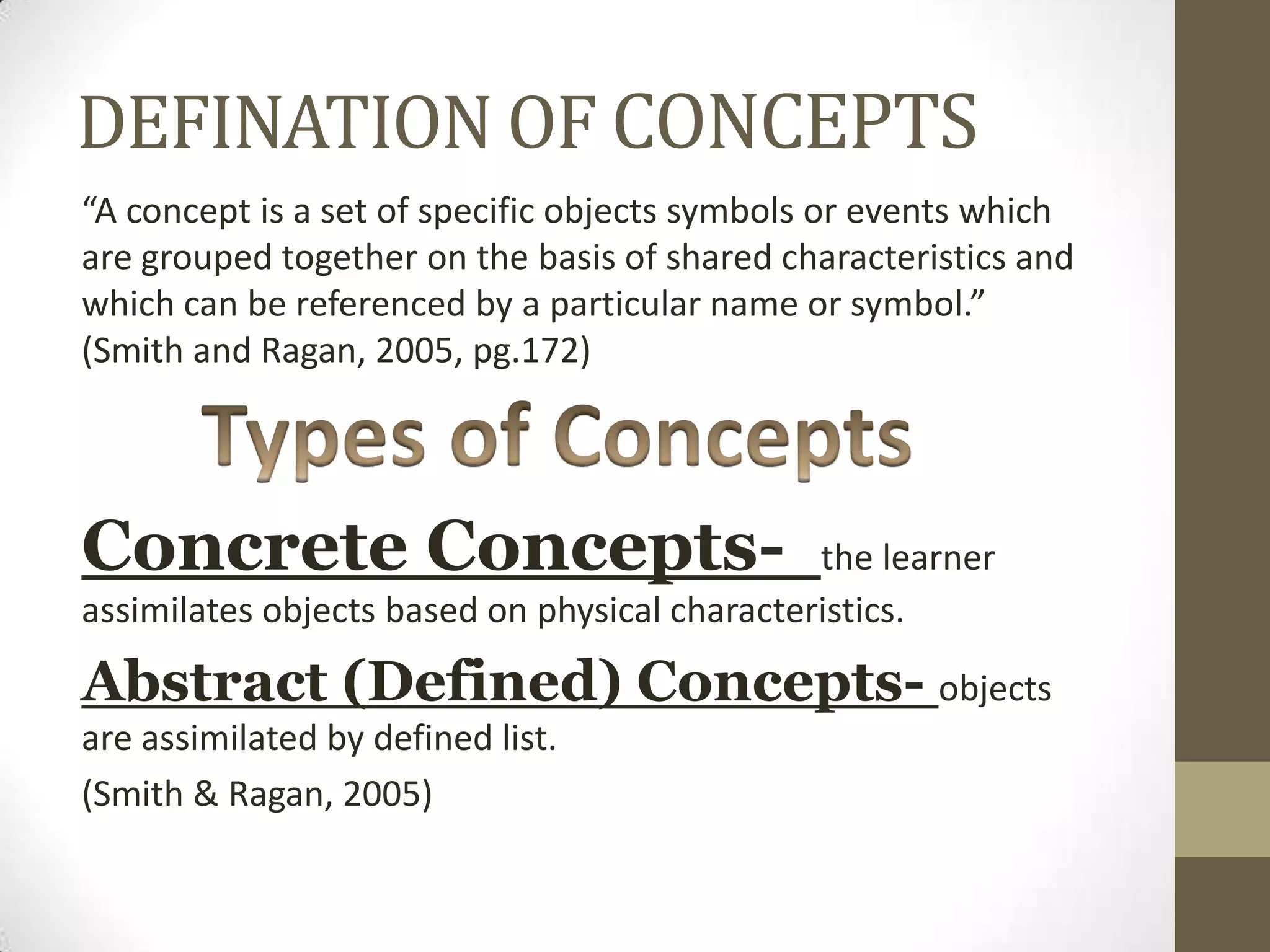
DEFINATION OF CONCEPTS
“A concept is a set of specific objects symbols or events which
are grouped together on the basis of shared characteristics and
which can be referenced by a particular name or symbol.”
(Smith and Ragan, 2005, pg.172)
Concrete Concepts- the learner
assimilates objects based on physical characteristics.
Abstract (Defined) Concepts- objects
are assimilated by defined list.
(Smith & Ragan, 2005)
CONCEPT LEARNING
STRATEGIES
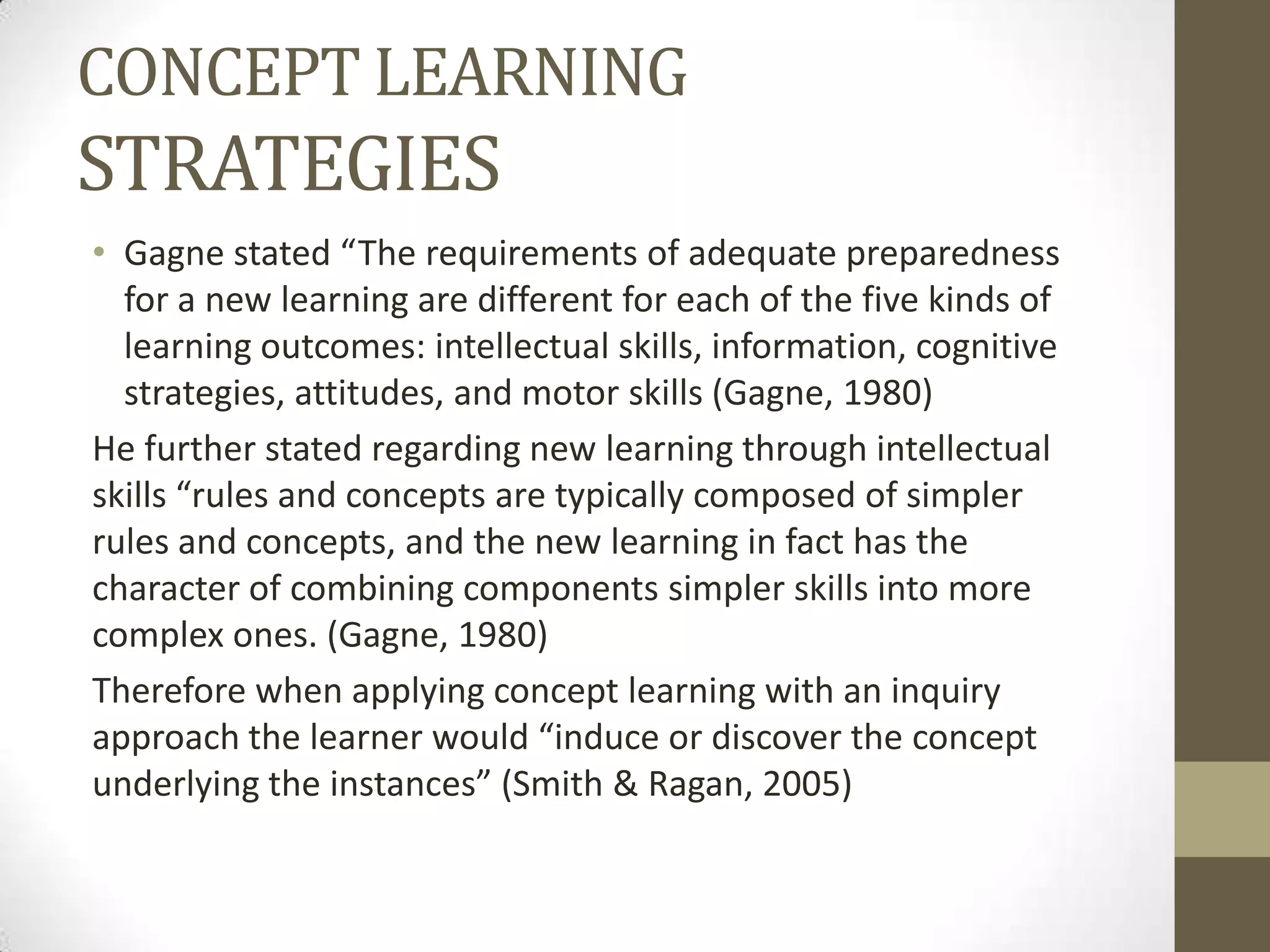
• Gagne stated “The requirements of adequate preparedness
for a new learning are different for each of the five kinds of
learning outcomes: intellectual skills, information, cognitive
strategies, attitudes, and motor skills (Gagne, 1980)
He further stated regarding new learning through intellectual
skills “rules and concepts are typically composed of simpler
rules and concepts, and the new learning in fact has the
character of combining components simpler skills into more
complex ones. (Gagne, 1980)
Therefore when applying concept learning with an inquiry
approach the learner would “induce or discover the concept
underlying the instances” (Smith & Ragan, 2005)
STRATEGIES CONT.
• An example of this application is the Sesame Street son
“One of These Things is Not Like the Other” which is also an
analogies.
One of These Things is Not Like the Others
Analogies can be used for abstract and concrete concepts
because they require the learner to relate prior knowledge and
assist with grouping of characteristics.
STRATEGIES cont.
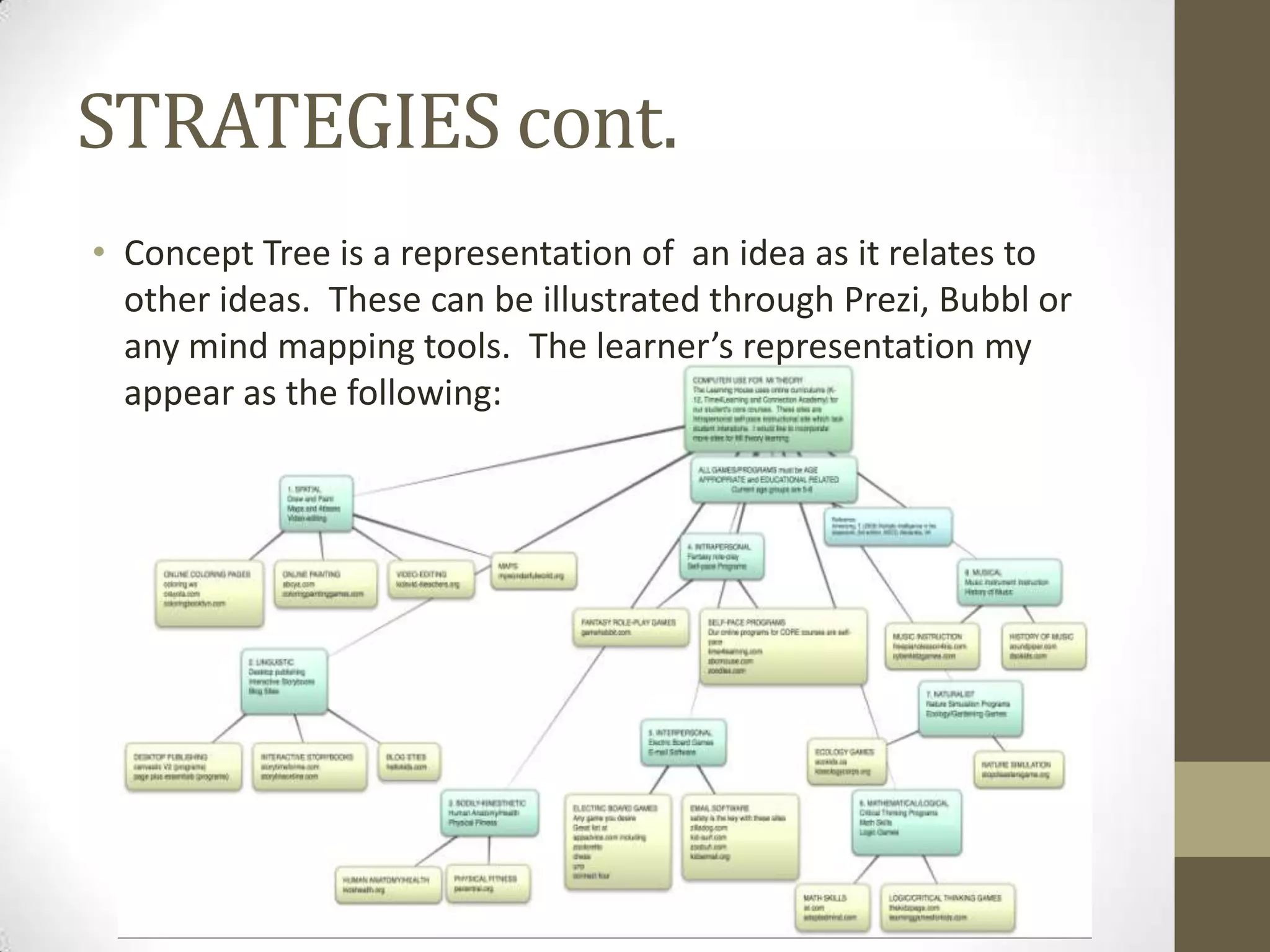
• Concept Tree is a representation of an idea as it relates to
other ideas. These can be illustrated through Prezi, Bubbl or
any mind mapping tools. The learner’s representation my
appear as the following:
References
• Smith, P.L. & Ragan, T.J. (2005) Instructional design
3rd edition. Wiley & Son, Hoboken, NJ
• Gagne, R. M. (1980). Preparing the learner for new
learning. Theory Into Practice, 19(1), 6.
• GAMES
• http://www.lumosity.com
• Pogo (2013) Poppit. Electronic Arts Retrieved 7/3/2013
from http://www.pogo.com/games/poppit
Graan, B (2012). Mahjong solitarie version V17.
Mahjonged.com

Concept learning strategies [autosaved]

  • 1.
    Concept Learning Strategies InstructionalDesign By: Cassandra Mobley July 2, 2013
  • 2.
    CONCEPT LEARNING • ConceptLearning is a branch from the Intellectual Skills based in R. Gagne’s Learning Outcomes. (Smith & Ragan, 2005) CONCEPT LEARNING INTELLECTUAL SKILLS
  • 3.
    Gagne’s Learning Outcome •Gagne’s Learning Outcomes five categories are; verbal information (declarative knowledge), intellectual skills, cognitive strategies, attitudes and psychomotor. (Smith & Ragan, 2005) VERBAL INFORMATION INTELLECTUAL SKILLS COGNITIVE STRATEGIES ATTITUDES PSYCHOMOTOR SKILLS
  • 4.
    INTELLECTUAL SKILLS • Accordingto Gagne Intellectual Skills are a hierarchy which consist of discriminations, concepts, principles (relational rules), procedures and problem solving. Intellectual Skills Discrimination Concepts Principles Procedure Problem Solving
  • 5.
    Hierarchy of IntellectualSkills Discrimination Concepts Principles • The ability to distinguish the difference through the senses (visual, auditory, tactile, taste and smell) • (Smith & Ragan, 2005) • The ability to put objects into group, categorizing or assimilating • (Smith & Ragan, 2005) • The ability to apply natural laws or relationships between objects • (Smith & Ragan, 2005)
  • 6.
    Hierarchy of IntellectualSkills Procedure Problem Solving “Learners must be able to make a discrimination among objects before they can identify concrete concepts. They must have acquired the concept that are used in the rules, and they have acquired the rules they will combine in unique ways to create domain-specific problem solving.” •The ability to apply the order of operation or processes •(Smith & Ragan, 2005) •The ability to apply the application of rules •(Smith & Ragan, 2005) •(Smith & Ragan, 2005, pg81)
  • 7.
    INTELLECTUAL SKILLS EXAMPLE • Ifwe consider acquiring the idea of colors…The learn must learn to tell one color from another (discrimination), then they begin to put same colors together (concept)which leads to an understanding between different colors (principal/laws regarding colors), how colors are made(procedures) and finally having the ability to distinguish light and dark colors which are the same color(problem solving)
  • 8.
  • 9.
    DEFINATION OF CONCEPTS “Aconcept is a set of specific objects symbols or events which are grouped together on the basis of shared characteristics and which can be referenced by a particular name or symbol.” (Smith and Ragan, 2005, pg.172) Concrete Concepts- the learner assimilates objects based on physical characteristics. Abstract (Defined) Concepts- objects are assimilated by defined list. (Smith & Ragan, 2005)
  • 10.
    CONCEPT LEARNING STRATEGIES • Gagnestated “The requirements of adequate preparedness for a new learning are different for each of the five kinds of learning outcomes: intellectual skills, information, cognitive strategies, attitudes, and motor skills (Gagne, 1980) He further stated regarding new learning through intellectual skills “rules and concepts are typically composed of simpler rules and concepts, and the new learning in fact has the character of combining components simpler skills into more complex ones. (Gagne, 1980) Therefore when applying concept learning with an inquiry approach the learner would “induce or discover the concept underlying the instances” (Smith & Ragan, 2005)
  • 11.
    STRATEGIES CONT. • Anexample of this application is the Sesame Street son “One of These Things is Not Like the Other” which is also an analogies. One of These Things is Not Like the Others Analogies can be used for abstract and concrete concepts because they require the learner to relate prior knowledge and assist with grouping of characteristics.
  • 12.
    STRATEGIES cont. • ConceptTree is a representation of an idea as it relates to other ideas. These can be illustrated through Prezi, Bubbl or any mind mapping tools. The learner’s representation my appear as the following:
  • 13.
    References • Smith, P.L.& Ragan, T.J. (2005) Instructional design 3rd edition. Wiley & Son, Hoboken, NJ • Gagne, R. M. (1980). Preparing the learner for new learning. Theory Into Practice, 19(1), 6. • GAMES • http://www.lumosity.com • Pogo (2013) Poppit. Electronic Arts Retrieved 7/3/2013 from http://www.pogo.com/games/poppit Graan, B (2012). Mahjong solitarie version V17. Mahjonged.com