Nazareth College of Education
for Women
Course : Learning and
Teaching
Teacher Educator : Mrs.Gayathri
(Head of the
Department of
Computer Science)
Topic : Nature of Learning
Process
SUJEETHA.R
MATHEMATICS
2018-2020
 Learning is an active social process
 Vygotsky (1978)
 McMahon (1997)
 Kukla (2000)
 Green and Gredler (2002)
 Definition of Learning
 What is Learning ?
 What is Teaching & Learning ?
SCOPE OF PRESENTATION
 Nature of Learning
 Five principles of learning
 Three important activities in the process of
learning
 Three domains of learning
 Types of learning
 Conclusion
SCOPE OF PRESENTATION
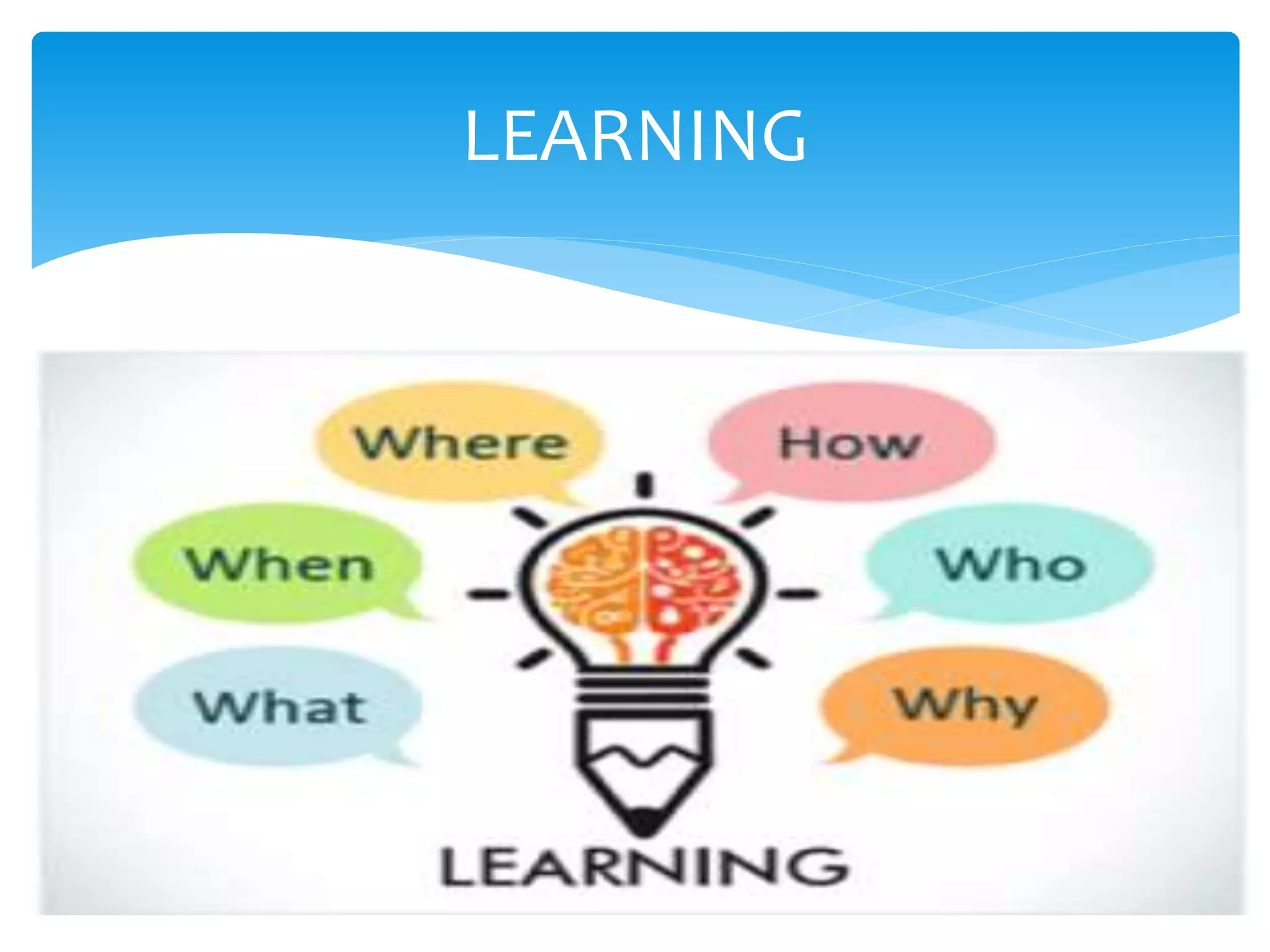
LEARNING
 Vygotsky (1978) also highlighted the convergence of
the social and practical elements in learning by saying
that the most significant moment in the course of
intellectual development occurs when speech and
practical activity, two previously completely
independent lines of development, converge. Through
practical activity a child constructs meaning on an
intrapersonal level, while speech connects this
meaning with the interpersonal world shared by the
child and her/his culture.
Learning is an active social process
 McMahon (1997) agrees that learning is a
social process. He further states that learning
is not a process that only takes place inside
our minds, nor is it a passive development of
our behaviors that is shaped by external
forces and that meaningful learning occurs
when individuals are engaged in social
activities.
Learning is an active social process
Kukla (2000) argues that reality
is constructed by our own
activities and that people,
together as members of a
society, invent the properties of
the world.
Learning is an active social process
 Green and Gredler (2002) emphasize learning as an
iterative process, involving discursive, adaptive,
interactive, and reflexive qualities. According to
them the main focus is on the instructor-student
relationship. Other studies, too, argue for the
importance of mentoring in the process of
learning. The social constructivist model thus
emphasizes the importance of the relationship
between the student and the instructor in the
learning process.
Learning is an active social process
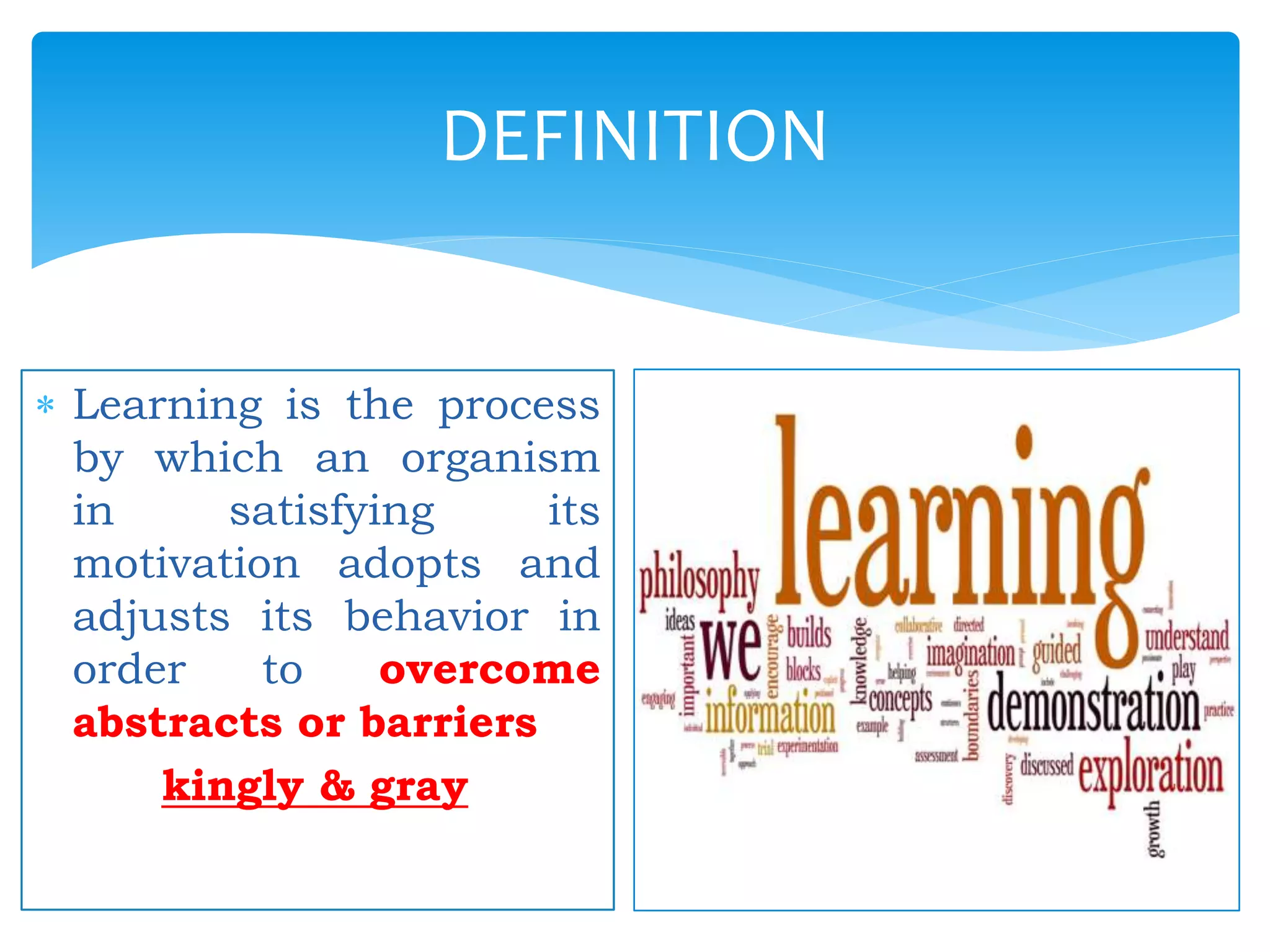
 Learning is the process
by which an organism
in satisfying its
motivation adopts and
adjusts its behavior in
order to overcome
abstracts or barriers
kingly & gray
DEFINITION
What is Learning ?
What is Teaching & Learning ?
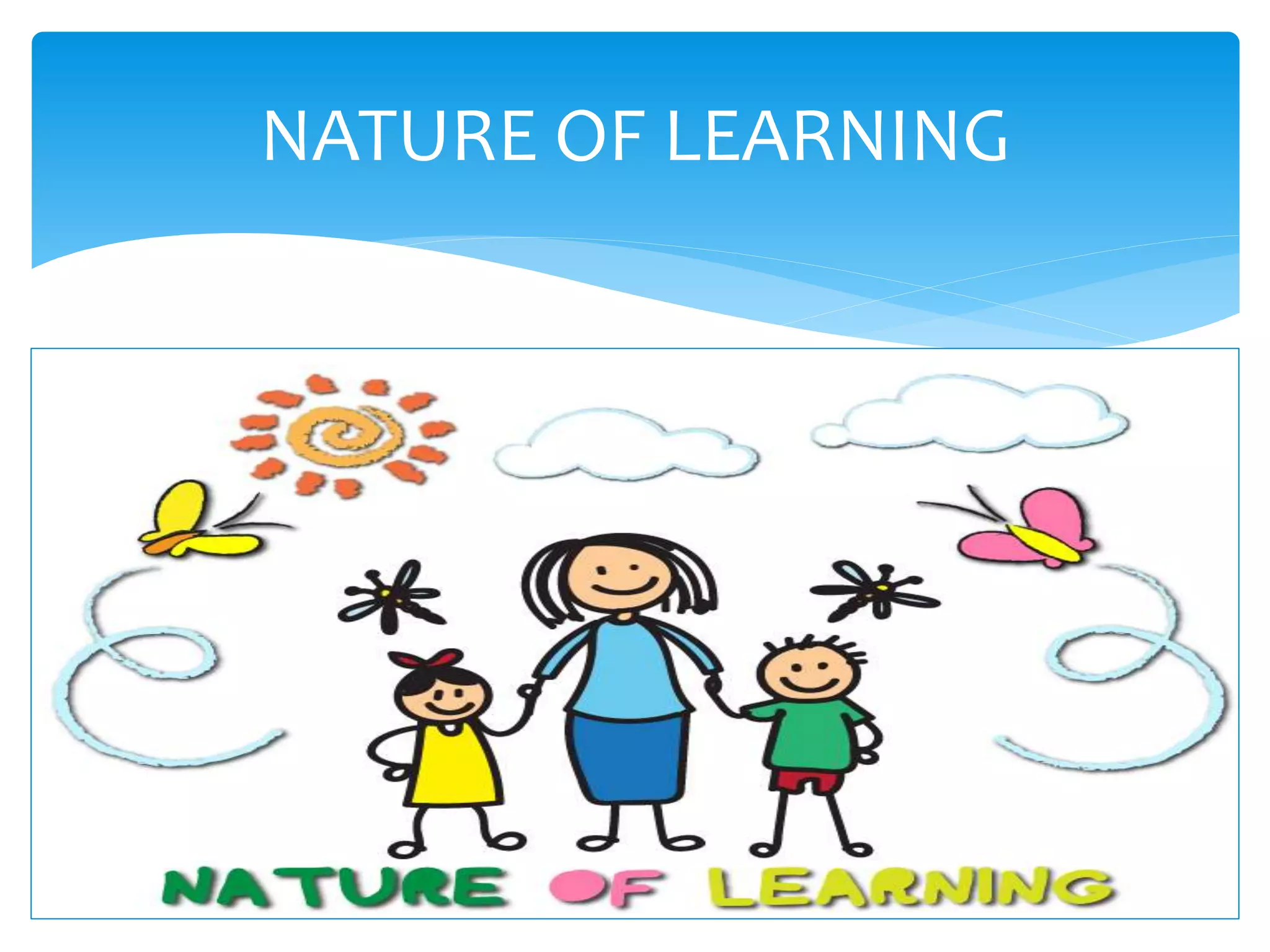
NATURE OF LEARNING
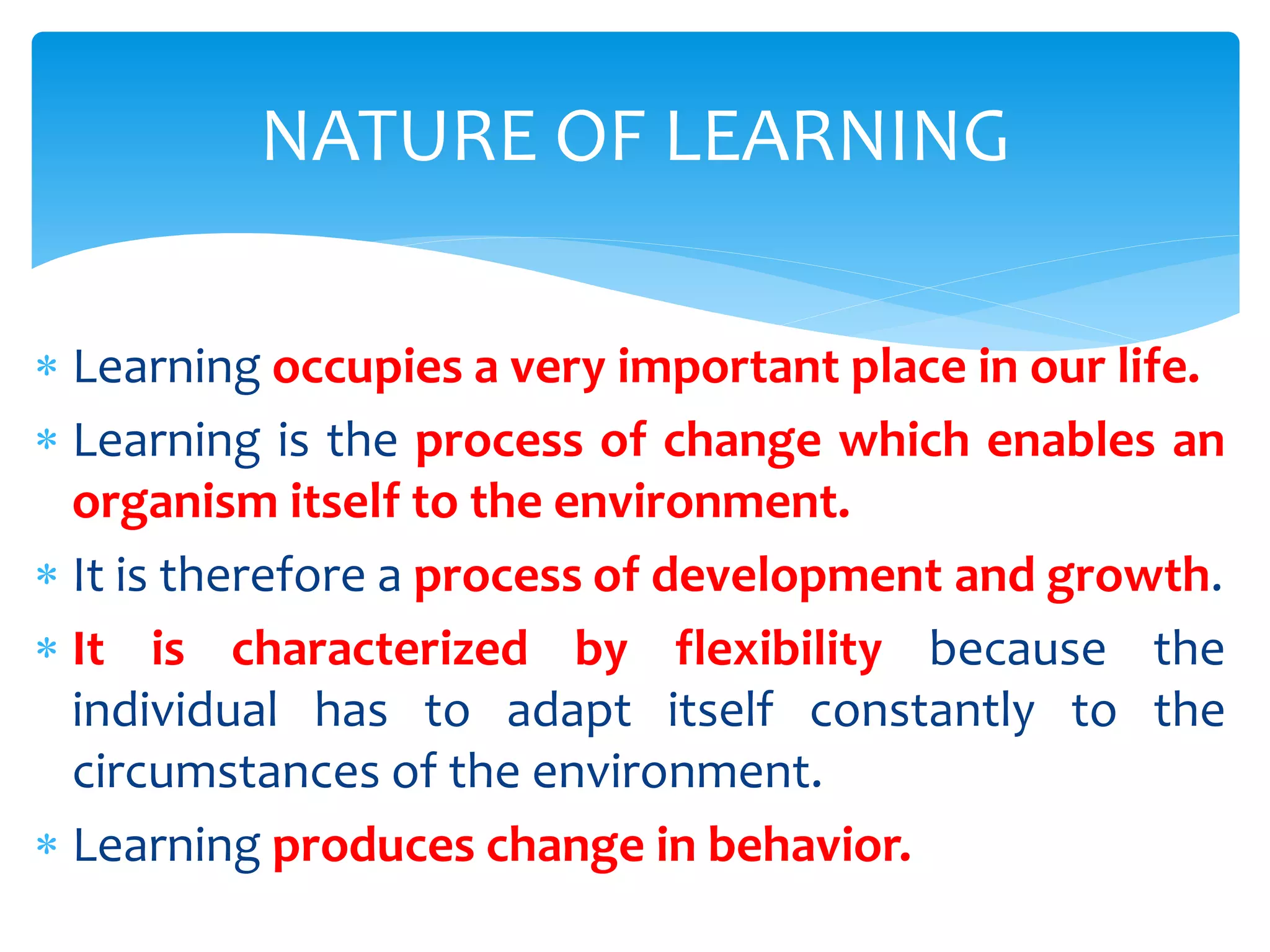
 Learning occupies a very important place in our life.
 Learning is the process of change which enables an
organism itself to the environment.
 It is therefore a process of development and growth.
 It is characterized by flexibility because the
individual has to adapt itself constantly to the
circumstances of the environment.
 Learning produces change in behavior.
NATURE OF LEARNING
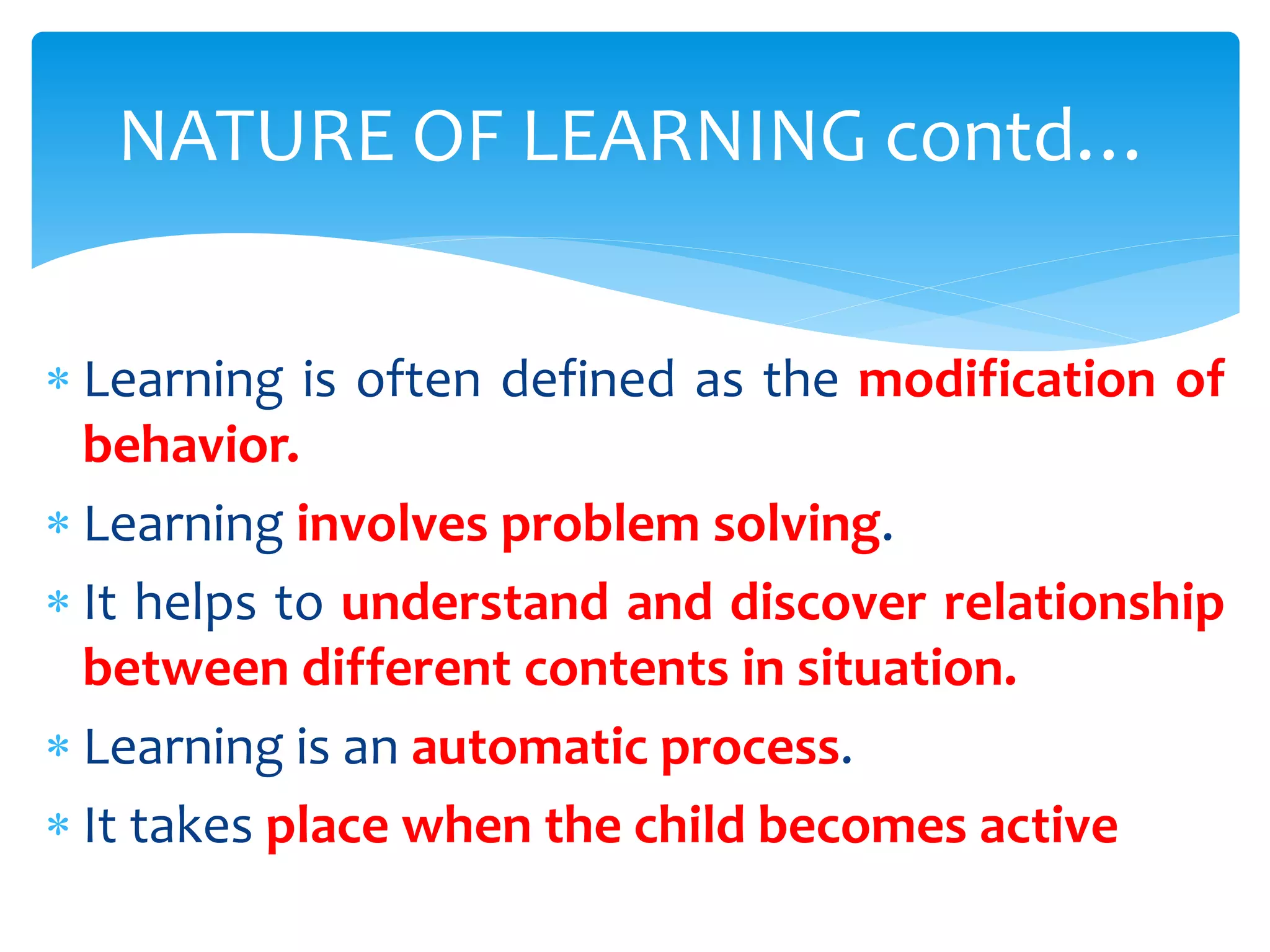
 Learning is often defined as the modification of
behavior.
 Learning involves problem solving.
 It helps to understand and discover relationship
between different contents in situation.
 Learning is an automatic process.
 It takes place when the child becomes active
NATURE OF LEARNING contd…
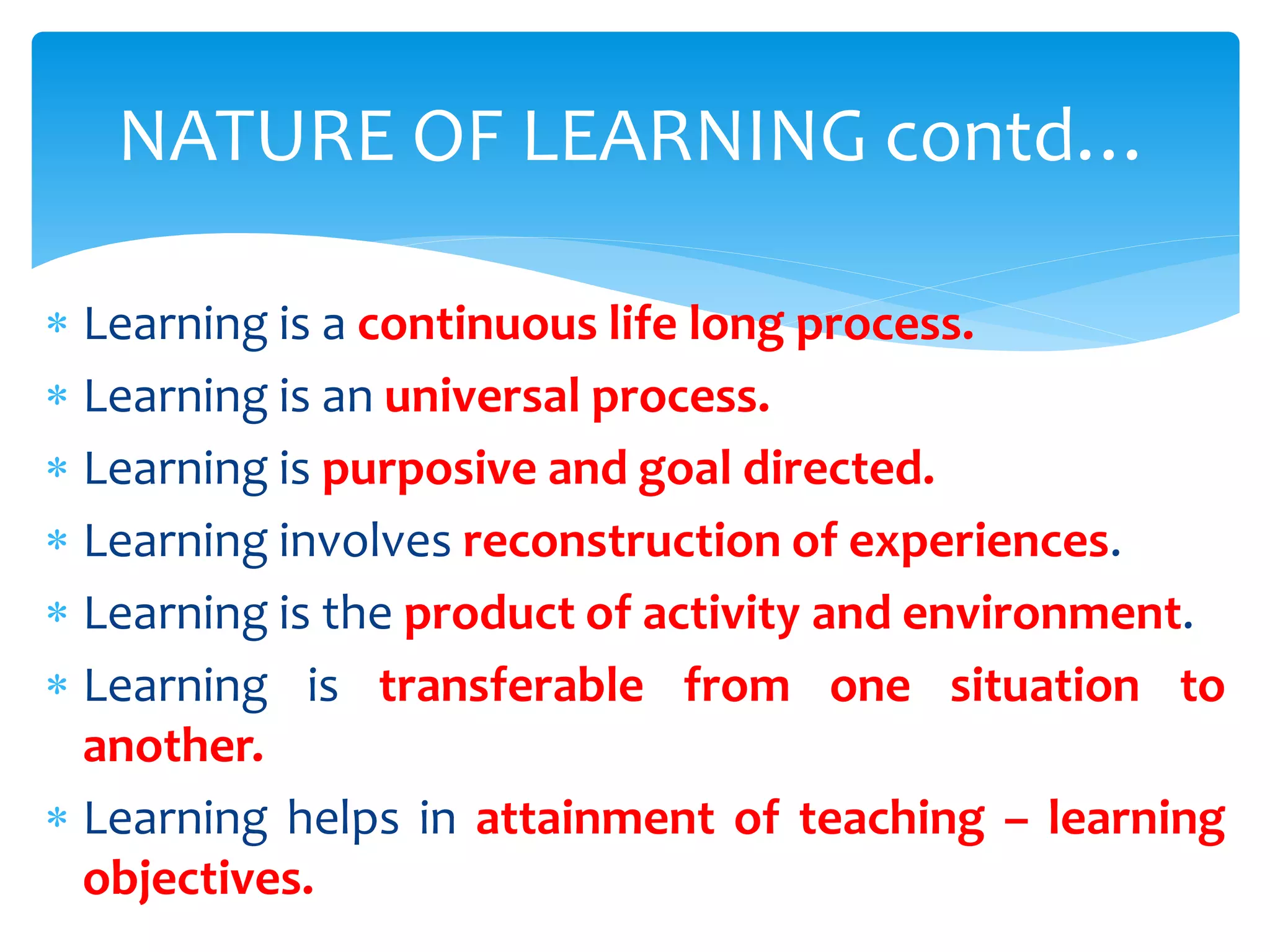
 Learning is a continuous life long process.
 Learning is an universal process.
 Learning is purposive and goal directed.
 Learning involves reconstruction of experiences.
 Learning is the product of activity and environment.
 Learning is transferable from one situation to
another.
 Learning helps in attainment of teaching – learning
objectives.
NATURE OF LEARNING contd…
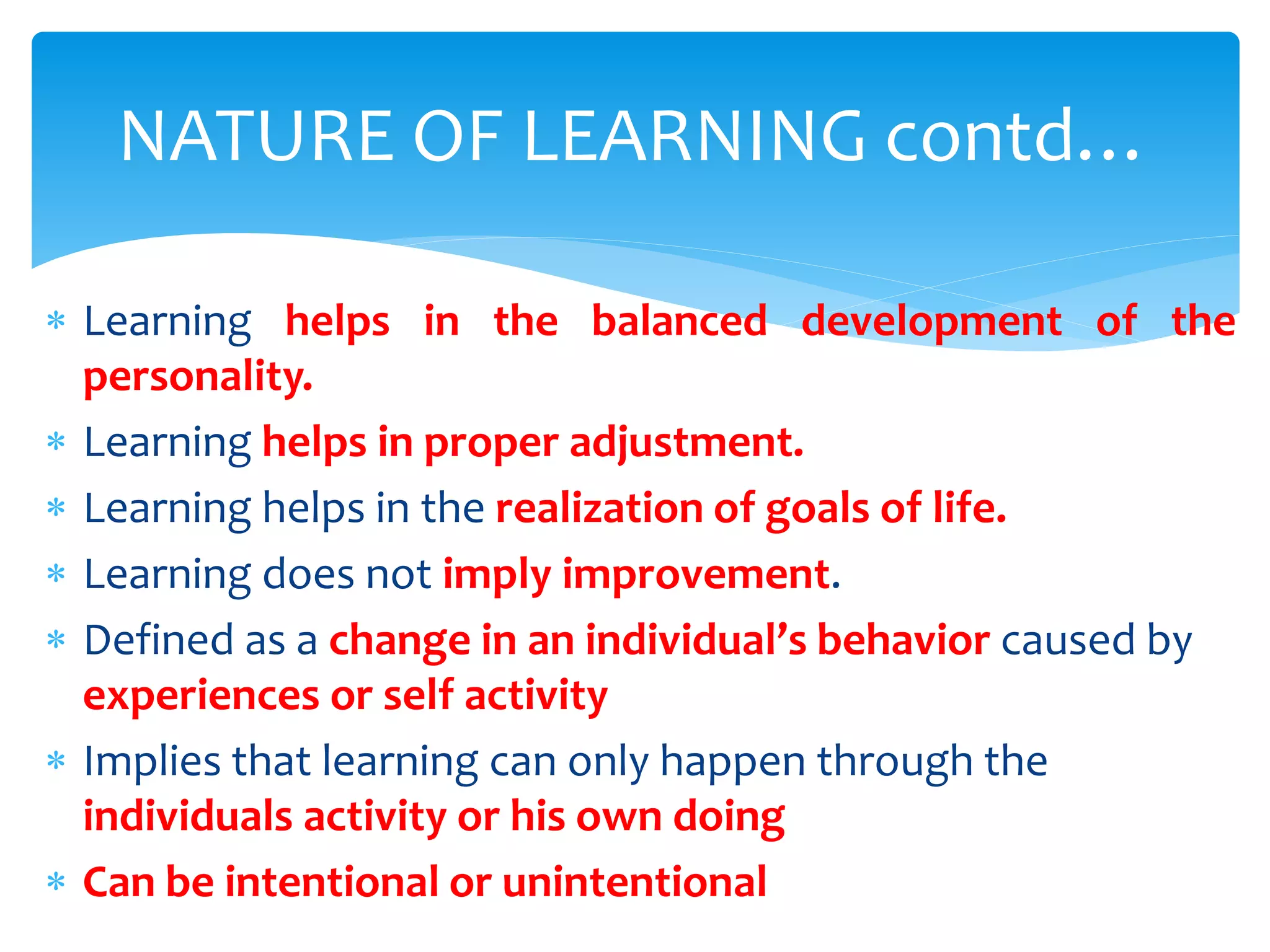
 Learning helps in the balanced development of the
personality.
 Learning helps in proper adjustment.
 Learning helps in the realization of goals of life.
 Learning does not imply improvement.
 Defined as a change in an individual’s behavior caused by
experiences or self activity
 Implies that learning can only happen through the
individuals activity or his own doing
 Can be intentional or unintentional
NATURE OF LEARNING contd…
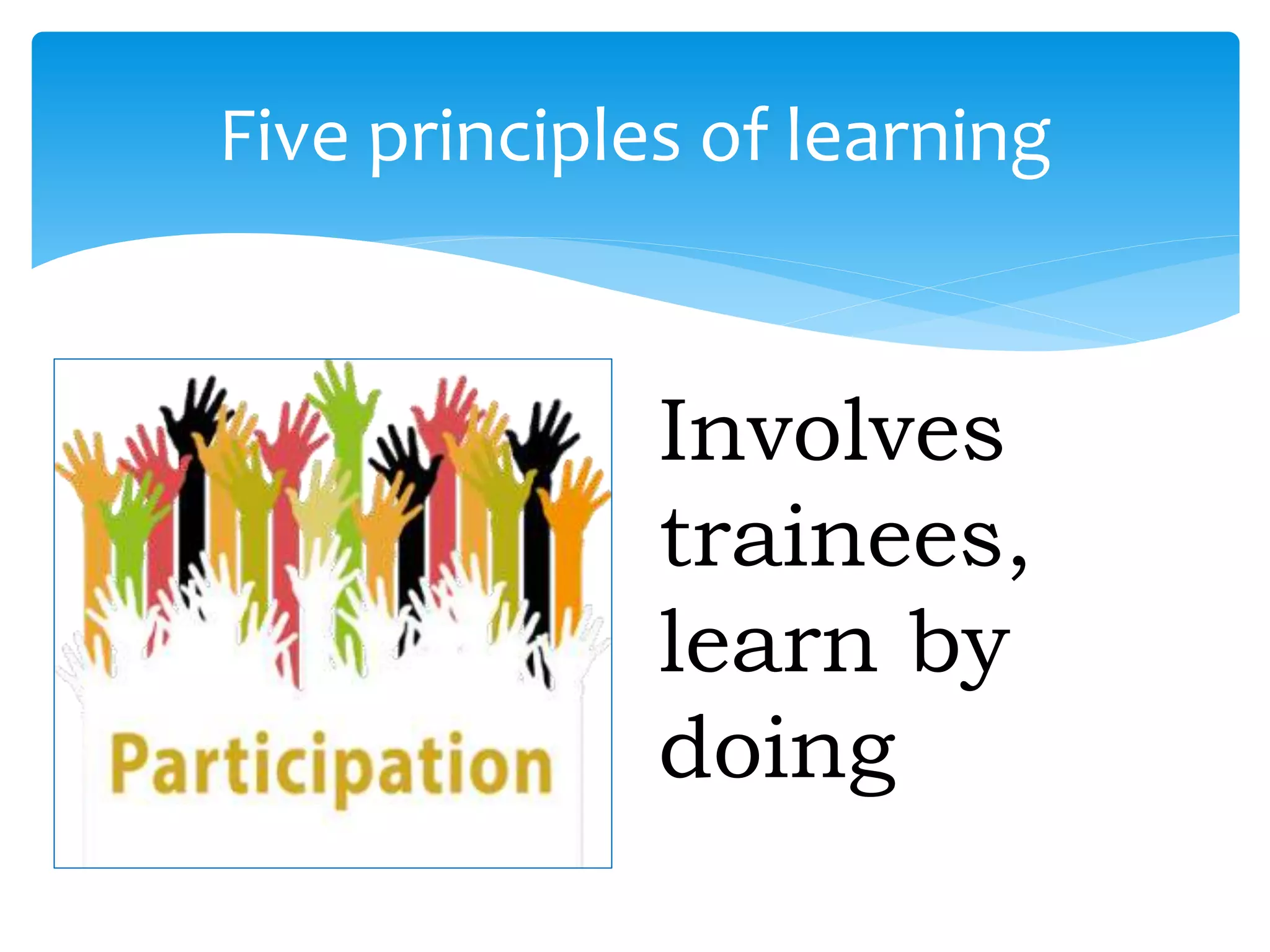
Five principles of learning
Involves
trainees,
learn by
doing
Five principles of learning
Repeat ideas
& concepts
to help
people learn
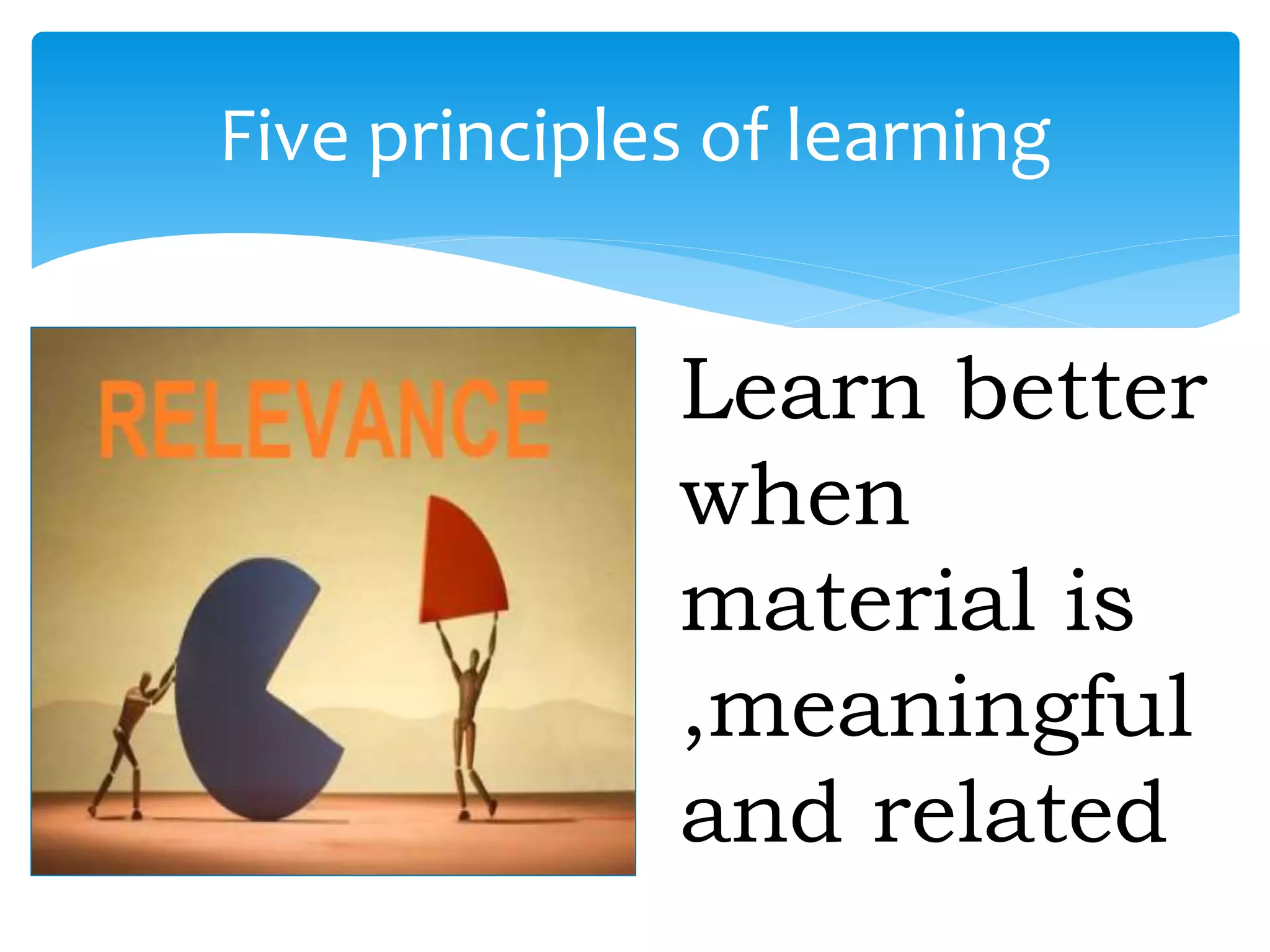
Five principles of learning
Learn better
when
material is
,meaningful
and related
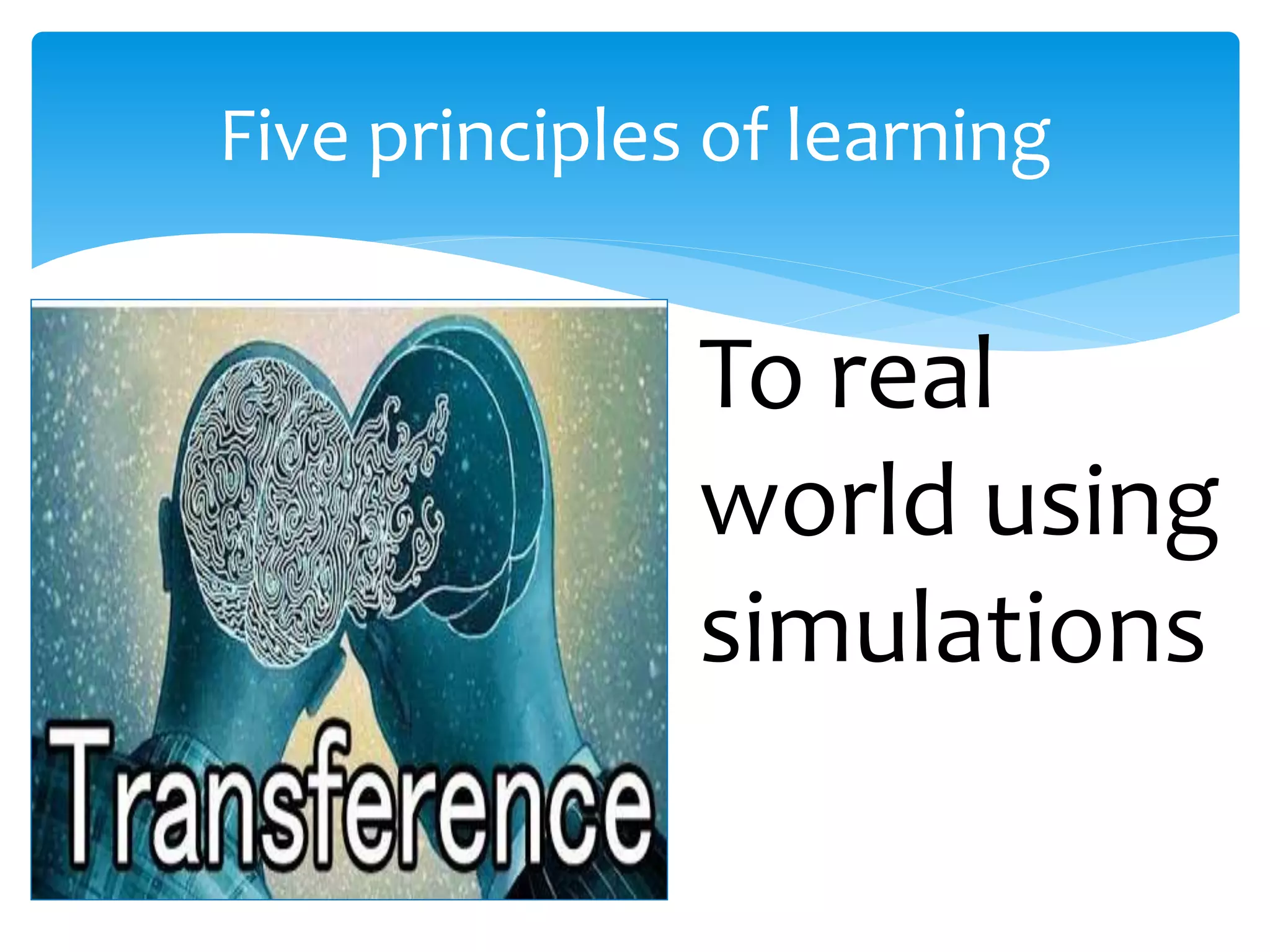
Five principles of learning
To real
world using
simulations
Five principles of learning
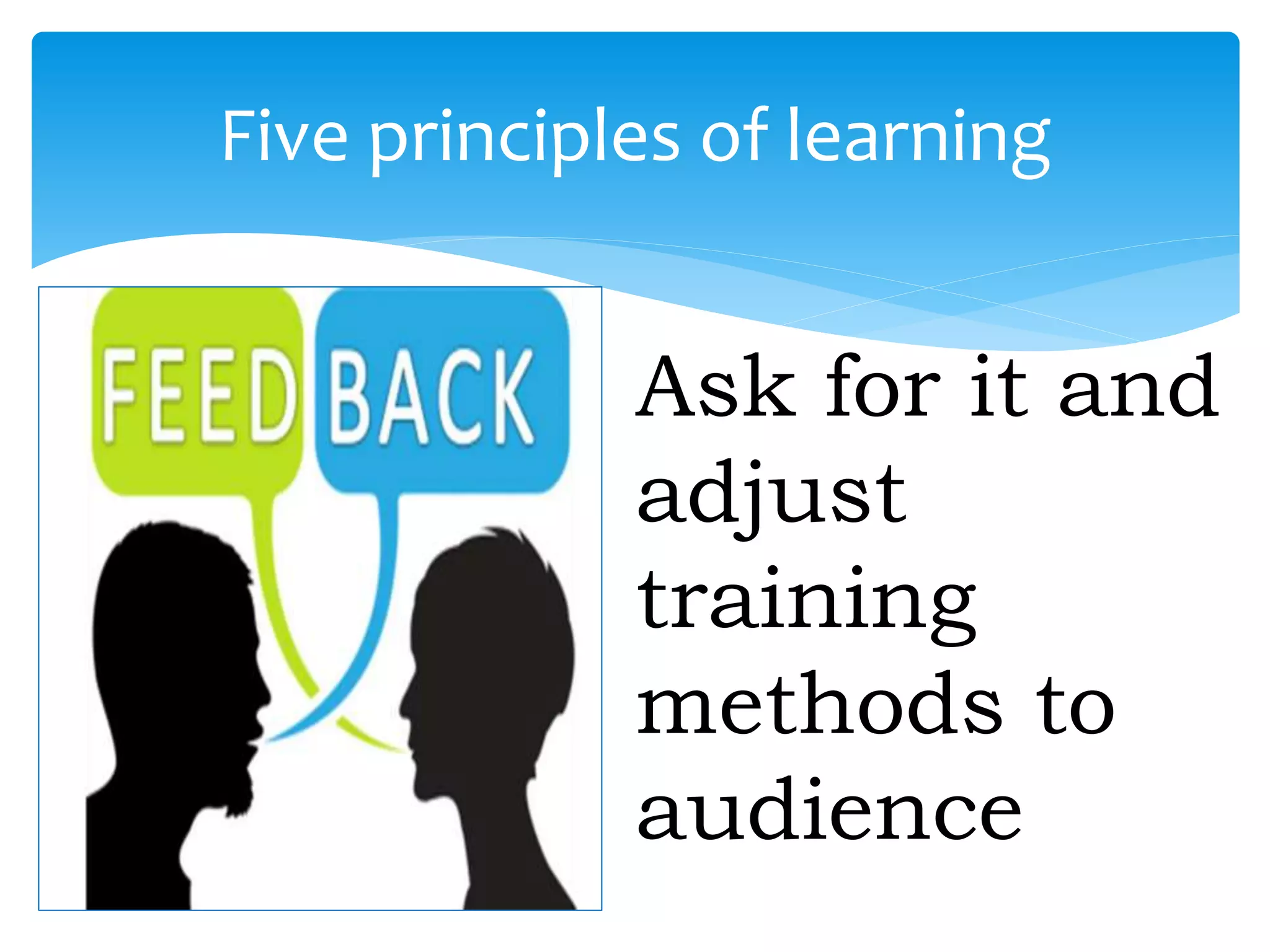
Ask for it and
adjust
training
methods to
audience
Three important activities in the
process of learning
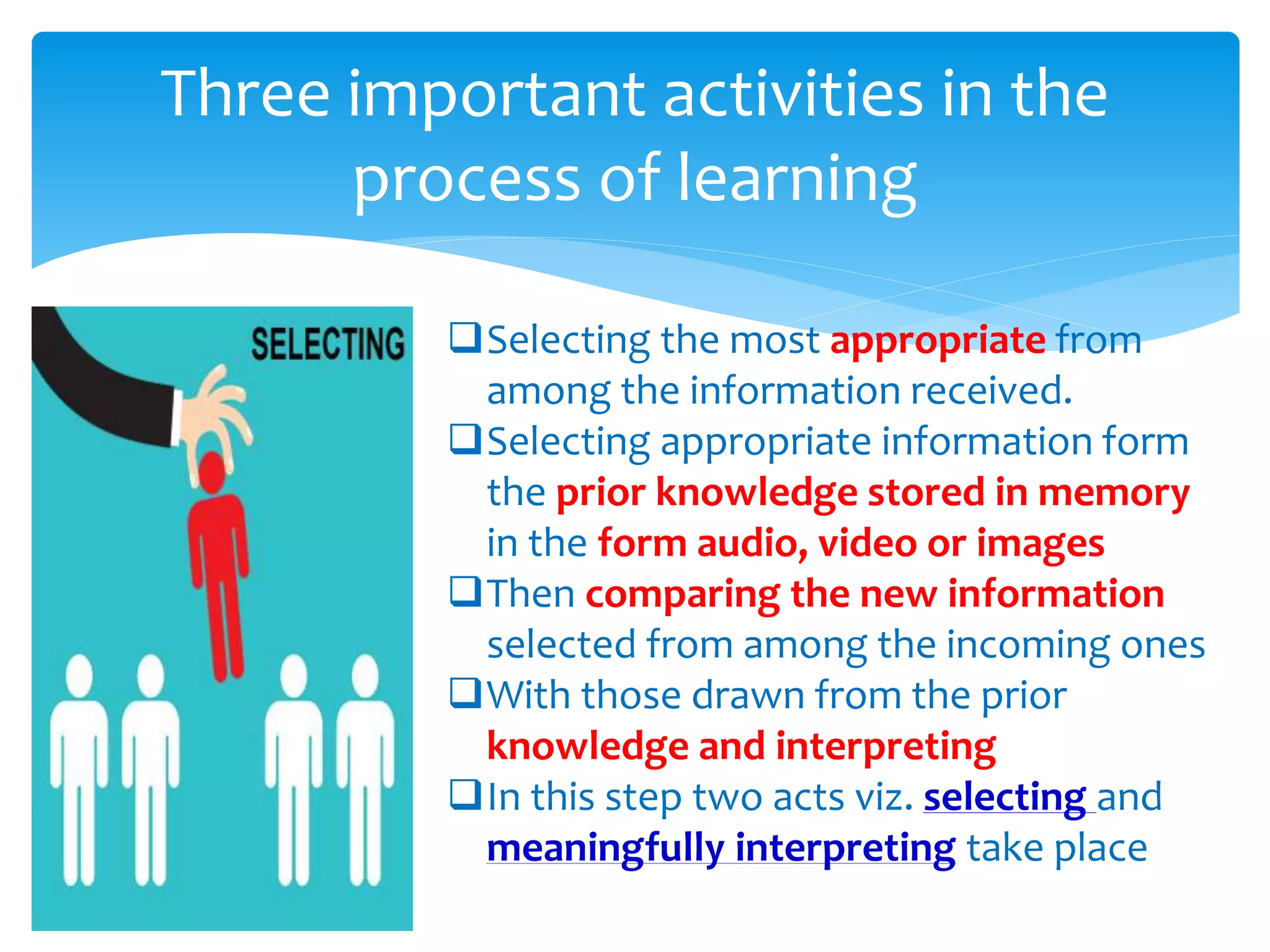
Selecting the most appropriate from
among the information received.
Selecting appropriate information form
the prior knowledge stored in memory
in the form audio, video or images
Then comparing the new information
selected from among the incoming ones
With those drawn from the prior
knowledge and interpreting
In this step two acts viz. selecting and
meaningfully interpreting take place
Three important activities in the
process of learning
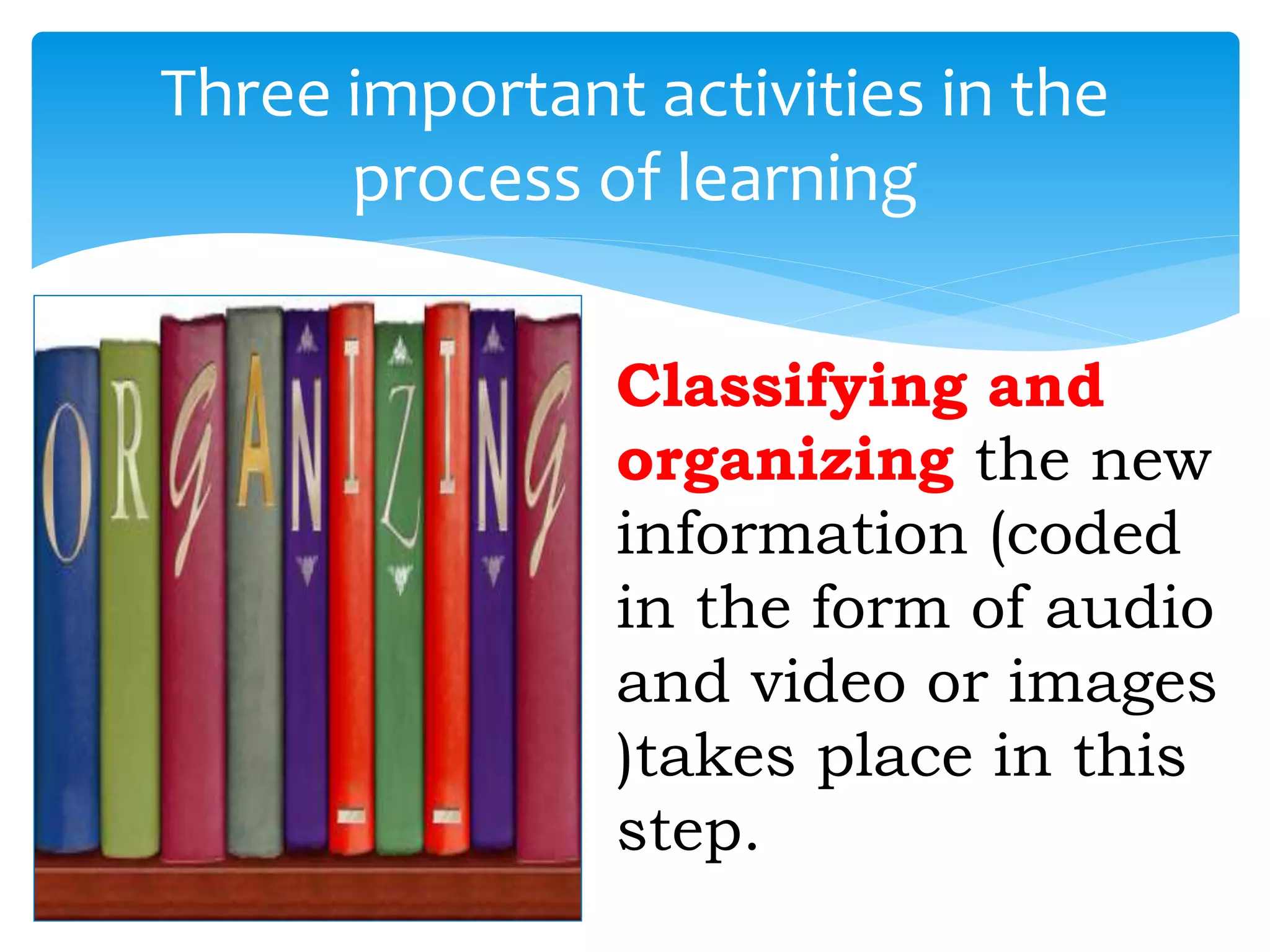
Classifying and
organizing the new
information (coded
in the form of audio
and video or images
)takes place in this
step.
Three important activities in the
process of learning
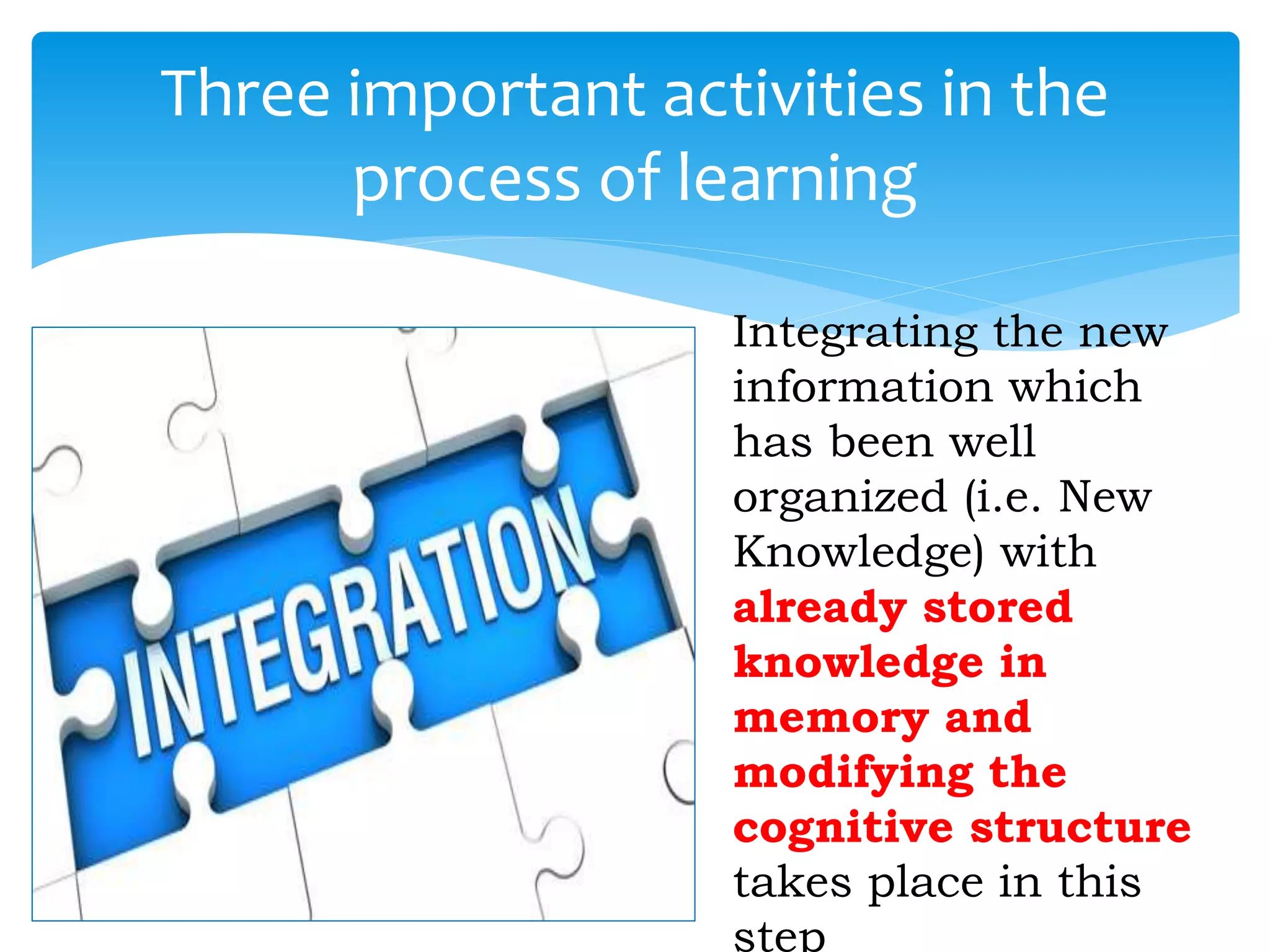
Integrating the new
information which
has been well
organized (i.e. New
Knowledge) with
already stored
knowledge in
memory and
modifying the
cognitive structure
takes place in this
step
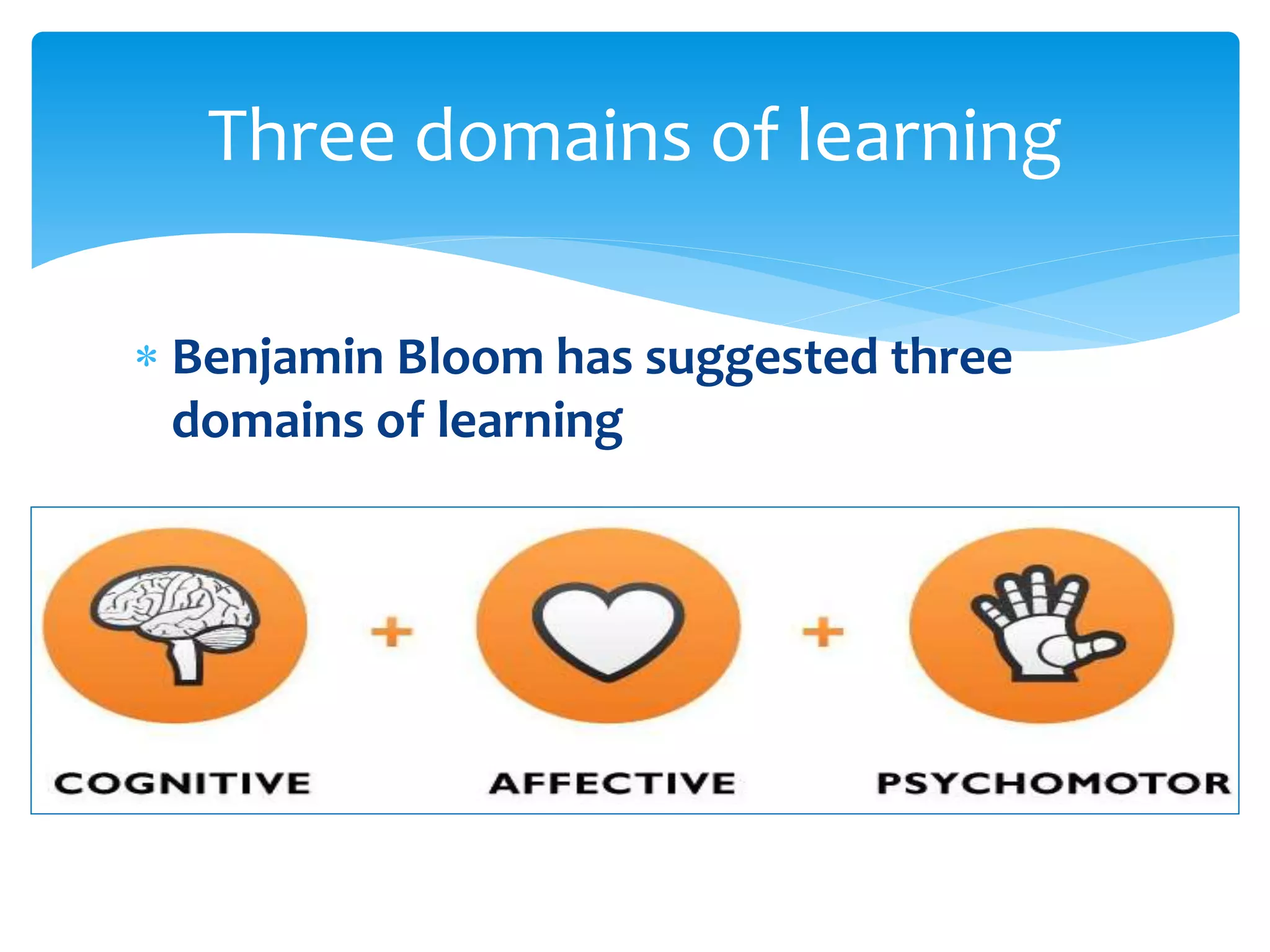
 Benjamin Bloom has suggested three
domains of learning
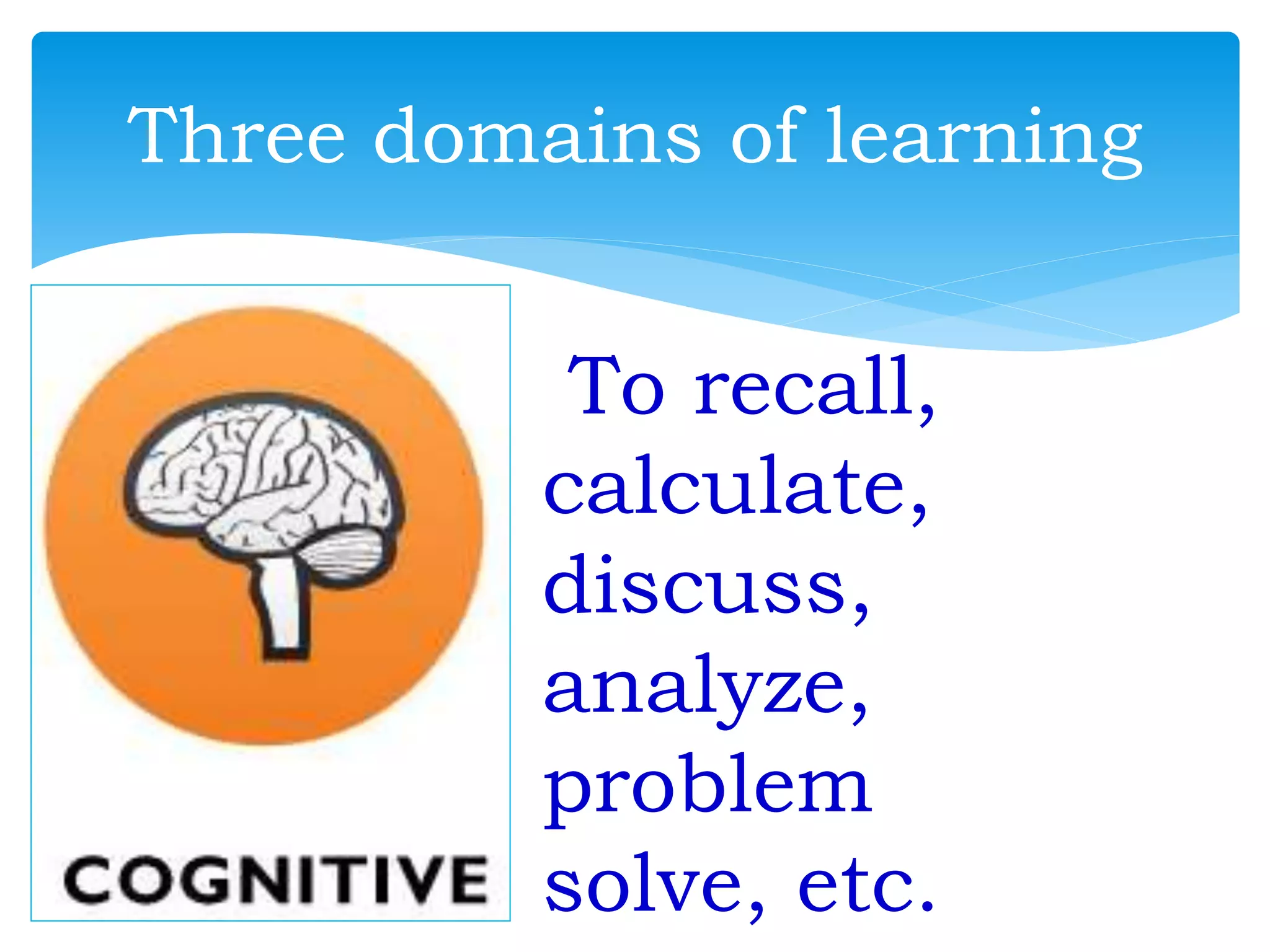
Three domains of learning
To recall,
calculate,
discuss,
analyze,
problem
solve, etc.
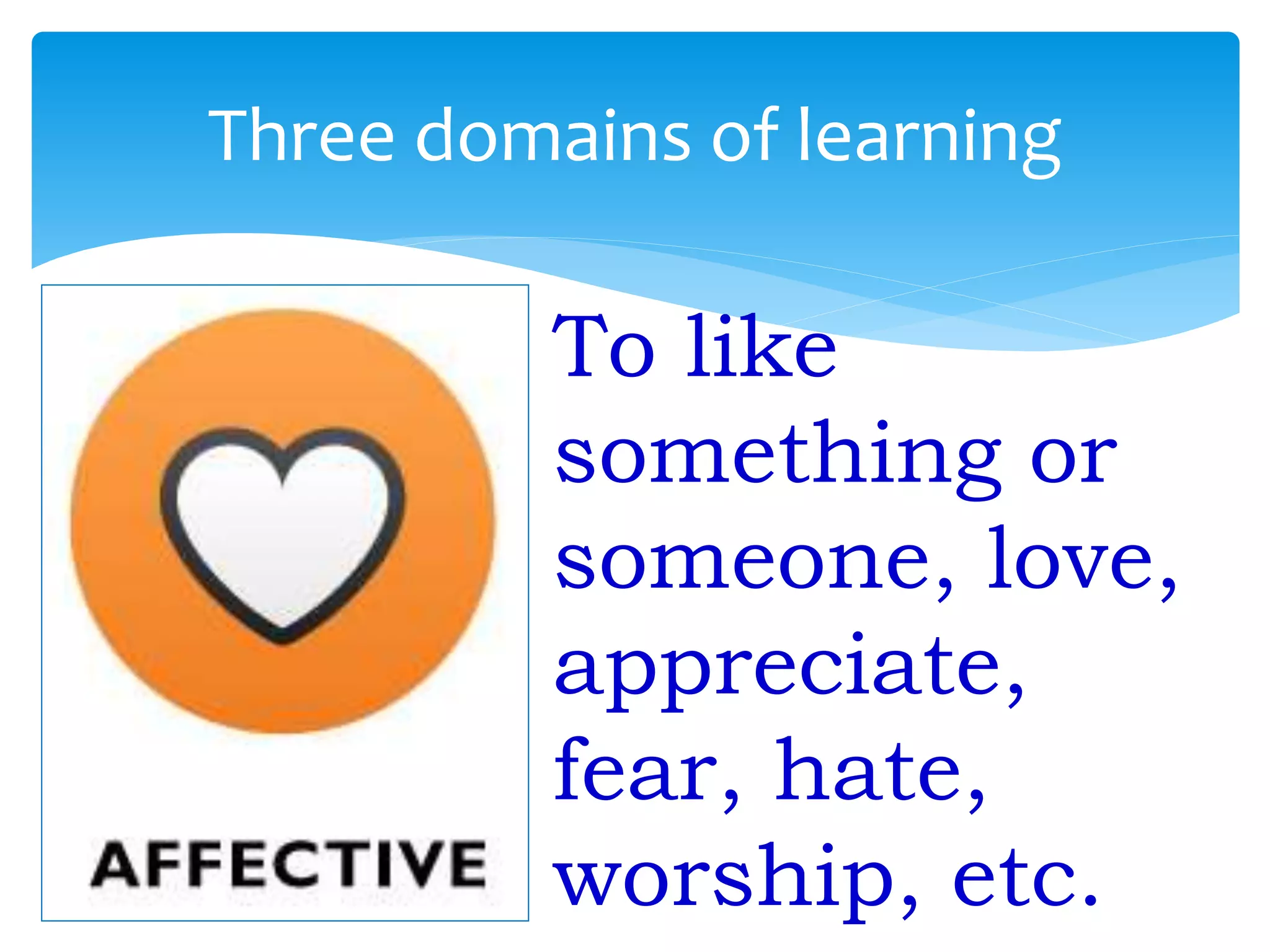
Three domains of learning
To like
something or
someone, love,
appreciate,
fear, hate,
worship, etc.
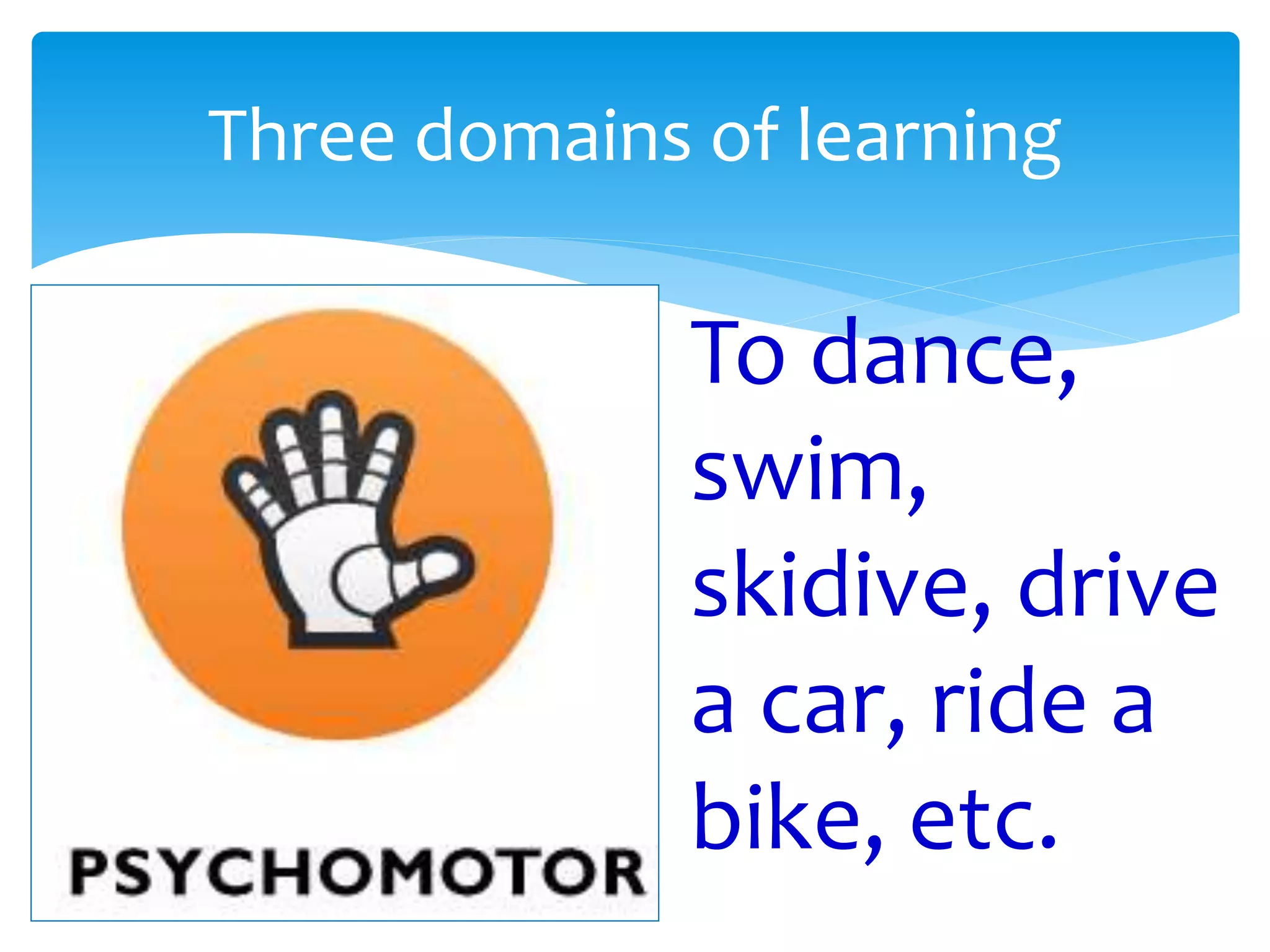
Three domains of learning
To dance,
swim,
skidive, drive
a car, ride a
bike, etc.
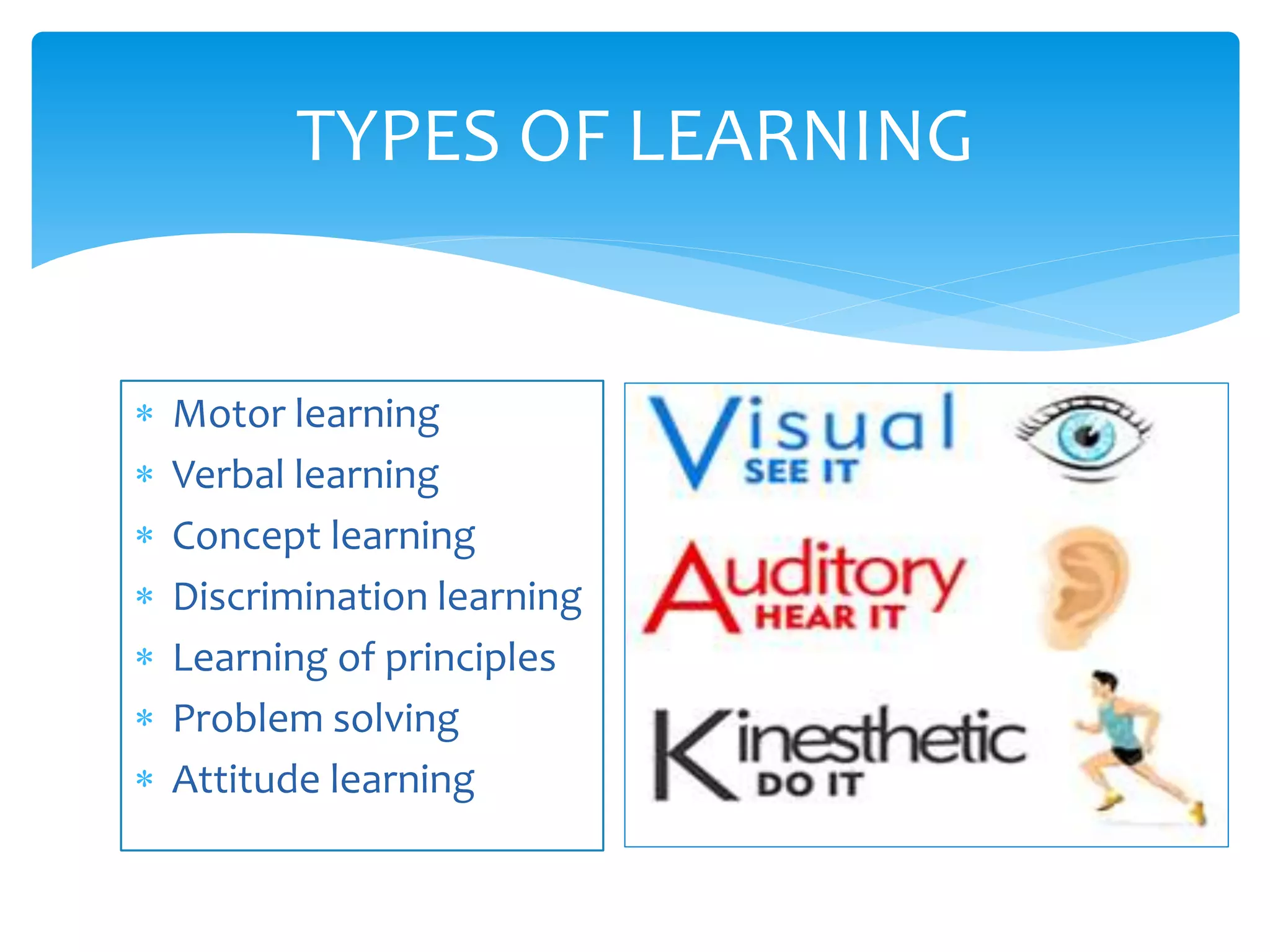
 Motor learning
 Verbal learning
 Concept learning
 Discrimination learning
 Learning of principles
 Problem solving
 Attitude learning
TYPES OF LEARNING
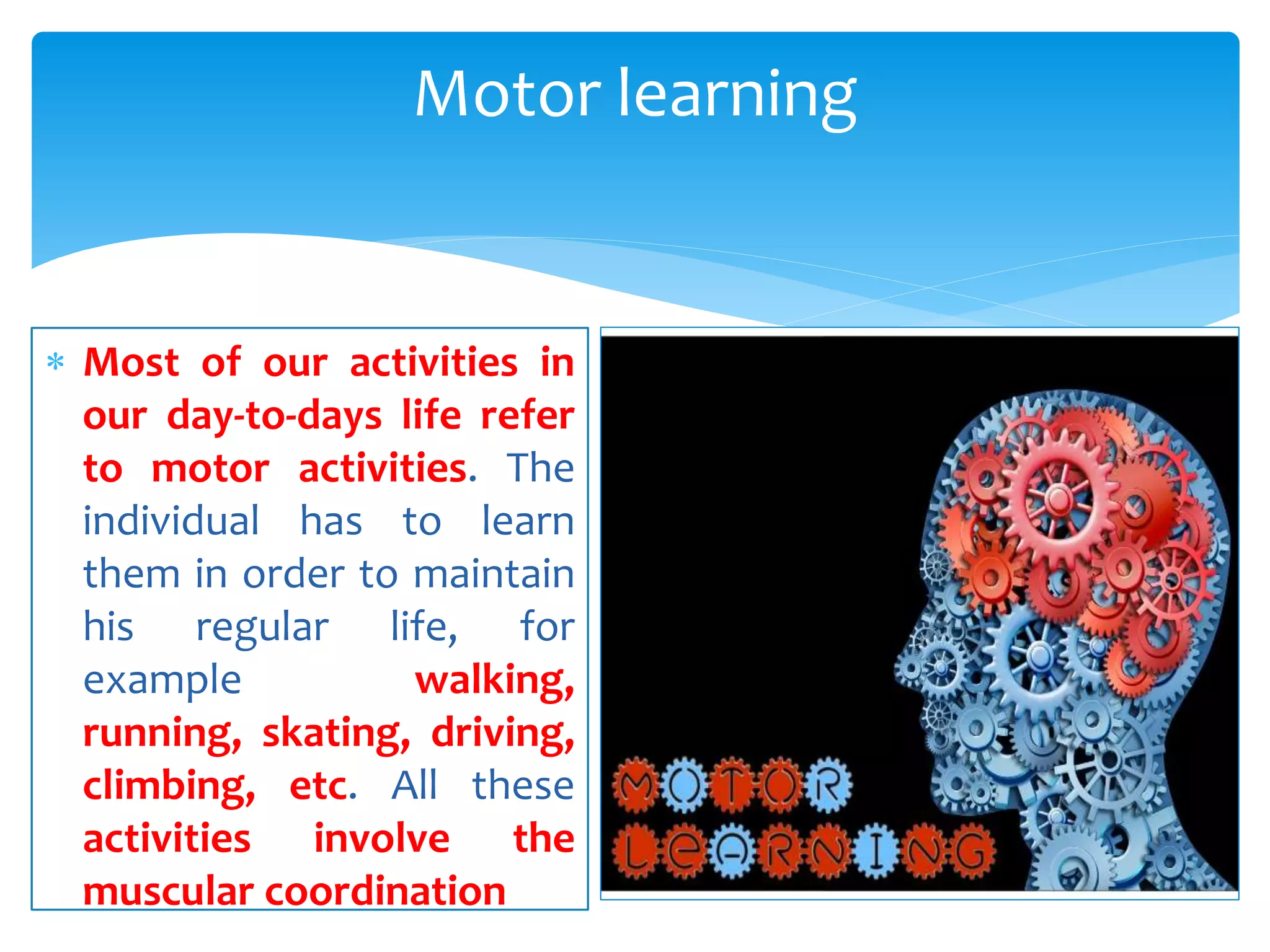
 Most of our activities in
our day-to-days life refer
to motor activities. The
individual has to learn
them in order to maintain
his regular life, for
example walking,
running, skating, driving,
climbing, etc. All these
activities involve the
muscular coordination
Motor learning
 This type of learning
involves the language
we speak, the
communication
devices we use. Signs,
pictures, symbols,
words, figures, sounds,
etc., are the tools used
in such activities. We
use words for
communication.
Verbal learning
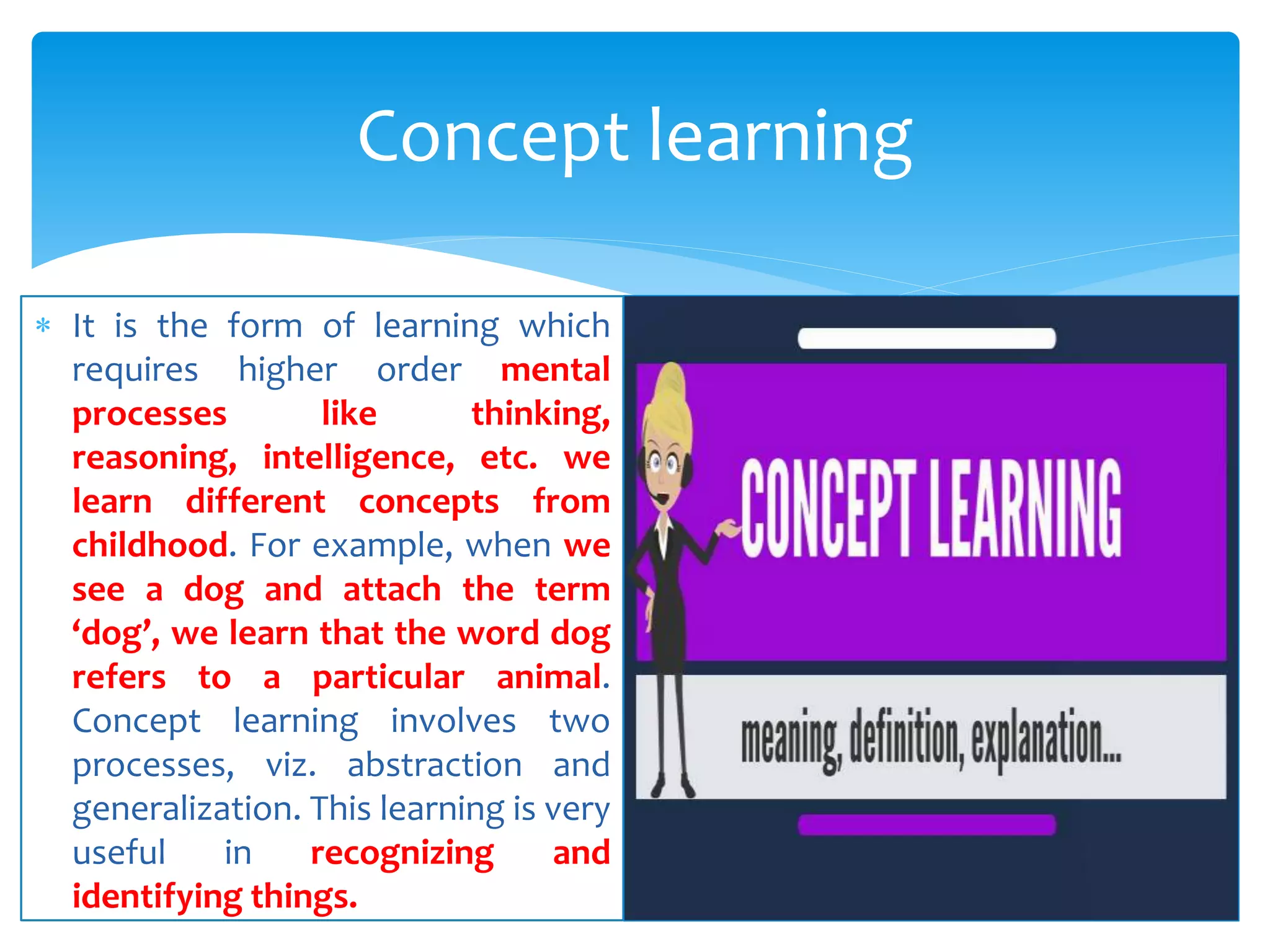
 It is the form of learning which
requires higher order mental
processes like thinking,
reasoning, intelligence, etc. we
learn different concepts from
childhood. For example, when we
see a dog and attach the term
‘dog’, we learn that the word dog
refers to a particular animal.
Concept learning involves two
processes, viz. abstraction and
generalization. This learning is very
useful in recognizing and
identifying things.
Concept learning
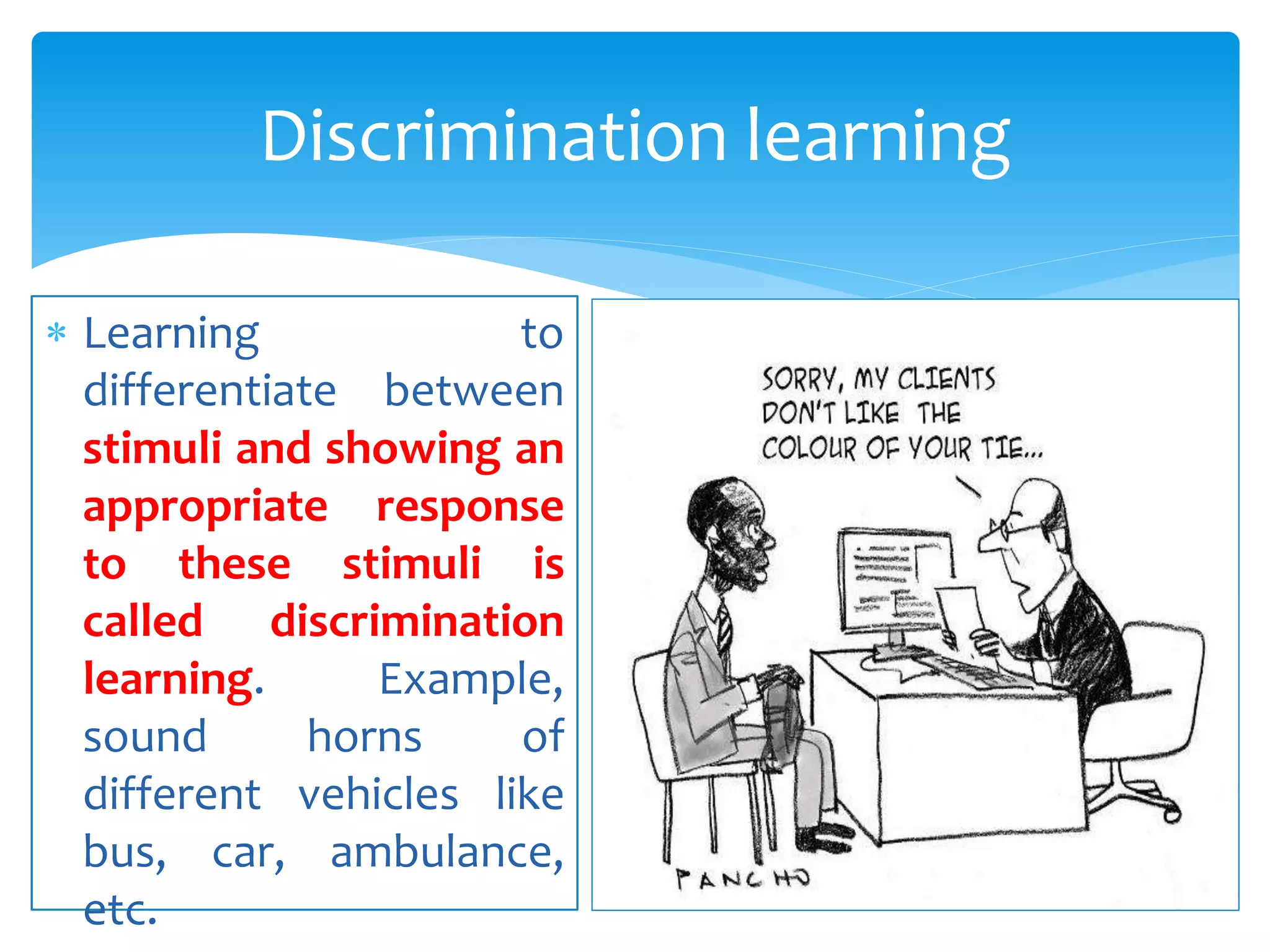
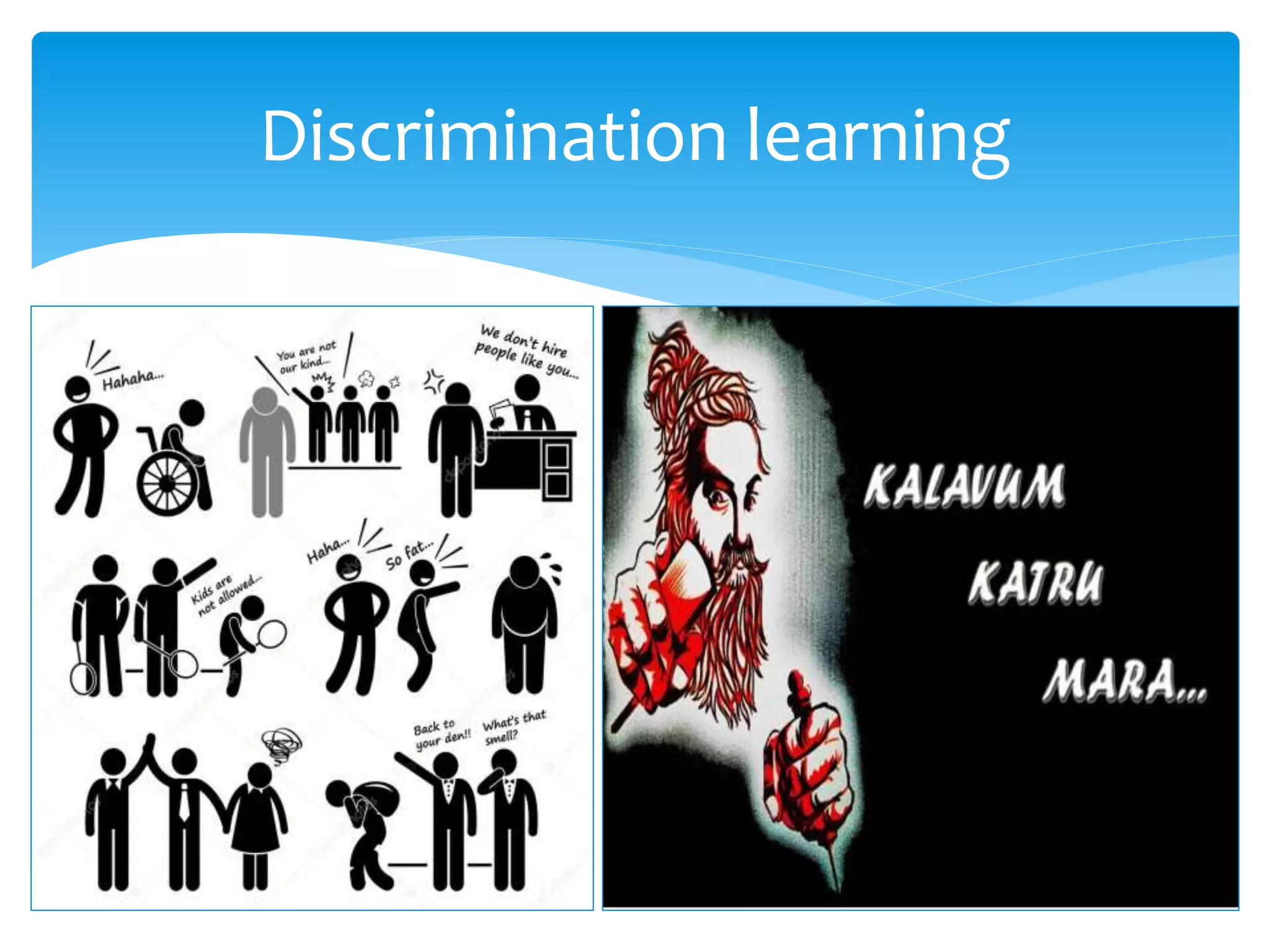
 Learning to
differentiate between
stimuli and showing an
appropriate response
to these stimuli is
called discrimination
learning. Example,
sound horns of
different vehicles like
bus, car, ambulance,
etc.
Discrimination learning
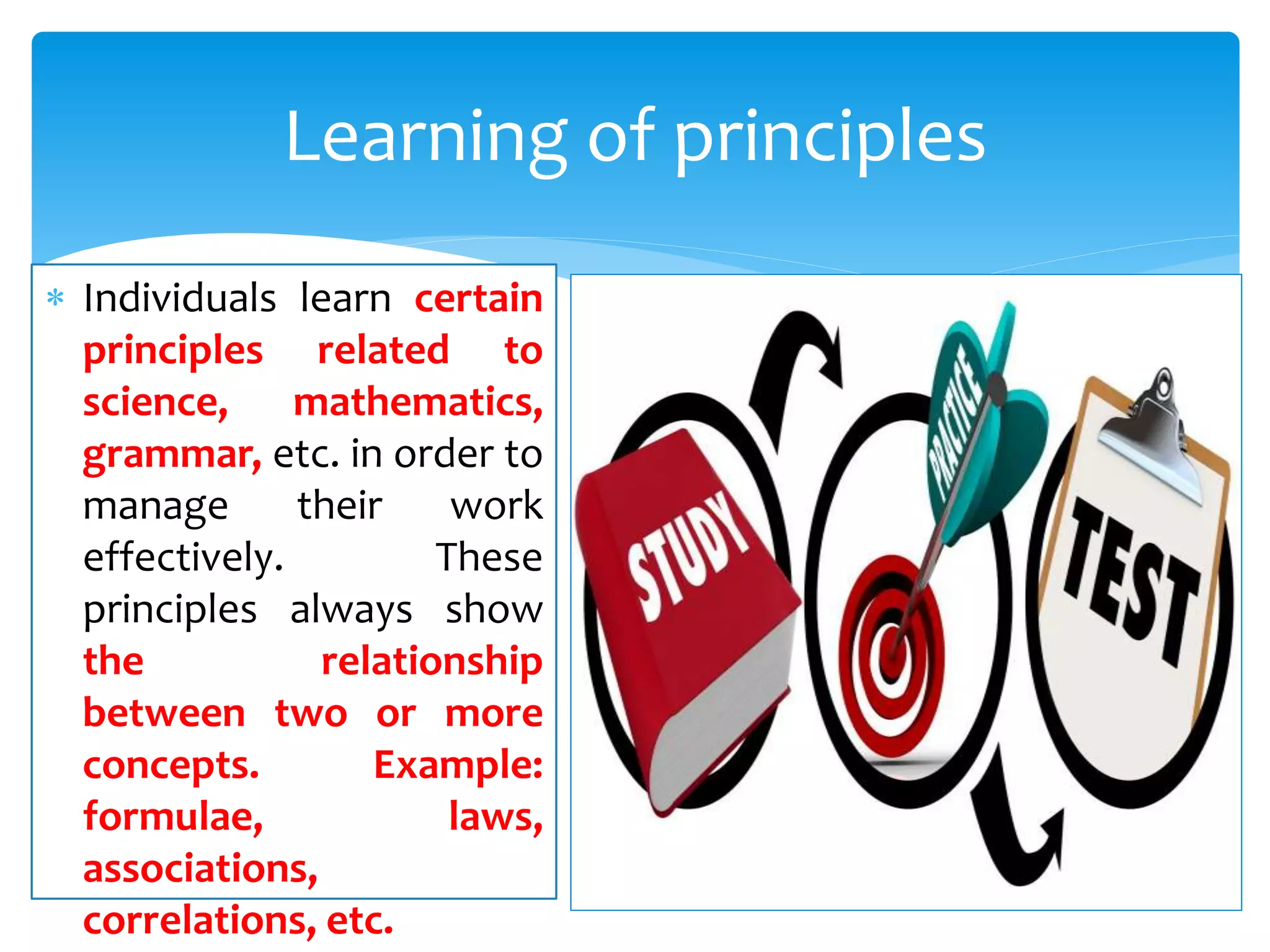
 Individuals learn certain
principles related to
science, mathematics,
grammar, etc. in order to
manage their work
effectively. These
principles always show
the relationship
between two or more
concepts. Example:
formulae, laws,
associations,
correlations, etc.
Learning of principles
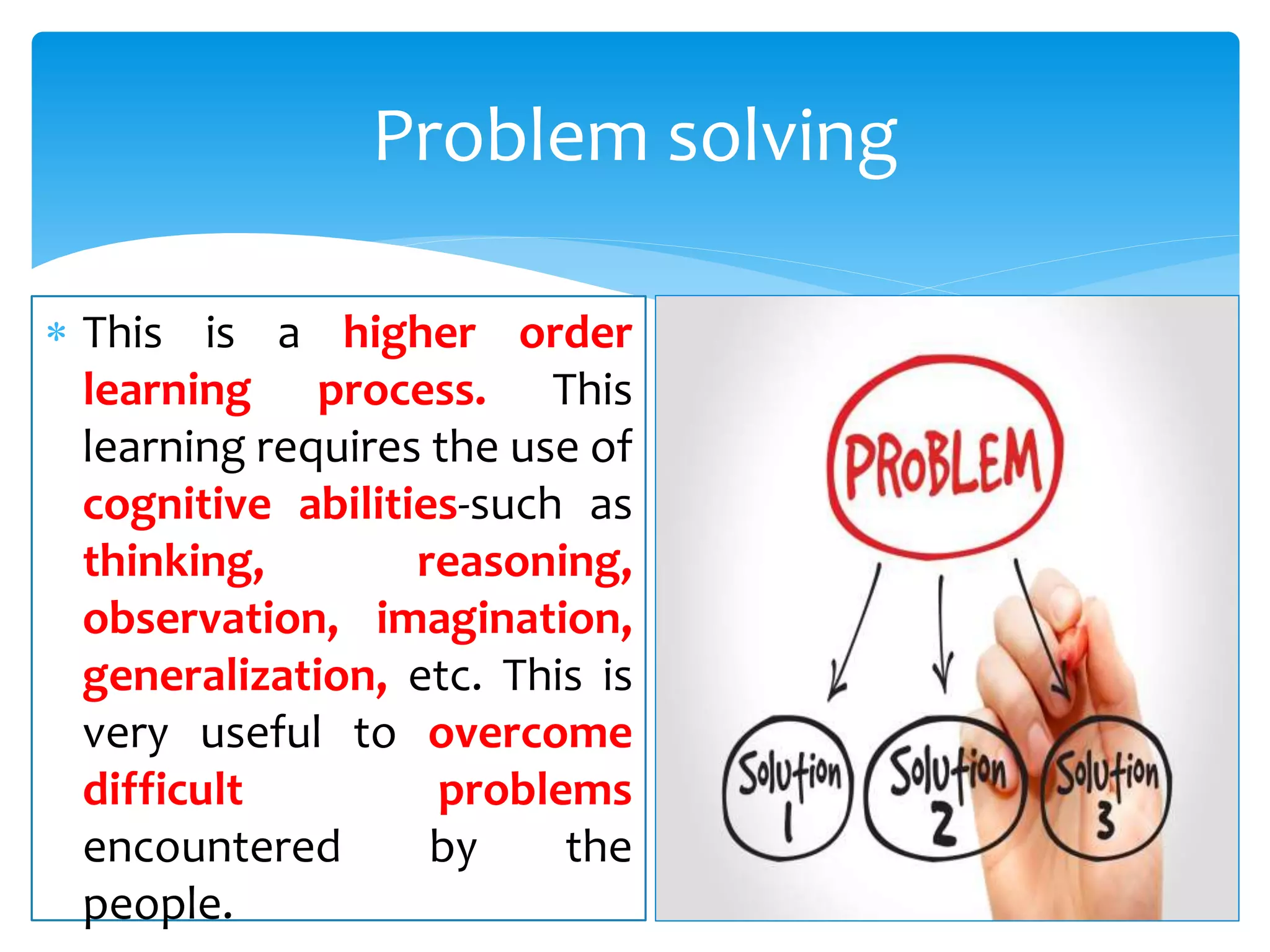
 This is a higher order
learning process. This
learning requires the use of
cognitive abilities-such as
thinking, reasoning,
observation, imagination,
generalization, etc. This is
very useful to overcome
difficult problems
encountered by the
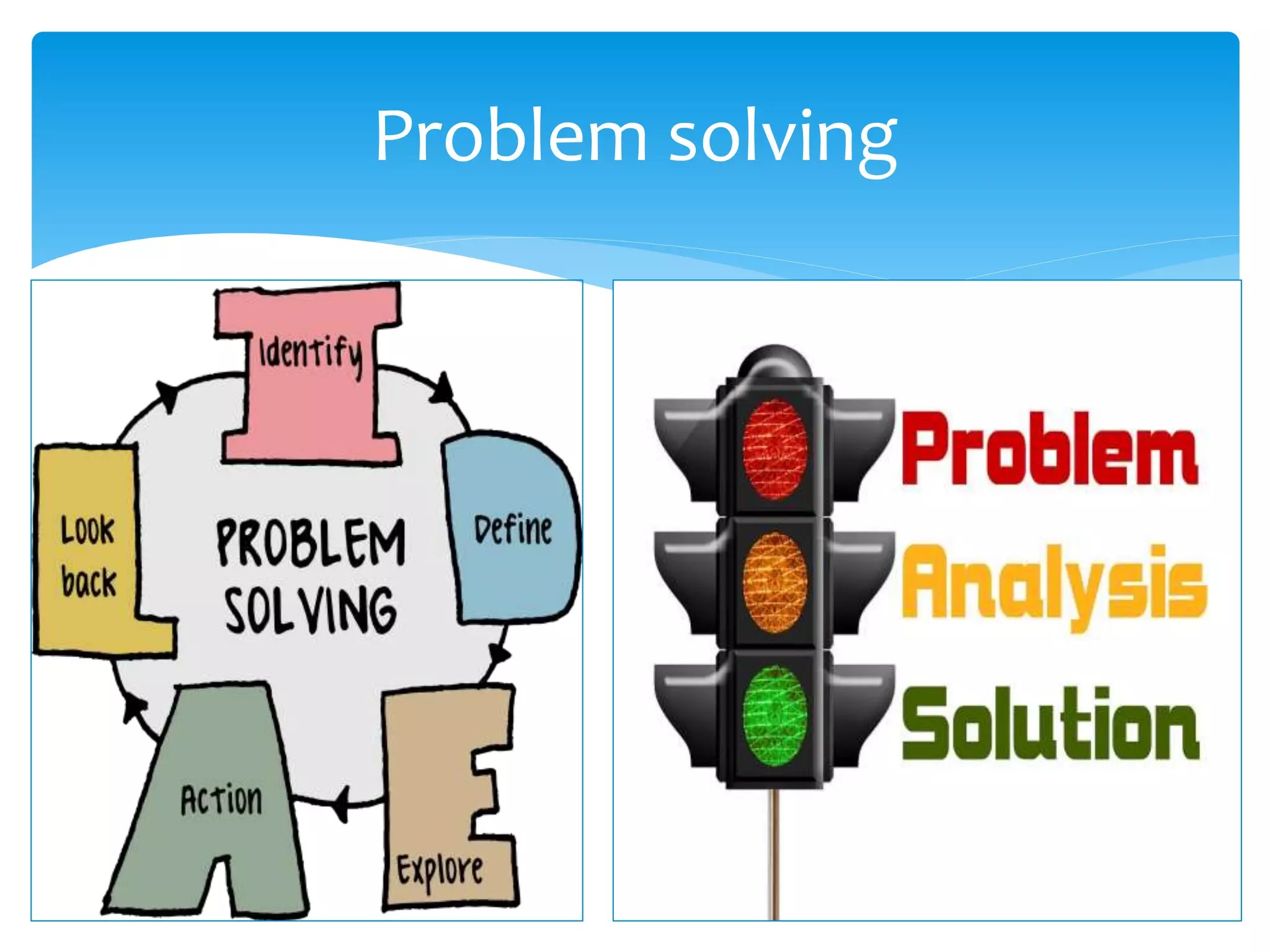
people.
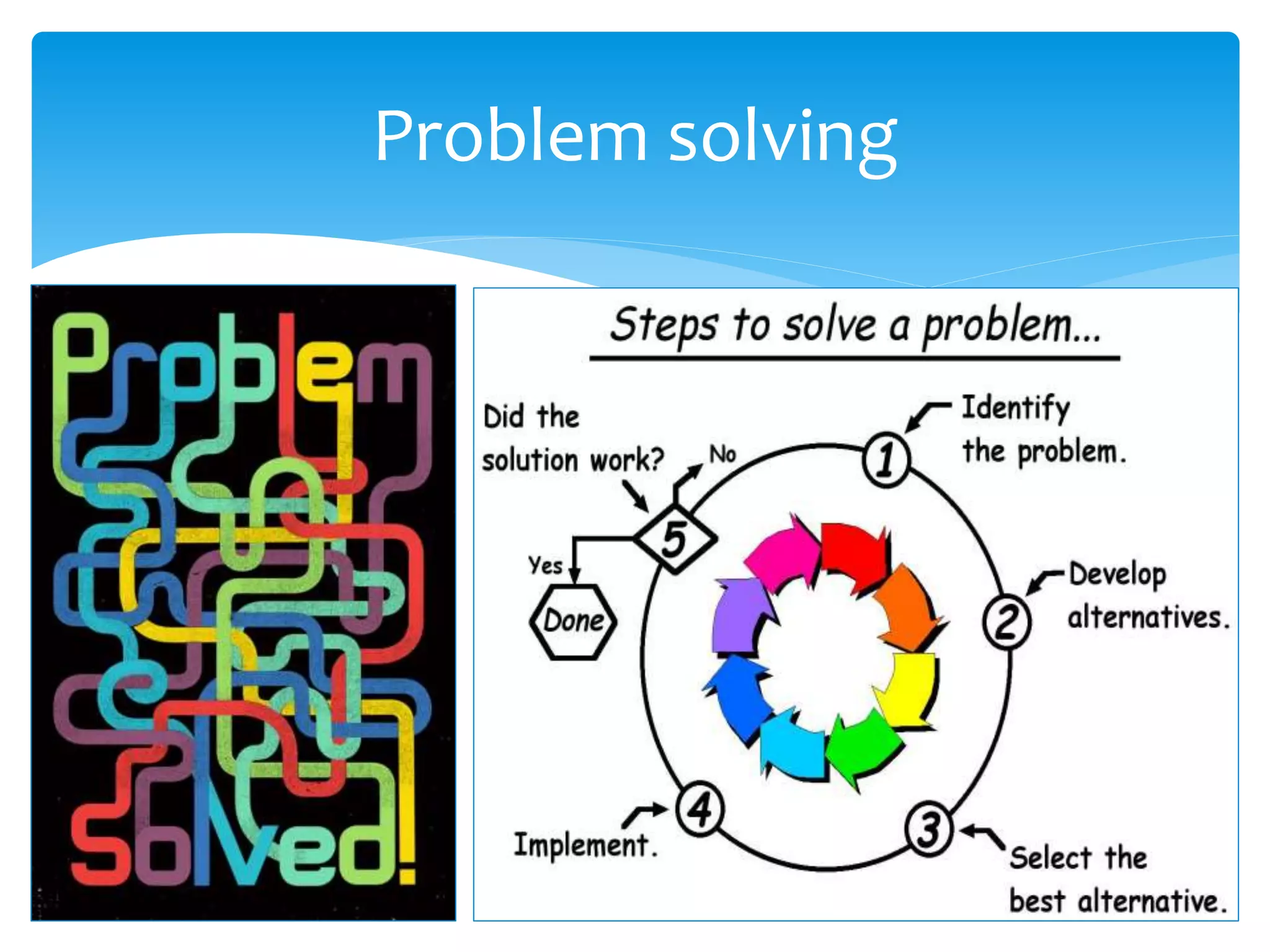
Problem solving
Problem solving
Problem solving
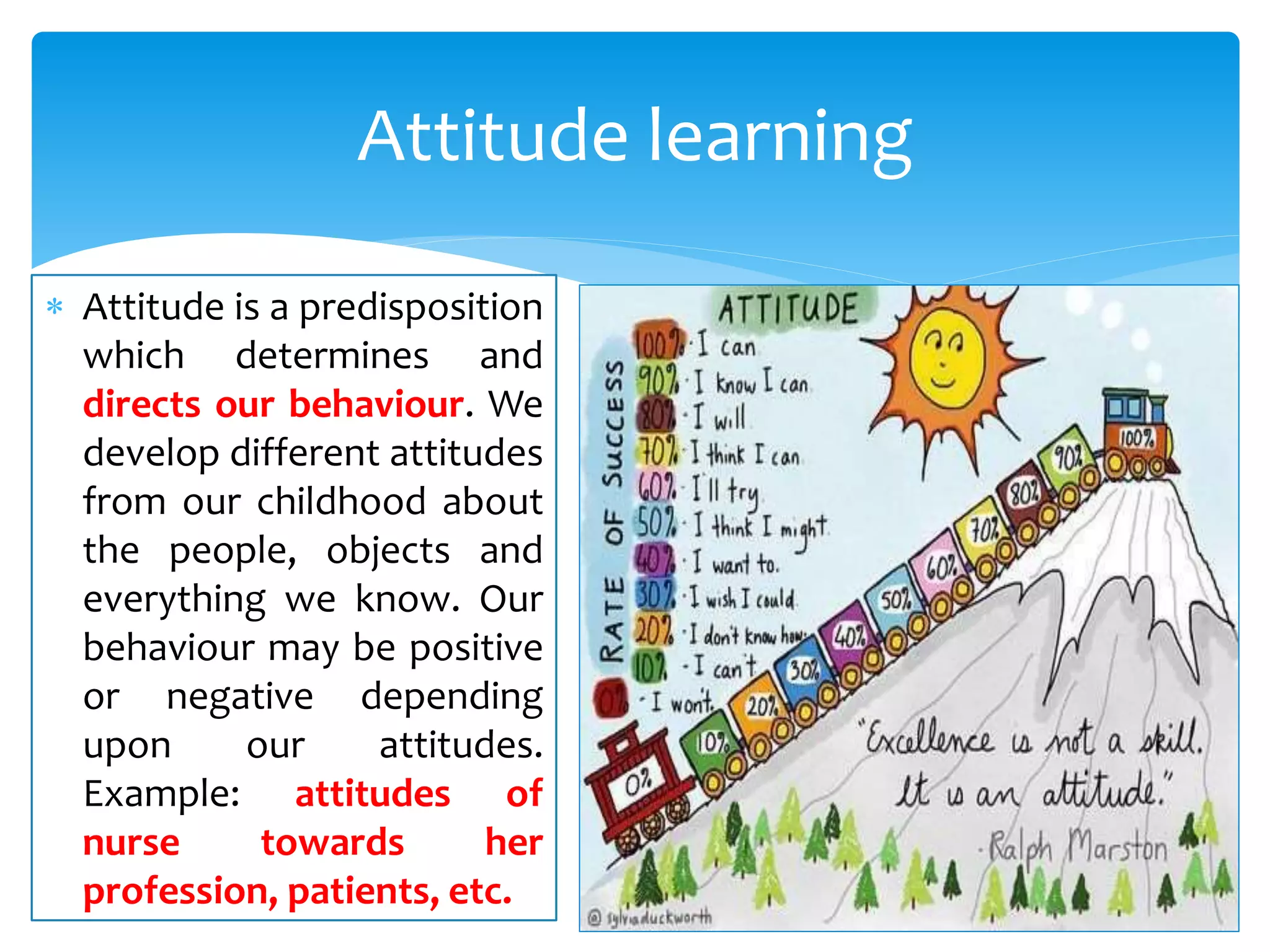
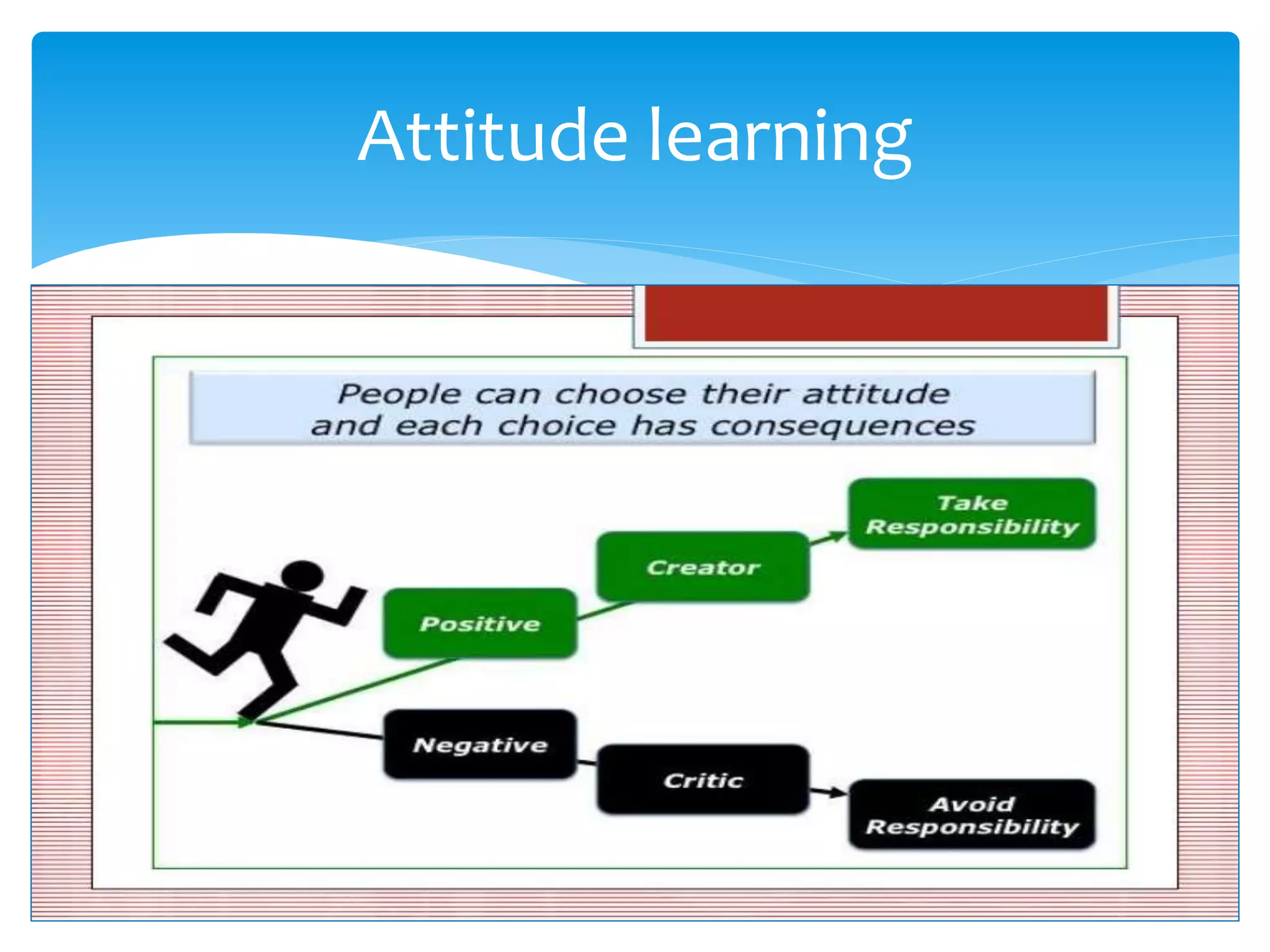
 Attitude is a predisposition
which determines and
directs our behaviour. We
develop different attitudes
from our childhood about
the people, objects and
everything we know. Our
behaviour may be positive
or negative depending
upon our attitudes.
Example: attitudes of
nurse towards her
profession, patients, etc.
Attitude learning
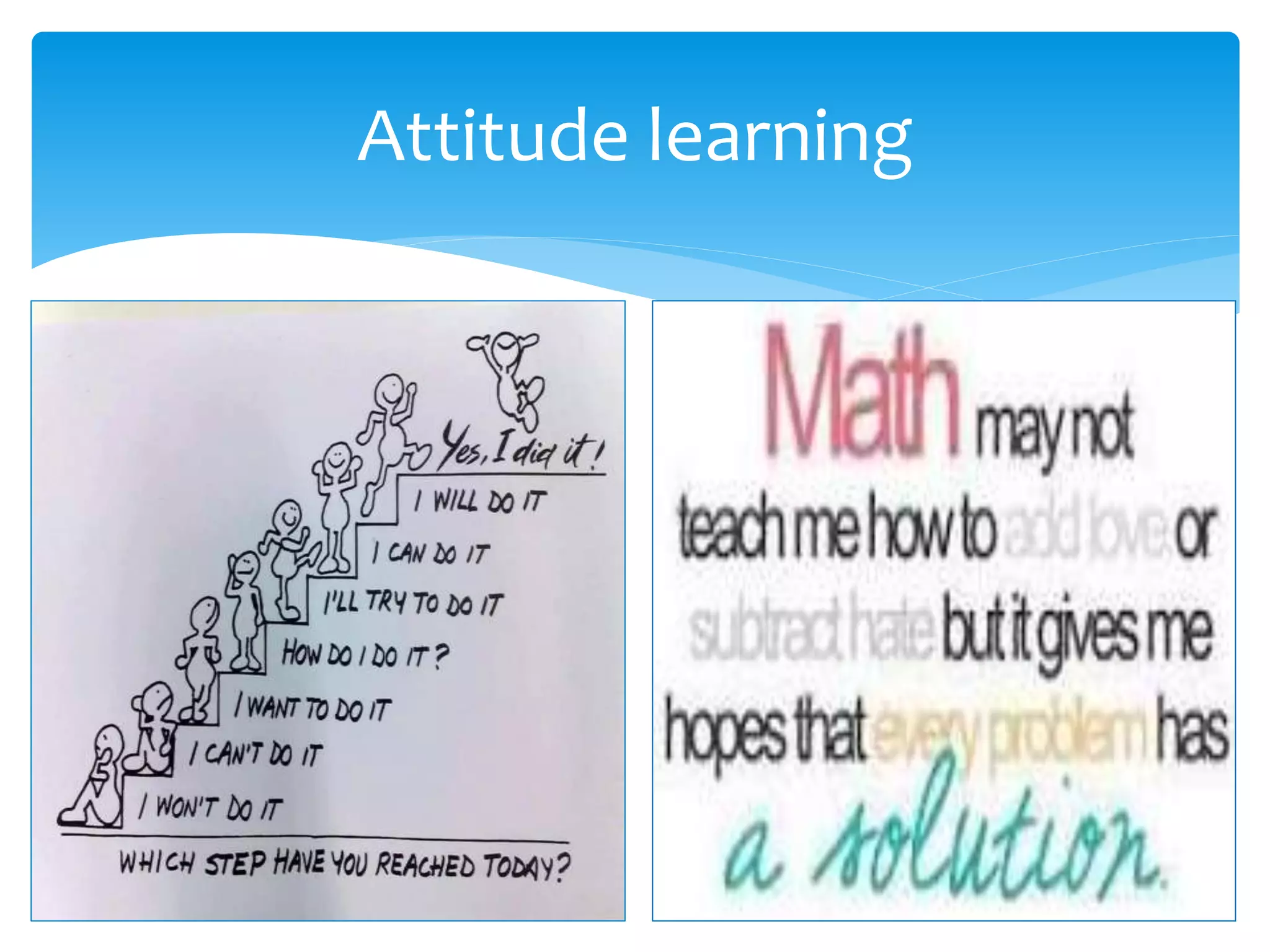
Attitude learning
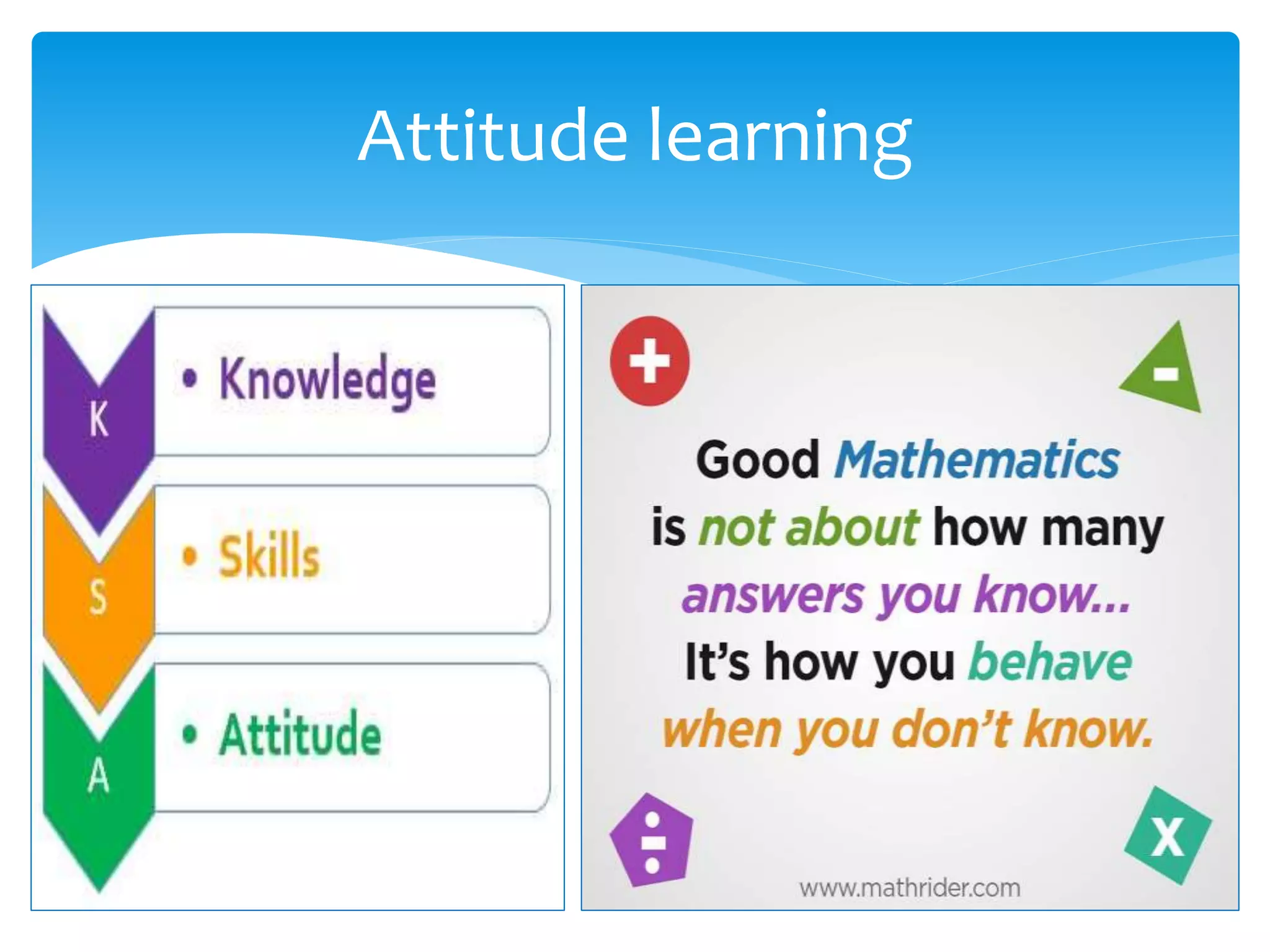
Attitude learning
 Language I can’t do it
 Physics
 Chemistry
 Botany
 Zoology
 History
 Civics
 Geography
 Computer Science Bug & Debug…Virus & Anti
virus…Patience
Attitude plays a major role in all the
subjects
Attitude learning
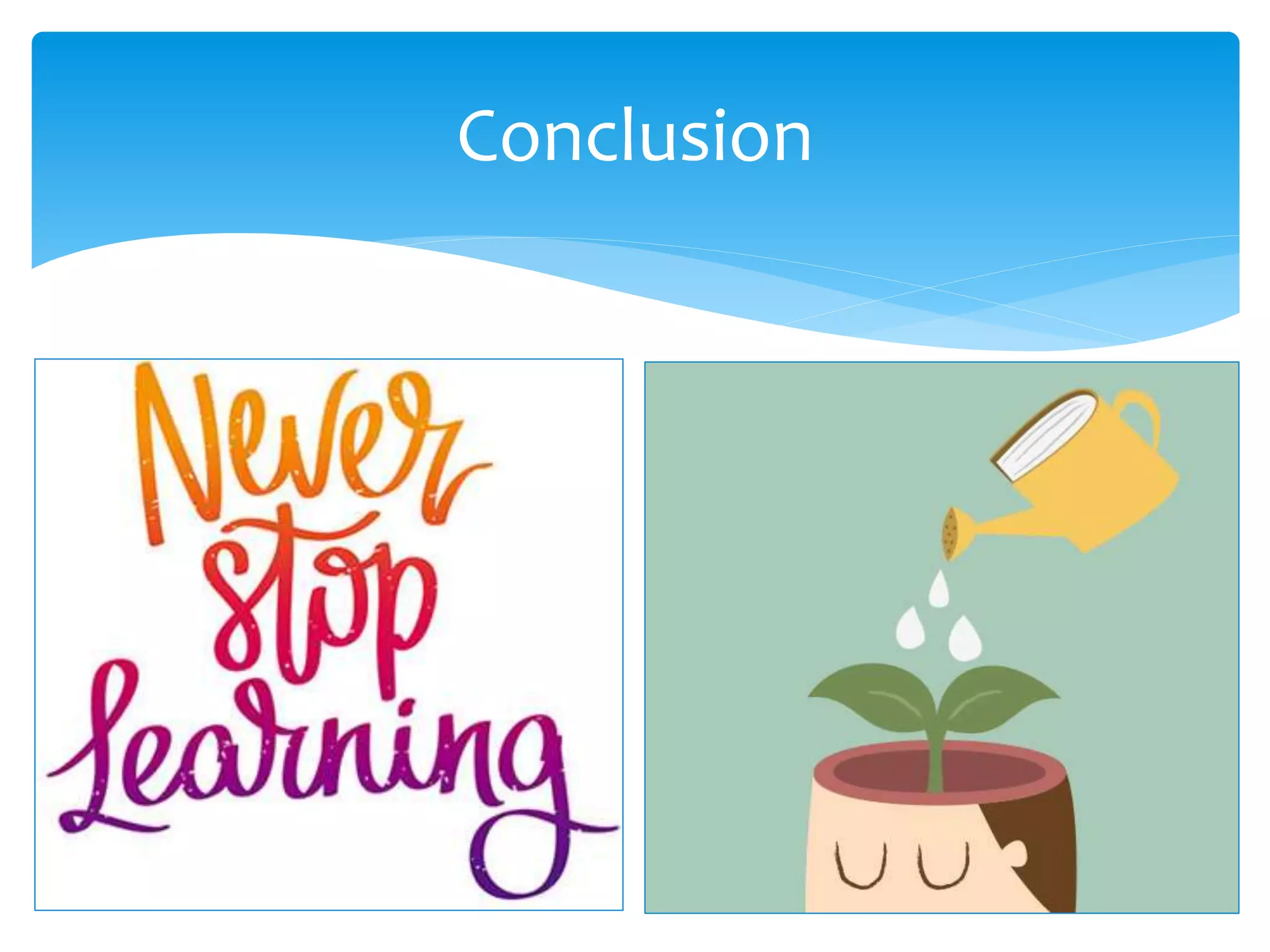
Conclusion
Learning process

Learning process

  • 1.
    Nazareth College ofEducation for Women Course : Learning and Teaching Teacher Educator : Mrs.Gayathri (Head of the Department of Computer Science) Topic : Nature of Learning Process SUJEETHA.R MATHEMATICS 2018-2020
  • 2.
     Learning isan active social process  Vygotsky (1978)  McMahon (1997)  Kukla (2000)  Green and Gredler (2002)  Definition of Learning  What is Learning ?  What is Teaching & Learning ? SCOPE OF PRESENTATION
  • 3.
     Nature ofLearning  Five principles of learning  Three important activities in the process of learning  Three domains of learning  Types of learning  Conclusion SCOPE OF PRESENTATION
  • 4.
  • 5.
     Vygotsky (1978)also highlighted the convergence of the social and practical elements in learning by saying that the most significant moment in the course of intellectual development occurs when speech and practical activity, two previously completely independent lines of development, converge. Through practical activity a child constructs meaning on an intrapersonal level, while speech connects this meaning with the interpersonal world shared by the child and her/his culture. Learning is an active social process
  • 6.
     McMahon (1997)agrees that learning is a social process. He further states that learning is not a process that only takes place inside our minds, nor is it a passive development of our behaviors that is shaped by external forces and that meaningful learning occurs when individuals are engaged in social activities. Learning is an active social process
  • 7.
    Kukla (2000) arguesthat reality is constructed by our own activities and that people, together as members of a society, invent the properties of the world. Learning is an active social process
  • 8.
     Green andGredler (2002) emphasize learning as an iterative process, involving discursive, adaptive, interactive, and reflexive qualities. According to them the main focus is on the instructor-student relationship. Other studies, too, argue for the importance of mentoring in the process of learning. The social constructivist model thus emphasizes the importance of the relationship between the student and the instructor in the learning process. Learning is an active social process
  • 9.
     Learning isthe process by which an organism in satisfying its motivation adopts and adjusts its behavior in order to overcome abstracts or barriers kingly & gray DEFINITION
  • 10.
  • 11.
    What is Teaching& Learning ?
  • 12.
    What is Teaching& Learning ?
  • 13.
  • 14.
     Learning occupiesa very important place in our life.  Learning is the process of change which enables an organism itself to the environment.  It is therefore a process of development and growth.  It is characterized by flexibility because the individual has to adapt itself constantly to the circumstances of the environment.  Learning produces change in behavior. NATURE OF LEARNING
  • 15.
     Learning isoften defined as the modification of behavior.  Learning involves problem solving.  It helps to understand and discover relationship between different contents in situation.  Learning is an automatic process.  It takes place when the child becomes active NATURE OF LEARNING contd…
  • 16.
     Learning isa continuous life long process.  Learning is an universal process.  Learning is purposive and goal directed.  Learning involves reconstruction of experiences.  Learning is the product of activity and environment.  Learning is transferable from one situation to another.  Learning helps in attainment of teaching – learning objectives. NATURE OF LEARNING contd…
  • 17.
     Learning helpsin the balanced development of the personality.  Learning helps in proper adjustment.  Learning helps in the realization of goals of life.  Learning does not imply improvement.  Defined as a change in an individual’s behavior caused by experiences or self activity  Implies that learning can only happen through the individuals activity or his own doing  Can be intentional or unintentional NATURE OF LEARNING contd…
  • 18.
    Five principles oflearning Involves trainees, learn by doing
  • 19.
    Five principles oflearning Repeat ideas & concepts to help people learn
  • 20.
    Five principles oflearning Learn better when material is ,meaningful and related
  • 21.
    Five principles oflearning To real world using simulations
  • 22.
    Five principles oflearning Ask for it and adjust training methods to audience
  • 23.
    Three important activitiesin the process of learning Selecting the most appropriate from among the information received. Selecting appropriate information form the prior knowledge stored in memory in the form audio, video or images Then comparing the new information selected from among the incoming ones With those drawn from the prior knowledge and interpreting In this step two acts viz. selecting and meaningfully interpreting take place
  • 24.
    Three important activitiesin the process of learning Classifying and organizing the new information (coded in the form of audio and video or images )takes place in this step.
  • 25.
    Three important activitiesin the process of learning Integrating the new information which has been well organized (i.e. New Knowledge) with already stored knowledge in memory and modifying the cognitive structure takes place in this step
  • 26.
     Benjamin Bloomhas suggested three domains of learning Three domains of learning
  • 27.
    Three domains oflearning To recall, calculate, discuss, analyze, problem solve, etc.
  • 28.
    Three domains oflearning To like something or someone, love, appreciate, fear, hate, worship, etc.
  • 29.
    Three domains oflearning To dance, swim, skidive, drive a car, ride a bike, etc.
  • 30.
     Motor learning Verbal learning  Concept learning  Discrimination learning  Learning of principles  Problem solving  Attitude learning TYPES OF LEARNING
  • 31.
     Most ofour activities in our day-to-days life refer to motor activities. The individual has to learn them in order to maintain his regular life, for example walking, running, skating, driving, climbing, etc. All these activities involve the muscular coordination Motor learning
  • 32.
     This typeof learning involves the language we speak, the communication devices we use. Signs, pictures, symbols, words, figures, sounds, etc., are the tools used in such activities. We use words for communication. Verbal learning
  • 33.
     It isthe form of learning which requires higher order mental processes like thinking, reasoning, intelligence, etc. we learn different concepts from childhood. For example, when we see a dog and attach the term ‘dog’, we learn that the word dog refers to a particular animal. Concept learning involves two processes, viz. abstraction and generalization. This learning is very useful in recognizing and identifying things. Concept learning
  • 34.
     Learning to differentiatebetween stimuli and showing an appropriate response to these stimuli is called discrimination learning. Example, sound horns of different vehicles like bus, car, ambulance, etc. Discrimination learning
  • 35.
  • 36.
     Individuals learncertain principles related to science, mathematics, grammar, etc. in order to manage their work effectively. These principles always show the relationship between two or more concepts. Example: formulae, laws, associations, correlations, etc. Learning of principles
  • 37.
     This isa higher order learning process. This learning requires the use of cognitive abilities-such as thinking, reasoning, observation, imagination, generalization, etc. This is very useful to overcome difficult problems encountered by the people. Problem solving
  • 38.
  • 39.
  • 40.
     Attitude isa predisposition which determines and directs our behaviour. We develop different attitudes from our childhood about the people, objects and everything we know. Our behaviour may be positive or negative depending upon our attitudes. Example: attitudes of nurse towards her profession, patients, etc. Attitude learning
  • 41.
  • 42.
  • 43.
     Language Ican’t do it  Physics  Chemistry  Botany  Zoology  History  Civics  Geography  Computer Science Bug & Debug…Virus & Anti virus…Patience Attitude plays a major role in all the subjects
  • 44.
  • 45.