TEACHING & LEARNING
Presented By: JASLEEN KAUR
MSc.(N)
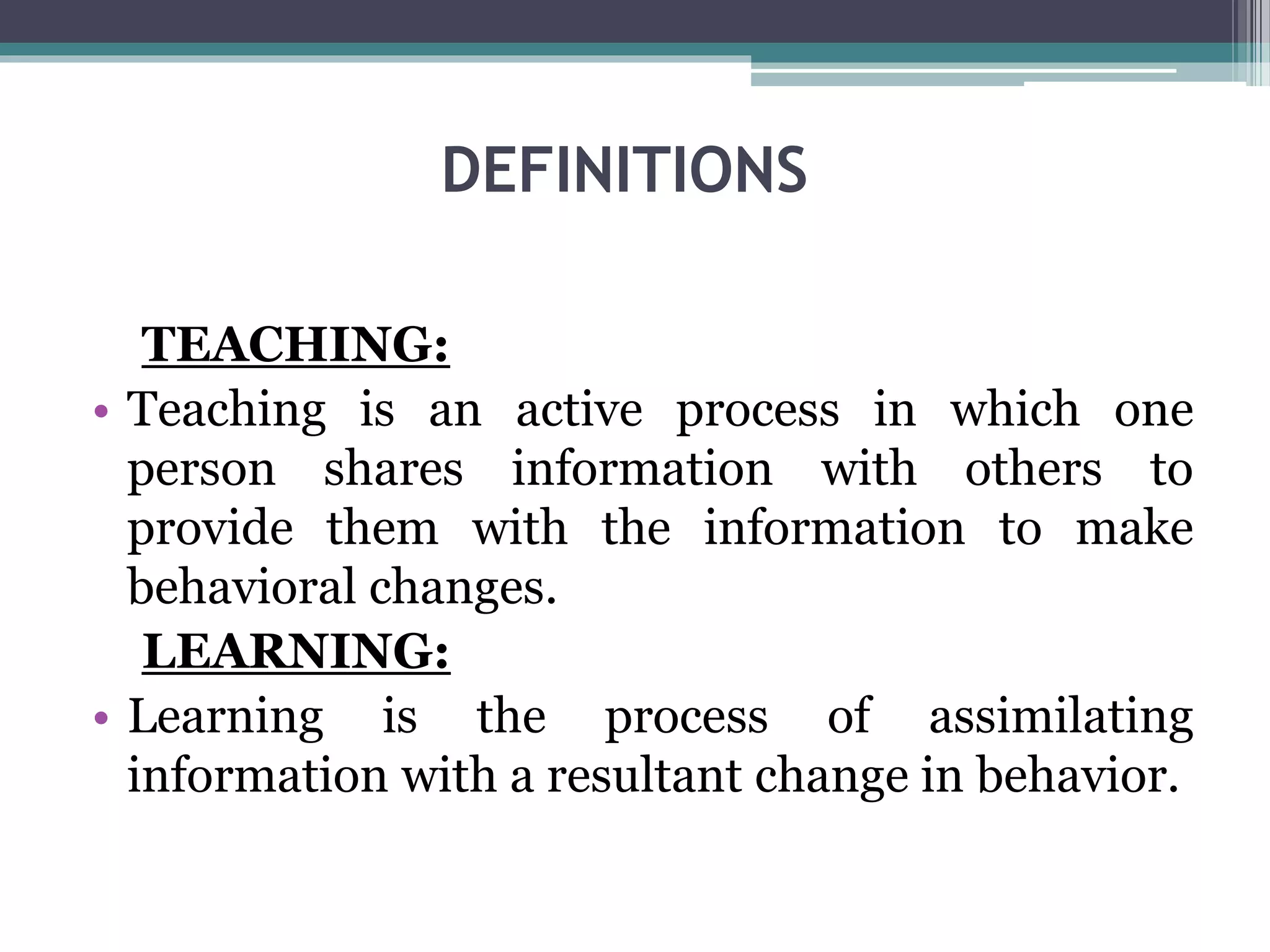
DEFINITIONS
TEACHING:
• Teaching is an active process in which one
person shares information with others to
provide them with the information to make
behavioral changes.
LEARNING:
• Learning is the process of assimilating
information with a resultant change in behavior.
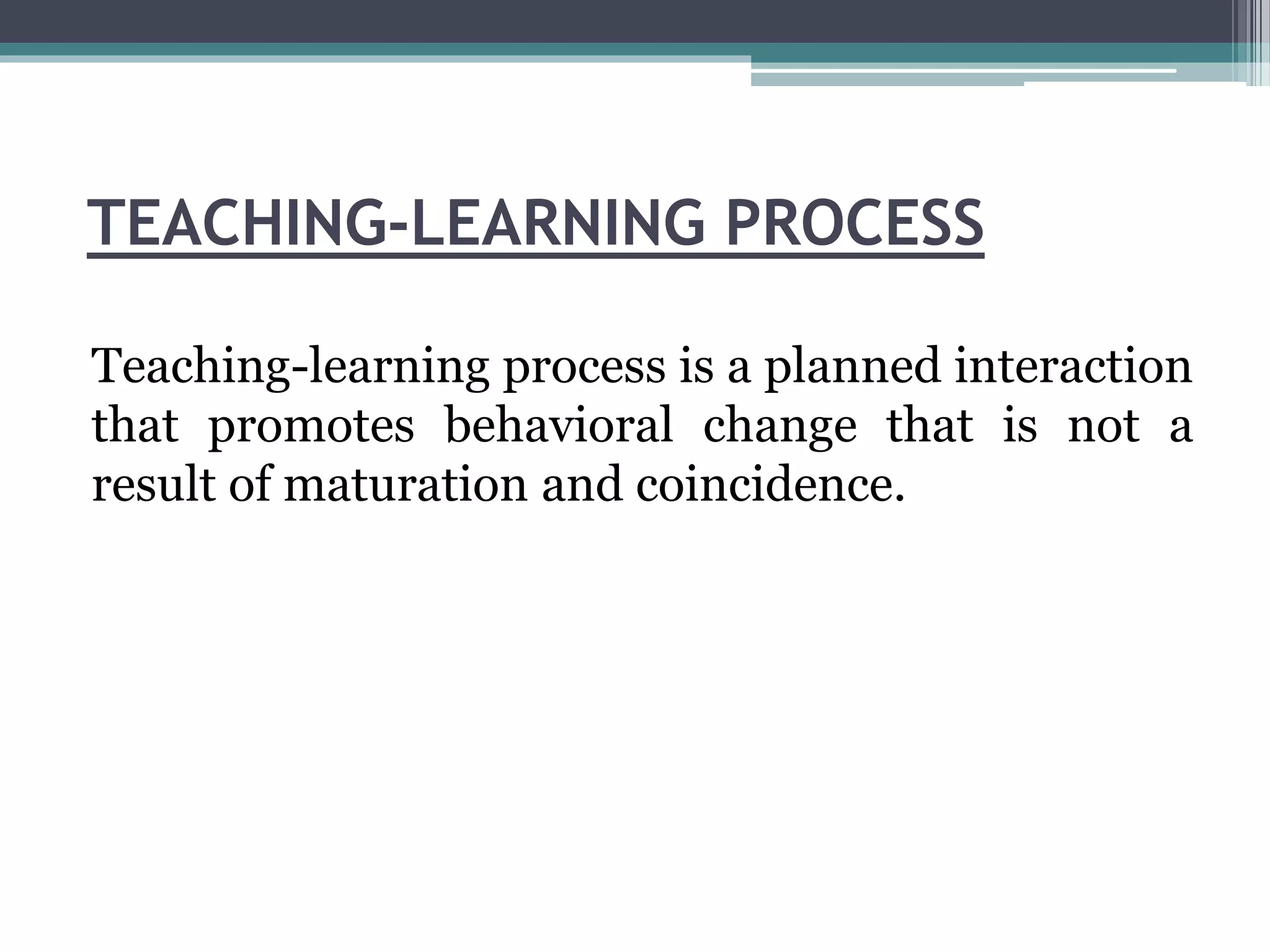
TEACHING-LEARNING PROCESS
Teaching-learning process is a planned interaction
that promotes behavioral change that is not a
result of maturation and coincidence.
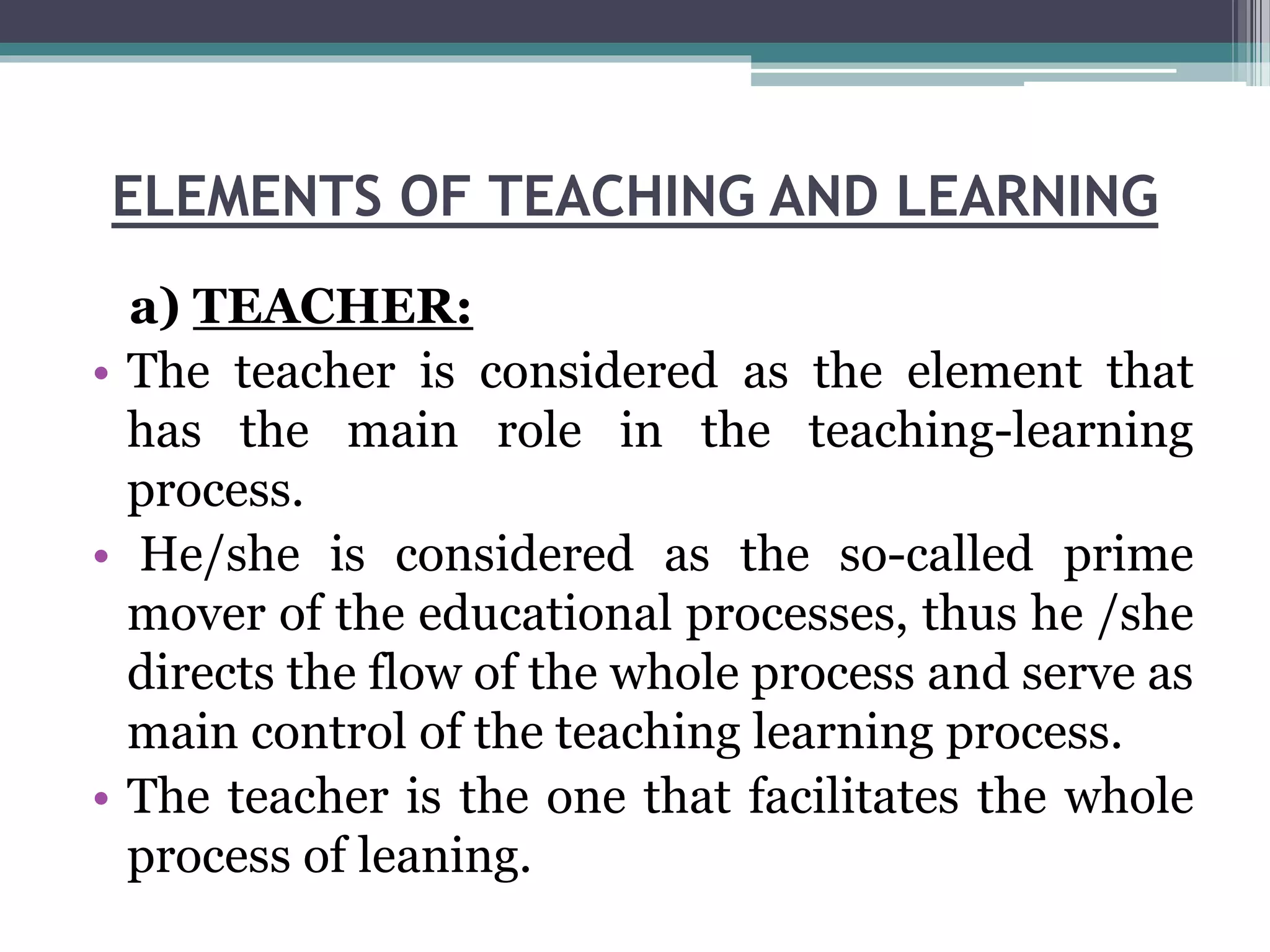
ELEMENTS OF TEACHING AND LEARNING
a) TEACHER:
• The teacher is considered as the element that
has the main role in the teaching-learning
process.
• He/she is considered as the so-called prime
mover of the educational processes, thus he /she
directs the flow of the whole process and serve as
main control of the teaching learning process.
• The teacher is the one that facilitates the whole
process of leaning.
b) LEARNERS:
The learners are considered as the key participant
in the teaching and learning process. They are
considered as the primary subject or the main
reason why the process is implemented.
The knowledge that acquired by the learners will
decide whether the teaching and learning
objectives are achieved.
c) MILIEU:
• The Learning Environment, Since learning is
triggered off by stimuli in the environment, it assumes
primary importance in teaching and learning.
• The classroom is the usual although not the exclusive
environment of learning at school. Teachers need to
make the learning environment as "stimulating" as
possible.
• Every stimulus in the classroom should contribute to
learning.
• Very much part of this environment is the human
stimuli, the most important of whom is the teacher
himself.
• Material stimuli include objects in the room as well as
common routine activities.
d)Matter:
• The Content of Learning, This refers to
what is to be learned as specified in the
instructional objective.
• The teacher should make sure that the minimum
standard or level of proficiency is attained by the
class before moving onto the next lesson or unit.
• Curriculum makers are advised to be realistic in
projecting subject matter and avoid giving the
students "too much, too soon," and to teach only
"little matter, but well mastered"
e)METHOD:
• The teaching-learning Strategy, This consist
of purposeful, planned activities and tasks that are
undertaken by the teacher and the students in the
classroom to bring about the intended
instructional objectives.
• The learners must also show efficiency in
handling the activity, going through it without
hassle.
• The strategy must also be effective to yield
expected result and must be economical in time,
effort and expense.
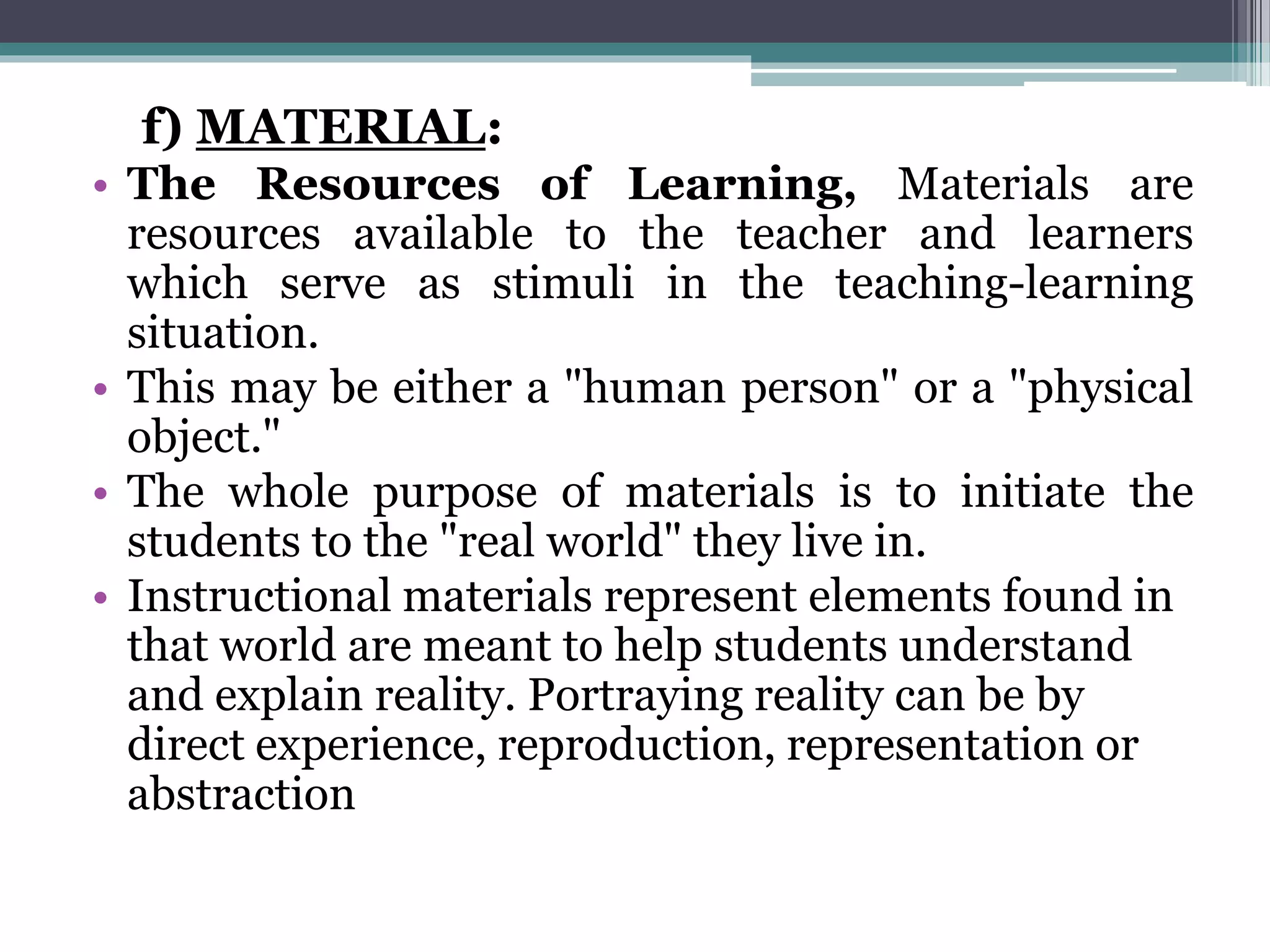
f) MATERIAL:
• The Resources of Learning, Materials are
resources available to the teacher and learners
which serve as stimuli in the teaching-learning
situation.
• This may be either a "human person" or a "physical
object."
• The whole purpose of materials is to initiate the
students to the "real world" they live in.
• Instructional materials represent elements found in
that world are meant to help students understand
and explain reality. Portraying reality can be by
direct experience, reproduction, representation or
abstraction
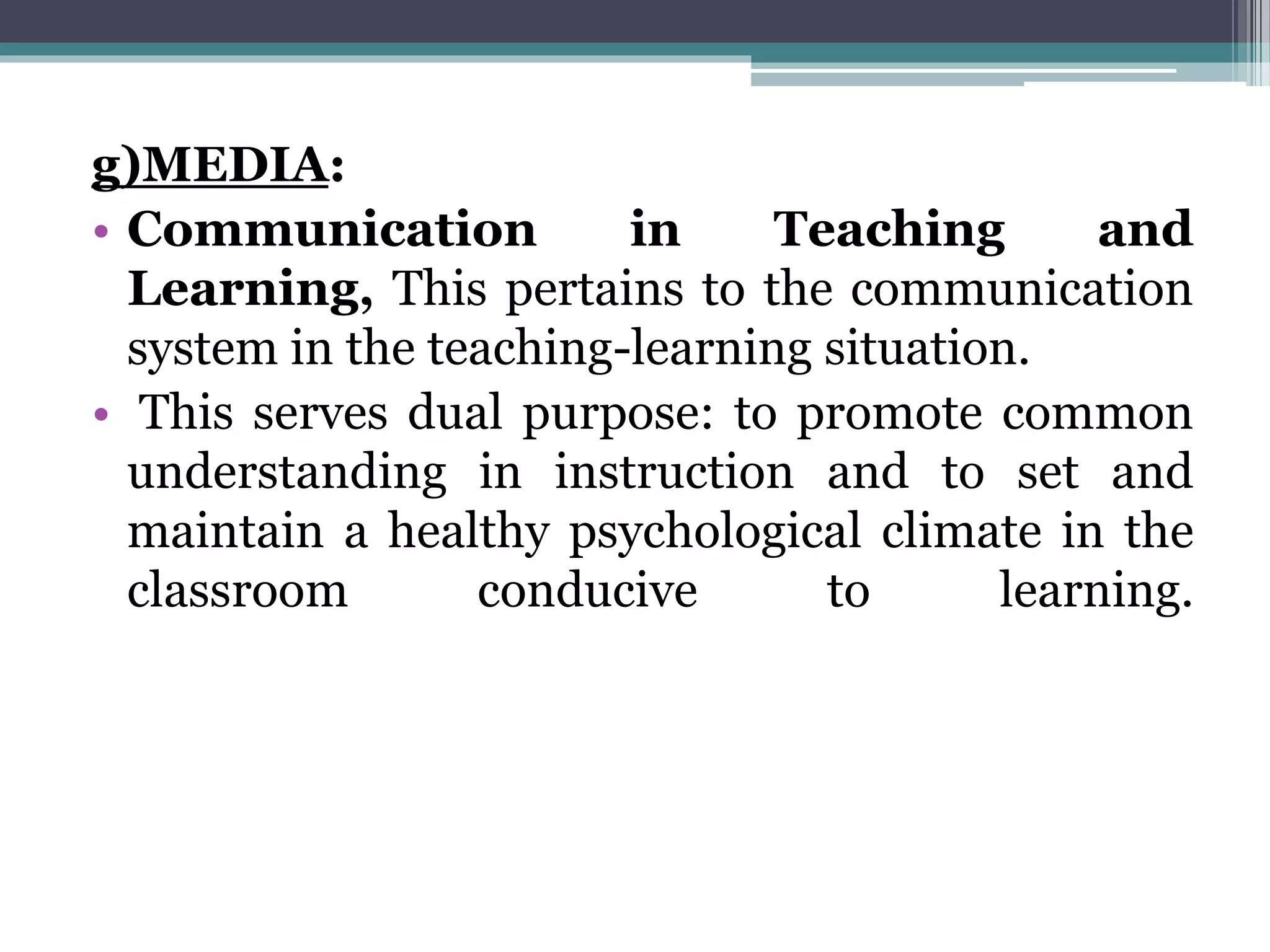
g)MEDIA:
• Communication in Teaching and
Learning, This pertains to the communication
system in the teaching-learning situation.
• This serves dual purpose: to promote common
understanding in instruction and to set and
maintain a healthy psychological climate in the
classroom conducive to learning.
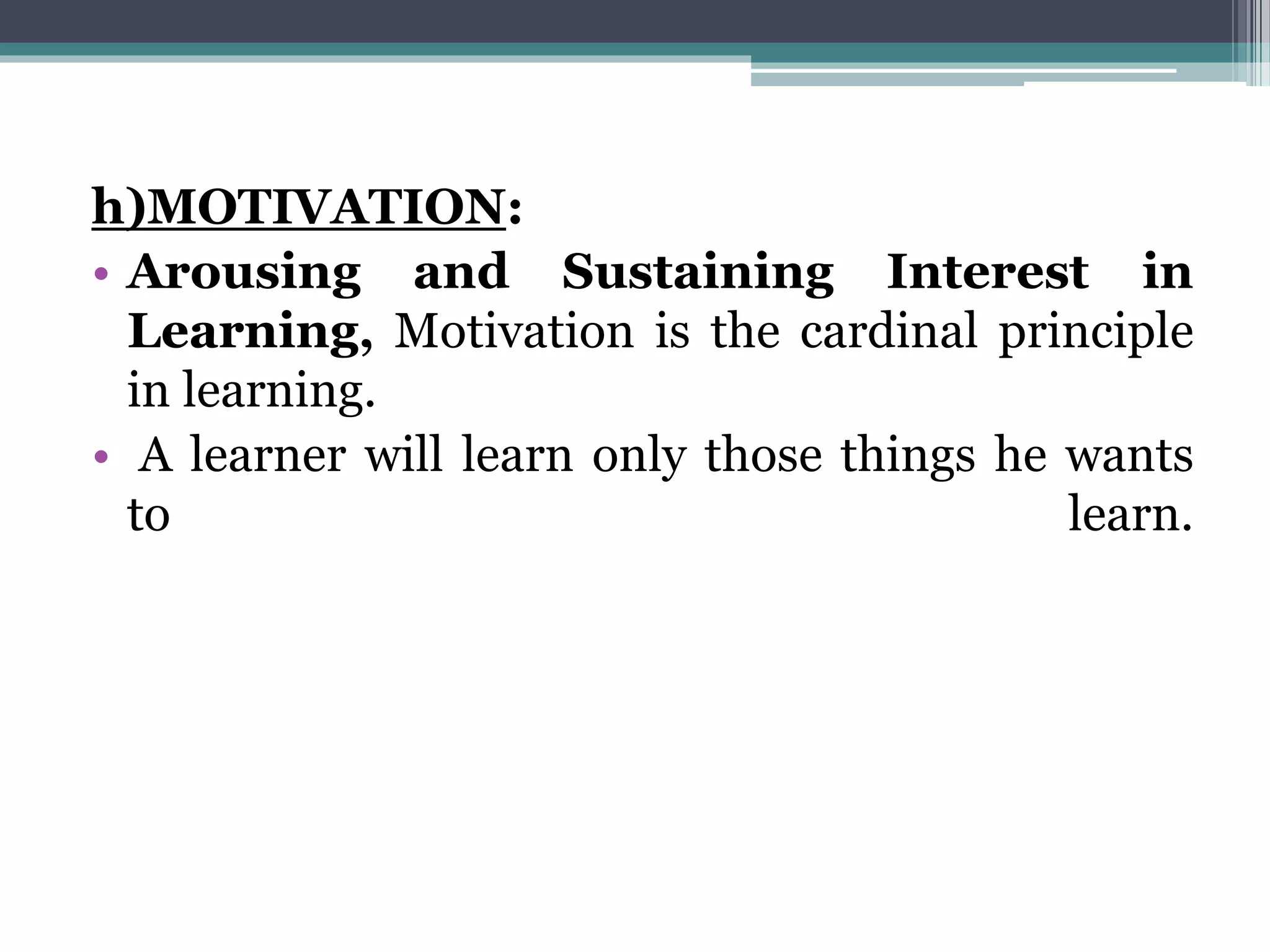
h)MOTIVATION:
• Arousing and Sustaining Interest in
Learning, Motivation is the cardinal principle
in learning.
• A learner will learn only those things he wants
to learn.
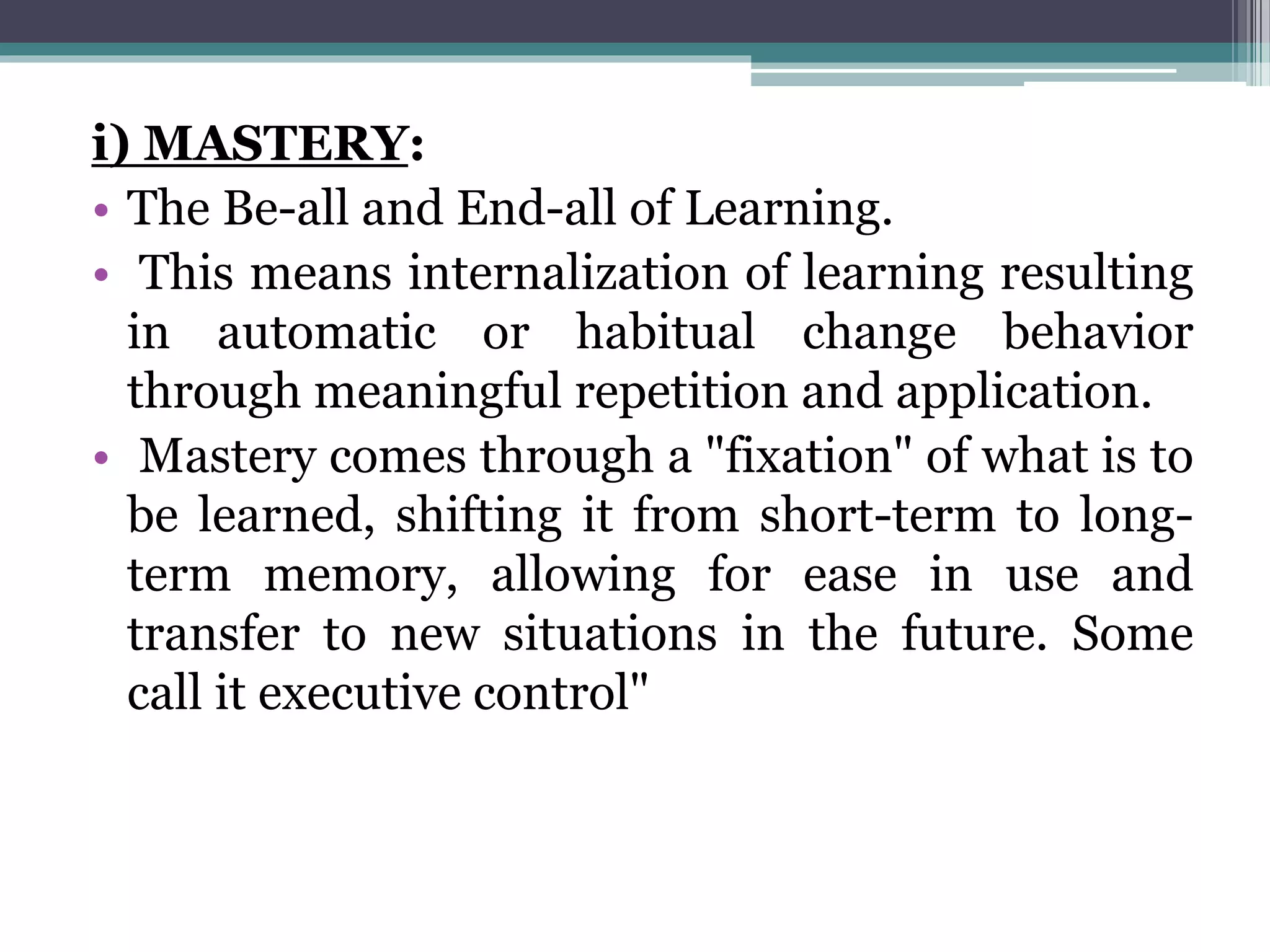
i) MASTERY:
• The Be-all and End-all of Learning.
• This means internalization of learning resulting
in automatic or habitual change behavior
through meaningful repetition and application.
• Mastery comes through a "fixation" of what is to
be learned, shifting it from short-term to long-
term memory, allowing for ease in use and
transfer to new situations in the future. Some
call it executive control"
• Psychological Security:
For learning to take place, participation of
learner is essential. The learner would not
participate freely unless he feels secured. The
teacher can't teach the child by threats. The
learner must be given the stimulating
environment, only in this environment, the
pupils are encouraged to try and therefore more
likely to learn.
j) FEEDBACK:
• A student learns more rapidly and more
thoroughly because he is forced to concentrate
on material before him and because he gets
immediate feedback on his progress.
• It is not uncommon that after solving a problem,
the child is interested to know whether his
solution is correct.
k)PRACTICE:
"Practice makes a man perfect"- the proverb
implies the importance of repetition in bringing
certain habits up to the point where they come
naturally to him. The factor of practice is
particularly true of skill learning.
l) Belonging and Configuration:
• Repetition, practice or drill whatever we may call
it, will not result in learning. Only after
restructuring, the learner can integrate and
organize the experience in certain required
relation.
• Thus, belonging and configuration makes the
teaching learning process more effective.
SIGNIFICANCE OF TEACHING LEARNING PROCESS IN
NURSING:
• As a nurse, one of our principal responsibility is
to educate our patients.
• Our teaching reaches across a broad areas:
medication (old and new medicine),procedures
,wound care, sign and symptoms to be aware of
health habits, how to continue caring for
themselves once they are at home. The teaching
can occur as spontaneous answer to a question
from a patient or nurse, formal education and
resource material.
Cont………….
• Patients are held in home for increasingly
shorter stays and are going home sicker,
precipitating a greater need for structured
information than ever before. The information
we provide them during their hospital stay will
hopefully help them in gaining full recovery and
decrease the risk of readmission.
•Thank You,,,,,

Teaching and learning

  • 1.
    TEACHING & LEARNING PresentedBy: JASLEEN KAUR MSc.(N)
  • 2.
    DEFINITIONS TEACHING: • Teaching isan active process in which one person shares information with others to provide them with the information to make behavioral changes. LEARNING: • Learning is the process of assimilating information with a resultant change in behavior.
  • 3.
    TEACHING-LEARNING PROCESS Teaching-learning processis a planned interaction that promotes behavioral change that is not a result of maturation and coincidence.
  • 4.
    ELEMENTS OF TEACHINGAND LEARNING a) TEACHER: • The teacher is considered as the element that has the main role in the teaching-learning process. • He/she is considered as the so-called prime mover of the educational processes, thus he /she directs the flow of the whole process and serve as main control of the teaching learning process. • The teacher is the one that facilitates the whole process of leaning.
  • 5.
    b) LEARNERS: The learnersare considered as the key participant in the teaching and learning process. They are considered as the primary subject or the main reason why the process is implemented. The knowledge that acquired by the learners will decide whether the teaching and learning objectives are achieved.
  • 6.
    c) MILIEU: • TheLearning Environment, Since learning is triggered off by stimuli in the environment, it assumes primary importance in teaching and learning. • The classroom is the usual although not the exclusive environment of learning at school. Teachers need to make the learning environment as "stimulating" as possible. • Every stimulus in the classroom should contribute to learning. • Very much part of this environment is the human stimuli, the most important of whom is the teacher himself. • Material stimuli include objects in the room as well as common routine activities.
  • 7.
    d)Matter: • The Contentof Learning, This refers to what is to be learned as specified in the instructional objective. • The teacher should make sure that the minimum standard or level of proficiency is attained by the class before moving onto the next lesson or unit. • Curriculum makers are advised to be realistic in projecting subject matter and avoid giving the students "too much, too soon," and to teach only "little matter, but well mastered"
  • 8.
    e)METHOD: • The teaching-learningStrategy, This consist of purposeful, planned activities and tasks that are undertaken by the teacher and the students in the classroom to bring about the intended instructional objectives. • The learners must also show efficiency in handling the activity, going through it without hassle. • The strategy must also be effective to yield expected result and must be economical in time, effort and expense.
  • 9.
    f) MATERIAL: • TheResources of Learning, Materials are resources available to the teacher and learners which serve as stimuli in the teaching-learning situation. • This may be either a "human person" or a "physical object." • The whole purpose of materials is to initiate the students to the "real world" they live in. • Instructional materials represent elements found in that world are meant to help students understand and explain reality. Portraying reality can be by direct experience, reproduction, representation or abstraction
  • 10.
    g)MEDIA: • Communication inTeaching and Learning, This pertains to the communication system in the teaching-learning situation. • This serves dual purpose: to promote common understanding in instruction and to set and maintain a healthy psychological climate in the classroom conducive to learning.
  • 11.
    h)MOTIVATION: • Arousing andSustaining Interest in Learning, Motivation is the cardinal principle in learning. • A learner will learn only those things he wants to learn.
  • 12.
    i) MASTERY: • TheBe-all and End-all of Learning. • This means internalization of learning resulting in automatic or habitual change behavior through meaningful repetition and application. • Mastery comes through a "fixation" of what is to be learned, shifting it from short-term to long- term memory, allowing for ease in use and transfer to new situations in the future. Some call it executive control"
  • 13.
    • Psychological Security: Forlearning to take place, participation of learner is essential. The learner would not participate freely unless he feels secured. The teacher can't teach the child by threats. The learner must be given the stimulating environment, only in this environment, the pupils are encouraged to try and therefore more likely to learn.
  • 14.
    j) FEEDBACK: • Astudent learns more rapidly and more thoroughly because he is forced to concentrate on material before him and because he gets immediate feedback on his progress. • It is not uncommon that after solving a problem, the child is interested to know whether his solution is correct.
  • 15.
    k)PRACTICE: "Practice makes aman perfect"- the proverb implies the importance of repetition in bringing certain habits up to the point where they come naturally to him. The factor of practice is particularly true of skill learning.
  • 16.
    l) Belonging andConfiguration: • Repetition, practice or drill whatever we may call it, will not result in learning. Only after restructuring, the learner can integrate and organize the experience in certain required relation. • Thus, belonging and configuration makes the teaching learning process more effective.
  • 17.
    SIGNIFICANCE OF TEACHINGLEARNING PROCESS IN NURSING: • As a nurse, one of our principal responsibility is to educate our patients. • Our teaching reaches across a broad areas: medication (old and new medicine),procedures ,wound care, sign and symptoms to be aware of health habits, how to continue caring for themselves once they are at home. The teaching can occur as spontaneous answer to a question from a patient or nurse, formal education and resource material.
  • 18.
    Cont…………. • Patients areheld in home for increasingly shorter stays and are going home sicker, precipitating a greater need for structured information than ever before. The information we provide them during their hospital stay will hopefully help them in gaining full recovery and decrease the risk of readmission.
  • 19.