MODULE 14 ~ CONSTRUCTIVISM
Knowledge Construction/ Concept Learning
Dianara . Rhoda . Guia . Dianara . Rhoda . Guia . Dianara . Rhoda . Guia .
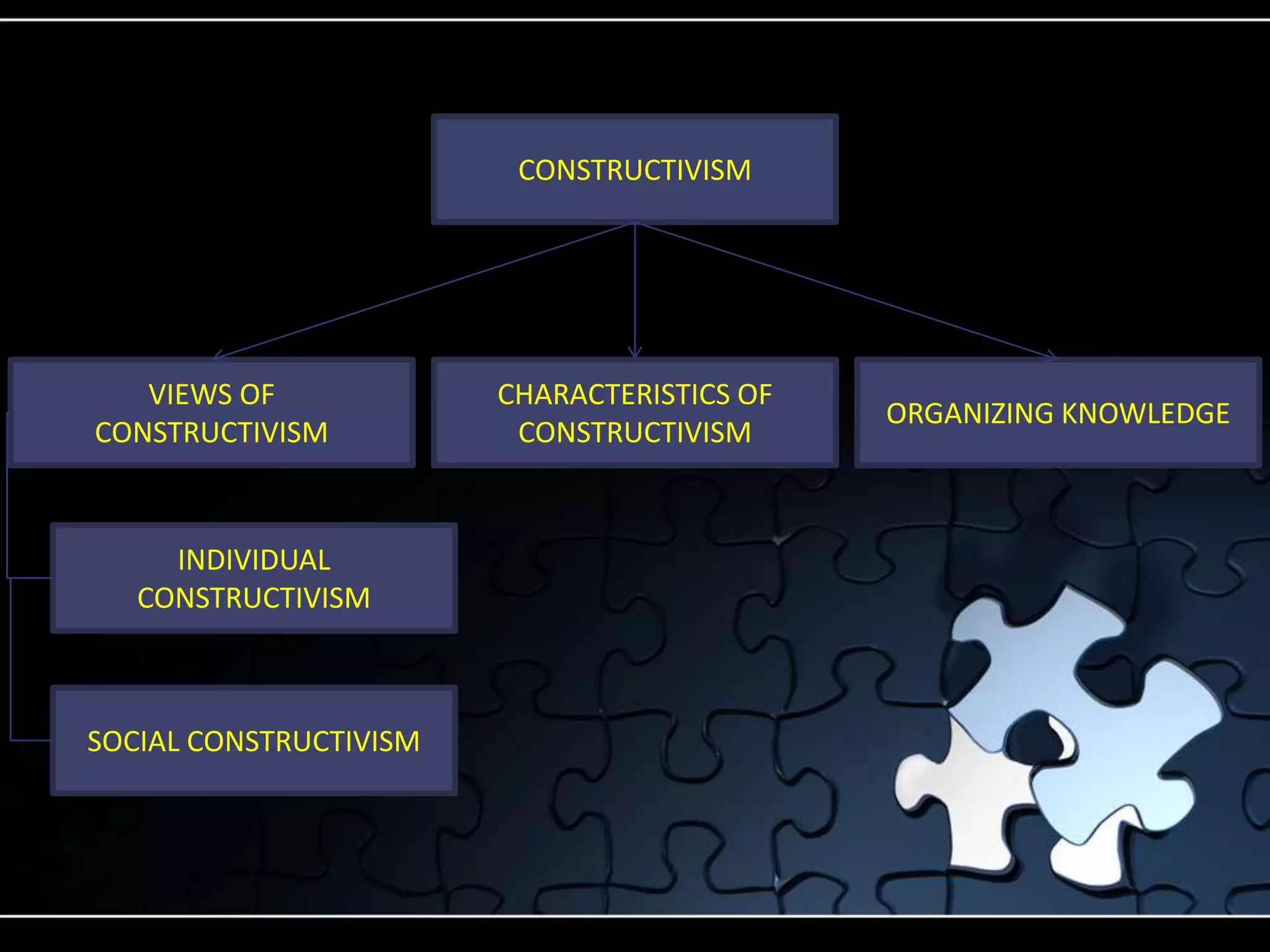
CONSTRUCTIVISM
VIEWS OF
CONSTRUCTIVISM
CHARACTERISTICS OF
CONSTRUCTIVISM
ORGANIZING KNOWLEDGE
INDIVIDUAL
CONSTRUCTIVISM
SOCIAL CONSTRUCTIVISM
CONSTRUCTIVISM
• can be described as a theory that deals with the way
people create meaning of the world through a series of
individual constructs.(Wikepedia)
• It signifies that teaching involves giving opportunities
for learners to explore and discover. Learners construct
their own meaning and generate insights.(textbook)
TWO VIEWS ON CONSTRUCTIVISM
• * also called cognitive constructivism
• * indirect instruction
• * largely based on Piaget’s Theory
• * child-centered and discovery learning
• *based on Vygotsky’s theory
• *conditions of knowledge is shared by two or more people
• *social and interaction context
1. INDIVIDUAL CONSTRUCTIVISM
2. SOCIAL CONSTRUCTIVISM
CHARACTERISTICS OF CONSTRUCTIVISM
• Learners construct Understanding. They see
learners who interpret new information based
on what they already know.
• New learning depends on current
understanding. Background Information is very
important.
According to Eggen and Kauchak, there are four characteristics of
Constructivism.
• Learning is facilitated by social interaction.
Learning communities help learners take
responsibility for their own leaning. Teachers
play as a facilitator rather than an expert one.
• Meaningful learning occurs within authentic
learning tasks. Involves learning activity that
involves constructing knowledge and
understanding needed when applied in the real
world.
ORGANIZING KNOWLEDGE
CONCEPTS
• A way of grouping or categorizing objects or events in
our mind. Includes:
model, discuss, illustrate, explain, assist
Concepts as Feature List
Involves learning specific features that
characterize positive instance of the concept.
A. Defining Feature – characteristic present in ALL
instances.
• For example: Because ALL triangles should have three
sides. If doesn’t, then it is not a triangle.
B. Correlation Feature – present in many positive
instances but not essential for concept
relationship.
• For example: a mother is loving, being loving is a feature
commonly present in the concept of mother. But a
mother may not be loving.
Concepts as Prototypes
• Prototype is an idea or a visual image of a typical
example. It is usually formed based on the positive
instances that learners encounter most often.
• Example: close your eyes now and for a moment think of a
cat.
• Exemplars represent a variety of examples. It allows
learners to know that an example under a concept
may have variability.
• Example: A learner’s concept of vegetable may include a
wide variety of different examples like
cauliflower, kangkong, cabbage, squash and so on.
Concepts as Exemplars
Make Concept-learning Effective
• Provide a clear definition of the concept
• Make the defining features very concrete and prominent
• Give a variety of positive instances
• Give negative instances
• Give a “best example” or prototype
• Provide opportunity for learners to identify positive and
negative instances
• Ask learners to think of their own example of the concept
• Point out how concepts can be related to each other
Schema is an organized body of knowledge about
something. It is like a file of information you hold in
your mind about something. Like a schema of what a
teacher is.
Script is a schema that includes a series of predictable
events of a specific activity.
• Examples: knowing the series of steps done when we
visit a doctor
Applying Constructivism in Facilitating Learning
• Aim to make learners understand a few key ideas in an in-depth
manner, rather than taking up so many topics superficially.
• Give varied examples.
• Provide opportunities for experimentation.
• Provide lots of opportunities for quality interaction.
• Have lots on hands-on activities.
• Relate your topic to real life situations
• Do not depend on the explanation method all the time.
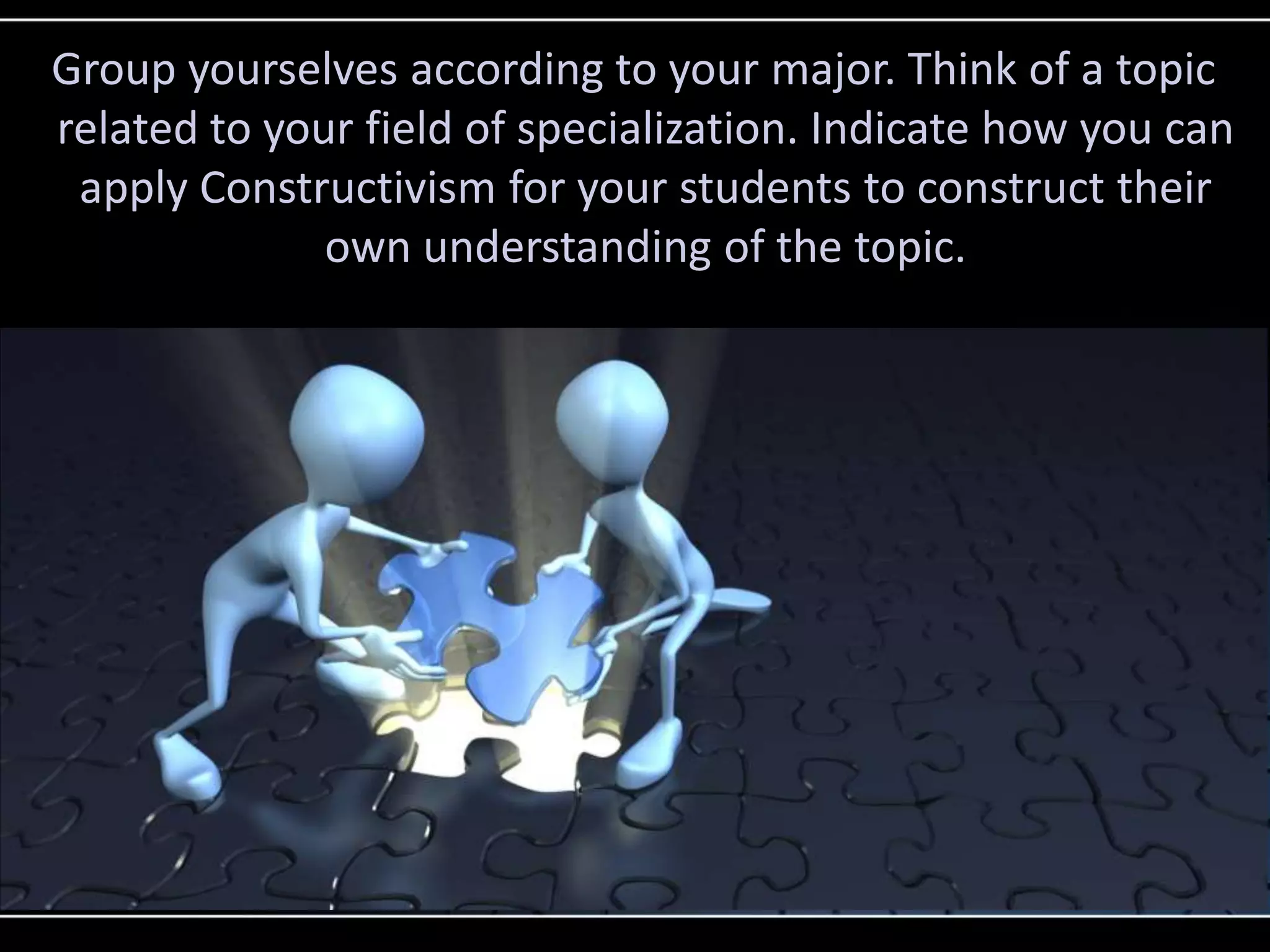
Group yourselves according to your major. Think of a topic
related to your field of specialization. Indicate how you can
apply Constructivism for your students to construct their
own understanding of the topic.

Module 14 ~ Constructivism

  • 1.
    MODULE 14 ~CONSTRUCTIVISM Knowledge Construction/ Concept Learning Dianara . Rhoda . Guia . Dianara . Rhoda . Guia . Dianara . Rhoda . Guia .
  • 2.
    CONSTRUCTIVISM VIEWS OF CONSTRUCTIVISM CHARACTERISTICS OF CONSTRUCTIVISM ORGANIZINGKNOWLEDGE INDIVIDUAL CONSTRUCTIVISM SOCIAL CONSTRUCTIVISM
  • 3.
    CONSTRUCTIVISM • can bedescribed as a theory that deals with the way people create meaning of the world through a series of individual constructs.(Wikepedia) • It signifies that teaching involves giving opportunities for learners to explore and discover. Learners construct their own meaning and generate insights.(textbook)
  • 4.
    TWO VIEWS ONCONSTRUCTIVISM • * also called cognitive constructivism • * indirect instruction • * largely based on Piaget’s Theory • * child-centered and discovery learning • *based on Vygotsky’s theory • *conditions of knowledge is shared by two or more people • *social and interaction context 1. INDIVIDUAL CONSTRUCTIVISM 2. SOCIAL CONSTRUCTIVISM
  • 5.
    CHARACTERISTICS OF CONSTRUCTIVISM •Learners construct Understanding. They see learners who interpret new information based on what they already know. • New learning depends on current understanding. Background Information is very important. According to Eggen and Kauchak, there are four characteristics of Constructivism.
  • 6.
    • Learning isfacilitated by social interaction. Learning communities help learners take responsibility for their own leaning. Teachers play as a facilitator rather than an expert one. • Meaningful learning occurs within authentic learning tasks. Involves learning activity that involves constructing knowledge and understanding needed when applied in the real world.
  • 7.
    ORGANIZING KNOWLEDGE CONCEPTS • Away of grouping or categorizing objects or events in our mind. Includes: model, discuss, illustrate, explain, assist
  • 8.
    Concepts as FeatureList Involves learning specific features that characterize positive instance of the concept. A. Defining Feature – characteristic present in ALL instances. • For example: Because ALL triangles should have three sides. If doesn’t, then it is not a triangle. B. Correlation Feature – present in many positive instances but not essential for concept relationship. • For example: a mother is loving, being loving is a feature commonly present in the concept of mother. But a mother may not be loving.
  • 9.
    Concepts as Prototypes •Prototype is an idea or a visual image of a typical example. It is usually formed based on the positive instances that learners encounter most often. • Example: close your eyes now and for a moment think of a cat. • Exemplars represent a variety of examples. It allows learners to know that an example under a concept may have variability. • Example: A learner’s concept of vegetable may include a wide variety of different examples like cauliflower, kangkong, cabbage, squash and so on. Concepts as Exemplars
  • 10.
    Make Concept-learning Effective •Provide a clear definition of the concept • Make the defining features very concrete and prominent • Give a variety of positive instances • Give negative instances • Give a “best example” or prototype • Provide opportunity for learners to identify positive and negative instances • Ask learners to think of their own example of the concept • Point out how concepts can be related to each other
  • 11.
    Schema is anorganized body of knowledge about something. It is like a file of information you hold in your mind about something. Like a schema of what a teacher is. Script is a schema that includes a series of predictable events of a specific activity. • Examples: knowing the series of steps done when we visit a doctor
  • 12.
    Applying Constructivism inFacilitating Learning • Aim to make learners understand a few key ideas in an in-depth manner, rather than taking up so many topics superficially. • Give varied examples. • Provide opportunities for experimentation. • Provide lots of opportunities for quality interaction. • Have lots on hands-on activities. • Relate your topic to real life situations • Do not depend on the explanation method all the time.
  • 13.
    Group yourselves accordingto your major. Think of a topic related to your field of specialization. Indicate how you can apply Constructivism for your students to construct their own understanding of the topic.