ARIHANT INSTITUTE
OF TEACHERS
TRAINING
NAME: Shendkar Rupali P.
COURSE NO: 103
Teaching and Learning
UNIT:Factors affecting Learning
Individual and Environmental
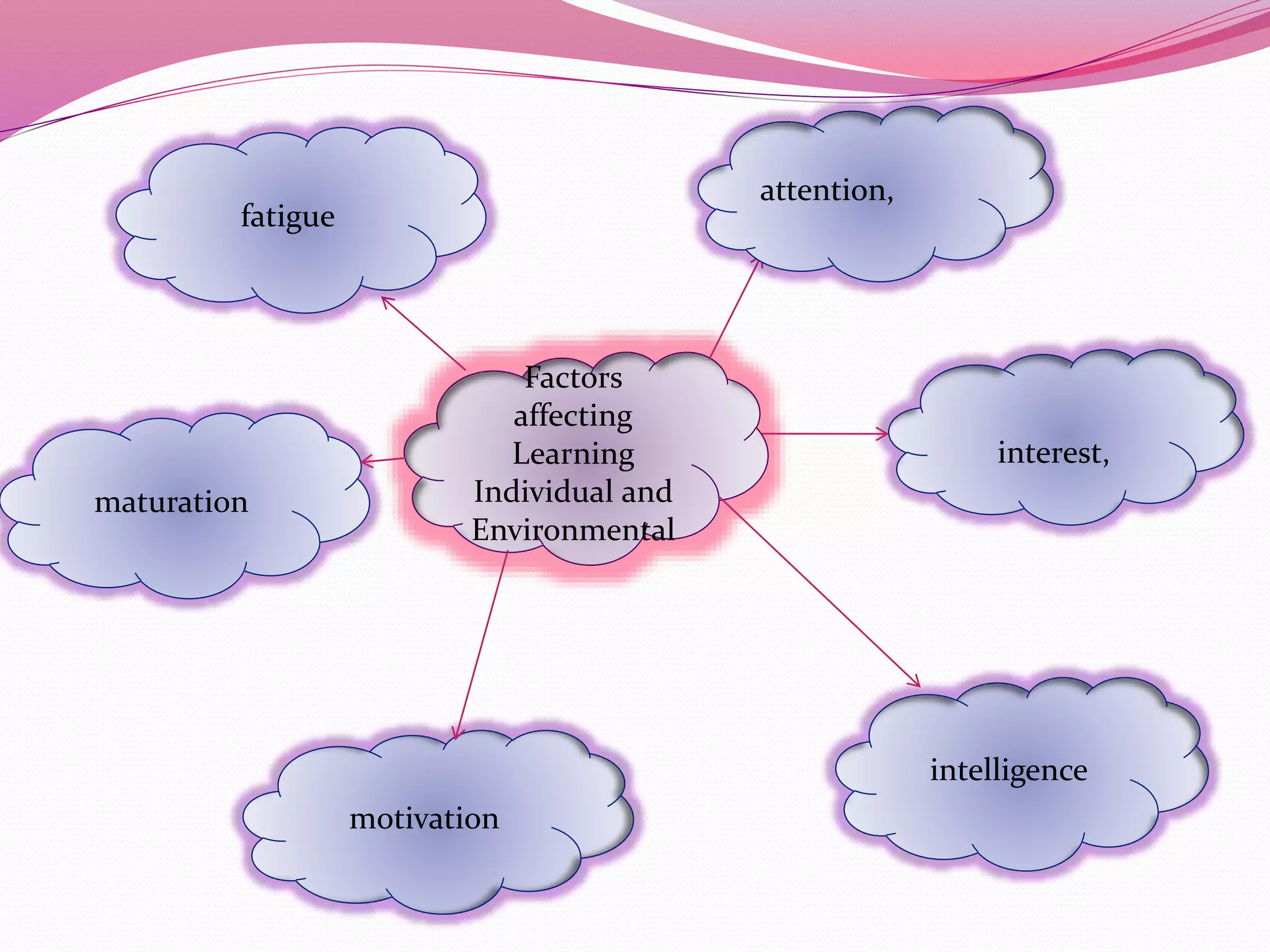
Factors
affecting
Learning
Individual and
Environmental
interest,
intelligence
motivation
maturation
attention,
fatigue
Maturation:
Development of child takes place of two basic but complex process
1- Learning
2- maturation
When the development results from the natural growth of the
physiological system, it is called maturation.
Learning is possible when certain stage of maturation is reached.
Maturation:
 Maturation may be physical or mental.
 Maturation is reflected in the readiness of the child to do certain
activity.
 Pacing means presenting activities at a rate commensurate with the
development of the child.
 Do not force the child to read and write in the KG class as the child
may not be mature enough and hence may not be ready to do the
activities.
 The more mature organism, the less training is needed to reach a
given level of proficiency.
Maturation:
 The principle of maturation merely warns us against enforcing
training on a child when he is not mature to learn the specific skills.
 Otherwise the child may develop wrong habits, may lose interest and
then will require more time to unlearn the wrong habits.
 teacher should explain this principle to parents who are over
ambitious and over enthusiastic in the education of their 3 or 4 years
old child.
Intelligence
 Intelligence goes on growing up to the age of 16 to 20 years but he I.Q. for
most individuals remains constant
 .the I.Q. provides a ratio for determining how bright an individualk is as
comopared to other age
Intelligence
 Intelligence is expressed by an IQ score in an intelligence test is positivity
related to training.
 Generally, people with higher IQs learn new material rapidly. However,
higher IQ in itself is no guarantee for rapid learning since other factors
such as motivation of the learner and the method used for learning are also
important.
Attention
 Attention is always present is consious life and is common to all types of
mental activity.
 We must attend before we know, feel or act.
 It is a characteristic of all conscious life.
Attention as the selective activity of consciousness or as a process of getting
an object of thought clearly before the mind.
Why do we attend?
Internal and external factors
 Conditions that control attention may be termed as objective and
subjective, those that are found in the objects ( external) and those
that lie within the subject ( internal).
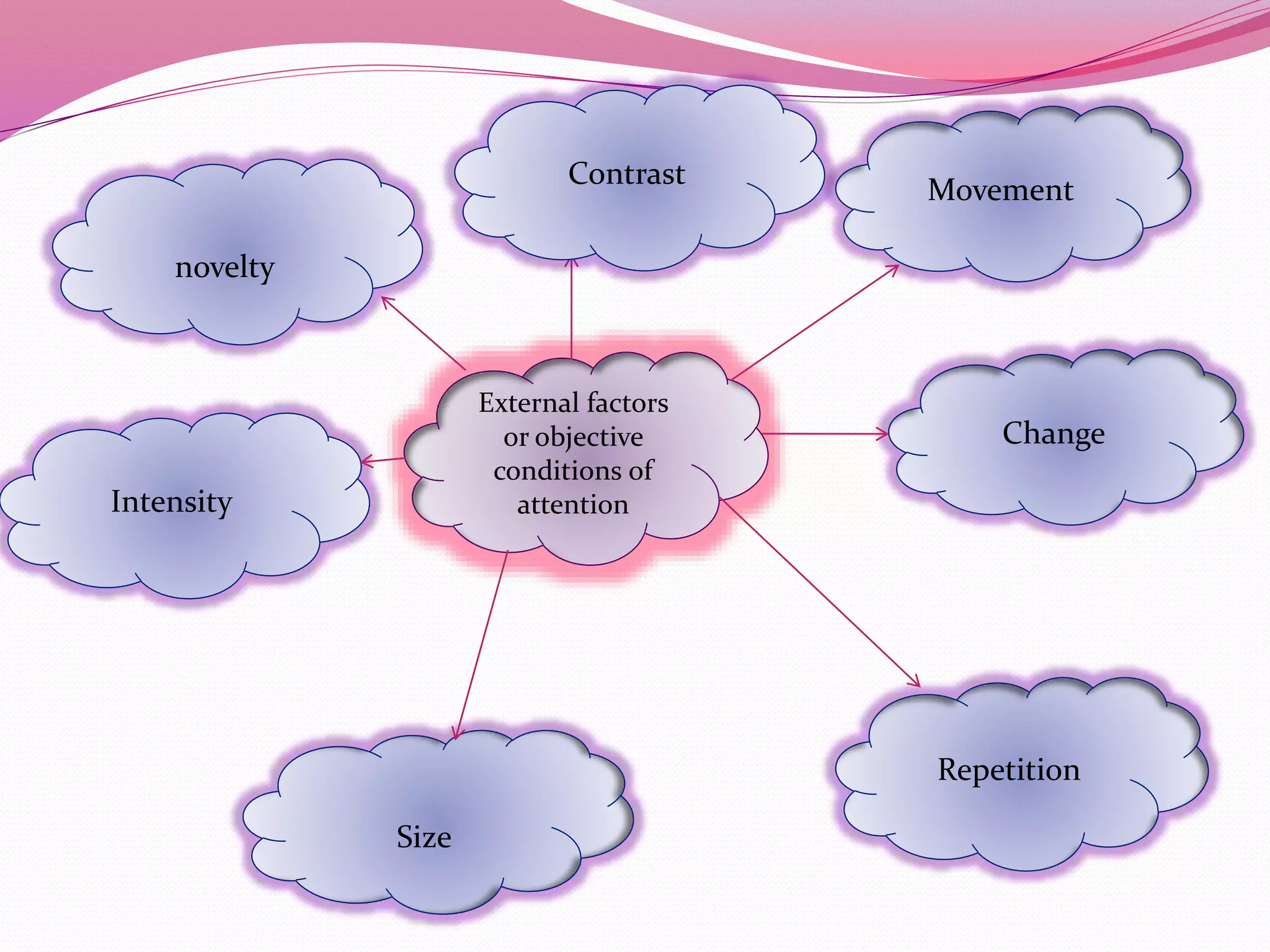
External factors
or objective
conditions of
attention
Change
Repetition
Size
Intensity
Movement
Contrast
novelty
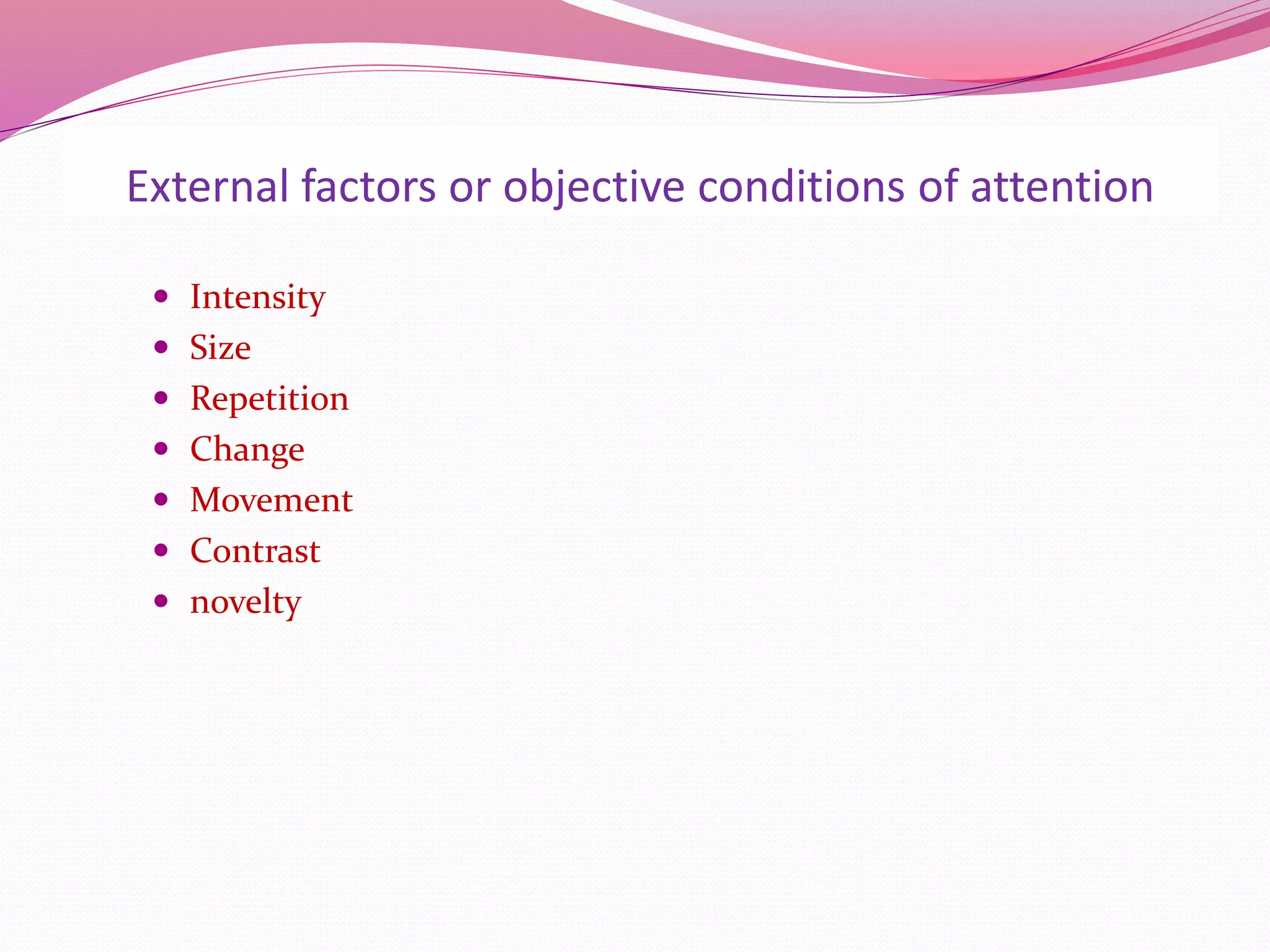
External factors or objective conditions of attention
 Intensity
 Size
 Repetition
 Change
 Movement
 Contrast
 novelty
Intensity-
A strong stimulus is more likely to be noticed than a weak one.
A loud noise has the advantage over a soft whisper, the bright head-light of a
car catches our attention more easily than the dull lamp of a cycle.
Size-
Other things being equal, a large object will draw our attention more readily
than a small one, a big advertisement or a tall building or an elephant will
easily attract our attention.
Repetition-
 The alarm of a clock would go unnoticed, if it strikes only
once. To Attract your attention, advertisers repeat a particular
slogan while advertising t.hrough radio and tv
Change-
To attract attention, change should not be gradual one but a sudden one, the
tickling of wall clock goes unnoticed, but it arrests attention as soon as it
stops. A Speaker modulates his voice to attract the attention of the audience.
Contrast-
Anything that is different from its surrounding is likely to stand out and catch
the eye. An ink blot on a white sari is likely to attract attention more readily
than one on a colored sari. A tall and a short person walking together attract
our attention more quickly.
Novelty-
A strange object generally arouses attention. An
advertisement printed upside down or a student wearing a
western style dress with a turban on his head is likely to
attract attention.
Internal factors (Subjective) or
conditions of Attention
How much and in what way a person will attend to a stimulus
depends not only upon the characteristics of that stimulus
or the favourable environmental conditions but also upon
the persons own interest, motives, Interest. We attend to
objects in which we are interested. these internal actors
are of many kinds but they can put into six classes-
1-Emotions
2- Interest
3-mood
4-Attitude
5-Motives
6-Instincts
1.Emotions-
emotions are said to be the “ internal motivation” of
attention. In joy and affection we attend to certain
things. In sorrow we like nothing. hence the teacher
should try to make the classroom situation pleasant so
that so student can attend and gain the maximum.
2 Interest and attention-
Interest is a very helpful factor in securing attention. We
attend to objects in which we are interested and we do
not attend to those in which we do not have interest.
A boy interested in hockey will be more interested in
watching a hockey match than football or the
volleyball matches being played at the same time on
adjacent grounds.
Teacher should make his lesson interesting by
connecting it with their basic need,drives and interest.
3.Mood-
 The more the pleasant mood of the child the greater
the level of attention.It also leads to less distraction
when pleasant.
 Our mood always influences the direction of
attention. If somebody is seriously ill at home, you
find it difficult to pay attention your study. if you are in
a pleasant mood, you pay attention easily.
 Our mood always influences the direction of attention.
If somebody is seriously ill at home, you find it
difficult to pay attention your study. if you are in a
pleasant mood, you pay attention easily.
4.Attitude-
 The attitude of the child towards something will
determine his attention level.
 Positive attitude will lead to higher level of attention or
negative attitude will lead to less or no attention.
5 Motives-
 The basic drives and urges of the individual are very important in
securing his attention.
 Thirst, hunger, sex, curiosity, fear are some of the important
motives that exercise a definite influence upon attention.
 A hungry person will definitely notice the smell of cooking.
The sex drive occupies a unique place among the
different drives. Even the most inattentive student in the
class can be made to sit on the edge of his chair if the
teacher announces that he is going to talk about the sex
practices of American hippies.Now a days in the world of
advertsing,sex is the drive that has been most widely
exploited. We can see the shapely girls in bathing suits to
sell such unrelated items as tyres,bolts and tractors.
6.Instincts
They are the “prime movers” of our behaviour. So
the things which appeal to our instincts attract our
attention.
Hence the teacher should appeal to the instincts
of the students in order to catch their attention and
make lesson success.
A hungry child pays attention to food, a cat looks
for a mice, mother pays attention to her sick child, etc.
•THANK YOU

Factors affecting on learning

  • 1.
  • 2.
    NAME: Shendkar RupaliP. COURSE NO: 103 Teaching and Learning UNIT:Factors affecting Learning Individual and Environmental
  • 3.
  • 4.
    Maturation: Development of childtakes place of two basic but complex process 1- Learning 2- maturation When the development results from the natural growth of the physiological system, it is called maturation. Learning is possible when certain stage of maturation is reached.
  • 5.
    Maturation:  Maturation maybe physical or mental.  Maturation is reflected in the readiness of the child to do certain activity.  Pacing means presenting activities at a rate commensurate with the development of the child.  Do not force the child to read and write in the KG class as the child may not be mature enough and hence may not be ready to do the activities.  The more mature organism, the less training is needed to reach a given level of proficiency.
  • 6.
    Maturation:  The principleof maturation merely warns us against enforcing training on a child when he is not mature to learn the specific skills.  Otherwise the child may develop wrong habits, may lose interest and then will require more time to unlearn the wrong habits.  teacher should explain this principle to parents who are over ambitious and over enthusiastic in the education of their 3 or 4 years old child.
  • 7.
    Intelligence  Intelligence goeson growing up to the age of 16 to 20 years but he I.Q. for most individuals remains constant  .the I.Q. provides a ratio for determining how bright an individualk is as comopared to other age
  • 8.
    Intelligence  Intelligence isexpressed by an IQ score in an intelligence test is positivity related to training.  Generally, people with higher IQs learn new material rapidly. However, higher IQ in itself is no guarantee for rapid learning since other factors such as motivation of the learner and the method used for learning are also important.
  • 9.
    Attention  Attention isalways present is consious life and is common to all types of mental activity.  We must attend before we know, feel or act.  It is a characteristic of all conscious life. Attention as the selective activity of consciousness or as a process of getting an object of thought clearly before the mind.
  • 10.
    Why do weattend? Internal and external factors  Conditions that control attention may be termed as objective and subjective, those that are found in the objects ( external) and those that lie within the subject ( internal).
  • 11.
    External factors or objective conditionsof attention Change Repetition Size Intensity Movement Contrast novelty
  • 12.
    External factors orobjective conditions of attention  Intensity  Size  Repetition  Change  Movement  Contrast  novelty
  • 13.
    Intensity- A strong stimulusis more likely to be noticed than a weak one. A loud noise has the advantage over a soft whisper, the bright head-light of a car catches our attention more easily than the dull lamp of a cycle.
  • 14.
    Size- Other things beingequal, a large object will draw our attention more readily than a small one, a big advertisement or a tall building or an elephant will easily attract our attention.
  • 15.
    Repetition-  The alarmof a clock would go unnoticed, if it strikes only once. To Attract your attention, advertisers repeat a particular slogan while advertising t.hrough radio and tv
  • 16.
    Change- To attract attention,change should not be gradual one but a sudden one, the tickling of wall clock goes unnoticed, but it arrests attention as soon as it stops. A Speaker modulates his voice to attract the attention of the audience.
  • 17.
    Contrast- Anything that isdifferent from its surrounding is likely to stand out and catch the eye. An ink blot on a white sari is likely to attract attention more readily than one on a colored sari. A tall and a short person walking together attract our attention more quickly.
  • 18.
    Novelty- A strange objectgenerally arouses attention. An advertisement printed upside down or a student wearing a western style dress with a turban on his head is likely to attract attention.
  • 19.
    Internal factors (Subjective)or conditions of Attention How much and in what way a person will attend to a stimulus depends not only upon the characteristics of that stimulus or the favourable environmental conditions but also upon the persons own interest, motives, Interest. We attend to objects in which we are interested. these internal actors are of many kinds but they can put into six classes- 1-Emotions 2- Interest 3-mood 4-Attitude 5-Motives 6-Instincts
  • 20.
    1.Emotions- emotions are saidto be the “ internal motivation” of attention. In joy and affection we attend to certain things. In sorrow we like nothing. hence the teacher should try to make the classroom situation pleasant so that so student can attend and gain the maximum.
  • 21.
    2 Interest andattention- Interest is a very helpful factor in securing attention. We attend to objects in which we are interested and we do not attend to those in which we do not have interest. A boy interested in hockey will be more interested in watching a hockey match than football or the volleyball matches being played at the same time on adjacent grounds. Teacher should make his lesson interesting by connecting it with their basic need,drives and interest.
  • 22.
    3.Mood-  The morethe pleasant mood of the child the greater the level of attention.It also leads to less distraction when pleasant.  Our mood always influences the direction of attention. If somebody is seriously ill at home, you find it difficult to pay attention your study. if you are in a pleasant mood, you pay attention easily.  Our mood always influences the direction of attention. If somebody is seriously ill at home, you find it difficult to pay attention your study. if you are in a pleasant mood, you pay attention easily.
  • 23.
    4.Attitude-  The attitudeof the child towards something will determine his attention level.  Positive attitude will lead to higher level of attention or negative attitude will lead to less or no attention.
  • 24.
    5 Motives-  Thebasic drives and urges of the individual are very important in securing his attention.  Thirst, hunger, sex, curiosity, fear are some of the important motives that exercise a definite influence upon attention.  A hungry person will definitely notice the smell of cooking. The sex drive occupies a unique place among the different drives. Even the most inattentive student in the class can be made to sit on the edge of his chair if the teacher announces that he is going to talk about the sex practices of American hippies.Now a days in the world of advertsing,sex is the drive that has been most widely exploited. We can see the shapely girls in bathing suits to sell such unrelated items as tyres,bolts and tractors.
  • 25.
    6.Instincts They are the“prime movers” of our behaviour. So the things which appeal to our instincts attract our attention. Hence the teacher should appeal to the instincts of the students in order to catch their attention and make lesson success. A hungry child pays attention to food, a cat looks for a mice, mother pays attention to her sick child, etc.
  • 26.

Editor's Notes