Principles of Learning
Dr.M.Deivam
Assistant Professor
Department of Education
The Gandhigram Rural Institute (Deemed to be University),
Gandhigram, Dindigul District, Tamil Nadu – 624 305
Learning is growth
• The word growth is generally associated with
the body which is growing, but through the
mental growth of the learner. Although it is
latent yet we can perceive its growth. Through
his daily activities the child grows both
mentally and physically. Therefore, we say
that learning is growth through experience.
Learning is adjustment
• Learning helps the individual to adjust himself
adequately to the new situations.
• Children meet with new situations which
demand solution. Repeated efforts are
required to react to them effectively.
• Life is full of experiences, and each
experience leaves behind some efforts in the
mental structure. These effects modify our
behaviour.
Learning is organizing experience
• Learning is not mere addition to knowledge. It
is not mere acquisition of facts and skills
through drill and repetition. It is the
reorganization of experiences.
Learning is purposeful
• All true learning is based on purpose. Purpose
plays a big role in learning.
• We do not learn anything and everything that
comes in our way, in a haphazard manner.
• All school activities should be purposeful so
that the child should feel real urge for
learning.
Learning is intelligent
• Meaningless efforts do not produce permanent
result.
• Any work done mechanically is without any soul.
When a child learns something unintelligently, he
is likely to forget it very soon.
• He does not assimilate but simply commits to
memory.
• Only efforts made intelligent way of learning
and understanding.
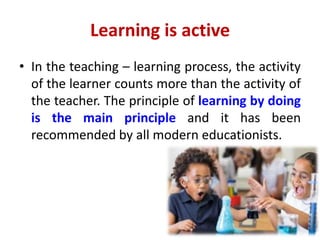
Learning is active
• In the teaching – learning process, the activity
of the learner counts more than the activity of
the teacher. The principle of learning by doing
is the main principle and it has been
recommended by all modern educationists.
Learning is both individual and social
• Learning is more than an individual activity. It
is a social activity also. Individual mind is
affected by the group mind consciously as well
as unconsciously as individual is influenced by
his friends.
• Social agencies like the family, church, film
and gangs of playmates have a tremendous
influence on the child and are always
moulding and remoulding him.
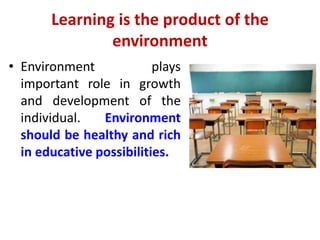
Learning is the product of the
environment
• Environment plays
important role in growth
and development of the
individual. Environment
should be healthy and rich
in educative possibilities.
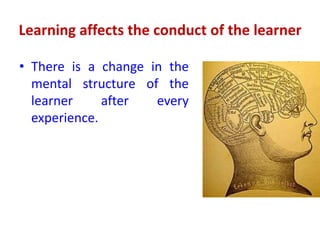
Learning affects the conduct of the learner
• There is a change in the
mental structure of the
learner after every
experience.
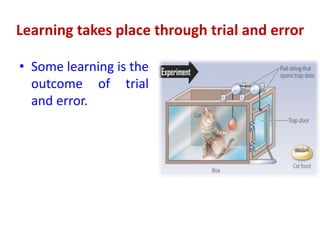
Learning takes place through trial and error
• Some learning is the
outcome of trial
and error.
Learning depends upon insight.
• Lasting learning depends
upon insight, Insight has
sometimes been
described as the flash of
understanding.
Thank you

Principles of learning

  • 1.
    Principles of Learning Dr.M.Deivam AssistantProfessor Department of Education The Gandhigram Rural Institute (Deemed to be University), Gandhigram, Dindigul District, Tamil Nadu – 624 305
  • 2.
    Learning is growth •The word growth is generally associated with the body which is growing, but through the mental growth of the learner. Although it is latent yet we can perceive its growth. Through his daily activities the child grows both mentally and physically. Therefore, we say that learning is growth through experience.
  • 3.
    Learning is adjustment •Learning helps the individual to adjust himself adequately to the new situations. • Children meet with new situations which demand solution. Repeated efforts are required to react to them effectively. • Life is full of experiences, and each experience leaves behind some efforts in the mental structure. These effects modify our behaviour.
  • 4.
    Learning is organizingexperience • Learning is not mere addition to knowledge. It is not mere acquisition of facts and skills through drill and repetition. It is the reorganization of experiences.
  • 5.
    Learning is purposeful •All true learning is based on purpose. Purpose plays a big role in learning. • We do not learn anything and everything that comes in our way, in a haphazard manner. • All school activities should be purposeful so that the child should feel real urge for learning.
  • 6.
    Learning is intelligent •Meaningless efforts do not produce permanent result. • Any work done mechanically is without any soul. When a child learns something unintelligently, he is likely to forget it very soon. • He does not assimilate but simply commits to memory. • Only efforts made intelligent way of learning and understanding.
  • 7.
    Learning is active •In the teaching – learning process, the activity of the learner counts more than the activity of the teacher. The principle of learning by doing is the main principle and it has been recommended by all modern educationists.
  • 8.
    Learning is bothindividual and social • Learning is more than an individual activity. It is a social activity also. Individual mind is affected by the group mind consciously as well as unconsciously as individual is influenced by his friends. • Social agencies like the family, church, film and gangs of playmates have a tremendous influence on the child and are always moulding and remoulding him.
  • 9.
    Learning is theproduct of the environment • Environment plays important role in growth and development of the individual. Environment should be healthy and rich in educative possibilities.
  • 10.
    Learning affects theconduct of the learner • There is a change in the mental structure of the learner after every experience.
  • 11.
    Learning takes placethrough trial and error • Some learning is the outcome of trial and error.
  • 12.
    Learning depends uponinsight. • Lasting learning depends upon insight, Insight has sometimes been described as the flash of understanding.
  • 13.