{
Compound Microscope
Dr. P. Suganya
Assistant Professor
Department of Biotechnology
Sri Kaliswari College (Autonomous), Sivakasi
 The term microscope can be split into two separate
words, ‘micro’ and ‘scope’, where the term ‘micro’
means small or tiny, and ‘scope’ means to view or to
observe.
 Therefore, a microscope can be understood as an
instrument to observe tiny elements.
 The optical microscope often referred to as the light
microscope, is a type of microscope that uses visible
light and a system of lenses to magnify images of small
subjects.
 There are two basic types of optical microscopes:
Definition
 The term “compound” in compound microscopes refers
to the microscope having more than one lens.
 Devised with a system of combination of lenses, a
compound microscope consists of two optical parts,
namely the objective lens and the ocular lens.
Compound Microscope
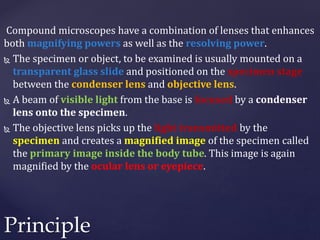
Compound microscopes have a combination of lenses that enhances
both magnifying powers as well as the resolving power.
 The specimen or object, to be examined is usually mounted on a
transparent glass slide and positioned on the specimen stage
between the condenser lens and objective lens.
 A beam of visible light from the base is focused by a condenser
lens onto the specimen.
 The objective lens picks up the light transmitted by the
specimen and creates a magnified image of the specimen called
the primary image inside the body tube. This image is again
magnified by the ocular lens or eyepiece.
Principle
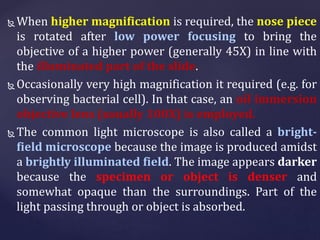
 When higher magnification is required, the nose piece
is rotated after low power focusing to bring the
objective of a higher power (generally 45X) in line with
the illuminated part of the slide.
 Occasionally very high magnification it required (e.g. for
observing bacterial cell). In that case, an oil immersion
objective lens (usually 100X) is employed.
 The common light microscope is also called a bright-
field microscope because the image is produced amidst
a brightly illuminated field. The image appears darker
because the specimen or object is denser and
somewhat opaque than the surroundings. Part of the
light passing through or object is absorbed.
 In order to ascertain the total magnification when viewing an image with a
compound light microscope, take the power of the objective lens which is at
4x, 10x or 40x and multiply it by the power of the eyepiece which is
typically 10x.
 Therefore, a 10x eyepiece used with a 40X objective lens will produce a
magnification of 400X. The naked eye can now view the specimen at
magnification 400 times greater and so microscopic details are revealed.
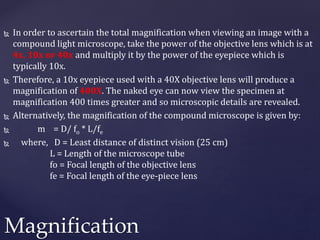
 Alternatively, the magnification of the compound microscope is given by:
 m = D/ fo * L/fe
 where, D = Least distance of distinct vision (25 cm)
L = Length of the microscope tube
fo = Focal length of the objective lens
fe = Focal length of the eye-piece lens
Magnification
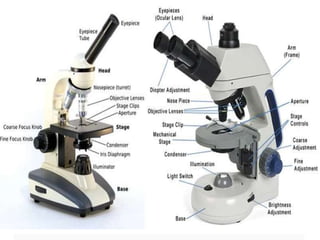
Eyepiece And Body Tube.
The eyepiece is the lens through which the
viewer looks to see the specimen.
It usually contains a 10X or 15X power
lens.
The body tube connects the eyepiece to the
objective lenses.
Parts of the compound
Microscope
Objectives and Stage Clips
 Objective Lenses are one of the most important parts of
a Compound Microscope.
 They are the closest to the specimen.
 A standard Microscope has three to four Objective Lenses
which range from 4X to 100X.
 Stage Clips are metal clips that held the slide in a place.
Arm and Base
 The Arm connects the Body Tube to the base of the
Microscope.
 The Base supports the Microscope and its where
Illuminator.
Illuminator and Stage
 The illuminator is the light source for a microscope.
 A compound light microscope mostly uses a low voltage
bulb as an illuminator.
 The stage is the flat platform where the slide is placed.
Nosepiece and Aperture
 Nosepiece is a rotating turret that holds the objective
lenses.
 The viewer spins the nosepiece to select different
objective lenses.
 The aperture is the middle of the stage that allows light
from the illuminator to reach the specimen.
Condenser, Iris diaphragm, and Diaphragm
 A condenser gathers and focuses light from the
illuminator onto the specimen being viewed.
 Iris diaphragm adjusts the amount of light that reaches
the specimen.
 The diaphragm is a five holed disk placed under the
stage.
 Each hole is of a different diameter. By turning it, you
can vary the amount of light passing through the stage
opening.
 A compound microscope is of great use in pathology labs so as to identify
diseases.
 Various crime cases are detected and solved by drawing out human cells and
examining them under the microscope in forensic laboratories.
 The presence or absence of minerals and the presence of metals can be
identified using compound microscopes.
 Students in schools and colleges are benefited by the use of a microscope for
conducting their academic experiments.
 It helps to see and understand the microbial world of bacteria and viruses,
which is otherwise invisible to the naked eye.
 Plant cells are examined and the microorganisms thriving on it can be
ascertained with the help of a compound microscope. Thereby, a compound
microscope has proved to be crucial to biologists.
Applications
 Simplicity and its convenience.
 A compound light microscope is relatively small,
therefore it’s easy to use and simple to store, and it
comes with its own light source.
 Because of their multiple lenses, compound light
microscopes are able to reveal a great amount of detail
in samples.
Advantages
Compound microscope

Compound microscope

  • 1.
    { Compound Microscope Dr. P.Suganya Assistant Professor Department of Biotechnology Sri Kaliswari College (Autonomous), Sivakasi
  • 2.
     The termmicroscope can be split into two separate words, ‘micro’ and ‘scope’, where the term ‘micro’ means small or tiny, and ‘scope’ means to view or to observe.  Therefore, a microscope can be understood as an instrument to observe tiny elements.  The optical microscope often referred to as the light microscope, is a type of microscope that uses visible light and a system of lenses to magnify images of small subjects.  There are two basic types of optical microscopes: Definition
  • 3.
     The term“compound” in compound microscopes refers to the microscope having more than one lens.  Devised with a system of combination of lenses, a compound microscope consists of two optical parts, namely the objective lens and the ocular lens. Compound Microscope
  • 5.
    Compound microscopes havea combination of lenses that enhances both magnifying powers as well as the resolving power.  The specimen or object, to be examined is usually mounted on a transparent glass slide and positioned on the specimen stage between the condenser lens and objective lens.  A beam of visible light from the base is focused by a condenser lens onto the specimen.  The objective lens picks up the light transmitted by the specimen and creates a magnified image of the specimen called the primary image inside the body tube. This image is again magnified by the ocular lens or eyepiece. Principle
  • 6.
     When highermagnification is required, the nose piece is rotated after low power focusing to bring the objective of a higher power (generally 45X) in line with the illuminated part of the slide.  Occasionally very high magnification it required (e.g. for observing bacterial cell). In that case, an oil immersion objective lens (usually 100X) is employed.  The common light microscope is also called a bright- field microscope because the image is produced amidst a brightly illuminated field. The image appears darker because the specimen or object is denser and somewhat opaque than the surroundings. Part of the light passing through or object is absorbed.
  • 7.
     In orderto ascertain the total magnification when viewing an image with a compound light microscope, take the power of the objective lens which is at 4x, 10x or 40x and multiply it by the power of the eyepiece which is typically 10x.  Therefore, a 10x eyepiece used with a 40X objective lens will produce a magnification of 400X. The naked eye can now view the specimen at magnification 400 times greater and so microscopic details are revealed.  Alternatively, the magnification of the compound microscope is given by:  m = D/ fo * L/fe  where, D = Least distance of distinct vision (25 cm) L = Length of the microscope tube fo = Focal length of the objective lens fe = Focal length of the eye-piece lens Magnification
  • 8.
    Eyepiece And BodyTube. The eyepiece is the lens through which the viewer looks to see the specimen. It usually contains a 10X or 15X power lens. The body tube connects the eyepiece to the objective lenses. Parts of the compound Microscope
  • 9.
    Objectives and StageClips  Objective Lenses are one of the most important parts of a Compound Microscope.  They are the closest to the specimen.  A standard Microscope has three to four Objective Lenses which range from 4X to 100X.  Stage Clips are metal clips that held the slide in a place. Arm and Base  The Arm connects the Body Tube to the base of the Microscope.  The Base supports the Microscope and its where Illuminator.
  • 10.
    Illuminator and Stage The illuminator is the light source for a microscope.  A compound light microscope mostly uses a low voltage bulb as an illuminator.  The stage is the flat platform where the slide is placed. Nosepiece and Aperture  Nosepiece is a rotating turret that holds the objective lenses.  The viewer spins the nosepiece to select different objective lenses.  The aperture is the middle of the stage that allows light from the illuminator to reach the specimen.
  • 11.
    Condenser, Iris diaphragm,and Diaphragm  A condenser gathers and focuses light from the illuminator onto the specimen being viewed.  Iris diaphragm adjusts the amount of light that reaches the specimen.  The diaphragm is a five holed disk placed under the stage.  Each hole is of a different diameter. By turning it, you can vary the amount of light passing through the stage opening.
  • 12.
     A compoundmicroscope is of great use in pathology labs so as to identify diseases.  Various crime cases are detected and solved by drawing out human cells and examining them under the microscope in forensic laboratories.  The presence or absence of minerals and the presence of metals can be identified using compound microscopes.  Students in schools and colleges are benefited by the use of a microscope for conducting their academic experiments.  It helps to see and understand the microbial world of bacteria and viruses, which is otherwise invisible to the naked eye.  Plant cells are examined and the microorganisms thriving on it can be ascertained with the help of a compound microscope. Thereby, a compound microscope has proved to be crucial to biologists. Applications
  • 13.
     Simplicity andits convenience.  A compound light microscope is relatively small, therefore it’s easy to use and simple to store, and it comes with its own light source.  Because of their multiple lenses, compound light microscopes are able to reveal a great amount of detail in samples. Advantages