Republic of the Philippines
Department of Education
Region III – Central Luzon
SCHOOLS DIVISION OF TARLAC PROVINCE
San Roque National High School
MODULE 1: MICROSCOPY
Learning Competency: Identify parts of the microscope and their functions S7LT-Ia- 1
After going through this module, you are expected to:
• Identify the parts and functions of the microscope.
• Classify the parts according to their function.
• Discuss the importance of microscope in different fields.
Microscopy is the technical field of using microscopes to view samples & objects that cannot be seen
with the unaided eye (objects that are not within the resolution range of the normal eye). A microscope is an
instrument that makes an enlarged image of a small object, thus revealing details too small to be seen by the
unaided eye. The most familiar kind of microscope is the optical microscope, which uses visible light focused
through lenses The word “microscope” comes from the Latin “microscopium,” which is derived from the Greek
words “mikros,” meaning “small,” and “skopein,” meaning “to look at.” Circa 1000AD – The first vision aid was
invented (inventor unknown) called a reading stone. It was a glass sphere that magnified when laid on top of
reading materials. Circa 1284 - Italian, Salvino D'Armate is credited with inventing the first wearable eyeglasses.
1590 – Two Dutch eye glass makers, Zaccharias Janssen and son Hans Janssen experimented with multiple lenses
placed in a tube. The Janssen's observed that viewed objects in front of the tube appeared greatly enlarged,
creating both the forerunner of the compound microscope and the telescope. 1665 – English physicist, Robert
Hooke looked at a sliver of cork through a microscope lens and noticed some "pores" or "cells" in it. 1674 –
Anton van Leeuwenhoek built a simple microscope with only one lens to examine blood, yeast, insects and many
other tiny objects. Leeuwenhoek was the first person to describe bacteria, and he invented new methods for
grinding and polishing microscope lenses that allowed for curvatures providing magnifications of up to 270
diameters, the best available lenses at that time. There are three main classification of the parts of the microscope.
Mechanical parts these are parts that are movable or can be manipulated. Illuminating parts these are the parts
of the microscope that gives light. And we have Magnifying parts these are parts that are used to magnify or to
enlarge the image.
MECHANICAL PARTS
Base – the bottom most part of the microscope that provides support to the entire microscope
Pillar – part above the base that give support and firm in the upper part of the microscope.
Inclination Joint – part of the microscope that is used to tilt the microscope during observation. Note that
inclination joint may not be present in modern microscope. It is usually located above the Pillar.
Arm/Neck – Curve/Slanted part of the microscope that held the upper portion of the microscope
Stage – platform where the specimen or sample is place during examination.
Stage Clip – It is used to secure the specimen in the stage during the examination.
Stage Opening – Hole in the middle of the stage where light passes through.
Body Tube – attach to the arm and bears the lenses.
Draw Tube – cylinder above the body tube that holds the ocular lenses
Revolving Nose Piece – rotating disc that holds the objectives of the microscope
Dust Shield – A robber disc attach in the upperpart of the revolving nose piece it is used to protect the ocular
lenses from dust.
Course Adjustment Knob– located on the arm of the microscope moves the stage up and down to bring the
specimen into approximate focus.
Fine Adjustment Knob– a smaller knob that is used to delicate focusing bringing the object in a perfect
focus
Condenser Knob – elevated and lowers the condenser to regulate the intensity of light.
Irish Diaphragm - lever in the front of the condenser and which is moved horizontally to open/close the
diaphragm
ILLUMINATING PARTS
Mirror– located beneath the stage and has a concave and plane surface to gather and direct light in order to
illuminate the object.
Electric Lamp – a built in illuminator beneath the stage that may used if sunlight is not preferred or is not
available.
MAGNIFYING PARTS
Ocular Lens/Eye Piece – set of lens on the top of the body tube which functions to further magnify the
image produced by the objectives lenses it usually ranges from 5x to 15x magnification
Objectives – these are metal cylinder attached below the revolving nose piece and contains especially
ground and polish lenses. There are three types of Objectives present.
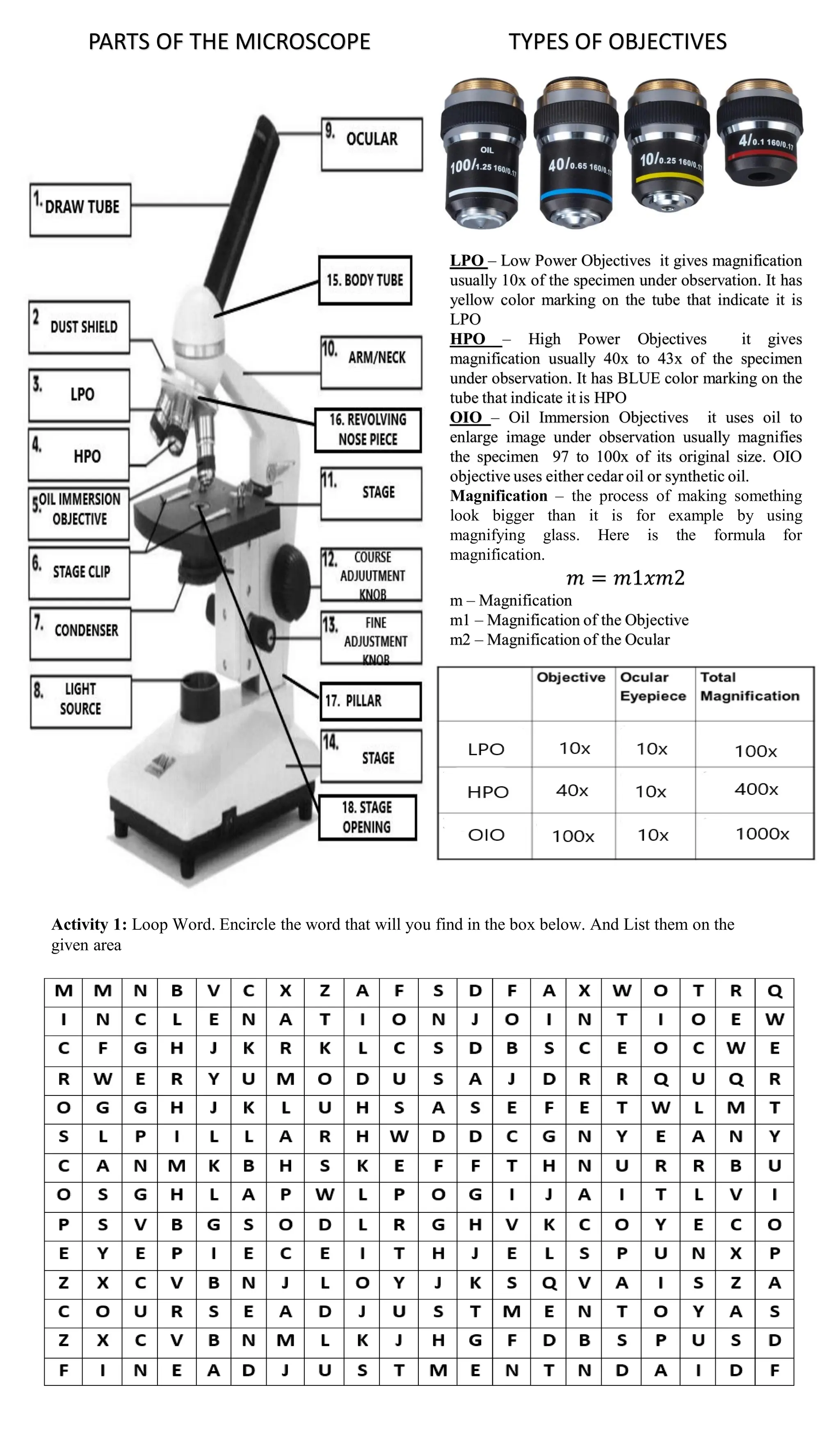
PARTS OF THE MICROSCOPE TYPES OF OBJECTIVES
LPO – Low Power Objectives it gives magnification
usually 10x of the specimen under observation. It has
yellow color marking on the tube that indicate it is
LPO
HPO – High Power Objectives it gives
magnification usually 40x to 43x of the specimen
under observation. It has BLUE color marking on the
tube that indicate it is HPO
OIO – Oil Immersion Objectives it uses oil to
enlarge image under observation usually magnifies
the specimen 97 to 100x of its original size. OIO
objective uses either cedar oil or synthetic oil.
Magnification – the process of making something
look bigger than it is for example by using
magnifying glass. Here is the formula for
magnification.
𝑚 = 𝑚1𝑥𝑚2
m – Magnification
m1 – Magnification of the Objective
m2 – Magnification of the Ocular
Activity 1: Loop Word. Encircle the word that will you find in the box below. And List them on the
given area
Activity 2: Classify the following parts if they are belong to MECHANICAL PARTS, ILLUMINATING
and MAGNIFYING PARTS. Write your answer on the space provided.
Activity 3: Name the parts of the Microscope and discuss its function. Write your answer on the space
provided
Activity 4: Share some importance of microscope in our community in this time of pandemic.
______________________________________________________________________________
______________________________________________________________________________
______________________________________________________________________________
______________________________________________________________________________
______________________________________________________________________________
______________________________________________________________________________
______________________________________________________________________________
______________________________________________________________________________
Republic of the Philippines
Department of Education
Region III – Central Luzon
SCHOOLS DIVISION OF TARLAC PROVINCE
San Roque National High School
You have learned in the previous lesson that microscope is composed of parts with functions. In this
lesson, you will study some appropriate techniques on how to use a compound microscope to gather
information about very small objects. The lessons include varied activities that will guide you on how to use a
compound microscope whenever the opportunity allows you to physically visit your school laboratory or your
science classroom to conduct a hands-on practice. Specifically, you are expected to learn how to focus
specimens using the compound microscope. In a laboratory, a small sample of something like cells, plasma,
tissues, or any part from an organ or organism that represents a whole are used from which a diagnosis is
rendered or other determination of said object's nature is made. These samples are called specimens. In
determining the characteristics of these samples, these specimens are examined under a microscope. Now, start
your learning journey and work on the learning tasks presented in the succeeding pages of this lesson. Although
you may not be able to get hold of the actual microscope, the learning tasks will provide you exciting
opportunity to explore the basic mechanism of a microscope.
When carrying out activity using a microscope in the laboratory, there are necessary reminders that you
must observe and follow carefully. These include the following:
• Carry the microscope with your both hands. Grasp the arm with one hand and place the other hand under
the base for support.
• Put the microscope on a table with the arm towards you.
• Do not touch the glass part of the lenses with your fingers.
• Use only a special lens paper to clean the lenses.
• Keep your microscope covered when not in used.
There are several steps to follow when examining specimens under the microscope. How do you focus
specimens using a compound microscope? Study the steps below.
Put a slide on the stage. Position the specimen over the opening on the stage and use the stage clip to hold it
in place.
• Check the stage from the side. Slowly turn the course adjustment knob to lower the body tube until the
lower-power objective almost touches the slide.
• Turn the course adjustment knob to raise the body tube.
• Look into the eyepiece and turn the fine adjustment knob until the specimen is properly focus.
• While looking into the eyepiece, adjust the diaphragm and the mirror until you see a bright white circle of
light.
• Shift to high power objective lens. Gently revolve the nosepiece until the high-power objective lens clicks in
place. Be sure that the lens will hit the slide.
• Rotate the nosepiece until the low-power objective lens clicks into place.
• Look into the eyepiece, and gently turn the course adjustment knob until you get the clear focus of the
specimen.
MODULE 2: CARRYING AND USE OF THE MICROSCOPE
Learning Competency: Focus specimens using the compound microscope S7LT-Ia- 1
After going through this module, you are expected to:
• Identify the proper handling of the microscope .
• Discuss the proper way on focusing specimen using microscope.
• Label the parts of the microscope.
Activity 1: Describe the images below based on the proper ways in carrying and use of the microscope.
_______________________________________________
_______________________________________________
_______________________________________________
_______________________________________________
_______________________________________________
_______________________________________________
_______________________________________________
_______________________________________________
_______________________________________________
_______________________________________________
_______________________________________________
_______________________________________________
_______________________________________________
_______________________________________________
_______________________________________________
_______________________________________________
_______________________________________________
_______________________________________________
_______________________________________________
_______________________________________________
Activity 2: Arrange the following steps in order of proper handling of microscope. Place 1 to 5 on the
space provided before the number.
_____ 1. Put the microscope on a table with the arm towards you.
_____ 2. Keep your microscope covered when not in used.
_____ 3. Carry the microscope with your both hands. Grasp the arm with one hand and
place the other hand under the base for support.
_____ 4. Use only a special lens paper to clean the lenses.
_____ 5. Do not touch the glass part of the lenses with your fingers.
Activity 3: Label the parts of the microscope. Write your answer on the space provided.
MODULE 3: BIOLOGICAL ORGANIZATION OF LIFE
Learning Competency: Describe the different levels of biological organization from cell to biosphere S7LT-IIc-3
After going through this module, you are expected to:
• Identify the different levels of levels of organization of organisms.
• Discuss the levels of the biological organization of Organisms.
• Label the parts of the microscope.
Republic of the Philippines
Department of Education
Region III – Central Luzon
SCHOOLS DIVISION OF TARLAC PROVINCE
San Roque National High School
This lesson will help you to understand and describe the different levels of biological organization from
cell to biosphere. To study the biological level of organization, we need to start with the simplest building blocks
of life. The cell is the smallest independently functioning unit of a living organism. A cell can regulate its internal
environment, take in and use energy, respond to its environment, and develop and maintain its complex
organization. All organism is composed of cells. They occur singly in a great variety of single-celled organisms or
unicellular organisms like amoebas and most bacteria. Cells are the subunits that make up multicellular organisms
such as birds and trees. Your body consists of trillions of cells of many different kinds. In any multicellular
organism, cells do not function alone. Cells that are similar in structure and functions are usually linked together to
form tissues. Tissues are the second level of the biological organization. For example, the cells in our bones form
bone tissues, a strong solid tissue that gives us shape and support. The blood cells in our body are part of the blood
tissue, a fluid tissue responsible for transporting food and oxygen throughout our body. The tissues are further
organized to form organs. An organ is an anatomically distinct structure which composed of two or more types of
tissues that work together. Our heart for example, is an organ that is made up of muscle tissues and nerve tissues.
You are probably familiar with the names of several body organs. We have the brain, lungs, stomach, kidneys and
the skin. Like cells and tissues, organs rarely work by itself. Organs in a way “collaborate” with other organs and
perform a specific function. These organs form an organ system. The organ system is next higher level of
organization in living things. We define organ system as a group of organs working together to perform a specific
function for the organism. The best example of an organism is you. Yes, you are an organism. Dogs, cats and other
animals around us are also organisms. Even single-celled bacterium is an organism. Organism is an individual
living thing that may be made up of one or more organ systems that carries out all the basic life functions.
Study the illustration below. Cells,
tissues, organs, organ systems and
organisms comprises the different levels
of biological organization. The smooth
functioning of a complex organism
happens when all these levels or parts
work together.
The organisms of the same kind, we call it
species that live in the same area make up a
population. Like when individual person lives in the
same location or area, they make up the human
population of that area, and if a certain species of fish
like milkfish or locally known as “Bangus”, are living
in the same area, they comprise the milkfish
population. The entire array populations that live in
the same location make up a community. The
community consists of different populations of
organism living in the same area. For example, the
Laguna Lake caters to different kinds of living things
like fishes, water plants and grasses. All these
organisms comprise the community of living things in
the lake. When the community interacts with its
physical environment which includes water, air,
sunlight, soil, rock and minerals. This brings us to the
next level of organization called ecosystem. An
ecosystem consists of all the living things in each area
together with the nonliving things.
The Laguna Lake is an example of an ecosystem. A group of similar ecosystems with the same type of
physical environment is called a biome. Many different biomes consist our biosphere. The biosphere is the
part of our planet where all life exists including all the environments on Earth that support life. These
include regions of land, bodies of water and the lower portion of the atmosphere.
Activity 1. Direction: Match the letter from column A to Colum B.
Activity 2. Direction: Illustrate the different levels of organization in order on the
space given. And give their description.
Activity 3. Identify and label the different levels of biological organization of
organisms. Write your answer on the space provided.
MODULE 4: DIFFERENCE OF ANIMALAND PLANT CELL
Learning Competency: Differentiate plant and animal cells according to presence or absence of certain organelles S7LT-IIc-3
After going through this module, you are expected to:
• Identify the parts and function of the organelles of the cell.
• Identify the organelles that are specialized only of animal and plant cell
• Discuss the differences of the Animal and plant cell based their structure and parts.
Republic of the Philippines
Department of Education
Region III – Central Luzon
SCHOOLS DIVISION OF TARLAC PROVINCE
San Roque National High School
We learned from the previous lesson about levels of organization, and we learned that all organisms are made
up of cells. We also learned from the first week of this quarter that the cells can be seen using a microscope. What are
the parts of the cell? What are their functions? Why is the cell the basic and structural unit of all organisms? Let us
find out in this module. According to the Cell Theory, all living organisms are composed of cells. The cell is the basic
unit of life and cells arise from pre-existing cells. These are formulated by German scientists: Theodor Schwann
(1810–1822), Matthias Schleiden 1804–1881, and Rudolph Virchow (1821–1902). The Cell Theory developed with
the advent of technology. In the modern version, it includes the following: (1) energy flow occurs within cells; (2)
heredity information (DNA) is passed on from cell to cell and; (3) all cells have the same basic chemical composition.
Students like you can mostly see the nucleus of a cell using a light microscope, but what about the other parts?
Biologists use an electron microscope. An electron microscope is a microscope that attains extremely high resolution
using an electron beam instead of a beam of light to illuminate the object of study. The word organelle (“little
organs”) is used to describe these tiny cellular structures. The nucleus is the part of the cell that can be observed
easily. It is the control center of the cell also labeled as “the brain” of the cell. This is where the DNA is located.
Deoxyribonucleic acid or DNA exists in all living things and can make exact copies of itself. It comprises the
chromosomes making it the bearer of genetic information of an organism. The nucleolus is where the subunits of
ribosome are produced. The ribosome is the one that synthesizes protein. The cytoplasm is where all the organelles
are embedded. It is a “jelly-like” substance that surrounds the organelles of the cell. The covering of our cell is the
plasma membrane. It is like “the skin” that encloses the cell parts from the outside environment. It allows the entry of
the materials inside the cell, and it is also where wastes exit. The other parts of the cell are mitochondrion,
endoplasmic reticulum, ribosomes, Golgi bodies, vacuoles, and lysosomes. The mitochondrion is where cellular
respiration takes place. The product of cellular respiration process is cellular energy. This cellular energy is used by
other parts of the cell. The popular tag line for mitochondrion is “the powerhouse” of the cell. The endoplasmic
reticulum (ER) serves as synthesizer, sorter, and transporter of materials such as protein and lipids. It is categorized
into two: the rough and the smooth. The rough endoplasmic reticulum contains ribosomes, and its main function is to
synthesize and transport proteins and other materials throughout the cell. The smooth endoplasmic reticulum on the
other hand does not contain ribosomes and it is the one that synthesizes lipids (such as phospholipids and cholesterol),
carbohydrates, and steroids. Remember that the ribosomes are the ones that produce protein. If there is a production of
proteins, the Golgi bodies are the one that process and pack the proteins. Lysosomes are “the digestion machine” of
the cell. When the cell absorbs materials (food) from the outside, the lysosomes will cling to it and starts to break it
down by releasing their enzymes. The complex sugars, carbohydrates, and other big molecules will become simple
molecules that can be used by the cell. Lysosomes also break down unwanted materials like bacteria and old
organelles. The vacuole in plants is larger than in animals taking up almost all the space in a plant cell. It makes the
plant cell rigid. The plants stand upright because of the water in the vacuoles. The freshness of leaves is also due to
water in the vacuole. Some vacuoles in plants contain toxic or poisonous substances. In animal cells, the vacuoles are
small and are called vesicles. It stores water and food and has the task of excretion of waste materials. The general
parts of the cell are given to you. But some parts are particular to a plant cell and an animal cell. What are these parts?
The plant cell has a cell wall and chloroplast. The cell wall is the outer lining beside the plasma membrane. The cell
wall adds stability and protection to plant cells. The chlorophyll in the chloroplasts absorb light energy and convert it
into chemical energy and allows plants to carry out the process of photosynthesis. The amyloplasts are found on plant
cells that stores starch. Animal cells have centrioles. Its function is connected to cell reproduction.
Activity 1. Name the following organelles of the cell. Write your answer on the space provided.
Activity 2: Determine whether the organelles are found in an animal cell, a plant cell, or both. Put a
check mark ( ) on the column you choose for each part.
Activity 3: Direction: Using the Venn diagram below differentiate the animal cell and plant cell
based on their parts.
Activity 4: Direction: Search the word in the box below using a RED BALLPEN put a line mark
the word you saw in the box below.
MODULE 5: REPRODUCTION
Learning Competency: Differentiate asexual from sexual reproduction in terms of 1 Number of individuals
involved; 2 Similarities of offspring to parents S7LT-IIg-7
After going through this module, you are expected to:
• Differentiate Asexual And Sexual Reproduction
• The number of individuals needed in each type of reproduction
• Identify the similarities of the offspring to the parents
Republic of the Philippines
Department of Education
Region III – Central Luzon
SCHOOLS DIVISION OF TARLAC PROVINCE
San Roque National High School
In the previous lesson, you concluded that the cell is the basic unit of life. There are
two types of cells, namely, multicellular and unicellular cell. What is the difference between
the two? Multicellular cells and animals are made up of tissues that made up tissues and
organs. On the other hand, unicellular cells are single-cell organisms. Examples of
unicellular cells such as bacteria and some fungi and protists. These are also examples of
microorganisms. Microorganisms are organisms that can be seen only with the aid of a
microscope.
Probiotic drinks are very popular these days, one of the active ingredients of drinks is
lactobacilli. This type of microorganisms may help us to have healthy digestion. Other
microorganisms that are beneficial to us are yeast (used in baking and fermentation),
phytoplankton (food for marine life), and nitrogen-fixing bacteria (enrich nutrient and
nitrogen fixation in soil). There are also harmful microorganisms. Escherichia coli (E.coli) is
a bacterium that gives us gastrointestinal illness. Harmful algal bloom gives off toxic
chemicals (red tide) that produce harmful effects to fishes, shellfish, and other marine life
and humans. Athlete’s foot is a fungal infection between our toes. There are many harmful
protozoans. These are amoeba which cause amoebiasis or amoebic dysentery in human
beings; Giardia intestinalis causes giardiasis (intestinal disease); and Plasmodium vivax
that causes malaria. A virus is not technically alive if it is not in a living host. It is described
as a submicroscopic infectious agent. It can infect all living things including bacteria. Its
only function is to reproduce by replicating itself inside a host cell and the host cell will
perish. The virus offspring invades a new host, and the cycle continues.
Microorganisms reproduce rapidly due to its simple structure and size. But how do they
reproduce? In what way microorganisms and other organisms multiply? Reproduction is
the process where the offspring (new organism) was created from a parent or parents. The
two types of reproduction are asexual reproduction and sexual reproduction. Asexual
reproduction only involves one parent, there are no gametes (sex cells) produced and the
offspring are genetically identical to the parent. Sexual reproduction involves two parents,
gametes are produced (one from the male and one from the female) and the offspring are
genetically different from the parents.
Let us look at the different kinds of asexual reproduction. The first is binary fission.
Bacteria, amoeba, paramecium, and some protozoa reproduce by binary fission. Binary
fission is an asexual reproduction where a single parent divide into two. The results are two
genetically identical daughter cells. Second is spore formation. Spore formation is a type
asexual reproduction where organisms reproduce by forming spores. Examples of this are
bread mold (fungi), fern (plant), and mosses (plant). The third is budding. In budding, a new
organism is formed from a bud which is an outgrowth from the parent. When the bud is
separated it becomes a new organism. Yeast and Hydra are examples of organism that
reproduce from budding. Some bud remains attached to the parent forming colonies and
others separate become free moving and live on its own. The fourth type is fragmentation.
Fragmentation is physically splitting the organism into segments and these segments
develop into new organisms. Examples of fragmentation are worms, echinoderms, sponges,
and starfish.
Regeneration is similar to fragmentation wherein a cut part can regenerate into a full
organism as exhibited by sea stars. Regrowth or regeneration of lost parts, such as in the
case of in brittle star and lizard’s tail, is not considered a type a reproduction since no new
organism is formed. The fifth is vegetative reproduction. It reproduces offspring from its
vegetative organs such as stem, roots and leave. Examples are the “eyes” or “dimples” of a
potato, stems of strawberries, ginger root, and banana plant.
Sexual reproduction is different from asexual reproduction because it needs two organisms,
a male and a female. Among animals, the male produces sperm cell and the female an egg
cell. Sperm cell and egg cell are collectively called gametes. When these gametes unite the
process is called fertilization. A zygote (fertilized egg) is the result of fertilization. The zygote
then develops and becomes an embryo. It will continue to develop until it reaches maturity
to be born.
Internal fertilization occurs when fertilization takes place inside the body of the
female. After internal fertilization, there are three ways for the new organism (offspring) to
develop. Have you ever wondered why chickens lay their egg? This method is called
oviparity. After the rooster fertilized the egg of the hen, the hen will lay its eggs. The unborn
offspring took its nourishment from the yolk which is part of the egg. The hen will take care
of the egg giving body heat. After 21 days, the egg hatches and a chick is born. All birds lay
eggs, snakes, spiders, platypus, crabs, butterflies are examples of oviparous animals. If the
fertilized egg retained inside the female but the embryo gets its nourishment from the egg
yolk this is called ovoviviparity.
As the egg hatch, the offspring continues to live inside the mother’s body. There is no
placenta or umbilical cord. The offspring are fully developed when they are born. The rays
(marine animals) are a classic example of ovoviviparous animal. Other examples are guppy
and basking sharks. Viviparity is when the embryo develops inside the female body and
receives nourishment through a placenta. For humans, the embryo develops into a human
baby for an average of 280 days. Many familiar animals we know are viviparous like dogs,
cats, pigs, and horses.
External fertilization happens when fertilization occurs outside the female body like most
aquatic animals (fish), amphibians (frogs, salamanders, newts), crustaceans (crabs and
shrimps) and some insects (mosquitos and mayflies).
The advantage of internal fertilization is that the survival rate is high though few
offspring are produced. The mother protects the developing offspring from dehydration and
predators. The advantage of external fertilization is many offspring are produced but
susceptible to predators. Few mothers protect their young.
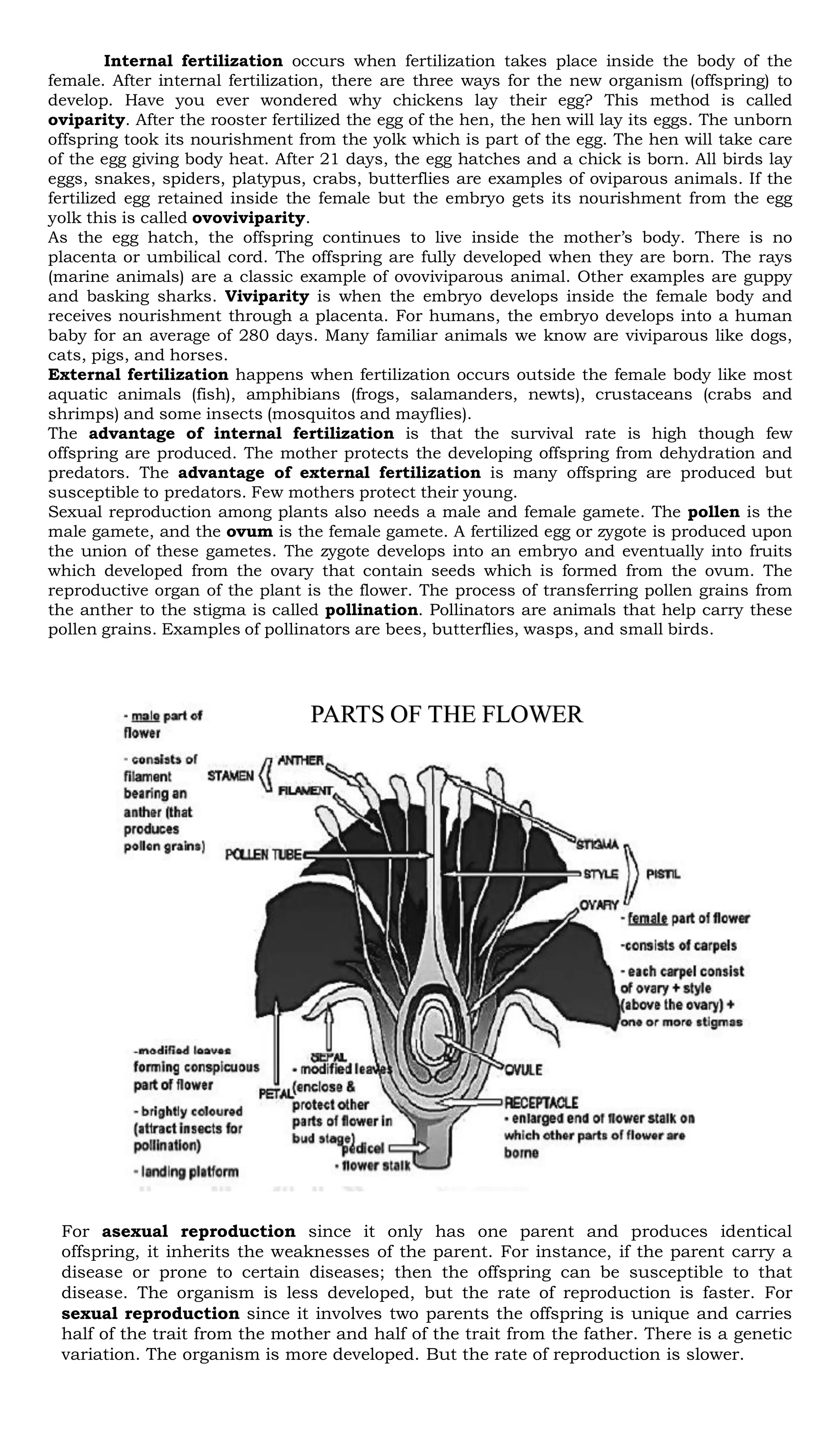
Sexual reproduction among plants also needs a male and female gamete. The pollen is the
male gamete, and the ovum is the female gamete. A fertilized egg or zygote is produced upon
the union of these gametes. The zygote develops into an embryo and eventually into fruits
which developed from the ovary that contain seeds which is formed from the ovum. The
reproductive organ of the plant is the flower. The process of transferring pollen grains from
the anther to the stigma is called pollination. Pollinators are animals that help carry these
pollen grains. Examples of pollinators are bees, butterflies, wasps, and small birds.
For asexual reproduction since it only has one parent and produces identical
offspring, it inherits the weaknesses of the parent. For instance, if the parent carry a
disease or prone to certain diseases; then the offspring can be susceptible to that
disease. The organism is less developed, but the rate of reproduction is faster. For
sexual reproduction since it involves two parents the offspring is unique and carries
half of the trait from the mother and half of the trait from the father. There is a genetic
variation. The organism is more developed. But the rate of reproduction is slower.
PARTS OF THE FLOWER
Activity 1: Identify the type of asexual reproduction shown on the picture. Write a brief explanation if their
process using the pictures as an example. Do this in your answer sheet
1._____________________________
______________________________
______________________________
______________________________
______________________________
______________________________
2._____________________________
______________________________
______________________________
______________________________
______________________________
______________________________
3._____________________________
______________________________
______________________________
______________________________
______________________________
______________________________
4._____________________________
______________________________
______________________________
______________________________
______________________________
______________________________
5._____________________________
______________________________
______________________________
______________________________
______________________________
______________________________
Activity 2: Complete the steps in sexual reproduction on animal and plants by arranging the words on the diagram
Activity 3: Direction: Identify what mode of reproduction does the following exhibit. Put a check (/) where it is
appropriate
ORGANISMS ASEXUAL REPRODUCTION SEXUAL REPRODUCTION
Hydra
Bacteria
Dog
Human
Plant
Flatworms
Whale
Rabbit
Flower
Amoeba
Activity 4: Direction: Identify the following statement as TRUE OR FALSE.
Activity 5: List the characteristics of asexual and sexual reproduction. List at least 5 characteristics.
Asexual Reproduction
Sexual Reproduction

SCIENCE-7-QUARTER-2-LAS (1).pdf

  • 1.
    Republic of thePhilippines Department of Education Region III – Central Luzon SCHOOLS DIVISION OF TARLAC PROVINCE San Roque National High School MODULE 1: MICROSCOPY Learning Competency: Identify parts of the microscope and their functions S7LT-Ia- 1 After going through this module, you are expected to: • Identify the parts and functions of the microscope. • Classify the parts according to their function. • Discuss the importance of microscope in different fields. Microscopy is the technical field of using microscopes to view samples & objects that cannot be seen with the unaided eye (objects that are not within the resolution range of the normal eye). A microscope is an instrument that makes an enlarged image of a small object, thus revealing details too small to be seen by the unaided eye. The most familiar kind of microscope is the optical microscope, which uses visible light focused through lenses The word “microscope” comes from the Latin “microscopium,” which is derived from the Greek words “mikros,” meaning “small,” and “skopein,” meaning “to look at.” Circa 1000AD – The first vision aid was invented (inventor unknown) called a reading stone. It was a glass sphere that magnified when laid on top of reading materials. Circa 1284 - Italian, Salvino D'Armate is credited with inventing the first wearable eyeglasses. 1590 – Two Dutch eye glass makers, Zaccharias Janssen and son Hans Janssen experimented with multiple lenses placed in a tube. The Janssen's observed that viewed objects in front of the tube appeared greatly enlarged, creating both the forerunner of the compound microscope and the telescope. 1665 – English physicist, Robert Hooke looked at a sliver of cork through a microscope lens and noticed some "pores" or "cells" in it. 1674 – Anton van Leeuwenhoek built a simple microscope with only one lens to examine blood, yeast, insects and many other tiny objects. Leeuwenhoek was the first person to describe bacteria, and he invented new methods for grinding and polishing microscope lenses that allowed for curvatures providing magnifications of up to 270 diameters, the best available lenses at that time. There are three main classification of the parts of the microscope. Mechanical parts these are parts that are movable or can be manipulated. Illuminating parts these are the parts of the microscope that gives light. And we have Magnifying parts these are parts that are used to magnify or to enlarge the image. MECHANICAL PARTS Base – the bottom most part of the microscope that provides support to the entire microscope Pillar – part above the base that give support and firm in the upper part of the microscope. Inclination Joint – part of the microscope that is used to tilt the microscope during observation. Note that inclination joint may not be present in modern microscope. It is usually located above the Pillar. Arm/Neck – Curve/Slanted part of the microscope that held the upper portion of the microscope Stage – platform where the specimen or sample is place during examination. Stage Clip – It is used to secure the specimen in the stage during the examination. Stage Opening – Hole in the middle of the stage where light passes through. Body Tube – attach to the arm and bears the lenses. Draw Tube – cylinder above the body tube that holds the ocular lenses Revolving Nose Piece – rotating disc that holds the objectives of the microscope Dust Shield – A robber disc attach in the upperpart of the revolving nose piece it is used to protect the ocular lenses from dust. Course Adjustment Knob– located on the arm of the microscope moves the stage up and down to bring the specimen into approximate focus. Fine Adjustment Knob– a smaller knob that is used to delicate focusing bringing the object in a perfect focus Condenser Knob – elevated and lowers the condenser to regulate the intensity of light. Irish Diaphragm - lever in the front of the condenser and which is moved horizontally to open/close the diaphragm ILLUMINATING PARTS Mirror– located beneath the stage and has a concave and plane surface to gather and direct light in order to illuminate the object. Electric Lamp – a built in illuminator beneath the stage that may used if sunlight is not preferred or is not available. MAGNIFYING PARTS Ocular Lens/Eye Piece – set of lens on the top of the body tube which functions to further magnify the image produced by the objectives lenses it usually ranges from 5x to 15x magnification Objectives – these are metal cylinder attached below the revolving nose piece and contains especially ground and polish lenses. There are three types of Objectives present.
  • 2.
    PARTS OF THEMICROSCOPE TYPES OF OBJECTIVES LPO – Low Power Objectives it gives magnification usually 10x of the specimen under observation. It has yellow color marking on the tube that indicate it is LPO HPO – High Power Objectives it gives magnification usually 40x to 43x of the specimen under observation. It has BLUE color marking on the tube that indicate it is HPO OIO – Oil Immersion Objectives it uses oil to enlarge image under observation usually magnifies the specimen 97 to 100x of its original size. OIO objective uses either cedar oil or synthetic oil. Magnification – the process of making something look bigger than it is for example by using magnifying glass. Here is the formula for magnification. 𝑚 = 𝑚1𝑥𝑚2 m – Magnification m1 – Magnification of the Objective m2 – Magnification of the Ocular Activity 1: Loop Word. Encircle the word that will you find in the box below. And List them on the given area
  • 3.
    Activity 2: Classifythe following parts if they are belong to MECHANICAL PARTS, ILLUMINATING and MAGNIFYING PARTS. Write your answer on the space provided. Activity 3: Name the parts of the Microscope and discuss its function. Write your answer on the space provided Activity 4: Share some importance of microscope in our community in this time of pandemic. ______________________________________________________________________________ ______________________________________________________________________________ ______________________________________________________________________________ ______________________________________________________________________________ ______________________________________________________________________________ ______________________________________________________________________________ ______________________________________________________________________________ ______________________________________________________________________________
  • 4.
    Republic of thePhilippines Department of Education Region III – Central Luzon SCHOOLS DIVISION OF TARLAC PROVINCE San Roque National High School You have learned in the previous lesson that microscope is composed of parts with functions. In this lesson, you will study some appropriate techniques on how to use a compound microscope to gather information about very small objects. The lessons include varied activities that will guide you on how to use a compound microscope whenever the opportunity allows you to physically visit your school laboratory or your science classroom to conduct a hands-on practice. Specifically, you are expected to learn how to focus specimens using the compound microscope. In a laboratory, a small sample of something like cells, plasma, tissues, or any part from an organ or organism that represents a whole are used from which a diagnosis is rendered or other determination of said object's nature is made. These samples are called specimens. In determining the characteristics of these samples, these specimens are examined under a microscope. Now, start your learning journey and work on the learning tasks presented in the succeeding pages of this lesson. Although you may not be able to get hold of the actual microscope, the learning tasks will provide you exciting opportunity to explore the basic mechanism of a microscope. When carrying out activity using a microscope in the laboratory, there are necessary reminders that you must observe and follow carefully. These include the following: • Carry the microscope with your both hands. Grasp the arm with one hand and place the other hand under the base for support. • Put the microscope on a table with the arm towards you. • Do not touch the glass part of the lenses with your fingers. • Use only a special lens paper to clean the lenses. • Keep your microscope covered when not in used. There are several steps to follow when examining specimens under the microscope. How do you focus specimens using a compound microscope? Study the steps below. Put a slide on the stage. Position the specimen over the opening on the stage and use the stage clip to hold it in place. • Check the stage from the side. Slowly turn the course adjustment knob to lower the body tube until the lower-power objective almost touches the slide. • Turn the course adjustment knob to raise the body tube. • Look into the eyepiece and turn the fine adjustment knob until the specimen is properly focus. • While looking into the eyepiece, adjust the diaphragm and the mirror until you see a bright white circle of light. • Shift to high power objective lens. Gently revolve the nosepiece until the high-power objective lens clicks in place. Be sure that the lens will hit the slide. • Rotate the nosepiece until the low-power objective lens clicks into place. • Look into the eyepiece, and gently turn the course adjustment knob until you get the clear focus of the specimen. MODULE 2: CARRYING AND USE OF THE MICROSCOPE Learning Competency: Focus specimens using the compound microscope S7LT-Ia- 1 After going through this module, you are expected to: • Identify the proper handling of the microscope . • Discuss the proper way on focusing specimen using microscope. • Label the parts of the microscope. Activity 1: Describe the images below based on the proper ways in carrying and use of the microscope. _______________________________________________ _______________________________________________ _______________________________________________ _______________________________________________ _______________________________________________ _______________________________________________ _______________________________________________ _______________________________________________ _______________________________________________ _______________________________________________
  • 5.
    _______________________________________________ _______________________________________________ _______________________________________________ _______________________________________________ _______________________________________________ _______________________________________________ _______________________________________________ _______________________________________________ _______________________________________________ _______________________________________________ Activity 2: Arrangethe following steps in order of proper handling of microscope. Place 1 to 5 on the space provided before the number. _____ 1. Put the microscope on a table with the arm towards you. _____ 2. Keep your microscope covered when not in used. _____ 3. Carry the microscope with your both hands. Grasp the arm with one hand and place the other hand under the base for support. _____ 4. Use only a special lens paper to clean the lenses. _____ 5. Do not touch the glass part of the lenses with your fingers. Activity 3: Label the parts of the microscope. Write your answer on the space provided.
  • 6.
    MODULE 3: BIOLOGICALORGANIZATION OF LIFE Learning Competency: Describe the different levels of biological organization from cell to biosphere S7LT-IIc-3 After going through this module, you are expected to: • Identify the different levels of levels of organization of organisms. • Discuss the levels of the biological organization of Organisms. • Label the parts of the microscope. Republic of the Philippines Department of Education Region III – Central Luzon SCHOOLS DIVISION OF TARLAC PROVINCE San Roque National High School This lesson will help you to understand and describe the different levels of biological organization from cell to biosphere. To study the biological level of organization, we need to start with the simplest building blocks of life. The cell is the smallest independently functioning unit of a living organism. A cell can regulate its internal environment, take in and use energy, respond to its environment, and develop and maintain its complex organization. All organism is composed of cells. They occur singly in a great variety of single-celled organisms or unicellular organisms like amoebas and most bacteria. Cells are the subunits that make up multicellular organisms such as birds and trees. Your body consists of trillions of cells of many different kinds. In any multicellular organism, cells do not function alone. Cells that are similar in structure and functions are usually linked together to form tissues. Tissues are the second level of the biological organization. For example, the cells in our bones form bone tissues, a strong solid tissue that gives us shape and support. The blood cells in our body are part of the blood tissue, a fluid tissue responsible for transporting food and oxygen throughout our body. The tissues are further organized to form organs. An organ is an anatomically distinct structure which composed of two or more types of tissues that work together. Our heart for example, is an organ that is made up of muscle tissues and nerve tissues. You are probably familiar with the names of several body organs. We have the brain, lungs, stomach, kidneys and the skin. Like cells and tissues, organs rarely work by itself. Organs in a way “collaborate” with other organs and perform a specific function. These organs form an organ system. The organ system is next higher level of organization in living things. We define organ system as a group of organs working together to perform a specific function for the organism. The best example of an organism is you. Yes, you are an organism. Dogs, cats and other animals around us are also organisms. Even single-celled bacterium is an organism. Organism is an individual living thing that may be made up of one or more organ systems that carries out all the basic life functions. Study the illustration below. Cells, tissues, organs, organ systems and organisms comprises the different levels of biological organization. The smooth functioning of a complex organism happens when all these levels or parts work together. The organisms of the same kind, we call it species that live in the same area make up a population. Like when individual person lives in the same location or area, they make up the human population of that area, and if a certain species of fish like milkfish or locally known as “Bangus”, are living in the same area, they comprise the milkfish population. The entire array populations that live in the same location make up a community. The community consists of different populations of organism living in the same area. For example, the Laguna Lake caters to different kinds of living things like fishes, water plants and grasses. All these organisms comprise the community of living things in the lake. When the community interacts with its physical environment which includes water, air, sunlight, soil, rock and minerals. This brings us to the next level of organization called ecosystem. An ecosystem consists of all the living things in each area together with the nonliving things. The Laguna Lake is an example of an ecosystem. A group of similar ecosystems with the same type of physical environment is called a biome. Many different biomes consist our biosphere. The biosphere is the part of our planet where all life exists including all the environments on Earth that support life. These include regions of land, bodies of water and the lower portion of the atmosphere.
  • 7.
    Activity 1. Direction:Match the letter from column A to Colum B. Activity 2. Direction: Illustrate the different levels of organization in order on the space given. And give their description. Activity 3. Identify and label the different levels of biological organization of organisms. Write your answer on the space provided.
  • 8.
    MODULE 4: DIFFERENCEOF ANIMALAND PLANT CELL Learning Competency: Differentiate plant and animal cells according to presence or absence of certain organelles S7LT-IIc-3 After going through this module, you are expected to: • Identify the parts and function of the organelles of the cell. • Identify the organelles that are specialized only of animal and plant cell • Discuss the differences of the Animal and plant cell based their structure and parts. Republic of the Philippines Department of Education Region III – Central Luzon SCHOOLS DIVISION OF TARLAC PROVINCE San Roque National High School We learned from the previous lesson about levels of organization, and we learned that all organisms are made up of cells. We also learned from the first week of this quarter that the cells can be seen using a microscope. What are the parts of the cell? What are their functions? Why is the cell the basic and structural unit of all organisms? Let us find out in this module. According to the Cell Theory, all living organisms are composed of cells. The cell is the basic unit of life and cells arise from pre-existing cells. These are formulated by German scientists: Theodor Schwann (1810–1822), Matthias Schleiden 1804–1881, and Rudolph Virchow (1821–1902). The Cell Theory developed with the advent of technology. In the modern version, it includes the following: (1) energy flow occurs within cells; (2) heredity information (DNA) is passed on from cell to cell and; (3) all cells have the same basic chemical composition. Students like you can mostly see the nucleus of a cell using a light microscope, but what about the other parts? Biologists use an electron microscope. An electron microscope is a microscope that attains extremely high resolution using an electron beam instead of a beam of light to illuminate the object of study. The word organelle (“little organs”) is used to describe these tiny cellular structures. The nucleus is the part of the cell that can be observed easily. It is the control center of the cell also labeled as “the brain” of the cell. This is where the DNA is located. Deoxyribonucleic acid or DNA exists in all living things and can make exact copies of itself. It comprises the chromosomes making it the bearer of genetic information of an organism. The nucleolus is where the subunits of ribosome are produced. The ribosome is the one that synthesizes protein. The cytoplasm is where all the organelles are embedded. It is a “jelly-like” substance that surrounds the organelles of the cell. The covering of our cell is the plasma membrane. It is like “the skin” that encloses the cell parts from the outside environment. It allows the entry of the materials inside the cell, and it is also where wastes exit. The other parts of the cell are mitochondrion, endoplasmic reticulum, ribosomes, Golgi bodies, vacuoles, and lysosomes. The mitochondrion is where cellular respiration takes place. The product of cellular respiration process is cellular energy. This cellular energy is used by other parts of the cell. The popular tag line for mitochondrion is “the powerhouse” of the cell. The endoplasmic reticulum (ER) serves as synthesizer, sorter, and transporter of materials such as protein and lipids. It is categorized into two: the rough and the smooth. The rough endoplasmic reticulum contains ribosomes, and its main function is to synthesize and transport proteins and other materials throughout the cell. The smooth endoplasmic reticulum on the other hand does not contain ribosomes and it is the one that synthesizes lipids (such as phospholipids and cholesterol), carbohydrates, and steroids. Remember that the ribosomes are the ones that produce protein. If there is a production of proteins, the Golgi bodies are the one that process and pack the proteins. Lysosomes are “the digestion machine” of the cell. When the cell absorbs materials (food) from the outside, the lysosomes will cling to it and starts to break it down by releasing their enzymes. The complex sugars, carbohydrates, and other big molecules will become simple molecules that can be used by the cell. Lysosomes also break down unwanted materials like bacteria and old organelles. The vacuole in plants is larger than in animals taking up almost all the space in a plant cell. It makes the plant cell rigid. The plants stand upright because of the water in the vacuoles. The freshness of leaves is also due to water in the vacuole. Some vacuoles in plants contain toxic or poisonous substances. In animal cells, the vacuoles are small and are called vesicles. It stores water and food and has the task of excretion of waste materials. The general parts of the cell are given to you. But some parts are particular to a plant cell and an animal cell. What are these parts? The plant cell has a cell wall and chloroplast. The cell wall is the outer lining beside the plasma membrane. The cell wall adds stability and protection to plant cells. The chlorophyll in the chloroplasts absorb light energy and convert it into chemical energy and allows plants to carry out the process of photosynthesis. The amyloplasts are found on plant cells that stores starch. Animal cells have centrioles. Its function is connected to cell reproduction.
  • 9.
    Activity 1. Namethe following organelles of the cell. Write your answer on the space provided. Activity 2: Determine whether the organelles are found in an animal cell, a plant cell, or both. Put a check mark ( ) on the column you choose for each part. Activity 3: Direction: Using the Venn diagram below differentiate the animal cell and plant cell based on their parts. Activity 4: Direction: Search the word in the box below using a RED BALLPEN put a line mark the word you saw in the box below.
  • 10.
    MODULE 5: REPRODUCTION LearningCompetency: Differentiate asexual from sexual reproduction in terms of 1 Number of individuals involved; 2 Similarities of offspring to parents S7LT-IIg-7 After going through this module, you are expected to: • Differentiate Asexual And Sexual Reproduction • The number of individuals needed in each type of reproduction • Identify the similarities of the offspring to the parents Republic of the Philippines Department of Education Region III – Central Luzon SCHOOLS DIVISION OF TARLAC PROVINCE San Roque National High School In the previous lesson, you concluded that the cell is the basic unit of life. There are two types of cells, namely, multicellular and unicellular cell. What is the difference between the two? Multicellular cells and animals are made up of tissues that made up tissues and organs. On the other hand, unicellular cells are single-cell organisms. Examples of unicellular cells such as bacteria and some fungi and protists. These are also examples of microorganisms. Microorganisms are organisms that can be seen only with the aid of a microscope. Probiotic drinks are very popular these days, one of the active ingredients of drinks is lactobacilli. This type of microorganisms may help us to have healthy digestion. Other microorganisms that are beneficial to us are yeast (used in baking and fermentation), phytoplankton (food for marine life), and nitrogen-fixing bacteria (enrich nutrient and nitrogen fixation in soil). There are also harmful microorganisms. Escherichia coli (E.coli) is a bacterium that gives us gastrointestinal illness. Harmful algal bloom gives off toxic chemicals (red tide) that produce harmful effects to fishes, shellfish, and other marine life and humans. Athlete’s foot is a fungal infection between our toes. There are many harmful protozoans. These are amoeba which cause amoebiasis or amoebic dysentery in human beings; Giardia intestinalis causes giardiasis (intestinal disease); and Plasmodium vivax that causes malaria. A virus is not technically alive if it is not in a living host. It is described as a submicroscopic infectious agent. It can infect all living things including bacteria. Its only function is to reproduce by replicating itself inside a host cell and the host cell will perish. The virus offspring invades a new host, and the cycle continues. Microorganisms reproduce rapidly due to its simple structure and size. But how do they reproduce? In what way microorganisms and other organisms multiply? Reproduction is the process where the offspring (new organism) was created from a parent or parents. The two types of reproduction are asexual reproduction and sexual reproduction. Asexual reproduction only involves one parent, there are no gametes (sex cells) produced and the offspring are genetically identical to the parent. Sexual reproduction involves two parents, gametes are produced (one from the male and one from the female) and the offspring are genetically different from the parents. Let us look at the different kinds of asexual reproduction. The first is binary fission. Bacteria, amoeba, paramecium, and some protozoa reproduce by binary fission. Binary fission is an asexual reproduction where a single parent divide into two. The results are two genetically identical daughter cells. Second is spore formation. Spore formation is a type asexual reproduction where organisms reproduce by forming spores. Examples of this are bread mold (fungi), fern (plant), and mosses (plant). The third is budding. In budding, a new organism is formed from a bud which is an outgrowth from the parent. When the bud is separated it becomes a new organism. Yeast and Hydra are examples of organism that reproduce from budding. Some bud remains attached to the parent forming colonies and others separate become free moving and live on its own. The fourth type is fragmentation. Fragmentation is physically splitting the organism into segments and these segments develop into new organisms. Examples of fragmentation are worms, echinoderms, sponges, and starfish. Regeneration is similar to fragmentation wherein a cut part can regenerate into a full organism as exhibited by sea stars. Regrowth or regeneration of lost parts, such as in the case of in brittle star and lizard’s tail, is not considered a type a reproduction since no new organism is formed. The fifth is vegetative reproduction. It reproduces offspring from its vegetative organs such as stem, roots and leave. Examples are the “eyes” or “dimples” of a potato, stems of strawberries, ginger root, and banana plant. Sexual reproduction is different from asexual reproduction because it needs two organisms, a male and a female. Among animals, the male produces sperm cell and the female an egg cell. Sperm cell and egg cell are collectively called gametes. When these gametes unite the process is called fertilization. A zygote (fertilized egg) is the result of fertilization. The zygote then develops and becomes an embryo. It will continue to develop until it reaches maturity to be born.
  • 11.
    Internal fertilization occurswhen fertilization takes place inside the body of the female. After internal fertilization, there are three ways for the new organism (offspring) to develop. Have you ever wondered why chickens lay their egg? This method is called oviparity. After the rooster fertilized the egg of the hen, the hen will lay its eggs. The unborn offspring took its nourishment from the yolk which is part of the egg. The hen will take care of the egg giving body heat. After 21 days, the egg hatches and a chick is born. All birds lay eggs, snakes, spiders, platypus, crabs, butterflies are examples of oviparous animals. If the fertilized egg retained inside the female but the embryo gets its nourishment from the egg yolk this is called ovoviviparity. As the egg hatch, the offspring continues to live inside the mother’s body. There is no placenta or umbilical cord. The offspring are fully developed when they are born. The rays (marine animals) are a classic example of ovoviviparous animal. Other examples are guppy and basking sharks. Viviparity is when the embryo develops inside the female body and receives nourishment through a placenta. For humans, the embryo develops into a human baby for an average of 280 days. Many familiar animals we know are viviparous like dogs, cats, pigs, and horses. External fertilization happens when fertilization occurs outside the female body like most aquatic animals (fish), amphibians (frogs, salamanders, newts), crustaceans (crabs and shrimps) and some insects (mosquitos and mayflies). The advantage of internal fertilization is that the survival rate is high though few offspring are produced. The mother protects the developing offspring from dehydration and predators. The advantage of external fertilization is many offspring are produced but susceptible to predators. Few mothers protect their young. Sexual reproduction among plants also needs a male and female gamete. The pollen is the male gamete, and the ovum is the female gamete. A fertilized egg or zygote is produced upon the union of these gametes. The zygote develops into an embryo and eventually into fruits which developed from the ovary that contain seeds which is formed from the ovum. The reproductive organ of the plant is the flower. The process of transferring pollen grains from the anther to the stigma is called pollination. Pollinators are animals that help carry these pollen grains. Examples of pollinators are bees, butterflies, wasps, and small birds. For asexual reproduction since it only has one parent and produces identical offspring, it inherits the weaknesses of the parent. For instance, if the parent carry a disease or prone to certain diseases; then the offspring can be susceptible to that disease. The organism is less developed, but the rate of reproduction is faster. For sexual reproduction since it involves two parents the offspring is unique and carries half of the trait from the mother and half of the trait from the father. There is a genetic variation. The organism is more developed. But the rate of reproduction is slower. PARTS OF THE FLOWER
  • 12.
    Activity 1: Identifythe type of asexual reproduction shown on the picture. Write a brief explanation if their process using the pictures as an example. Do this in your answer sheet 1._____________________________ ______________________________ ______________________________ ______________________________ ______________________________ ______________________________ 2._____________________________ ______________________________ ______________________________ ______________________________ ______________________________ ______________________________ 3._____________________________ ______________________________ ______________________________ ______________________________ ______________________________ ______________________________ 4._____________________________ ______________________________ ______________________________ ______________________________ ______________________________ ______________________________ 5._____________________________ ______________________________ ______________________________ ______________________________ ______________________________ ______________________________ Activity 2: Complete the steps in sexual reproduction on animal and plants by arranging the words on the diagram
  • 13.
    Activity 3: Direction:Identify what mode of reproduction does the following exhibit. Put a check (/) where it is appropriate ORGANISMS ASEXUAL REPRODUCTION SEXUAL REPRODUCTION Hydra Bacteria Dog Human Plant Flatworms Whale Rabbit Flower Amoeba Activity 4: Direction: Identify the following statement as TRUE OR FALSE. Activity 5: List the characteristics of asexual and sexual reproduction. List at least 5 characteristics. Asexual Reproduction Sexual Reproduction