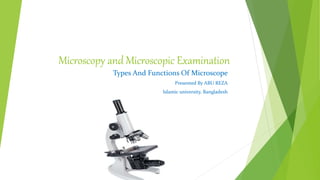
Microscopy and Microscopic Examination
Types And Functions Of Microscope
Presented By ABU REZA
Islamic university, Bangladesh
Definition of Microscope:
 The word microscope is derived from the Latin word “micro” means “small”
and the Greek word “skope” means “to look at”.
 A microscope is an instrument used to see objects that are too small to be
seen by the naked eye.
 It can magnify objects in a range from x100 to x400,000.
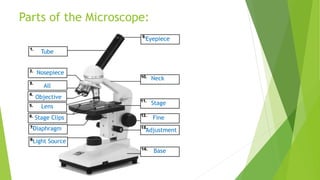
Parts of the Microscope:
Eyepiece
Neck
Stage
Adjustment
Light Source
Diaphragm
Stage Clips
Objective
Lens
Tube
Base
Fine
All
Nosepiece
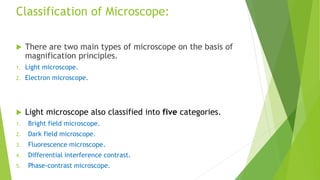
Classification of Microscope:
 There are two main types of microscope on the basis of
magnification principles.
1. Light microscope.
2. Electron microscope.
 Light microscope also classified into five categories.
1. Bright field microscope.
2. Dark field microscope.
3. Fluorescence microscope.
4. Differential interference contrast.
5. Phase-contrast microscope.
Classification of Microscope:
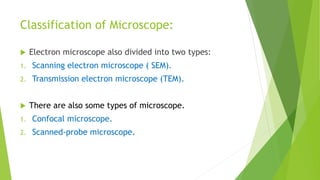
 Electron microscope also divided into two types:
1. Scanning electron microscope ( SEM).
2. Transmission electron microscope (TEM).
 There are also some types of microscope.
1. Confocal microscope.
2. Scanned-probe microscope.
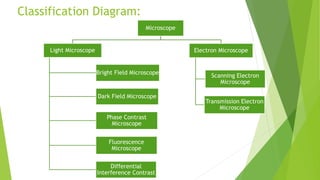
Classification Diagram:
Microscope
Light Microscope
Bright Field Microscope
Dark Field Microscope
Phase Contrast
Microscope
Fluorescence
Microscope
Differential
Interference Contrast
Electron Microscope
Scanning Electron
Microscope
Transmission Electron
Microscope
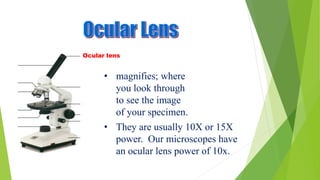
Ocular lens
• magnifies; where
you look through
to see the image
of your specimen.
• They are usually 10X or 15X
power. Our microscopes have
an ocular lens power of 10x.
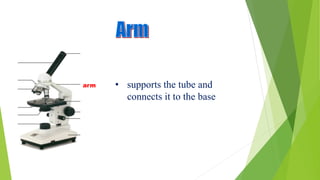
arm • supports the tube and
connects it to the base
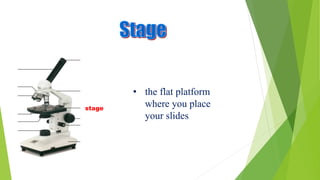
stage
• the flat platform
where you place
your slides
base
• the bottom of
the microscope,
used for support
body tube
• connects the
eyepiece to
the objective
lenses
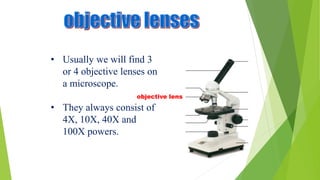
objective lens
• Usually we will find 3
or 4 objective lenses on
a microscope.
• They always consist of
4X, 10X, 40X and
100X powers.
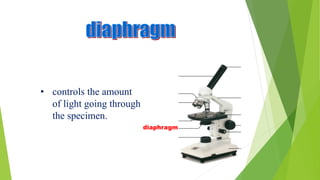
diaphragm
• controls the amount
of light going through
the specimen.
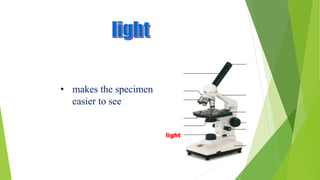
light
• makes the specimen
easier to see
Types and functions of Microscope

Types and functions of Microscope

  • 1.
    Microscopy and MicroscopicExamination Types And Functions Of Microscope Presented By ABU REZA Islamic university, Bangladesh
  • 2.
    Definition of Microscope: The word microscope is derived from the Latin word “micro” means “small” and the Greek word “skope” means “to look at”.  A microscope is an instrument used to see objects that are too small to be seen by the naked eye.  It can magnify objects in a range from x100 to x400,000.
  • 3.
    Parts of theMicroscope: Eyepiece Neck Stage Adjustment Light Source Diaphragm Stage Clips Objective Lens Tube Base Fine All Nosepiece
  • 4.
    Classification of Microscope: There are two main types of microscope on the basis of magnification principles. 1. Light microscope. 2. Electron microscope.  Light microscope also classified into five categories. 1. Bright field microscope. 2. Dark field microscope. 3. Fluorescence microscope. 4. Differential interference contrast. 5. Phase-contrast microscope.
  • 5.
    Classification of Microscope: Electron microscope also divided into two types: 1. Scanning electron microscope ( SEM). 2. Transmission electron microscope (TEM).  There are also some types of microscope. 1. Confocal microscope. 2. Scanned-probe microscope.
  • 6.
    Classification Diagram: Microscope Light Microscope BrightField Microscope Dark Field Microscope Phase Contrast Microscope Fluorescence Microscope Differential Interference Contrast Electron Microscope Scanning Electron Microscope Transmission Electron Microscope
  • 7.
    Ocular lens • magnifies;where you look through to see the image of your specimen. • They are usually 10X or 15X power. Our microscopes have an ocular lens power of 10x.
  • 8.
    arm • supportsthe tube and connects it to the base
  • 9.
    stage • the flatplatform where you place your slides
  • 10.
    base • the bottomof the microscope, used for support
  • 11.
    body tube • connectsthe eyepiece to the objective lenses
  • 12.
    objective lens • Usuallywe will find 3 or 4 objective lenses on a microscope. • They always consist of 4X, 10X, 40X and 100X powers.
  • 13.
    diaphragm • controls theamount of light going through the specimen.
  • 14.
    light • makes thespecimen easier to see