TYPES OF MICROSCOPY
TYPES OF MICROSCOPES
• Depending upon the illumination,
magnification power involved –
microscopes are of two categories.
• They are
1. Light or Optical Microscopes
2. Electron Microscopes
LIGHT MICROSCOPES
• Light microscope uses optical lenses and visible light for
magnification.
• There are two types of light microscopes namely,
1. Simple Microscope:
It consists of only one biconvex lens
2. Compound Microscope
It consists of at least two lens system, i.e. objective and
ocular or eyepiece.
Most commonly used compound microscopes are
Bright field microscope
Dark field microscope
Phase contrast microscope

SIMPLE MICROSCOPE
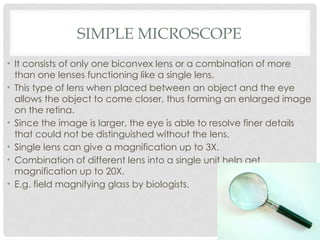
• It consists of only one biconvex lens or a combination of more
than one lenses functioning like a single lens.
• This type of lens when placed between an object and the eye
allows the object to come closer, thus forming an enlarged image
on the retina.
• Since the image is larger, the eye is able to resolve finer details
that could not be distinguished without the lens.
• Single lens can give a magnification up to 3X.
• Combination of different lens into a single unit help get
magnification up to 20X.
• E.g. field magnifying glass by biologists.
COMPOUND MICROSCOPE
• The microscopes in which multiple lenses are used
are called compound light microscopes.
• There are two types of compound microscopes
which differ only for source of light.
a) Simple compound microscope: in these
microscopes the source of light is ordinary sunlight.
A mirror is fixed at the base of the stage of
microscope. This mirror reflects the light on the side
under observation.
b) Compound light microscope: In these
microscopes, the source of illumination is electric
light.
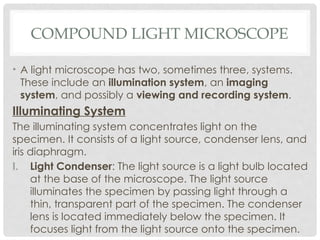
COMPOUND LIGHT MICROSCOPE
• A light microscope has two, sometimes three, systems.
These include an illumination system, an imaging
system, and possibly a viewing and recording system.
Illuminating System
The illuminating system concentrates light on the
specimen. It consists of a light source, condenser lens, and
iris diaphragm.
I. Light Condenser: The light source is a light bulb located
at the base of the microscope. The light source
illuminates the specimen by passing light through a
thin, transparent part of the specimen. The condenser
lens is located immediately below the specimen. It
focuses light from the light source onto the specimen.
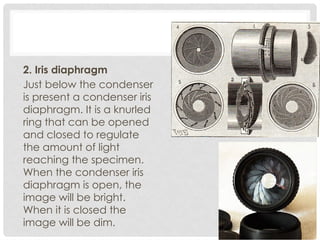
2. Iris diaphragm
Just below the condenser
is present a condenser iris
diaphragm. It is a knurled
ring that can be opened
and closed to regulate
the amount of light
reaching the specimen.
When the condenser iris
diaphragm is open, the
image will be bright.
When it is closed the
image will be dim.
IMAGING SYSTEM
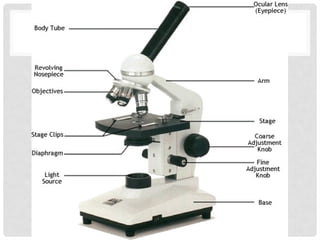
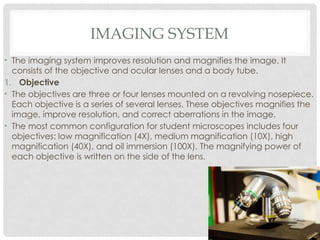
• The imaging system improves resolution and magnifies the image. It
consists of the objective and ocular lenses and a body tube.
1. Objective
• The objectives are three or four lenses mounted on a revolving nosepiece.
Each objective is a series of several lenses. These objectives magnifies the
image, improve resolution, and correct aberrations in the image.
• The most common configuration for student microscopes includes four
objectives: low magnification (4X), medium magnification (10X), high
magnification (40X), and oil immersion (100X). The magnifying power of
each objective is written on the side of the lens.
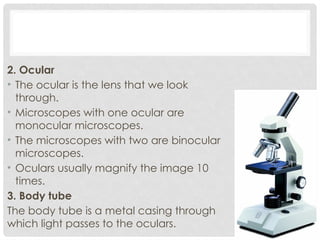
2. Ocular
• The ocular is the lens that we look
through.
• Microscopes with one ocular are
monocular microscopes.
• The microscopes with two are binocular
microscopes.
• Oculars usually magnify the image 10
times.
3. Body tube
The body tube is a metal casing through
which light passes to the oculars.
VIEWING AND RECORDING SYSTEM
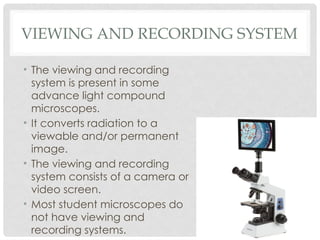
• The viewing and recording
system is present in some
advance light compound
microscopes.
• It converts radiation to a
viewable and/or permanent
image.
• The viewing and recording
system consists of a camera or
video screen.
• Most student microscopes do
not have viewing and
recording systems.
DRAWBACKS OF THE COMPOUND
MICROSCOPE
• The magnifying power of a compound light
microscope is limited to 2000 times.
• Certain specimens, such as viruses, atoms, and
molecules can't be viewed with it.
• The resolution of an object under a compound light
microscope is not always accurate. Just because it
makes the object appear bigger doesn’t mean it
will be a clear image.
• The lenses of these microscopes may get dirty and
blurry over time if not cleaned and maintained
properly.

Types of Microscopy (Light Microscope, Simple Microscope, Compound Light Microscope.pptx

  • 1.
  • 2.
    TYPES OF MICROSCOPES •Depending upon the illumination, magnification power involved – microscopes are of two categories. • They are 1. Light or Optical Microscopes 2. Electron Microscopes
  • 3.
    LIGHT MICROSCOPES • Lightmicroscope uses optical lenses and visible light for magnification. • There are two types of light microscopes namely, 1. Simple Microscope: It consists of only one biconvex lens 2. Compound Microscope It consists of at least two lens system, i.e. objective and ocular or eyepiece. Most commonly used compound microscopes are Bright field microscope Dark field microscope Phase contrast microscope 
  • 4.
    SIMPLE MICROSCOPE • Itconsists of only one biconvex lens or a combination of more than one lenses functioning like a single lens. • This type of lens when placed between an object and the eye allows the object to come closer, thus forming an enlarged image on the retina. • Since the image is larger, the eye is able to resolve finer details that could not be distinguished without the lens. • Single lens can give a magnification up to 3X. • Combination of different lens into a single unit help get magnification up to 20X. • E.g. field magnifying glass by biologists.
  • 5.
    COMPOUND MICROSCOPE • Themicroscopes in which multiple lenses are used are called compound light microscopes. • There are two types of compound microscopes which differ only for source of light. a) Simple compound microscope: in these microscopes the source of light is ordinary sunlight. A mirror is fixed at the base of the stage of microscope. This mirror reflects the light on the side under observation. b) Compound light microscope: In these microscopes, the source of illumination is electric light.
  • 6.
    COMPOUND LIGHT MICROSCOPE •A light microscope has two, sometimes three, systems. These include an illumination system, an imaging system, and possibly a viewing and recording system. Illuminating System The illuminating system concentrates light on the specimen. It consists of a light source, condenser lens, and iris diaphragm. I. Light Condenser: The light source is a light bulb located at the base of the microscope. The light source illuminates the specimen by passing light through a thin, transparent part of the specimen. The condenser lens is located immediately below the specimen. It focuses light from the light source onto the specimen.
  • 8.
    2. Iris diaphragm Justbelow the condenser is present a condenser iris diaphragm. It is a knurled ring that can be opened and closed to regulate the amount of light reaching the specimen. When the condenser iris diaphragm is open, the image will be bright. When it is closed the image will be dim.
  • 9.
    IMAGING SYSTEM • Theimaging system improves resolution and magnifies the image. It consists of the objective and ocular lenses and a body tube. 1. Objective • The objectives are three or four lenses mounted on a revolving nosepiece. Each objective is a series of several lenses. These objectives magnifies the image, improve resolution, and correct aberrations in the image. • The most common configuration for student microscopes includes four objectives: low magnification (4X), medium magnification (10X), high magnification (40X), and oil immersion (100X). The magnifying power of each objective is written on the side of the lens.
  • 10.
    2. Ocular • Theocular is the lens that we look through. • Microscopes with one ocular are monocular microscopes. • The microscopes with two are binocular microscopes. • Oculars usually magnify the image 10 times. 3. Body tube The body tube is a metal casing through which light passes to the oculars.
  • 11.
    VIEWING AND RECORDINGSYSTEM • The viewing and recording system is present in some advance light compound microscopes. • It converts radiation to a viewable and/or permanent image. • The viewing and recording system consists of a camera or video screen. • Most student microscopes do not have viewing and recording systems.
  • 12.
    DRAWBACKS OF THECOMPOUND MICROSCOPE • The magnifying power of a compound light microscope is limited to 2000 times. • Certain specimens, such as viruses, atoms, and molecules can't be viewed with it. • The resolution of an object under a compound light microscope is not always accurate. Just because it makes the object appear bigger doesn’t mean it will be a clear image. • The lenses of these microscopes may get dirty and blurry over time if not cleaned and maintained properly.