Complications of 
Total Knee Replacement 
Vaishnavi Suresh Nair
KNEE-ANATOMY 
The knee is one of the largest and most complex joints in 
the body. The knee joins the thigh bone (femur) to the shin 
bone (tibia). The smaller bone that runs alongside the tibia 
(fibula) and the kneecap (patella) are the other bones that 
make the knee joint. 
Tendons connect the knee bones to the leg muscles that 
move the knee joint. Ligaments join the knee bones and 
provide stability to the knee: 
•The anterior cruciate ligament prevents the femur from 
sliding backward on the tibia (or the tibia sliding forward 
on the femur). 
•The posterior cruciate ligament prevents the femur 
from sliding forward on the tibia (or the tibia from sliding 
backward on the femur). 
•The medial and lateral collateral ligaments prevent the 
femur from sliding side to side. 
Two C-shaped pieces of cartilage called the medial and 
lateral menisci act as shock absorbers between the 
femur and tibia. 
Numerous bursae, or fluid-filled sacs, help the knee move 
smoothly.
Nerves, Blood Vessels, and Lymphatics of the Knee and Leg 
BLOOD SUPPLY & DRAINAGE: 
•Popliteal artery 
•Genicular arteries 
•Anterior tibial artery 
•Posterior tibial artery 
•Fibular artery 
•Lateral superior genicular vein 
•Lateral inferior genicular vein 
•Great saphenous vein 
•Small saphenous vein 
The lymph nodes 
The popliteal fossa also contains a few lymph nodes. 
INNERVATION: 
•Tibial nerve 
•Common fibular (peroneal) 
nerve 
•Medial sural cutaneous nerve 
•Lateral sural cutaneous nerve 
Popliteal lymph nodes receive lymph from superficial and deep lymphatic vessels and the joint 
capsule. 
Superficial lymphatic vessels from the lateral side of the foot and leg accompany the small 
saphenous vein to the popliteal nodes. 
The deep lymphatic vessels follow along sides of the deep veins of the leg to the popliteal nodes. The 
lymph from these nodes flows in the deep lymphatic vessels of the thigh to the deep inguinal nodes.
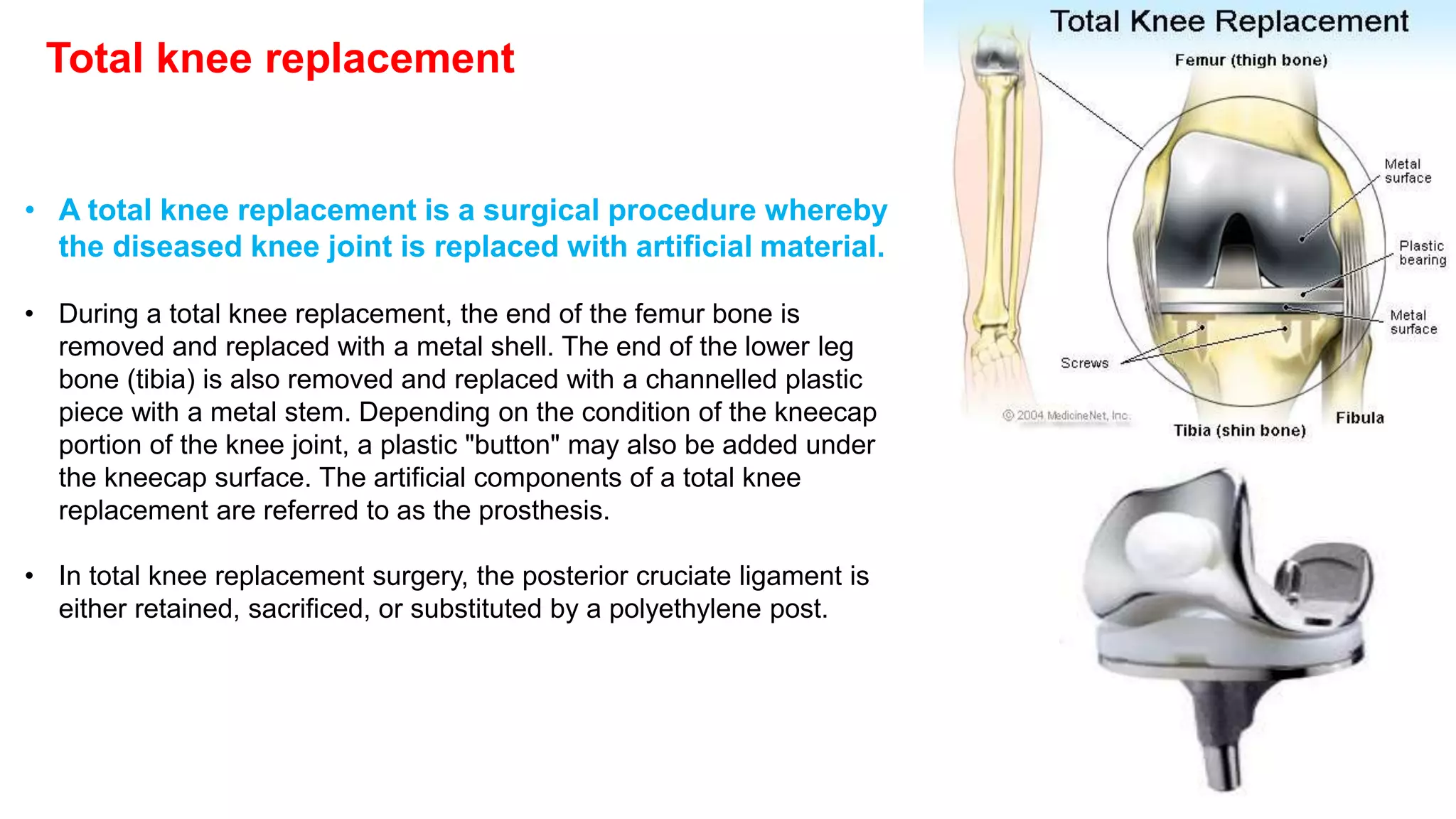
Total knee replacement 
• A total knee replacement is a surgical procedure whereby 
the diseased knee joint is replaced with artificial material. 
• During a total knee replacement, the end of the femur bone is 
removed and replaced with a metal shell. The end of the lower leg 
bone (tibia) is also removed and replaced with a channelled plastic 
piece with a metal stem. Depending on the condition of the kneecap 
portion of the knee joint, a plastic "button" may also be added under 
the kneecap surface. The artificial components of a total knee 
replacement are referred to as the prosthesis. 
• In total knee replacement surgery, the posterior cruciate ligament is 
either retained, sacrificed, or substituted by a polyethylene post.
Conditions that can be treated with knee replacement 
•Knee replacement can be used to replace a knee joint affected by a range of 
conditions including 
Severe arthritis such as (osteoarthritis, rheumatic arthritis, traumatic arthritis 
•Ligament damage or infection that leads to severe osteoarthritis 
•Rheumatoid arthritis 
•Haemophilia 
•Crystal deposition diseases such as gout and ‘pseudo gout’ 
•Avascular necrosis – death of bone following loss of blood supply 
•Bone dysplasia – disorders of the growth of bone.
Indications for Knee Replacement Surgery 
•Total knee replacement may be recommended when other treatment options (e.g., weight loss, pain relievers) no 
longer reduce knee pain and disability effectively. Symptoms of knee damage that may require knee replacement 
surgery include the following: 
•Knee pain that hinders walking, climbing stairs, or getting in and out of a chair 
•Knee pain that interferes with sleep or does not subside with rest 
•Inability to cope with side effects of pain relief medication 
•Knee swelling that does not respond to treatment and that limits bending or straightening the knee 
•Significant bowing in or out of the knee 
Benefits of Knee Replacement Surgery 
• Reduction of joint pain. 
• Increased mobility. 
• Correction of deformities. 
• Increased stability.
Knee Replacement Surgery 
Total knee replacement surgery generally takes about 2 hours to perform. The procedure involves removing 
damaged bone, tissue, and knee cartilage and fitting these three replacement pieces: 
•Femoral component (metal piece that attaches to the thighbone) 
•Tibial component (plastic and metal piece that attaches to the shinbone or tibia) 
•Patellar component (plastic piece that replaces the kneecap or patella) 
Types of Knee Replacement Surgery 
There are several different kinds of total knee replacement surgery. In most cases, the orthopedic surgeon 
determines which type of surgery is best for each individual patient. 
Minimally invasive surgery 
is a type of knee replacement performed using smaller incisions with less disruption of surrounding tissue. This 
procedure is not used if there is considerable misalignment of the thigh and lower leg. 
Bilateral total knee replacement 
involves replacing both knees at the same time. Candidates for this type of surgery must be in good overall health. 
A one-week stay at an extended care facility is often necessary for recovery from bilateral total knee replacement.
Computer-assisted total knee replacement surgery 
It involves using computer technology to help better align the replacement joint. Better alignment may increase the 
longevity of the prosthesis. 
Anaesthesia 
Two types of anesthesia may be used in knee replacement surgery. In some cases, general anesthesia is used 
and in other cases, spinal or epidural anesthesia is used. 
General anesthesia involves putting the patient to sleep so that he or she is unconscious during the surgery. 
When spinal anesthesia is used, the patient is awake, but is numb from the waist down. The anesthesiologist and 
surgeon determine which type of anesthesia to use after consulting with the patient and reviewing his or her 
medical history.
COMPLICATIONS OF KNEE REPLACEMENT SURGERY: 
Complications of total knee replacement (TKR) can be mainly divided into the following 3 
categories: 
•Complications specific to the operative procedure 
•General perioperative complications (including complications of anaesthesia) 
•Other medical complications (postoperative complications)
Complications From Anesthesia 
Possible complications from anaesthesia include heart 
attack, stroke, pneumonia, and blood clots. 
(It's important for the anaesthesiologist to be aware of the 
patient’s medical history, especially past or current heart 
and/or lung issues, before surgery.) 
After knee replacement surgery, anticoagulants may be 
used for a period of time to reduce the risk for blood clots. 
SYMPTOMS INCLUDE: 
•dizziness 
•shivering 
•sore throat 
•aches and pains 
•discomfort 
•drowsiness
Complications specific to knee replacement surgery 
•injury to nerves or blood vessels in the leg 
•loosening or dislocation of the prosthesis 
•difference in leg length following the surgery 
•stiffness in the joint 
•pain that persists or worsens after surgery 
•allergic reaction to the cement used to affix the prosthesis 
Complications can interfere with full recovery of the replaced joint.
Blood Clots 
Knee replacements are likely to cause blood clots (DVT). Typically, blood clots occur within two 
weeks of surgery but they can take place within a few hours or even in the operating room. 
Clots contained within the legs represent a relatively minor risk. However, a clot that dislodges and 
travels through the body to the heart or lungs can cause serious health concerns and, in rare 
instances, death. 
To reduce the risk of clots after surgery, take blood-thinning medications such as warfarin 
(Coumadin), heparin, or enoxaparin (Lovenox). Common preventative measures include support 
stockings, lower leg exercises, calf pumps, or elevating your legs. All of these techniques help to 
increase circulation and prevent the formation of clots.
Infection 
Patients with rheumatoid arthritis , diabetes , weakened immune system have a greater risk of 
infection in the weeks following a procedure. ,an infection in another part of the body at the time of your 
knee operation—in the mouth, kidneys, or prostate could lead to an infection in the knee, even months 
or years later. 
In rare cases, infection can occur at the site of the incision or within the prosthesis. Risk for 
infection in the prosthetic joint persists for the rest of the patient's life. To reduce this risk, some 
patients who have undergone knee replacement surgery take preventive (prophylactic) antibiotics 
before future surgical or dental procedures.
Complications from a Transfusion 
Not everyone needs a blood transfusion during a TKR. But, if you do, there’s a tiny risk 
• Incompatible blood transfusions 
• haemolytic transfusion reaction, to the donor blood 
Signs and symptoms of an adverse transfusion reaction usually occur within 24 hours and include 
hives, fever, chills, shortness of breath, and red urine 
Prosthesis Problems/Implant Failure 
An inherent risk with any joint replacement surgery is improper placement or a malfunction of the 
implant which can cause: 
•Infection 
•continued pain 
•knee stiffness 
•wear 
•instability 
•Loosening 
•dislocation
Prosthetic joint infections are classified into three types based on the amount of time that has elapsed 
from the surgery to the onset of infection: 
Early infections occur within 3 months of surgery and are usually caused by microorganisms that 
enter the body during the operation. People with these infections may suffer from a leaking wound, 
fever, swelling and effusion around the implant. 
Delayed infections can occur from 3 months to 12 months after the surgery and are also caused 
by organisms entering the body during the surgery. The symptoms of these infections are usually 
the same as those seen in early infections. 
Late infections occur more than a year after surgery. These infections are usually haematogenus, 
meaning they are acquired from another location in the body. Bacteria from other infections such 
as a dental infection, pneumonia, skin infection or urinary tract infection can travel in the blood and 
adhere to the prosthesis. To prevent these types of infections, doctors recommend that patients 
with prostheses take antibiotics before any surgical procedure. In late infections, joint pain and 
effusion are common symptoms. Sometimes, the joint is also inflamed, and sepsis may set in.
Artery Injuries 
Because the major arteries of the leg are positioned directly behind the knee, there’s a slight risk that damage 
could occur to these vessels. If damage does take place, a vascular surgeon can usually repair the arteries. 
Nerve or Neurovascular Damage 
Damage to the nerves is also uncommon. However, it is possible for the nerve or blood vessel that’s associated 
with the muscles leading to the foot to experience numbness following a procedure. The problem usually 
disappears after a few months as nerves and tissue heals. 
Knee Stiffness and Loss of Motion in the Knee 
In some cases, scar tissue or other complications diminish motion within the knee. This problem can often be 
resolved with special exercises and/or physical therapy. Severe cases of stiffness, also called arthrofibrosis, may 
require a follow-up procedure in order to break-up scar tissue or adjust the prosthesis inside the knee.
Instability of Ligaments 
When ligaments are cut, damaged or improperly balanced after surgery, the knee can become unstable. Since most 
knee implants are intended to work with a patient’s existing ligaments, if they are damaged, the implant may not 
move correctly. This can cause the knee to give way, usually from side to side. This typically improves over time after 
the ligaments heal, but occasionally a knee brace may be required to prevent buckling after surgery. 
Arthrofibrosis (Joint Stiffness) 
Patients who have knee replacement surgery are susceptible to significant joint stiffness. If the person is obese, has 
diabetes or is slow to mobilize after surgery, it can worsen this condition. This usually happens when excessive scar 
tissue builds up around the joint. Doctors treat this by anesthetizing the knee and manipulating it to break down the 
scar tissue. When the scar tissue is extensive, another surgery may be required to remove it. 
Extensor Mechanism Disruption 
Extensor mechanism disruption is one of the most serious mechanical complications that can occur after knee 
replacement. This occurs when the tendon attached to the patella moves away from the tibia during or after surgery. 
When this happens, the knee cannot extend. Surgery is required to repair the tendon, and a tendon graft may be 
required. 
Patella Tracking Problems 
A healthy patella glides up and down in a groove over the femur. Sometimes the patella dislocates after surgery. This 
is most commonly associated with patellas that have been resurfaced with a plastic button, which can cause the 
patella to track differently or catch and “clunk” as it passes over the metal flange of the knee. In some cases, the 
tracking problem is severe enough to warrant revision surgery.
Allergy to Metal Components 
Occasionally, a patient suffers a reaction to the metal used in the artificial knee joint. The metal materials used in 
implants are typically made from titanium or cobalt-chromium based alloy. Most likely, you will know if you have a 
metal allergy. If that is the case, make sure to tell your surgeon about the allergy well before your surgery. If you 
are unsure, take the time to discuss the topic with your surgeon or medical team. 
Wound and Bleeding Complications 
Typically, the sutures or staples used to close the wound are removed after about two weeks. In some cases, 
however, wounds may be slow to heal and bleeding complications can occur for several days following surgery. 
The hospital staff will monitor your wound during the time you are there. Blood thinners can contribute to 
problems and, in some cases, the surgeon might need to re-open the wound and drain fluid. You could also 
experience a Baker’s cyst, which is a build up of fluid behind the knee. This may require draining with a needle to 
remove the fluid. In addition, if the skin does not heal properly, you might require a skin graft at the wound site.
Osteolysis 
Osteolysis is a complication of knee replacement that occurs when particles are generated by the plastic pieces 
of the implant. These particles activate the body’s defences, including white blood cells. The white blood cells 
digest these foreign particles, but they also can digest bone. The result is bone damage and implant loosening. 
This condition is more common in implants that are made of polyethylene. While this material allows for more 
natural joint function, it is also more susceptible to wear. When severe bone loss occurs, the implant loosens 
and revision surgery is required. 
Some general complications that can arise as a result of the 
surgery include: 
• Stroke 
• DVT 
• Congestive heart failure 
• Hyperglycemia 
• Hemorrhage 
• Limping 
• scarring. 
• Cardiac arrhythmias 
• Edema 
• Wound problems 
Knee is inflamed and infected 
after total knee replacement 
surgery
Mortality 
The risk of death from knee replacement is very low, but it does occur. 
A 2010 study published in the Journal of Bone and Joint Surgery estimated the risk of mortality 
to be 0.1 percent. 
The risk is highest during the first month after surgery. 
Prognosis 
The results of a total knee replacement are often excellent. The operation relieves pain for most 
people. Most people do not need help walking after they fully recover. 
Most artificial knee joints last 10 to 15 years. Some last as long as 20 years before they loosen and 
need to be replaced again.
• For an optimal outcome after total knee replacement surgery, it is important for patients to 
continue in an outpatient physical-therapy program along with home exercises during the healing 
process. Patients will be asked to continue exercising the muscles around the replaced joint to 
prevent scarring (and contracture) and maintain muscle strength for the purposes of joint stability. 
These exercises after surgery can reduce recovery time and lead to optimal strength and 
stability. 
• Patients also should watch for warning signs of infection, including abnormal redness, increasing 
warmth, swelling, or unusual pain. 
• Patients with joint replacements should alert their doctors and dentists that they have an artificial 
joint. 
• Future activities are generally limited to those that do not risk injuring the replaced joint.
Complications of total knee replacement

Complications of total knee replacement

  • 1.
    Complications of TotalKnee Replacement Vaishnavi Suresh Nair
  • 2.
    KNEE-ANATOMY The kneeis one of the largest and most complex joints in the body. The knee joins the thigh bone (femur) to the shin bone (tibia). The smaller bone that runs alongside the tibia (fibula) and the kneecap (patella) are the other bones that make the knee joint. Tendons connect the knee bones to the leg muscles that move the knee joint. Ligaments join the knee bones and provide stability to the knee: •The anterior cruciate ligament prevents the femur from sliding backward on the tibia (or the tibia sliding forward on the femur). •The posterior cruciate ligament prevents the femur from sliding forward on the tibia (or the tibia from sliding backward on the femur). •The medial and lateral collateral ligaments prevent the femur from sliding side to side. Two C-shaped pieces of cartilage called the medial and lateral menisci act as shock absorbers between the femur and tibia. Numerous bursae, or fluid-filled sacs, help the knee move smoothly.
  • 3.
    Nerves, Blood Vessels,and Lymphatics of the Knee and Leg BLOOD SUPPLY & DRAINAGE: •Popliteal artery •Genicular arteries •Anterior tibial artery •Posterior tibial artery •Fibular artery •Lateral superior genicular vein •Lateral inferior genicular vein •Great saphenous vein •Small saphenous vein The lymph nodes The popliteal fossa also contains a few lymph nodes. INNERVATION: •Tibial nerve •Common fibular (peroneal) nerve •Medial sural cutaneous nerve •Lateral sural cutaneous nerve Popliteal lymph nodes receive lymph from superficial and deep lymphatic vessels and the joint capsule. Superficial lymphatic vessels from the lateral side of the foot and leg accompany the small saphenous vein to the popliteal nodes. The deep lymphatic vessels follow along sides of the deep veins of the leg to the popliteal nodes. The lymph from these nodes flows in the deep lymphatic vessels of the thigh to the deep inguinal nodes.
  • 4.
    Total knee replacement • A total knee replacement is a surgical procedure whereby the diseased knee joint is replaced with artificial material. • During a total knee replacement, the end of the femur bone is removed and replaced with a metal shell. The end of the lower leg bone (tibia) is also removed and replaced with a channelled plastic piece with a metal stem. Depending on the condition of the kneecap portion of the knee joint, a plastic "button" may also be added under the kneecap surface. The artificial components of a total knee replacement are referred to as the prosthesis. • In total knee replacement surgery, the posterior cruciate ligament is either retained, sacrificed, or substituted by a polyethylene post.
  • 5.
    Conditions that canbe treated with knee replacement •Knee replacement can be used to replace a knee joint affected by a range of conditions including Severe arthritis such as (osteoarthritis, rheumatic arthritis, traumatic arthritis •Ligament damage or infection that leads to severe osteoarthritis •Rheumatoid arthritis •Haemophilia •Crystal deposition diseases such as gout and ‘pseudo gout’ •Avascular necrosis – death of bone following loss of blood supply •Bone dysplasia – disorders of the growth of bone.
  • 6.
    Indications for KneeReplacement Surgery •Total knee replacement may be recommended when other treatment options (e.g., weight loss, pain relievers) no longer reduce knee pain and disability effectively. Symptoms of knee damage that may require knee replacement surgery include the following: •Knee pain that hinders walking, climbing stairs, or getting in and out of a chair •Knee pain that interferes with sleep or does not subside with rest •Inability to cope with side effects of pain relief medication •Knee swelling that does not respond to treatment and that limits bending or straightening the knee •Significant bowing in or out of the knee Benefits of Knee Replacement Surgery • Reduction of joint pain. • Increased mobility. • Correction of deformities. • Increased stability.
  • 7.
    Knee Replacement Surgery Total knee replacement surgery generally takes about 2 hours to perform. The procedure involves removing damaged bone, tissue, and knee cartilage and fitting these three replacement pieces: •Femoral component (metal piece that attaches to the thighbone) •Tibial component (plastic and metal piece that attaches to the shinbone or tibia) •Patellar component (plastic piece that replaces the kneecap or patella) Types of Knee Replacement Surgery There are several different kinds of total knee replacement surgery. In most cases, the orthopedic surgeon determines which type of surgery is best for each individual patient. Minimally invasive surgery is a type of knee replacement performed using smaller incisions with less disruption of surrounding tissue. This procedure is not used if there is considerable misalignment of the thigh and lower leg. Bilateral total knee replacement involves replacing both knees at the same time. Candidates for this type of surgery must be in good overall health. A one-week stay at an extended care facility is often necessary for recovery from bilateral total knee replacement.
  • 8.
    Computer-assisted total kneereplacement surgery It involves using computer technology to help better align the replacement joint. Better alignment may increase the longevity of the prosthesis. Anaesthesia Two types of anesthesia may be used in knee replacement surgery. In some cases, general anesthesia is used and in other cases, spinal or epidural anesthesia is used. General anesthesia involves putting the patient to sleep so that he or she is unconscious during the surgery. When spinal anesthesia is used, the patient is awake, but is numb from the waist down. The anesthesiologist and surgeon determine which type of anesthesia to use after consulting with the patient and reviewing his or her medical history.
  • 9.
    COMPLICATIONS OF KNEEREPLACEMENT SURGERY: Complications of total knee replacement (TKR) can be mainly divided into the following 3 categories: •Complications specific to the operative procedure •General perioperative complications (including complications of anaesthesia) •Other medical complications (postoperative complications)
  • 10.
    Complications From Anesthesia Possible complications from anaesthesia include heart attack, stroke, pneumonia, and blood clots. (It's important for the anaesthesiologist to be aware of the patient’s medical history, especially past or current heart and/or lung issues, before surgery.) After knee replacement surgery, anticoagulants may be used for a period of time to reduce the risk for blood clots. SYMPTOMS INCLUDE: •dizziness •shivering •sore throat •aches and pains •discomfort •drowsiness
  • 11.
    Complications specific toknee replacement surgery •injury to nerves or blood vessels in the leg •loosening or dislocation of the prosthesis •difference in leg length following the surgery •stiffness in the joint •pain that persists or worsens after surgery •allergic reaction to the cement used to affix the prosthesis Complications can interfere with full recovery of the replaced joint.
  • 12.
    Blood Clots Kneereplacements are likely to cause blood clots (DVT). Typically, blood clots occur within two weeks of surgery but they can take place within a few hours or even in the operating room. Clots contained within the legs represent a relatively minor risk. However, a clot that dislodges and travels through the body to the heart or lungs can cause serious health concerns and, in rare instances, death. To reduce the risk of clots after surgery, take blood-thinning medications such as warfarin (Coumadin), heparin, or enoxaparin (Lovenox). Common preventative measures include support stockings, lower leg exercises, calf pumps, or elevating your legs. All of these techniques help to increase circulation and prevent the formation of clots.
  • 13.
    Infection Patients withrheumatoid arthritis , diabetes , weakened immune system have a greater risk of infection in the weeks following a procedure. ,an infection in another part of the body at the time of your knee operation—in the mouth, kidneys, or prostate could lead to an infection in the knee, even months or years later. In rare cases, infection can occur at the site of the incision or within the prosthesis. Risk for infection in the prosthetic joint persists for the rest of the patient's life. To reduce this risk, some patients who have undergone knee replacement surgery take preventive (prophylactic) antibiotics before future surgical or dental procedures.
  • 14.
    Complications from aTransfusion Not everyone needs a blood transfusion during a TKR. But, if you do, there’s a tiny risk • Incompatible blood transfusions • haemolytic transfusion reaction, to the donor blood Signs and symptoms of an adverse transfusion reaction usually occur within 24 hours and include hives, fever, chills, shortness of breath, and red urine Prosthesis Problems/Implant Failure An inherent risk with any joint replacement surgery is improper placement or a malfunction of the implant which can cause: •Infection •continued pain •knee stiffness •wear •instability •Loosening •dislocation
  • 15.
    Prosthetic joint infectionsare classified into three types based on the amount of time that has elapsed from the surgery to the onset of infection: Early infections occur within 3 months of surgery and are usually caused by microorganisms that enter the body during the operation. People with these infections may suffer from a leaking wound, fever, swelling and effusion around the implant. Delayed infections can occur from 3 months to 12 months after the surgery and are also caused by organisms entering the body during the surgery. The symptoms of these infections are usually the same as those seen in early infections. Late infections occur more than a year after surgery. These infections are usually haematogenus, meaning they are acquired from another location in the body. Bacteria from other infections such as a dental infection, pneumonia, skin infection or urinary tract infection can travel in the blood and adhere to the prosthesis. To prevent these types of infections, doctors recommend that patients with prostheses take antibiotics before any surgical procedure. In late infections, joint pain and effusion are common symptoms. Sometimes, the joint is also inflamed, and sepsis may set in.
  • 16.
    Artery Injuries Becausethe major arteries of the leg are positioned directly behind the knee, there’s a slight risk that damage could occur to these vessels. If damage does take place, a vascular surgeon can usually repair the arteries. Nerve or Neurovascular Damage Damage to the nerves is also uncommon. However, it is possible for the nerve or blood vessel that’s associated with the muscles leading to the foot to experience numbness following a procedure. The problem usually disappears after a few months as nerves and tissue heals. Knee Stiffness and Loss of Motion in the Knee In some cases, scar tissue or other complications diminish motion within the knee. This problem can often be resolved with special exercises and/or physical therapy. Severe cases of stiffness, also called arthrofibrosis, may require a follow-up procedure in order to break-up scar tissue or adjust the prosthesis inside the knee.
  • 17.
    Instability of Ligaments When ligaments are cut, damaged or improperly balanced after surgery, the knee can become unstable. Since most knee implants are intended to work with a patient’s existing ligaments, if they are damaged, the implant may not move correctly. This can cause the knee to give way, usually from side to side. This typically improves over time after the ligaments heal, but occasionally a knee brace may be required to prevent buckling after surgery. Arthrofibrosis (Joint Stiffness) Patients who have knee replacement surgery are susceptible to significant joint stiffness. If the person is obese, has diabetes or is slow to mobilize after surgery, it can worsen this condition. This usually happens when excessive scar tissue builds up around the joint. Doctors treat this by anesthetizing the knee and manipulating it to break down the scar tissue. When the scar tissue is extensive, another surgery may be required to remove it. Extensor Mechanism Disruption Extensor mechanism disruption is one of the most serious mechanical complications that can occur after knee replacement. This occurs when the tendon attached to the patella moves away from the tibia during or after surgery. When this happens, the knee cannot extend. Surgery is required to repair the tendon, and a tendon graft may be required. Patella Tracking Problems A healthy patella glides up and down in a groove over the femur. Sometimes the patella dislocates after surgery. This is most commonly associated with patellas that have been resurfaced with a plastic button, which can cause the patella to track differently or catch and “clunk” as it passes over the metal flange of the knee. In some cases, the tracking problem is severe enough to warrant revision surgery.
  • 18.
    Allergy to MetalComponents Occasionally, a patient suffers a reaction to the metal used in the artificial knee joint. The metal materials used in implants are typically made from titanium or cobalt-chromium based alloy. Most likely, you will know if you have a metal allergy. If that is the case, make sure to tell your surgeon about the allergy well before your surgery. If you are unsure, take the time to discuss the topic with your surgeon or medical team. Wound and Bleeding Complications Typically, the sutures or staples used to close the wound are removed after about two weeks. In some cases, however, wounds may be slow to heal and bleeding complications can occur for several days following surgery. The hospital staff will monitor your wound during the time you are there. Blood thinners can contribute to problems and, in some cases, the surgeon might need to re-open the wound and drain fluid. You could also experience a Baker’s cyst, which is a build up of fluid behind the knee. This may require draining with a needle to remove the fluid. In addition, if the skin does not heal properly, you might require a skin graft at the wound site.
  • 19.
    Osteolysis Osteolysis isa complication of knee replacement that occurs when particles are generated by the plastic pieces of the implant. These particles activate the body’s defences, including white blood cells. The white blood cells digest these foreign particles, but they also can digest bone. The result is bone damage and implant loosening. This condition is more common in implants that are made of polyethylene. While this material allows for more natural joint function, it is also more susceptible to wear. When severe bone loss occurs, the implant loosens and revision surgery is required. Some general complications that can arise as a result of the surgery include: • Stroke • DVT • Congestive heart failure • Hyperglycemia • Hemorrhage • Limping • scarring. • Cardiac arrhythmias • Edema • Wound problems Knee is inflamed and infected after total knee replacement surgery
  • 20.
    Mortality The riskof death from knee replacement is very low, but it does occur. A 2010 study published in the Journal of Bone and Joint Surgery estimated the risk of mortality to be 0.1 percent. The risk is highest during the first month after surgery. Prognosis The results of a total knee replacement are often excellent. The operation relieves pain for most people. Most people do not need help walking after they fully recover. Most artificial knee joints last 10 to 15 years. Some last as long as 20 years before they loosen and need to be replaced again.
  • 21.
    • For anoptimal outcome after total knee replacement surgery, it is important for patients to continue in an outpatient physical-therapy program along with home exercises during the healing process. Patients will be asked to continue exercising the muscles around the replaced joint to prevent scarring (and contracture) and maintain muscle strength for the purposes of joint stability. These exercises after surgery can reduce recovery time and lead to optimal strength and stability. • Patients also should watch for warning signs of infection, including abnormal redness, increasing warmth, swelling, or unusual pain. • Patients with joint replacements should alert their doctors and dentists that they have an artificial joint. • Future activities are generally limited to those that do not risk injuring the replaced joint.