FUNCTIONAL CAST
BRACING & SPICA
DR.S.SENTHIL SAILESH
SENIOR ASSISTANT PROFESSOR
IOT MMC RGGGH
FUNCTIONAL CAST
• The concept of Functional cast bracing
was described in the early 18th century
• Sarmiento re-established the ideology
in late 60s
• It is a type of bracing where the limb is
allowed to do restricted function with
the brace in
PRINCIPLES
Continuing function while a fracture is uniting encourages
osteogenesis promotes the healing of tissues and prevents the
development of joint stiffness thus accelerating rehabilitation
PRINCIPLES
• Not merely a method of fracture reduction but an attitude
towards fracture healing.
• Requirements for fracture healing
• Stability
• Maintenance of reduction
• Blood supply
STABILITY
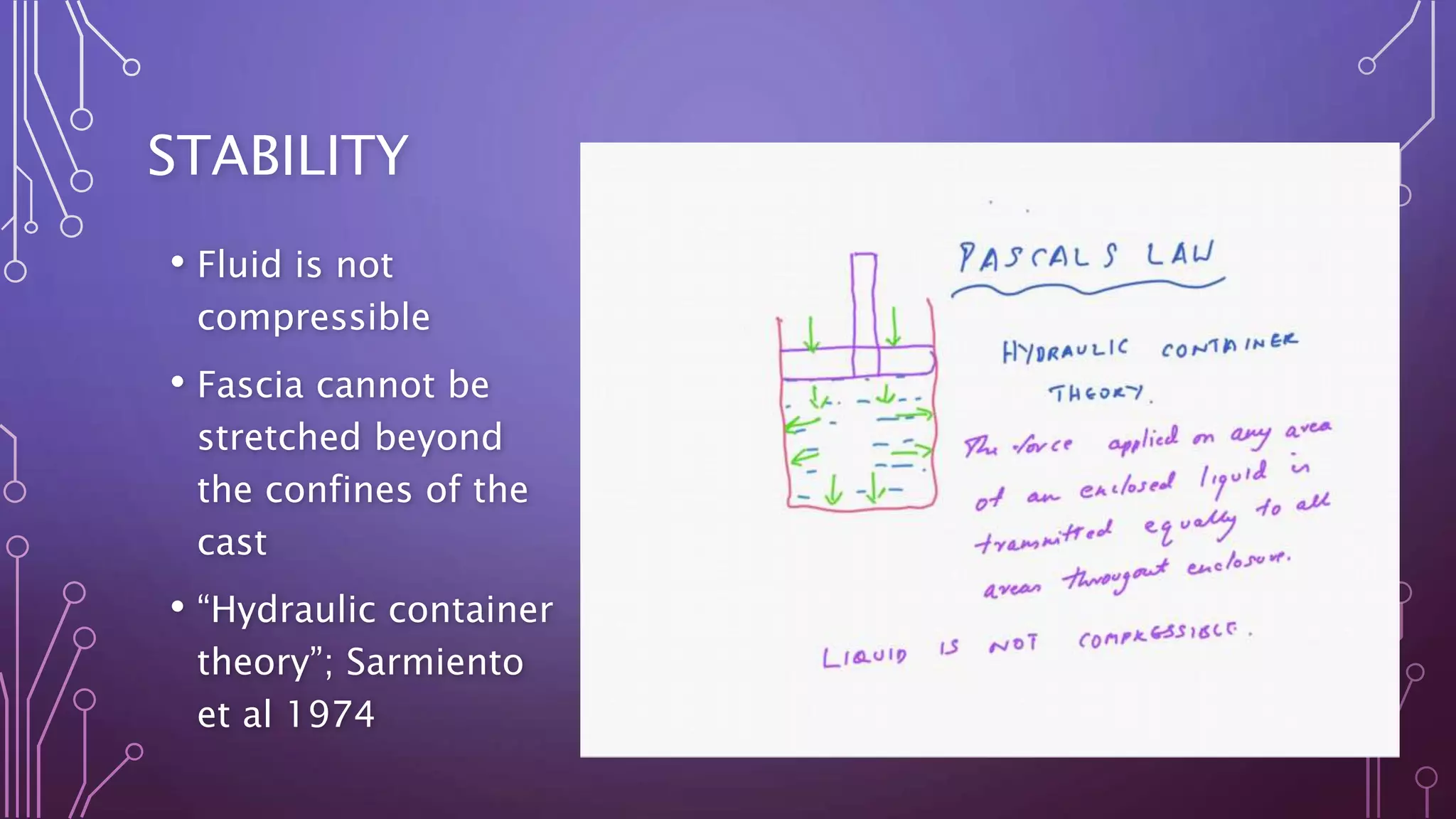
• Fluid is not
compressible
• Fascia cannot be
stretched beyond
the confines of the
cast
• “Hydraulic container
theory”; Sarmiento
et al 1974
LOADING
• Stability is maintained
by loading in a
functional cast
• Pressure & Load is
transmitted without
further deformation
• Rotation is restricted
by components of the
brace
MUSCLE CONTRACTION
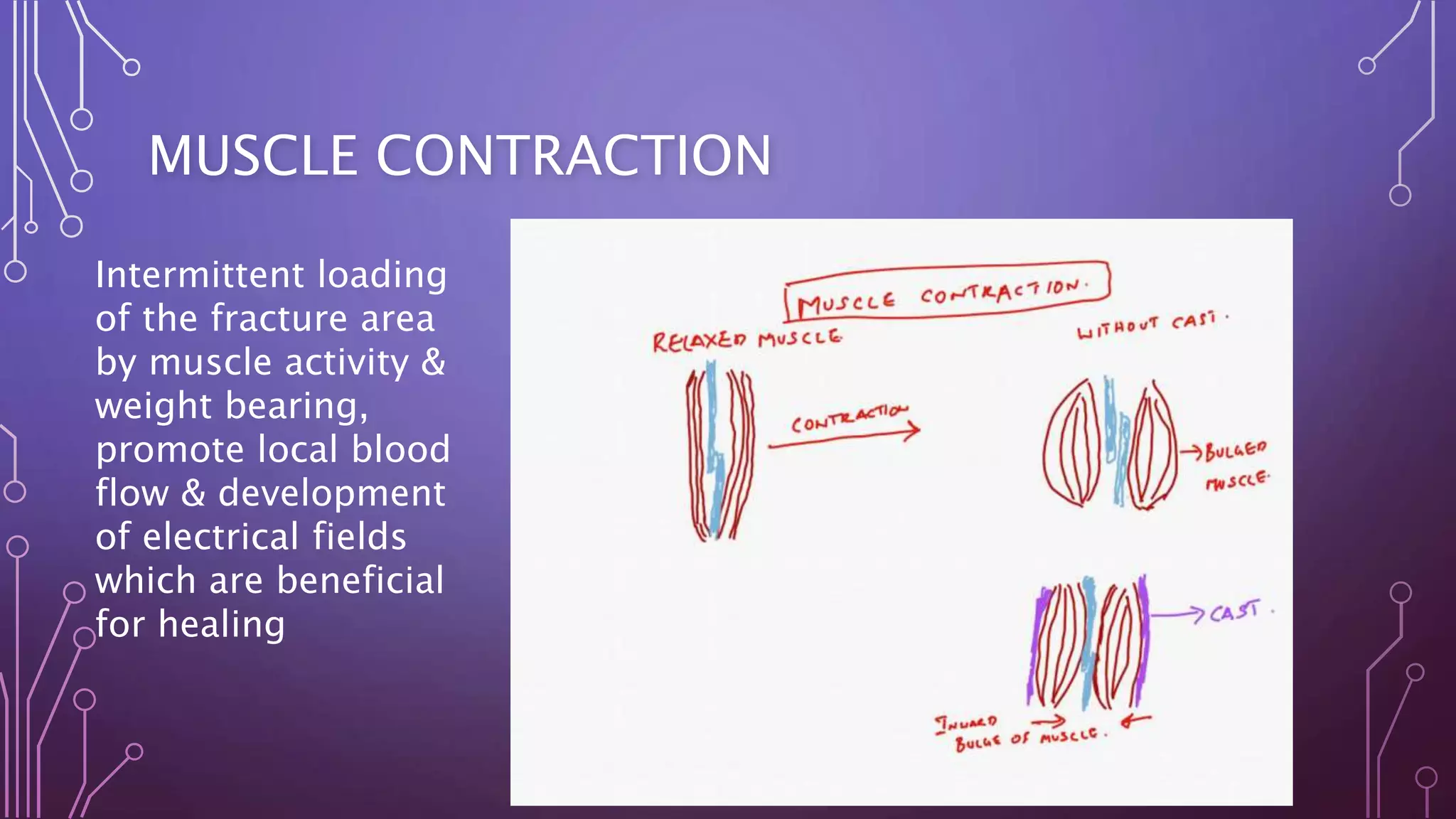
Intermittent loading
of the fracture area
by muscle activity &
weight bearing,
promote local blood
flow & development
of electrical fields
which are beneficial
for healing
Muscle
only
Muscle with
Fascia
POP
BLOOD SUPPLY
Loading
Contraction
of muscle
Micromotion
at # site
Increases
Blood supply
Bridging
callus
BRIDGING CALLUS & BLOOD SUPPLY
INDICATION
• All middle third shaft fractures and lower 3rd
junction fractures in long bones
in co-operative patients.
TIMING
• For # tibia following low energy injury,
bracing can be done with in first 2 wks.
• High energy injuries with more pain &
swelling needs an additional period of 1 or
2 more wks.
• For humerus fractures , most conditions
bracing can be done by 7-10 days time.
• Median time of brace removal
• Tibia - 18.7 wks,
• Humerus - 10 wks.
TIME TO APPLY
• Fracture ends sticky
• Assess the # , when pain and swelling subsided
1. Minor movts at # site should be pain free
2. Any deformity should disappear once D.F removed
3. Reasonable resistance to telescoping.
4. Shortening should not exceed 6.0 mm for tibia, 1.25 cm for femur
CONTRAINDICATION
• Intraarticular fractures.
• Compound fractures
• Lack of co-operation by the pt.
• Patient with spastic disorders
• Bed-ridden & mentally incompetent pts.
• Deficient sensibility of the limb [D.M with P.N]
• Fractures of both bones forearm when reduction is difficult.
NOT USED IN
• Galeazzi fractures
• Monteggia fractures
• Proximal half of shaft of femur [tends to angulate in to varus
only used by expert]
• Isolated # of tibia, fibula
• Tends to cause varus angulation and to delay in consolidation
of #.
ACCEPTABLE REDUCTION
• 50% cortical contact
• <5-10* of varus / valgus angulation
• <10-15* of anterior / posterior bowing
• <5-7* of internal / external rotation
• Not more than 10-15mm of shortening
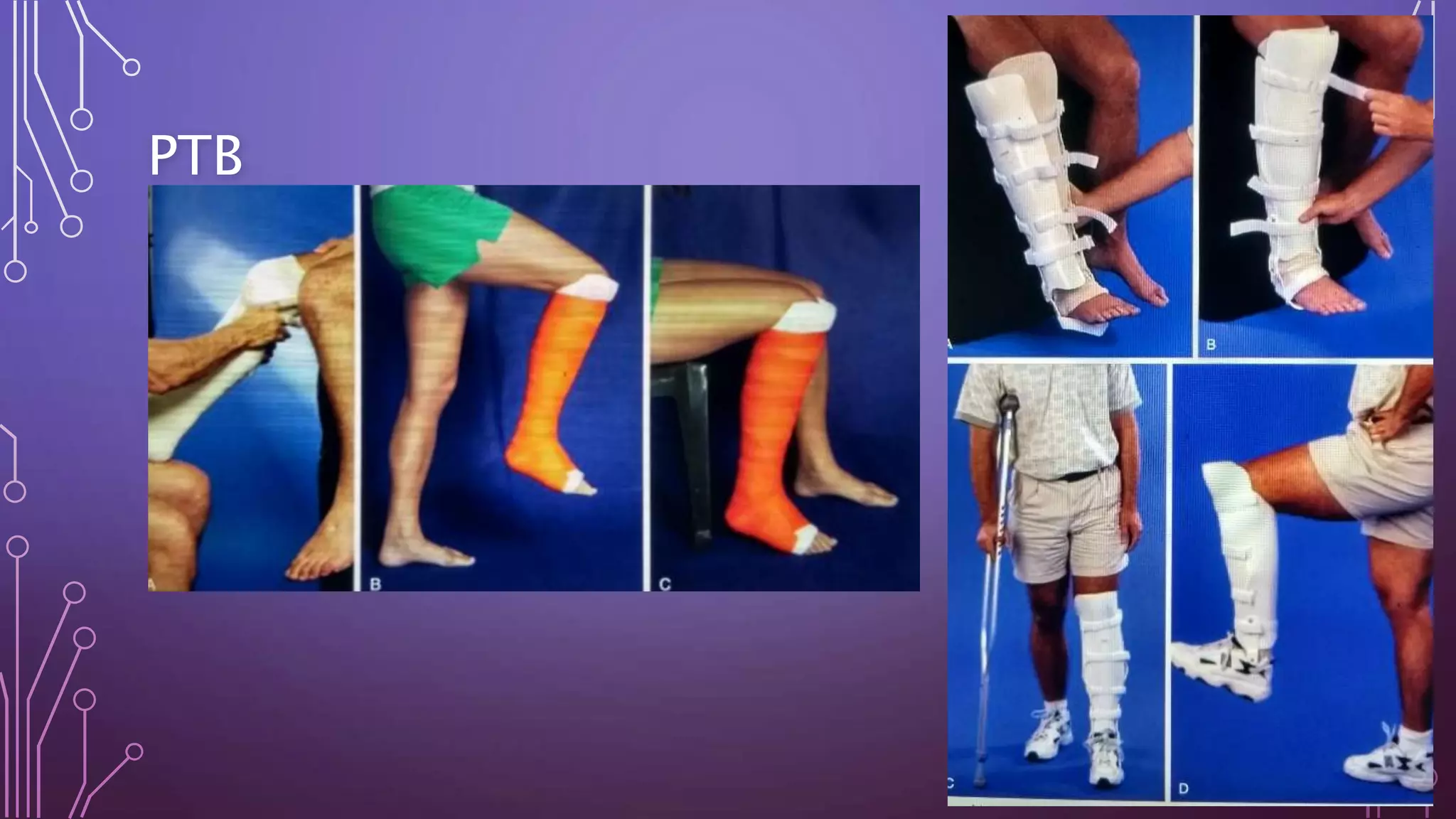
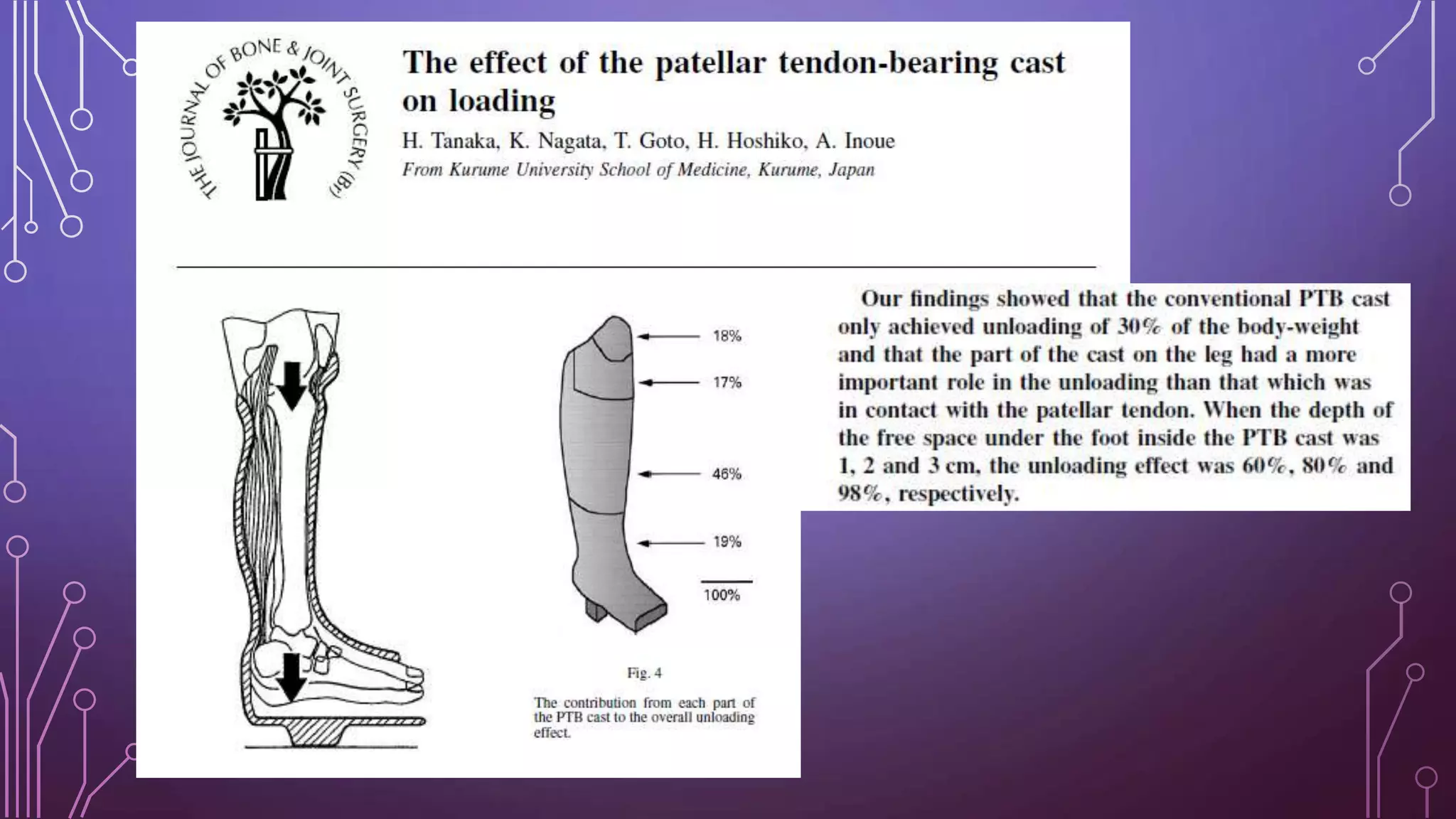
SARMIENTO CAST / PTB CAST - PRINCIPLE
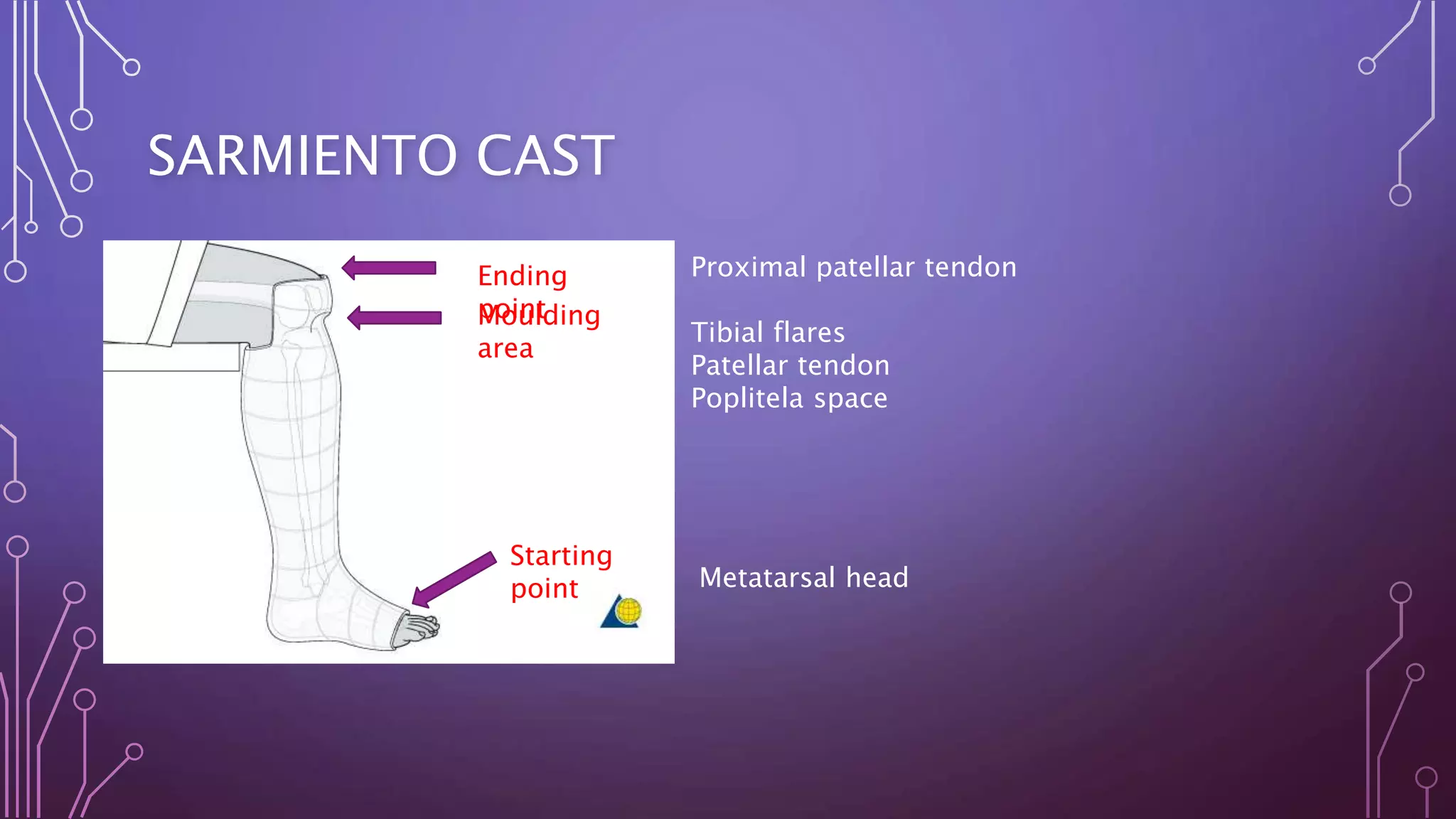
• Described by Sarmiento
• Below knee cast extending to the upper pole of
the patella and with a firm moulding over the
medial flare of the tibia, the patellar tendon and
the popliteal space and shaped in a triangular
manner at the upper end of the tibia
• Knee free to move allowed early ambulation as
weight bearing forces should be transmitted
from the ground to the proximal end of tibia
bypassing fracture site
SARMIENTO CAST
Ending
point
Starting
point
Moulding
area
Proximal patellar tendon
Tibial flares
Patellar tendon
Poplitela space
Metatarsal head
PTB
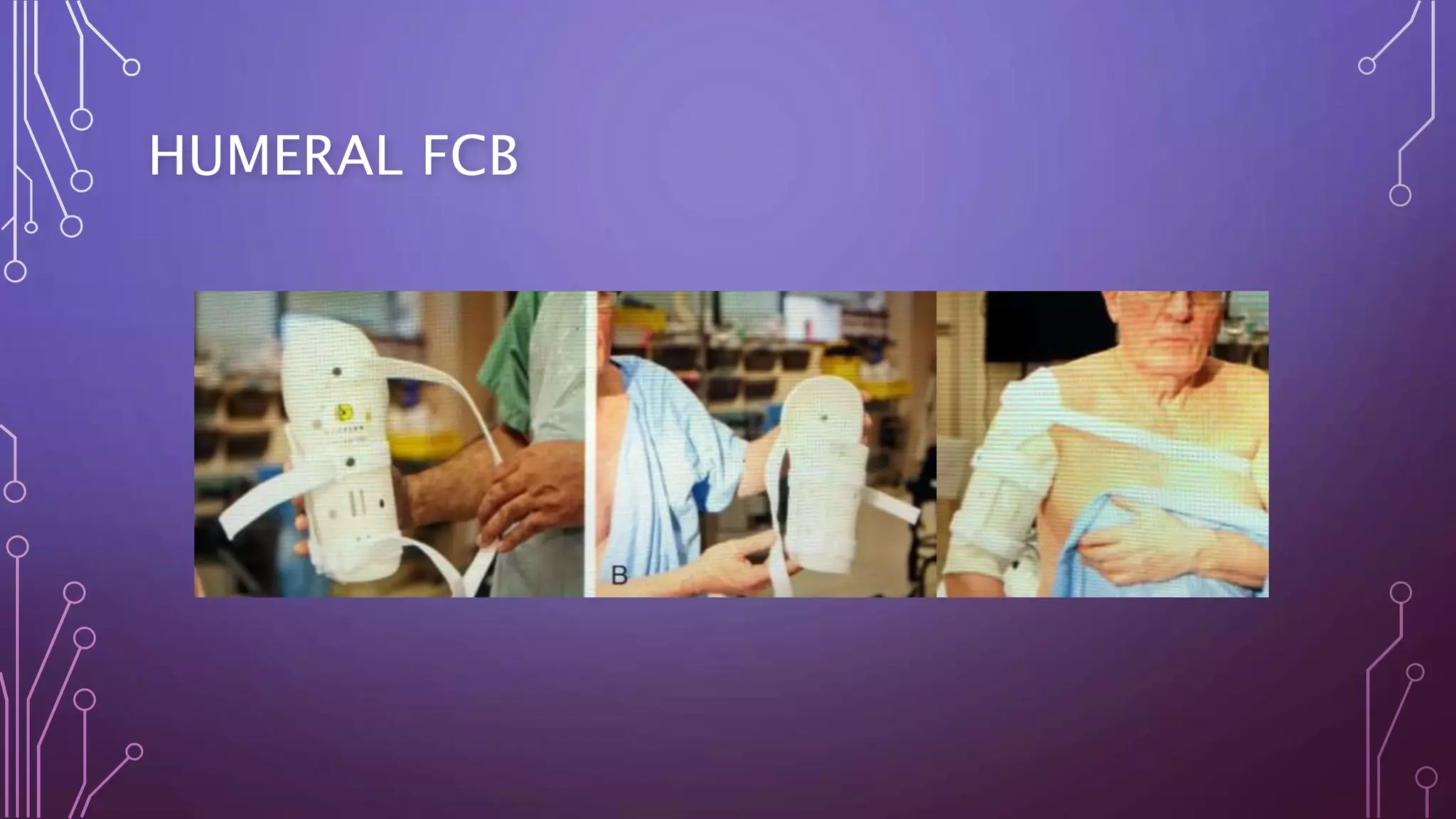
HUMERAL FCB
SPICA - DEFINITION
• A bandage folded into a spiral
arrangement resembling an ear
of wheat or barley.
• It is applied where
immobilisation is required at
areas where there is difference in
size
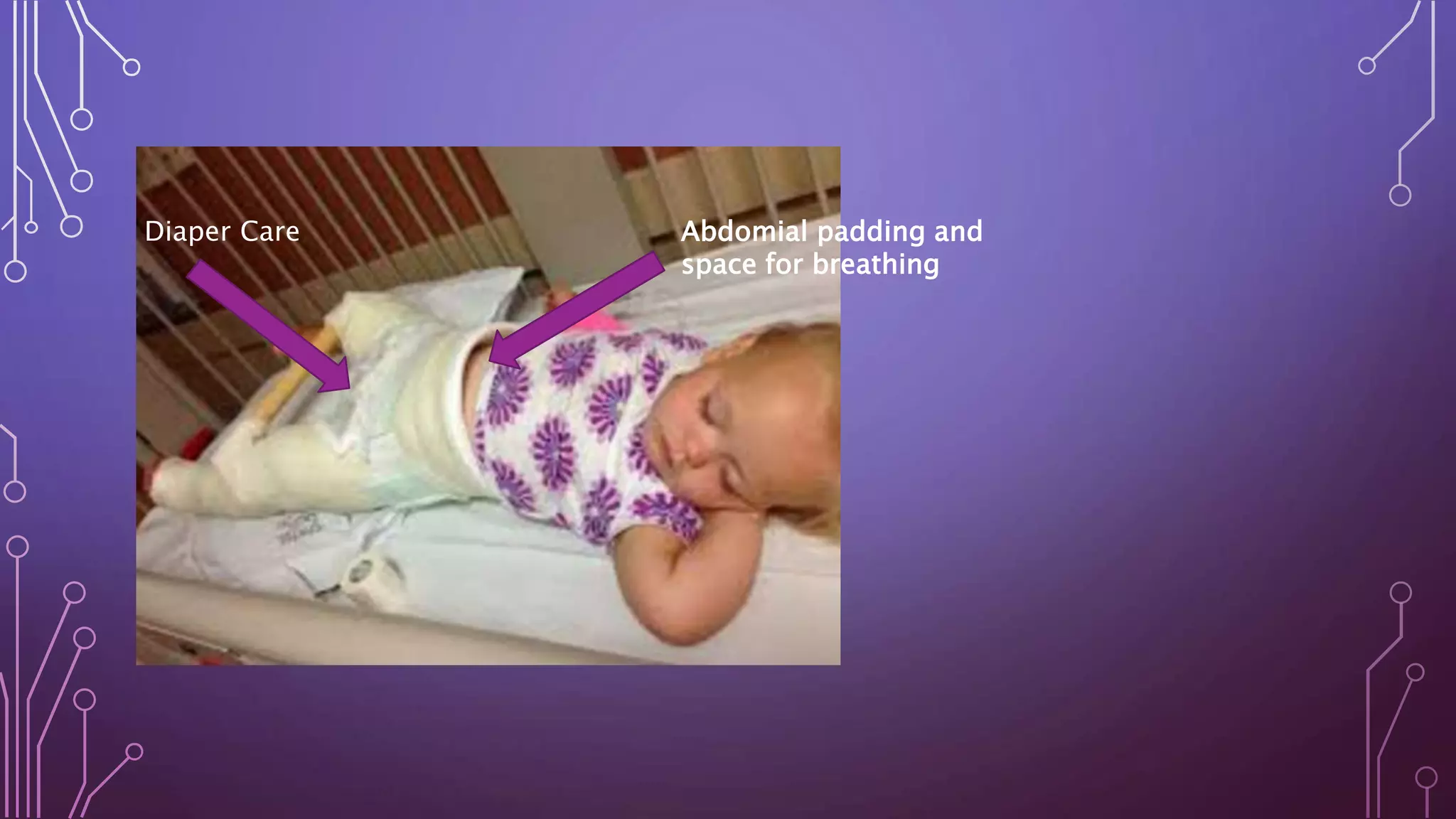
HIP SPICA
• Hip spicas are most commonly used to
• correct developmental hip dysplasia (DDH)
• children with hip, femur and pelvic fractures
• Other orthopaedic conditions which require
stabilization of the hip and leg.
Eg: Abduction Cast in Post THR dislocation
• Hips spicas are generally used for children
from 6 months to 6 years of age
Abdomial padding and
space for breathing
Diaper Care
TYPES
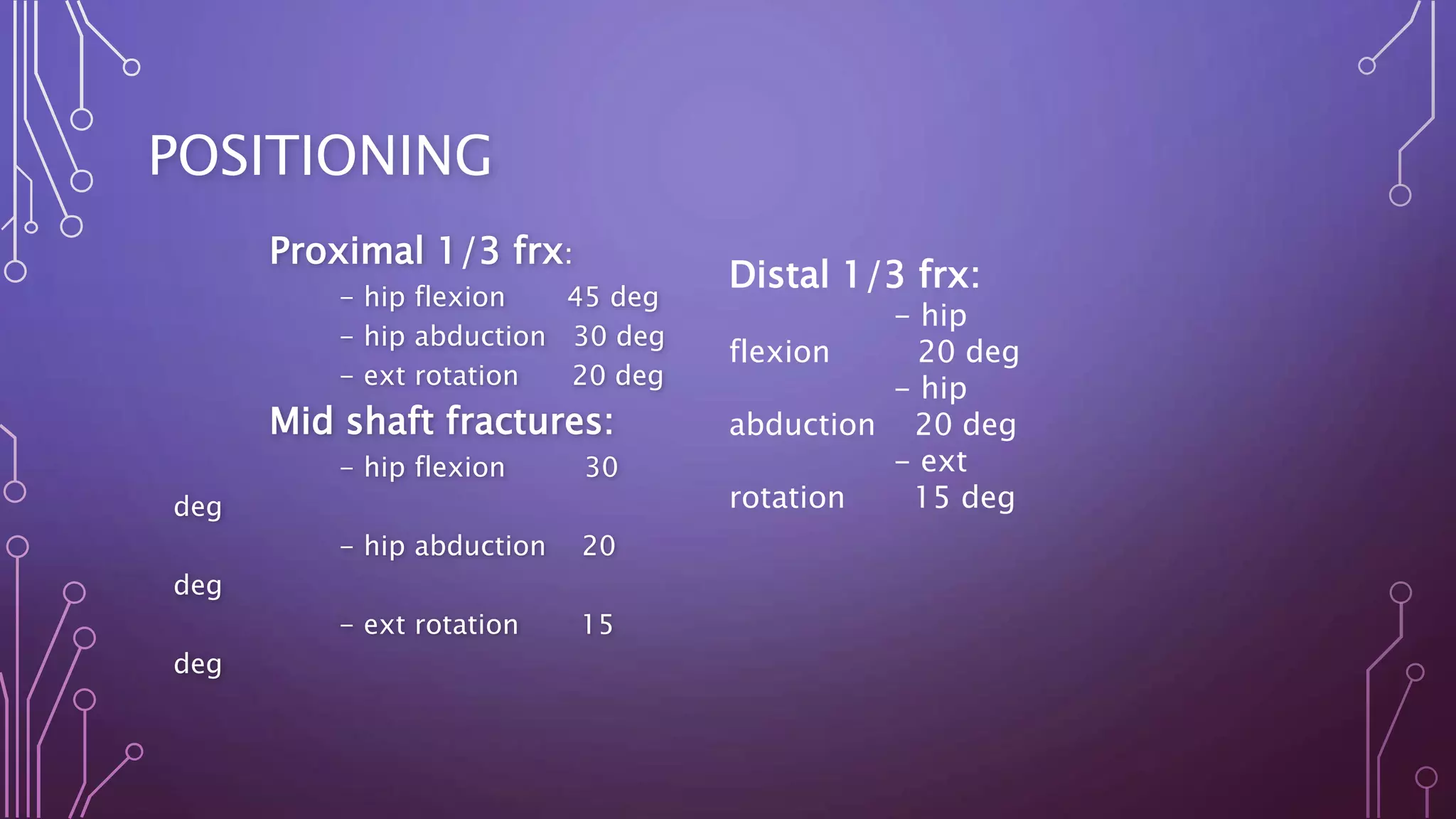
POSITIONING
Proximal 1/3 frx:
- hip flexion 45 deg
- hip abduction 30 deg
- ext rotation 20 deg
Mid shaft fractures:
- hip flexion 30
deg
- hip abduction 20
deg
- ext rotation 15
deg
Distal 1/3 frx:
- hip
flexion 20 deg
- hip
abduction 20 deg
- ext
rotation 15 deg
COMPLICATIONS
COMPARTMENT SYNDROME
•decreased with
•applying smooth contours around popliteal fossa
•limiting knee flexion to < 90°
•avoiding excessive traction
•monitored for by observing the child's neurovascular exam
and level of comfort
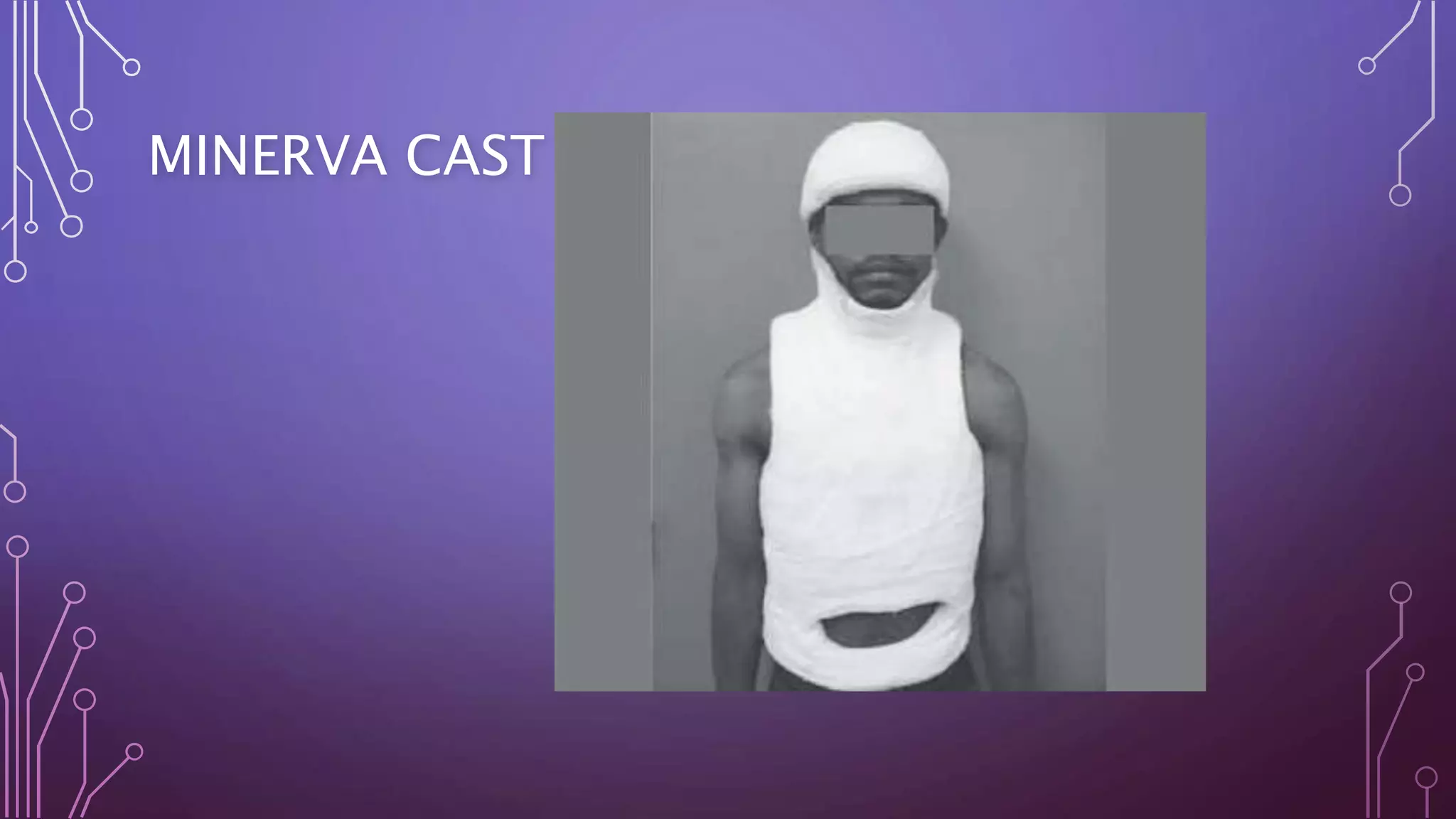
MINERVA CAST
t
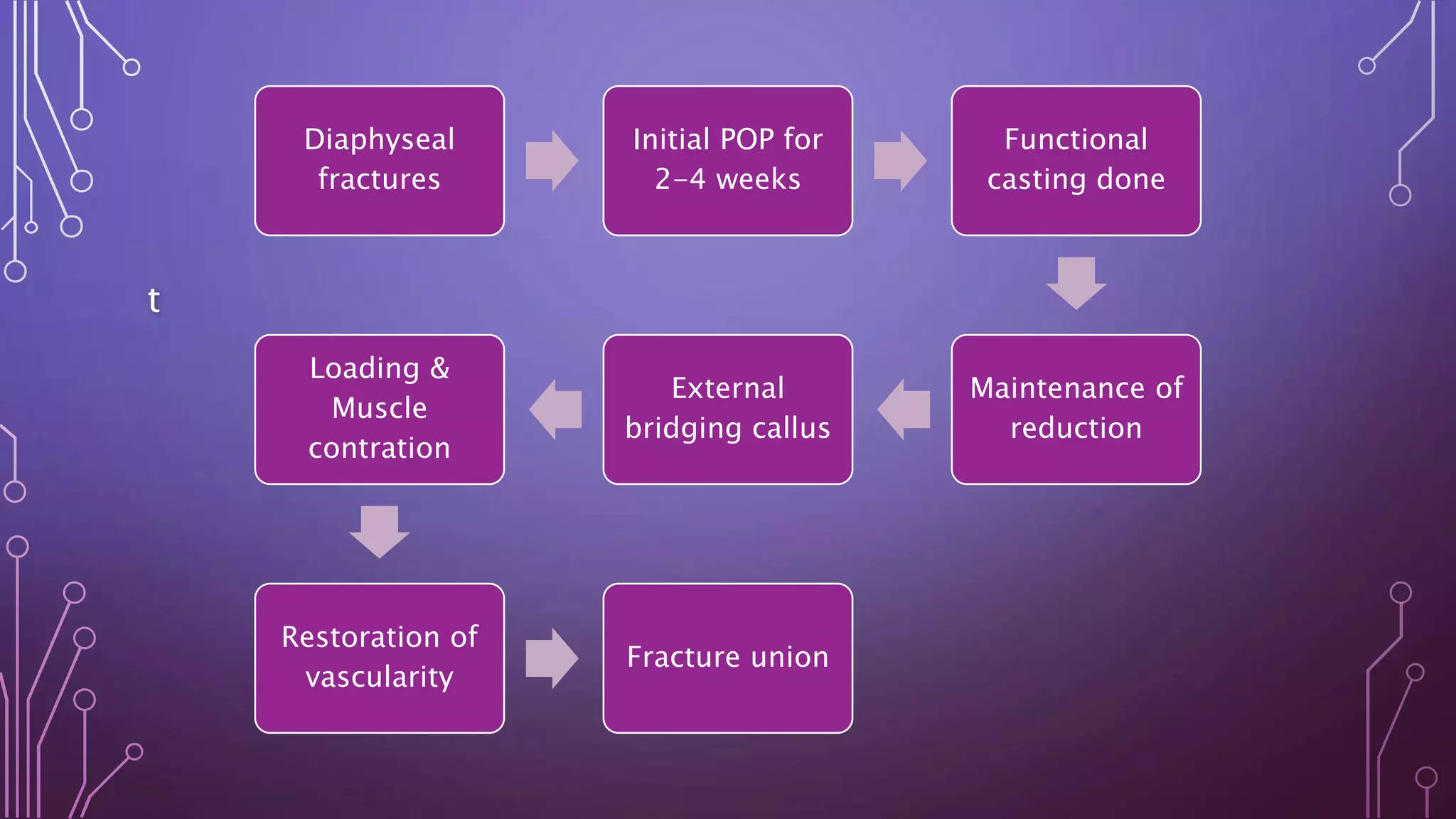
Diaphyseal
fractures
Initial POP for
2-4 weeks
Functional
casting done
Maintenance of
reduction
External
bridging callus
Loading &
Muscle
contration
Restoration of
vascularity
Fracture union
THANK YOU

Dr.S.Senthil Sailesh-functional cast bracing,PTBcast,sarmiento principle

  • 1.
    FUNCTIONAL CAST BRACING &SPICA DR.S.SENTHIL SAILESH SENIOR ASSISTANT PROFESSOR IOT MMC RGGGH
  • 2.
    FUNCTIONAL CAST • Theconcept of Functional cast bracing was described in the early 18th century • Sarmiento re-established the ideology in late 60s • It is a type of bracing where the limb is allowed to do restricted function with the brace in
  • 3.
    PRINCIPLES Continuing function whilea fracture is uniting encourages osteogenesis promotes the healing of tissues and prevents the development of joint stiffness thus accelerating rehabilitation
  • 4.
    PRINCIPLES • Not merelya method of fracture reduction but an attitude towards fracture healing. • Requirements for fracture healing • Stability • Maintenance of reduction • Blood supply
  • 5.
    STABILITY • Fluid isnot compressible • Fascia cannot be stretched beyond the confines of the cast • “Hydraulic container theory”; Sarmiento et al 1974
  • 6.
    LOADING • Stability ismaintained by loading in a functional cast • Pressure & Load is transmitted without further deformation • Rotation is restricted by components of the brace
  • 7.
    MUSCLE CONTRACTION Intermittent loading ofthe fracture area by muscle activity & weight bearing, promote local blood flow & development of electrical fields which are beneficial for healing
  • 8.
  • 9.
    BLOOD SUPPLY Loading Contraction of muscle Micromotion at# site Increases Blood supply Bridging callus
  • 10.
    BRIDGING CALLUS &BLOOD SUPPLY
  • 11.
    INDICATION • All middlethird shaft fractures and lower 3rd junction fractures in long bones in co-operative patients.
  • 12.
    TIMING • For #tibia following low energy injury, bracing can be done with in first 2 wks. • High energy injuries with more pain & swelling needs an additional period of 1 or 2 more wks. • For humerus fractures , most conditions bracing can be done by 7-10 days time. • Median time of brace removal • Tibia - 18.7 wks, • Humerus - 10 wks.
  • 13.
    TIME TO APPLY •Fracture ends sticky • Assess the # , when pain and swelling subsided 1. Minor movts at # site should be pain free 2. Any deformity should disappear once D.F removed 3. Reasonable resistance to telescoping. 4. Shortening should not exceed 6.0 mm for tibia, 1.25 cm for femur
  • 14.
    CONTRAINDICATION • Intraarticular fractures. •Compound fractures • Lack of co-operation by the pt. • Patient with spastic disorders • Bed-ridden & mentally incompetent pts. • Deficient sensibility of the limb [D.M with P.N] • Fractures of both bones forearm when reduction is difficult.
  • 15.
    NOT USED IN •Galeazzi fractures • Monteggia fractures • Proximal half of shaft of femur [tends to angulate in to varus only used by expert] • Isolated # of tibia, fibula • Tends to cause varus angulation and to delay in consolidation of #.
  • 16.
    ACCEPTABLE REDUCTION • 50%cortical contact • <5-10* of varus / valgus angulation • <10-15* of anterior / posterior bowing • <5-7* of internal / external rotation • Not more than 10-15mm of shortening
  • 17.
    SARMIENTO CAST /PTB CAST - PRINCIPLE • Described by Sarmiento • Below knee cast extending to the upper pole of the patella and with a firm moulding over the medial flare of the tibia, the patellar tendon and the popliteal space and shaped in a triangular manner at the upper end of the tibia • Knee free to move allowed early ambulation as weight bearing forces should be transmitted from the ground to the proximal end of tibia bypassing fracture site
  • 18.
    SARMIENTO CAST Ending point Starting point Moulding area Proximal patellartendon Tibial flares Patellar tendon Poplitela space Metatarsal head
  • 19.
  • 22.
  • 23.
    SPICA - DEFINITION •A bandage folded into a spiral arrangement resembling an ear of wheat or barley. • It is applied where immobilisation is required at areas where there is difference in size
  • 24.
    HIP SPICA • Hipspicas are most commonly used to • correct developmental hip dysplasia (DDH) • children with hip, femur and pelvic fractures • Other orthopaedic conditions which require stabilization of the hip and leg. Eg: Abduction Cast in Post THR dislocation • Hips spicas are generally used for children from 6 months to 6 years of age
  • 25.
    Abdomial padding and spacefor breathing Diaper Care
  • 26.
  • 27.
    POSITIONING Proximal 1/3 frx: -hip flexion 45 deg - hip abduction 30 deg - ext rotation 20 deg Mid shaft fractures: - hip flexion 30 deg - hip abduction 20 deg - ext rotation 15 deg Distal 1/3 frx: - hip flexion 20 deg - hip abduction 20 deg - ext rotation 15 deg
  • 28.
    COMPLICATIONS COMPARTMENT SYNDROME •decreased with •applyingsmooth contours around popliteal fossa •limiting knee flexion to < 90° •avoiding excessive traction •monitored for by observing the child's neurovascular exam and level of comfort
  • 29.
  • 30.
    t Diaphyseal fractures Initial POP for 2-4weeks Functional casting done Maintenance of reduction External bridging callus Loading & Muscle contration Restoration of vascularity Fracture union
  • 31.