ACL Tears
Anatomy of anterior cruciate ligament
• It is an intra Articular but extra synovial ligament.
• 2 bundles-Anteromedial bundle and posterolateral bundle.
• Anteromedial bundle-Proximal part of the femur to the anteromedial aspect of tibial
insertion.
• Posterolateral bundle-Distal part of femur to posterolateral aspect of tibial insertion.
• Main blood supply-Middle genicular artery.
• Function of ACL-Static stabilizer preventing anterior translation of tibia over the femur.
• Attatchment:Posterior aspect of inner surface of lateral condyle of femur to Anterior
intercondyloid of tibia.
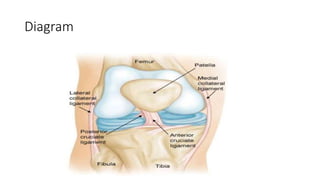
Diagram
Biomechanics of ACL
• Average length of ACL is 4cm and average width is 11mm.
• Ligament is taut in full extension of knee and relaxed at 40-50 degree
flexion.
• It is an elastic ligament (Under tension the ligament lengthens)
• -Biomechanics and failure of ACL must be correlated with associated injuries
• 1) External rotation and abduction with knee in 90 degree flexion-External
rotation will stretch MCL,Abduction will tear MCL and finally when both forces
are increased ACL disrupted.
• 2)Internal rotation of tibia with knee hyperextended-Isolated ACL tear As we
know posterolateral part is taut in full extension and both posterolateral and
anteromedial band tighten when extended knee is internally rotated.
• 3)Complete dislocation of knee joint-Due to hyperextension first posterior
capsule ruptures at approximately 30 degrees of hyperextension followed by PCL
and ACL Tears.
• The two bundles of ACL have different functions during various
degrees of knee motion.
• When the knee is extended they lie parallel to each other.
• When the knee is flexed the femoral origin of posterolateral bundle
moves Anteriorly causing two bundles to cross each other.
• Anteromedial bundle tightens and posterolateral bundle loosens in
knee flexion whereas in extension posterolateral bundle tightens.
Etiology
• ACL injuries are common in sports which involve sudden stops,or
changes in directions like
• 1)Skiers
• 2)Soccer players
• 3) Basketball players
•
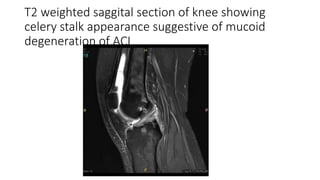
• Mucoid degeneration of ACL-Age related degeneration in which
secondary signs of an ACL injury like bone bruise, meniscus tears and
anterior translation of tibia is absent.
Pathology
• Disruption usually occurs through the midportion of the ligament and
is commonly associated with meniscal tears and medial collateral
ligament tears.
Clinical features
• Popping sensation at the time of injury with pain,swelling, instability.
• A rapid accumulation of fluid into the joint is due to haemarthrosis.
Tests
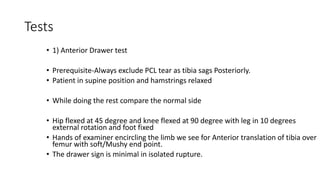
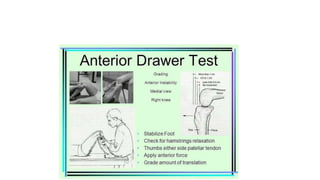
• 1) Anterior Drawer test
• Prerequisite-Always exclude PCL tear as tibia sags Posteriorly.
• Patient in supine position and hamstrings relaxed
• While doing the rest compare the normal side
• Hip flexed at 45 degree and knee flexed at 90 degree with leg in 10 degrees
external rotation and foot fixed
• Hands of examiner encircling the limb we see for Anterior translation of tibia over
femur with soft/Mushy end point.
• The drawer sign is minimal in isolated rupture.
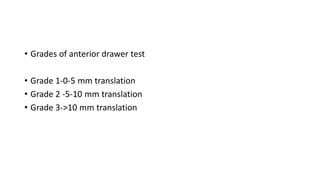
• Grades of anterior drawer test
• Grade 1-0-5 mm translation
• Grade 2 -5-10 mm translation
• Grade 3->10 mm translation
• False negative anterior drawer test seen in
• 1)Hamstring spasm and haemarthrosis
• 2)Door Stopper effect of Posterior horn of medial meniscus-In 90
degree knee flexion medial meniscus abuts against medial femoral
condyle Hindering Anterior translation of tibia.
• Slocum’s Anterior Drawer test is for rotatory instability
• Perform anterior drawer test in 30 degrees of external rotation for
• Anterolateral rotatory instability and 15 degrees of internal rotation
for anteromedial rotatory instability
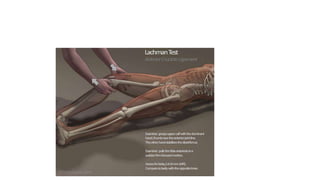
• Lachman test
• Most sensitive
• Done in 20 degree knee flexion left hand over distal femur and right
hand holding tibia and we watch for end point(Soft/Mushy)and
anterior translation of tibia over femur
• Grading
• Grade 1-Feel of positive test
• Grade 2-Visible anterior translation
• Grade 3-Passive subluxation of tibia with patient lying supine
• Grade 4-Active subluxation of tibia
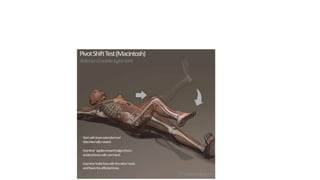
• Pivot shift test/Mac intosh test
• Prerequisite-Intact MCL
• Supine position
• Hip flexed and abducted to 30 degree
• One hand over Calcaneum and one over knee internal rotate tibia and
give valgus force and go from extension to flexion.
• Test is positive if at about 30 degree patient experiences subluxation
of lateral tibial plateau experienced as a clunk.
Investigations
• 1)X-ray of the knee-Anteroposterior and lateral view
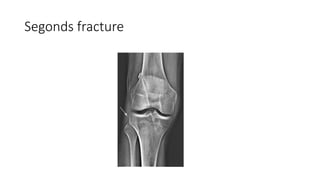
• See for seconds fracture-Avulsion fracture if lateral capsular ligament
of knee which is ACL insertion site
•
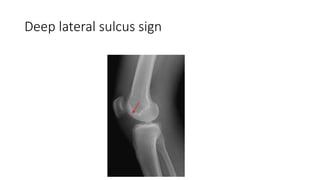
• Deep Lateral sulcus sign-Depression of lateral femoral condyle.
Deep lateral sulcus sign
Segonds fracture
• 2)MRI of the knee joint
• Normal ACL is seen as smooth,well defined structure with low signal
intensity in sagittal image through intercondylar notch.
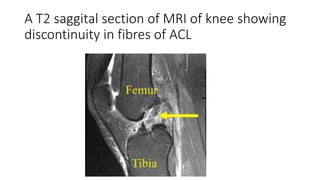
A disrupted ACL will show discontinuity in the saggital plane.
Also see for bone bruises seen as areas of increased signal intensity.
See for meniscal injuries,MCL ligament injuries.
A T2 saggital section of MRI of knee showing
discontinuity in fibres of ACL
T2 weighted saggital section of knee showing
celery stalk appearance suggestive of mucoid
degeneration of ACL
Injuries associated with ACL tears
• 1) Meniscal injuries
• 2) Collateral ligament injuries
• 3)Bone bruises-Occult osteochondral lesions due to impaction
between posterior part of lateral tibial plateau and lateral femoral
condyle.
• 4)Chondral damage.
Management
• Treatment of ACL can be divided into
• Conservative management
• Operative management
Goals of treatment
• 1) Minimise pain and swelling
• 2)Have relatively normal walking pattern
• 3)Full extension of knee.
• 4)120 degrees of knee flexion.
• 5) Quadriceps and hamstrings control.
• 6)Working towards having single leg control.
• RICE-Rest,Ice, compression and elevation
• Pain Medications-NSAIDS
•
• Immobilise knee in extension brace for 3 weeks followed by hinged knee
brace for 3 weeks
• Avoidance of sports
• Neuromuscular electrical stimulation To enhance and strengthen
quadriceps muscles
• Physiotherapy-Quadriceps and hamstrings strengthening
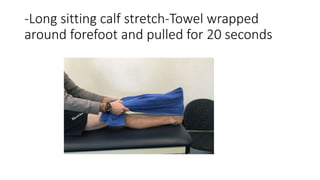
-Long sitting calf stretch-Towel wrapped
around forefoot and pulled for 20 seconds
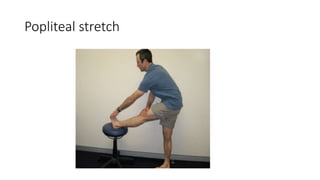
Popliteal stretch
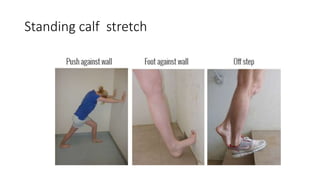
Standing calf stretch
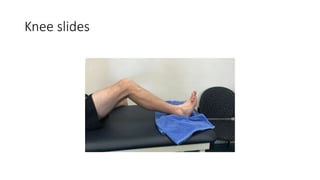
Knee slides
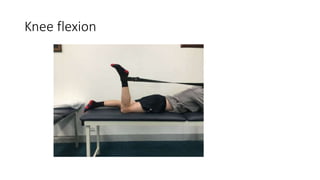
Knee flexion
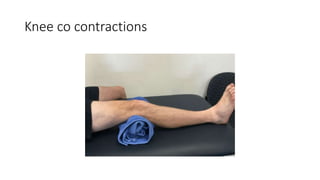
Knee co contractions
• Double leg squat,single leg squats
Operative management
• Indications
• 1)) Occupational requirements-High contact sports.
• 2) Instability in day to day living
• 3)Young patient
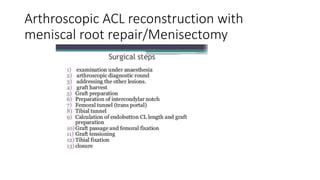
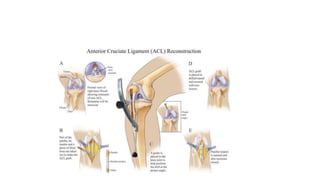
Arthroscopic ACL reconstruction with
meniscal root repair/Menisectomy
Grafts
• Autografts
-Transplanted from one part of the body to another in the same
individual.
• Allografts:Transplanted from one individual to another of the same
species Which are not genetically Identical.
• Synthetic grafts
• Autografts are preferred over allografts as they are biologically better
and have lesser infection.
• Autografts
• Bone patellar tendon bone graft
•
• Quadruple strand hamstring graft(Semi T)
• Quadriceps tendo autograft
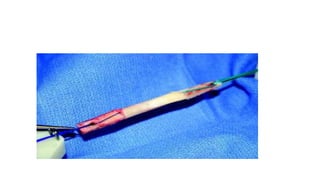
Bone patellar tendon bone autograft
• Most commonly used and gold standard for ACL reconstruction
• Generally taken from middle third of patellar tendon
• Advantage-Bone to bone healing
• Disadvantages
• Increases incidence of anterior knee pain
• Donor site morbidity
• Quadriceps weakness
• Patellar fractures
Quadruple strand hamstring graft(Semi T-
Gracillis autograft)
• Provides biomechanical properties similar to BPTB autograft.
• Disadvantages-Weakness of hamstrings,tunnel widening
Quadriceps tendon autograft
• AdVantage-preserves hamstring function,decreased risk of patellar
fracture.
• Disadvantage-Difficukty in harvesting the graft
Allografts
• Avoid donor site complications
• Patellar fracture
• Anterior knee pain
• Extensor weakness
•
• Examples-Tibialis anterior and posterior
• Quadriceps tendon
• Hamstring tendon
Synthetic grafts
• Dacron
• Carbon
Types of reconstruction
• Single bundle reconstruction
• Double bundle reconstruction
Single bundle reconstruction
• Done using transitional technique
•
1. One incision arthroscopically assisted ACL reconstruction
introduced drilling of femoral tunnel through tibial tunnel.
Advantages-Simple,quick,does not require knee to be flexed beyond 90
degrees, interference screws can be placed parallel
Disadvantages-Difficulty in placing grafts,damage to posterolateral
structures.
Double bundle reconstruction
• To replicate both anteromedial and posterolateral bundles
endobutton is used.
• Disadvantage-Increased surgical time,improper placement of tunnels.
Complications of ACL reconstruction
• Intraoperative
• Post operative
Intraoperative
• 1)Improper placement of tunnels-Ideally tunnels should be posterior
to blumensaats line
• If too anterior they lead to raft failure,if too Posterior graft becomes
too vertical
•
• 2)Graft tension
• 3) Inadequate placement of graft
Post operative
• 1)Infection
• 2)Joint stiffness
Post operative protot
• 4 phases
• Phase 1-1st 4 weeks
• Phase 2-4-12 weeks
• Phase 3-Starting impact loading activities
• Phase 4-Normal routine activities
Phase 1
• Brace in extension
• Static quadriceps excercises,ankle pumps,toe touch walking.
• Patient mobilization with bilateral axillary crutches
• Knee is kept in hinged brace for 4 weeks to prevent undue stress on
the graft.
Phase 2
• After 4 weeks
• Aim to achieve full rom progressing at 10-15 degree flexion per week.
• Weight bearing is gradually increased at 4 weeks and patient is
gradually weaned from crutches at the end of 6 weeks.
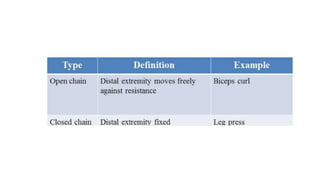
• Isometric close chain excercises are started after 6 weeks
Phase 3
• After 12 weeks impact loading activities such as jogging and double
legged hopping are initiated.
• If patient has good eccentric quad and hip abductor and external
rotator control progressive jogging to running and jumping is started.
Phase 4
• Patient to return back to preinjury level
•
• When can patient return to sport
• If he/she has completed all goals of post operative phases 1,2 and 3
and he/she is able to complete a single leg hop atleast 90 percent
while comparing to uninjured limb at 6 months post operatively.
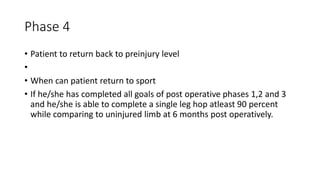
Summary of rehabilitation protocol
• Thank you

Acl tears

  • 1.
  • 2.
    Anatomy of anteriorcruciate ligament • It is an intra Articular but extra synovial ligament. • 2 bundles-Anteromedial bundle and posterolateral bundle. • Anteromedial bundle-Proximal part of the femur to the anteromedial aspect of tibial insertion. • Posterolateral bundle-Distal part of femur to posterolateral aspect of tibial insertion. • Main blood supply-Middle genicular artery. • Function of ACL-Static stabilizer preventing anterior translation of tibia over the femur. • Attatchment:Posterior aspect of inner surface of lateral condyle of femur to Anterior intercondyloid of tibia.
  • 3.
  • 4.
    Biomechanics of ACL •Average length of ACL is 4cm and average width is 11mm. • Ligament is taut in full extension of knee and relaxed at 40-50 degree flexion. • It is an elastic ligament (Under tension the ligament lengthens)
  • 5.
    • -Biomechanics andfailure of ACL must be correlated with associated injuries • 1) External rotation and abduction with knee in 90 degree flexion-External rotation will stretch MCL,Abduction will tear MCL and finally when both forces are increased ACL disrupted. • 2)Internal rotation of tibia with knee hyperextended-Isolated ACL tear As we know posterolateral part is taut in full extension and both posterolateral and anteromedial band tighten when extended knee is internally rotated. • 3)Complete dislocation of knee joint-Due to hyperextension first posterior capsule ruptures at approximately 30 degrees of hyperextension followed by PCL and ACL Tears.
  • 6.
    • The twobundles of ACL have different functions during various degrees of knee motion. • When the knee is extended they lie parallel to each other. • When the knee is flexed the femoral origin of posterolateral bundle moves Anteriorly causing two bundles to cross each other. • Anteromedial bundle tightens and posterolateral bundle loosens in knee flexion whereas in extension posterolateral bundle tightens.
  • 7.
    Etiology • ACL injuriesare common in sports which involve sudden stops,or changes in directions like • 1)Skiers • 2)Soccer players • 3) Basketball players • • Mucoid degeneration of ACL-Age related degeneration in which secondary signs of an ACL injury like bone bruise, meniscus tears and anterior translation of tibia is absent.
  • 8.
    Pathology • Disruption usuallyoccurs through the midportion of the ligament and is commonly associated with meniscal tears and medial collateral ligament tears.
  • 9.
    Clinical features • Poppingsensation at the time of injury with pain,swelling, instability. • A rapid accumulation of fluid into the joint is due to haemarthrosis.
  • 10.
    Tests • 1) AnteriorDrawer test • Prerequisite-Always exclude PCL tear as tibia sags Posteriorly. • Patient in supine position and hamstrings relaxed • While doing the rest compare the normal side • Hip flexed at 45 degree and knee flexed at 90 degree with leg in 10 degrees external rotation and foot fixed • Hands of examiner encircling the limb we see for Anterior translation of tibia over femur with soft/Mushy end point. • The drawer sign is minimal in isolated rupture.
  • 12.
    • Grades ofanterior drawer test • Grade 1-0-5 mm translation • Grade 2 -5-10 mm translation • Grade 3->10 mm translation
  • 13.
    • False negativeanterior drawer test seen in • 1)Hamstring spasm and haemarthrosis • 2)Door Stopper effect of Posterior horn of medial meniscus-In 90 degree knee flexion medial meniscus abuts against medial femoral condyle Hindering Anterior translation of tibia.
  • 14.
    • Slocum’s AnteriorDrawer test is for rotatory instability • Perform anterior drawer test in 30 degrees of external rotation for • Anterolateral rotatory instability and 15 degrees of internal rotation for anteromedial rotatory instability
  • 15.
    • Lachman test •Most sensitive • Done in 20 degree knee flexion left hand over distal femur and right hand holding tibia and we watch for end point(Soft/Mushy)and anterior translation of tibia over femur
  • 17.
    • Grading • Grade1-Feel of positive test • Grade 2-Visible anterior translation • Grade 3-Passive subluxation of tibia with patient lying supine • Grade 4-Active subluxation of tibia
  • 18.
    • Pivot shifttest/Mac intosh test • Prerequisite-Intact MCL • Supine position • Hip flexed and abducted to 30 degree • One hand over Calcaneum and one over knee internal rotate tibia and give valgus force and go from extension to flexion. • Test is positive if at about 30 degree patient experiences subluxation of lateral tibial plateau experienced as a clunk.
  • 20.
    Investigations • 1)X-ray ofthe knee-Anteroposterior and lateral view • See for seconds fracture-Avulsion fracture if lateral capsular ligament of knee which is ACL insertion site • • Deep Lateral sulcus sign-Depression of lateral femoral condyle.
  • 21.
  • 22.
  • 23.
    • 2)MRI ofthe knee joint • Normal ACL is seen as smooth,well defined structure with low signal intensity in sagittal image through intercondylar notch. A disrupted ACL will show discontinuity in the saggital plane. Also see for bone bruises seen as areas of increased signal intensity. See for meniscal injuries,MCL ligament injuries.
  • 24.
    A T2 saggitalsection of MRI of knee showing discontinuity in fibres of ACL
  • 25.
    T2 weighted saggitalsection of knee showing celery stalk appearance suggestive of mucoid degeneration of ACL
  • 26.
    Injuries associated withACL tears • 1) Meniscal injuries • 2) Collateral ligament injuries • 3)Bone bruises-Occult osteochondral lesions due to impaction between posterior part of lateral tibial plateau and lateral femoral condyle. • 4)Chondral damage.
  • 27.
    Management • Treatment ofACL can be divided into • Conservative management • Operative management
  • 28.
    Goals of treatment •1) Minimise pain and swelling • 2)Have relatively normal walking pattern • 3)Full extension of knee. • 4)120 degrees of knee flexion. • 5) Quadriceps and hamstrings control. • 6)Working towards having single leg control.
  • 29.
    • RICE-Rest,Ice, compressionand elevation • Pain Medications-NSAIDS • • Immobilise knee in extension brace for 3 weeks followed by hinged knee brace for 3 weeks • Avoidance of sports • Neuromuscular electrical stimulation To enhance and strengthen quadriceps muscles • Physiotherapy-Quadriceps and hamstrings strengthening
  • 30.
    -Long sitting calfstretch-Towel wrapped around forefoot and pulled for 20 seconds
  • 31.
  • 32.
  • 33.
  • 34.
  • 35.
  • 36.
    • Double legsquat,single leg squats
  • 37.
    Operative management • Indications •1)) Occupational requirements-High contact sports. • 2) Instability in day to day living • 3)Young patient
  • 38.
    Arthroscopic ACL reconstructionwith meniscal root repair/Menisectomy
  • 40.
    Grafts • Autografts -Transplanted fromone part of the body to another in the same individual. • Allografts:Transplanted from one individual to another of the same species Which are not genetically Identical. • Synthetic grafts
  • 41.
    • Autografts arepreferred over allografts as they are biologically better and have lesser infection.
  • 42.
    • Autografts • Bonepatellar tendon bone graft • • Quadruple strand hamstring graft(Semi T) • Quadriceps tendo autograft
  • 43.
    Bone patellar tendonbone autograft • Most commonly used and gold standard for ACL reconstruction • Generally taken from middle third of patellar tendon • Advantage-Bone to bone healing • Disadvantages • Increases incidence of anterior knee pain • Donor site morbidity • Quadriceps weakness • Patellar fractures
  • 45.
    Quadruple strand hamstringgraft(Semi T- Gracillis autograft) • Provides biomechanical properties similar to BPTB autograft. • Disadvantages-Weakness of hamstrings,tunnel widening
  • 46.
    Quadriceps tendon autograft •AdVantage-preserves hamstring function,decreased risk of patellar fracture. • Disadvantage-Difficukty in harvesting the graft
  • 47.
    Allografts • Avoid donorsite complications • Patellar fracture • Anterior knee pain • Extensor weakness • • Examples-Tibialis anterior and posterior • Quadriceps tendon • Hamstring tendon
  • 48.
  • 49.
    Types of reconstruction •Single bundle reconstruction • Double bundle reconstruction
  • 50.
    Single bundle reconstruction •Done using transitional technique • 1. One incision arthroscopically assisted ACL reconstruction introduced drilling of femoral tunnel through tibial tunnel. Advantages-Simple,quick,does not require knee to be flexed beyond 90 degrees, interference screws can be placed parallel Disadvantages-Difficulty in placing grafts,damage to posterolateral structures.
  • 51.
    Double bundle reconstruction •To replicate both anteromedial and posterolateral bundles endobutton is used. • Disadvantage-Increased surgical time,improper placement of tunnels.
  • 52.
    Complications of ACLreconstruction • Intraoperative • Post operative
  • 53.
    Intraoperative • 1)Improper placementof tunnels-Ideally tunnels should be posterior to blumensaats line • If too anterior they lead to raft failure,if too Posterior graft becomes too vertical • • 2)Graft tension • 3) Inadequate placement of graft
  • 54.
  • 55.
    Post operative protot •4 phases • Phase 1-1st 4 weeks • Phase 2-4-12 weeks • Phase 3-Starting impact loading activities • Phase 4-Normal routine activities
  • 56.
    Phase 1 • Bracein extension • Static quadriceps excercises,ankle pumps,toe touch walking. • Patient mobilization with bilateral axillary crutches • Knee is kept in hinged brace for 4 weeks to prevent undue stress on the graft.
  • 57.
    Phase 2 • After4 weeks • Aim to achieve full rom progressing at 10-15 degree flexion per week. • Weight bearing is gradually increased at 4 weeks and patient is gradually weaned from crutches at the end of 6 weeks. • Isometric close chain excercises are started after 6 weeks
  • 59.
    Phase 3 • After12 weeks impact loading activities such as jogging and double legged hopping are initiated. • If patient has good eccentric quad and hip abductor and external rotator control progressive jogging to running and jumping is started.
  • 60.
    Phase 4 • Patientto return back to preinjury level • • When can patient return to sport • If he/she has completed all goals of post operative phases 1,2 and 3 and he/she is able to complete a single leg hop atleast 90 percent while comparing to uninjured limb at 6 months post operatively.
  • 61.
  • 62.