Total knee
replacement
Goals of Joint Replacement Surgery
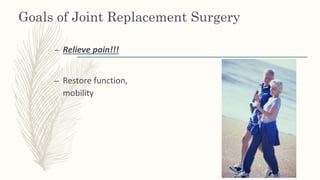
– Relieve pain!!!
– Restore function,
mobility
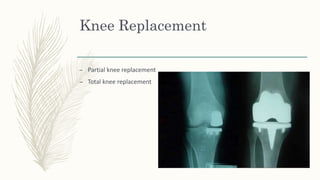
Knee Replacement
– Partial knee replacement
– Total knee replacement
– Extreme pain
– Limited range of motion
– Previous surgeries to the knee
– Muscle atrophy
– Locking/catching within knee
– Chronic inflammation
– Deformity
– Unable to kneel down
– Lack of function
– Limiting activities of daily living and/or hobbies
Preexisting factors leading to
total knee replacements (tkr)
Who Is A Candidate For TKR
– Quality of life severely affected
– Daily pain
– Restriction of ordinary activities
– Evidence of significant radiographic changes of the knee
What Is The Time For
Replacement
– Old age with more sedentary life style
– Young patients who have limited function
– Progressive deformity
– Other treatment modalities have failed
– TKR should be done before things get out of hand and the patient experiences a
severe decrease in ROM, deformity, contracture, joint instability or muscle
atrophy
Contraindications to tkr
– Infection
– Severe vascular disease
– Neuropathic joint
– Obesity
– Skin diseases
Post-op Care
– Monitor VS
– Wound assessments
– Neurovascular assessments
– Monitor wound drainage
– Pain relief
– Infection/Osteomyelitis prevention
– Promote early ambulation
– Ensure physiotherapy is consulted
After Surgery
– Movement of knee determined by doctor.
– Physical therapy is very important to regain mobility and strength.
Post Operative Rehabilitation
– Rapid post-operative mobilization
– Range of motion exercises started
– CPM
– Passive extension by placing pillow under foot
– Flexion- by dangling the legs over the side of bed
– Muscle strengthening exercises
– Weight bearing is allowed on first post op day
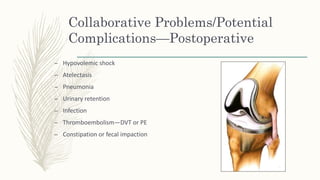
Collaborative Problems/Potential
Complications—Postoperative
– Hypovolemic shock
– Atelectasis
– Pneumonia
– Urinary retention
– Infection
– Thromboembolism—DVT or PE
– Constipation or fecal impaction
Position in bed
• A towel roll should be placed at the ankle to promote knee extension when
patients are supine in bed.
• Nothing should be placed behind the operative knee, to promote maximal knee
extension and prevent knee flexion contracture.
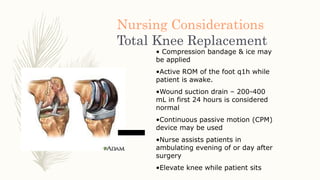
Nursing Considerations
Total Knee Replacement
• Compression bandage & ice may
be applied
•Active ROM of the foot q1h while
patient is awake.
•Wound suction drain – 200-400
mL in first 24 hours is considered
normal
•Continuous passive motion (CPM)
device may be used
•Nurse assists patients in
ambulating evening of or day after
surgery
•Elevate knee while patient sits

Total knee replacement

  • 1.
  • 2.
    Goals of JointReplacement Surgery – Relieve pain!!! – Restore function, mobility
  • 3.
    Knee Replacement – Partialknee replacement – Total knee replacement
  • 4.
    – Extreme pain –Limited range of motion – Previous surgeries to the knee – Muscle atrophy – Locking/catching within knee – Chronic inflammation – Deformity – Unable to kneel down – Lack of function – Limiting activities of daily living and/or hobbies Preexisting factors leading to total knee replacements (tkr)
  • 5.
    Who Is ACandidate For TKR – Quality of life severely affected – Daily pain – Restriction of ordinary activities – Evidence of significant radiographic changes of the knee
  • 6.
    What Is TheTime For Replacement – Old age with more sedentary life style – Young patients who have limited function – Progressive deformity – Other treatment modalities have failed – TKR should be done before things get out of hand and the patient experiences a severe decrease in ROM, deformity, contracture, joint instability or muscle atrophy
  • 7.
    Contraindications to tkr –Infection – Severe vascular disease – Neuropathic joint – Obesity – Skin diseases
  • 8.
    Post-op Care – MonitorVS – Wound assessments – Neurovascular assessments – Monitor wound drainage – Pain relief – Infection/Osteomyelitis prevention – Promote early ambulation – Ensure physiotherapy is consulted
  • 9.
    After Surgery – Movementof knee determined by doctor. – Physical therapy is very important to regain mobility and strength.
  • 10.
    Post Operative Rehabilitation –Rapid post-operative mobilization – Range of motion exercises started – CPM – Passive extension by placing pillow under foot – Flexion- by dangling the legs over the side of bed – Muscle strengthening exercises – Weight bearing is allowed on first post op day
  • 11.
    Collaborative Problems/Potential Complications—Postoperative – Hypovolemicshock – Atelectasis – Pneumonia – Urinary retention – Infection – Thromboembolism—DVT or PE – Constipation or fecal impaction
  • 12.
    Position in bed •A towel roll should be placed at the ankle to promote knee extension when patients are supine in bed. • Nothing should be placed behind the operative knee, to promote maximal knee extension and prevent knee flexion contracture.
  • 13.
    Nursing Considerations Total KneeReplacement • Compression bandage & ice may be applied •Active ROM of the foot q1h while patient is awake. •Wound suction drain – 200-400 mL in first 24 hours is considered normal •Continuous passive motion (CPM) device may be used •Nurse assists patients in ambulating evening of or day after surgery •Elevate knee while patient sits