PRESENTED BY DR. U. KARTHIKEYAN
MODERATOR DR. PRAMOD KUMAR, PROFESSOR
BASICSOFKNEEARTHROPLASTY
• Arthroplasty is the surgical reconstruction of a joint which aims to relieve pain, correct
deformities and retain movements of a joint.
• Arthroplasty, or joint replacement, can be most simply defined as the functional substitution of
the articulating surfaces of the joint
• Total knee arthroplasty- surgical procedure to replace the weight bearing surfaces of the knee
joint.
ARTHROPLASTY
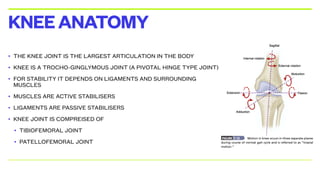
• THE KNEE JOINT IS THE LARGEST ARTICULATION IN THE BODY
• KNEE IS A TROCHO-GINGLYMOUS JOINT (A PIVOTAL HINGE TYPE JOINT)
• FOR STABILITY IT DEPENDS ON LIGAMENTS AND SURROUNDING
MUSCLES
• MUSCLES ARE ACTIVE STABILISERS
• LIGAMENTS ARE PASSIVE STABILISERS
• KNEE JOINT IS COMPREISED OF
• TIBIOFEMORAL JOINT
• PATELLOFEMORAL JOINT
KNEEANATOMY
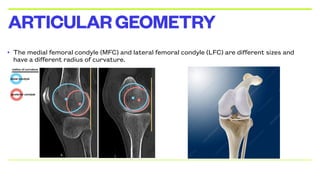
ARTICULARGEOMETRY
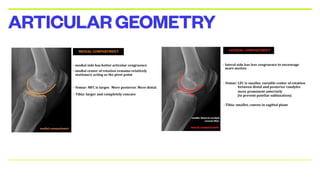
• The medial femoral condyle (MFC) and lateral femoral condyle (LFC) are different sizes and
have a different radius of curvature.
ARTICULARGEOMETRY
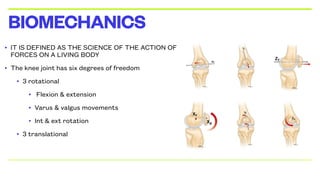
• IT IS DEFINED AS THE SCIENCE OF THE ACTION OF
FORCES ON A LIVING BODY
• The knee joint has six degrees of freedom
• 3 rotational
• Flexion & extension
• Varus & valgus movements
• Int & ext rotation
• 3 translational
BIOMECHANICS
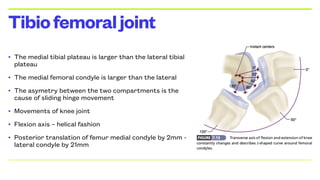
• The medial tibial plateau is larger than the lateral tibial
plateau
• The medial femoral condyle is larger than the lateral
• The asymetry between the two compartments is the
cause of sliding hinge movement
• Movements of knee joint
• Flexion axis – helical fashion
• Posterior translation of femur medial condyle by 2mm -
lateral condyle by 21mm
Tibiofemoraljoint
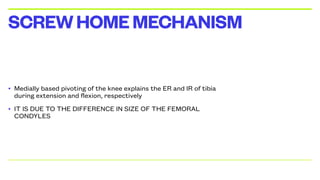
• Medially based pivoting of the knee explains the ER and IR of tibia
during extension and flexion, respectively
• IT IS DUE TO THE DIFFERENCE IN SIZE OF THE FEMORAL
CONDYLES
SCREWHOMEMECHANISM
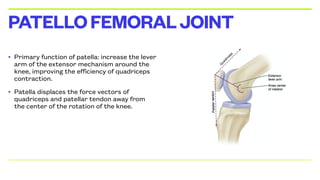
• Primary function of patella: increase the lever
arm of the extensor mechanism around the
knee, improving the efficiency of quadriceps
contraction.
• Patella displaces the force vectors of
quadriceps and patellar tendon away from
the center of the rotation of the knee.
PATELLOFEMORALJOINT
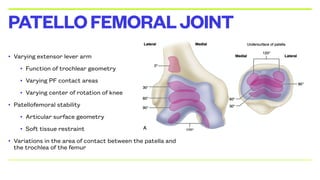
• Varying extensor lever arm
• Function of trochlear geometry
• Varying PF contact areas
• Varying center of rotation of knee
• Patellofemoral stability
• Articular surface geometry
• Soft tissue restraint
• Variations in the area of contact between the patella and
the trochlea of the femur
PATELLOFEMORALJOINT
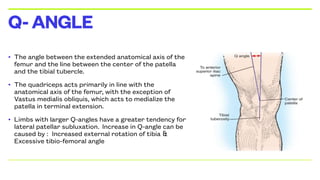
• The angle between the extended anatomical axis of the
femur and the line between the center of the patella
and the tibial tubercle.
• The quadriceps acts primarily in line with the
anatomical axis of the femur, with the exception of
Vastus medialis obliquis, which acts to medialize the
patella in terminal extension.
• Limbs with larger Q-angles have a greater tendency for
lateral patellar subluxation. Increase in Q-angle can be
caused by : Increased external rotation of tibia &
Excessive tibio-femoral angle
Q-ANGLE
• MECHANICAL AXIS
• ANATOMICAL AXIS
• JOINT LINE
ALIGNMENTOFKNEE
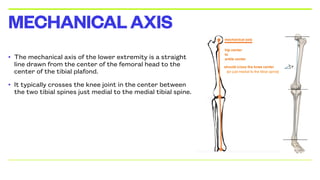
• The mechanical axis of the lower extremity is a straight
line drawn from the center of the femoral head to the
center of the tibial plafond.
• It typically crosses the knee joint in the center between
the two tibial spines just medial to the medial tibial spine.
MECHANICALAXIS
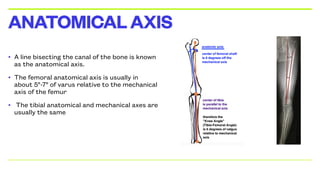
• A line bisecting the canal of the bone is known
as the anatomical axis.
• The femoral anatomical axis is usually in
about 5°-7° of varus relative to the mechanical
axis of the femur
• The tibial anatomical and mechanical axes are
usually the same
ANATOMICALAXIS
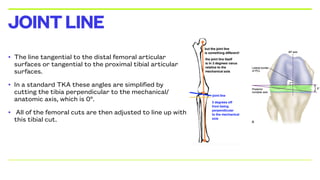
• The line tangential to the distal femoral articular
surfaces or tangential to the proximal tibial articular
surfaces.
• In a standard TKA these angles are simplified by
cutting the tibia perpendicular to the mechanical/
anatomic axis, which is 0°.
• All of the femoral cuts are then adjusted to line up with
this tibial cut.
JOINTLINE
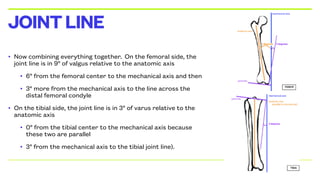
• Now combining everything together. On the femoral side, the
joint line is in 9° of valgus relative to the anatomic axis
• 6° from the femoral center to the mechanical axis and then
• 3° more from the mechanical axis to the line across the
distal femoral condyle
• On the tibial side, the joint line is in 3° of varus relative to the
anatomic axis
• 0° from the tibial center to the mechanical axis because
these two are parallel
• 3° from the mechanical axis to the tibial joint line).
JOINTLINE
• The Knee is more complex than a simple hinge joint.
• Motion occurs not only in flexion-extension, but also involves rotation, pivot, and gliding
movements.
• The best way to understand our knee motion is to first understand that it is controlled by
three things:
• The articular geometry
• The ligamentous balance
• Muscular tension.
KINEMATICS
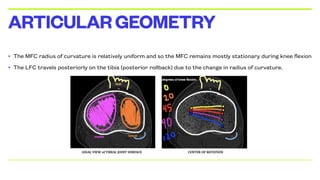
• The MFC radius of curvature is relatively uniform and so the MFC remains mostly stationary during knee flexion
• The LFC travels posteriorly on the tibia (posterior rollback) due to the change in radius of curvature.
ARTICULARGEOMETRY
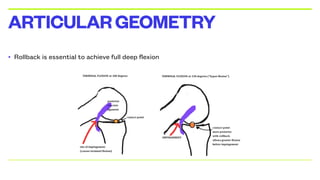
• Rollback is essential to achieve full deep flexion
ARTICULARGEOMETRY
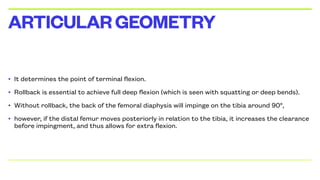
• It determines the point of terminal flexion.
• Rollback is essential to achieve full deep flexion (which is seen with squatting or deep bends).
• Without rollback, the back of the femoral diaphysis will impinge on the tibia around 90°,
• however, if the distal femur moves posteriorly in relation to the tibia, it increases the clearance
before impingment, and thus allows for extra flexion.
ARTICULARGEOMETRY
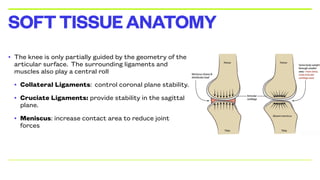
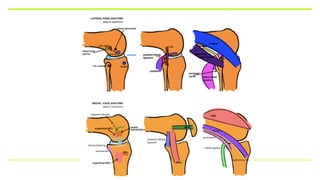
• The knee is only partially guided by the geometry of the
articular surface. The surrounding ligaments and
muscles also play a central roll
• Collateral Ligaments: control coronal plane stability.
• Cruciate Ligaments: provide stability in the sagittal
plane.
• Meniscus: increase contact area to reduce joint
forces
SOFTTISSUEANATOMY
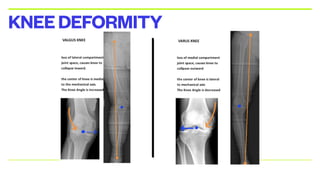
KNEEDEFORMITY
• Preservation of the joint line
• Restoration of a normal mechanical axis, i.e. 0°
• Balanced flexion and extension bone gaps
• Balanced soft-tissue restraints, maintaining adequate medial/lateral (coronal) and
anteroposterior (sagittal) joint stability
• Good patellar tracking (maintaining or restoring a normal Q angle).
GOALSOFTKR
• Relieve pain caused by severe arthritis, with or without deformity.
• Young patients with limited function due to systemic arthritis with multiple joint involvement.
• Osteonecrosis with subchondral collapse of a condyle.
• Severe patellofemoral arthritis.
• Severe deformity associated with moderate arthritis and variable pain.
1°INDICATIONS
• Recent knee sepsis.
• Source of ongoing infection elsewhere in body.
• Extensor mechanism discontinuity or dysfunction.
• Painless, well functioning knee arthrodesis.
ABSOLUTECONTRAINDICATIONS
• Severely osteoarthritic ipsilateral hip which should be operated first because it is easier to
rehabilitate a THR with the OA knee than to rehabilitate a TKR with a OA hip.
• Atherosclerotic disease of operative leg.
• Venous stasis disease with recurrent cellulitis.
• History of osteomyelitis in proximity of knee.
• Morbid obesity BMI > 40
• Medical conditions that is patients ability to withstand anesthesia, metabolic demands of
surgery and wound healing.
RELATIVECONTRAINDICATIONS
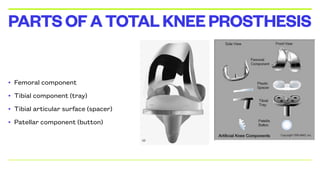
• Femoral component
• Tibial component (tray)
• Tibial articular surface (spacer)
• Patellar component (button)
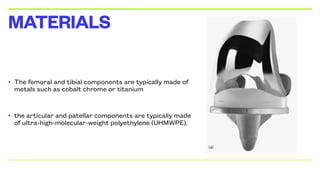
PARTSOFATOTALKNEEPROSTHESIS
• The femoral and tibial components are typically made of
metals such as cobalt chrome or titanium
• the articular and patellar components are typically made
of ultra-high-molecular-weight polyethylene (UHMWPE).
MATERIALS
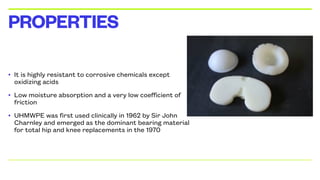
• IT IS ULTRA HIGH MOLECULAR WEIGHT
POLYETHYLENE
• It is a subset of the thermoplastic polyethylene
• It has extremely long chains, with a high molecular mass 1]
which serves to transfer load more effectively to the
polymer backbone by strengthening intermolecular
interactionsresults in a very tough material, with the
highest impact strength
TIBIALINSERT
• It is highly resistant to corrosive chemicals except
oxidizing acids
• Low moisture absorption and a very low coefficient of
friction
• UHMWPE was first used clinically in 1962 by Sir John
Charnley and emerged as the dominant bearing material
for total hip and knee replacements in the 1970
PROPERTIES
• Highly cross-linked UHMWPE materials were clinically introduced in 1998
• These new materials are cross-linked with gamma or electron beam radiation (50–105 kGy)
and then thermally processed to improve their oxidation resistance
• In 2007, manufacturers started incorporating anti-oxidants into UHMWPE for hip and knee
arthroplasty bearing surfaces.[1]
• Vitamin E (a-tocopherol) is the most common anti-oxidant used
• The anti-oxidant helps quench free radicals that are introduced during the irradiation process,
imparting improved oxidation resistance to the UHMWPE without the need for thermal
treatment
VARIANTS
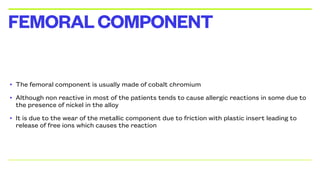
• The femoral component is usually made of cobalt chromium
• Although non reactive in most of the patients tends to cause allergic reactions in some due to
the presence of nickel in the alloy
• It is due to the wear of the metallic component due to friction with plastic insert leading to
release of free ions which causes the reaction
FEMORALCOMPONENT
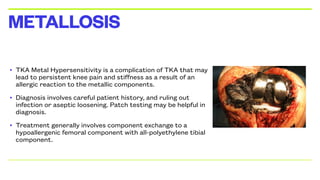
• TKA Metal Hypersensitivity is a complication of TKA that may
lead to persistent knee pain and stiffness as a result of an
allergic reaction to the metallic components.
• Diagnosis involves careful patient history, and ruling out
infection or aseptic loosening. Patch testing may be helpful in
diagnosis.
• Treatment generally involves component exchange to a
hypoallergenic femoral component with all-polyethylene tibial
component.
METALLOSIS
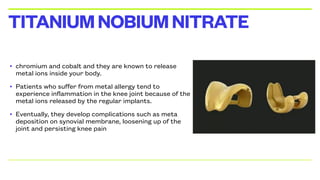
• chromium and cobalt and they are known to release
metal ions inside your body.
• Patients who suffer from metal allergy tend to
experience inflammation in the knee joint because of the
metal ions released by the regular implants.
• Eventually, they develop complications such as meta
deposition on synovial membrane, loosening up of the
joint and persisting knee pain
TITANIUMNOBIUMNITRATE
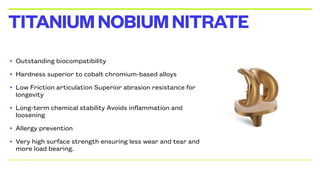
• Outstanding biocompatibility
• Hardness superior to cobalt chromium-based alloys
• Low Friction articulation Superior abrasion resistance for
longevity
• Long-term chemical stability Avoids inflammation and
loosening
• Allergy prevention
• Very high surface strength ensuring less wear and tear and
more load bearing.
TITANIUMNOBIUMNITRATE
• 8 times harder than a regular CoCr product
• It is twice as hard as the Zirconium Oxide implants
• most biocompatible non-allergic surface material
• 0.0008 times ionic release compared to that of regular Cobalt Chromium products
• Friction in the knee caused by the implant is also less than half
TITANIUMNOBIUMNITRATE
• METAL ON PLASTIC
• CERAMIC ON PLASTIC
• CERAMIC ON CERAMIC
• METAL ON METAL
TYPESBASEDONMATERIALS
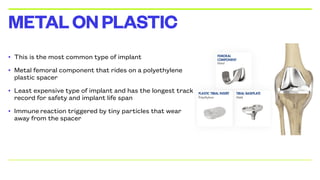
• This is the most common type of implant
• Metal femoral component that rides on a polyethylene
plastic spacer
• Least expensive type of implant and has the longest track
record for safety and implant life span
• Immune reaction triggered by tiny particles that wear
away from the spacer
METALONPLASTIC
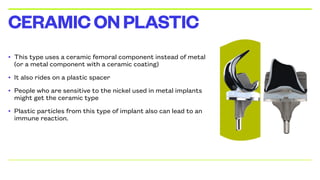
• This type uses a ceramic femoral component instead of metal
(or a metal component with a ceramic coating)
• It also rides on a plastic spacer
• People who are sensitive to the nickel used in metal implants
might get the ceramic type
• Plastic particles from this type of implant also can lead to an
immune reaction.
CERAMICONPLASTIC
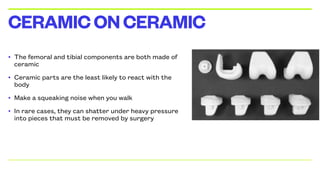
• The femoral and tibial components are both made of
ceramic
• Ceramic parts are the least likely to react with the
body
• Make a squeaking noise when you walk
• In rare cases, they can shatter under heavy pressure
into pieces that must be removed by surgery
CERAMICONCERAMIC
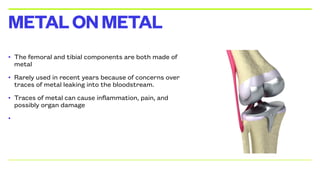
• The femoral and tibial components are both made of
metal
• Rarely used in recent years because of concerns over
traces of metal leaking into the bloodstream.
• Traces of metal can cause inflammation, pain, and
possibly organ damage
•
METALONMETAL
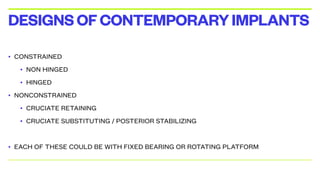
• CONSTRAINED
• NON HINGED
• HINGED
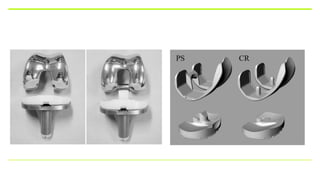
• NONCONSTRAINED
• CRUCIATE RETAINING
• CRUCIATE SUBSTITUTING / POSTERIOR STABILIZING
• EACH OF THESE COULD BE WITH FIXED BEARING OR ROTATING PLATFORM
DESIGNSOFCONTEMPORARYIMPLANTS
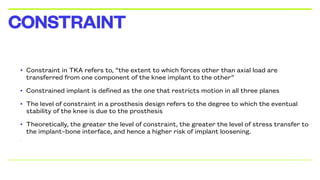
• Constraint in TKA refers to, “the extent to which forces other than axial load are
transferred from one component of the knee implant to the other”
• Constrained implant is defined as the one that restricts motion in all three planes
• The level of constraint in a prosthesis design refers to the degree to which the eventual
stability of the knee is due to the prosthesis
• Theoretically, the greater the level of constraint, the greater the level of stress transfer to
the implant–bone interface, and hence a higher risk of implant loosening.
•
CONSTRAINT
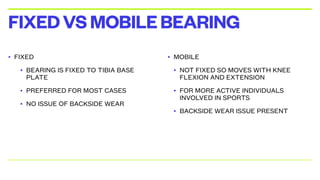
• FIXED
• BEARING IS FIXED TO TIBIA BASE
PLATE
• PREFERRED FOR MOST CASES
• NO ISSUE OF BACKSIDE WEAR
• MOBILE
• NOT FIXED SO MOVES WITH KNEE
FLEXION AND EXTENSION
• FOR MORE ACTIVE INDIVIDUALS
INVOLVED IN SPORTS
• BACKSIDE WEAR ISSUE PRESENT
FIXEDVSMOBILEBEARING
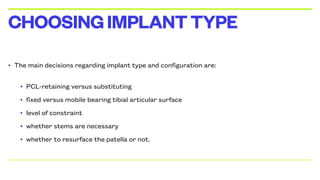
• The main decisions regarding implant type and configuration are:
• PCL-retaining versus substituting
• fixed versus mobile bearing tibial articular surface
• level of constraint
• whether stems are necessary
• whether to resurface the patella or not.
CHOOSINGIMPLANTTYPE
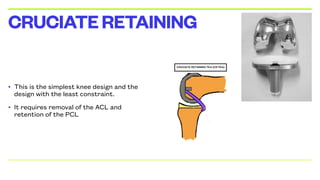
• This is the simplest knee design and the
design with the least constraint.
• It requires removal of the ACL and
retention of the PCL
CRUCIATERETAINING
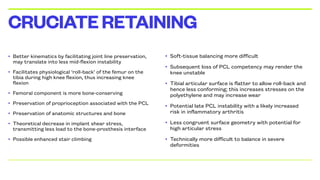
• Better kinematics by facilitating joint line preservation,
may translate into less mid-flexion instability
• Facilitates physiological ‘roll-back’ of the femur on the
tibia during high knee flexion, thus increasing knee
flexion
• Femoral component is more bone-conserving
• Preservation of proprioception associated with the PCL
• Preservation of anatomic structures and bone
• Theoretical decrease in implant shear stress,
transmitting less load to the bone-prosthesis interface
• Possible enhanced stair climbing
•
CRUCIATERETAINING
• Soft-tissue balancing more difficult
• Subsequent loss of PCL competency may render the
knee unstable
• Tibial articular surface is flatter to allow roll-back and
hence less conforming; this increases stresses on the
polyethylene and may increase wear
• Potential late PCL instability with a likely increased
risk in inflammatory arthritis
• Less congruent surface geometry with potential for
high articular stress
• Technically more difficult to balance in severe
deformities
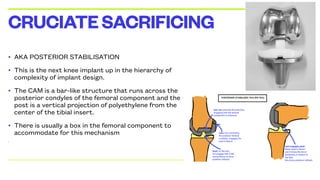
• AKA POSTERIOR STABILISATION
• This is the next knee implant up in the hierarchy of
complexity of implant design.
• The CAM is a bar-like structure that runs across the
posterior condyles of the femoral component and the
post is a vertical projection of polyethylene from the
center of the tibial insert.
• There is usually a box in the femoral component to
accommodate for this mechanism
•
CRUCIATESACRIFICING
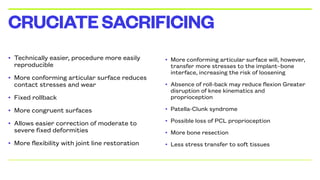
• Technically easier, procedure more easily
reproducible
• More conforming articular surface reduces
contact stresses and wear
• Fixed rollback
• More congruent surfaces
• Allows easier correction of moderate to
severe fixed deformities
• More flexibility with joint line restoration
CRUCIATESACRIFICING
• More conforming articular surface will, however,
transfer more stresses to the implant–bone
interface, increasing the risk of loosening
• Absence of roll-back may reduce flexion Greater
disruption of knee kinematics and
proprioception
• Patella-Clunk syndrome7
• Possible loss of PCL proprioception
• More bone resection
• Less stress transfer to soft tissues
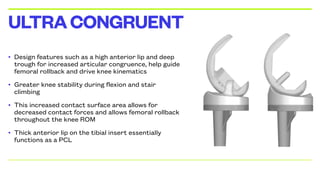
• Design features such as a high anterior lip and deep
trough for increased articular congruence, help guide
femoral rollback and drive knee kinematics
• Greater knee stability during flexion and stair
climbing
• This increased contact surface area allows for
decreased contact forces and allows femoral rollback
throughout the knee ROM
• Thick anterior lip on the tibial insert essentially
functions as a PCL
ULTRACONGRUENT
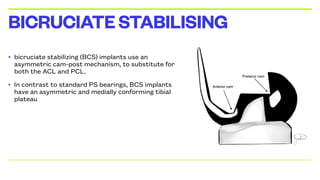
• bicruciate stabilizing (BCS) implants use an
asymmetric cam-post mechanism, to substitute for
both the ACL and PCL.
• In contrast to standard PS bearings, BCS implants
have an asymmetric and medially conforming tibial
plateau
BICRUCIATESTABILISING
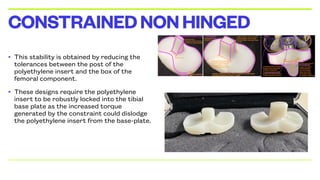
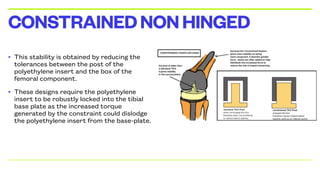
• This stability is obtained by reducing the
tolerances between the post of the
polyethylene insert and the box of the
femoral component.
• These designs require the polyethylene
insert to be robustly locked into the tibial
base plate as the increased torque
generated by the constraint could dislodge
the polyethylene insert from the base-plate.
CONSTRAINEDNONHINGED
• This stability is obtained by reducing the
tolerances between the post of the
polyethylene insert and the box of the
femoral component.
• These designs require the polyethylene
insert to be robustly locked into the tibial
base plate as the increased torque
generated by the constraint could dislodge
the polyethylene insert from the base-plate.
CONSTRAINEDNONHINGED
• Stems are rods that can be attached to the femoral or
tibial components, and placed intramedullarly.
• Transfer stresses away from the implant–bone
interface, and improve implant stability on the cut
bone surfaces.
• Thus, stems are often used in instances when the
host bone is poor and/or deficient
• Also, with implants with higher levels of constraint,
stems help to reduce the stresses at the principal
component–bone interface
ROLEOFSTEMS
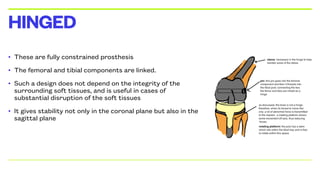
• These are fully constrained prosthesis
• The femoral and tibial components are linked.
• Such a design does not depend on the integrity of the
surrounding soft tissues, and is useful in cases of
substantial disruption of the soft tissues
• It gives stability not only in the coronal plane but also in the
sagittal plane
HINGED
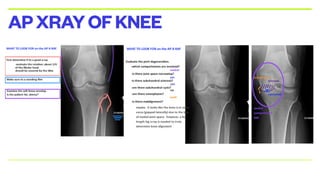
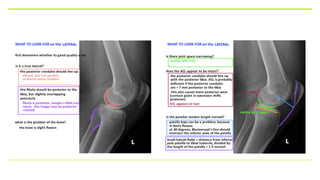
• STANDING XRAY OF KNEE AP AND LATERAL VIEW
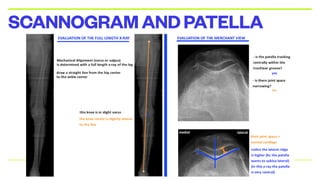
• SCANNOGRAM OF THE LOWER LIMG
• MERCHANTS VIEW OF PATELLA
PREOPEVALUATION
APXRAYOFKNEE
SCANNOGRAMANDPATELLA
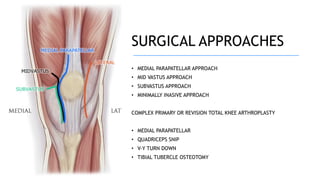
SURGICAL APPROACHES
• MEDIAL PARAPATELLAR APPROACH
• MID VASTUS APPROACH
• SUBVASTUS APPROACH
• MINIMALLY INASIVE APPROACH
COMPLEX PRIMARY OR REVISION TOTAL KNEE ARTHROPLASTY
• MEDIAL PARAPATELLAR
• QUADRICEPS SNIP
• V-Y TURN DOWN
• TIBIAL TUBERCLE OSTEOTOMY
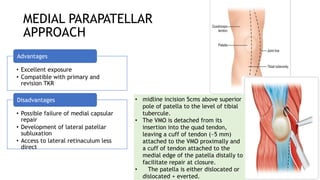
MEDIAL PARAPATELLAR
APPROACH
• Excellent exposure
• Compatible with primary and
revision TKR
Advantages
• Possible failure of medial capsular
repair
• Development of lateral patellar
subluxation
• Access to lateral retinaculum less
direct
Disadvantages • midline incision 5cms above superior
pole of patella to the level of tibial
tubercule.
• The VMO is detached from its
insertion into the quad tendon,
leaving a cuff of tendon (~5 mm)
attached to the VMO proximally and
a cuff of tendon attached to the
medial edge of the patella distally to
facilitate repair at closure.
• The patella is either dislocated or
dislocated + everted.
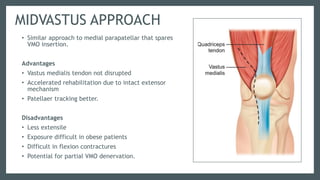
MIDVASTUS APPROACH
• Similar approach to medial parapatellar that spares
VMO insertion.
Advantages
• Vastus medialis tendon not disrupted
• Accelerated rehabilitation due to intact extensor
mechanism
• Patellaer tracking better.
Disadvantages
• Less extensile
• Exposure difficult in obese patients
• Difficult in flexion contractures
• Potential for partial VMO denervation.
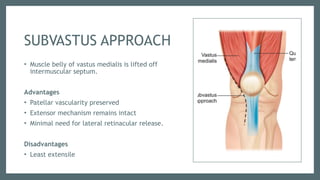
SUBVASTUS APPROACH
• Muscle belly of vastus medialis is lifted off
intermuscular septum.
Advantages
• Patellar vascularity preserved
• Extensor mechanism remains intact
• Minimal need for lateral retinacular release.
Disadvantages
• Least extensile
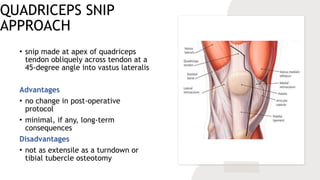
QUADRICEPS SNIP
APPROACH
• snip made at apex of quadriceps
tendon obliquely across tendon at a
45-degree angle into vastus lateralis
Advantages
• no change in post-operative
protocol
• minimal, if any, long-term
consequences
Disadvantages
• not as extensile as a turndown or
tibial tubercle osteotomy
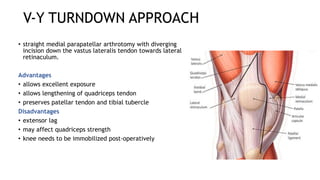
V-Y TURNDOWN APPROACH
• straight medial parapatellar arthrotomy with diverging
incision down the vastus lateralis tendon towards lateral
retinaculum.
Advantages
• allows excellent exposure
• allows lengthening of quadriceps tendon
• preserves patellar tendon and tibial tubercle
Disadvantages
• extensor lag
• may affect quadriceps strength
• knee needs to be immobilized post-operatively
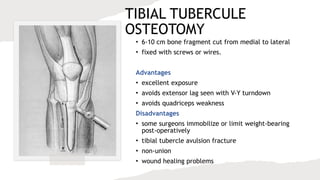
TIBIAL TUBERCULE
OSTEOTOMY
• 6-10 cm bone fragment cut from medial to lateral
• fixed with screws or wires.
Advantages
• excellent exposure
• avoids extensor lag seen with V-Y turndown
• avoids quadriceps weakness
Disadvantages
• some surgeons immobilize or limit weight-bearing
post-operatively
• tibial tubercle avulsion fracture
• non-union
• wound healing problems
• There are currently three schools of thought regarding the techniques of TKA;
• Measured resection,
• Gap balancing
• Kinematic alignment.
• All three philosophies have a common goal of achieving balanced flexion and extension gaps leading to well-
balanced medial and lateral collateral ligaments.
• Measured resection and Gap balancIng techniques have a common goal in achieving a neutral mechanical
axis
• Kinematic alignment aims to reconstruct the patient’s pre-arthritic alignment, be it constitutional varus
or valgus.
CURRENTPHILOSOPHIESINTKA
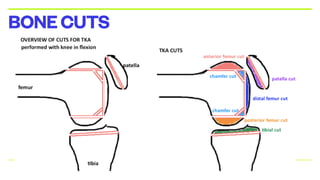
BONECUTS
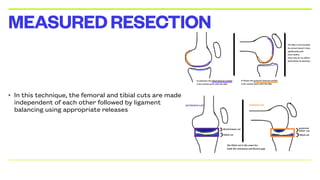
• In this technique, the femoral and tibial cuts are made
independent of each other followed by ligament
balancing using appropriate releases
MEASUREDRESECTION
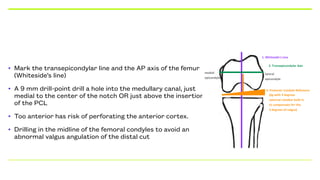
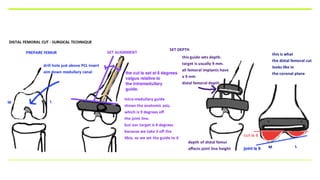
• Mark the transepicondylar line and the AP axis of the femur
(Whiteside’s line)
• A 9 mm drill-point drill a hole into the medullary canal, just
medial to the center of the notch OR just above the insertion
of the PCL
• Too anterior has risk of perforating the anterior cortex.
• Drilling in the midline of the femoral condyles to avoid an
abnormal valgus angulation of the distal cut
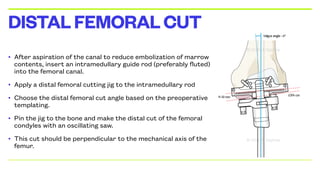
• After aspiration of the canal to reduce embolization of marrow
contents, insert an intramedullary guide rod (preferably fluted)
into the femoral canal.
• Apply a distal femoral cutting jig to the intramedullary rod
• Choose the distal femoral cut angle based on the preoperative
templating.
• Pin the jig to the bone and make the distal cut of the femoral
condyles with an oscillating saw.
• This cut should be perpendicular to the mechanical axis of the
femur.
DISTALFEMORALCUT
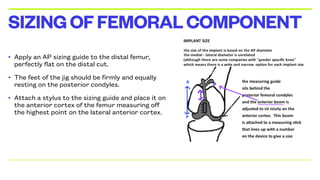
• Apply an AP sizing guide to the distal femur,
perfectly flat on the distal cut.
• The feet of the jig should be firmly and equally
resting on the posterior condyles.
• Attach a stylus to the sizing guide and place it on
the anterior cortex of the femur measuring off
the highest point on the lateral anterior cortex.
SIZINGOFFEMORALCOMPONENT
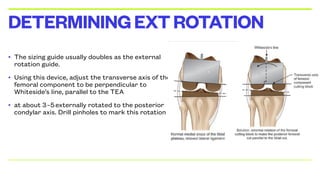
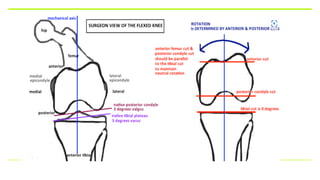
• The sizing guide usually doubles as the external
rotation guide.
• Using this device, adjust the transverse axis of the
femoral component to be perpendicular to
Whiteside’s line, parallel to the TEA
• at about 3o
–5o
externally rotated to the posterior
condylar axis. Drill pinholes to mark this rotation
DETERMININGEXTROTATION
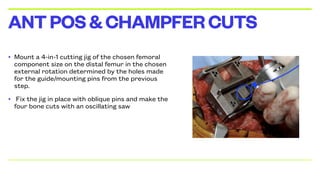
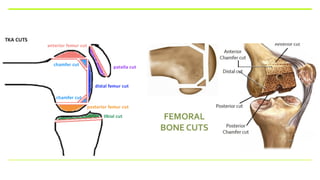
• Mount a 4-in-1 cutting jig of the chosen femoral
component size on the distal femur in the chosen
external rotation determined by the holes made
for the guide/mounting pins from the previous
step.
• Fix the jig in place with oblique pins and make the
four bone cuts with an oscillating saw
ANTPOS&CHAMPFERCUTS
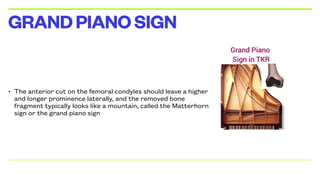
• The anterior cut on the femoral condyles should leave a higher
and longer prominence laterally, and the removed bone
fragment typically looks like a mountain, called the Matterhorn
sign or the grand piano sign
GRANDPIANOSIGN
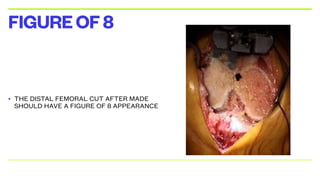
• THE DISTAL FEMORAL CUT AFTER MADE
SHOULD HAVE A FIGURE OF 8 APPEARANCE
FIGUREOF8
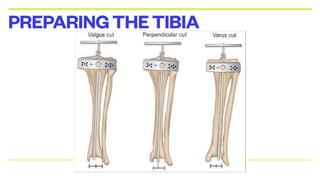
PREPARINGTHETIBIA
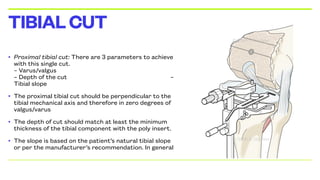
• Proximal tibial cut: There are 3 parameters to achieve
with this single cut.
– Varus/valgus
– Depth of the cut –
Tibial slope
• The proximal tibial cut should be perpendicular to the
tibial mechanical axis and therefore in zero degrees of
valgus/varus
• The depth of cut should match at least the minimum
thickness of the tibial component with the poly insert.
• The slope is based on the patient’s natural tibial slope
or per the manufacturer’s recommendation. In general
TIBIALCUT
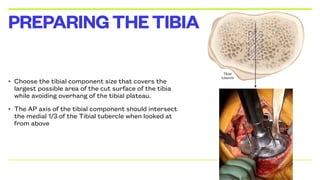
• Choose the tibial component size that covers the
largest possible area of the cut surface of the tibia
while avoiding overhang of the tibial plateau.
• The AP axis of the tibial component should intersect
the medial 1/3rd
of the Tibial tubercle when looked at
from above
PREPARINGTHETIBIA
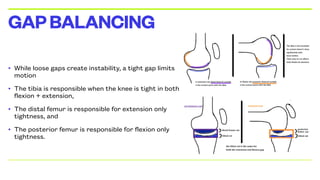
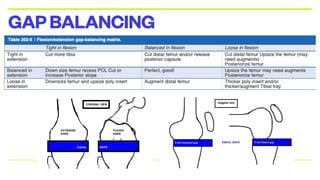
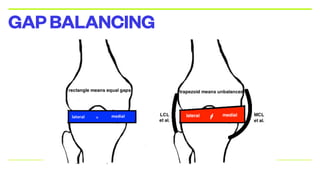
• While loose gaps create instability, a tight gap limits
motion
• The tibia is responsible when the knee is tight in both
flexion + extension,
• The distal femur is responsible for extension only
tightness, and
• The posterior femur is responsible for flexion only
tightness.
GAPBALANCING
GAPBALANCING
OSTEOPHYTEREMOVAL
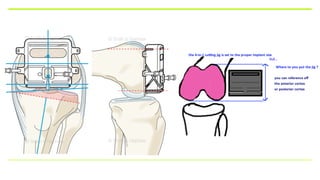
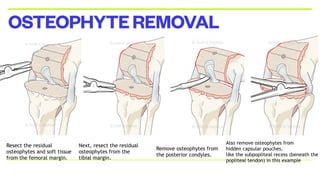
Resect the residual
osteophytes and soft tissue
from the femoral margin.
Next, resect the residual
osteophytes from the
tibial margin.
Remove osteophytes from
the posterior condyles.
Also remove osteophytes from
hidden capsular pouches,
like the subpopliteal recess (beneath the
popliteal tendon) in this example
• Soft tissue balancing is essential to providing a stable
joint after TKA.
• After bone preparation is completed, the flexion and
extension gaps should be evaluated for symmetry for
equal height in flexion and extension.
• Before release of any anatomical soft tissue supporting
structure about the knee, all peripheral osteophytes
should be removed from the femur and tibia.
• The removal of osteophytes alone may be enough to
balance existing coronal plane deformities.
LIGAMENTOUSBALANCING
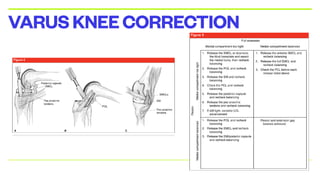
• Steps of medial release
• Step 1 Deep MCL Release To Mid-Coronal Plane Of Tibia
• Step 2 Medial Osteophyte Removal
• Step 3 Release Posteromedial Corner (Posterior Oblique Ligament)
• Step 4 Medial Tibial Reduction Ostectomy
• Step 5: Consider PCL Release/Substitution If Imbalance Persists At This Point (If Substitution Not Initially
Chosen)
• Step 6 Release Semimembranosis (Especially If There Is An Associated Flexion Contracture)
• Step 7 Pie Crust Superficial MCL (Favor Use Of 18 Gauge Needle)
• Step 8 Complete Superficial MCL Release / Pes Anserinus
VARUSKNEECORRECTION
VARUSKNEECORRECTION
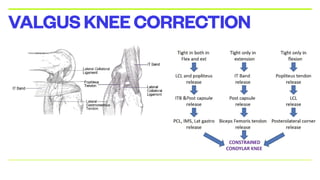
• Lateral release in order
• Step 1 osteophytes
• Step 2 posterolateral capsule
• Step 3 iliotibial band if tight in extension with pie crust or release off Gerdy's tubercle
• Step 4 popliteus if tight in flexion (release if tight in flexion) release the anterior part of its insertion for severe
deformities release both the iliotibial band and the popliteus
• Step 5 LCL
• Step 6 Intermuscular septum (from the vastus lateralis)
• Step 7 Posterior cruciate ligament
• Step 8 Biceps tendon off fibula head (usually the last to bereleased).
VALGUSKNEECORRECTION
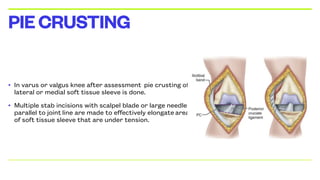
• In varus or valgus knee after assessment pie crusting of
lateral or medial soft tissue sleeve is done.
• Multiple stab incisions with scalpel blade or large needle
parallel to joint line are made to effectively elongate areas
of soft tissue sleeve that are under tension.
PIECRUSTING
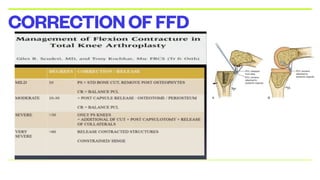
• Most preoperative flexion deformities improve with appropriate soft tissue balancing for coronal plane deformity.
• If a flexion contracture persists despite balanced medial and lateral soft tissues, the shortened posterior
structures must be effectively lengthened.
• If the contracture persists, the joint line may need to be elevated by increasing the amount of distal femoral bone
resection.
• Posterior release order
• 1) posterior femoral & posterior tibial osteophytes
• 2) posterior capsule
• 3) additional resection of distal femur
• 4) gastronemius muscles (medial and lateral)
CORRECTIONOFFFD
CORRECTIONOFFFD
GAPBALANCING
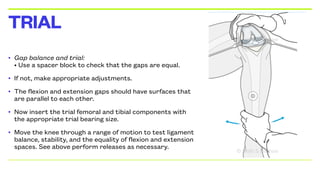
• Gap balance and trial:
• Use a spacer block to check that the gaps are equal.
• If not, make appropriate adjustments.
• The flexion and extension gaps should have surfaces that
are parallel to each other.
• Now insert the trial femoral and tibial components with
the appropriate trial bearing size.
• Move the knee through a range of motion to test ligament
balance, stability, and the equality of flexion and extension
spaces. See above perform releases as necessary.
TRIAL
• The Kinematically aligned TKA (KA-TKA) is based on the
premise that there are three main kinematic axes that
should be reconstructed during a TKA
• The primary flexion-extension axis of the knee:
• 2. The flexion-extension axis of the patella:
• 3. The longitudinal axis of the tibia:
KINEMATICALIGNMENT
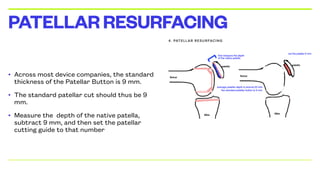
• Across most device companies, the standard
thickness of the Patellar Button is 9 mm.
• The standard patellar cut should thus be 9
mm.
• Measure the depth of the native patella,
subtract 9 mm, and then set the patellar
cutting guide to that number
PATELLARRESURFACING
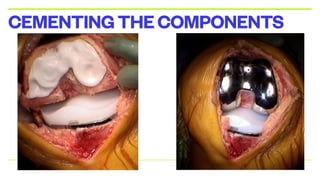
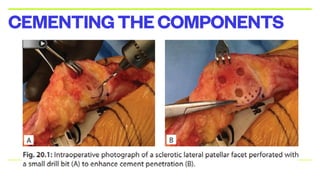
• It functions as a ‘grout’ that forms an intimate sleeve between the implant and interdigitates
into the cancellous structure of the bone.
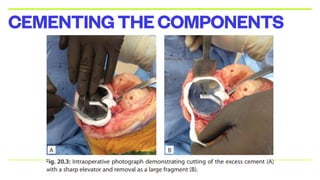
• Poor cementation techniques risk premature implant loosening. Careless removal of excess
cement results in micro and macroscopic third body particles, which can entrap within the joint
articulation and cause catastrophic polyethylene wear.
CEMENTINGTHECOMPONENTS
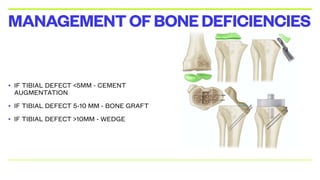
• IF TIBIAL DEFECT <5MM - CEMENT
AUGMENTATION
• IF TIBIAL DEFECT 5-10 MM - BONE GRAFT
• IF TIBIAL DEFECT >10MM - WEDGE
MANAGEMENTOFBONEDEFICIENCIES
• PAIN MANAGEMENT
• Continuous epidural
• Parentral posterior capsule analgesia
• Drains to be removed after 48 hrs
• Thromboprophylaxis like LMWH to be started on the evening of surgery for a week
• Staples removed on day 12-14
POSTOPMANAGEMENT
• Start rom exercises on day 1
• Made to stand on day 2 with support and walking initiated
• To do knee flexions and straight leg raises
• Encouraged to increase activity with walker for 2 weeks
• 2-4 weeks walking frame can be replced with a walking stick
• After that patinet can adjust activity as tolerated
REHABILITATION
• Standard exercises that are used for early postoperative knee replacement include:
• Quadriceps strngthening
• Terminal knee extension
• Heel slides
• Straight leg raising
• Pillow squeezes
REHABILITATION
• SYSTEMIC
• THROMBOEMBOLISM
• FAT EMBOLISM
• LOCAL
• WOUND DRIANAGE
• VASCULAR COMPLICATIONS
• NEUROLOGICAL COMPLICATIONS
COMPLICATIONS
• SURGICAL SITE INFECTION
• PERONEAL NERVE PALSY
• EXTENSOR MECHANISM INJURY
• TORNIQUET RELATED ISCHEMIC INJURY
• ARTERIAL INJURY
• INTRA OP FRACTURE
• LIGAMENT INJURY
IMMEDIATECOMPLICATIONS
• Blood loss
• Perioperative blood loss during TKA can be minimized by using blood-saving techniques
(tourniquet, topical agents, systemic agents).
• Using these strategies, intraoperative blood loss is generally low.
• Following transfusion guidelines and perioperative protocols to reduce bleeding (ie, tranexamic
acid and local infiltration analgesia), the rate of intraoperative transfusion can be reduced to
nearly 0 percent
IMMEDIATECOMPLICATIONS
• THROMBOEMBOLISM
• The development of deep vein thrombosis (DVT) with the potential to propagate a potentially
lethal pulmonary embolus (PE) is one of the most feared complications of TKA.
• The reported incidence of DVT following TKA without prophylaxis ranges from 40 to 88
percent [6-8].
• The incidences of asymptomatic PE, symptomatic PE, and mortality range from 10 to 20
percent, 0.5 to 3 percent, and up to 2 percent, respectively.
EARLYCOMPLICATIONS
• ASEPTIC LOOSENING
• JOINT INSTABILITY
• SUB ACUTE AND CHRONIC PERIPROSTHETIC INFECTIONS
• POLYETHYLENE WEAR
• OSTEOLYSIS
• ARTHROFIBROSIS, JOINT STIFFNESS
• PERSISTANT PAIN
• METAL HYPERSENSITIVITY
INTERMEDIATE&LATECOMPLICATIONS
• Patellofemoral instability
• Patellar fracture
• Patellar component failure
• Patellar component loosening
• Patellar clunk syndrome
• Extensor mechanism rupture
PATELLOFEMORALCOMPLICATIONS
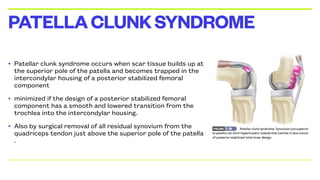
• Patellar clunk syndrome occurs when scar tissue builds up at
the superior pole of the patella and becomes trapped in the
intercondylar housing of a posterior stabilized femoral
component
• minimized if the design of a posterior stabilized femoral
component has a smooth and lowered transition from the
trochlea into the intercondylar housing.
• Also by surgical removal of all residual synovium from the
quadriceps tendon just above the superior pole of the patella
.
PATELLACLUNKSYNDROME
• NAVIGATIONS SYSTEMS
• ROBOTICS
RECENTADVANCES
• It provides surgeons with a precision tool for carrying out surgery
• Possibility of intraoperative simulation and objective control over various anatomical and
surgical parameters
• Basically used to control the alignment of bone cutting referenced to the mechanical axis of the
lower limb
• Also component rotation, ligament balancing and arranging the symmetry of flexion and
extension spaces
• Better alignment of the lower-limb axis has been widely proven
NAVIGATIONSYSTEMS
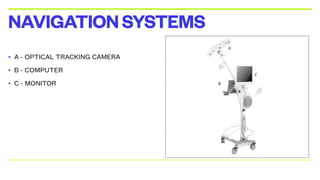
• A - OPTICAL TRACKING CAMERA
• B - COMPUTER
• C - MONITOR
NAVIGATIONSYSTEMS
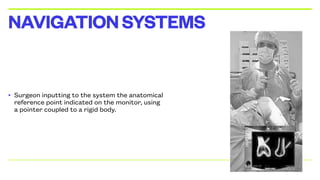
• Surgeon inputting to the system the anatomical
reference point indicated on the monitor, using
a pointer coupled to a rigid body.
NAVIGATIONSYSTEMS
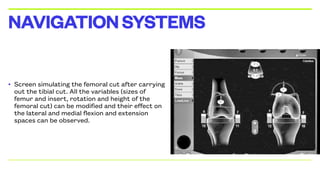
• Screen simulating the femoral cut after carrying
out the tibial cut. All the variables (sizes of
femur and insert, rotation and height of the
femoral cut) can be modified and their effect on
the lateral and medial flexion and extension
spaces can be observed.
NAVIGATIONSYSTEMS
• PASSIVE SYSTEMS
• ACTIVE SYSTEM
• INTERACTIVE SYSTEM
• TELE OPERATED SYSTEM
ROBOTICS
• Donot directly carry out the procedure
• Usually handheld devices that guide the surgeon
• Eg. Conventional navigation systems
PASSIVESYSTEMS
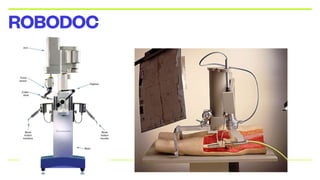
• These use preop and intraop data to perform surgical steps independentlywithout surgeons
participation
• Surgeon makes standard approach
• Positions pins ans navigation markers
• The robotic reaming tools once activated makes tibial and femoral cuts
• Eg. Robodoc 1986
ACTIVESYSTEM
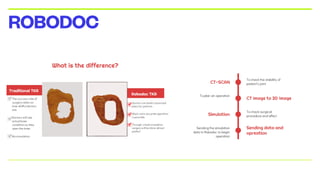
ROBODOC
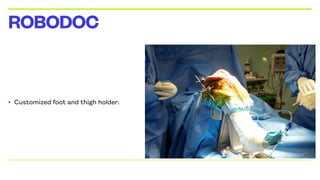
• Customized foot and thigh holder.
ROBODOC
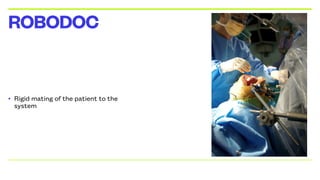
• Rigid mating of the patient to the
system
ROBODOC
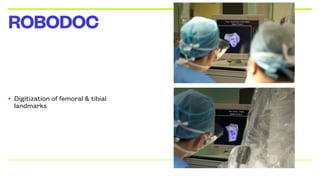
• Digitization of femoral & tibial
landmarks
ROBODOC
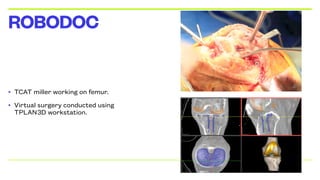
• TCAT miller working on femur.
• Virtual surgery conducted using
TPLAN3D workstation.
ROBODOC
ROBODOC
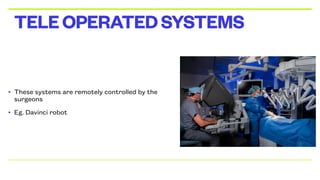
• These systems are remotely controlled by the
surgeons
• Eg. Davinci robot
TELEOPERATEDSYSTEMS
THANKYOU

Total Knee Replacement final ppt FINAL.pdf

  • 1.
    PRESENTED BY DR.U. KARTHIKEYAN MODERATOR DR. PRAMOD KUMAR, PROFESSOR BASICSOFKNEEARTHROPLASTY
  • 2.
    • Arthroplasty isthe surgical reconstruction of a joint which aims to relieve pain, correct deformities and retain movements of a joint. • Arthroplasty, or joint replacement, can be most simply defined as the functional substitution of the articulating surfaces of the joint • Total knee arthroplasty- surgical procedure to replace the weight bearing surfaces of the knee joint. ARTHROPLASTY
  • 3.
    • THE KNEEJOINT IS THE LARGEST ARTICULATION IN THE BODY • KNEE IS A TROCHO-GINGLYMOUS JOINT (A PIVOTAL HINGE TYPE JOINT) • FOR STABILITY IT DEPENDS ON LIGAMENTS AND SURROUNDING MUSCLES • MUSCLES ARE ACTIVE STABILISERS • LIGAMENTS ARE PASSIVE STABILISERS • KNEE JOINT IS COMPREISED OF • TIBIOFEMORAL JOINT • PATELLOFEMORAL JOINT KNEEANATOMY
  • 4.
  • 5.
    • The medialfemoral condyle (MFC) and lateral femoral condyle (LFC) are different sizes and have a different radius of curvature. ARTICULARGEOMETRY
  • 6.
    • IT ISDEFINED AS THE SCIENCE OF THE ACTION OF FORCES ON A LIVING BODY • The knee joint has six degrees of freedom • 3 rotational • Flexion & extension • Varus & valgus movements • Int & ext rotation • 3 translational BIOMECHANICS
  • 7.
    • The medialtibial plateau is larger than the lateral tibial plateau • The medial femoral condyle is larger than the lateral • The asymetry between the two compartments is the cause of sliding hinge movement • Movements of knee joint • Flexion axis – helical fashion • Posterior translation of femur medial condyle by 2mm - lateral condyle by 21mm Tibiofemoraljoint
  • 8.
    • Medially basedpivoting of the knee explains the ER and IR of tibia during extension and flexion, respectively • IT IS DUE TO THE DIFFERENCE IN SIZE OF THE FEMORAL CONDYLES SCREWHOMEMECHANISM
  • 9.
    • Primary functionof patella: increase the lever arm of the extensor mechanism around the knee, improving the efficiency of quadriceps contraction. • Patella displaces the force vectors of quadriceps and patellar tendon away from the center of the rotation of the knee. PATELLOFEMORALJOINT
  • 10.
    • Varying extensorlever arm • Function of trochlear geometry • Varying PF contact areas • Varying center of rotation of knee • Patellofemoral stability • Articular surface geometry • Soft tissue restraint • Variations in the area of contact between the patella and the trochlea of the femur PATELLOFEMORALJOINT
  • 11.
    • The anglebetween the extended anatomical axis of the femur and the line between the center of the patella and the tibial tubercle. • The quadriceps acts primarily in line with the anatomical axis of the femur, with the exception of Vastus medialis obliquis, which acts to medialize the patella in terminal extension. • Limbs with larger Q-angles have a greater tendency for lateral patellar subluxation. Increase in Q-angle can be caused by : Increased external rotation of tibia & Excessive tibio-femoral angle Q-ANGLE
  • 12.
    • MECHANICAL AXIS •ANATOMICAL AXIS • JOINT LINE ALIGNMENTOFKNEE
  • 13.
    • The mechanicalaxis of the lower extremity is a straight line drawn from the center of the femoral head to the center of the tibial plafond. • It typically crosses the knee joint in the center between the two tibial spines just medial to the medial tibial spine. MECHANICALAXIS
  • 14.
    • A linebisecting the canal of the bone is known as the anatomical axis. • The femoral anatomical axis is usually in about 5°-7° of varus relative to the mechanical axis of the femur • The tibial anatomical and mechanical axes are usually the same ANATOMICALAXIS
  • 15.
    • The linetangential to the distal femoral articular surfaces or tangential to the proximal tibial articular surfaces. • In a standard TKA these angles are simplified by cutting the tibia perpendicular to the mechanical/ anatomic axis, which is 0°. • All of the femoral cuts are then adjusted to line up with this tibial cut. JOINTLINE
  • 16.
    • Now combiningeverything together. On the femoral side, the joint line is in 9° of valgus relative to the anatomic axis • 6° from the femoral center to the mechanical axis and then • 3° more from the mechanical axis to the line across the distal femoral condyle • On the tibial side, the joint line is in 3° of varus relative to the anatomic axis • 0° from the tibial center to the mechanical axis because these two are parallel • 3° from the mechanical axis to the tibial joint line). JOINTLINE
  • 17.
    • The Kneeis more complex than a simple hinge joint. • Motion occurs not only in flexion-extension, but also involves rotation, pivot, and gliding movements. • The best way to understand our knee motion is to first understand that it is controlled by three things: • The articular geometry • The ligamentous balance • Muscular tension. KINEMATICS
  • 18.
    • The MFCradius of curvature is relatively uniform and so the MFC remains mostly stationary during knee flexion • The LFC travels posteriorly on the tibia (posterior rollback) due to the change in radius of curvature. ARTICULARGEOMETRY
  • 19.
    • Rollback isessential to achieve full deep flexion ARTICULARGEOMETRY
  • 20.
    • It determinesthe point of terminal flexion. • Rollback is essential to achieve full deep flexion (which is seen with squatting or deep bends). • Without rollback, the back of the femoral diaphysis will impinge on the tibia around 90°, • however, if the distal femur moves posteriorly in relation to the tibia, it increases the clearance before impingment, and thus allows for extra flexion. ARTICULARGEOMETRY
  • 21.
    • The kneeis only partially guided by the geometry of the articular surface. The surrounding ligaments and muscles also play a central roll • Collateral Ligaments: control coronal plane stability. • Cruciate Ligaments: provide stability in the sagittal plane. • Meniscus: increase contact area to reduce joint forces SOFTTISSUEANATOMY
  • 23.
  • 24.
    • Preservation ofthe joint line • Restoration of a normal mechanical axis, i.e. 0° • Balanced flexion and extension bone gaps • Balanced soft-tissue restraints, maintaining adequate medial/lateral (coronal) and anteroposterior (sagittal) joint stability • Good patellar tracking (maintaining or restoring a normal Q angle). GOALSOFTKR
  • 25.
    • Relieve paincaused by severe arthritis, with or without deformity. • Young patients with limited function due to systemic arthritis with multiple joint involvement. • Osteonecrosis with subchondral collapse of a condyle. • Severe patellofemoral arthritis. • Severe deformity associated with moderate arthritis and variable pain. 1°INDICATIONS
  • 26.
    • Recent kneesepsis. • Source of ongoing infection elsewhere in body. • Extensor mechanism discontinuity or dysfunction. • Painless, well functioning knee arthrodesis. ABSOLUTECONTRAINDICATIONS
  • 27.
    • Severely osteoarthriticipsilateral hip which should be operated first because it is easier to rehabilitate a THR with the OA knee than to rehabilitate a TKR with a OA hip. • Atherosclerotic disease of operative leg. • Venous stasis disease with recurrent cellulitis. • History of osteomyelitis in proximity of knee. • Morbid obesity BMI > 40 • Medical conditions that is patients ability to withstand anesthesia, metabolic demands of surgery and wound healing. RELATIVECONTRAINDICATIONS
  • 28.
    • Femoral component •Tibial component (tray) • Tibial articular surface (spacer) • Patellar component (button) PARTSOFATOTALKNEEPROSTHESIS
  • 29.
    • The femoraland tibial components are typically made of metals such as cobalt chrome or titanium • the articular and patellar components are typically made of ultra-high-molecular-weight polyethylene (UHMWPE). MATERIALS
  • 30.
    • IT ISULTRA HIGH MOLECULAR WEIGHT POLYETHYLENE • It is a subset of the thermoplastic polyethylene • It has extremely long chains, with a high molecular mass 1] which serves to transfer load more effectively to the polymer backbone by strengthening intermolecular interactionsresults in a very tough material, with the highest impact strength TIBIALINSERT
  • 31.
    • It ishighly resistant to corrosive chemicals except oxidizing acids • Low moisture absorption and a very low coefficient of friction • UHMWPE was first used clinically in 1962 by Sir John Charnley and emerged as the dominant bearing material for total hip and knee replacements in the 1970 PROPERTIES
  • 32.
    • Highly cross-linkedUHMWPE materials were clinically introduced in 1998 • These new materials are cross-linked with gamma or electron beam radiation (50–105 kGy) and then thermally processed to improve their oxidation resistance • In 2007, manufacturers started incorporating anti-oxidants into UHMWPE for hip and knee arthroplasty bearing surfaces.[1] • Vitamin E (a-tocopherol) is the most common anti-oxidant used • The anti-oxidant helps quench free radicals that are introduced during the irradiation process, imparting improved oxidation resistance to the UHMWPE without the need for thermal treatment VARIANTS
  • 33.
    • The femoralcomponent is usually made of cobalt chromium • Although non reactive in most of the patients tends to cause allergic reactions in some due to the presence of nickel in the alloy • It is due to the wear of the metallic component due to friction with plastic insert leading to release of free ions which causes the reaction FEMORALCOMPONENT
  • 34.
    • TKA MetalHypersensitivity is a complication of TKA that may lead to persistent knee pain and stiffness as a result of an allergic reaction to the metallic components. • Diagnosis involves careful patient history, and ruling out infection or aseptic loosening. Patch testing may be helpful in diagnosis. • Treatment generally involves component exchange to a hypoallergenic femoral component with all-polyethylene tibial component. METALLOSIS
  • 35.
    • chromium andcobalt and they are known to release metal ions inside your body. • Patients who suffer from metal allergy tend to experience inflammation in the knee joint because of the metal ions released by the regular implants. • Eventually, they develop complications such as meta deposition on synovial membrane, loosening up of the joint and persisting knee pain TITANIUMNOBIUMNITRATE
  • 36.
    • Outstanding biocompatibility •Hardness superior to cobalt chromium-based alloys • Low Friction articulation Superior abrasion resistance for longevity • Long-term chemical stability Avoids inflammation and loosening • Allergy prevention • Very high surface strength ensuring less wear and tear and more load bearing. TITANIUMNOBIUMNITRATE
  • 37.
    • 8 timesharder than a regular CoCr product • It is twice as hard as the Zirconium Oxide implants • most biocompatible non-allergic surface material • 0.0008 times ionic release compared to that of regular Cobalt Chromium products • Friction in the knee caused by the implant is also less than half TITANIUMNOBIUMNITRATE
  • 38.
    • METAL ONPLASTIC • CERAMIC ON PLASTIC • CERAMIC ON CERAMIC • METAL ON METAL TYPESBASEDONMATERIALS
  • 39.
    • This isthe most common type of implant • Metal femoral component that rides on a polyethylene plastic spacer • Least expensive type of implant and has the longest track record for safety and implant life span • Immune reaction triggered by tiny particles that wear away from the spacer METALONPLASTIC
  • 40.
    • This typeuses a ceramic femoral component instead of metal (or a metal component with a ceramic coating) • It also rides on a plastic spacer • People who are sensitive to the nickel used in metal implants might get the ceramic type • Plastic particles from this type of implant also can lead to an immune reaction. CERAMICONPLASTIC
  • 41.
    • The femoraland tibial components are both made of ceramic • Ceramic parts are the least likely to react with the body • Make a squeaking noise when you walk • In rare cases, they can shatter under heavy pressure into pieces that must be removed by surgery CERAMICONCERAMIC
  • 42.
    • The femoraland tibial components are both made of metal • Rarely used in recent years because of concerns over traces of metal leaking into the bloodstream. • Traces of metal can cause inflammation, pain, and possibly organ damage • METALONMETAL
  • 43.
    • CONSTRAINED • NONHINGED • HINGED • NONCONSTRAINED • CRUCIATE RETAINING • CRUCIATE SUBSTITUTING / POSTERIOR STABILIZING • EACH OF THESE COULD BE WITH FIXED BEARING OR ROTATING PLATFORM DESIGNSOFCONTEMPORARYIMPLANTS
  • 44.
    • Constraint inTKA refers to, “the extent to which forces other than axial load are transferred from one component of the knee implant to the other” • Constrained implant is defined as the one that restricts motion in all three planes • The level of constraint in a prosthesis design refers to the degree to which the eventual stability of the knee is due to the prosthesis • Theoretically, the greater the level of constraint, the greater the level of stress transfer to the implant–bone interface, and hence a higher risk of implant loosening. • CONSTRAINT
  • 45.
    • FIXED • BEARINGIS FIXED TO TIBIA BASE PLATE • PREFERRED FOR MOST CASES • NO ISSUE OF BACKSIDE WEAR • MOBILE • NOT FIXED SO MOVES WITH KNEE FLEXION AND EXTENSION • FOR MORE ACTIVE INDIVIDUALS INVOLVED IN SPORTS • BACKSIDE WEAR ISSUE PRESENT FIXEDVSMOBILEBEARING
  • 46.
    • The maindecisions regarding implant type and configuration are: • PCL-retaining versus substituting • fixed versus mobile bearing tibial articular surface • level of constraint • whether stems are necessary • whether to resurface the patella or not. CHOOSINGIMPLANTTYPE
  • 47.
    • This isthe simplest knee design and the design with the least constraint. • It requires removal of the ACL and retention of the PCL CRUCIATERETAINING
  • 48.
    • Better kinematicsby facilitating joint line preservation, may translate into less mid-flexion instability • Facilitates physiological ‘roll-back’ of the femur on the tibia during high knee flexion, thus increasing knee flexion • Femoral component is more bone-conserving • Preservation of proprioception associated with the PCL • Preservation of anatomic structures and bone • Theoretical decrease in implant shear stress, transmitting less load to the bone-prosthesis interface • Possible enhanced stair climbing • CRUCIATERETAINING • Soft-tissue balancing more difficult • Subsequent loss of PCL competency may render the knee unstable • Tibial articular surface is flatter to allow roll-back and hence less conforming; this increases stresses on the polyethylene and may increase wear • Potential late PCL instability with a likely increased risk in inflammatory arthritis • Less congruent surface geometry with potential for high articular stress • Technically more difficult to balance in severe deformities
  • 49.
    • AKA POSTERIORSTABILISATION • This is the next knee implant up in the hierarchy of complexity of implant design. • The CAM is a bar-like structure that runs across the posterior condyles of the femoral component and the post is a vertical projection of polyethylene from the center of the tibial insert. • There is usually a box in the femoral component to accommodate for this mechanism • CRUCIATESACRIFICING
  • 50.
    • Technically easier,procedure more easily reproducible • More conforming articular surface reduces contact stresses and wear • Fixed rollback • More congruent surfaces • Allows easier correction of moderate to severe fixed deformities • More flexibility with joint line restoration CRUCIATESACRIFICING • More conforming articular surface will, however, transfer more stresses to the implant–bone interface, increasing the risk of loosening • Absence of roll-back may reduce flexion Greater disruption of knee kinematics and proprioception • Patella-Clunk syndrome7 • Possible loss of PCL proprioception • More bone resection • Less stress transfer to soft tissues
  • 52.
    • Design featuressuch as a high anterior lip and deep trough for increased articular congruence, help guide femoral rollback and drive knee kinematics • Greater knee stability during flexion and stair climbing • This increased contact surface area allows for decreased contact forces and allows femoral rollback throughout the knee ROM • Thick anterior lip on the tibial insert essentially functions as a PCL ULTRACONGRUENT
  • 53.
    • bicruciate stabilizing(BCS) implants use an asymmetric cam-post mechanism, to substitute for both the ACL and PCL. • In contrast to standard PS bearings, BCS implants have an asymmetric and medially conforming tibial plateau BICRUCIATESTABILISING
  • 54.
    • This stabilityis obtained by reducing the tolerances between the post of the polyethylene insert and the box of the femoral component. • These designs require the polyethylene insert to be robustly locked into the tibial base plate as the increased torque generated by the constraint could dislodge the polyethylene insert from the base-plate. CONSTRAINEDNONHINGED
  • 55.
    • This stabilityis obtained by reducing the tolerances between the post of the polyethylene insert and the box of the femoral component. • These designs require the polyethylene insert to be robustly locked into the tibial base plate as the increased torque generated by the constraint could dislodge the polyethylene insert from the base-plate. CONSTRAINEDNONHINGED
  • 56.
    • Stems arerods that can be attached to the femoral or tibial components, and placed intramedullarly. • Transfer stresses away from the implant–bone interface, and improve implant stability on the cut bone surfaces. • Thus, stems are often used in instances when the host bone is poor and/or deficient • Also, with implants with higher levels of constraint, stems help to reduce the stresses at the principal component–bone interface ROLEOFSTEMS
  • 57.
    • These arefully constrained prosthesis • The femoral and tibial components are linked. • Such a design does not depend on the integrity of the surrounding soft tissues, and is useful in cases of substantial disruption of the soft tissues • It gives stability not only in the coronal plane but also in the sagittal plane HINGED
  • 58.
    • STANDING XRAYOF KNEE AP AND LATERAL VIEW • SCANNOGRAM OF THE LOWER LIMG • MERCHANTS VIEW OF PATELLA PREOPEVALUATION
  • 59.
  • 61.
  • 62.
    SURGICAL APPROACHES • MEDIALPARAPATELLAR APPROACH • MID VASTUS APPROACH • SUBVASTUS APPROACH • MINIMALLY INASIVE APPROACH COMPLEX PRIMARY OR REVISION TOTAL KNEE ARTHROPLASTY • MEDIAL PARAPATELLAR • QUADRICEPS SNIP • V-Y TURN DOWN • TIBIAL TUBERCLE OSTEOTOMY
  • 63.
    MEDIAL PARAPATELLAR APPROACH • Excellentexposure • Compatible with primary and revision TKR Advantages • Possible failure of medial capsular repair • Development of lateral patellar subluxation • Access to lateral retinaculum less direct Disadvantages • midline incision 5cms above superior pole of patella to the level of tibial tubercule. • The VMO is detached from its insertion into the quad tendon, leaving a cuff of tendon (~5 mm) attached to the VMO proximally and a cuff of tendon attached to the medial edge of the patella distally to facilitate repair at closure. • The patella is either dislocated or dislocated + everted.
  • 64.
    MIDVASTUS APPROACH • Similarapproach to medial parapatellar that spares VMO insertion. Advantages • Vastus medialis tendon not disrupted • Accelerated rehabilitation due to intact extensor mechanism • Patellaer tracking better. Disadvantages • Less extensile • Exposure difficult in obese patients • Difficult in flexion contractures • Potential for partial VMO denervation.
  • 65.
    SUBVASTUS APPROACH • Musclebelly of vastus medialis is lifted off intermuscular septum. Advantages • Patellar vascularity preserved • Extensor mechanism remains intact • Minimal need for lateral retinacular release. Disadvantages • Least extensile
  • 66.
    QUADRICEPS SNIP APPROACH • snipmade at apex of quadriceps tendon obliquely across tendon at a 45-degree angle into vastus lateralis Advantages • no change in post-operative protocol • minimal, if any, long-term consequences Disadvantages • not as extensile as a turndown or tibial tubercle osteotomy
  • 67.
    V-Y TURNDOWN APPROACH •straight medial parapatellar arthrotomy with diverging incision down the vastus lateralis tendon towards lateral retinaculum. Advantages • allows excellent exposure • allows lengthening of quadriceps tendon • preserves patellar tendon and tibial tubercle Disadvantages • extensor lag • may affect quadriceps strength • knee needs to be immobilized post-operatively
  • 68.
    TIBIAL TUBERCULE OSTEOTOMY • 6-10cm bone fragment cut from medial to lateral • fixed with screws or wires. Advantages • excellent exposure • avoids extensor lag seen with V-Y turndown • avoids quadriceps weakness Disadvantages • some surgeons immobilize or limit weight-bearing post-operatively • tibial tubercle avulsion fracture • non-union • wound healing problems
  • 69.
    • There arecurrently three schools of thought regarding the techniques of TKA; • Measured resection, • Gap balancing • Kinematic alignment. • All three philosophies have a common goal of achieving balanced flexion and extension gaps leading to well- balanced medial and lateral collateral ligaments. • Measured resection and Gap balancIng techniques have a common goal in achieving a neutral mechanical axis • Kinematic alignment aims to reconstruct the patient’s pre-arthritic alignment, be it constitutional varus or valgus. CURRENTPHILOSOPHIESINTKA
  • 70.
  • 71.
    • In thistechnique, the femoral and tibial cuts are made independent of each other followed by ligament balancing using appropriate releases MEASUREDRESECTION
  • 72.
    • Mark thetransepicondylar line and the AP axis of the femur (Whiteside’s line) • A 9 mm drill-point drill a hole into the medullary canal, just medial to the center of the notch OR just above the insertion of the PCL • Too anterior has risk of perforating the anterior cortex. • Drilling in the midline of the femoral condyles to avoid an abnormal valgus angulation of the distal cut
  • 73.
    • After aspirationof the canal to reduce embolization of marrow contents, insert an intramedullary guide rod (preferably fluted) into the femoral canal. • Apply a distal femoral cutting jig to the intramedullary rod • Choose the distal femoral cut angle based on the preoperative templating. • Pin the jig to the bone and make the distal cut of the femoral condyles with an oscillating saw. • This cut should be perpendicular to the mechanical axis of the femur. DISTALFEMORALCUT
  • 74.
    • Apply anAP sizing guide to the distal femur, perfectly flat on the distal cut. • The feet of the jig should be firmly and equally resting on the posterior condyles. • Attach a stylus to the sizing guide and place it on the anterior cortex of the femur measuring off the highest point on the lateral anterior cortex. SIZINGOFFEMORALCOMPONENT
  • 75.
    • The sizingguide usually doubles as the external rotation guide. • Using this device, adjust the transverse axis of the femoral component to be perpendicular to Whiteside’s line, parallel to the TEA • at about 3o –5o externally rotated to the posterior condylar axis. Drill pinholes to mark this rotation DETERMININGEXTROTATION
  • 76.
    • Mount a4-in-1 cutting jig of the chosen femoral component size on the distal femur in the chosen external rotation determined by the holes made for the guide/mounting pins from the previous step. • Fix the jig in place with oblique pins and make the four bone cuts with an oscillating saw ANTPOS&CHAMPFERCUTS
  • 81.
    • The anteriorcut on the femoral condyles should leave a higher and longer prominence laterally, and the removed bone fragment typically looks like a mountain, called the Matterhorn sign or the grand piano sign GRANDPIANOSIGN
  • 82.
    • THE DISTALFEMORAL CUT AFTER MADE SHOULD HAVE A FIGURE OF 8 APPEARANCE FIGUREOF8
  • 83.
  • 84.
    • Proximal tibialcut: There are 3 parameters to achieve with this single cut. – Varus/valgus – Depth of the cut – Tibial slope • The proximal tibial cut should be perpendicular to the tibial mechanical axis and therefore in zero degrees of valgus/varus • The depth of cut should match at least the minimum thickness of the tibial component with the poly insert. • The slope is based on the patient’s natural tibial slope or per the manufacturer’s recommendation. In general TIBIALCUT
  • 85.
    • Choose thetibial component size that covers the largest possible area of the cut surface of the tibia while avoiding overhang of the tibial plateau. • The AP axis of the tibial component should intersect the medial 1/3rd of the Tibial tubercle when looked at from above PREPARINGTHETIBIA
  • 86.
    • While loosegaps create instability, a tight gap limits motion • The tibia is responsible when the knee is tight in both flexion + extension, • The distal femur is responsible for extension only tightness, and • The posterior femur is responsible for flexion only tightness. GAPBALANCING
  • 87.
  • 88.
    OSTEOPHYTEREMOVAL Resect the residual osteophytesand soft tissue from the femoral margin. Next, resect the residual osteophytes from the tibial margin. Remove osteophytes from the posterior condyles. Also remove osteophytes from hidden capsular pouches, like the subpopliteal recess (beneath the popliteal tendon) in this example
  • 89.
    • Soft tissuebalancing is essential to providing a stable joint after TKA. • After bone preparation is completed, the flexion and extension gaps should be evaluated for symmetry for equal height in flexion and extension. • Before release of any anatomical soft tissue supporting structure about the knee, all peripheral osteophytes should be removed from the femur and tibia. • The removal of osteophytes alone may be enough to balance existing coronal plane deformities. LIGAMENTOUSBALANCING
  • 90.
    • Steps ofmedial release • Step 1 Deep MCL Release To Mid-Coronal Plane Of Tibia • Step 2 Medial Osteophyte Removal • Step 3 Release Posteromedial Corner (Posterior Oblique Ligament) • Step 4 Medial Tibial Reduction Ostectomy • Step 5: Consider PCL Release/Substitution If Imbalance Persists At This Point (If Substitution Not Initially Chosen) • Step 6 Release Semimembranosis (Especially If There Is An Associated Flexion Contracture) • Step 7 Pie Crust Superficial MCL (Favor Use Of 18 Gauge Needle) • Step 8 Complete Superficial MCL Release / Pes Anserinus VARUSKNEECORRECTION
  • 91.
  • 92.
    • Lateral releasein order • Step 1 osteophytes • Step 2 posterolateral capsule • Step 3 iliotibial band if tight in extension with pie crust or release off Gerdy's tubercle • Step 4 popliteus if tight in flexion (release if tight in flexion) release the anterior part of its insertion for severe deformities release both the iliotibial band and the popliteus • Step 5 LCL • Step 6 Intermuscular septum (from the vastus lateralis) • Step 7 Posterior cruciate ligament • Step 8 Biceps tendon off fibula head (usually the last to bereleased). VALGUSKNEECORRECTION
  • 93.
  • 94.
    • In varusor valgus knee after assessment pie crusting of lateral or medial soft tissue sleeve is done. • Multiple stab incisions with scalpel blade or large needle parallel to joint line are made to effectively elongate areas of soft tissue sleeve that are under tension. PIECRUSTING
  • 95.
    • Most preoperativeflexion deformities improve with appropriate soft tissue balancing for coronal plane deformity. • If a flexion contracture persists despite balanced medial and lateral soft tissues, the shortened posterior structures must be effectively lengthened. • If the contracture persists, the joint line may need to be elevated by increasing the amount of distal femoral bone resection. • Posterior release order • 1) posterior femoral & posterior tibial osteophytes • 2) posterior capsule • 3) additional resection of distal femur • 4) gastronemius muscles (medial and lateral) CORRECTIONOFFFD
  • 96.
  • 97.
  • 98.
    • Gap balanceand trial: • Use a spacer block to check that the gaps are equal. • If not, make appropriate adjustments. • The flexion and extension gaps should have surfaces that are parallel to each other. • Now insert the trial femoral and tibial components with the appropriate trial bearing size. • Move the knee through a range of motion to test ligament balance, stability, and the equality of flexion and extension spaces. See above perform releases as necessary. TRIAL
  • 99.
    • The Kinematicallyaligned TKA (KA-TKA) is based on the premise that there are three main kinematic axes that should be reconstructed during a TKA • The primary flexion-extension axis of the knee: • 2. The flexion-extension axis of the patella: • 3. The longitudinal axis of the tibia: KINEMATICALIGNMENT
  • 100.
    • Across mostdevice companies, the standard thickness of the Patellar Button is 9 mm. • The standard patellar cut should thus be 9 mm. • Measure the depth of the native patella, subtract 9 mm, and then set the patellar cutting guide to that number PATELLARRESURFACING
  • 101.
    • It functionsas a ‘grout’ that forms an intimate sleeve between the implant and interdigitates into the cancellous structure of the bone. • Poor cementation techniques risk premature implant loosening. Careless removal of excess cement results in micro and macroscopic third body particles, which can entrap within the joint articulation and cause catastrophic polyethylene wear. CEMENTINGTHECOMPONENTS
  • 102.
  • 103.
  • 104.
  • 105.
    • IF TIBIALDEFECT <5MM - CEMENT AUGMENTATION • IF TIBIAL DEFECT 5-10 MM - BONE GRAFT • IF TIBIAL DEFECT >10MM - WEDGE MANAGEMENTOFBONEDEFICIENCIES
  • 108.
    • PAIN MANAGEMENT •Continuous epidural • Parentral posterior capsule analgesia • Drains to be removed after 48 hrs • Thromboprophylaxis like LMWH to be started on the evening of surgery for a week • Staples removed on day 12-14 POSTOPMANAGEMENT
  • 109.
    • Start romexercises on day 1 • Made to stand on day 2 with support and walking initiated • To do knee flexions and straight leg raises • Encouraged to increase activity with walker for 2 weeks • 2-4 weeks walking frame can be replced with a walking stick • After that patinet can adjust activity as tolerated REHABILITATION
  • 110.
    • Standard exercisesthat are used for early postoperative knee replacement include: • Quadriceps strngthening • Terminal knee extension • Heel slides • Straight leg raising • Pillow squeezes REHABILITATION
  • 111.
    • SYSTEMIC • THROMBOEMBOLISM •FAT EMBOLISM • LOCAL • WOUND DRIANAGE • VASCULAR COMPLICATIONS • NEUROLOGICAL COMPLICATIONS COMPLICATIONS
  • 112.
    • SURGICAL SITEINFECTION • PERONEAL NERVE PALSY • EXTENSOR MECHANISM INJURY • TORNIQUET RELATED ISCHEMIC INJURY • ARTERIAL INJURY • INTRA OP FRACTURE • LIGAMENT INJURY IMMEDIATECOMPLICATIONS
  • 113.
    • Blood loss •Perioperative blood loss during TKA can be minimized by using blood-saving techniques (tourniquet, topical agents, systemic agents). • Using these strategies, intraoperative blood loss is generally low. • Following transfusion guidelines and perioperative protocols to reduce bleeding (ie, tranexamic acid and local infiltration analgesia), the rate of intraoperative transfusion can be reduced to nearly 0 percent IMMEDIATECOMPLICATIONS
  • 114.
    • THROMBOEMBOLISM • Thedevelopment of deep vein thrombosis (DVT) with the potential to propagate a potentially lethal pulmonary embolus (PE) is one of the most feared complications of TKA. • The reported incidence of DVT following TKA without prophylaxis ranges from 40 to 88 percent [6-8]. • The incidences of asymptomatic PE, symptomatic PE, and mortality range from 10 to 20 percent, 0.5 to 3 percent, and up to 2 percent, respectively. EARLYCOMPLICATIONS
  • 115.
    • ASEPTIC LOOSENING •JOINT INSTABILITY • SUB ACUTE AND CHRONIC PERIPROSTHETIC INFECTIONS • POLYETHYLENE WEAR • OSTEOLYSIS • ARTHROFIBROSIS, JOINT STIFFNESS • PERSISTANT PAIN • METAL HYPERSENSITIVITY INTERMEDIATE&LATECOMPLICATIONS
  • 116.
    • Patellofemoral instability •Patellar fracture • Patellar component failure • Patellar component loosening • Patellar clunk syndrome • Extensor mechanism rupture PATELLOFEMORALCOMPLICATIONS
  • 117.
    • Patellar clunksyndrome occurs when scar tissue builds up at the superior pole of the patella and becomes trapped in the intercondylar housing of a posterior stabilized femoral component • minimized if the design of a posterior stabilized femoral component has a smooth and lowered transition from the trochlea into the intercondylar housing. • Also by surgical removal of all residual synovium from the quadriceps tendon just above the superior pole of the patella . PATELLACLUNKSYNDROME
  • 118.
    • NAVIGATIONS SYSTEMS •ROBOTICS RECENTADVANCES
  • 119.
    • It providessurgeons with a precision tool for carrying out surgery • Possibility of intraoperative simulation and objective control over various anatomical and surgical parameters • Basically used to control the alignment of bone cutting referenced to the mechanical axis of the lower limb • Also component rotation, ligament balancing and arranging the symmetry of flexion and extension spaces • Better alignment of the lower-limb axis has been widely proven NAVIGATIONSYSTEMS
  • 120.
    • A -OPTICAL TRACKING CAMERA • B - COMPUTER • C - MONITOR NAVIGATIONSYSTEMS
  • 121.
    • Surgeon inputtingto the system the anatomical reference point indicated on the monitor, using a pointer coupled to a rigid body. NAVIGATIONSYSTEMS
  • 122.
    • Screen simulatingthe femoral cut after carrying out the tibial cut. All the variables (sizes of femur and insert, rotation and height of the femoral cut) can be modified and their effect on the lateral and medial flexion and extension spaces can be observed. NAVIGATIONSYSTEMS
  • 123.
    • PASSIVE SYSTEMS •ACTIVE SYSTEM • INTERACTIVE SYSTEM • TELE OPERATED SYSTEM ROBOTICS
  • 124.
    • Donot directlycarry out the procedure • Usually handheld devices that guide the surgeon • Eg. Conventional navigation systems PASSIVESYSTEMS
  • 125.
    • These usepreop and intraop data to perform surgical steps independentlywithout surgeons participation • Surgeon makes standard approach • Positions pins ans navigation markers • The robotic reaming tools once activated makes tibial and femoral cuts • Eg. Robodoc 1986 ACTIVESYSTEM
  • 126.
  • 127.
    • Customized footand thigh holder. ROBODOC
  • 128.
    • Rigid matingof the patient to the system ROBODOC
  • 129.
    • Digitization offemoral & tibial landmarks ROBODOC
  • 130.
    • TCAT millerworking on femur. • Virtual surgery conducted using TPLAN3D workstation. ROBODOC
  • 131.
  • 132.
    • These systemsare remotely controlled by the surgeons • Eg. Davinci robot TELEOPERATEDSYSTEMS
  • 133.