LYMPHANGIOLEIOMYOMATOSIS
Vaishnavi Suresh Nair
Lymphangioleiomyomatosis (LAM) is a rare disorder resulting
from proliferation in the lung, kidney, and axial lymphatics of
leiomyoma (LAM cells) that exhibit features of
neoplasia. Cystic destruction of the lung with progressive
pulmonary dysfunction(pneumothorax , dyspnea), and the
presence of abdominal tumors (eg, angiomyolipomas
[AML], lymphangioleiomyomas) characterize the disease.
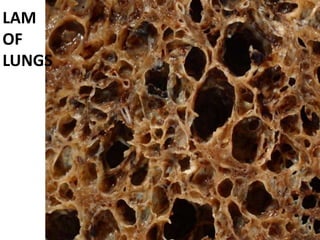
LAM
OF
LUNGS
LAM typically occurs in premenopausal
women, suggesting the involvement of
female hormones in disease pathogenesis.
LAM can occur with increased frequency in
patients with tuberous sclerosis complex
(TSC), an autosomal dominant disorder due
to mutations in the TSC1 or TSC2 gene.
Proliferation of lymphangioleiomyomatosis (LAM) cells
may obstruct bronchioles,possibly leading to airflow
obstruction, air trapping, formation of bullae, and
pneumothoraces. Obstruction of lymphatics may result in
lymphangioleiomyomas, chylothorax, and chylous ascites.
Obstruction of venules may result in hemosiderosis and
hemoptysis. Excessive proteolytic activity, which relates
to an imbalance of the elastase/alpha1-antitrypsin system
or metalloprotease (MMPs) and their inhibitors (tissue
inhibitors of metalloproteases [TIMPs]), may be
important in lung destruction and formation of cysts.
PATHOLOGY
R
Race
No racial predilection has been reported for
lymphangioleiomyomatosis (LAM).
Sex
Lymphangioleiomyomatosis (LAM) primarily is a disease of
women (esp in premenopausal time /pregnancy) ;
however, rare case reports describe LAM in men with TSC.
Age
Although primarily a disease of women of childbearing
age, lymphangioleiomyomatosis (LAM) has also been reported
in postmenopausal patients.
EPIDEMIOLOGY:
CLINICAL MANIFESTATIONS
Common lymphangioleiomyomatosis (LAM) symptoms include the
following:
Dyspnea
Cough
Less common symptoms (findings) are associated with the
following:
Pneumothorax, pneumoperitoneum
Chylothorax, chylous ascites
Lymphedema
Exacerbations of LAM have been reported to occur during
pregnancy and menstruation, as well as with exogenous estrogen
use.
LAM may be present in approximately 30-40% of patients with
tuberous sclerosis complex (TSC).
Causes
The etiology of lymphangioleiomyomatosis
(LAM) is unknown; however, the fact that the
condition occurs primarily in premenopausal
women and that it is exacerbated by high
estrogen states suggests a role for hormones.
The link with TSC suggests a genetic
component.
Laboratory Studies
Vascular endothelial growth factor-D (VEGF-D)
levels, above a certain threshold, are found in
lymphangioleiomyomatosis (LAM) but not other
cystic lung diseases. Hence, a serologic test for
VEGF-D may be useful for diagnosis. A prior study
has shown that high levels of VEGF-D are
associated with lymphatic involvement
(eg, lymphangioleiomyomas, adenopathy) in LAM.
Imaging Studies
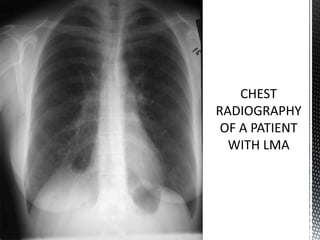
*Chest radiographs in lymphangioleiomyomatosis (LAM)
may be normal. Fine reticular or reticulo-nodular interstitial
infiltrate with preserved lung volumes is the most commonly
observed abnormality. Pleural effusions may be present.
Patients may present with pneumothorax.
*CT or MRI scanning of the head may reveal an incidental or
symptomatic meningioma, which occurs with increased
frequency in patients with LAM .
*On bone densitometry, patients with LAM exhibit
accelerated osteoporosis
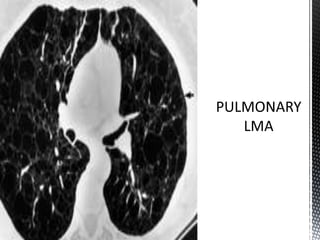
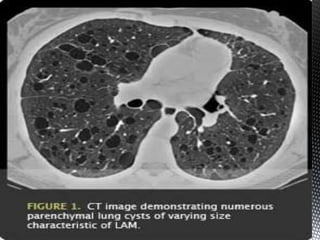
*CT scan and high-resolution CT scan findings include
the following:
 Diffuse thin-walled cysts - The defining appearance in LAM
 Adenopathy and thoracic duct dilatation
 Pleural effusion
 Pneumothorax
 Ground-glass opacities - May be present, perhaps representing alveolar
hemorrhage or interstitial disease
 Pericardial effusion
 Multifocal multinodular pneumocyte hyperplasia (MMPH) - Can be seen in
patients with tuberous sclerosus complex (TSC), but the pathology is distinct
from LAM
*Abdominal imaging by either ultrasound or CT scan may
demonstrate the following:
 Angiomyolipoma (AML) - Benign tumors (kidney, liver, spleen) containing
smooth muscle, thick-walled blood vessels, and mature adipose tissue
 Retroperitoneal or mediastinal lymphangioleiomyomas
Other Tests
Pulmonary function testing, decreased diffusing capacity for
carbon monoxide is the most common abnormality seen, and it
is often markedly reduced.Hypoxemia at rest, worsening with
exercise, is a common finding.
On spirometry, airflow obstruction is the most frequent
abnormality; restriction or mixed obstruction and restriction can
also be seen.
Lung volumes may show an increased ratio of residual volume
to total lung capacity
Procedures
Histologic diagnosis can be made by performing an open
lung, video-assisted thoracoscopic, or transbronchial biopsy
(TBB); the amount of tissue obtained from TBB may be
insufficient to confirm a diagnosis. Lymphangioleiomyomatosis
(LAM) cells react with human melanoma black (HMB)–45, an
antibody generated against an extract of melanoma.HMB-45
staining is used for the identification of LAM cells and may help
in confirming LAM on TBB.
With classic high-resolution CT scans of the lung and associated
findings of LAM (eg, tuberous sclerosis
complex, angiomyolipoma, lymphangioleiomyomas), histologic
confirmation may be unnecessary.
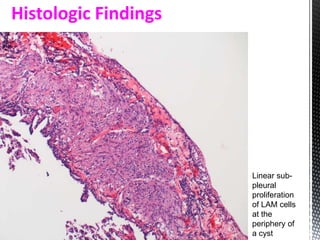
Histologic Findings
Linear sub-
pleural
proliferation
of LAM cells
at the
periphery of
a cyst
Microscopic pathology
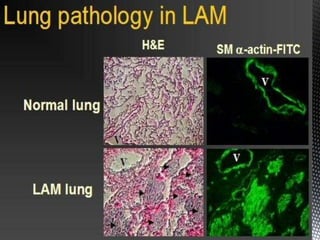
In histological sections of the lung, the following are observed:
Proliferation of lymphangioleiomyomatosis (LAM) cells (spindle-
shaped cells with small nuclei, larger epithelioid cells with clear
cytoplasm and round nuclei) having a smooth muscle cell
phenotype.
Loss of alveoli with cyst formation
Aggregates of LAM cells abutting cystic spaces
Distal airway narrowing, thickened arterial walls with venous
occlusion, and hemosiderosis
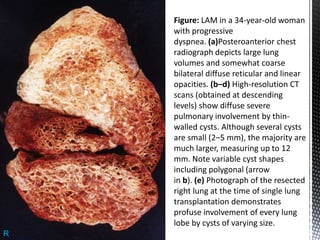
Macroscopic pathology
Cysts are evenly distributed in all lung fields. Lymph nodes
(retroperitoneal and pelvic) may appear pale and spongy; large
chyle-filled cysts can be found within the axial lymphatic system.
The thoracic duct may be large, spongy, and sausage-like.
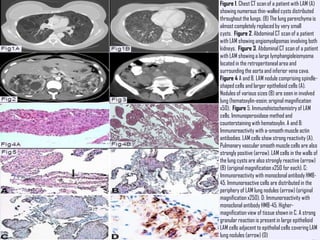
Figure 1. Chest CT scan of a patient with LAM (A)
showing numerous thin-walled cysts distributed
throughout the lungs. (B) The lung parenchyma is
almost completely replaced by very small
cysts. Figure 2. Abdominal CT scan of a patient
with LAM showing angiomyolipomas involving both
kidneys. Figure 3. Abdominal CT scan of a patient
with LAM showing a large lymphangioleiomyoma
located in the retroperitoneal area and
surrounding the aorta and inferior vena cava.
Figure 4 A and B. LAM nodule comprising spindle-
shaped cells and larger epithelioid cells (A).
Nodules of various sizes (B) are seen in involved
lung (hematoxylin-eosin; original magnification
x50). Figure 5. Immunohistochemistry of LAM
cells. Immunoperoxidase method and
counterstaining with hematoxylin. A and B:
Immunoreactivity with a-smooth muscle actin
antibodies. LAM cells show strong reactivity (A).
Pulmonary vascular smooth muscle cells are also
strongly positive (arrow). LAM cells in the walls of
the lung cysts are also strongly reactive (arrow)
(B) (original magnification x250 for each). C:
Immunoreactivity with monoclonal antibody HMB-
45. Immunoreactive cells are distributed in the
periphery of LAM lung nodules (arrow) (original
magnification x250). D: Immunoreactivity with
monoclonal antibody HMB-45. Higher-
magnification view of tissue shown in C. A strong
granular reaction is present in large epithelioid
LAM cells adjacent to epithelial cells covering LAM
lung nodules (arrow) (D)
In involved lymph nodes and the thoracic duct, there are
interlacing bundles of LAM cells, which may invade the walls of
the lymphatics.
Immunohistochemical staining of LAM lesions demonstrates the
following:
Reactivity with anti–alpha-smooth actin antibodies, which is
consistent with smooth-muscle differentiation
Estrogen and progesterone receptors
Immunoreactivity with the monoclonal antibody HMB-45, which
recognizes LAM cells with epithelioid features; rarely, spindle
cells are also HMB-45 positive
Renal and hepatic AMLs, as well as lymphangioleiomyomas, can
also be detected with HMB-45 antibody
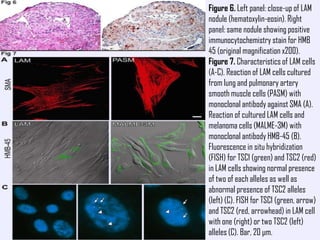
Figure 6. Left panel: close-up of LAM
nodule (hematoxylin-eosin). Right
panel: same nodule showing positive
immunocytochemistry stain for HMB
45 (original magnification x200).
Figure 7. Characteristics of LAM cells
(A-C). Reaction of LAM cells cultured
from lung and pulmonary artery
smooth muscle cells (PASM) with
monoclonal antibody against SMA (A).
Reaction of cultured LAM cells and
melanoma cells (MALME-3M) with
monoclonal antibody HMB-45 (B).
Fluorescence in situ hybridization
(FISH) for TSC1 (green) and TSC2 (red)
in LAM cells showing normal presence
of two of each alleles as well as
abnormal presence of TSC2 alleles
(left) (C). FISH for TSC1 (green, arrow)
and TSC2 (red, arrowhead) in LAM cell
with one (right) or two TSC2 (left)
alleles (C). Bar, 20 µm.
TREATMENT
 General care for patients with lymphangioleiomyomatosis (LAM) addresses
the following findings:
 Pleural effusions - Consider chemical pleurodesis; surgical obliteration of
the pleural space; medium-chain triglyceride (MCT [not a component of
chyle]), lipid-free diet to reduce chyle flow (utility unknown)
 Ascites - Paracentesis, MCT diet (utility unknown)
 Airways disease and hypoxemia - Bronchodilators may be of benefit[25] ;
supplemental oxygen, pulmonary rehabilitation, smoking cessation
 Standard vaccination for respiratory infections
 Osteoporosis - Standard surveillance and treatment; avoid exogenous
estrogens
 Lung transplantation
Possible options for hormonal manipulation include the
following:
Medroxyprogesterone - Utility not known; recent case series does
not support its use
Gonadotropin-releasing hormone agonists - Utility not known; few
case reports support their use
Tamoxifen does not appear to be effective and is not recommended
due to estrogen receptor agonist activity
Rate of decline in lung function trends to be less in postmenopausal
women (eg, surgical oophorectomy, age)
New experimental therapies include the following:
Rapamycin - Shrinks angiomyolipomas and improves lung
function, but response is not sustained
Doxycycline - Antiangiogenic, antibiotic, and matrix
effects
Aromatase inhibitors - Antiestrogenic effect
THANK YOU


Lymphangioleiomyomatosis

  • 1.
  • 2.
    Lymphangioleiomyomatosis (LAM) isa rare disorder resulting from proliferation in the lung, kidney, and axial lymphatics of leiomyoma (LAM cells) that exhibit features of neoplasia. Cystic destruction of the lung with progressive pulmonary dysfunction(pneumothorax , dyspnea), and the presence of abdominal tumors (eg, angiomyolipomas [AML], lymphangioleiomyomas) characterize the disease.
  • 3.
  • 4.
    LAM typically occursin premenopausal women, suggesting the involvement of female hormones in disease pathogenesis. LAM can occur with increased frequency in patients with tuberous sclerosis complex (TSC), an autosomal dominant disorder due to mutations in the TSC1 or TSC2 gene.
  • 5.
    Proliferation of lymphangioleiomyomatosis(LAM) cells may obstruct bronchioles,possibly leading to airflow obstruction, air trapping, formation of bullae, and pneumothoraces. Obstruction of lymphatics may result in lymphangioleiomyomas, chylothorax, and chylous ascites. Obstruction of venules may result in hemosiderosis and hemoptysis. Excessive proteolytic activity, which relates to an imbalance of the elastase/alpha1-antitrypsin system or metalloprotease (MMPs) and their inhibitors (tissue inhibitors of metalloproteases [TIMPs]), may be important in lung destruction and formation of cysts. PATHOLOGY
  • 6.
  • 8.
    Race No racial predilectionhas been reported for lymphangioleiomyomatosis (LAM). Sex Lymphangioleiomyomatosis (LAM) primarily is a disease of women (esp in premenopausal time /pregnancy) ; however, rare case reports describe LAM in men with TSC. Age Although primarily a disease of women of childbearing age, lymphangioleiomyomatosis (LAM) has also been reported in postmenopausal patients. EPIDEMIOLOGY:
  • 9.
    CLINICAL MANIFESTATIONS Common lymphangioleiomyomatosis(LAM) symptoms include the following: Dyspnea Cough Less common symptoms (findings) are associated with the following: Pneumothorax, pneumoperitoneum Chylothorax, chylous ascites Lymphedema Exacerbations of LAM have been reported to occur during pregnancy and menstruation, as well as with exogenous estrogen use. LAM may be present in approximately 30-40% of patients with tuberous sclerosis complex (TSC).
  • 10.
    Causes The etiology oflymphangioleiomyomatosis (LAM) is unknown; however, the fact that the condition occurs primarily in premenopausal women and that it is exacerbated by high estrogen states suggests a role for hormones. The link with TSC suggests a genetic component.
  • 11.
    Laboratory Studies Vascular endothelialgrowth factor-D (VEGF-D) levels, above a certain threshold, are found in lymphangioleiomyomatosis (LAM) but not other cystic lung diseases. Hence, a serologic test for VEGF-D may be useful for diagnosis. A prior study has shown that high levels of VEGF-D are associated with lymphatic involvement (eg, lymphangioleiomyomas, adenopathy) in LAM.
  • 12.
    Imaging Studies *Chest radiographsin lymphangioleiomyomatosis (LAM) may be normal. Fine reticular or reticulo-nodular interstitial infiltrate with preserved lung volumes is the most commonly observed abnormality. Pleural effusions may be present. Patients may present with pneumothorax. *CT or MRI scanning of the head may reveal an incidental or symptomatic meningioma, which occurs with increased frequency in patients with LAM . *On bone densitometry, patients with LAM exhibit accelerated osteoporosis
  • 14.
    *CT scan andhigh-resolution CT scan findings include the following:  Diffuse thin-walled cysts - The defining appearance in LAM  Adenopathy and thoracic duct dilatation  Pleural effusion  Pneumothorax  Ground-glass opacities - May be present, perhaps representing alveolar hemorrhage or interstitial disease  Pericardial effusion  Multifocal multinodular pneumocyte hyperplasia (MMPH) - Can be seen in patients with tuberous sclerosus complex (TSC), but the pathology is distinct from LAM *Abdominal imaging by either ultrasound or CT scan may demonstrate the following:  Angiomyolipoma (AML) - Benign tumors (kidney, liver, spleen) containing smooth muscle, thick-walled blood vessels, and mature adipose tissue  Retroperitoneal or mediastinal lymphangioleiomyomas
  • 16.
    Other Tests Pulmonary functiontesting, decreased diffusing capacity for carbon monoxide is the most common abnormality seen, and it is often markedly reduced.Hypoxemia at rest, worsening with exercise, is a common finding. On spirometry, airflow obstruction is the most frequent abnormality; restriction or mixed obstruction and restriction can also be seen. Lung volumes may show an increased ratio of residual volume to total lung capacity
  • 17.
    Procedures Histologic diagnosis canbe made by performing an open lung, video-assisted thoracoscopic, or transbronchial biopsy (TBB); the amount of tissue obtained from TBB may be insufficient to confirm a diagnosis. Lymphangioleiomyomatosis (LAM) cells react with human melanoma black (HMB)–45, an antibody generated against an extract of melanoma.HMB-45 staining is used for the identification of LAM cells and may help in confirming LAM on TBB. With classic high-resolution CT scans of the lung and associated findings of LAM (eg, tuberous sclerosis complex, angiomyolipoma, lymphangioleiomyomas), histologic confirmation may be unnecessary.
  • 18.
  • 19.
    Microscopic pathology In histologicalsections of the lung, the following are observed: Proliferation of lymphangioleiomyomatosis (LAM) cells (spindle- shaped cells with small nuclei, larger epithelioid cells with clear cytoplasm and round nuclei) having a smooth muscle cell phenotype. Loss of alveoli with cyst formation Aggregates of LAM cells abutting cystic spaces Distal airway narrowing, thickened arterial walls with venous occlusion, and hemosiderosis
  • 21.
    Macroscopic pathology Cysts areevenly distributed in all lung fields. Lymph nodes (retroperitoneal and pelvic) may appear pale and spongy; large chyle-filled cysts can be found within the axial lymphatic system. The thoracic duct may be large, spongy, and sausage-like.
  • 22.
    Figure 1. ChestCT scan of a patient with LAM (A) showing numerous thin-walled cysts distributed throughout the lungs. (B) The lung parenchyma is almost completely replaced by very small cysts. Figure 2. Abdominal CT scan of a patient with LAM showing angiomyolipomas involving both kidneys. Figure 3. Abdominal CT scan of a patient with LAM showing a large lymphangioleiomyoma located in the retroperitoneal area and surrounding the aorta and inferior vena cava. Figure 4 A and B. LAM nodule comprising spindle- shaped cells and larger epithelioid cells (A). Nodules of various sizes (B) are seen in involved lung (hematoxylin-eosin; original magnification x50). Figure 5. Immunohistochemistry of LAM cells. Immunoperoxidase method and counterstaining with hematoxylin. A and B: Immunoreactivity with a-smooth muscle actin antibodies. LAM cells show strong reactivity (A). Pulmonary vascular smooth muscle cells are also strongly positive (arrow). LAM cells in the walls of the lung cysts are also strongly reactive (arrow) (B) (original magnification x250 for each). C: Immunoreactivity with monoclonal antibody HMB- 45. Immunoreactive cells are distributed in the periphery of LAM lung nodules (arrow) (original magnification x250). D: Immunoreactivity with monoclonal antibody HMB-45. Higher- magnification view of tissue shown in C. A strong granular reaction is present in large epithelioid LAM cells adjacent to epithelial cells covering LAM lung nodules (arrow) (D)
  • 23.
    In involved lymphnodes and the thoracic duct, there are interlacing bundles of LAM cells, which may invade the walls of the lymphatics. Immunohistochemical staining of LAM lesions demonstrates the following: Reactivity with anti–alpha-smooth actin antibodies, which is consistent with smooth-muscle differentiation Estrogen and progesterone receptors Immunoreactivity with the monoclonal antibody HMB-45, which recognizes LAM cells with epithelioid features; rarely, spindle cells are also HMB-45 positive Renal and hepatic AMLs, as well as lymphangioleiomyomas, can also be detected with HMB-45 antibody
  • 24.
    Figure 6. Leftpanel: close-up of LAM nodule (hematoxylin-eosin). Right panel: same nodule showing positive immunocytochemistry stain for HMB 45 (original magnification x200). Figure 7. Characteristics of LAM cells (A-C). Reaction of LAM cells cultured from lung and pulmonary artery smooth muscle cells (PASM) with monoclonal antibody against SMA (A). Reaction of cultured LAM cells and melanoma cells (MALME-3M) with monoclonal antibody HMB-45 (B). Fluorescence in situ hybridization (FISH) for TSC1 (green) and TSC2 (red) in LAM cells showing normal presence of two of each alleles as well as abnormal presence of TSC2 alleles (left) (C). FISH for TSC1 (green, arrow) and TSC2 (red, arrowhead) in LAM cell with one (right) or two TSC2 (left) alleles (C). Bar, 20 µm.
  • 25.
    TREATMENT  General carefor patients with lymphangioleiomyomatosis (LAM) addresses the following findings:  Pleural effusions - Consider chemical pleurodesis; surgical obliteration of the pleural space; medium-chain triglyceride (MCT [not a component of chyle]), lipid-free diet to reduce chyle flow (utility unknown)  Ascites - Paracentesis, MCT diet (utility unknown)  Airways disease and hypoxemia - Bronchodilators may be of benefit[25] ; supplemental oxygen, pulmonary rehabilitation, smoking cessation  Standard vaccination for respiratory infections  Osteoporosis - Standard surveillance and treatment; avoid exogenous estrogens  Lung transplantation
  • 26.
    Possible options forhormonal manipulation include the following: Medroxyprogesterone - Utility not known; recent case series does not support its use Gonadotropin-releasing hormone agonists - Utility not known; few case reports support their use Tamoxifen does not appear to be effective and is not recommended due to estrogen receptor agonist activity Rate of decline in lung function trends to be less in postmenopausal women (eg, surgical oophorectomy, age)
  • 27.
    New experimental therapiesinclude the following: Rapamycin - Shrinks angiomyolipomas and improves lung function, but response is not sustained Doxycycline - Antiangiogenic, antibiotic, and matrix effects Aromatase inhibitors - Antiestrogenic effect
  • 28.