EVERYTHING YOU NEED TO KNOW ABOUT KNEE
REPLACEMENT SURGERY
Source - http://healthfirstmagazine.blogspot.in/2016/08/everything-you-need-to-know-about-knee.html
In order to live a healthy and active lifestyle, good knees are essential! However, when
suffer from an injury or arthritis occurs, particularly osteoarthritis, your ability to bend and
flex your knees can become restricted due to damage, inflammation and pain. If not taken
care of properly, the damage can progress, making life so much more difficult and painful.
Deterioration of your joint and surrounding tissue can make it quite difficult to perform
basic daily activities, even while you sit or lie down.
While cartilage wears down and bone rubs against bone, pain and reduced mobility follow.
Knee replacement surgery is a common solution that provides dramatic pain relief for more
than 90 percent of patients.
The vast majority of knee replacement procedures are used to treat osteoarthritis. The
procedure which was introduced in 1968, relies on a mechanical implant to replace severely
arthritic or damaged knee joints.
Total knee replacement (TKR), also called total knee arthroplasty (TKA), is considered one
of the safest and most effective procedures in orthopedics.
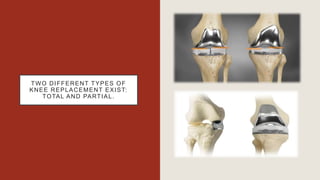
TWO DIFFERENT TYPES OF
KNEE REPLACEMENT EXIST:
TOTAL AND PARTIAL.
TOTAL KNEE
REPLACEMENT
Total Knee Replacement makes up about
90 percent of all knee replacement
procedures.
 Total Knee Replacement makes up about 90
percent of all knee replacement procedures.
 During TKR, a surgeon plans to repair your
knee joint by covering the thighbone with a
metal covering and encasing the shinbone with
plastic.
 The prosthesis replaces the rough and irregular
surfaces of the worn bone with smooth
surfaces. In many cases, the surgeon can also
replace the undersurface of your kneecap with a
plastic surface.
 This further reduces pain and provides a
smoother functioning joint. If this is an option
you are considering, it’s important to remember
that the procedure involves some removal of
bone and cartilage.
 This is a major surgery!
PARTIAL KNEE
REPLACEMENT
If you receive a partial knee
replacement, your surgeon will replace
only the part of your knee that’s
damaged or arthritic.
The advantage to this type of procedure is
that it requires a smaller incision, involves
less bone and blood loss and consequently
produces less pain.
Patients undergoing partial knee
replacement tend to experience a faster
recovery time than those who have TKR.
However, there are disadvantages,
including the possibility that you will have
to eventually undergo further surgery if
arthritis develops in the parts of the knee
that are not replaced.
RISKS, COMPLICATIONS,
AND CONSIDERATIONS
Today, knee replacements are
considered safe. Very few patients
experience complications. The most
common surgical complication is
infection, which has been documented
to occur in fewer than 2 percent of
patients
. When complications do occur, they may
include: infection, blood clots, a problem
with the implant, or persistent pain and
damage to the blood vessels surrounding
the knee as a result of the surgery.
Thoroughly discuss the benefits and risks
of TKR with your surgeon before making
any decision about a procedure.
You may also want to evaluate other
considerations, such as: financial issues
(the cost of surgery, follow-up care, and
time off from work), hospital quality, and
what to expect from your new knee.
TKR is an increasingly attractive and viable option if you happen to be dealing with chronic
knee pain or unable to participate in common activities.
Approximately 90 percent of the replacement joints last 10 years. In about 80 percent of
cases, it functions for 20 years.
This can depend heavily on your age and level of activity. Seniors, who are less likely to put
their new joint under regular stress, wear the joint down less than relatively younger patients
who are more active.
After a knee replacement, there’s a high probability that you will once again participate in
activities such as walking, bicycling, golf, tennis and swimming.
As the pain subsides and the ability to use your knee returns, your quality of life will most
likely improve!
N o t e - T h i s A r t i c l e i s o r i g i n a l l y a p p e a r e d o n h t t p : / / h e a l t h f i r s t m a g a z i n e . b l o g s p o t . i n / 2 0 1 6 / 0 8 / e v e r yt h i n g - yo u -
n e e d - t o - k n o w - a b o u t - k n e e . h t m l

Everything you need to know about knee replacement surgery

  • 1.
    EVERYTHING YOU NEEDTO KNOW ABOUT KNEE REPLACEMENT SURGERY Source - http://healthfirstmagazine.blogspot.in/2016/08/everything-you-need-to-know-about-knee.html
  • 2.
    In order tolive a healthy and active lifestyle, good knees are essential! However, when suffer from an injury or arthritis occurs, particularly osteoarthritis, your ability to bend and flex your knees can become restricted due to damage, inflammation and pain. If not taken care of properly, the damage can progress, making life so much more difficult and painful. Deterioration of your joint and surrounding tissue can make it quite difficult to perform basic daily activities, even while you sit or lie down. While cartilage wears down and bone rubs against bone, pain and reduced mobility follow. Knee replacement surgery is a common solution that provides dramatic pain relief for more than 90 percent of patients. The vast majority of knee replacement procedures are used to treat osteoarthritis. The procedure which was introduced in 1968, relies on a mechanical implant to replace severely arthritic or damaged knee joints. Total knee replacement (TKR), also called total knee arthroplasty (TKA), is considered one of the safest and most effective procedures in orthopedics.
  • 3.
    TWO DIFFERENT TYPESOF KNEE REPLACEMENT EXIST: TOTAL AND PARTIAL.
  • 4.
    TOTAL KNEE REPLACEMENT Total KneeReplacement makes up about 90 percent of all knee replacement procedures.  Total Knee Replacement makes up about 90 percent of all knee replacement procedures.  During TKR, a surgeon plans to repair your knee joint by covering the thighbone with a metal covering and encasing the shinbone with plastic.  The prosthesis replaces the rough and irregular surfaces of the worn bone with smooth surfaces. In many cases, the surgeon can also replace the undersurface of your kneecap with a plastic surface.  This further reduces pain and provides a smoother functioning joint. If this is an option you are considering, it’s important to remember that the procedure involves some removal of bone and cartilage.  This is a major surgery!
  • 5.
    PARTIAL KNEE REPLACEMENT If youreceive a partial knee replacement, your surgeon will replace only the part of your knee that’s damaged or arthritic. The advantage to this type of procedure is that it requires a smaller incision, involves less bone and blood loss and consequently produces less pain. Patients undergoing partial knee replacement tend to experience a faster recovery time than those who have TKR. However, there are disadvantages, including the possibility that you will have to eventually undergo further surgery if arthritis develops in the parts of the knee that are not replaced.
  • 6.
    RISKS, COMPLICATIONS, AND CONSIDERATIONS Today,knee replacements are considered safe. Very few patients experience complications. The most common surgical complication is infection, which has been documented to occur in fewer than 2 percent of patients . When complications do occur, they may include: infection, blood clots, a problem with the implant, or persistent pain and damage to the blood vessels surrounding the knee as a result of the surgery. Thoroughly discuss the benefits and risks of TKR with your surgeon before making any decision about a procedure. You may also want to evaluate other considerations, such as: financial issues (the cost of surgery, follow-up care, and time off from work), hospital quality, and what to expect from your new knee.
  • 7.
    TKR is anincreasingly attractive and viable option if you happen to be dealing with chronic knee pain or unable to participate in common activities. Approximately 90 percent of the replacement joints last 10 years. In about 80 percent of cases, it functions for 20 years. This can depend heavily on your age and level of activity. Seniors, who are less likely to put their new joint under regular stress, wear the joint down less than relatively younger patients who are more active. After a knee replacement, there’s a high probability that you will once again participate in activities such as walking, bicycling, golf, tennis and swimming. As the pain subsides and the ability to use your knee returns, your quality of life will most likely improve!
  • 8.
    N o te - T h i s A r t i c l e i s o r i g i n a l l y a p p e a r e d o n h t t p : / / h e a l t h f i r s t m a g a z i n e . b l o g s p o t . i n / 2 0 1 6 / 0 8 / e v e r yt h i n g - yo u - n e e d - t o - k n o w - a b o u t - k n e e . h t m l