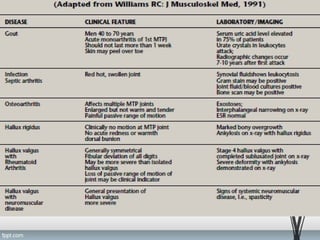
Hallux Valgus
Siwaporn Khureerung
Roi-Et Medical School
3 Sep 2014
Introduction
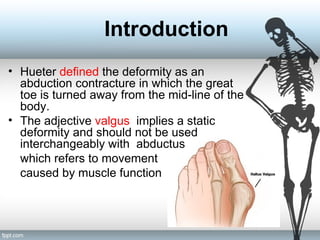
• Hueter defined the deformity as an
abduction contracture in which the great
toe is turned away from the mid-line of the
body.
• The adjective valgus implies a static
deformity and should not be used
interchangeably with abductus
which refers to movement
caused by muscle function
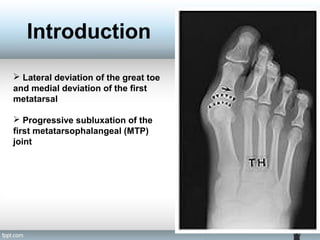
 Lateral deviation of the great toe
and medial deviation of the first
metatarsal
 Progressive subluxation of the
first metatarsophalangeal (MTP)
joint
Introduction
Anatomy
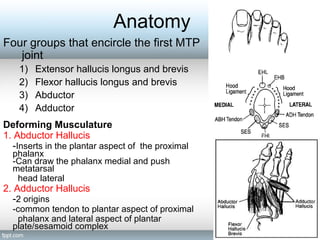
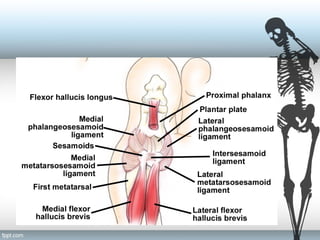
Four groups that encircle the first MTP
joint
1) Extensor hallucis longus and brevis
2) Flexor hallucis longus and brevis
3) Abductor
4) Adductor
Deforming Musculature
1. Abductor Hallucis
-Inserts in the plantar aspect of the proximal
phalanx
-Can draw the phalanx medial and push
metatarsal
head lateral
2. Adductor Hallucis
-2 origins
-common tendon to plantar aspect of proximal
phalanx and lateral aspect of plantar
plate/sesamoid complex
Anatomy
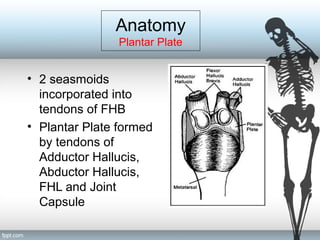
Plantar Plate
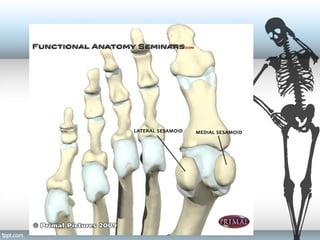
• 2 seasmoids
incorporated into
tendons of FHB
• Plantar Plate formed
by tendons of
Adductor Hallucis,
Abductor Hallucis,
FHL and Joint
Capsule
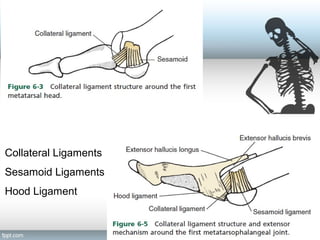
Collateral Ligaments
Sesamoid Ligaments
Hood Ligament
Dermographic
• Age of oset : >20y
• Gender : female
• Bilaterality :> 84%
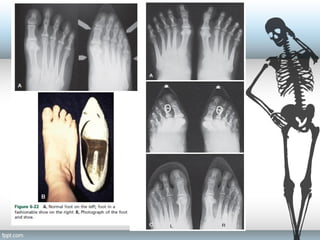
Footwear
Occupation
 Heredity- 60% to 90%
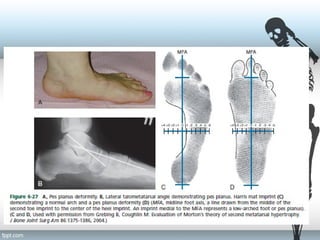
 Pes Planus
 Hypermobility of
Metatarsocuneiform joint
 Ligamentous laxity
 Achilles Contracture
 Neuromuscular disorders
 Systemic conditions like RA
 Misc factors: 2nd
toe amputation;
 Cystic degneration of medial capsule
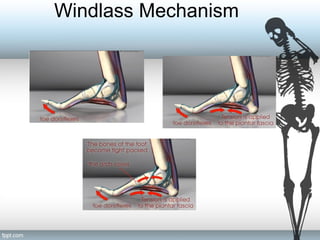
Windlass Mechanism
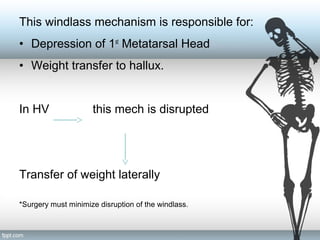
This windlass mechanism is responsible for:
• Depression of 1st
Metatarsal Head
• Weight transfer to hallux.
In HV this mech is disrupted
Transfer of weight laterally
*Surgery must minimize disruption of the windlass.
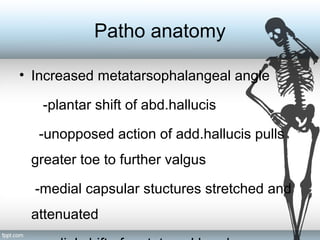
Patho anatomy
• Increased metatarsophalangeal angle
-plantar shift of abd.hallucis
-unopposed action of add.hallucis pulls
greater toe to further valgus
-medial capsular stuctures stretched and
attenuated
CONT….
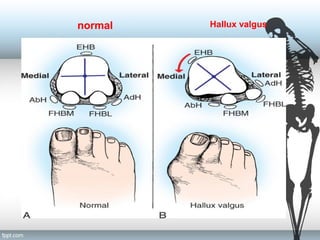
• FHL,FHB&EHL increase valgus stress
• Lateral sesamoid displaced into first
webspace
normal Hallux valgus
•
Clinical Presentation
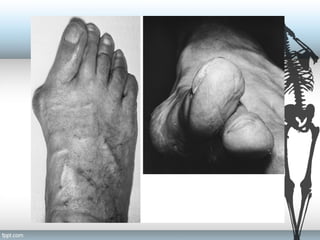
PAIN over the medial eminence (Bunion).
• Pressure from footwear is the most frequent cause of
this discomfort.
• Bursal inflammation
• Irritation of the skin
• Breakdown of the skin may be noted.
• Bunion consists of:
• Bony exostosis / prominence of the metatarsal head
• Overlying subcutaneous bursa
• Hyperkeratosis of dermis
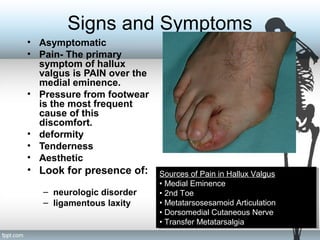
Signs and Symptoms
• Asymptomatic
• Pain- The primary
symptom of hallux
valgus is PAIN over the
medial eminence.
• Pressure from footwear
is the most frequent
cause of this
discomfort.
• deformity
• Tenderness
• Aesthetic
• Look for presence of:
– neurologic disorder
– ligamentous laxity
Sources of Pain in Hallux Valgus
• Medial Eminence
• 2nd Toe
• Metatarsosesamoid Articulation
• Dorsomedial Cutaneous Nerve
• Transfer Metatarsalgia
Sources of Pain in Hallux Valgus
• Medial Eminence
• 2nd Toe
• Metatarsosesamoid Articulation
• Dorsomedial Cutaneous Nerve
• Transfer Metatarsalgia
Pronated Toe Fig 6
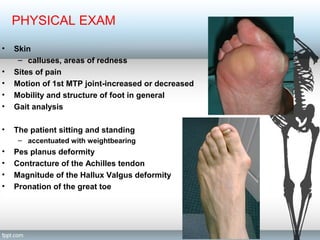
PHYSICAL EXAM
• Skin
– calluses, areas of redness
• Sites of pain
• Motion of 1st MTP joint-increased or decreased
• Mobility and structure of foot in general
• Gait analysis
• The patient sitting and standing
– accentuated with weightbearing
• Pes planus deformity
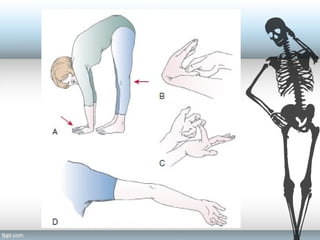
• Contracture of the Achilles tendon
• Magnitude of the Hallux Valgus deformity
• Pronation of the great toe
• Passive and active range of motion of the
MTP joint is measured
– Pain or crepitus, or both, with motion of
the MTP joint
• Metatarsocuneiform joint for hypermobility
– Examiner grasps the first metatarsal
with the thumb and index finger and
pushes it in a plantar lateral-to-
dorsomedial direction.
– Mobility of more than 9 mm represents
hypermobility
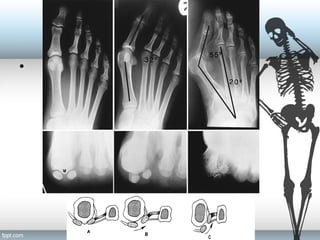
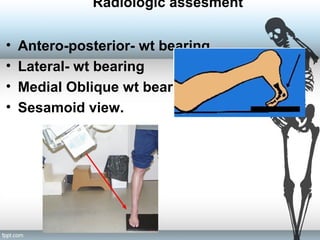
Radiologic assesment
• Antero-posterior- wt bearing
• Lateral- wt bearing
• Medial Oblique wt bearing
• Sesamoid view.
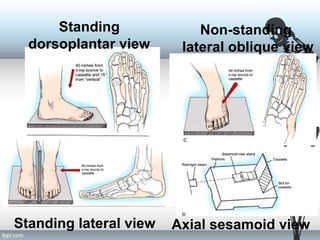
Standing
dorsoplantar view
Non-standing
lateral oblique view
Standing lateral view Axial sesamoid view
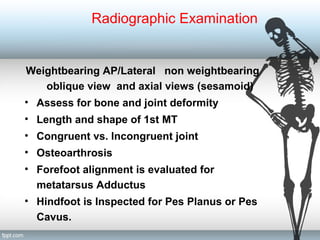
Radiographic Examination
Weightbearing AP/Lateral non weightbearing
oblique view and axial views (sesamoid)
• Assess for bone and joint deformity
• Length and shape of 1st MT
• Congruent vs. Incongruent joint
• Osteoarthrosis
• Forefoot alignment is evaluated for
metatarsus Adductus
• Hindfoot is Inspected for Pes Planus or Pes
Cavus.
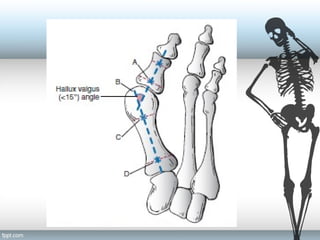
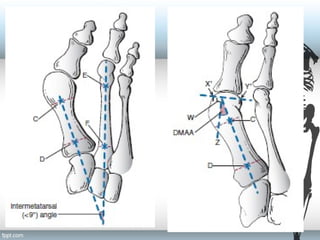
IMA (normal <9°) [8-9]
HVA (normal <15°) [15-20]
DMAA (normal <10°) [10-15]
Hallux
valgus
angle
Intermetatarsal
angle
Distal
metatarsal
articular
angle
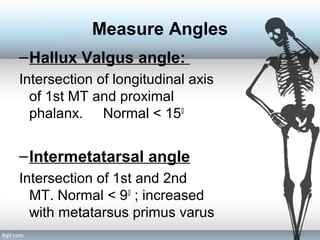
Measure Angles
–Hallux Valgus angle:
Intersection of longitudinal axis
of 1st MT and proximal
phalanx. Normal < 150
–Intermetatarsal angle
Intersection of 1st and 2nd
MT. Normal < 90
; increased
with metatarsus primus varus
Radiographic measurements
• Distal Metatarsal Articular Angle(DMMA)
Defines the relationship of the distal articular
surface of the 1st MT to the longitudinal axis.
Quantities the magnitude of lateral slope of
articular surface.
With subluxation, the articular surface deviates
laterally in relationship to the 1st Metatarsal.
Usually < 60
.
Radiographic measurements
• Hallux Interphalyngeal angle
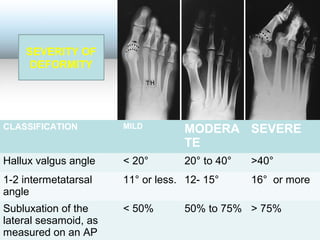
CLASSIFICATION MILD
MODERA
TE
SEVERE
Hallux valgus angle < 20° 20° to 40° >40°
1-2 intermetatarsal
angle
11° or less. 12- 15° 16° or more
Subluxation of the
lateral sesamoid, as
measured on an AP
< 50% 50% to 75% > 75%
SEVERITY OF
DEFORMITY
TREATMENT
• Non-operative vs. Operative
• All patients should be treated non-operatively
first.
Despite conservative measures, some patients
eventually need surgical intervention.
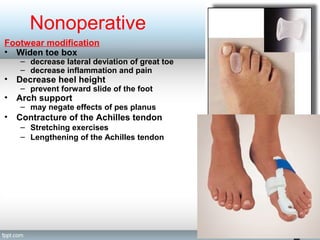
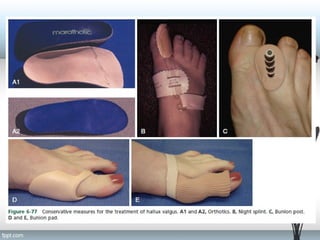
Nonoperative
Footwear modification
• Widen toe box
– decrease lateral deviation of great toe
– decrease inflammation and pain
• Decrease heel height
– prevent forward slide of the foot
• Arch support
– may negate effects of pes planus
• Contracture of the Achilles tendon
– Stretching exercises
– Lengthening of the Achilles tendon
Painful joint ROMPainful joint ROM
Deformity of the joint complexDeformity of the joint complex
Pain or difficulty with footwearPain or difficulty with footwear
Inhibition of activity or lifestyleInhibition of activity or lifestyle
Indications for surgeryIndications for surgery
Associated foot disordersAssociated foot disorders
- Neuritis/nerve entrapment
- Overlapping/underlapping 2nd
digit
- Hammer digits
- First metatarsocuneiform joint exostosis
- Sesamoiditis
- Ulceration
- Inflammatory conditions (bursitis, tendinitis)
of 1st
metatarsal head
Indications for surgeryIndications for surgery
Extensive peripheral vascular diseaseExtensive peripheral vascular disease
Active infectionActive infection
Active osteoarthropathyActive osteoarthropathy
Septic arthritisSeptic arthritis
Lack of pain or deformityLack of pain or deformity
Advanced ageAdvanced age
Lack of complianceLack of compliance
ContraindicationsContraindications
MIMI within the previouswithin the previous 66 monthsmonths
Comorbid conditions that place theComorbid conditions that place the
patient at significantpatient at significant CVCV or respiratory riskor respiratory risk
ContraindicationsContraindications
Relieve pain
Correct deformity
Preserve MTP joint motion
Surgical GoalsSurgical Goals
1. Valgus deviation of the great toe
2. Varus deviation of the 1st
metatarsal
3. Pronation of hallux and/or 1st
metatarsal
4. Hallux valgus interphalangeus
5. Arthritis and limitation of motion of the
1st
metatarsophalangeal joint
6. Length of the 1st
metatarsal relative to
lesser metatarsals
Preoperative evaluationPreoperative evaluation
7. Excessive mobility or obliquity of the 1st
metatarsomedial cuneiform joint
8. The medial eminence (bunion)
9. The location of the sesamoid apparatus
10. Intrinsic and extrinsic muscle-tendon
balance and synchrony
Preoperative evaluationPreoperative evaluation
Hallux Valgus <25Hallux Valgus <25°°
Congruent Joint
Chevron osteotomy
Mitchell osteotomy
Incongruent Joint
Distal soft-tissue realignment
(subluxation)
Chevron osteotomy
Mitchell osteotomy
Modified from Mann RA: Decision making in bunion surgery, ICL 1990.
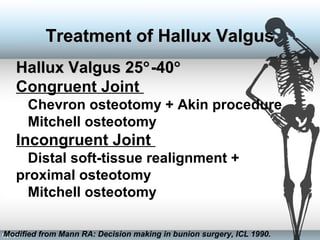
Treatment of Hallux ValgusTreatment of Hallux Valgus
Hallux Valgus 25Hallux Valgus 25°°-40-40°°
Congruent Joint
Chevron osteotomy + Akin procedure
Mitchell osteotomy
Incongruent Joint
Distal soft-tissue realignment +
proximal osteotomy
Mitchell osteotomy
Modified from Mann RA: Decision making in bunion surgery, ICL 1990.
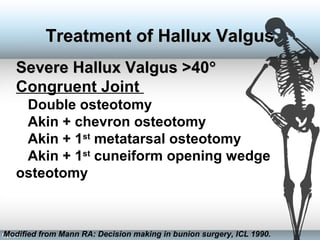
Treatment of Hallux ValgusTreatment of Hallux Valgus
Severe Hallux Valgus >40Severe Hallux Valgus >40°°
Congruent Joint
Double osteotomy
Akin + chevron osteotomy
Akin + 1st
metatarsal osteotomy
Akin + 1st
cuneiform opening wedge
osteotomy
Modified from Mann RA: Decision making in bunion surgery, ICL 1990.
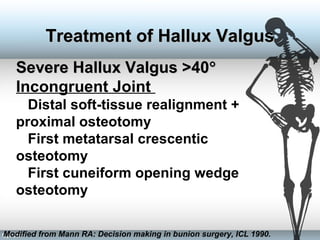
Treatment of Hallux ValgusTreatment of Hallux Valgus
Severe Hallux Valgus >40Severe Hallux Valgus >40°°
Incongruent Joint
Distal soft-tissue realignment +
proximal osteotomy
First metatarsal crescentic
osteotomy
First cuneiform opening wedge
osteotomy
Modified from Mann RA: Decision making in bunion surgery, ICL 1990.
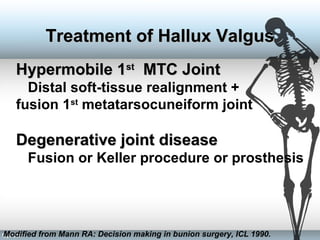
Treatment of Hallux ValgusTreatment of Hallux Valgus
Hypermobile 1Hypermobile 1stst
MTC JointMTC Joint
Distal soft-tissue realignment +
fusion 1st
metatarsocuneiform joint
Degenerative joint diseaseDegenerative joint disease
Fusion or Keller procedure or prosthesis
Modified from Mann RA: Decision making in bunion surgery, ICL 1990.
Treatment of Hallux ValgusTreatment of Hallux Valgus
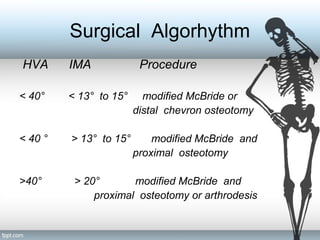
Surgical Algorhythm
HVA IMA Procedure
< 40° < 13° to 15° modified McBride or
distal chevron osteotomy
< 40 ° > 13° to 15° modified McBride and
proximal osteotomy
>40° > 20° modified McBride and
proximal osteotomy or arthrodesis
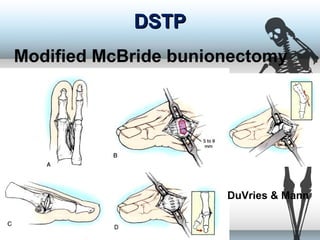
DSTPDSTP
Modified McBride bunionectomy
DuVries & Mann
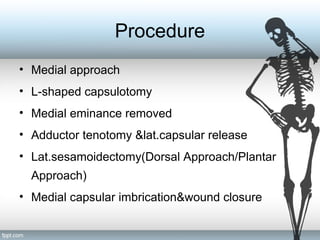
Procedure
• Medial approach
• L-shaped capsulotomy
• Medial eminance removed
• Adductor tenotomy &lat.capsular release
• Lat.sesamoidectomy(Dorsal Approach/Plantar
Approach)
• Medial capsular imbrication&wound closure
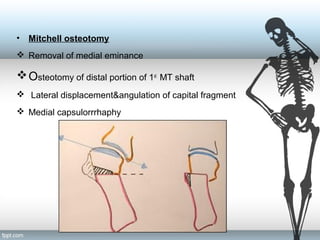
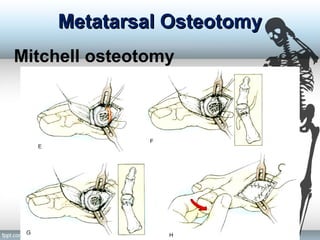
• Mitchell osteotomy
 Removal of medial eminance
Osteotomy of distal portion of 1st
MT shaft
 Lateral displacement&angulation of capital fragment
 Medial capsulorrrhaphy
Metatarsal OsteotomyMetatarsal Osteotomy
Mitchell osteotomy
Metatarsal OsteotomyMetatarsal Osteotomy
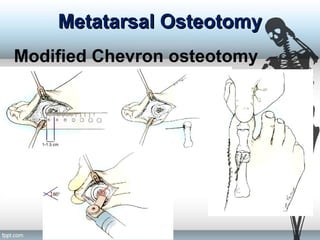
Modified Chevron osteotomy
Metatarsal OsteotomyMetatarsal Osteotomy
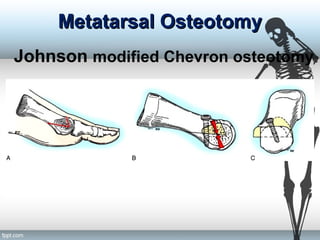
Johnson modified Chevron osteotomy
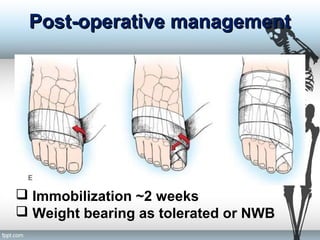
Post-operative managementPost-operative management
 Immobilization ~2 weeks
 Weight bearing as tolerated or NWB
Post-operative managementPost-operative management
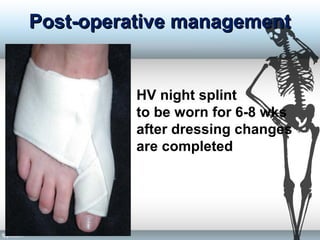
HV night splint
to be worn for 6-8 wks
after dressing changes
are completed
Complications
SURGERY
• Recurrent deformity 20-30%
• Hallux Varus
• Pronation deformity
• Pain
• Neurologic Injury
• Osteonecrosis
• Physeal injury/arrest
• Nonunion/malunion

Hallux valgus.pptx

  • 1.
  • 2.
    Introduction • Hueter definedthe deformity as an abduction contracture in which the great toe is turned away from the mid-line of the body. • The adjective valgus implies a static deformity and should not be used interchangeably with abductus which refers to movement caused by muscle function
  • 3.
     Lateral deviationof the great toe and medial deviation of the first metatarsal  Progressive subluxation of the first metatarsophalangeal (MTP) joint Introduction
  • 4.
    Anatomy Four groups thatencircle the first MTP joint 1) Extensor hallucis longus and brevis 2) Flexor hallucis longus and brevis 3) Abductor 4) Adductor Deforming Musculature 1. Abductor Hallucis -Inserts in the plantar aspect of the proximal phalanx -Can draw the phalanx medial and push metatarsal head lateral 2. Adductor Hallucis -2 origins -common tendon to plantar aspect of proximal phalanx and lateral aspect of plantar plate/sesamoid complex
  • 5.
    Anatomy Plantar Plate • 2seasmoids incorporated into tendons of FHB • Plantar Plate formed by tendons of Adductor Hallucis, Abductor Hallucis, FHL and Joint Capsule
  • 6.
  • 9.
    Dermographic • Age ofoset : >20y • Gender : female • Bilaterality :> 84%
  • 10.
    Footwear Occupation  Heredity- 60%to 90%  Pes Planus  Hypermobility of Metatarsocuneiform joint  Ligamentous laxity  Achilles Contracture  Neuromuscular disorders  Systemic conditions like RA  Misc factors: 2nd toe amputation;  Cystic degneration of medial capsule
  • 14.
  • 15.
    This windlass mechanismis responsible for: • Depression of 1st Metatarsal Head • Weight transfer to hallux. In HV this mech is disrupted Transfer of weight laterally *Surgery must minimize disruption of the windlass.
  • 16.
    Patho anatomy • Increasedmetatarsophalangeal angle -plantar shift of abd.hallucis -unopposed action of add.hallucis pulls greater toe to further valgus -medial capsular stuctures stretched and attenuated
  • 17.
    CONT…. • FHL,FHB&EHL increasevalgus stress • Lateral sesamoid displaced into first webspace
  • 18.
  • 19.
  • 20.
    Clinical Presentation PAIN overthe medial eminence (Bunion). • Pressure from footwear is the most frequent cause of this discomfort. • Bursal inflammation • Irritation of the skin • Breakdown of the skin may be noted. • Bunion consists of: • Bony exostosis / prominence of the metatarsal head • Overlying subcutaneous bursa • Hyperkeratosis of dermis
  • 21.
    Signs and Symptoms •Asymptomatic • Pain- The primary symptom of hallux valgus is PAIN over the medial eminence. • Pressure from footwear is the most frequent cause of this discomfort. • deformity • Tenderness • Aesthetic • Look for presence of: – neurologic disorder – ligamentous laxity Sources of Pain in Hallux Valgus • Medial Eminence • 2nd Toe • Metatarsosesamoid Articulation • Dorsomedial Cutaneous Nerve • Transfer Metatarsalgia Sources of Pain in Hallux Valgus • Medial Eminence • 2nd Toe • Metatarsosesamoid Articulation • Dorsomedial Cutaneous Nerve • Transfer Metatarsalgia
  • 22.
  • 23.
    PHYSICAL EXAM • Skin –calluses, areas of redness • Sites of pain • Motion of 1st MTP joint-increased or decreased • Mobility and structure of foot in general • Gait analysis • The patient sitting and standing – accentuated with weightbearing • Pes planus deformity • Contracture of the Achilles tendon • Magnitude of the Hallux Valgus deformity • Pronation of the great toe
  • 24.
    • Passive andactive range of motion of the MTP joint is measured – Pain or crepitus, or both, with motion of the MTP joint • Metatarsocuneiform joint for hypermobility – Examiner grasps the first metatarsal with the thumb and index finger and pushes it in a plantar lateral-to- dorsomedial direction. – Mobility of more than 9 mm represents hypermobility
  • 25.
    Radiologic assesment • Antero-posterior-wt bearing • Lateral- wt bearing • Medial Oblique wt bearing • Sesamoid view.
  • 26.
    Standing dorsoplantar view Non-standing lateral obliqueview Standing lateral view Axial sesamoid view
  • 27.
    Radiographic Examination Weightbearing AP/Lateralnon weightbearing oblique view and axial views (sesamoid) • Assess for bone and joint deformity • Length and shape of 1st MT • Congruent vs. Incongruent joint • Osteoarthrosis • Forefoot alignment is evaluated for metatarsus Adductus • Hindfoot is Inspected for Pes Planus or Pes Cavus.
  • 28.
    IMA (normal <9°)[8-9] HVA (normal <15°) [15-20] DMAA (normal <10°) [10-15] Hallux valgus angle Intermetatarsal angle Distal metatarsal articular angle
  • 29.
    Measure Angles –Hallux Valgusangle: Intersection of longitudinal axis of 1st MT and proximal phalanx. Normal < 150 –Intermetatarsal angle Intersection of 1st and 2nd MT. Normal < 90 ; increased with metatarsus primus varus
  • 30.
    Radiographic measurements • DistalMetatarsal Articular Angle(DMMA) Defines the relationship of the distal articular surface of the 1st MT to the longitudinal axis. Quantities the magnitude of lateral slope of articular surface. With subluxation, the articular surface deviates laterally in relationship to the 1st Metatarsal. Usually < 60 .
  • 33.
  • 34.
    CLASSIFICATION MILD MODERA TE SEVERE Hallux valgusangle < 20° 20° to 40° >40° 1-2 intermetatarsal angle 11° or less. 12- 15° 16° or more Subluxation of the lateral sesamoid, as measured on an AP < 50% 50% to 75% > 75% SEVERITY OF DEFORMITY
  • 36.
    TREATMENT • Non-operative vs.Operative • All patients should be treated non-operatively first. Despite conservative measures, some patients eventually need surgical intervention.
  • 37.
    Nonoperative Footwear modification • Widentoe box – decrease lateral deviation of great toe – decrease inflammation and pain • Decrease heel height – prevent forward slide of the foot • Arch support – may negate effects of pes planus • Contracture of the Achilles tendon – Stretching exercises – Lengthening of the Achilles tendon
  • 39.
    Painful joint ROMPainfuljoint ROM Deformity of the joint complexDeformity of the joint complex Pain or difficulty with footwearPain or difficulty with footwear Inhibition of activity or lifestyleInhibition of activity or lifestyle Indications for surgeryIndications for surgery
  • 40.
    Associated foot disordersAssociatedfoot disorders - Neuritis/nerve entrapment - Overlapping/underlapping 2nd digit - Hammer digits - First metatarsocuneiform joint exostosis - Sesamoiditis - Ulceration - Inflammatory conditions (bursitis, tendinitis) of 1st metatarsal head Indications for surgeryIndications for surgery
  • 41.
    Extensive peripheral vasculardiseaseExtensive peripheral vascular disease Active infectionActive infection Active osteoarthropathyActive osteoarthropathy Septic arthritisSeptic arthritis Lack of pain or deformityLack of pain or deformity Advanced ageAdvanced age Lack of complianceLack of compliance ContraindicationsContraindications
  • 42.
    MIMI within thepreviouswithin the previous 66 monthsmonths Comorbid conditions that place theComorbid conditions that place the patient at significantpatient at significant CVCV or respiratory riskor respiratory risk ContraindicationsContraindications
  • 43.
    Relieve pain Correct deformity PreserveMTP joint motion Surgical GoalsSurgical Goals
  • 44.
    1. Valgus deviationof the great toe 2. Varus deviation of the 1st metatarsal 3. Pronation of hallux and/or 1st metatarsal 4. Hallux valgus interphalangeus 5. Arthritis and limitation of motion of the 1st metatarsophalangeal joint 6. Length of the 1st metatarsal relative to lesser metatarsals Preoperative evaluationPreoperative evaluation
  • 45.
    7. Excessive mobilityor obliquity of the 1st metatarsomedial cuneiform joint 8. The medial eminence (bunion) 9. The location of the sesamoid apparatus 10. Intrinsic and extrinsic muscle-tendon balance and synchrony Preoperative evaluationPreoperative evaluation
  • 46.
    Hallux Valgus <25HalluxValgus <25°° Congruent Joint Chevron osteotomy Mitchell osteotomy Incongruent Joint Distal soft-tissue realignment (subluxation) Chevron osteotomy Mitchell osteotomy Modified from Mann RA: Decision making in bunion surgery, ICL 1990. Treatment of Hallux ValgusTreatment of Hallux Valgus
  • 47.
    Hallux Valgus 25HalluxValgus 25°°-40-40°° Congruent Joint Chevron osteotomy + Akin procedure Mitchell osteotomy Incongruent Joint Distal soft-tissue realignment + proximal osteotomy Mitchell osteotomy Modified from Mann RA: Decision making in bunion surgery, ICL 1990. Treatment of Hallux ValgusTreatment of Hallux Valgus
  • 48.
    Severe Hallux Valgus>40Severe Hallux Valgus >40°° Congruent Joint Double osteotomy Akin + chevron osteotomy Akin + 1st metatarsal osteotomy Akin + 1st cuneiform opening wedge osteotomy Modified from Mann RA: Decision making in bunion surgery, ICL 1990. Treatment of Hallux ValgusTreatment of Hallux Valgus
  • 49.
    Severe Hallux Valgus>40Severe Hallux Valgus >40°° Incongruent Joint Distal soft-tissue realignment + proximal osteotomy First metatarsal crescentic osteotomy First cuneiform opening wedge osteotomy Modified from Mann RA: Decision making in bunion surgery, ICL 1990. Treatment of Hallux ValgusTreatment of Hallux Valgus
  • 50.
    Hypermobile 1Hypermobile 1stst MTCJointMTC Joint Distal soft-tissue realignment + fusion 1st metatarsocuneiform joint Degenerative joint diseaseDegenerative joint disease Fusion or Keller procedure or prosthesis Modified from Mann RA: Decision making in bunion surgery, ICL 1990. Treatment of Hallux ValgusTreatment of Hallux Valgus
  • 51.
    Surgical Algorhythm HVA IMAProcedure < 40° < 13° to 15° modified McBride or distal chevron osteotomy < 40 ° > 13° to 15° modified McBride and proximal osteotomy >40° > 20° modified McBride and proximal osteotomy or arthrodesis
  • 52.
  • 53.
    Procedure • Medial approach •L-shaped capsulotomy • Medial eminance removed • Adductor tenotomy &lat.capsular release • Lat.sesamoidectomy(Dorsal Approach/Plantar Approach) • Medial capsular imbrication&wound closure
  • 54.
    • Mitchell osteotomy Removal of medial eminance Osteotomy of distal portion of 1st MT shaft  Lateral displacement&angulation of capital fragment  Medial capsulorrrhaphy
  • 55.
  • 56.
  • 57.
  • 58.
    Post-operative managementPost-operative management Immobilization ~2 weeks  Weight bearing as tolerated or NWB
  • 59.
    Post-operative managementPost-operative management HVnight splint to be worn for 6-8 wks after dressing changes are completed
  • 60.
    Complications SURGERY • Recurrent deformity20-30% • Hallux Varus • Pronation deformity • Pain • Neurologic Injury • Osteonecrosis • Physeal injury/arrest • Nonunion/malunion