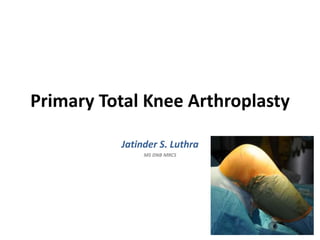
Primary Total Knee Arthroplasty
Jatinder S. Luthra
MS DNB MRCS
Historic Evolution
• 19th century – Soft tissue interposition
• 1950 Walldius Hinged knee replacement
• 1960 MacIntosh & McKeever Acrylic tibial
plateau
• 1973 – Total condylar prosthesis
Prosthetic Design
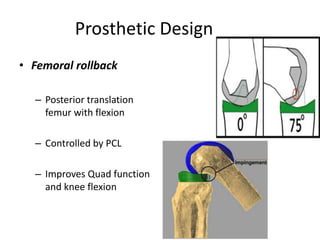
• Femoral rollback
– Posterior translation
femur with flexion
– Controlled by PCL
– Improves Quad function
and knee flexion
Prosthetic Design
Modularity
• Augmentation of
standard prosthesis
Metal base plate + Poly
Metal augment - bone
loss
Femoral/ tibial stem
Prosthetic Design
• Constraint
– Ability of prosthesis to provide varus – valgus and
flexion –extension stability in presence of
ligamentous laxity / bone loss
Prosthetic Design
• Cruciate retaining prosthesis (CR)
• Cruciate sacrificing prosthesis (CS)
• Varus – valgus constrained
• Hinged prosthesis
• Total condylar Prosthesis
Prosthetic Design
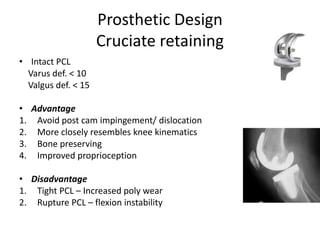
Cruciate retaining
• Intact PCL
Varus def. < 10
Valgus def. < 15
• Advantage
1. Avoid post cam impingement/ dislocation
2. More closely resembles knee kinematics
3. Bone preserving
4. Improved proprioception
• Disadvantage
1. Tight PCL – Increased poly wear
2. Rupture PCL – flexion instability
Prosthetic Design
Cruciate stabilized
• Cam and post mechanism
• Insert more congruent / dished
Advantages
Easier to balance knee
More range of motion
Disadvantages
Cam jump
Post wear
Patellar clunk syndrome
Additional cut from distal femur
ABSOLUTE INDICATION
•Previous patellectomy
•Inflammatory arthritis
•Deficient PCL
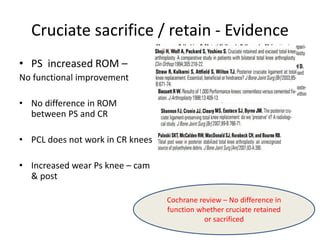
Cruciate sacrifice / retain - Evidence
• PS increased ROM –
No functional improvement
• No difference in ROM
between PS and CR
• PCL does not work in CR knees
• Increased wear Ps knee – cam
& post
Cochrane review – No difference in
function whether cruciate retained
or sacrificed
Prosthetic Design
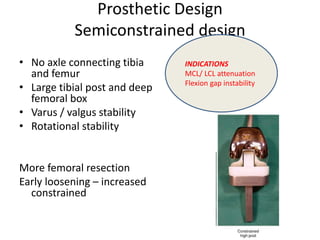
Semiconstrained design
• No axle connecting tibia
and femur
• Large tibial post and deep
femoral box
• Varus / valgus stability
• Rotational stability
More femoral resection
Early loosening – increased
constrained
INDICATIONS
MCL/ LCL attenuation
Flexion gap instability
Prosthetic Design
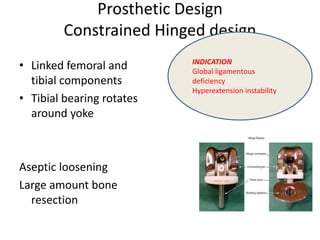
Constrained Hinged design
• Linked femoral and
tibial components
• Tibial bearing rotates
around yoke
Aseptic loosening
Large amount bone
resection
INDICATION
Global ligamentous
deficiency
Hyperextension instability
Prosthetic Design
Mobile Bearing Design
• Poly Rotates over tibial
base plate
• Reduced poly wear
• Bearing spin out
Fixed Bearing or mobile bearing -
Evidence
• No advantage of mobile bearing over fixed
bearing
• Increased wear in undersurface of mobile
bearing
Prosthetic Design
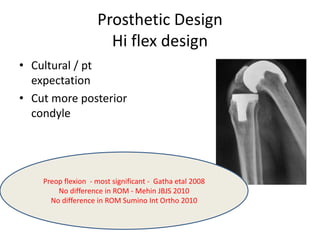
Hi flex design
• Cultural / pt
expectation
• Cut more posterior
condyle
Preop flexion - most significant - Gatha etal 2008
No difference in ROM - Mehin JBJS 2010
No difference in ROM Sumino Int Ortho 2010
Radiographs
• Standing Ap & Lateral
• Sunrise – Merchant view
• Hip to ankle x- rays
– Bony deformity
– Short stature ( < 150 cm)
– Very tall ( > 190 cm)
Radiographs
• Femoral and tibial cut
• Position of femoral canal entry
• Bone defects
• Joint subluxation
• Ligament stretch out – Varus Thrust
• Ligament release
• Constraint needed
Approaches
• Multiple incision –
choose lateral incision
• Previous transverse
incision – cross at right
angles
Approaches
Medial parapatellar approach
• Most common
• Surgeon are familiar
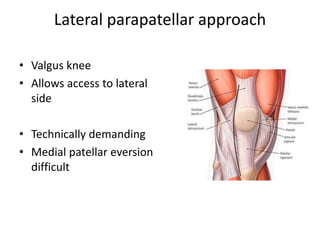
Lateral parapatellar approach
• Valgus knee
• Allows access to lateral
side
• Technically demanding
• Medial patellar eversion
difficult
Midvastus approach
• Spares VMO insertion
• Advantages
Accelerated rehab.
Improved patellar tracking
• Disadvantages
Less extensile
Difficult in obese & flex
contracture
Subvastus approach
• Vastus medialis lifted off
Lateral intermuscular
septum
• Advantages
Intact quad
Preserved vascularity of
patella
• Disadvantage
Least extensile
Denervation of VMO possible
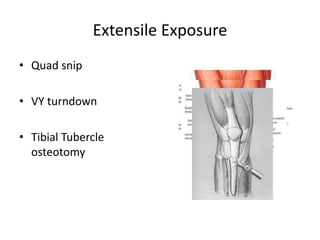
Extensile Exposure
• Quad snip
• VY turndown
• Tibial Tubercle
osteotomy
Technical Goals
• Restore mechanical
alignment
• Restore joint line
• Balanced ligaments
• Normal Q angle
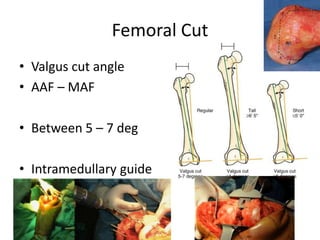
Femoral Cut
• Valgus cut angle
• AAF – MAF
• Between 5 – 7 deg
• Intramedullary guide
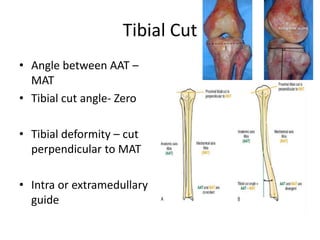
Tibial Cut
• Angle between AAT –
MAT
• Tibial cut angle- Zero
• Tibial deformity – cut
perpendicular to MAT
• Intra or extramedullary
guide
Joint line preservation
• Inserting prosthesis prosthesis same size as removed
bone and cartilage
• Elevate joint line –
mid flexion instability
Abnormal patellofemoral tracking
Equivalent to Patella Baja
• Lowering joint line
Lack of full extension
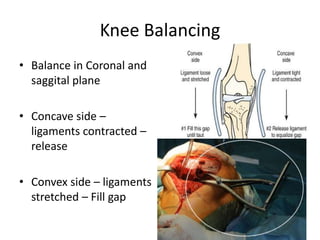
Knee Balancing
• Balance in Coronal and
saggital plane
• Concave side –
ligaments contracted –
release
• Convex side – ligaments
stretched – Fill gap
Varus Knees
HenriK Schroeder – Boesch – Ligament balancing in TKR
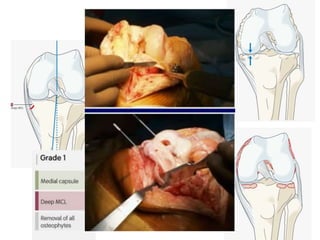
Grade 1 release
Grade 2 release
Grade 2A
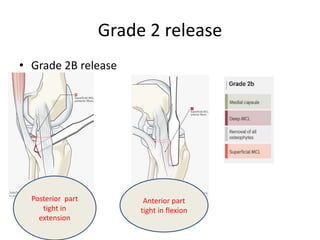
Grade 2 release
• Grade 2B release
Posterior part
tight in
extension
Anterior part
tight in flexion
Grade 3 release
• Grade 2A + 2B
Grade 4 release
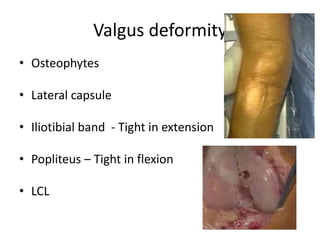
Valgus deformity
• Osteophytes
• Lateral capsule
• Iliotibial band - Tight in extension
• Popliteus – Tight in flexion
• LCL
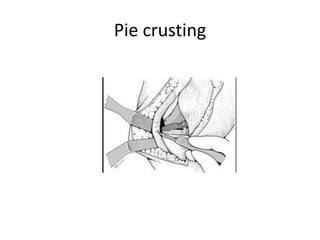
Pie crusting
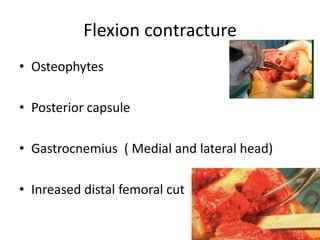
Flexion contracture
• Osteophytes
• Posterior capsule
• Gastrocnemius ( Medial and lateral head)
• Inreased distal femoral cut
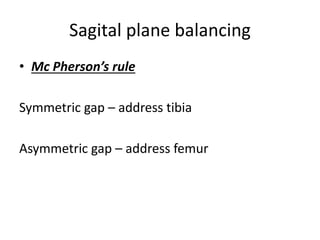
Sagital plane balancing
• Mc Pherson’s rule
Symmetric gap – address tibia
Asymmetric gap – address femur
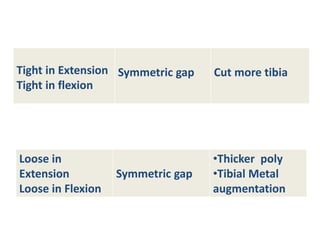
Tight in Extension
Tight in flexion
Symmetric gap Cut more tibia
Loose in
Extension
Loose in Flexion
Symmetric gap
•Thicker poly
•Tibial Metal
augmentation
Extension good
Loose in flexion
Asymmetric gap
1. Increase size
femoral
component
2. Translate
femoral
component
posterior
3. Use thicker
poly and
readdress as
tight
extension gap
Extension Tight
Flexion Good
Asymmetric Gap
1. Cut more
distal femur
2. Release
posterior
capsule
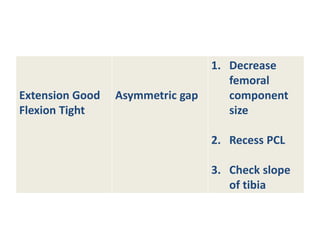
Extension Good
Flexion Tight
Asymmetric gap
1. Decrease
femoral
component
size
2. Recess PCL
3. Check slope
of tibia
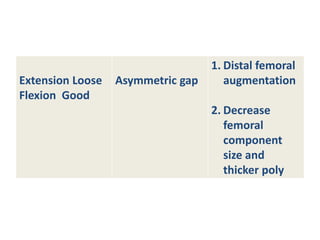
Extension Loose
Flexion Good
Asymmetric gap
1. Distal femoral
augmentation
2. Decrease
femoral
component
size and
thicker poly
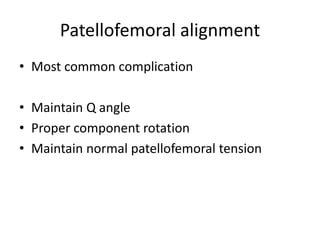
Patellofemoral alignment
• Most common complication
• Maintain Q angle
• Proper component rotation
• Maintain normal patellofemoral tension
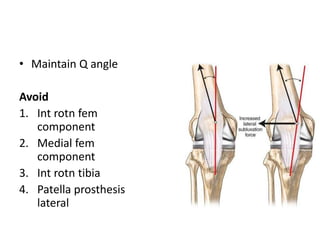
• Maintain Q angle
Avoid
1. Int rotn fem
component
2. Medial fem
component
3. Int rotn tibia
4. Patella prosthesis
lateral
Femoral component rotation
• Ap Axis ( whiteside line)
• Transepicondylar axis
• Post condylar axis
• Tibial alignment axis
• Gap balance
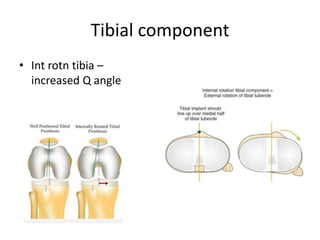
Tibial component
• Int rotn tibia –
increased Q angle
Patellar component
• Centre or medialized
• Avoid lateralizing
• Increases Q angle and
cause patella
maltracking
Patella Baja
• Patellar component
superior
• Lower joint line
• Transfer tibial tubercle
cephalad
• Patellectomy
Patella resurfacing vs non resurfacing
• Resurfacing
– Component loosening
– Clunk
– Fracture
– AVN
• Non resurfacing
– Anterior knee pain
– May require second
resurfacing
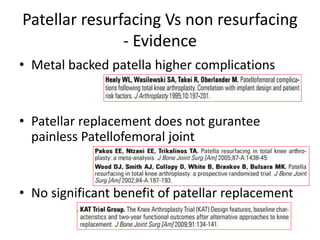
Patellar resurfacing Vs non resurfacing
- Evidence
• Metal backed patella higher complications
• Patellar replacement does not gurantee
painless Patellofemoral joint
• No significant benefit of patellar replacement
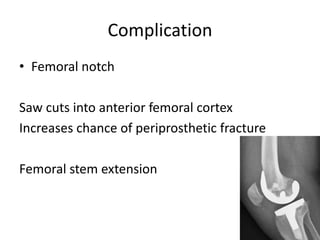
Complication
• Femoral notch
Saw cuts into anterior femoral cortex
Increases chance of periprosthetic fracture
Femoral stem extension
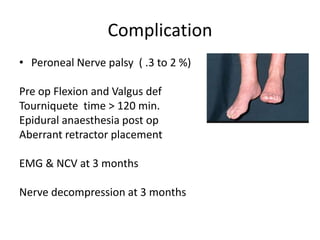
Complication
• Peroneal Nerve palsy ( .3 to 2 %)
Pre op Flexion and Valgus def
Tourniquete time > 120 min.
Epidural anaesthesia post op
Aberrant retractor placement
EMG & NCV at 3 months
Nerve decompression at 3 months
Complication
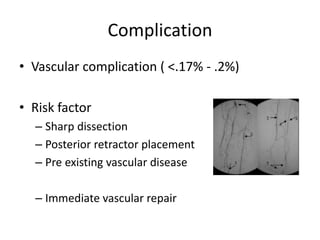
• Vascular complication ( <.17% - .2%)
• Risk factor
– Sharp dissection
– Posterior retractor placement
– Pre existing vascular disease
– Immediate vascular repair
Complications
• Extensor mechanism rupture ( .17% - 2.5% )
– Direct repair with suture - < 30 % avulsion
– Primary repair and augment with graft
– Allograft repair
Complications
• Stiffness
– Flexion contracture 10 – 15 % deg
– Flexion < 90 deg
• Treatment
– Manipulation under Anaesthesia
– Arthroscopic lysis of adhesion
– Revision TKR
Complications
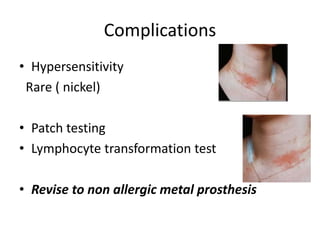
• Hypersensitivity
Rare ( nickel)
• Patch testing
• Lymphocyte transformation test
• Revise to non allergic metal prosthesis
Summary
• Choose correct pt
• Plan properly
• Adequate exposure
• Follow principles to align and balance knee
• Meticulous closure
Hope for the best
because 20 % of pt.
with well performed
TKR are not happy !!
THANK YOU

Primary total knee arthroplasty
  • 1.
    Primary Total KneeArthroplasty Jatinder S. Luthra MS DNB MRCS
  • 2.
    Historic Evolution • 19thcentury – Soft tissue interposition • 1950 Walldius Hinged knee replacement • 1960 MacIntosh & McKeever Acrylic tibial plateau • 1973 – Total condylar prosthesis
  • 3.
    Prosthetic Design • Femoralrollback – Posterior translation femur with flexion – Controlled by PCL – Improves Quad function and knee flexion
  • 4.
    Prosthetic Design Modularity • Augmentationof standard prosthesis Metal base plate + Poly Metal augment - bone loss Femoral/ tibial stem
  • 5.
    Prosthetic Design • Constraint –Ability of prosthesis to provide varus – valgus and flexion –extension stability in presence of ligamentous laxity / bone loss
  • 6.
    Prosthetic Design • Cruciateretaining prosthesis (CR) • Cruciate sacrificing prosthesis (CS) • Varus – valgus constrained • Hinged prosthesis • Total condylar Prosthesis
  • 7.
    Prosthetic Design Cruciate retaining •Intact PCL Varus def. < 10 Valgus def. < 15 • Advantage 1. Avoid post cam impingement/ dislocation 2. More closely resembles knee kinematics 3. Bone preserving 4. Improved proprioception • Disadvantage 1. Tight PCL – Increased poly wear 2. Rupture PCL – flexion instability
  • 8.
    Prosthetic Design Cruciate stabilized •Cam and post mechanism • Insert more congruent / dished Advantages Easier to balance knee More range of motion Disadvantages Cam jump Post wear Patellar clunk syndrome Additional cut from distal femur ABSOLUTE INDICATION •Previous patellectomy •Inflammatory arthritis •Deficient PCL
  • 9.
    Cruciate sacrifice /retain - Evidence • PS increased ROM – No functional improvement • No difference in ROM between PS and CR • PCL does not work in CR knees • Increased wear Ps knee – cam & post Cochrane review – No difference in function whether cruciate retained or sacrificed
  • 10.
    Prosthetic Design Semiconstrained design •No axle connecting tibia and femur • Large tibial post and deep femoral box • Varus / valgus stability • Rotational stability More femoral resection Early loosening – increased constrained INDICATIONS MCL/ LCL attenuation Flexion gap instability
  • 11.
    Prosthetic Design Constrained Hingeddesign • Linked femoral and tibial components • Tibial bearing rotates around yoke Aseptic loosening Large amount bone resection INDICATION Global ligamentous deficiency Hyperextension instability
  • 12.
    Prosthetic Design Mobile BearingDesign • Poly Rotates over tibial base plate • Reduced poly wear • Bearing spin out
  • 13.
    Fixed Bearing ormobile bearing - Evidence • No advantage of mobile bearing over fixed bearing • Increased wear in undersurface of mobile bearing
  • 14.
    Prosthetic Design Hi flexdesign • Cultural / pt expectation • Cut more posterior condyle Preop flexion - most significant - Gatha etal 2008 No difference in ROM - Mehin JBJS 2010 No difference in ROM Sumino Int Ortho 2010
  • 15.
    Radiographs • Standing Ap& Lateral • Sunrise – Merchant view • Hip to ankle x- rays – Bony deformity – Short stature ( < 150 cm) – Very tall ( > 190 cm)
  • 16.
    Radiographs • Femoral andtibial cut • Position of femoral canal entry • Bone defects • Joint subluxation • Ligament stretch out – Varus Thrust • Ligament release • Constraint needed
  • 17.
    Approaches • Multiple incision– choose lateral incision • Previous transverse incision – cross at right angles
  • 18.
    Approaches Medial parapatellar approach •Most common • Surgeon are familiar
  • 19.
    Lateral parapatellar approach •Valgus knee • Allows access to lateral side • Technically demanding • Medial patellar eversion difficult
  • 20.
    Midvastus approach • SparesVMO insertion • Advantages Accelerated rehab. Improved patellar tracking • Disadvantages Less extensile Difficult in obese & flex contracture
  • 21.
    Subvastus approach • Vastusmedialis lifted off Lateral intermuscular septum • Advantages Intact quad Preserved vascularity of patella • Disadvantage Least extensile Denervation of VMO possible
  • 22.
    Extensile Exposure • Quadsnip • VY turndown • Tibial Tubercle osteotomy
  • 23.
    Technical Goals • Restoremechanical alignment • Restore joint line • Balanced ligaments • Normal Q angle
  • 24.
    Femoral Cut • Valguscut angle • AAF – MAF • Between 5 – 7 deg • Intramedullary guide
  • 25.
    Tibial Cut • Anglebetween AAT – MAT • Tibial cut angle- Zero • Tibial deformity – cut perpendicular to MAT • Intra or extramedullary guide
  • 26.
    Joint line preservation •Inserting prosthesis prosthesis same size as removed bone and cartilage • Elevate joint line – mid flexion instability Abnormal patellofemoral tracking Equivalent to Patella Baja • Lowering joint line Lack of full extension
  • 27.
    Knee Balancing • Balancein Coronal and saggital plane • Concave side – ligaments contracted – release • Convex side – ligaments stretched – Fill gap
  • 28.
    Varus Knees HenriK Schroeder– Boesch – Ligament balancing in TKR
  • 29.
  • 30.
  • 31.
    Grade 2 release •Grade 2B release Posterior part tight in extension Anterior part tight in flexion
  • 32.
    Grade 3 release •Grade 2A + 2B
  • 33.
  • 34.
    Valgus deformity • Osteophytes •Lateral capsule • Iliotibial band - Tight in extension • Popliteus – Tight in flexion • LCL
  • 36.
  • 37.
    Flexion contracture • Osteophytes •Posterior capsule • Gastrocnemius ( Medial and lateral head) • Inreased distal femoral cut
  • 38.
    Sagital plane balancing •Mc Pherson’s rule Symmetric gap – address tibia Asymmetric gap – address femur
  • 39.
    Tight in Extension Tightin flexion Symmetric gap Cut more tibia Loose in Extension Loose in Flexion Symmetric gap •Thicker poly •Tibial Metal augmentation
  • 40.
    Extension good Loose inflexion Asymmetric gap 1. Increase size femoral component 2. Translate femoral component posterior 3. Use thicker poly and readdress as tight extension gap
  • 41.
    Extension Tight Flexion Good AsymmetricGap 1. Cut more distal femur 2. Release posterior capsule
  • 42.
    Extension Good Flexion Tight Asymmetricgap 1. Decrease femoral component size 2. Recess PCL 3. Check slope of tibia
  • 43.
    Extension Loose Flexion Good Asymmetricgap 1. Distal femoral augmentation 2. Decrease femoral component size and thicker poly
  • 44.
    Patellofemoral alignment • Mostcommon complication • Maintain Q angle • Proper component rotation • Maintain normal patellofemoral tension
  • 45.
    • Maintain Qangle Avoid 1. Int rotn fem component 2. Medial fem component 3. Int rotn tibia 4. Patella prosthesis lateral
  • 46.
    Femoral component rotation •Ap Axis ( whiteside line) • Transepicondylar axis • Post condylar axis • Tibial alignment axis • Gap balance
  • 47.
    Tibial component • Introtn tibia – increased Q angle
  • 48.
    Patellar component • Centreor medialized • Avoid lateralizing • Increases Q angle and cause patella maltracking
  • 49.
    Patella Baja • Patellarcomponent superior • Lower joint line • Transfer tibial tubercle cephalad • Patellectomy
  • 50.
    Patella resurfacing vsnon resurfacing • Resurfacing – Component loosening – Clunk – Fracture – AVN • Non resurfacing – Anterior knee pain – May require second resurfacing
  • 51.
    Patellar resurfacing Vsnon resurfacing - Evidence • Metal backed patella higher complications • Patellar replacement does not gurantee painless Patellofemoral joint • No significant benefit of patellar replacement
  • 52.
    Complication • Femoral notch Sawcuts into anterior femoral cortex Increases chance of periprosthetic fracture Femoral stem extension
  • 53.
    Complication • Peroneal Nervepalsy ( .3 to 2 %) Pre op Flexion and Valgus def Tourniquete time > 120 min. Epidural anaesthesia post op Aberrant retractor placement EMG & NCV at 3 months Nerve decompression at 3 months
  • 54.
    Complication • Vascular complication( <.17% - .2%) • Risk factor – Sharp dissection – Posterior retractor placement – Pre existing vascular disease – Immediate vascular repair
  • 55.
    Complications • Extensor mechanismrupture ( .17% - 2.5% ) – Direct repair with suture - < 30 % avulsion – Primary repair and augment with graft – Allograft repair
  • 56.
    Complications • Stiffness – Flexioncontracture 10 – 15 % deg – Flexion < 90 deg • Treatment – Manipulation under Anaesthesia – Arthroscopic lysis of adhesion – Revision TKR
  • 57.
    Complications • Hypersensitivity Rare (nickel) • Patch testing • Lymphocyte transformation test • Revise to non allergic metal prosthesis
  • 58.
    Summary • Choose correctpt • Plan properly • Adequate exposure • Follow principles to align and balance knee • Meticulous closure Hope for the best because 20 % of pt. with well performed TKR are not happy !!
  • 59.