LEGG CALVE PERTHES DISEASE
Dr. Bipul Borthakur,
Professor,
Dept. of Orthopaedics, SMCH
Overview
• Definition
• Demography
• Risk and Pathology
• Vascular supply of femoral head
• Clinical features
• Classification
• Diagnosis
• Treatment
Conservative
Containment
procedure
Salvage
Procedure
Definition
• Idiopathic avascular necrosis of the proximal
femoral epiphysis in children.
SYNONYMS
• Legg calve perthes disease
• Legg stress fracture of femoral head
• Osteochondritis deformans juvenalis
• Osteochondrosis of hip joint
• Coxa plana
• Pseudocoxalgia
Demographics
• First Described by LEGG AND WALDENSTORM
• In 1909 - PERTHES
• In 1910 -CALVE
• Incidence
– 1 in 10,000 children
• Demographics
– 4-8 years M/C
– M:F is 5:1
– Higher among lower socioeconomic class
– Race
Caucasian > East Asian and African American
Risk Factors
• Positive family history
• Low birth weight
• Abnormal birth presentation
• Asian and Central European decent
Location
• Location bilateral in 12%
– Asymmetrical, asynchronous involvement
rarely at the same stage of disease
– Symmetrical involvement suggests MED (multiple
epiphyseal dysplasia)
Pathogenesis
• Current suggestion : Disorder of the clotting
mechanism with deficiency of factors such as
protein C or S and Factor V Leiden mutation
(MERCERS).
• Apart from AVN there is changes in ,
1. Articular cartilage
2. Growth plate
3. Synovium
4. In Established disease-Reactive
Synovitis will be present
Other Theories
• Repeated subclinical trauma and mechanical
overload lead to bone collapse and repair
(multiple-infarction theory)
Blood supply of femoral head
• Retinacular Arteries
• Metaphyseal Arteries
• Artery of teres ligament
Cntnue…
• IN INFANTS :
1. Medial Ascending cervical or inferior
metaphyseal arteries of trueta
2. Lateral ephiphyseal arteries
3. Lig teres –insignificant
• IN 4 months to 4 years :
1. Lateral ephiphyseal
2. Medial ephiphyseal decrease in number
• IN 4 to 7 Years:
1. Ephiphyseal plate forms a barrier to
metaphyseal vessels
• IN Pre-Adolescent
1. After 7 years ligament teres artery
anastomose with lateral ephiphyseal vessels
Pathogenesis in Head deformity
Clinical features
• Intermittent pain in hip and a limp
• insidious onset
• Classical presentation- Painless limp
• Restriction of abduction and internal rotation
• Nature of pain : Aggravated by movement
reileved by rest
Examination
• Antalgic gait
• Muscle spasm secondary to irritated hip
• Trendelenberg positive
• Short stature
• FFD
Stages of Perthes disease
• Stage of Avascular necrosis
• Stage of Fragmentation
• Stage of Regeneration
• Stage of Healing
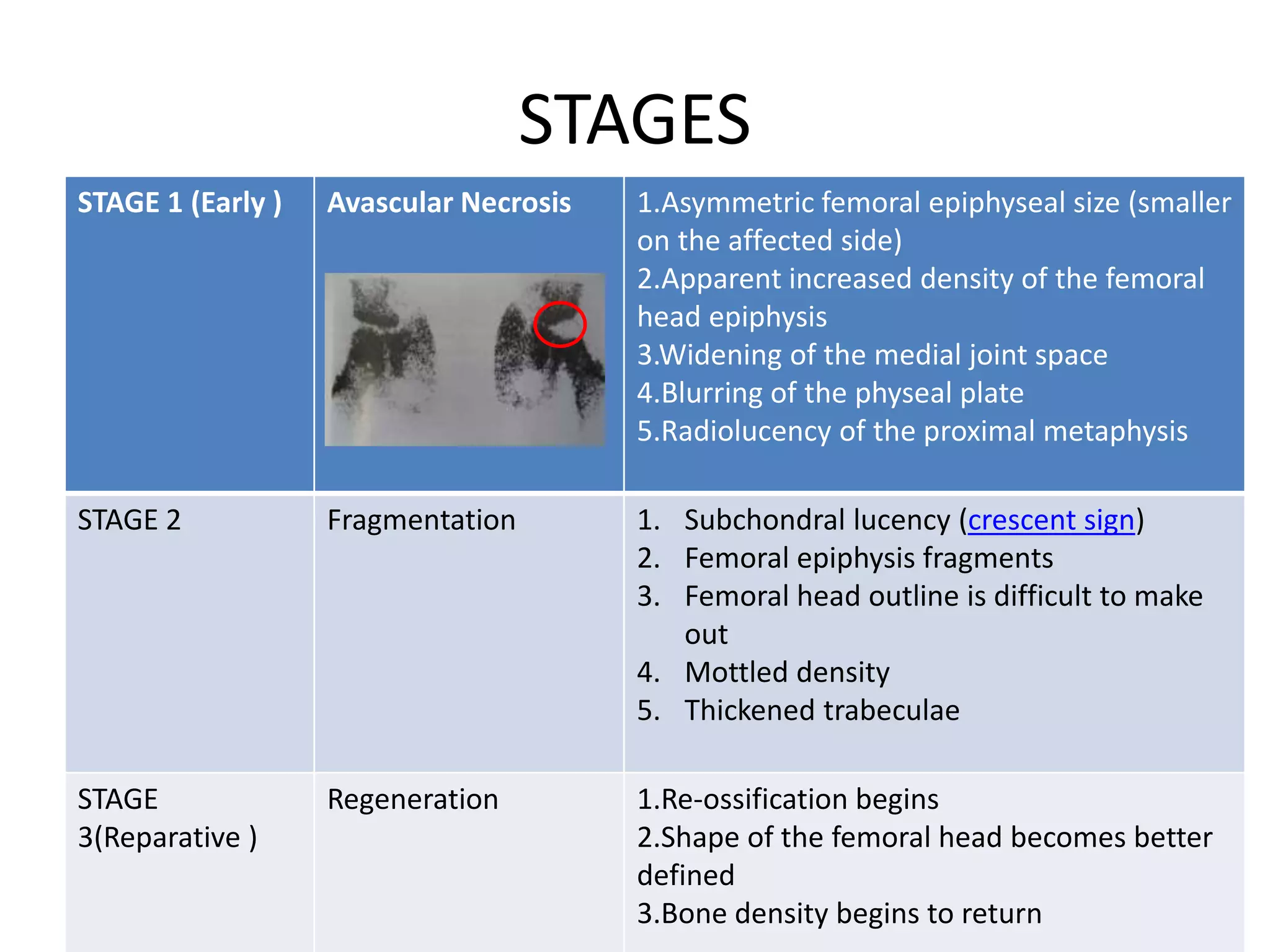
STAGES
STAGE 1 (Early ) Avascular Necrosis 1.Asymmetric femoral epiphyseal size (smaller
on the affected side)
2.Apparent increased density of the femoral
head epiphysis
3.Widening of the medial joint space
4.Blurring of the physeal plate
5.Radiolucency of the proximal metaphysis
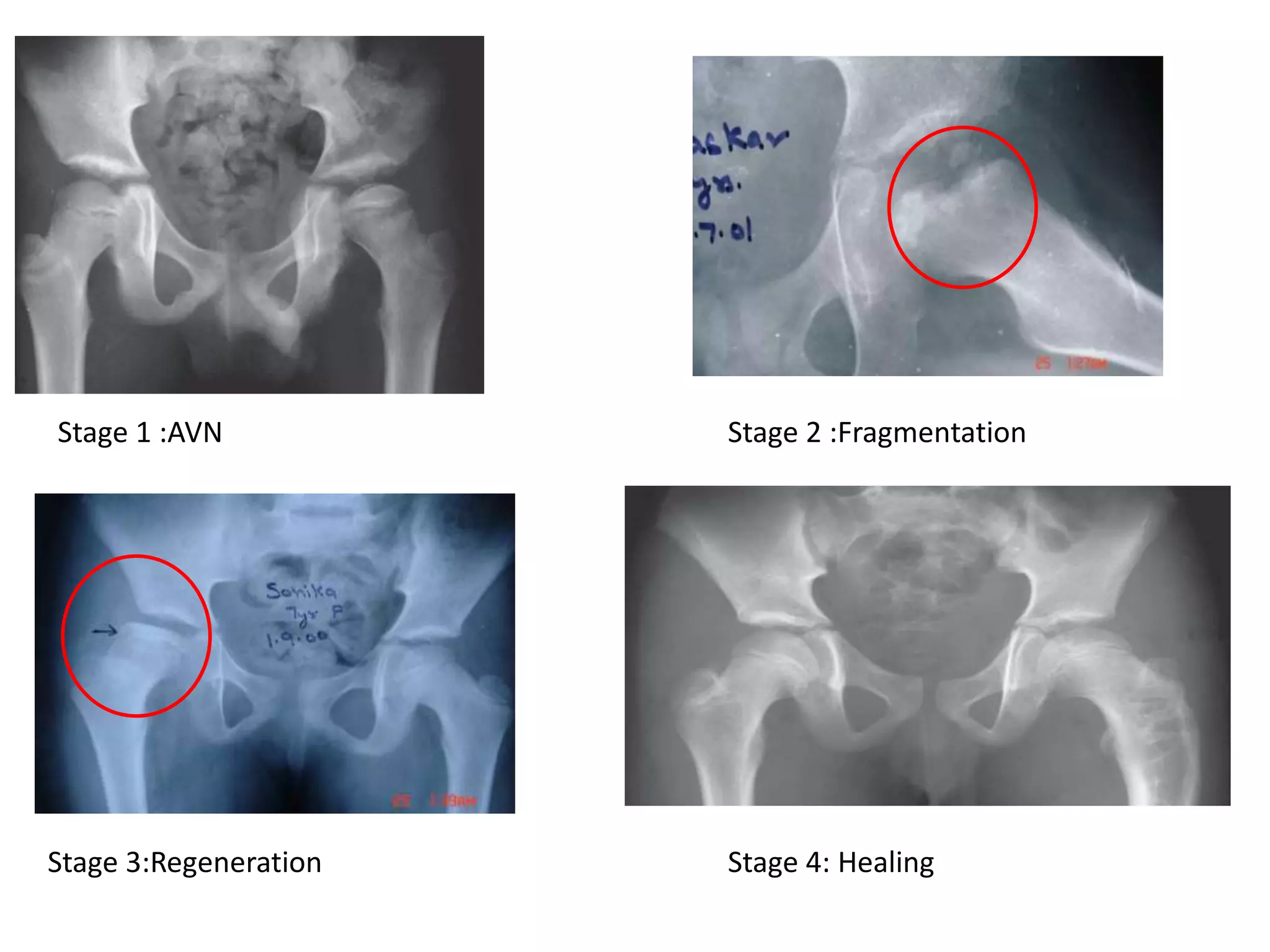
STAGE 2 Fragmentation 1. Subchondral lucency (crescent sign)
2. Femoral epiphysis fragments
3. Femoral head outline is difficult to make
out
4. Mottled density
5. Thickened trabeculae
STAGE
3(Reparative )
Regeneration 1.Re-ossification begins
2.Shape of the femoral head becomes better
defined
3.Bone density begins to return
•
STAGE 4 Healing 1.Changes depend on the
severity the femoral head
which may be nearly
normal or may
demonstrate:
-Flattening of the articular
surface, especially
superiorly
-widening of the head and
neck of the femur
CRESCENT SIGN OR SALTER
SIGN OR CAFFEY SIGN IN
STAGE 2
Stage 1 :AVN Stage 2 :Fragmentation
Stage 3:Regeneration Stage 4: Healing
Metaphyseal changes
Metaphyseal necrosis
& lucencies
(“holes of
decalcification”)
Sagging rope sign
Radiodense line in proximal
femoral metaphysis
--It’s the Metaphyseal
response to
physeal damage
Acetabular changes
• Bicompartmental acetabulum appears to be
composed of 2 arc partly overlapping each other –
interpreted as the subluxated femoral head
articulating only with the lateral half of the
acetabulum moulding it into 2 compartments
Classifications based on Extent of
Lesion
• Catterall(Based on degree of head involvement)
• Salter & thompson(Based on radiographic cresent sign)
• Herring (lateral pillar )
• Elizabeth (Epiphysis involvement )
• Stulberg (residual femoral head deformity and joint congruence)
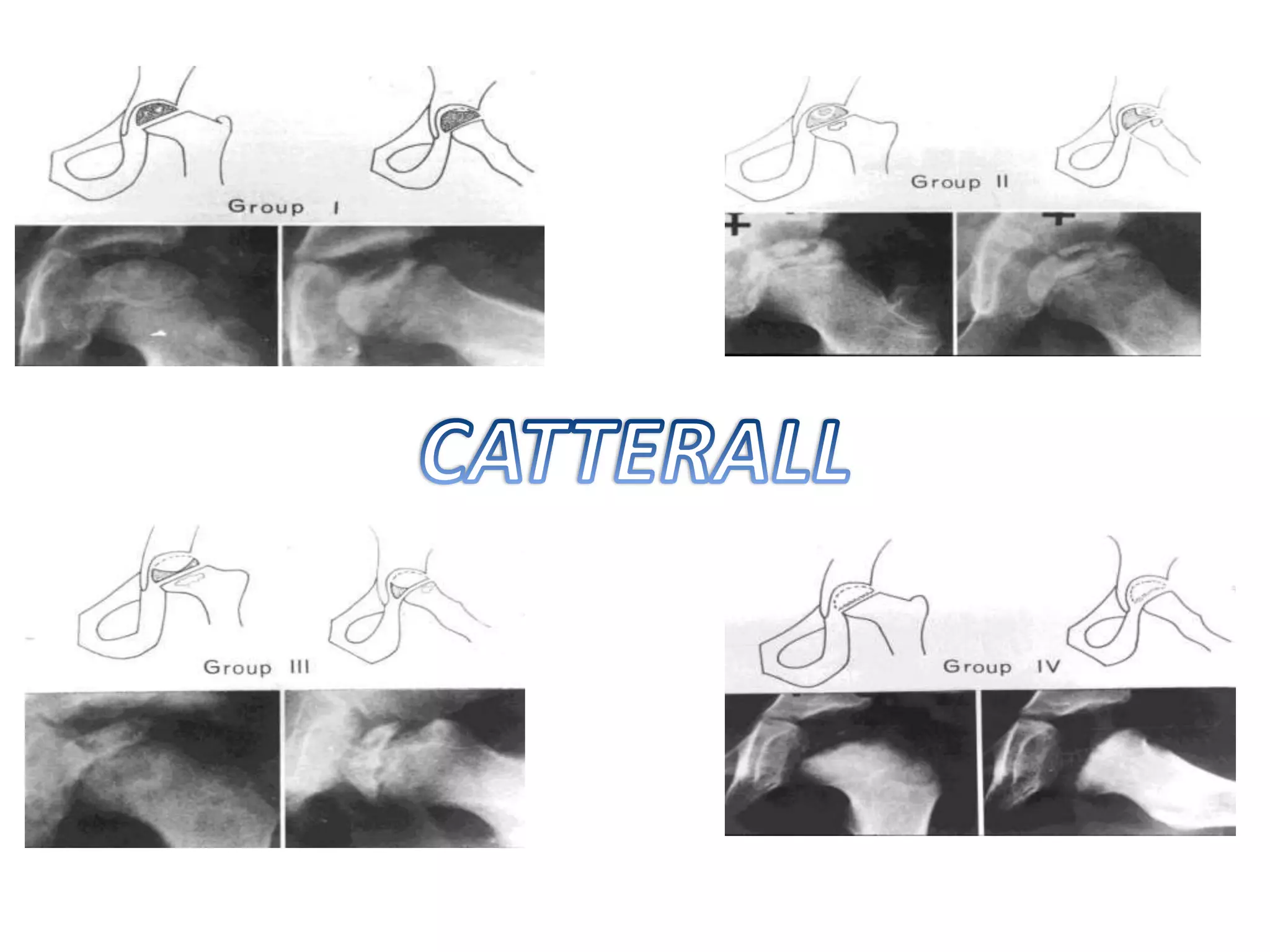
• Catterall et al.
Grade <CATTERALL> Characteristics
I (good prognosis ) Only anterolateral quadrant affected
(< ½ of epiphysis affected )
II (good prognosis ) Anterior third or half of the femoral head
III (poor prognosis) Up to ¾ of the femoral head affected ,i.e
more than half of epiphysis
IV(poor prognosis ) Whole femoral head affected (entire)
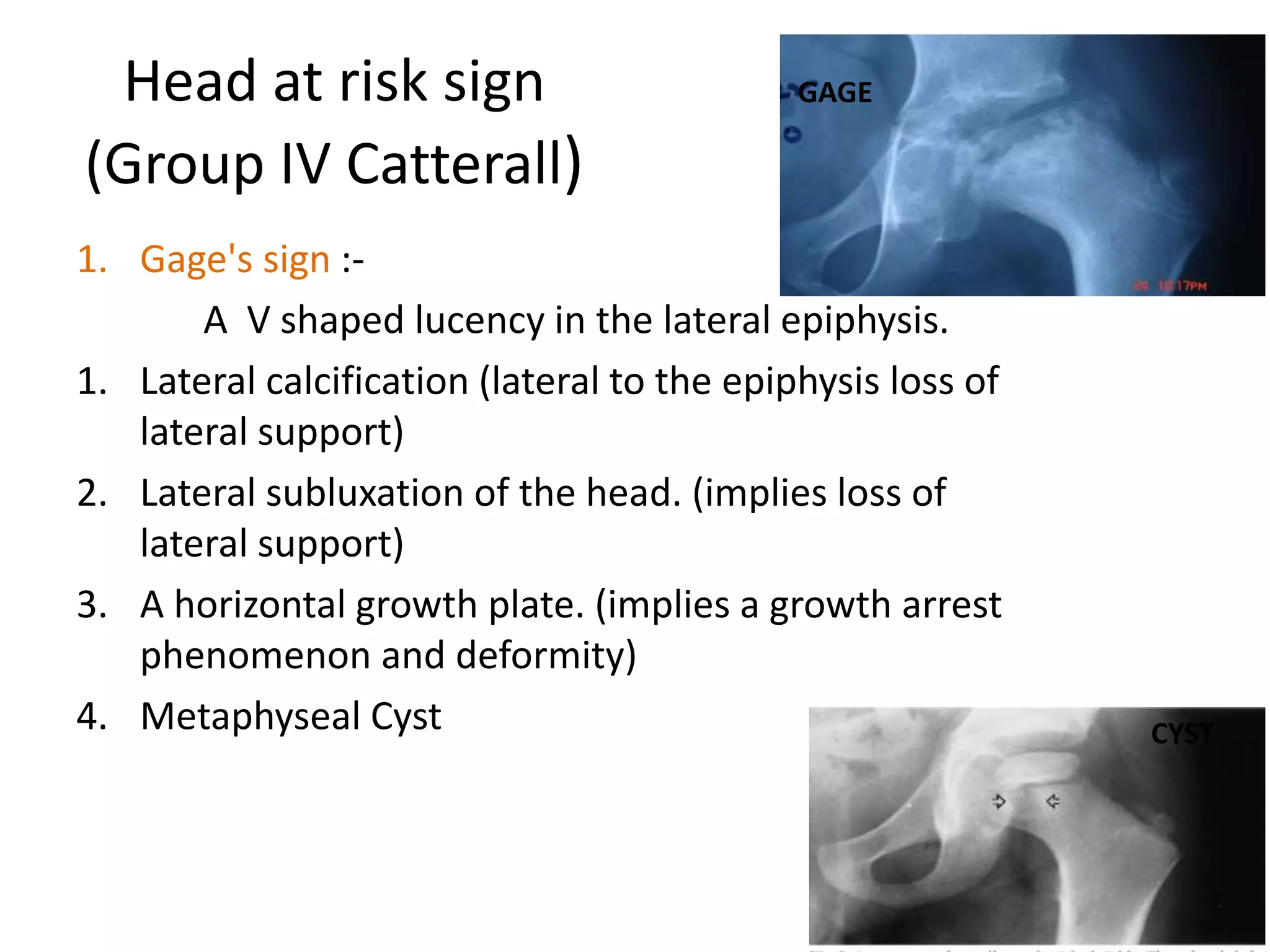
Head at risk sign
(Group IV Catterall)
1. Gage's sign :-
A V shaped lucency in the lateral epiphysis.
1. Lateral calcification (lateral to the epiphysis loss of
lateral support)
2. Lateral subluxation of the head. (implies loss of
lateral support)
3. A horizontal growth plate. (implies a growth arrest
phenomenon and deformity)
4. Metaphyseal Cyst
GAGE
CYST
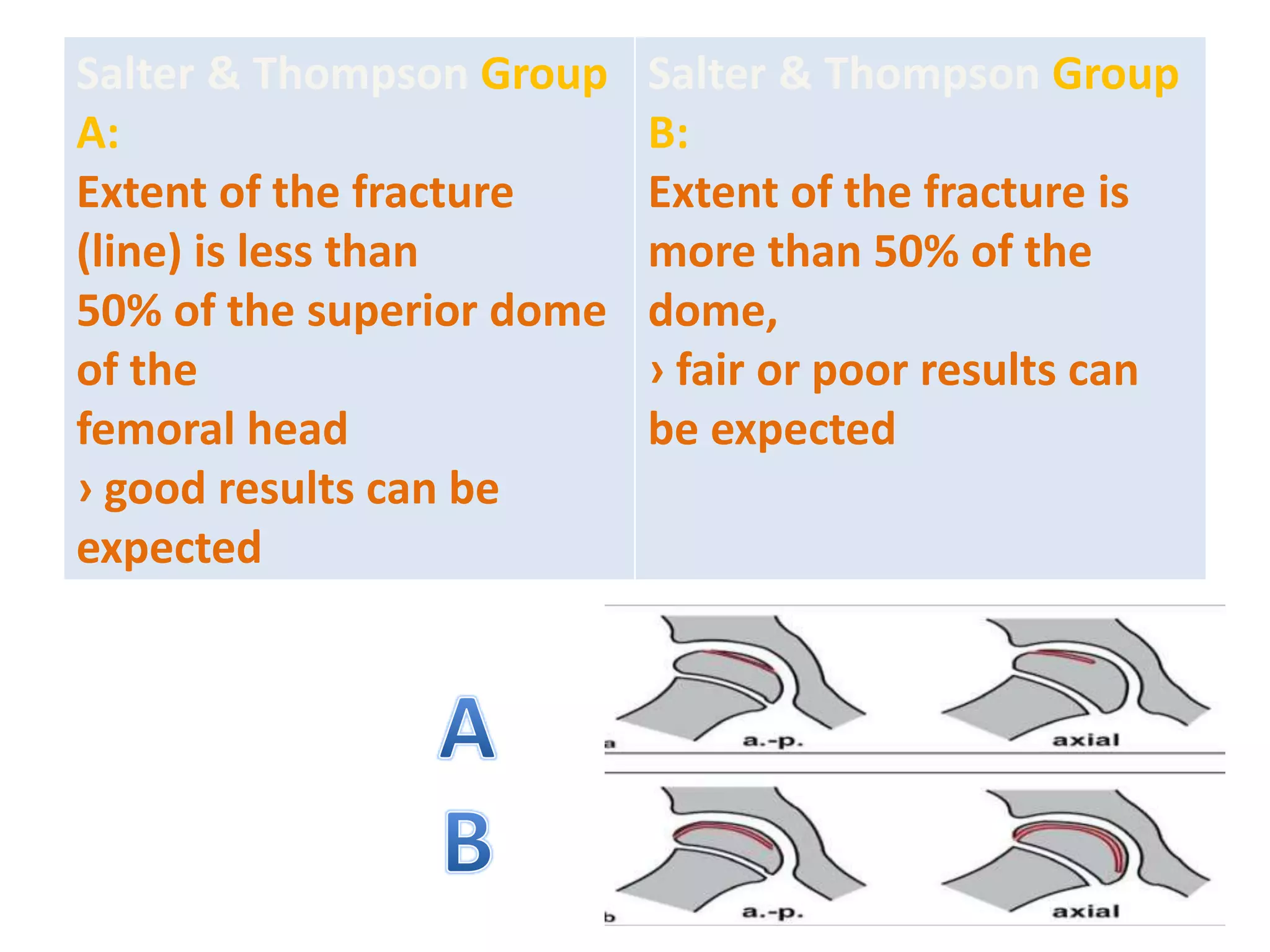
Salter & Thompson Group
A:
Extent of the fracture
(line) is less than
50% of the superior dome
of the
femoral head
› good results can be
expected
Salter & Thompson Group
B:
Extent of the fracture is
more than 50% of the
dome,
› fair or poor results can
be expected
(Herring) Lateral Pillar Classification
There is no loss in height of the lateral
1/3 of the head and minimal density change.
Fragmentation
occurs in the central segment of the head
There is lucency and loss of height in
the lateral pillar but not more that 50% of
the original
(contralateral) pillar height. there may be
some lateral extrusion
of the head
(Herring) Lateral Pillar Classification
There is greater than 50% loss in the
height of the lateral pillar. The lateral pillar is
lower than the
central segment early on.
Group B/C Border – Lateral pillar is narrowed
(2-3 mm) or poorly
Ossified with approximately 50% height
■ Recently added to increase consistency
and prognosis of classification
Herring) Lateral Pillar Classification
Outcome of Herring
• Herring A - all do well without treatment
• Herring B – bone age <8 years :uniform
outcome irrespective of type of treatment.
• Herring B –bone age >8 years:surgery >brace
• Herring C- bone age <8years: surgery > brace
• Herring C –bone age > 8 years: poor outcome
• irrespective of type of containment
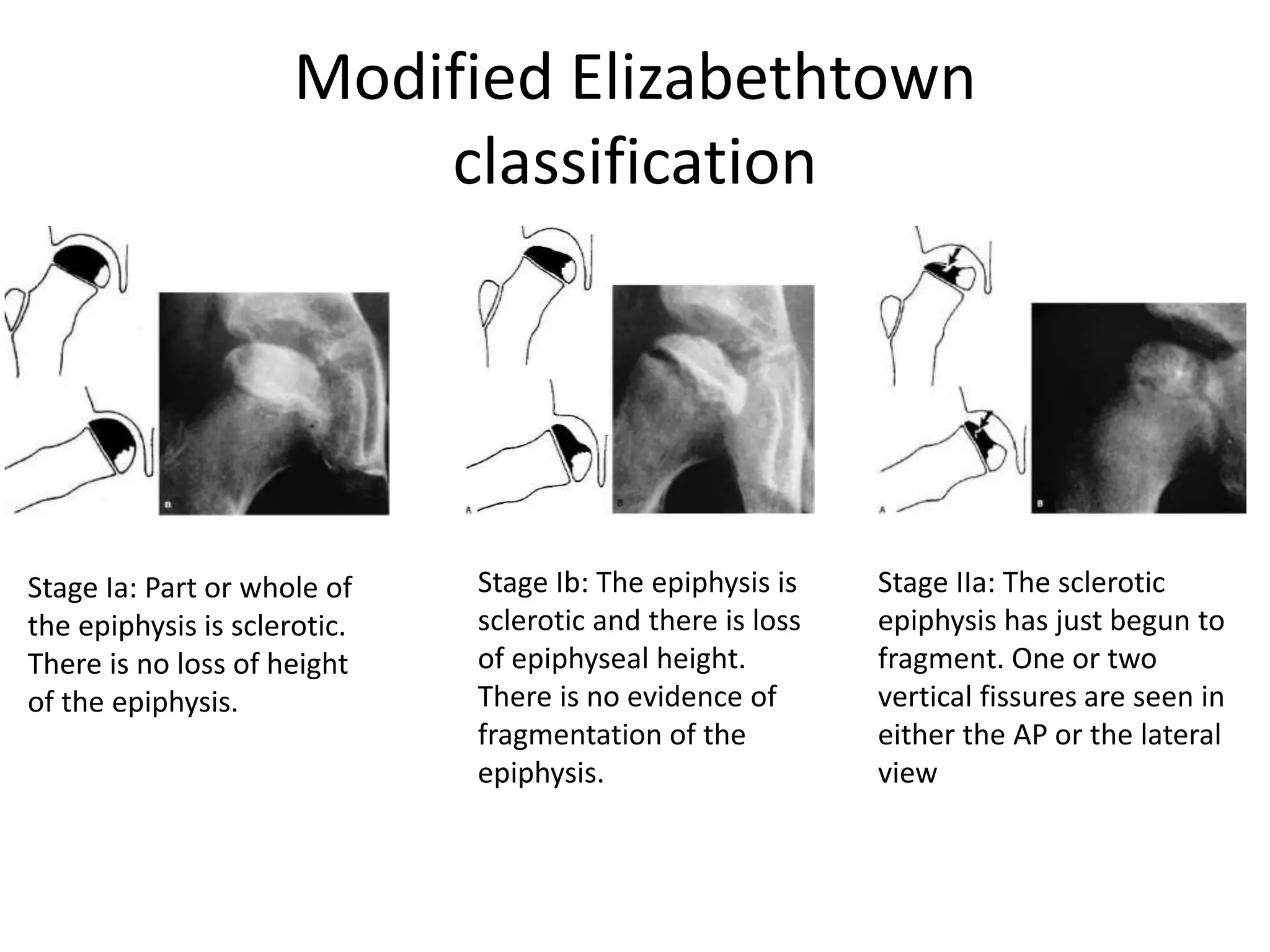
Modified Elizabethtown
classification
Stage Ia: Part or whole of
the epiphysis is sclerotic.
There is no loss of height
of the epiphysis.
Stage Ib: The epiphysis is
sclerotic and there is loss
of epiphyseal height.
There is no evidence of
fragmentation of the
epiphysis.
Stage IIa: The sclerotic
epiphysis has just begun to
fragment. One or two
vertical fissures are seen in
either the AP or the lateral
view
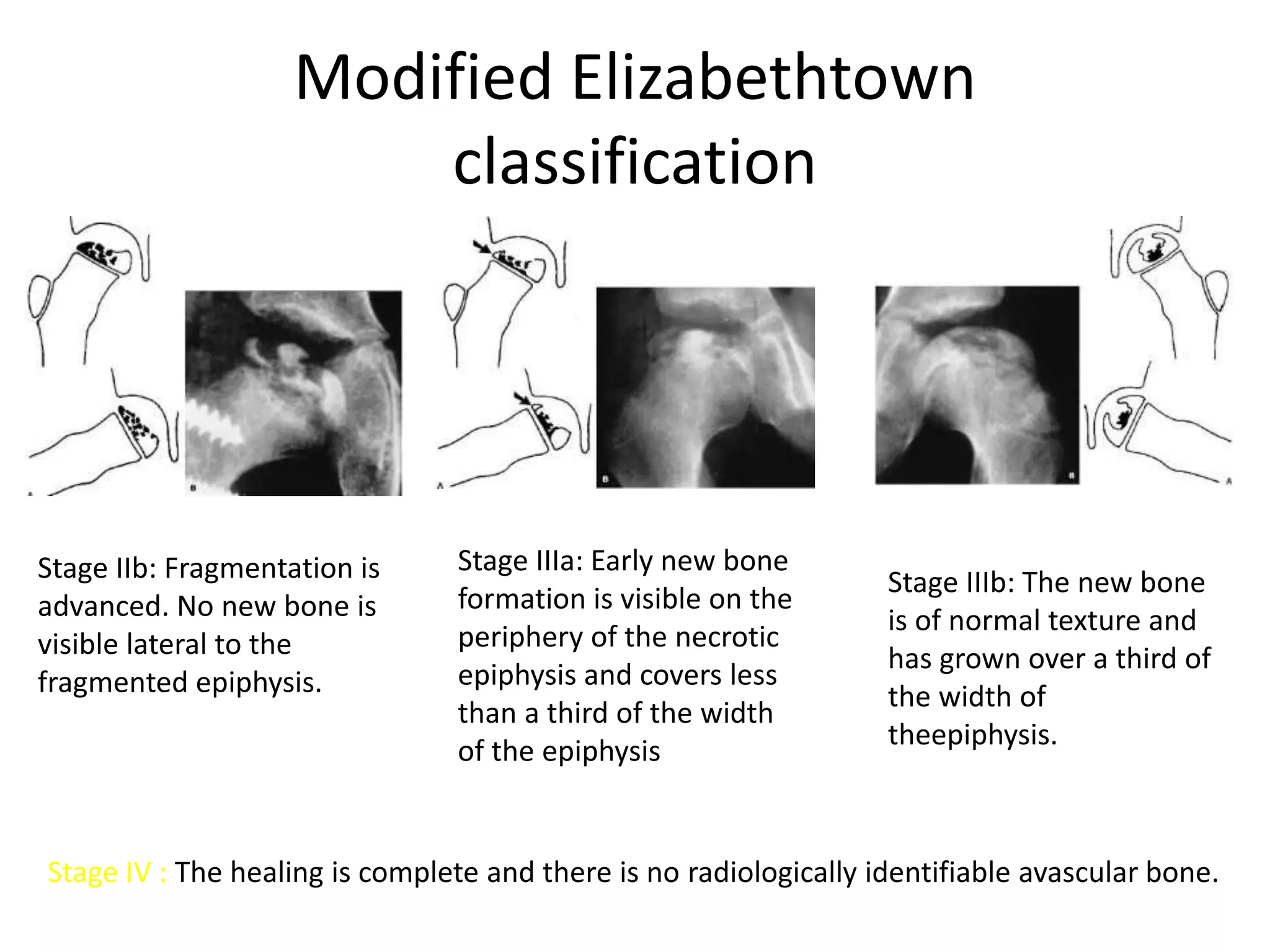
Modified Elizabethtown
classification
Stage IIIa: Early new bone
formation is visible on the
periphery of the necrotic
epiphysis and covers less
than a third of the width
of the epiphysis
Stage IIb: Fragmentation is
advanced. No new bone is
visible lateral to the
fragmented epiphysis.
Stage IIIb: The new bone
is of normal texture and
has grown over a third of
the width of
theepiphysis.
Stage IV : The healing is complete and there is no radiologically identifiable avascular bone.
Clinical course of disease
Ref :Waldenstrom et al, Observed that clinical course is
variable. He divided into 4 stages
MANAGEMENT
INVESTIGATIONS TREATMENT
-CONSERVATIVE
-SURGICAL
INVESTIGATIONS
• Hematological parameters
• ESR
• CRP
• RA factor.
• Coagulability profile.
• X-rays
• CT scan
• MRI
• Arthrography
• Scintigraphy.
Role of Scintigraphy
• Effective means of diagnosing perthes disease in its early
stages much before radiographic changes are apparent.
• extent of necrosis,
• reveals revascularization and the stage of the disease.
Role of CT
CT is of benefit in later stages of the disease to
evaluate pain, locking of joint and other
mechanical symptoms
Role of USG
• Early stages of perthes disease to
demonstrate joint effusion
• Later stages to assess shape of femoral head
• Blood flow in femoral head.
• USG with microbubble contrast enhancement used to
evaluate vascularisation of femoral head
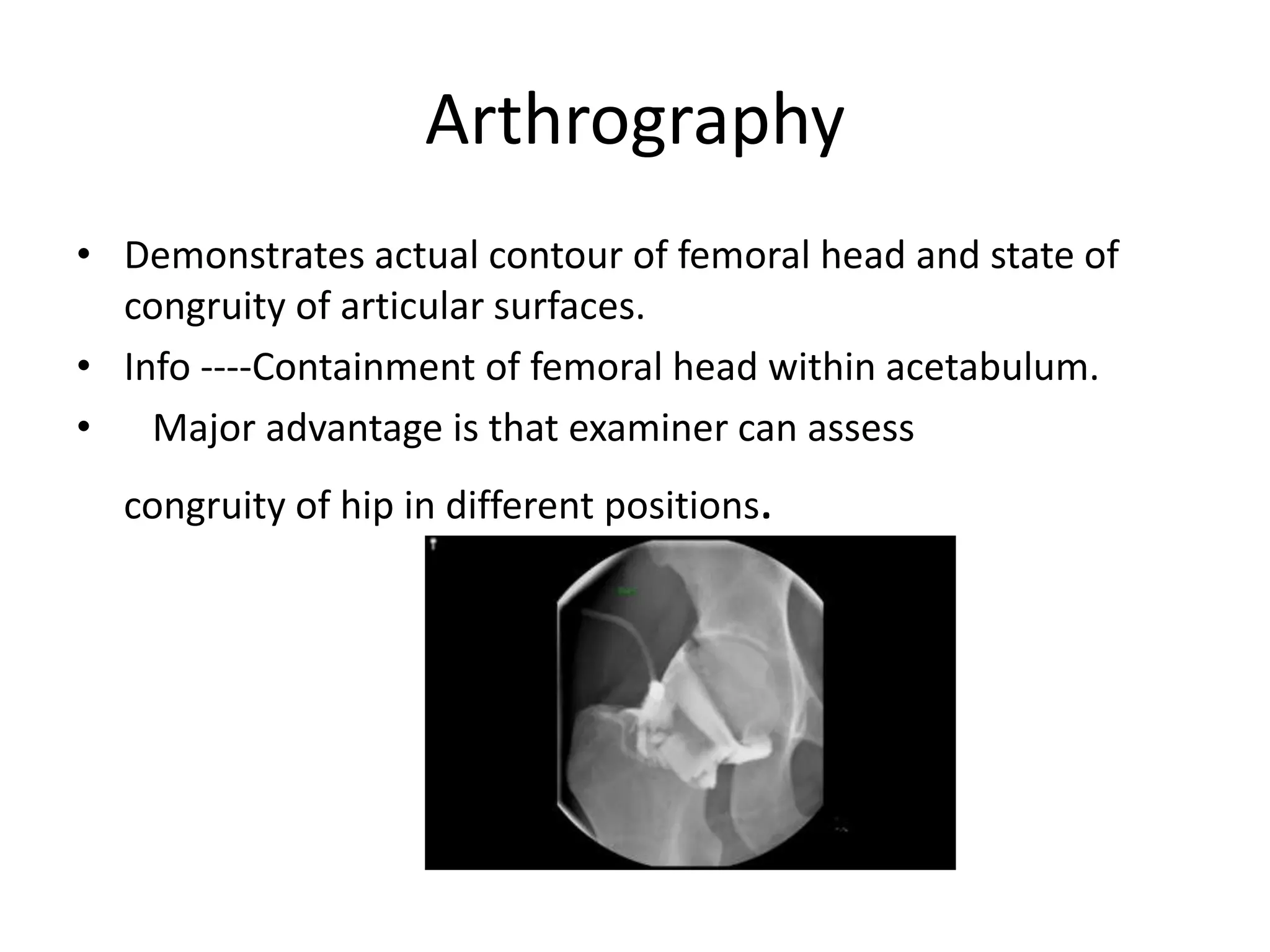
Arthrography
• Demonstrates actual contour of femoral head and state of
congruity of articular surfaces.
• Info ----Containment of femoral head within acetabulum.
• Major advantage is that examiner can assess
congruity of hip in different positions.
MRI
• Early diagnosis of perthes disease.
• Epiphyseal involvement
• Diagnostic accuracy: 97-99%.
• Revascularisation and extent of femoral head
necrosis.
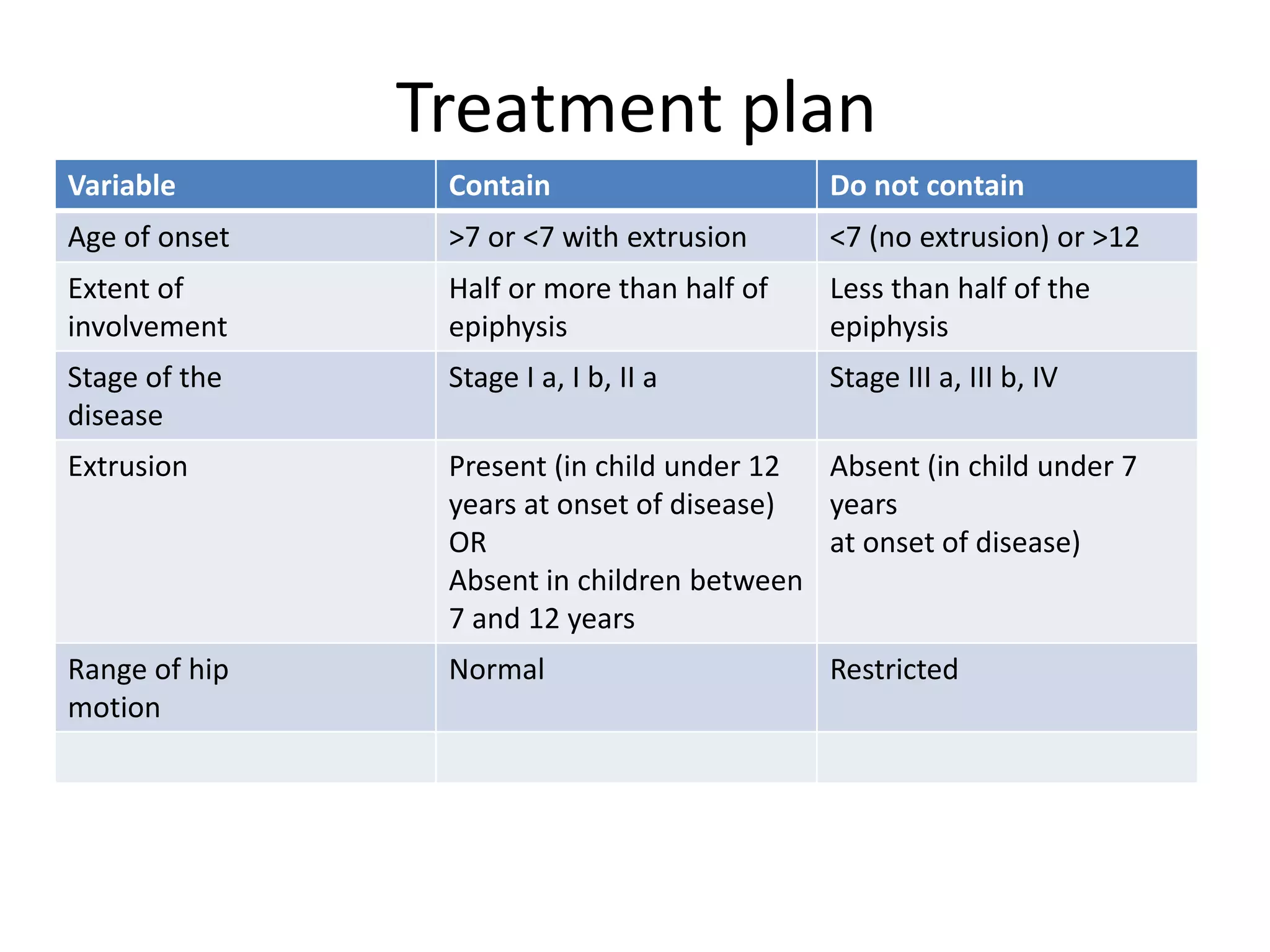
Treatment plan
Variable Contain Do not contain
Age of onset >7 or <7 with extrusion <7 (no extrusion) or >12
Extent of
involvement
Half or more than half of
epiphysis
Less than half of the
epiphysis
Stage of the
disease
Stage I a, I b, II a Stage III a, III b, IV
Extrusion Present (in child under 12
years at onset of disease)
OR
Absent in children between
7 and 12 years
Absent (in child under 7
years
at onset of disease)
Range of hip
motion
Normal Restricted
PRESENTGUIDELINES
FAVOURABLE OUTCOME
(<1/2 head + no extrusion)
(Catterall I&II,Herring A,B)
UNFAVORABLE OUTCOME
(whole head + lateral extrusion)
Catterall III & IV,herring C,Head
@risk sign
<7
yrs
>7
yrs
1.Braces
2.Periodic
review
1.Surgical
containment
Symptomatic Rx
Periodic radioligical
review
Management
• In Active Phase(Early Stage ) ;
a. Children age 4 years – Counsel the parents -expected
duration of the disease (24 to 36 months).
Children 2 to 3 years old –No need aggressive treatment.
b. Once synovitis resolves active and assisted range-of motion
c. If loss of motion is significant, and subluxation laterally is
occurring, bed rest, skin traction, progressive passive and
active physical therapy, abduction exercises, and pool therapy,
d. If there is no improvement -percutaneous adductor longus
tenotomy, followed by an ambulatory abduction cast (Petrie)
for 6 weeks or more.
Goals in Management
• There is a importance of the timing and the indications
for surgery, rather than the type of procedure
• Main aim is the containment of femoral head
• Deformation occurs during the phase of
revascularization (fragmentation) & early regeneration
(ossification).
• For containment is to succeed, it would need to be
performed before the late phase of fragmentation, i.e.,
in stages of AVN or early fragmentation
Rationale of Containment
• Containment of the head within the acetabulum is
reported to encourage spherical remodelling during
the reossification and subsequent phases.
• However if there is total head involvement and the
lateral pillar collapses then the effect of containment
is probably less.
How long Containment?
Needs to be ensured until the healing process
and beyond the stage where epiphysis is
vulnerable to deformation that is until the late
stage of regeneration phase ( 2 yrs)
Conservative Surgical
Braces and Orthosis
(indicated <5 years of age )
• Non Ambulatory weight releiving
• 1. Abduction broomstick plaster cast
• 2. Hip spica cast
• 3. Milgram hip abduction orthosis
• Ambulatory Both limbs included
• 1. Petrie Abduction cast
• 2. Toronto orthosis
• 3. Newington orthosis
• 4. Birmingham brace
• 5. Atlanta Scotish Rite Brace
• Ambulatory unilateral
• 1. Tachdjian trilateral socket orthosis
Atlanta Scotish Rite
Brace
Newington
orthosis
Birmingham brace
Toronto Brace
Tachdjian
trilateral
socket orthosis
BROOMSTICK CASTS
Radiographic evidence of healing
1. Appearance of regular ossification in the femoral
head.
2. Increased density of femoral head should
disappear.
3. Metaphyseal rarefaction involving the lateral
cortex of the metaphysis should ossify.
4. There should be intact lateral column.
5. There should be normal trabecular bone in the
epiphysis.
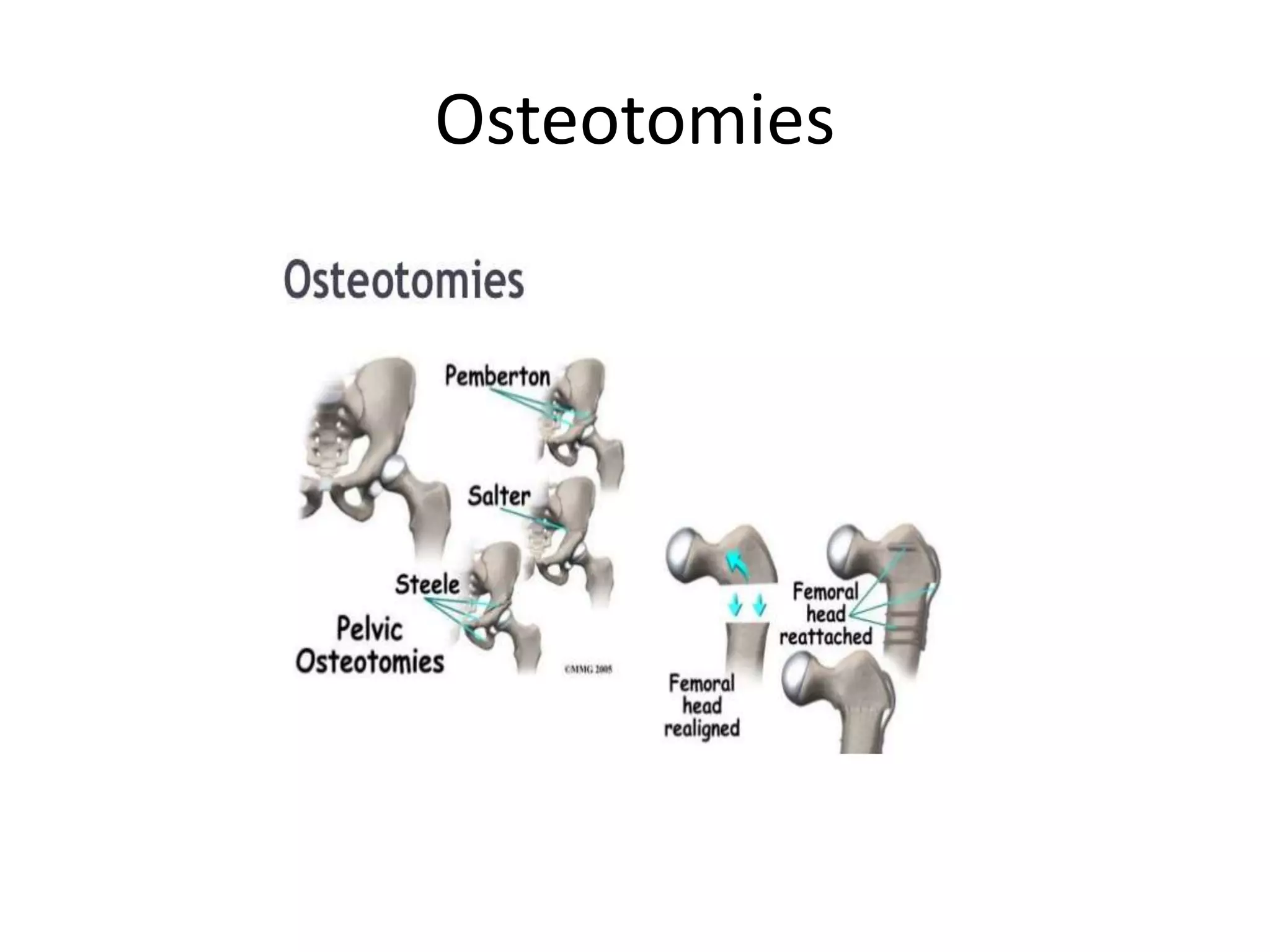
Osteotomies
Varus derotation osteotomy
• If all movements are normal VDO should be
considered.
• If abduction is normal and internal rotation is
restricted, VEO should be done.
• Produces same results as pelvis osteotomy.
• It has less chances of surgical risk (sciatic nerve
injury) and no intra-articular increase in pressure.
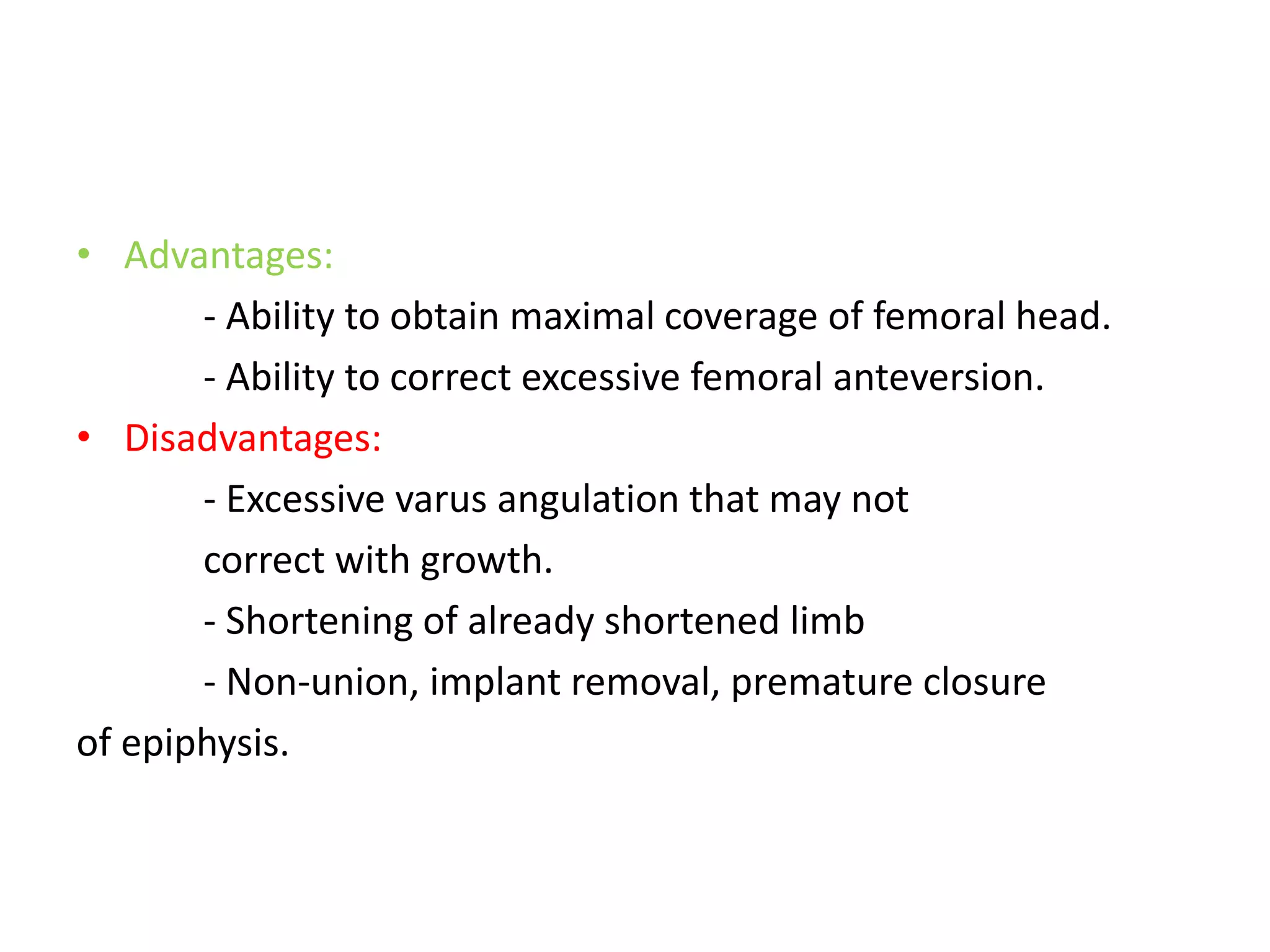
• Advantages:
- Ability to obtain maximal coverage of femoral head.
- Ability to correct excessive femoral anteversion.
• Disadvantages:
- Excessive varus angulation that may not
correct with growth.
- Shortening of already shortened limb
- Non-union, implant removal, premature closure
of epiphysis.
Level of osteotomy level
of lesser trochanter or
slightly distal
Insertion of guide pin and
reaming of femur
Plate and compression screw
application Insertion of bone screws.
Spica cast is worn for 8-12 weeks and
internal
fixation can be removed after 1-2
years.
First depth marking flush with lateral cortex
Removal of wedge to customize it
Innominate Osteotomy
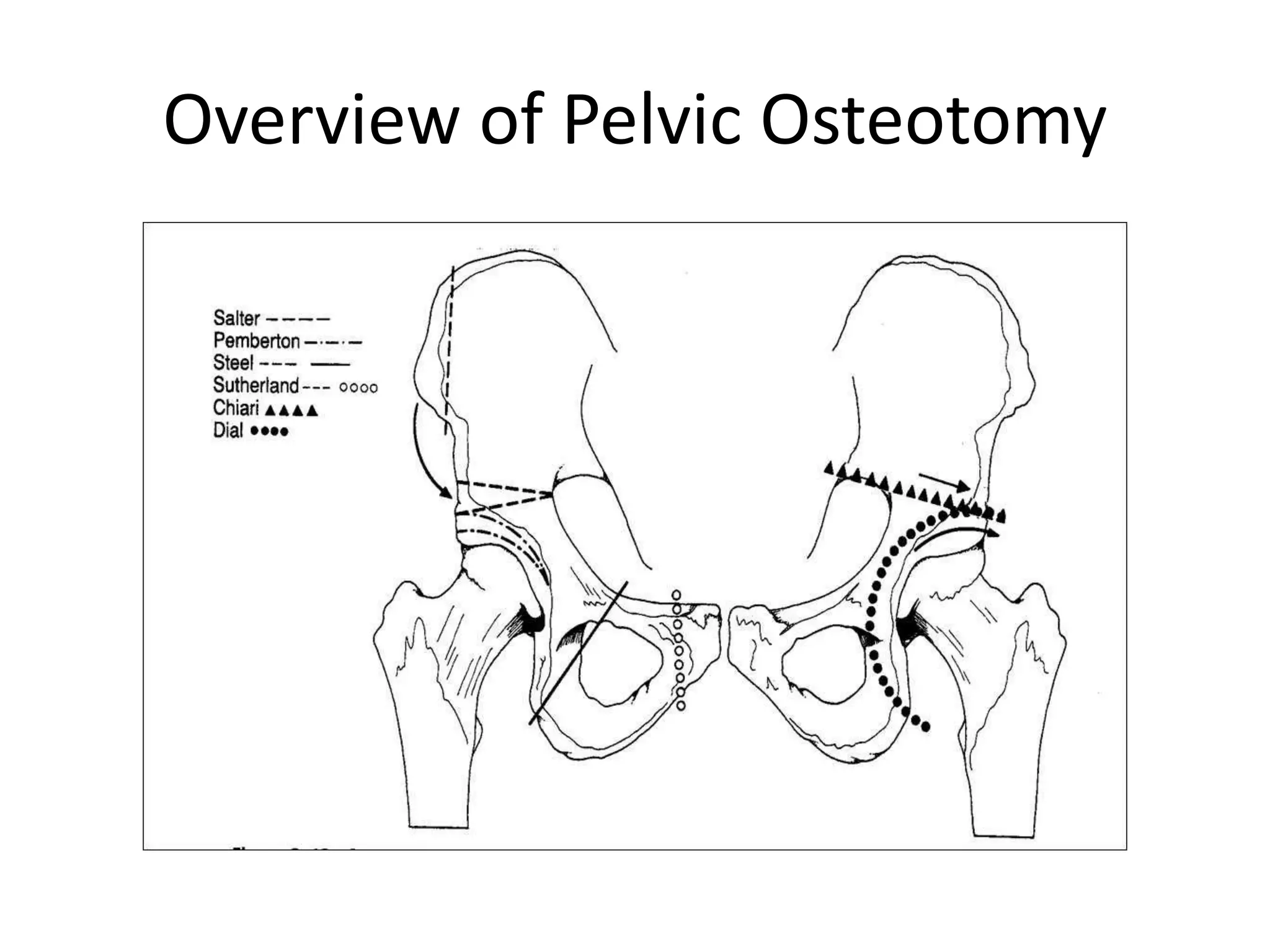
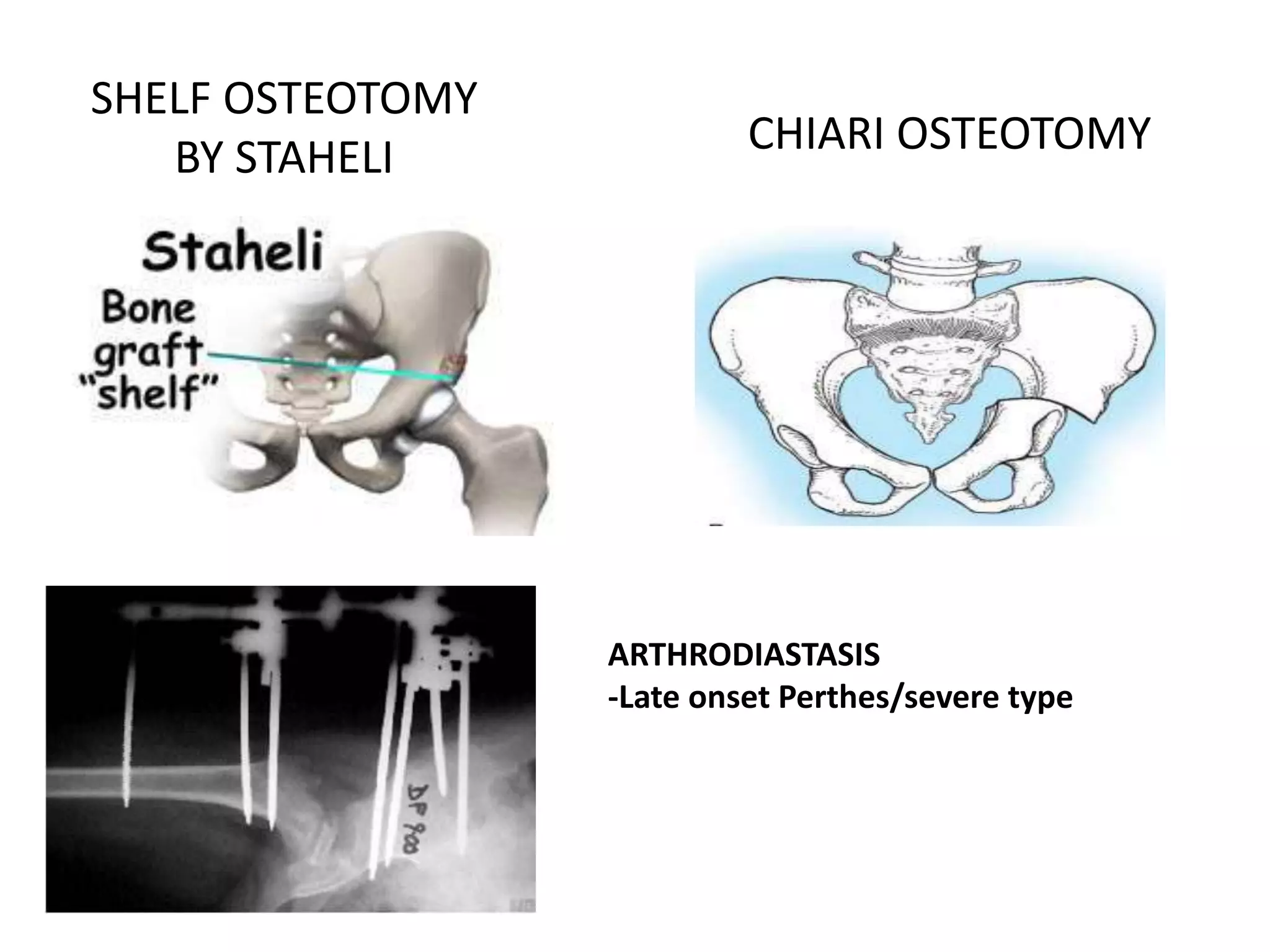
• Salter, Triple and shelf acetabuloplasty are
pelvic osteotomy for Perthes disease.
Overview of Pelvic Osteotomy
• Advantages :
• Anterolateral coverage of femoral head
• Lengthening of extremity
• Avoidance of second operation for plate removal
• Disadvantages:
• Possibility of improper containment of femoral head
• In acetabular and hip joint pressure --further
avascular changes in the femoral head
• In limb length on operated side which may lead to relative
adduction of the hip and femoral head uncovering.
Salter osteotomy
• Osteotomy made from AIIS to Greater Sciatic Notch
• Graft is taken from iliac crest and trained to the shape of a
wedge
• The distal segment is shifted forward, downward and outward
Place the graft into open segment anteriorly.
• Secure it by passing a Kwire from proximal fragment through
graft into distal fragment taking care not to enter acetabulum
STEEL’s TRIPLE INNOMINATE
OSTEOTOMY
1. Osteotomy made from AIIS to
Greater Sciatic notch
2. Ischial ramus is divided
posterolaterally at 45 from
perpendicular.
3. Superior pubic ramus is divided
posteromedially 15 from
perpendicular.
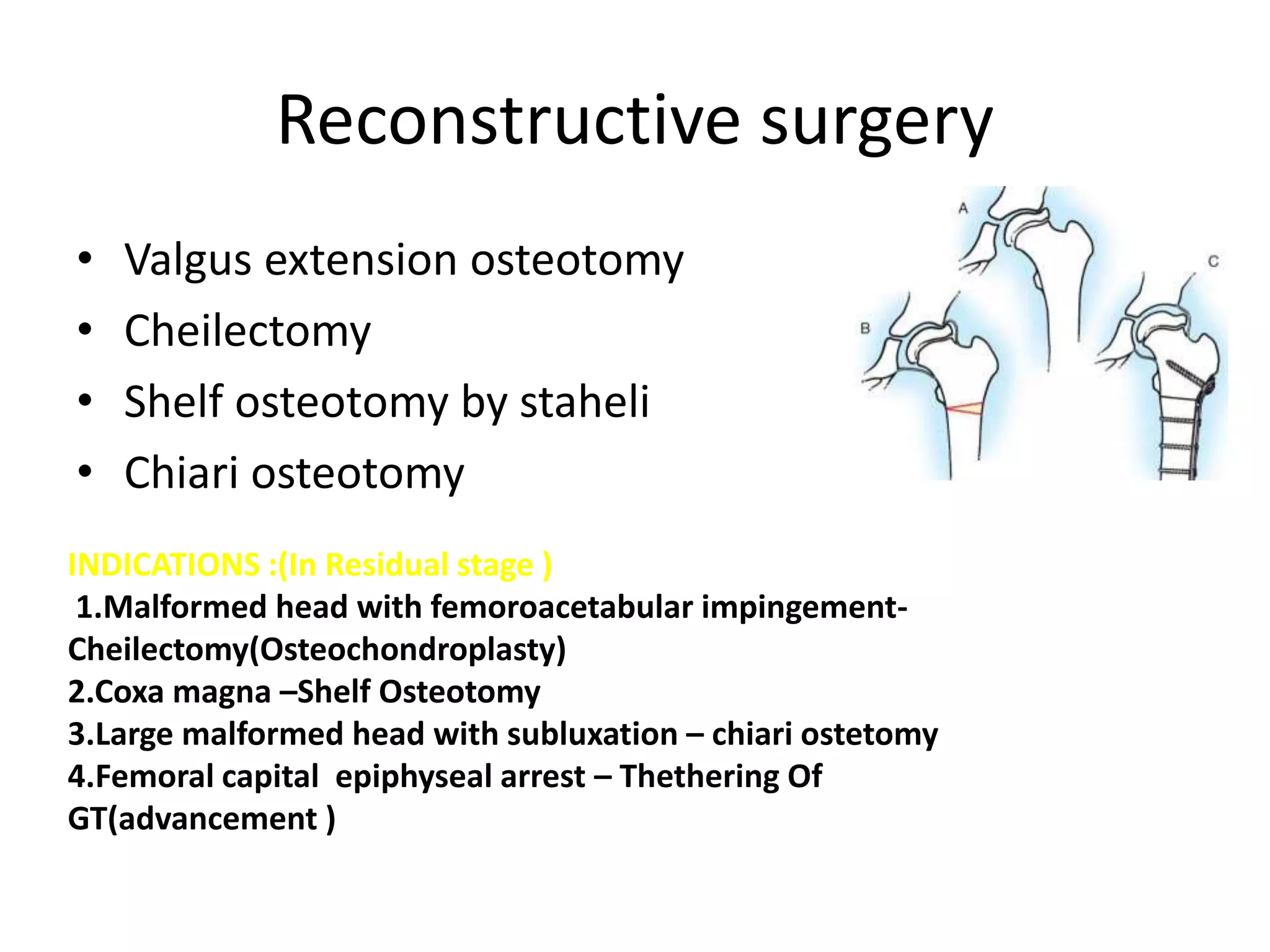
Reconstructive surgery
• Valgus extension osteotomy
• Cheilectomy
• Shelf osteotomy by staheli
• Chiari osteotomy
INDICATIONS :(In Residual stage )
1.Malformed head with femoroacetabular impingement-
Cheilectomy(Osteochondroplasty)
2.Coxa magna –Shelf Osteotomy
3.Large malformed head with subluxation – chiari ostetomy
4.Femoral capital epiphyseal arrest – Thethering Of
GT(advancement )
SHELF OSTEOTOMY
BY STAHELI CHIARI OSTEOTOMY
ARTHRODIASTASIS
-Late onset Perthes/severe type
Assesment grading by Mose
• Good- CE angle 20 degrees or more.
• Fair -CE angle of 15-19 degrees
• Poor- CE angle less than 15 degrees
LINE 1: Vertical line passing
through centre of head
LINE 2 :Perpendicular to line 1
LINE 3 :CE line from centre
of head to the edge
of acetabulum
PROGNOSIS
• AGE – important factor ,<6 good prognosis
• Girls poorer Prog than Boys
• Caterall –greater the degree of head inv-
poorer outcome
• Poor prognosis – “HEAD @RISK SIGN,GAGE
SIGN POSITIVE”
• HERRING group C –poor
perthes disease

perthes disease

  • 1.
    LEGG CALVE PERTHESDISEASE Dr. Bipul Borthakur, Professor, Dept. of Orthopaedics, SMCH
  • 2.
    Overview • Definition • Demography •Risk and Pathology • Vascular supply of femoral head • Clinical features • Classification • Diagnosis • Treatment Conservative Containment procedure Salvage Procedure
  • 3.
    Definition • Idiopathic avascularnecrosis of the proximal femoral epiphysis in children. SYNONYMS • Legg calve perthes disease • Legg stress fracture of femoral head • Osteochondritis deformans juvenalis • Osteochondrosis of hip joint • Coxa plana • Pseudocoxalgia
  • 4.
    Demographics • First Describedby LEGG AND WALDENSTORM • In 1909 - PERTHES • In 1910 -CALVE • Incidence – 1 in 10,000 children • Demographics – 4-8 years M/C – M:F is 5:1 – Higher among lower socioeconomic class – Race Caucasian > East Asian and African American
  • 5.
    Risk Factors • Positivefamily history • Low birth weight • Abnormal birth presentation • Asian and Central European decent
  • 6.
    Location • Location bilateralin 12% – Asymmetrical, asynchronous involvement rarely at the same stage of disease – Symmetrical involvement suggests MED (multiple epiphyseal dysplasia)
  • 7.
    Pathogenesis • Current suggestion: Disorder of the clotting mechanism with deficiency of factors such as protein C or S and Factor V Leiden mutation (MERCERS). • Apart from AVN there is changes in , 1. Articular cartilage 2. Growth plate 3. Synovium 4. In Established disease-Reactive Synovitis will be present
  • 8.
    Other Theories • Repeatedsubclinical trauma and mechanical overload lead to bone collapse and repair (multiple-infarction theory)
  • 9.
    Blood supply offemoral head • Retinacular Arteries • Metaphyseal Arteries • Artery of teres ligament
  • 10.
    Cntnue… • IN INFANTS: 1. Medial Ascending cervical or inferior metaphyseal arteries of trueta 2. Lateral ephiphyseal arteries 3. Lig teres –insignificant • IN 4 months to 4 years : 1. Lateral ephiphyseal 2. Medial ephiphyseal decrease in number
  • 11.
    • IN 4to 7 Years: 1. Ephiphyseal plate forms a barrier to metaphyseal vessels • IN Pre-Adolescent 1. After 7 years ligament teres artery anastomose with lateral ephiphyseal vessels
  • 12.
  • 13.
    Clinical features • Intermittentpain in hip and a limp • insidious onset • Classical presentation- Painless limp • Restriction of abduction and internal rotation • Nature of pain : Aggravated by movement reileved by rest
  • 14.
    Examination • Antalgic gait •Muscle spasm secondary to irritated hip • Trendelenberg positive • Short stature • FFD
  • 15.
    Stages of Perthesdisease • Stage of Avascular necrosis • Stage of Fragmentation • Stage of Regeneration • Stage of Healing
  • 16.
    STAGES STAGE 1 (Early) Avascular Necrosis 1.Asymmetric femoral epiphyseal size (smaller on the affected side) 2.Apparent increased density of the femoral head epiphysis 3.Widening of the medial joint space 4.Blurring of the physeal plate 5.Radiolucency of the proximal metaphysis STAGE 2 Fragmentation 1. Subchondral lucency (crescent sign) 2. Femoral epiphysis fragments 3. Femoral head outline is difficult to make out 4. Mottled density 5. Thickened trabeculae STAGE 3(Reparative ) Regeneration 1.Re-ossification begins 2.Shape of the femoral head becomes better defined 3.Bone density begins to return
  • 17.
    • STAGE 4 Healing1.Changes depend on the severity the femoral head which may be nearly normal or may demonstrate: -Flattening of the articular surface, especially superiorly -widening of the head and neck of the femur CRESCENT SIGN OR SALTER SIGN OR CAFFEY SIGN IN STAGE 2
  • 18.
    Stage 1 :AVNStage 2 :Fragmentation Stage 3:Regeneration Stage 4: Healing
  • 19.
    Metaphyseal changes Metaphyseal necrosis &lucencies (“holes of decalcification”) Sagging rope sign Radiodense line in proximal femoral metaphysis --It’s the Metaphyseal response to physeal damage
  • 20.
    Acetabular changes • Bicompartmentalacetabulum appears to be composed of 2 arc partly overlapping each other – interpreted as the subluxated femoral head articulating only with the lateral half of the acetabulum moulding it into 2 compartments
  • 21.
    Classifications based onExtent of Lesion • Catterall(Based on degree of head involvement) • Salter & thompson(Based on radiographic cresent sign) • Herring (lateral pillar ) • Elizabeth (Epiphysis involvement ) • Stulberg (residual femoral head deformity and joint congruence)
  • 22.
    • Catterall etal. Grade <CATTERALL> Characteristics I (good prognosis ) Only anterolateral quadrant affected (< ½ of epiphysis affected ) II (good prognosis ) Anterior third or half of the femoral head III (poor prognosis) Up to ¾ of the femoral head affected ,i.e more than half of epiphysis IV(poor prognosis ) Whole femoral head affected (entire)
  • 24.
    Head at risksign (Group IV Catterall) 1. Gage's sign :- A V shaped lucency in the lateral epiphysis. 1. Lateral calcification (lateral to the epiphysis loss of lateral support) 2. Lateral subluxation of the head. (implies loss of lateral support) 3. A horizontal growth plate. (implies a growth arrest phenomenon and deformity) 4. Metaphyseal Cyst GAGE CYST
  • 25.
    Salter & ThompsonGroup A: Extent of the fracture (line) is less than 50% of the superior dome of the femoral head › good results can be expected Salter & Thompson Group B: Extent of the fracture is more than 50% of the dome, › fair or poor results can be expected
  • 26.
    (Herring) Lateral PillarClassification There is no loss in height of the lateral 1/3 of the head and minimal density change. Fragmentation occurs in the central segment of the head There is lucency and loss of height in the lateral pillar but not more that 50% of the original (contralateral) pillar height. there may be some lateral extrusion of the head
  • 27.
    (Herring) Lateral PillarClassification There is greater than 50% loss in the height of the lateral pillar. The lateral pillar is lower than the central segment early on. Group B/C Border – Lateral pillar is narrowed (2-3 mm) or poorly Ossified with approximately 50% height ■ Recently added to increase consistency and prognosis of classification
  • 28.
  • 29.
    Outcome of Herring •Herring A - all do well without treatment • Herring B – bone age <8 years :uniform outcome irrespective of type of treatment. • Herring B –bone age >8 years:surgery >brace • Herring C- bone age <8years: surgery > brace • Herring C –bone age > 8 years: poor outcome • irrespective of type of containment
  • 30.
    Modified Elizabethtown classification Stage Ia:Part or whole of the epiphysis is sclerotic. There is no loss of height of the epiphysis. Stage Ib: The epiphysis is sclerotic and there is loss of epiphyseal height. There is no evidence of fragmentation of the epiphysis. Stage IIa: The sclerotic epiphysis has just begun to fragment. One or two vertical fissures are seen in either the AP or the lateral view
  • 31.
    Modified Elizabethtown classification Stage IIIa:Early new bone formation is visible on the periphery of the necrotic epiphysis and covers less than a third of the width of the epiphysis Stage IIb: Fragmentation is advanced. No new bone is visible lateral to the fragmented epiphysis. Stage IIIb: The new bone is of normal texture and has grown over a third of the width of theepiphysis. Stage IV : The healing is complete and there is no radiologically identifiable avascular bone.
  • 33.
    Clinical course ofdisease Ref :Waldenstrom et al, Observed that clinical course is variable. He divided into 4 stages
  • 34.
  • 35.
    INVESTIGATIONS • Hematological parameters •ESR • CRP • RA factor. • Coagulability profile. • X-rays • CT scan • MRI • Arthrography • Scintigraphy.
  • 36.
    Role of Scintigraphy •Effective means of diagnosing perthes disease in its early stages much before radiographic changes are apparent. • extent of necrosis, • reveals revascularization and the stage of the disease.
  • 37.
    Role of CT CTis of benefit in later stages of the disease to evaluate pain, locking of joint and other mechanical symptoms
  • 38.
    Role of USG •Early stages of perthes disease to demonstrate joint effusion • Later stages to assess shape of femoral head • Blood flow in femoral head. • USG with microbubble contrast enhancement used to evaluate vascularisation of femoral head
  • 39.
    Arthrography • Demonstrates actualcontour of femoral head and state of congruity of articular surfaces. • Info ----Containment of femoral head within acetabulum. • Major advantage is that examiner can assess congruity of hip in different positions.
  • 40.
    MRI • Early diagnosisof perthes disease. • Epiphyseal involvement • Diagnostic accuracy: 97-99%. • Revascularisation and extent of femoral head necrosis.
  • 41.
    Treatment plan Variable ContainDo not contain Age of onset >7 or <7 with extrusion <7 (no extrusion) or >12 Extent of involvement Half or more than half of epiphysis Less than half of the epiphysis Stage of the disease Stage I a, I b, II a Stage III a, III b, IV Extrusion Present (in child under 12 years at onset of disease) OR Absent in children between 7 and 12 years Absent (in child under 7 years at onset of disease) Range of hip motion Normal Restricted
  • 42.
    PRESENTGUIDELINES FAVOURABLE OUTCOME (<1/2 head+ no extrusion) (Catterall I&II,Herring A,B) UNFAVORABLE OUTCOME (whole head + lateral extrusion) Catterall III & IV,herring C,Head @risk sign <7 yrs >7 yrs 1.Braces 2.Periodic review 1.Surgical containment Symptomatic Rx Periodic radioligical review
  • 43.
    Management • In ActivePhase(Early Stage ) ; a. Children age 4 years – Counsel the parents -expected duration of the disease (24 to 36 months). Children 2 to 3 years old –No need aggressive treatment. b. Once synovitis resolves active and assisted range-of motion c. If loss of motion is significant, and subluxation laterally is occurring, bed rest, skin traction, progressive passive and active physical therapy, abduction exercises, and pool therapy, d. If there is no improvement -percutaneous adductor longus tenotomy, followed by an ambulatory abduction cast (Petrie) for 6 weeks or more.
  • 44.
    Goals in Management •There is a importance of the timing and the indications for surgery, rather than the type of procedure • Main aim is the containment of femoral head • Deformation occurs during the phase of revascularization (fragmentation) & early regeneration (ossification). • For containment is to succeed, it would need to be performed before the late phase of fragmentation, i.e., in stages of AVN or early fragmentation
  • 45.
    Rationale of Containment •Containment of the head within the acetabulum is reported to encourage spherical remodelling during the reossification and subsequent phases. • However if there is total head involvement and the lateral pillar collapses then the effect of containment is probably less.
  • 46.
    How long Containment? Needsto be ensured until the healing process and beyond the stage where epiphysis is vulnerable to deformation that is until the late stage of regeneration phase ( 2 yrs) Conservative Surgical
  • 47.
    Braces and Orthosis (indicated<5 years of age ) • Non Ambulatory weight releiving • 1. Abduction broomstick plaster cast • 2. Hip spica cast • 3. Milgram hip abduction orthosis • Ambulatory Both limbs included • 1. Petrie Abduction cast • 2. Toronto orthosis • 3. Newington orthosis • 4. Birmingham brace • 5. Atlanta Scotish Rite Brace • Ambulatory unilateral • 1. Tachdjian trilateral socket orthosis
  • 48.
    Atlanta Scotish Rite Brace Newington orthosis Birminghambrace Toronto Brace Tachdjian trilateral socket orthosis BROOMSTICK CASTS
  • 49.
    Radiographic evidence ofhealing 1. Appearance of regular ossification in the femoral head. 2. Increased density of femoral head should disappear. 3. Metaphyseal rarefaction involving the lateral cortex of the metaphysis should ossify. 4. There should be intact lateral column. 5. There should be normal trabecular bone in the epiphysis.
  • 50.
  • 51.
    Varus derotation osteotomy •If all movements are normal VDO should be considered. • If abduction is normal and internal rotation is restricted, VEO should be done. • Produces same results as pelvis osteotomy. • It has less chances of surgical risk (sciatic nerve injury) and no intra-articular increase in pressure.
  • 52.
    • Advantages: - Abilityto obtain maximal coverage of femoral head. - Ability to correct excessive femoral anteversion. • Disadvantages: - Excessive varus angulation that may not correct with growth. - Shortening of already shortened limb - Non-union, implant removal, premature closure of epiphysis.
  • 53.
    Level of osteotomylevel of lesser trochanter or slightly distal Insertion of guide pin and reaming of femur Plate and compression screw application Insertion of bone screws. Spica cast is worn for 8-12 weeks and internal fixation can be removed after 1-2 years. First depth marking flush with lateral cortex Removal of wedge to customize it
  • 54.
    Innominate Osteotomy • Salter,Triple and shelf acetabuloplasty are pelvic osteotomy for Perthes disease.
  • 55.
  • 56.
    • Advantages : •Anterolateral coverage of femoral head • Lengthening of extremity • Avoidance of second operation for plate removal • Disadvantages: • Possibility of improper containment of femoral head • In acetabular and hip joint pressure --further avascular changes in the femoral head • In limb length on operated side which may lead to relative adduction of the hip and femoral head uncovering.
  • 57.
    Salter osteotomy • Osteotomymade from AIIS to Greater Sciatic Notch • Graft is taken from iliac crest and trained to the shape of a wedge • The distal segment is shifted forward, downward and outward Place the graft into open segment anteriorly. • Secure it by passing a Kwire from proximal fragment through graft into distal fragment taking care not to enter acetabulum
  • 58.
    STEEL’s TRIPLE INNOMINATE OSTEOTOMY 1.Osteotomy made from AIIS to Greater Sciatic notch 2. Ischial ramus is divided posterolaterally at 45 from perpendicular. 3. Superior pubic ramus is divided posteromedially 15 from perpendicular.
  • 59.
    Reconstructive surgery • Valgusextension osteotomy • Cheilectomy • Shelf osteotomy by staheli • Chiari osteotomy INDICATIONS :(In Residual stage ) 1.Malformed head with femoroacetabular impingement- Cheilectomy(Osteochondroplasty) 2.Coxa magna –Shelf Osteotomy 3.Large malformed head with subluxation – chiari ostetomy 4.Femoral capital epiphyseal arrest – Thethering Of GT(advancement )
  • 60.
    SHELF OSTEOTOMY BY STAHELICHIARI OSTEOTOMY ARTHRODIASTASIS -Late onset Perthes/severe type
  • 61.
    Assesment grading byMose • Good- CE angle 20 degrees or more. • Fair -CE angle of 15-19 degrees • Poor- CE angle less than 15 degrees LINE 1: Vertical line passing through centre of head LINE 2 :Perpendicular to line 1 LINE 3 :CE line from centre of head to the edge of acetabulum
  • 62.
    PROGNOSIS • AGE –important factor ,<6 good prognosis • Girls poorer Prog than Boys • Caterall –greater the degree of head inv- poorer outcome • Poor prognosis – “HEAD @RISK SIGN,GAGE SIGN POSITIVE” • HERRING group C –poor