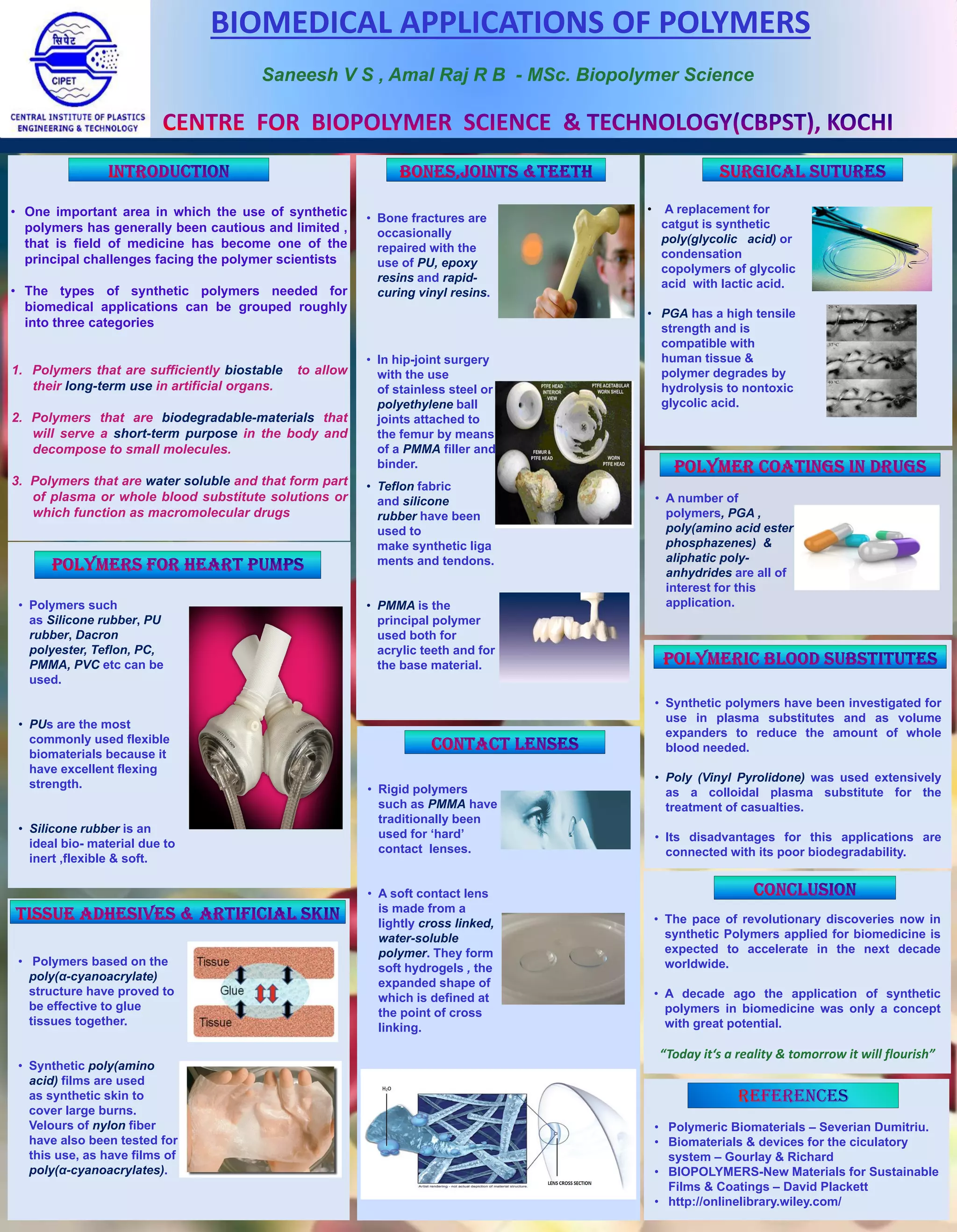
BIOMEDICAL APPLICATIONS OF POLYMERS
Saneesh V S , Amal Raj R B - MSc. Biopolymer Science
• Bone fractures are
occasionally
repaired with the
use of PU, epoxy
resins and rapid-
curing vinyl resins.
• In hip-joint surgery
with the use
of stainless steel or
polyethylene ball
joints attached to
the femur by means
of a PMMA filler and
binder.
• Teflon fabric
and silicone
rubber have been
used to
make synthetic liga
ments and tendons.
• PMMA is the
principal polymer
used both for
acrylic teeth and for
the base material.
• A number of
polymers, PGA ,
poly(amino acid ester
phosphazenes) &
aliphatic poly-
anhydrides are all of
interest for this
application.
• Synthetic polymers have been investigated for
use in plasma substitutes and as volume
expanders to reduce the amount of whole
blood needed.
• Poly (Vinyl Pyrolidone) was used extensively
as a colloidal plasma substitute for the
treatment of casualties.
• Its disadvantages for this applications are
connected with its poor biodegradability.
• Rigid polymers
such as PMMA have
traditionally been
used for ‘hard’
contact lenses.
• A soft contact lens
is made from a
lightly cross linked,
water-soluble
polymer. They form
soft hydrogels , the
expanded shape of
which is defined at
the point of cross
linking.
• A replacement for
catgut is synthetic
poly(glycolic acid) or
condensation
copolymers of glycolic
acid with lactic acid.
• PGA has a high tensile
strength and is
compatible with
human tissue &
polymer degrades by
hydrolysis to nontoxic
glycolic acid.
• One important area in which the use of synthetic
polymers has generally been cautious and limited ,
that is field of medicine has become one of the
principal challenges facing the polymer scientists
• The types of synthetic polymers needed for
biomedical applications can be grouped roughly
into three categories
1. Polymers that are sufficiently biostable to allow
their long-term use in artificial organs.
2. Polymers that are biodegradable-materials that
will serve a short-term purpose in the body and
decompose to small molecules.
3. Polymers that are water soluble and that form part
of plasma or whole blood substitute solutions or
which function as macromolecular drugs
• Polymers such
as Silicone rubber, PU
rubber, Dacron
polyester, Teflon, PC,
PMMA, PVC etc can be
used.
• PUs are the most
commonly used flexible
biomaterials because it
have excellent flexing
strength.
• Silicone rubber is an
ideal bio- material due to
inert ,flexible & soft.
• Polymers based on the
poly(α-cyanoacrylate)
structure have proved to
be effective to glue
tissues together.
• Synthetic poly(amino
acid) films are used
as synthetic skin to
cover large burns.
Velours of nylon fiber
have also been tested for
this use, as have films of
poly(α-cyanoacrylates).
• The pace of revolutionary discoveries now in
synthetic Polymers applied for biomedicine is
expected to accelerate in the next decade
worldwide.
• A decade ago the application of synthetic
polymers in biomedicine was only a concept
with great potential.
“Today it‘s a reality & tomorrow it will flourish”
• Polymeric Biomaterials – Severian Dumitriu.
• Biomaterials & devices for the ciculatory
system – Gourlay & Richard
• BIOPOLYMERS-New Materials for Sustainable
Films & Coatings – David Plackett
• http://onlinelibrary.wiley.com/

BIOMEDICAL APPLICATIONS OF POLYMERS

  • 1.
    BIOMEDICAL APPLICATIONS OFPOLYMERS Saneesh V S , Amal Raj R B - MSc. Biopolymer Science • Bone fractures are occasionally repaired with the use of PU, epoxy resins and rapid- curing vinyl resins. • In hip-joint surgery with the use of stainless steel or polyethylene ball joints attached to the femur by means of a PMMA filler and binder. • Teflon fabric and silicone rubber have been used to make synthetic liga ments and tendons. • PMMA is the principal polymer used both for acrylic teeth and for the base material. • A number of polymers, PGA , poly(amino acid ester phosphazenes) & aliphatic poly- anhydrides are all of interest for this application. • Synthetic polymers have been investigated for use in plasma substitutes and as volume expanders to reduce the amount of whole blood needed. • Poly (Vinyl Pyrolidone) was used extensively as a colloidal plasma substitute for the treatment of casualties. • Its disadvantages for this applications are connected with its poor biodegradability. • Rigid polymers such as PMMA have traditionally been used for ‘hard’ contact lenses. • A soft contact lens is made from a lightly cross linked, water-soluble polymer. They form soft hydrogels , the expanded shape of which is defined at the point of cross linking. • A replacement for catgut is synthetic poly(glycolic acid) or condensation copolymers of glycolic acid with lactic acid. • PGA has a high tensile strength and is compatible with human tissue & polymer degrades by hydrolysis to nontoxic glycolic acid. • One important area in which the use of synthetic polymers has generally been cautious and limited , that is field of medicine has become one of the principal challenges facing the polymer scientists • The types of synthetic polymers needed for biomedical applications can be grouped roughly into three categories 1. Polymers that are sufficiently biostable to allow their long-term use in artificial organs. 2. Polymers that are biodegradable-materials that will serve a short-term purpose in the body and decompose to small molecules. 3. Polymers that are water soluble and that form part of plasma or whole blood substitute solutions or which function as macromolecular drugs • Polymers such as Silicone rubber, PU rubber, Dacron polyester, Teflon, PC, PMMA, PVC etc can be used. • PUs are the most commonly used flexible biomaterials because it have excellent flexing strength. • Silicone rubber is an ideal bio- material due to inert ,flexible & soft. • Polymers based on the poly(α-cyanoacrylate) structure have proved to be effective to glue tissues together. • Synthetic poly(amino acid) films are used as synthetic skin to cover large burns. Velours of nylon fiber have also been tested for this use, as have films of poly(α-cyanoacrylates). • The pace of revolutionary discoveries now in synthetic Polymers applied for biomedicine is expected to accelerate in the next decade worldwide. • A decade ago the application of synthetic polymers in biomedicine was only a concept with great potential. “Today it‘s a reality & tomorrow it will flourish” • Polymeric Biomaterials – Severian Dumitriu. • Biomaterials & devices for the ciculatory system – Gourlay & Richard • BIOPOLYMERS-New Materials for Sustainable Films & Coatings – David Plackett • http://onlinelibrary.wiley.com/