
INFLAMMATION OF
CORNEA
DONE BY
ROSE
ROLL NO 2
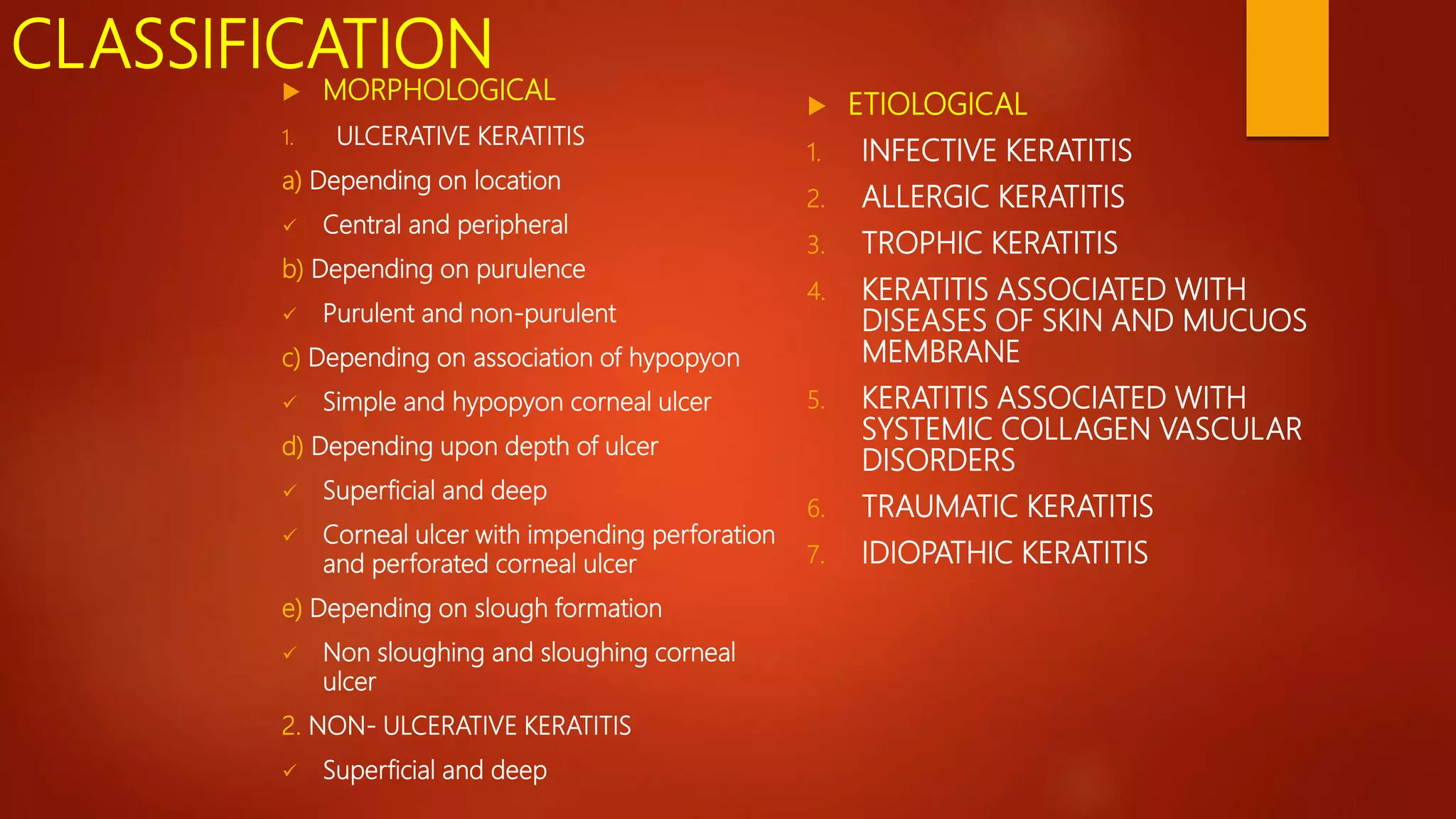
CLASSIFICATION
 MORPHOLOGICAL
1. ULCERATIVE KERATITIS
a) Depending on location
 Central and peripheral
b) Depending on purulence
 Purulent and non-purulent
c) Depending on association of hypopyon
 Simple and hypopyon corneal ulcer
d) Depending upon depth of ulcer
 Superficial and deep
 Corneal ulcer with impending perforation
and perforated corneal ulcer
e) Depending on slough formation
 Non sloughing and sloughing corneal
ulcer
2. NON- ULCERATIVE KERATITIS
 Superficial and deep
 ETIOLOGICAL
1. INFECTIVE KERATITIS
2. ALLERGIC KERATITIS
3. TROPHIC KERATITIS
4. KERATITIS ASSOCIATED WITH
DISEASES OF SKIN AND MUCUOS
MEMBRANE
5. KERATITIS ASSOCIATED WITH
SYSTEMIC COLLAGEN VASCULAR
DISORDERS
6. TRAUMATIC KERATITIS
7. IDIOPATHIC KERATITIS
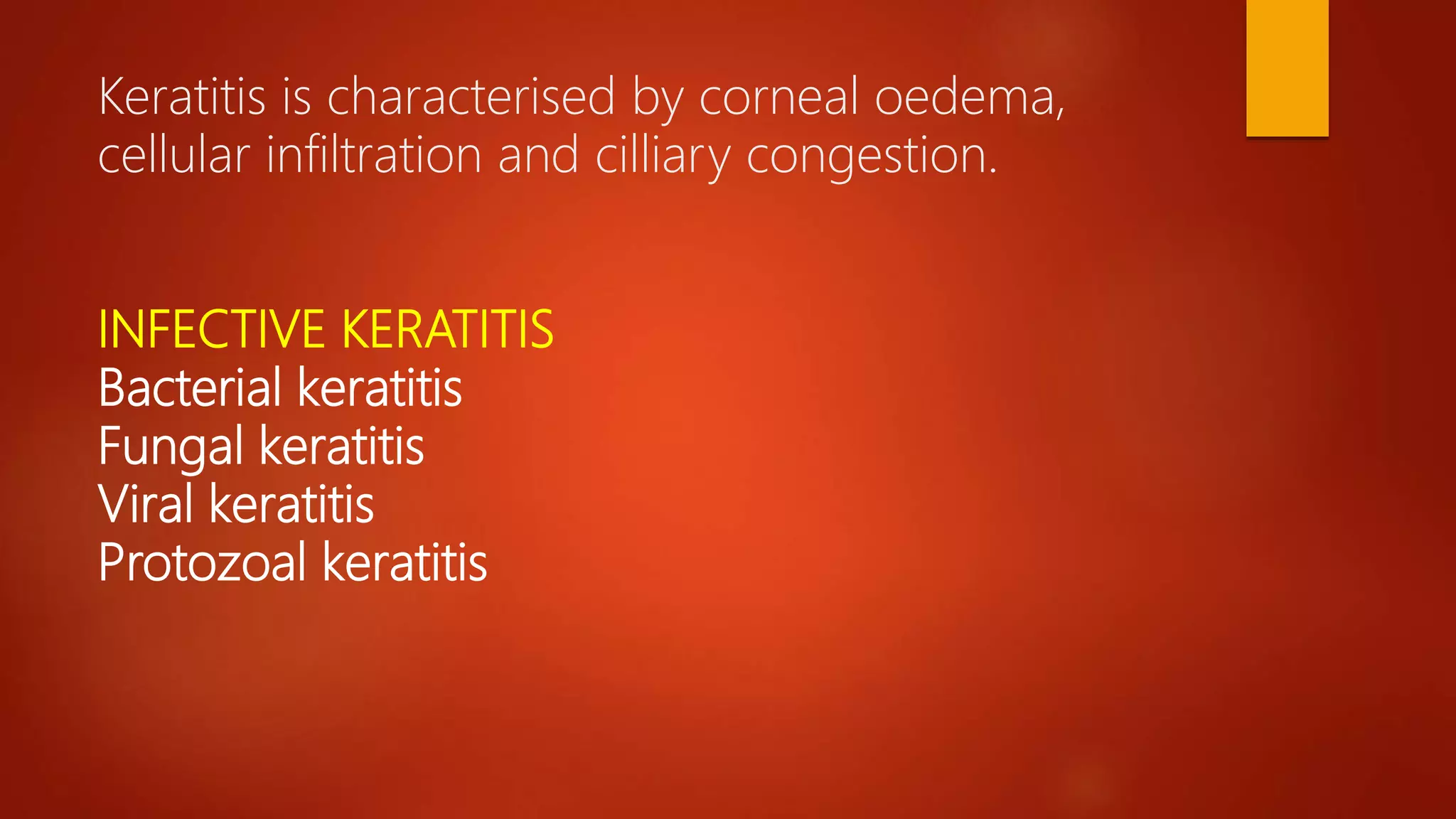
Keratitis is characterised by corneal oedema,
cellular infiltration and cilliary congestion.
INFECTIVE KERATITIS
Bacterial keratitis
Fungal keratitis
Viral keratitis
Protozoal keratitis
ULCERATIVE KERATITIS/CORNEAL
ULCER
Corneal ulcer can be defined as discontinuation
in normal epithelium surface of cornea
associated with necrosis of the surrounding
corneal tissue.
BACTERIAL KERATITIS
Common pathogens
 Staphylococcus aureus
 Streptococcus pneumoniae
 Pseudomonas
 Cornybacterium diphtheria
 Neisseria gonorrhoeae
ETIOLOGY
Predisposing factors which increase the risk of
corneal ulcers are:
 Introduction of organism during trauma
 Prolonged used of tropical steroids
 Dry eyes
 Entropion with trichiasis
 Wearing of contact lenses
 Bullous keratopathy and poor hygiene
PATHOLOGY
 The ulcer is usually saucer shaped, and the walls project above
normal surface of the cornea owing to swelling. Surrounding
is packed with leucocytes and appears as a grey zone of
infiltration. This is the progressive stage.
 When the necrotic material has been shed off the ulcer is
somewhat larger, but as the surrounding infiltration and swelling
disappears, the floor and edges become more smooth and
transparent, and the regressive stage is reached.
 Vascularization and minute superficial vessels grow in from the
limbus near the ulcer to restore the loss of substance.
 When ulcer is vascularized, Cicatrization occurs which is carried
by the regeneration of collagen and formation of fibrous tissue.
STAGES OF
CORNEAL
ULCER
SYMPTOMS
 Irritative effect upon the vessels of the iris and
ciliary body.
 Formation of hypopyon.
 During the progressive stage there is
lacrimation, photophobia, blepharospasm
and pain.
 SIGNS
 Blurred vision, pain and redness of the eye.
 Staphylococcus aureus and streoptococcus
pneumoniae produce an oval yellowish
white densely opaque ulcer which is
surrounded by a clear cornea.
 Pseudomonas species produces an irregular
sharp ulcer with thick greenish mucopurulent
exudate, diffuse liquefactive necrosis and semi-
opaque surrounding cornea.
 Enterobacteriae produce a shallow ulcer with
greyish white pleomorphic suppuration and
diffuse stromal opalescence. These gram
negative bacilli produce ring-shaped corneal
infiltrate.
BACTERIAL CORNEAL ULCER: RING SHAPED ULCER
 Pneumococcus produce characteristic
hypopyon corneal ulcer called ulcus serpens. It
is a greyish white or yellowish disc shaped ulcer
occurring near the centre of cornea .
BACTERIAL CORNEAL ULCER: ULCUS SERPENS
COMPLICATIONS
 Toxic iridocyclitis
 Secondary glaucoma
 Descemetocele- herniation of a transparent vesicle due to
effect of intraocular pressure on Descemet’s membrane when
ulcer reaches upto it.
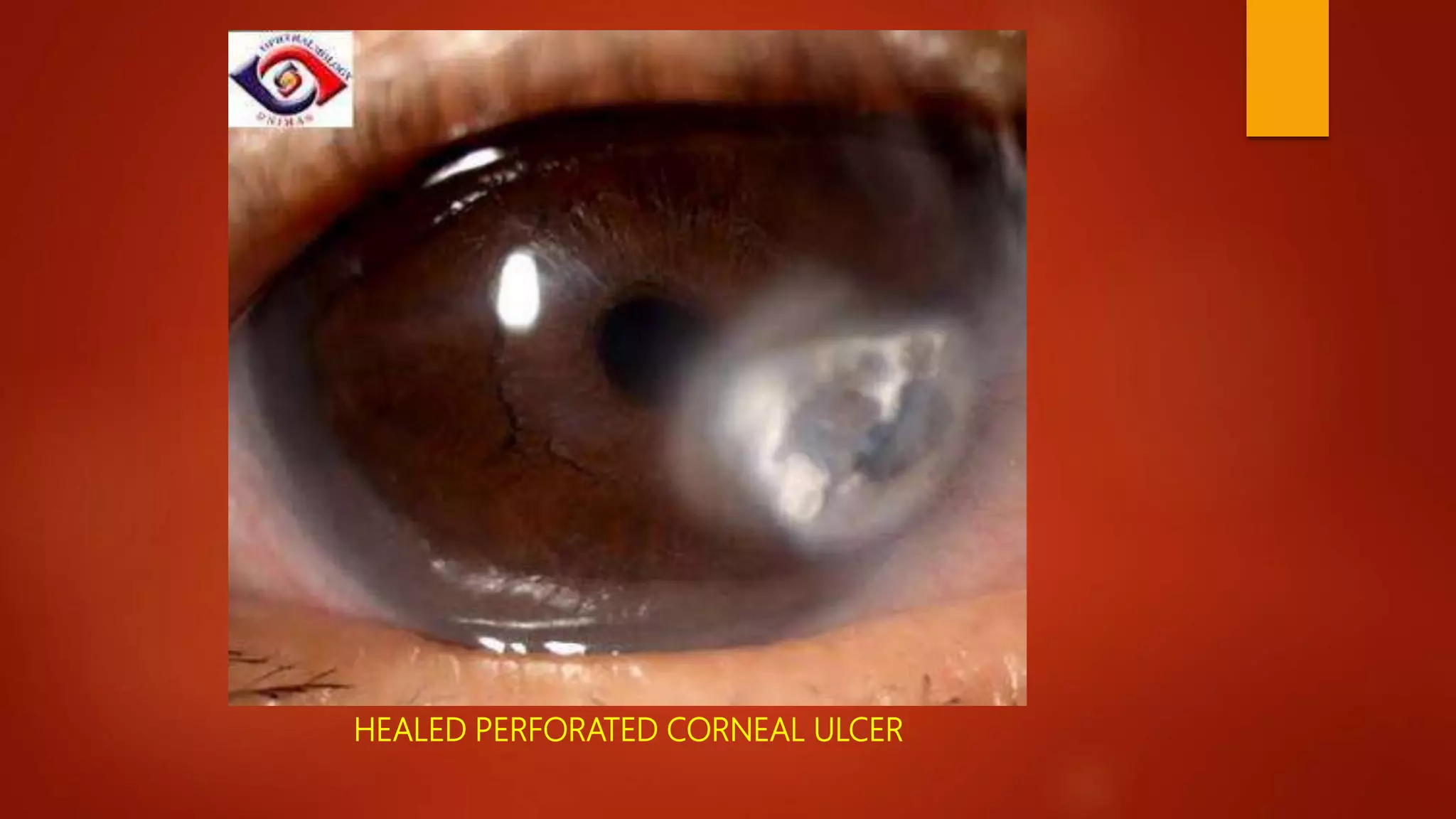
 Perforation of corneal ulcer- caused by sudden strain due to
cough, sneeze or spasm of orbicularis muscle.
 Sequels of corneal ulcer perforation: anterior dislocation of
lens, iris prolapse,leucoma, intraocular haemorrhage,corneal
fistula, anterior synechiae, anterior capsular cataract, purulent
infections, anterior staphyloma and phthisis bulbi.
 Corneal scarring
DESCEMETOCELE
HEALED PERFORATED CORNEAL ULCER
MANAGEMENT
 Identification of causative organism
 Hospitalization
 Standard combined therapy with aminoglycosides
and cephalosporins like fortified 5% cephazoline,
fortified1.3% tobramycin
 Monotherapy with fluoroquinolone like 0.3%
ciprofloxacin or 0.5% moxifloxacin.
 Cycloplegics ( Atropin sulphate 1%) to prevent
posterior synechiae and pain
 Systemic analgesics and anti-inflammatory drugs
like paracetamol and ibuprofen for pain and
oedema.
FUNGAL KERATITIS
Commonly due to
 Aspergillus
 Fusarium
 Candida albicans
ETIOLOGY
 Injury by vegetative material such as crop
leaf,thorn, branch of a tree.
 Secondary fungal ulcers are common in
immunosuppressed patients.
 Injury by animal tail
 Excessive use of antibiotics
SIGNS
 Ulcer is dry looking, greyish white, with elevated
rolled out margins.
 Pigmented ulcer caused by dermatiaceous fungi.
 Delicate feather like extensions are present into
the surrounding stroma under intact epithelium
 A sterile immune ring
 Multiple, small satellite lesions
 Big hypopyon is present.
 Endothelial plaque
FUNGAL CORNEAL ULCER
DIAGNOSIS
 Lab investigations required for confirmation
include examination of wet KOH, calcofluor
white, Grams and Giemsa stained films for
fungal hyphae and culture on Sabouraud’s
medium’.
 Confocal microscopic examination.
 PCR
TREATMENT
 Topical antifungal eyedrops like 5%
Natamycin, 0.1-0.3% Amphotericin, 0.2%
Fluconalzole.
 Intracameral administration of voriconazole
 Therapeutic penetrating keratoplasty may be
required for unresponsive cases.
VIRAL KERATITIS
Commonly caused by:
 Herpes simplex virus
 Herpes zoster
 Adenovirus
HERPES SIMPLEX KERATITIS
ETIOLOGY
 HSV-1 is acquired by close contact with a
patient suffering from herpes labialis.
 HSV-2 is transmitted to eyes of neonates
through infected genitalia of mother.
PATHOLOGY
(Ocular lesions)
PRIMARY HERPES
 Skin lesions
 Conjunctiva
 Acute follicular conjunctivitis
 Cornea
 Fine epithelial punctuate
keratitis
 Course epithelial punctuate
keratitis
 Dentritic ulcer
RECURRENT HERPES
 Active epithelial keratitis
 Punctuate epithelial keratitis
 Dendritic ulcer
 Geographical ulcer
 Stromal keratitis
 Disciform keratitis
 Diffuse stromal necrotic
keratitis
 Trophic keratitis
LESIONS OF
RECURRENT HERPES
SIMPLEX KERATITIS
SYMPTOMS
 Acute pain
 Photophobia
 Lacrimation
 Redness
 Blurring of vision
DIAGNOSIS
 Immunofluorescene of epithelial scrapings
 Demonstration of elementary bodies in tissue
biopsy and culture.
TREATMENT
 Supportive- hot fermentation to relive pain and congestion,
eye irrigation with normal saline, eye pads to prevent
exposure to dust, wind etc., dark goggles for photophobia,
rest, good diet and fresh air for speedy recovery.
 Oral antiviral drugs- Acyclovir in a dose of 800mg,
Valaciclovir in a dose of 500mg
 Analgesics- combination of mephenamic acid and
paracetamol
 Systemic steroids
 Cyclopegic drugs- 1% atropine
 Surgical treatment- lateral tarsorrhaphy, amniotic membrane
transplantation
 Keratoplasty
PROTOZOAL KERATITIS
 ACANTHAMOEBA
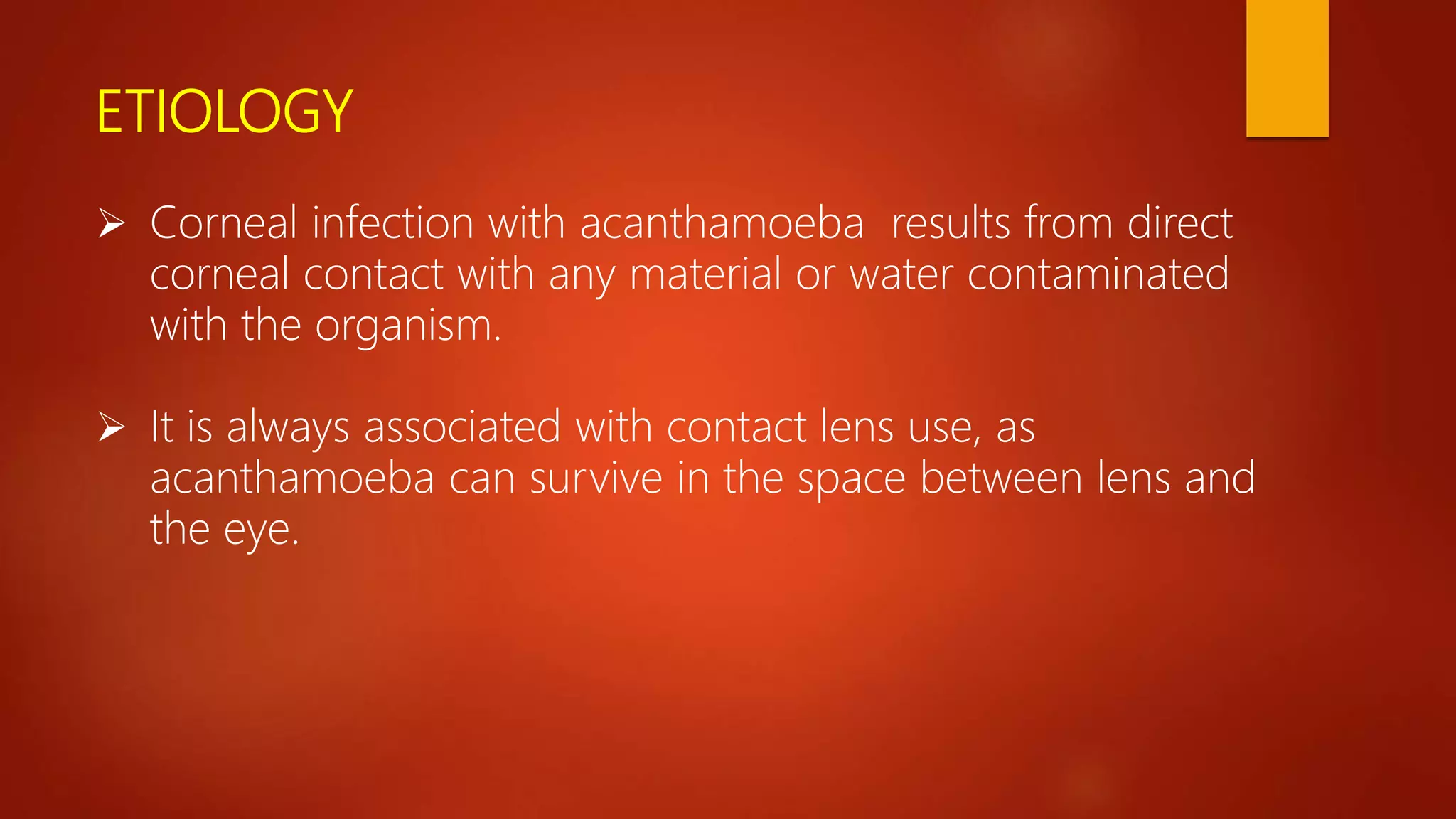
ETIOLOGY
 Corneal infection with acanthamoeba results from direct
corneal contact with any material or water contaminated
with the organism.
 It is always associated with contact lens use, as
acanthamoeba can survive in the space between lens and
the eye.
SIGNS
 Epithelial lesions include: Epithelial roughening and
irregularities, Epithelial ridges, Pseudodendrites
formation.
 Stromal lesions include : Radial keratoneuritis,
patchy and stromal infiltrates, ring infiltrates, ring
abscess.
 Limbal and scleral lesions include: Limbitis, Scleritis
ACANTHAMOEBA
KERATITIS: STROMAL
LESIONS
DIAGNOSIS
 Confocal microscopy
 KOH mount
 Lactophenol cotton blue stained
 Culture on non-nutrient agar
 PCR
 Corneal biopsy
TREATMENT
 Specific treatment:
Topic antiamoebic agents: Diamidines, Biguanides,
aminoglycosides, multiple drug therapy
(chlorhexidine+neomycin or paromycin+clotrimazole)
Oral ketoconazole
Penetrating keratoplasty
 Non-specific treaments : analgesics, anti-inflammatory drugs,
cycloplegic drugs
Inflammation of cornea

Inflammation of cornea

  • 1.
  • 2.
    CLASSIFICATION  MORPHOLOGICAL 1. ULCERATIVEKERATITIS a) Depending on location  Central and peripheral b) Depending on purulence  Purulent and non-purulent c) Depending on association of hypopyon  Simple and hypopyon corneal ulcer d) Depending upon depth of ulcer  Superficial and deep  Corneal ulcer with impending perforation and perforated corneal ulcer e) Depending on slough formation  Non sloughing and sloughing corneal ulcer 2. NON- ULCERATIVE KERATITIS  Superficial and deep  ETIOLOGICAL 1. INFECTIVE KERATITIS 2. ALLERGIC KERATITIS 3. TROPHIC KERATITIS 4. KERATITIS ASSOCIATED WITH DISEASES OF SKIN AND MUCUOS MEMBRANE 5. KERATITIS ASSOCIATED WITH SYSTEMIC COLLAGEN VASCULAR DISORDERS 6. TRAUMATIC KERATITIS 7. IDIOPATHIC KERATITIS
  • 3.
    Keratitis is characterisedby corneal oedema, cellular infiltration and cilliary congestion. INFECTIVE KERATITIS Bacterial keratitis Fungal keratitis Viral keratitis Protozoal keratitis
  • 4.
    ULCERATIVE KERATITIS/CORNEAL ULCER Corneal ulcercan be defined as discontinuation in normal epithelium surface of cornea associated with necrosis of the surrounding corneal tissue.
  • 5.
    BACTERIAL KERATITIS Common pathogens Staphylococcus aureus  Streptococcus pneumoniae  Pseudomonas  Cornybacterium diphtheria  Neisseria gonorrhoeae
  • 6.
    ETIOLOGY Predisposing factors whichincrease the risk of corneal ulcers are:  Introduction of organism during trauma  Prolonged used of tropical steroids  Dry eyes  Entropion with trichiasis  Wearing of contact lenses  Bullous keratopathy and poor hygiene
  • 7.
    PATHOLOGY  The ulceris usually saucer shaped, and the walls project above normal surface of the cornea owing to swelling. Surrounding is packed with leucocytes and appears as a grey zone of infiltration. This is the progressive stage.  When the necrotic material has been shed off the ulcer is somewhat larger, but as the surrounding infiltration and swelling disappears, the floor and edges become more smooth and transparent, and the regressive stage is reached.  Vascularization and minute superficial vessels grow in from the limbus near the ulcer to restore the loss of substance.  When ulcer is vascularized, Cicatrization occurs which is carried by the regeneration of collagen and formation of fibrous tissue.
  • 8.
  • 9.
    SYMPTOMS  Irritative effectupon the vessels of the iris and ciliary body.  Formation of hypopyon.  During the progressive stage there is lacrimation, photophobia, blepharospasm and pain.  SIGNS  Blurred vision, pain and redness of the eye.
  • 10.
     Staphylococcus aureusand streoptococcus pneumoniae produce an oval yellowish white densely opaque ulcer which is surrounded by a clear cornea.
  • 12.
     Pseudomonas speciesproduces an irregular sharp ulcer with thick greenish mucopurulent exudate, diffuse liquefactive necrosis and semi- opaque surrounding cornea.
  • 14.
     Enterobacteriae producea shallow ulcer with greyish white pleomorphic suppuration and diffuse stromal opalescence. These gram negative bacilli produce ring-shaped corneal infiltrate.
  • 15.
    BACTERIAL CORNEAL ULCER:RING SHAPED ULCER
  • 16.
     Pneumococcus producecharacteristic hypopyon corneal ulcer called ulcus serpens. It is a greyish white or yellowish disc shaped ulcer occurring near the centre of cornea .
  • 17.
  • 18.
    COMPLICATIONS  Toxic iridocyclitis Secondary glaucoma  Descemetocele- herniation of a transparent vesicle due to effect of intraocular pressure on Descemet’s membrane when ulcer reaches upto it.  Perforation of corneal ulcer- caused by sudden strain due to cough, sneeze or spasm of orbicularis muscle.  Sequels of corneal ulcer perforation: anterior dislocation of lens, iris prolapse,leucoma, intraocular haemorrhage,corneal fistula, anterior synechiae, anterior capsular cataract, purulent infections, anterior staphyloma and phthisis bulbi.  Corneal scarring
  • 19.
  • 20.
  • 21.
    MANAGEMENT  Identification ofcausative organism  Hospitalization  Standard combined therapy with aminoglycosides and cephalosporins like fortified 5% cephazoline, fortified1.3% tobramycin  Monotherapy with fluoroquinolone like 0.3% ciprofloxacin or 0.5% moxifloxacin.  Cycloplegics ( Atropin sulphate 1%) to prevent posterior synechiae and pain  Systemic analgesics and anti-inflammatory drugs like paracetamol and ibuprofen for pain and oedema.
  • 22.
    FUNGAL KERATITIS Commonly dueto  Aspergillus  Fusarium  Candida albicans
  • 23.
    ETIOLOGY  Injury byvegetative material such as crop leaf,thorn, branch of a tree.  Secondary fungal ulcers are common in immunosuppressed patients.  Injury by animal tail  Excessive use of antibiotics
  • 24.
    SIGNS  Ulcer isdry looking, greyish white, with elevated rolled out margins.  Pigmented ulcer caused by dermatiaceous fungi.  Delicate feather like extensions are present into the surrounding stroma under intact epithelium  A sterile immune ring  Multiple, small satellite lesions  Big hypopyon is present.  Endothelial plaque
  • 25.
  • 26.
    DIAGNOSIS  Lab investigationsrequired for confirmation include examination of wet KOH, calcofluor white, Grams and Giemsa stained films for fungal hyphae and culture on Sabouraud’s medium’.  Confocal microscopic examination.  PCR
  • 27.
    TREATMENT  Topical antifungaleyedrops like 5% Natamycin, 0.1-0.3% Amphotericin, 0.2% Fluconalzole.  Intracameral administration of voriconazole  Therapeutic penetrating keratoplasty may be required for unresponsive cases.
  • 28.
    VIRAL KERATITIS Commonly causedby:  Herpes simplex virus  Herpes zoster  Adenovirus
  • 29.
  • 30.
    ETIOLOGY  HSV-1 isacquired by close contact with a patient suffering from herpes labialis.  HSV-2 is transmitted to eyes of neonates through infected genitalia of mother.
  • 31.
    PATHOLOGY (Ocular lesions) PRIMARY HERPES Skin lesions  Conjunctiva  Acute follicular conjunctivitis  Cornea  Fine epithelial punctuate keratitis  Course epithelial punctuate keratitis  Dentritic ulcer RECURRENT HERPES  Active epithelial keratitis  Punctuate epithelial keratitis  Dendritic ulcer  Geographical ulcer  Stromal keratitis  Disciform keratitis  Diffuse stromal necrotic keratitis  Trophic keratitis
  • 32.
  • 33.
    SYMPTOMS  Acute pain Photophobia  Lacrimation  Redness  Blurring of vision
  • 34.
    DIAGNOSIS  Immunofluorescene ofepithelial scrapings  Demonstration of elementary bodies in tissue biopsy and culture.
  • 35.
    TREATMENT  Supportive- hotfermentation to relive pain and congestion, eye irrigation with normal saline, eye pads to prevent exposure to dust, wind etc., dark goggles for photophobia, rest, good diet and fresh air for speedy recovery.  Oral antiviral drugs- Acyclovir in a dose of 800mg, Valaciclovir in a dose of 500mg  Analgesics- combination of mephenamic acid and paracetamol  Systemic steroids  Cyclopegic drugs- 1% atropine  Surgical treatment- lateral tarsorrhaphy, amniotic membrane transplantation  Keratoplasty
  • 36.
  • 37.
    ETIOLOGY  Corneal infectionwith acanthamoeba results from direct corneal contact with any material or water contaminated with the organism.  It is always associated with contact lens use, as acanthamoeba can survive in the space between lens and the eye.
  • 38.
    SIGNS  Epithelial lesionsinclude: Epithelial roughening and irregularities, Epithelial ridges, Pseudodendrites formation.  Stromal lesions include : Radial keratoneuritis, patchy and stromal infiltrates, ring infiltrates, ring abscess.  Limbal and scleral lesions include: Limbitis, Scleritis
  • 39.
  • 40.
    DIAGNOSIS  Confocal microscopy KOH mount  Lactophenol cotton blue stained  Culture on non-nutrient agar  PCR  Corneal biopsy
  • 41.
    TREATMENT  Specific treatment: Topicantiamoebic agents: Diamidines, Biguanides, aminoglycosides, multiple drug therapy (chlorhexidine+neomycin or paromycin+clotrimazole) Oral ketoconazole Penetrating keratoplasty  Non-specific treaments : analgesics, anti-inflammatory drugs, cycloplegic drugs