


CASE STUDY
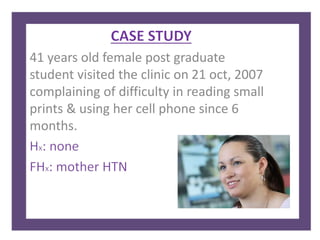
41 years old female post graduate
student visited the clinic on 21 oct, 2007
complaining of difficulty in reading small
prints & using her cell phone since 6
months.
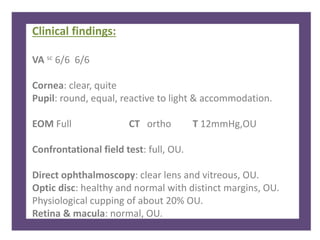
Clinical findings:
VA sc 6/6 6/6
Cornea: clear, quite
Pupil: round, equal, reactive to light & accommodation.
EOM Full CT ortho T 12mmHg,OU
Confrontational field test: full, OU.
Direct ophthalmoscopy: clear lens and vitreous, OU.
Optic disc: healthy and normal with distinct margins, OU.
Physiological cupping of about 20% OU.
Retina & macula: normal, OU.
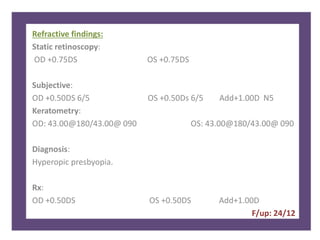
Refractive findings:
Static retinoscopy:
OD +0.75DS OS +0.75DS
Subjective:
OD +0.50DS 6/5 OS +0.50Ds 6/5 Add+1.00D N5
Keratometry:
OD: 43.00@180/43.00@ 090 OS: 43.00@180/43.00@ 090
Diagnosis:
Hyperopic presbyopia.
Rx:
OD +0.50DS OS +0.50DS Add+1.00D
F/up: 24/12
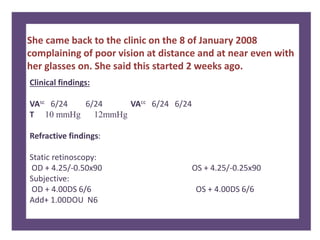
She came back to the clinic on the 8 of January 2008
complaining of poor vision at distance and at near even with
her glasses on. She said this started 2 weeks ago.
Clinical findings:
VAsc 6/24 6/24 VAcc 6/24 6/24
T 10 mmHg 12mmHg
Refractive findings:
Static retinoscopy:
OD + 4.25/-0.50x90 OS + 4.25/-0.25x90
Subjective:
OD + 4.00DS 6/6 OS + 4.00DS 6/6
Add+ 1.00DOU N6
DD:
latent hyperopia.
pressure on the cornea.
diabetes mellitus type II.
Qs?
Decision?
Follow up #2: Jan, 10 2008.
FSL=305mg/dl  diabetes mellitus.
Decision: referred to a physician.
F/up 6/52.
Follow up #2: Feb, 22 2008.
FSL= 195mg/dl.
ttt 250mg chlorpropamide daily with low carb diet & exercise. She
reported still having to strain her eye when doing close work and
distant vision was still blurry & wanted to change her glasses.
Decision ???
F/up 3/52
Follow up #3: Mar, 13 2008.
FSL= 95mg/dl
She discovered that she could see very well with her glasses once
more.
F/up 1/12
Management of Diabetic Patient in
the Optometry Clinic
Manal Al-Romeih
Diabetes mellitus
is a group of metabolic diseases characterized by
sustained hyperglycemia of varying severity
secondary to lack or diminished efficacy of
endogenous insulin and/or increased cellular
resistance to insulin.
It is also chronic disease with long-term
macrovascular and microvascular complications,
including diabetic nephropathy, neuropathy, and
retinopathy. It is a leading cause of death, disability,
and blindness.
Types:
Type 1 DM results from destruction of beta cells in the
pancreas mostly an immune-mediated disease with
autoimmune markers. Age of onset ˂ 30 yrs.
Type 2 DM  underlying causes can vary from
predominant insulin resistance with relative insulin
deficiency to a predominant insulin secretory defect with
insulin resistance. Mostly hereditary.
Most patients with type 2 DM do not initially require
insulin therapy.
Physiological changes within the eye
Refraction & media
Conc. of glucose in aqueous //conc. in plasma.
hyperglycemia ↑glucose level in serum and ↑glucose in
aqueous humor.
Facts about glucose:
1. It diffuses through the lens (transport system is not needed).
2. Initial rate of glucose metabolism is determined by hexokinase
(regulatory enzyme).
3. Excessive glucose in lens (˃200 mg/ 100 ml) saturates hexokinase
 glucose piles up and is converted into sorbitol and fructose.
Sorbitol: a polyol intermediate that is not able to escape from the
lens & generates high intracellular osmotic pressure.
↑sorbitol  draw water (hydration):
1. ↓refractive index of the lens (more plus)
2. Rupture lens fiber  vacuolation in lens cortex.
3. Curvature changes in lens capsule.
Decreased refractive index will increase the whole
refractive power of the eye and cause a myopic shift and
vice versa in hypoglycemia.
Another effect of sorbitol in the lens:
(lens protein disruption ) disorganize lens collagen fiber
that was precisely arranged to maintain transparency. 
Diabetic cataract.
.
↑ PH of diabetic acidosis dilute the plasma, ↓its
osmotic pressure.
the osmotic pressure of the aqueous will be less
than that of the lens which will encourage the
action of fluid movement to the higher
concentration (the lens); lens hydration.
Presbyopia starts earlier in diabetic patients as a
result of several factors like:
1. Glycogen deposition within the ciliary body that
reduces the ciliary body's ability to function and
2. Changes in lens hydration
3. Changes in the lens capsule.
Retina:
Poor glucose metabolism:
1. ↑ release of vascular endothelial growth factor (VEGF)
in retina.
2. Damage to the walls of the capillaries (pericytes loss).
3. Formation of tiny aneurysms in the walls of the
capillaries within the retina.
4. Microaneurysms begin to bleed (hemorrhage) and
result in protein & fat deposits into the surrounding
retina " non-proliferative diabetic retinopathy“.
5. When this affects the macula it is called "diabetic
maculopathy“.
As VEGF elevates in the stagnated retina
Neovascularization “proliferative diabetic retinopathy”
These new fragile vessels might:
1. Break causing retinal hemorrhage.
2. Grow into the angle of the AC and cause neovascular
glaucoma.
3. Pull the retina causing tractional retinal detachment.
Ocular manifestations of Diabetes Mellitus
Visual (refractive error fluctuations, increased contrast
sensitivity, reduced night vision, increased glare sensitivity,
and early onset presbyopia).
Diabetic retinopathy.
Glaucoma.
Cataract.
Macular oedema.
Tractional retinal detachment.
Other reversible or temporary effects such as: recurrent
chalazion (abnormal fat metabolism secondary to
abnormal glucose metabolism) & recurrent stye (low
immunity).
Reduced corneal sensitivity resulting in dry eye, corneal
abrasion.
Oculomotor nerve palsy.
Examination for Ocular Manifestations of Diabetes
Mellitus
Adults and children aged 10 years or older with type 1 DM
should have an initial comprehensive, dilated-pupil eye
examination within 5 years after the onset of DM.
The patient with type 2 DM should have an initial
comprehensive, dilated-pupil eye examination shortly after
the diagnosis of DM.
Full examination
1. Visual needs & environments assessment (e.g. driving).
2. Ocular motility assessment, convergence, pupil reflexes.
3. History: personal/ family history of an ocular/ general health,
medication & dosage, and previous optical prescription.
4. Aided and/or unaided vision of each eye (record the specific
prescription used).
5. Internal and external examination of the eye:
6. Slit-lamp biomicroscopy  anterior eye, adnexa, AC & lens.
7. Subjective refraction (if plasma glucose level is ˂ 160 mg/dl).
8. Assessment of accommodation (add for intermediate or near
tasks).
9. Binocular balancing and binocular visual acuity.
10. Contrast sensitivity tests.
11. IOP measurement on patients at risk of glaucoma.
12. Visual field assessment on all patients, especially at risk of
glaucoma.
Full Exam:
Fundus:
Minimally  direct ophthalmoscopy
(undilated).
Inadequate view of the fundus pupil
dilation and/or indirect ophthalmoscopy.
Fundus examination with slit-lamp and
condensing (e.g. Volk) lens and/or
appropriate digital imaging.
Refractive changes in Diabetic Mellitus (Optometry Management)

Refractive changes in Diabetic Mellitus (Optometry Management)

  • 1.
  • 2.
    41 years oldfemale post graduate student visited the clinic on 21 oct, 2007 complaining of difficulty in reading small prints & using her cell phone since 6 months.
  • 3.
    Clinical findings: VA sc6/6 6/6 Cornea: clear, quite Pupil: round, equal, reactive to light & accommodation. EOM Full CT ortho T 12mmHg,OU Confrontational field test: full, OU. Direct ophthalmoscopy: clear lens and vitreous, OU. Optic disc: healthy and normal with distinct margins, OU. Physiological cupping of about 20% OU. Retina & macula: normal, OU.
  • 4.
    Refractive findings: Static retinoscopy: OD+0.75DS OS +0.75DS Subjective: OD +0.50DS 6/5 OS +0.50Ds 6/5 Add+1.00D N5 Keratometry: OD: 43.00@180/43.00@ 090 OS: 43.00@180/43.00@ 090 Diagnosis: Hyperopic presbyopia. Rx: OD +0.50DS OS +0.50DS Add+1.00D F/up: 24/12
  • 5.
    She came backto the clinic on the 8 of January 2008 complaining of poor vision at distance and at near even with her glasses on. She said this started 2 weeks ago. Clinical findings: VAsc 6/24 6/24 VAcc 6/24 6/24 T 10 mmHg 12mmHg Refractive findings: Static retinoscopy: OD + 4.25/-0.50x90 OS + 4.25/-0.25x90 Subjective: OD + 4.00DS 6/6 OS + 4.00DS 6/6 Add+ 1.00DOU N6
  • 6.
    DD: latent hyperopia. pressure onthe cornea. diabetes mellitus type II. Qs? Decision?
  • 7.
    Follow up #2:Jan, 10 2008. FSL=305mg/dl  diabetes mellitus. Decision: referred to a physician. F/up 6/52. Follow up #2: Feb, 22 2008. FSL= 195mg/dl. ttt 250mg chlorpropamide daily with low carb diet & exercise. She reported still having to strain her eye when doing close work and distant vision was still blurry & wanted to change her glasses. Decision ??? F/up 3/52 Follow up #3: Mar, 13 2008. FSL= 95mg/dl She discovered that she could see very well with her glasses once more. F/up 1/12
  • 9.
    Management of DiabeticPatient in the Optometry Clinic Manal Al-Romeih
  • 10.
    Diabetes mellitus is agroup of metabolic diseases characterized by sustained hyperglycemia of varying severity secondary to lack or diminished efficacy of endogenous insulin and/or increased cellular resistance to insulin. It is also chronic disease with long-term macrovascular and microvascular complications, including diabetic nephropathy, neuropathy, and retinopathy. It is a leading cause of death, disability, and blindness.
  • 11.
    Types: Type 1 DMresults from destruction of beta cells in the pancreas mostly an immune-mediated disease with autoimmune markers. Age of onset ˂ 30 yrs. Type 2 DM  underlying causes can vary from predominant insulin resistance with relative insulin deficiency to a predominant insulin secretory defect with insulin resistance. Mostly hereditary. Most patients with type 2 DM do not initially require insulin therapy.
  • 12.
    Physiological changes withinthe eye Refraction & media
  • 13.
    Conc. of glucosein aqueous //conc. in plasma. hyperglycemia ↑glucose level in serum and ↑glucose in aqueous humor. Facts about glucose: 1. It diffuses through the lens (transport system is not needed). 2. Initial rate of glucose metabolism is determined by hexokinase (regulatory enzyme). 3. Excessive glucose in lens (˃200 mg/ 100 ml) saturates hexokinase  glucose piles up and is converted into sorbitol and fructose. Sorbitol: a polyol intermediate that is not able to escape from the lens & generates high intracellular osmotic pressure.
  • 14.
    ↑sorbitol  drawwater (hydration): 1. ↓refractive index of the lens (more plus) 2. Rupture lens fiber  vacuolation in lens cortex. 3. Curvature changes in lens capsule. Decreased refractive index will increase the whole refractive power of the eye and cause a myopic shift and vice versa in hypoglycemia. Another effect of sorbitol in the lens: (lens protein disruption ) disorganize lens collagen fiber that was precisely arranged to maintain transparency.  Diabetic cataract. .
  • 15.
    ↑ PH ofdiabetic acidosis dilute the plasma, ↓its osmotic pressure. the osmotic pressure of the aqueous will be less than that of the lens which will encourage the action of fluid movement to the higher concentration (the lens); lens hydration.
  • 16.
    Presbyopia starts earlierin diabetic patients as a result of several factors like: 1. Glycogen deposition within the ciliary body that reduces the ciliary body's ability to function and 2. Changes in lens hydration 3. Changes in the lens capsule.
  • 17.
    Retina: Poor glucose metabolism: 1.↑ release of vascular endothelial growth factor (VEGF) in retina. 2. Damage to the walls of the capillaries (pericytes loss). 3. Formation of tiny aneurysms in the walls of the capillaries within the retina. 4. Microaneurysms begin to bleed (hemorrhage) and result in protein & fat deposits into the surrounding retina " non-proliferative diabetic retinopathy“. 5. When this affects the macula it is called "diabetic maculopathy“.
  • 18.
    As VEGF elevatesin the stagnated retina Neovascularization “proliferative diabetic retinopathy” These new fragile vessels might: 1. Break causing retinal hemorrhage. 2. Grow into the angle of the AC and cause neovascular glaucoma. 3. Pull the retina causing tractional retinal detachment.
  • 19.
    Ocular manifestations ofDiabetes Mellitus
  • 20.
    Visual (refractive errorfluctuations, increased contrast sensitivity, reduced night vision, increased glare sensitivity, and early onset presbyopia). Diabetic retinopathy. Glaucoma. Cataract. Macular oedema. Tractional retinal detachment. Other reversible or temporary effects such as: recurrent chalazion (abnormal fat metabolism secondary to abnormal glucose metabolism) & recurrent stye (low immunity). Reduced corneal sensitivity resulting in dry eye, corneal abrasion. Oculomotor nerve palsy.
  • 21.
    Examination for OcularManifestations of Diabetes Mellitus Adults and children aged 10 years or older with type 1 DM should have an initial comprehensive, dilated-pupil eye examination within 5 years after the onset of DM. The patient with type 2 DM should have an initial comprehensive, dilated-pupil eye examination shortly after the diagnosis of DM.
  • 22.
    Full examination 1. Visualneeds & environments assessment (e.g. driving). 2. Ocular motility assessment, convergence, pupil reflexes. 3. History: personal/ family history of an ocular/ general health, medication & dosage, and previous optical prescription. 4. Aided and/or unaided vision of each eye (record the specific prescription used). 5. Internal and external examination of the eye: 6. Slit-lamp biomicroscopy  anterior eye, adnexa, AC & lens. 7. Subjective refraction (if plasma glucose level is ˂ 160 mg/dl). 8. Assessment of accommodation (add for intermediate or near tasks). 9. Binocular balancing and binocular visual acuity. 10. Contrast sensitivity tests. 11. IOP measurement on patients at risk of glaucoma. 12. Visual field assessment on all patients, especially at risk of glaucoma.
  • 23.
    Full Exam: Fundus: Minimally direct ophthalmoscopy (undilated). Inadequate view of the fundus pupil dilation and/or indirect ophthalmoscopy. Fundus examination with slit-lamp and condensing (e.g. Volk) lens and/or appropriate digital imaging.