Direct Ophthalmoscope
Dr.Mohammad Khabbaz
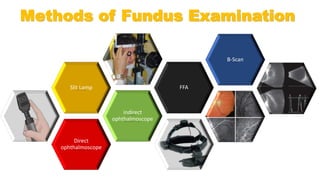
Methods of Fundus Examination
Direct
ophthalmoscope
indirect
ophthalmoscope
Slit Lamp FFA
B-Scan
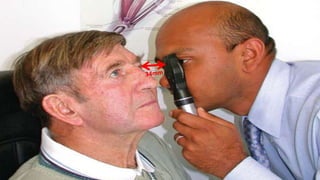
Direct Ophthalmoscope
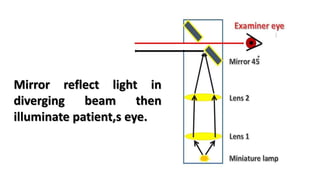
System of Lens
focusing light on a 45
dgree mirror with
Hole.
Mirror reflect light in
diverging beam then
illuminate patient,s eye.
Light reflected from
illuminated retina of the
patient ,then passes back
through the hole to
observer,s eye.
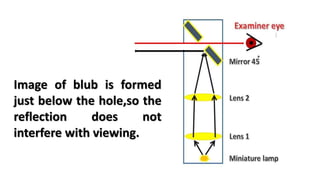
Image of blub is formed
just below the hole,so the
reflection does not
interfere with viewing.
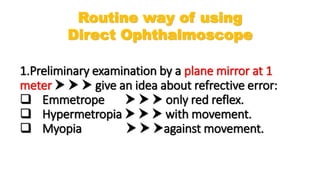
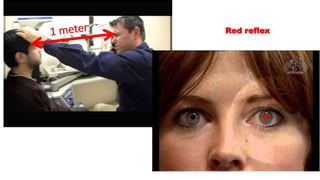
1.Preliminary examination by a plane mirror at 1
meter    give an idea about refrective error:
 Emmetrope    only red reflex.
 Hypermetropia    with movement.
 Myopia   against movement.
Routine way of using
Direct Ophthalmoscope
Red reflex
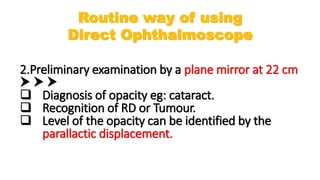
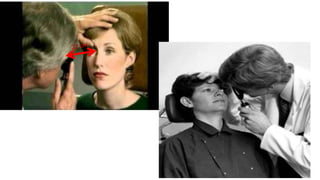
2.Preliminary examination by a plane mirror at 22 cm
  
 Diagnosis of opacity eg: cataract.
 Recognition of RD or Tumour.
 Level of the opacity can be identified by the
parallactic displacement.
Routine way of using
Direct Ophthalmoscope
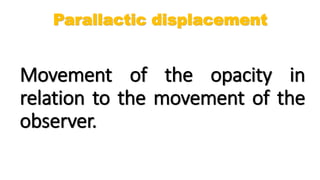
Movement of the opacity in
relation to the movement of the
observer.
Parallactic displacement
Parallactic
displacement
Behind the pupil
opacity moves with
examiner,s motion.
At the pupil
the opacity is stationary
with examiner,s motion.
In front of the pupil
opacity moves opposite to
examiner,s motion.
It is method by which an
Erect magnified image
of the fundus can be
seen.
Direct Ophthalmoscope
Definition
Macula
disk
vessels
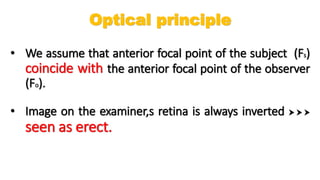
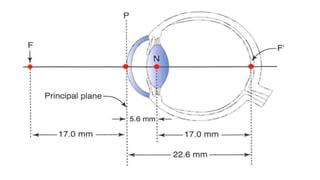
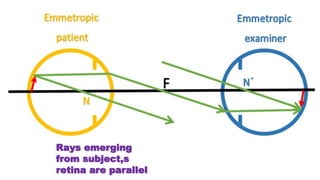
• We assume that anterior focal point of the subject (Fs)
coincide with the anterior focal point of the observer
(Fo).
• Image on the examiner,s retina is always inverted   
seen as erect.
Optical principle
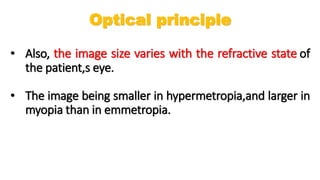
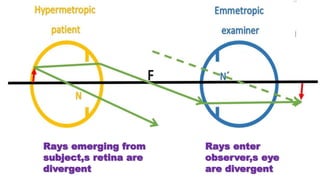
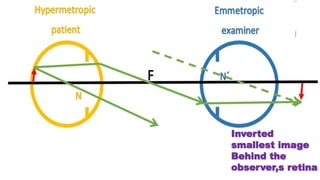
• Also, the image size varies with the refractive state of
the patient,s eye.
• The image being smaller in hypermetropia,and larger in
myopia than in emmetropia.
Optical principle
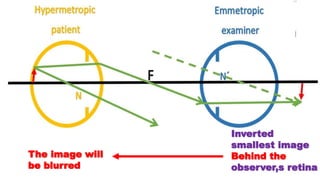
Emmetropia
Rays emerging
from subject,s
retina are parallel
Hypermetropia
Rays emerging from
subject,s retina are
divergent
Rays enter
observer,s eye
are divergent
Inverted
smallest image
Behind the
observer,s retina
Inverted
smallest image
Behind the
observer,s retina
The image will
be blurred
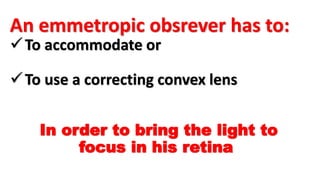
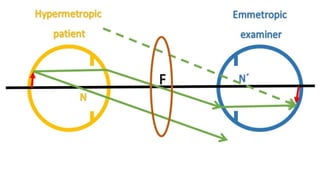
An emmetropic obsrever has to:
To accommodate or
To use a correcting convex lens
In order to bring the light to
focus in his retina
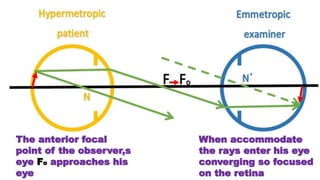
When accommodate
the rays enter his eye
converging so focused
on the retina
The anterior focal
point of the observer,s
eye Fo approaches his
eye
Myopia
Rays emerging from
subject,s retina are
convergent
Inverted
largest image
In front of the
observer,s retina
The image will
be blurred
To focus this image on the observer,s
retina he should use a concave lens.
The image formed on the observer,s
retina is
• Smaller when a hypermetropic eye is
viewed ,Larger when a myopic eye is
viewed when an emmetropic eye is
examined
• But the use of a correcting lens reduces
the discrepancy in size.
The formula for Magnification achieved by a loupe
is
If ascribe dioptric power of 60+ D to the patient,s
emmetropic eye, the magnification of the direct
ophthalmoscope is 15x.
Magnification
Magnification
Dioptric power of the loupe
Magnification
 In E----M=60/4=15x.
 In H----M= <15x (F<60D).
 In M----M= >15x (F>60D).
 Size of the pupil of subject,s eye.
 Size of the pupil of observer,s eye.
 Error of refraction:
H----> greatest
M----> smallest
 The distance between the observed eye and
observer eye (decrease distance----> increase field)
Ophthalmoscopic
Field of vision
direct ophthalmoscope

direct ophthalmoscope