Introduction to  Developmental Psychology LIFESPAN DEVELOPMENT
Week 1 Course Introduction  DEVELOPMENTAL PSYCHOLOGY
Introduction (1) General introduction to the process of human development throughout the lifespan, this module will emphasise the theories on normal developmental processes, with attention given to various developmental tasks (perceptual, cognitive, personality, and social development) through life. Social research methods appropriate to the areas are introduced.
Introduction (2) Understand the field of human development as a branch of scientific study within psychology  Understand the lifespan development perspective in approaching human developmental phenomena Understand the major theories of human development and be familiar with their relevance to the developmental process during various life stages Be familiar with the major research methods used by developmental psychologists Identify and discuss the major issues involved in studying human development
Introduction (3) Introduce students to perceptual development, cognitive development, social development, and personality development. Introduce the basic theories of developmental psychology to equip the students to handle Developmental Psychology at the degree level
Introduction (4) Assessment: mixture of coursework (50%) and examination (50%) 1-Tutorial Participation (10%): 2- Quizzes or Short Assignments (10%) 3- Continuing Assessment, Mid Semester Test (30%)  Extra Credit  4- Written Examination (50%)  No CA Component Worth (%) Due Date 1 Tutorial Participation 10 On-going 2 Quizzes 10 On-going 3 Mid Semester Test 30 01 Mar 2011, 7pm 4 Written Examination 50     TOTAL  100  
Text Book 1 Berk, L. E. (2007). Development through the life span (4th ed). Boston: Allyn and Bacon. 2- Companion Website:  http://wps.ablongman.com/ab_berk_lifespan_4/ http://wps.ablongman.com/ab_berk_lifespan_4/52/13493/3454335.cw/index.html 3-Online Resources: National Library Board Singapore – ebrary (Online Library) http://www.nlb.gov.sg/ American Psychological Association http://www.apa.org/ Amazon.com Other additional reference materials will be suggested in each lecture .
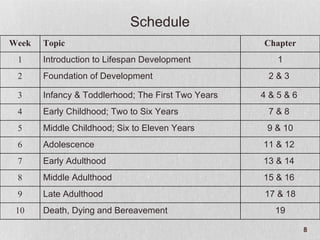
Schedule Week Topic Chapter 1 Introduction to Lifespan Development 1 2 Foundation of Development 2 & 3  3 Infancy & Toddlerhood; The First Two Years 4 & 5 & 6  4 Early Childhood; Two to Six Years 7 & 8  5 Middle Childhood; Six to Eleven Years 9 & 10 6 Adolescence 11 & 12  7 Early Adulthood 13 & 14  8 Middle Adulthood 15 & 16  9 Late Adulthood 17 & 18 10 Death, Dying and Bereavement 19
Contact Information INSTRUCTOR : Miss. Maliheh Taheri Tel:   63535110,  Mobile:   96692253 E-Mail : mali@malihehtaheri.com, haiku_vieru@yahoo.com
Here’s to an interesting journey of knowledge gathering! Movie ( Opal Dreaming)
Week 1 Introduction to developmental psychology  DEVELOPMENTAL PSYCHOLOGY
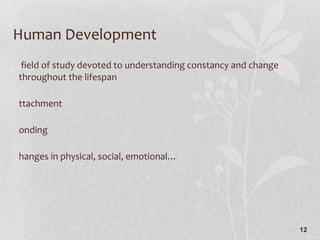
Human Development A field of study devoted to understanding constancy and change throughout the lifespan Attachment Bonding Changes in physical, social, emotional…
The Life-Span Perspective Development —pattern of change that begins at conception and continues through life span
Research  Is a relatively new area Late 19 th  early 20 th  century From speculation to research and construction of theories
Theory  Orderly integrated set of statements that describes, explains and predicts behaviours Provide frameworks for observations of people Verification of theory provides sound basis for practical action
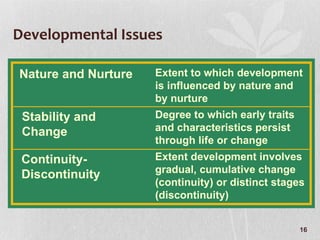
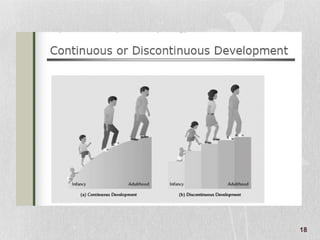
Developmental Issues Nature and Nurture Stability and Change Continuity-Discontinuity Extent to which development is influenced by nature and by nurture Degree to which early traits and characteristics persist through life or change Extent development involves gradual, cumulative change (continuity) or distinct stages (discontinuity)
Nature Vs Nurture Are genetics or environment more important to influence development? Stability Vs Plasticity – that one has certain stable traits that developed due to early experiences, as opposed to changes that will occur with each new experience
Life Span Perspective Leading dynamic systems approach Lifelong  Multidimensional and multidirectional Highly plastic Affected by multiple interacting forces
Lifespan perspective Perspective that considers that there are stages when new skills will emerge, and that there is gain and deficits that will set in. there are many possible courses, and as development is influenced by multiple interacting forces, there are many possible pathways. The intricate blend of hereditary and environmental factors, hence both early and late experiences are important to development.
Development in lifelong All stages are equally important Events all have same potential effect Change occurs in three broad domains – physical, cognitive, and emotional/social
Dimension and direction Multidimensional – affected by blend of biological, social, psychological factors Multidirectional – marked by joint expression of improvements and declines in skills
Development is plastic Concept of plasticity – that it is not static, inflexible. Possible to go through the stages at different times, express differences, etc.
Multiple interacting forces Age graded influences: fairly predictable in timing (age) of occurrence History graded influences: the effect of cohort Non-normative influences: the effect of non-regular non-predictable events that are specific to an individual
Adult Development Life expectancy —number of years a person is expected to live on average when born in a particular year Developmental change occurs during adulthood as well as childhood
Conceptions of Age Chronological age —number of years elapsed since person’s birth Biological age —age in terms of biological health Psychological age —individual’s adaptive capacities Social age —social roles and expectations related to person’s age
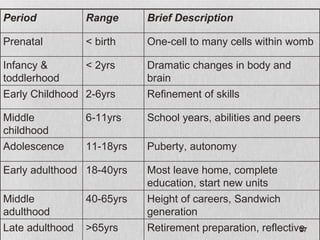
Period Range Brief Description Prenatal < birth One-cell to many cells within womb Infancy & toddlerhood < 2yrs Dramatic changes in body and brain Early Childhood 2-6yrs Refinement of skills Middle childhood 6-11yrs School years, abilities and peers Adolescence 11-18yrs Puberty, autonomy Early adulthood 18-40yrs Most leave home, complete education, start new units Middle adulthood 40-65yrs Height of careers, Sandwich generation Late adulthood >65yrs Retirement preparation, reflective
Erikson’s Psychosocial Theory Eight stages of development Unique development task confronts individuals with  crisis  that must be resolved Positive resolution builds  foundation for healthy development
Historical Foundations to Development John Locke (1632 – 1704) posited that children were like a blank slate (tabula rasa) Jean-Jacques Rousseau (1712 – 1778) saw children as noble savages with strong sense of right and wrong, children determined their own destinies.
Historical Foundations to Development John Locke: continuous, nurturing, many courses of development Jean-Jacques Rousseau (1712 – 1778) child centred philosophy which emphasised that adults be receptive to the child’s needs. Discontinuous, dependent on nature, and follows a single unified course .
Psychoanalytic Theories Development depends  primarily on unconscious mind Early experiences important in development
Psychoanalytic Perspective Freud Psychosexual theory emphasising on how parents manage child’s sexual and aggressive drives is crucial for the healthy personality development. Stages: oral, anal, phallic, latency, genital. Dependent on gratification - Criticised on many grounds
Behavioral Theories Pavlov’s Classical Conditioning Skinner’s Operant Conditioning Focus on observable, learned behaviors
Behaviourism and social learning theory Watson, Bandura Conditioning – classical and operant Social learning theory, vicarious learning Behaviour modification in which procedures from conditioning and modelling will be used to reduce undesirable behaviours
Piaget’s Cognitive Developmental Theory Children actively construct understanding Development proceeds based largely on biology Four stages of cognitive development Sensorimotor Preoperational Concrete Operational Formal Operational
Recent Theoretical Perspectives Information processing approach: human mind is akin to a symbol-manipulating system through which information flows Developmental cognitive neuroscience: bringing together perspectives from psychology, biology, neuroscience, and medicine
Ethological Theory Behaviour Strongly influenced by biology Tied to evolution Characterized by critical or sensitive periods.  Examples: language, attachment
Concepts  Ethology: concerned with adaptive or survival value of behaviour and evolutionary history Sensitive period: time at which learning is optimal, in which the individual is especially responsive to environmental influences
Sociocultural Contexts Cross-cultural studies —comparisons of one culture with one or more other cultures. Ethnicity —range of characteristics rooted in cultural heritage. Gender —psychological and sociocultural dimension of being female or male.
Vygotsky’s Sociocultural theory How culture is transmitted to the next generation Social interaction, particularly dialogues, is necessary for children to acquire the ways of thinking and behaving that makeup a community’s culture
Vygotsky’s Sociocultural Cognitive Theory Emphasizes how  culture and social interaction  guide cognitive development Social interaction with more skilled adults and peers is advances cognitive development
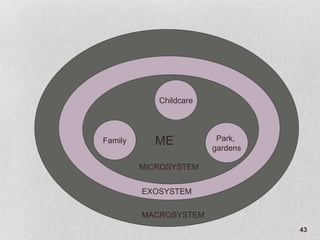
Bronfenbrenner’s  Ecological Systems theory Focus on complex system of relationships affected by multiple levels of surrounding environment Five environmental systems: microsystem, mesosystem, exosystem, macrosystem, chronosystem Environment is dynamic, not a static force that affects people in a uniform way
Family Park,  gardens Childcare MICROSYSTEM EXOSYSTEM MACROSYSTEM ME
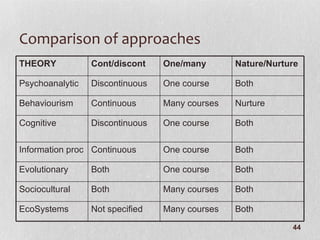
Comparison of approaches THEORY Cont/discont One/many  Nature/Nurture Psychoanalytic Discontinuous One course Both  Behaviourism Continuous Many courses Nurture Cognitive Discontinuous One course Both  Information proc Continuous One course Both  Evolutionary Both One course Both  Sociocultural Both  Many courses Both  EcoSystems Not specified Many courses Both
Learning Objectives What is the science of life-span development? What are the three goals of developmental psychology? What are the seven assumptions of the modern life-span perspective on human development?
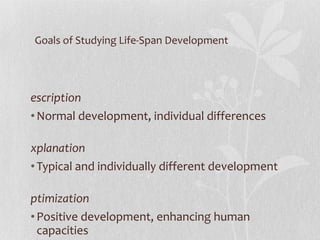
Goals of Studying Life-Span Development Description Normal development, individual differences Explanation Typical and individually different development Optimization Positive development, enhancing human capacities Prevention and overcoming difficulties
Methods of Studying Life-Span Development Historical Baby Biographies: Charles Darwin Questionnaires: G. Stanley Hall Key Assumptions of Modern Life-Span Perspectives  Lifelong,  Multidirectional process Gain and loss  Lifelong plasticity Historical/cultural contexts,  multiple influences Multi-disciplinary studies
Key Assumptions of Life-Span Perspective Key Assumptions of Modern Life-Span Perspectives  Lifelong, Multidirectional process, Gain and loss, Lifelong plasticity, Historical/cultural contexts,  Multiple influences, Multi-disciplinary studies
Learning Objectives What is the  scientific “mindset ”? How is the scientific method used to study development?
Unique Challenges in Developmental Research Infants and young children Attention, instruction, answering questions may be difficult Elderly Adults Possible sensory impairments Discomfort being studied, tested
Conducting Developmental Research Self-reports:  Interview Advantage: Quick, easy and inexpesnsive Disadvantage:  Can not be used with infants, young children and cognitively impaired elders  Questions may have to be worded differently at different ages Respondents tend to put themselves in a more favorable light May be influenced by current events
Conducting Developmental Research Self-reports:  Questionnaires,  Advantage: Quick, easy and inexpensive Disadvantage: Reading level of subject has to be considered Can not be used with visually impaired Respondents tend to put themselves in a more favorable light May be influenced by current events
Conducting Developmental Research Self-reports:  Tests Advantage: Quick, easy and inexpensive Disadvantage:  Reading level of subject has to be considered Can not be used with visually impaired Motivation level of test taker has to be considered May be influenced by current events
Conducting Developmental Research Behavioral Observations (Experiments) Naturalistic Advantage: natural setting Disadvantage: conditions not controlled Structured (Lab) Advantage: conditions controlled Disadvantage: cannot generalize to natural settings
Learning Objective What are the essential features of the experimental method?  What sorts of information can be gathered from this type of study?  What are its strengths and weaknesses?
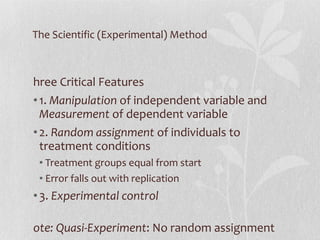
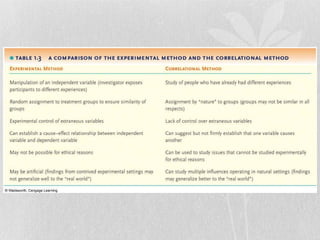
The Scientific (Experimental) Method Three Critical Features 1.  Manipulation  of independent variable and  Measurement  of dependent variable 2.  Random assignment  of individuals to  treatment conditions Treatment groups equal from start Error falls out with replication 3.  Experimental control Note: Quasi-Experiment : No random assignment
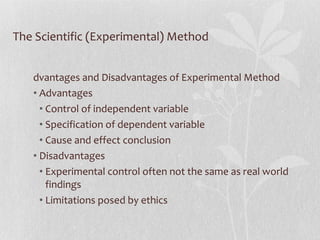
The Scientific (Experimental) Method Advantages and Disadvantages of Experimental Method Advantages Control of independent variable Specification of dependent variable Cause and effect conclusion Disadvantages Experimental control often not the same as real world findings Limitations posed by ethics
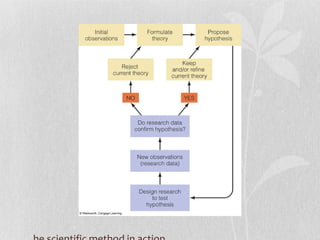
The scientific method in action
Learning Objective What are the important features of the  correlational  method? What sorts of information can be gathered from this type of study? What are its strengths and weaknesses?
The Correlational Method Determine if 2 or more variables are related Correlation: A measure of the relationship Can range from +1.0 to –1.0 Positive: variables move in same direction Negative: variables move in opposite direction No relationship if correlation is 0 Cannot establish a causal relationship
The Correlational Method Advantage: Can be used when ethical issues limit experimentation Easier and less expensive than experimental method Disadvantage: Cannot establish a causal relationship The direction of the cause & effect implication may be reversed The relationship may be cause by a third variable
 
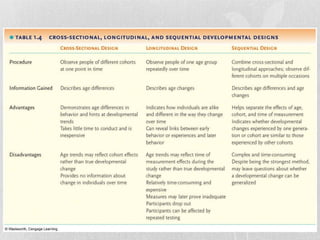
Learning Objective What are the advantages and disadvantages of the  cross-sectional  and  longitudinal  designs? How does the  sequential  design resolve the weaknesses of these designs?
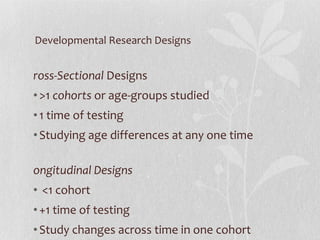
Developmental Research Designs Cross-Sectional  Designs >1  cohorts  or age-groups studied 1 time of testing Studying age differences at any one time Longitudinal Designs <1 cohort +1 time of testing Study changes across time in one cohort
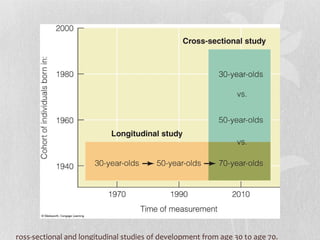
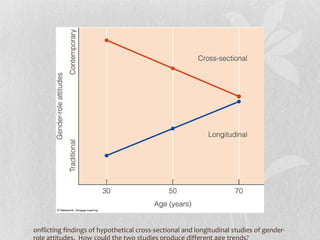
Cross-sectional and longitudinal studies of development from age 30 to age 70.
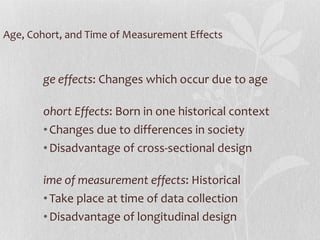
Age, Cohort, and Time of Measurement Effects Age effects : Changes which occur due to age Cohort Effects : Born in one historical context Changes due to differences in society Disadvantage of cross-sectional design Time of measurement effects : Historical Take place at time of data collection Disadvantage of longitudinal design
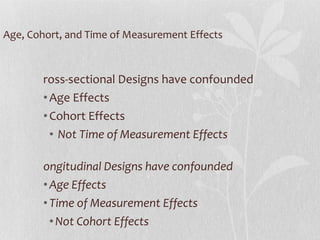
Age, Cohort, and Time of Measurement Effects Cross-sectional Designs have confounded Age Effects Cohort Effects Not Time of Measurement Effects Longitudinal Designs have confounded  Age Effects Time of Measurement Effects Not Cohort Effects
Conflicting findings of hypothetical cross-sectional and longitudinal studies of gender-role attitudes.  How could the two studies produce different age trends?
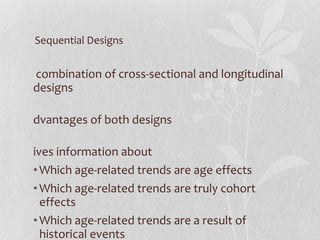
Sequential Designs A combination of cross-sectional and longitudinal designs Advantages of both designs Gives information about  Which age-related trends are age effects  Which age-related trends are truly cohort effects Which age-related trends are a result of historical events
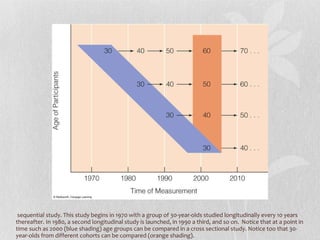
A sequential study. This study begins in 1970 with a group of 30-year-olds studied longitudinally every 10 years thereafter. In 1980, a second longitudinal study is launched, in 1990 a third, and so on.  Notice that at a point in time such as 2000 (blue shading) age groups can be compared in a cross sectional study. Notice too that 30-year-olds from different cohorts can be compared (orange shading).
 
Learning Objective What special challenges do developmental scientists face? What challenges arise in studying development and how can scientists address these issues?
Issues in Developmental Studies Random sampling Increases likelihood that sample is representative of population Distributes error randomly so it disappears with replication Protecting rights of research participants Must assess the benefit to risk balance Researcher responsibilities Informed consent, debriefing, protection from harm, confidentiality
Cultural and Subcultural Sensitivity in Research Culturally sensitive methods & measurements Social Economic Status (SES)   Occupational Prestiage Education Income Ethnocentrism The belief that one’s own group and culture is superior
Historical Changes in Periods of Lifespan Childhood Pressure to grow up Early exposure to adult issues Adolescence: A transition & delayed adulthood Emerging Adulthood Identity exploration in preparation for adulthood Adulthood By 2030, >20%  will be over age 65
The End http:// www.quizlet.com/550383/development-flash-cards /

Cog lifespan 1 introduction (1)

  • 1.
    Introduction to Developmental Psychology LIFESPAN DEVELOPMENT
  • 2.
    Week 1 CourseIntroduction DEVELOPMENTAL PSYCHOLOGY
  • 3.
    Introduction (1) Generalintroduction to the process of human development throughout the lifespan, this module will emphasise the theories on normal developmental processes, with attention given to various developmental tasks (perceptual, cognitive, personality, and social development) through life. Social research methods appropriate to the areas are introduced.
  • 4.
    Introduction (2) Understandthe field of human development as a branch of scientific study within psychology Understand the lifespan development perspective in approaching human developmental phenomena Understand the major theories of human development and be familiar with their relevance to the developmental process during various life stages Be familiar with the major research methods used by developmental psychologists Identify and discuss the major issues involved in studying human development
  • 5.
    Introduction (3) Introducestudents to perceptual development, cognitive development, social development, and personality development. Introduce the basic theories of developmental psychology to equip the students to handle Developmental Psychology at the degree level
  • 6.
    Introduction (4) Assessment:mixture of coursework (50%) and examination (50%) 1-Tutorial Participation (10%): 2- Quizzes or Short Assignments (10%) 3- Continuing Assessment, Mid Semester Test (30%) Extra Credit 4- Written Examination (50%) No CA Component Worth (%) Due Date 1 Tutorial Participation 10 On-going 2 Quizzes 10 On-going 3 Mid Semester Test 30 01 Mar 2011, 7pm 4 Written Examination 50     TOTAL 100  
  • 7.
    Text Book 1Berk, L. E. (2007). Development through the life span (4th ed). Boston: Allyn and Bacon. 2- Companion Website: http://wps.ablongman.com/ab_berk_lifespan_4/ http://wps.ablongman.com/ab_berk_lifespan_4/52/13493/3454335.cw/index.html 3-Online Resources: National Library Board Singapore – ebrary (Online Library) http://www.nlb.gov.sg/ American Psychological Association http://www.apa.org/ Amazon.com Other additional reference materials will be suggested in each lecture .
  • 8.
    Schedule Week TopicChapter 1 Introduction to Lifespan Development 1 2 Foundation of Development 2 & 3 3 Infancy & Toddlerhood; The First Two Years 4 & 5 & 6 4 Early Childhood; Two to Six Years 7 & 8 5 Middle Childhood; Six to Eleven Years 9 & 10 6 Adolescence 11 & 12 7 Early Adulthood 13 & 14 8 Middle Adulthood 15 & 16 9 Late Adulthood 17 & 18 10 Death, Dying and Bereavement 19
  • 9.
    Contact Information INSTRUCTOR: Miss. Maliheh Taheri Tel: 63535110, Mobile: 96692253 E-Mail : mali@malihehtaheri.com, haiku_vieru@yahoo.com
  • 10.
    Here’s to aninteresting journey of knowledge gathering! Movie ( Opal Dreaming)
  • 11.
    Week 1 Introductionto developmental psychology DEVELOPMENTAL PSYCHOLOGY
  • 12.
    Human Development Afield of study devoted to understanding constancy and change throughout the lifespan Attachment Bonding Changes in physical, social, emotional…
  • 13.
    The Life-Span PerspectiveDevelopment —pattern of change that begins at conception and continues through life span
  • 14.
    Research Isa relatively new area Late 19 th early 20 th century From speculation to research and construction of theories
  • 15.
    Theory Orderlyintegrated set of statements that describes, explains and predicts behaviours Provide frameworks for observations of people Verification of theory provides sound basis for practical action
  • 16.
    Developmental Issues Natureand Nurture Stability and Change Continuity-Discontinuity Extent to which development is influenced by nature and by nurture Degree to which early traits and characteristics persist through life or change Extent development involves gradual, cumulative change (continuity) or distinct stages (discontinuity)
  • 17.
    Nature Vs NurtureAre genetics or environment more important to influence development? Stability Vs Plasticity – that one has certain stable traits that developed due to early experiences, as opposed to changes that will occur with each new experience
  • 19.
    Life Span PerspectiveLeading dynamic systems approach Lifelong Multidimensional and multidirectional Highly plastic Affected by multiple interacting forces
  • 20.
    Lifespan perspective Perspectivethat considers that there are stages when new skills will emerge, and that there is gain and deficits that will set in. there are many possible courses, and as development is influenced by multiple interacting forces, there are many possible pathways. The intricate blend of hereditary and environmental factors, hence both early and late experiences are important to development.
  • 21.
    Development in lifelongAll stages are equally important Events all have same potential effect Change occurs in three broad domains – physical, cognitive, and emotional/social
  • 22.
    Dimension and directionMultidimensional – affected by blend of biological, social, psychological factors Multidirectional – marked by joint expression of improvements and declines in skills
  • 23.
    Development is plasticConcept of plasticity – that it is not static, inflexible. Possible to go through the stages at different times, express differences, etc.
  • 24.
    Multiple interacting forcesAge graded influences: fairly predictable in timing (age) of occurrence History graded influences: the effect of cohort Non-normative influences: the effect of non-regular non-predictable events that are specific to an individual
  • 25.
    Adult Development Lifeexpectancy —number of years a person is expected to live on average when born in a particular year Developmental change occurs during adulthood as well as childhood
  • 26.
    Conceptions of AgeChronological age —number of years elapsed since person’s birth Biological age —age in terms of biological health Psychological age —individual’s adaptive capacities Social age —social roles and expectations related to person’s age
  • 27.
    Period Range BriefDescription Prenatal < birth One-cell to many cells within womb Infancy & toddlerhood < 2yrs Dramatic changes in body and brain Early Childhood 2-6yrs Refinement of skills Middle childhood 6-11yrs School years, abilities and peers Adolescence 11-18yrs Puberty, autonomy Early adulthood 18-40yrs Most leave home, complete education, start new units Middle adulthood 40-65yrs Height of careers, Sandwich generation Late adulthood >65yrs Retirement preparation, reflective
  • 28.
    Erikson’s Psychosocial TheoryEight stages of development Unique development task confronts individuals with crisis that must be resolved Positive resolution builds foundation for healthy development
  • 29.
    Historical Foundations toDevelopment John Locke (1632 – 1704) posited that children were like a blank slate (tabula rasa) Jean-Jacques Rousseau (1712 – 1778) saw children as noble savages with strong sense of right and wrong, children determined their own destinies.
  • 30.
    Historical Foundations toDevelopment John Locke: continuous, nurturing, many courses of development Jean-Jacques Rousseau (1712 – 1778) child centred philosophy which emphasised that adults be receptive to the child’s needs. Discontinuous, dependent on nature, and follows a single unified course .
  • 31.
    Psychoanalytic Theories Developmentdepends primarily on unconscious mind Early experiences important in development
  • 32.
    Psychoanalytic Perspective FreudPsychosexual theory emphasising on how parents manage child’s sexual and aggressive drives is crucial for the healthy personality development. Stages: oral, anal, phallic, latency, genital. Dependent on gratification - Criticised on many grounds
  • 33.
    Behavioral Theories Pavlov’sClassical Conditioning Skinner’s Operant Conditioning Focus on observable, learned behaviors
  • 34.
    Behaviourism and sociallearning theory Watson, Bandura Conditioning – classical and operant Social learning theory, vicarious learning Behaviour modification in which procedures from conditioning and modelling will be used to reduce undesirable behaviours
  • 35.
    Piaget’s Cognitive DevelopmentalTheory Children actively construct understanding Development proceeds based largely on biology Four stages of cognitive development Sensorimotor Preoperational Concrete Operational Formal Operational
  • 36.
    Recent Theoretical PerspectivesInformation processing approach: human mind is akin to a symbol-manipulating system through which information flows Developmental cognitive neuroscience: bringing together perspectives from psychology, biology, neuroscience, and medicine
  • 37.
    Ethological Theory BehaviourStrongly influenced by biology Tied to evolution Characterized by critical or sensitive periods. Examples: language, attachment
  • 38.
    Concepts Ethology:concerned with adaptive or survival value of behaviour and evolutionary history Sensitive period: time at which learning is optimal, in which the individual is especially responsive to environmental influences
  • 39.
    Sociocultural Contexts Cross-culturalstudies —comparisons of one culture with one or more other cultures. Ethnicity —range of characteristics rooted in cultural heritage. Gender —psychological and sociocultural dimension of being female or male.
  • 40.
    Vygotsky’s Sociocultural theoryHow culture is transmitted to the next generation Social interaction, particularly dialogues, is necessary for children to acquire the ways of thinking and behaving that makeup a community’s culture
  • 41.
    Vygotsky’s Sociocultural CognitiveTheory Emphasizes how culture and social interaction guide cognitive development Social interaction with more skilled adults and peers is advances cognitive development
  • 42.
    Bronfenbrenner’s EcologicalSystems theory Focus on complex system of relationships affected by multiple levels of surrounding environment Five environmental systems: microsystem, mesosystem, exosystem, macrosystem, chronosystem Environment is dynamic, not a static force that affects people in a uniform way
  • 43.
    Family Park, gardens Childcare MICROSYSTEM EXOSYSTEM MACROSYSTEM ME
  • 44.
    Comparison of approachesTHEORY Cont/discont One/many Nature/Nurture Psychoanalytic Discontinuous One course Both Behaviourism Continuous Many courses Nurture Cognitive Discontinuous One course Both Information proc Continuous One course Both Evolutionary Both One course Both Sociocultural Both Many courses Both EcoSystems Not specified Many courses Both
  • 45.
    Learning Objectives Whatis the science of life-span development? What are the three goals of developmental psychology? What are the seven assumptions of the modern life-span perspective on human development?
  • 46.
    Goals of StudyingLife-Span Development Description Normal development, individual differences Explanation Typical and individually different development Optimization Positive development, enhancing human capacities Prevention and overcoming difficulties
  • 47.
    Methods of StudyingLife-Span Development Historical Baby Biographies: Charles Darwin Questionnaires: G. Stanley Hall Key Assumptions of Modern Life-Span Perspectives Lifelong, Multidirectional process Gain and loss Lifelong plasticity Historical/cultural contexts, multiple influences Multi-disciplinary studies
  • 48.
    Key Assumptions ofLife-Span Perspective Key Assumptions of Modern Life-Span Perspectives Lifelong, Multidirectional process, Gain and loss, Lifelong plasticity, Historical/cultural contexts, Multiple influences, Multi-disciplinary studies
  • 49.
    Learning Objectives Whatis the scientific “mindset ”? How is the scientific method used to study development?
  • 50.
    Unique Challenges inDevelopmental Research Infants and young children Attention, instruction, answering questions may be difficult Elderly Adults Possible sensory impairments Discomfort being studied, tested
  • 51.
    Conducting Developmental ResearchSelf-reports: Interview Advantage: Quick, easy and inexpesnsive Disadvantage: Can not be used with infants, young children and cognitively impaired elders Questions may have to be worded differently at different ages Respondents tend to put themselves in a more favorable light May be influenced by current events
  • 52.
    Conducting Developmental ResearchSelf-reports: Questionnaires, Advantage: Quick, easy and inexpensive Disadvantage: Reading level of subject has to be considered Can not be used with visually impaired Respondents tend to put themselves in a more favorable light May be influenced by current events
  • 53.
    Conducting Developmental ResearchSelf-reports: Tests Advantage: Quick, easy and inexpensive Disadvantage: Reading level of subject has to be considered Can not be used with visually impaired Motivation level of test taker has to be considered May be influenced by current events
  • 54.
    Conducting Developmental ResearchBehavioral Observations (Experiments) Naturalistic Advantage: natural setting Disadvantage: conditions not controlled Structured (Lab) Advantage: conditions controlled Disadvantage: cannot generalize to natural settings
  • 55.
    Learning Objective Whatare the essential features of the experimental method? What sorts of information can be gathered from this type of study? What are its strengths and weaknesses?
  • 56.
    The Scientific (Experimental)Method Three Critical Features 1. Manipulation of independent variable and Measurement of dependent variable 2. Random assignment of individuals to treatment conditions Treatment groups equal from start Error falls out with replication 3. Experimental control Note: Quasi-Experiment : No random assignment
  • 57.
    The Scientific (Experimental)Method Advantages and Disadvantages of Experimental Method Advantages Control of independent variable Specification of dependent variable Cause and effect conclusion Disadvantages Experimental control often not the same as real world findings Limitations posed by ethics
  • 58.
  • 59.
    Learning Objective Whatare the important features of the correlational method? What sorts of information can be gathered from this type of study? What are its strengths and weaknesses?
  • 60.
    The Correlational MethodDetermine if 2 or more variables are related Correlation: A measure of the relationship Can range from +1.0 to –1.0 Positive: variables move in same direction Negative: variables move in opposite direction No relationship if correlation is 0 Cannot establish a causal relationship
  • 61.
    The Correlational MethodAdvantage: Can be used when ethical issues limit experimentation Easier and less expensive than experimental method Disadvantage: Cannot establish a causal relationship The direction of the cause & effect implication may be reversed The relationship may be cause by a third variable
  • 62.
  • 63.
    Learning Objective Whatare the advantages and disadvantages of the cross-sectional and longitudinal designs? How does the sequential design resolve the weaknesses of these designs?
  • 64.
    Developmental Research DesignsCross-Sectional Designs >1 cohorts or age-groups studied 1 time of testing Studying age differences at any one time Longitudinal Designs <1 cohort +1 time of testing Study changes across time in one cohort
  • 65.
    Cross-sectional and longitudinalstudies of development from age 30 to age 70.
  • 66.
    Age, Cohort, andTime of Measurement Effects Age effects : Changes which occur due to age Cohort Effects : Born in one historical context Changes due to differences in society Disadvantage of cross-sectional design Time of measurement effects : Historical Take place at time of data collection Disadvantage of longitudinal design
  • 67.
    Age, Cohort, andTime of Measurement Effects Cross-sectional Designs have confounded Age Effects Cohort Effects Not Time of Measurement Effects Longitudinal Designs have confounded Age Effects Time of Measurement Effects Not Cohort Effects
  • 68.
    Conflicting findings ofhypothetical cross-sectional and longitudinal studies of gender-role attitudes. How could the two studies produce different age trends?
  • 69.
    Sequential Designs Acombination of cross-sectional and longitudinal designs Advantages of both designs Gives information about Which age-related trends are age effects Which age-related trends are truly cohort effects Which age-related trends are a result of historical events
  • 70.
    A sequential study.This study begins in 1970 with a group of 30-year-olds studied longitudinally every 10 years thereafter. In 1980, a second longitudinal study is launched, in 1990 a third, and so on. Notice that at a point in time such as 2000 (blue shading) age groups can be compared in a cross sectional study. Notice too that 30-year-olds from different cohorts can be compared (orange shading).
  • 71.
  • 72.
    Learning Objective Whatspecial challenges do developmental scientists face? What challenges arise in studying development and how can scientists address these issues?
  • 73.
    Issues in DevelopmentalStudies Random sampling Increases likelihood that sample is representative of population Distributes error randomly so it disappears with replication Protecting rights of research participants Must assess the benefit to risk balance Researcher responsibilities Informed consent, debriefing, protection from harm, confidentiality
  • 74.
    Cultural and SubculturalSensitivity in Research Culturally sensitive methods & measurements Social Economic Status (SES) Occupational Prestiage Education Income Ethnocentrism The belief that one’s own group and culture is superior
  • 75.
    Historical Changes inPeriods of Lifespan Childhood Pressure to grow up Early exposure to adult issues Adolescence: A transition & delayed adulthood Emerging Adulthood Identity exploration in preparation for adulthood Adulthood By 2030, >20% will be over age 65
  • 76.
    The End http://www.quizlet.com/550383/development-flash-cards /

Editor's Notes

  • #16 Theories guide and give meaning to what we see. once we understand what we see, we will then be in a much better position to help and improve the welfare and treatment of all
  • #19 Stage theory where we have to cross certain markers to attain maturity of that stage, or is it a smooth process. Can be likened to stages in development of life cycle of frog and fish A third major issue in developmental psychology is that of continuity. Does change occur smoothly over time, or through a series of predetermined steps? Some theories of development argue that changes are simply a matter of quantity; children display more of certain skills as they grow older. Other theories outline a series of sequential stages in which skills emerge at certain points of development.
  • #44 Individual is centre, most important. the immediate environment of the individual is the microsystem. The interaction of elements in the microsystem is what determines the mesosystem. The next system is the exosystem, which includes extended family, workplace etc, and finally the macrosystem which talks about the political system, moral values of society etc.
  • #45 There are so many schools of thought, what are the