Humandevelopment:Meaning,
conceptsandapproaches
CRIS A. CAPILAYAN
Here are pictures of John and Nessa. Each one is a bundle of
possibilities. Describe what they were before birth (their point
of origin) and who they will possibly be after birth unto
adulthood. What will they possibly become? Expound your
answers.
MEANINGOFHUMANDEVELOPMENT
Human development - pattern of movement or change that
begins at conception and continues through the life span.
Development includes growth (positive) and decline
(negative).
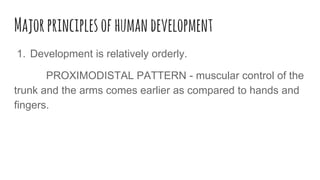
Majorprinciplesofhumandevelopment
1. Development is relatively orderly.
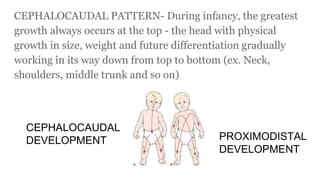
PROXIMODISTAL PATTERN - muscular control of the
trunk and the arms comes earlier as compared to hands and
fingers.
CEPHALOCAUDAL PATTERN- During infancy, the greatest
growth always occurs at the top - the head with physical
growth in size, weight and future differentiation gradually
working in its way down from top to bottom (ex. Neck,
shoulders, middle trunk and so on)
PROXIMODISTAL
DEVELOPMENT
CEPHALOCAUDAL
DEVELOPMENT
2. While the pattern of development is likely to be similar, the
outcomes of developmental processes and the rate of
development are likely to vary among individuals.
If children come from good home with loving and caring
parents, they may develop into warm and responsible
children, adolescents and adults. If they come from deprived
environment, they may develop into carefree and
irresponsible adolescents and adults.
3.DEvelopment takesplacegradually.
While some changes occur in a flash of insight, more often
it takes weeks , months, or years for a person to undergo
changes that result in the display of developmental
characteristics.
Development as a process is complex because it is the product of
biological, cognitive and socioemotional processes
Biologicalprocesses involve changes in the individual’s physical
nature.
Children will experience hormonal changes when they reach the
period of puberty, and cardiovascular decline as they approach late
adulthood.
Cognitiveprocesses
Involve changes in the individual’s thought, intelligence, and language.
Ex. Children develop from mere sounds to a word becoming two words,
the two words becoming a sentence.
They would move on to memorizing their first prayer, singing Bayang
Magiliw, solving chess and solving math problem.
Socioemotionalprocesses
Changes in the individual’s relationships
with other people.
From aggressive children, they may develop into a fine lady
and a gentleman or otherwise,depending on a myriad of
factors. They may fall in love and get inspired for life or
may end up betrayed, deserted and desperate afterwards.
These biological , cognitive, and
socioemotional processes are inextricably
intertwined. While these processes are
studied separately, the effect of one process
or factor on a person’s development is not
isolated from the other processes.
Twoapproaches tohumandevelopment
TRADITIONAL - Extensive change from birth to
adolescence, little or no change in adulthood
and decline in late old age.
Life-spandevelopment characteristics: (Santrock,2002)
1. Development is lifelong. It does not end in adulthood.
2. Development is multidimensional . Development
consists of biological, cognitive, and socio-emotional
dimensions.
3. Development is plastic. Development is possible
throughout the lifespan.
4. Development is contextual. Individuals are changing
beings in a changing world.
5. Development involves growth, maintenance and regulation. The goals
of individuals vary among developmental stages.
Principles of child development and learning that inform practice
Below are the principles of child development and learning
which are the bases of developmentally appropriate practice
(DAP) in early childhood program for children from birth
through age 8, which are stated in the position paper of the
National Association for the Education of Young Children
(2009)
1.All the domains of development and learning-physical
social and emotional, and cognitive are important and
they are closely interrelated.
2. Many aspects of children’s learning and development follow
well documented sequences , with later abilities, skills and
knowledge building on those already acquired.
3. Development and learning proceed at varying rates from
child to child, as well as at uneven rates across different
areas of child’s individual functioning.
4. Development and learning result from a dynamic and
continuous interaction of biological maturation and
experience.
5. Early experiences have profound effects, both cummulative
and delayed, on a child’s development and learning; and
optimal periods exist for certain types of development and
learning to occur.
6. Development proceeds toward greater complexity, self-regulation, and
symbolic or representational capacities.
7. Children develop best when they have secure, consistent, relationships
with responsive adults and opportunities for positive relationships with
peers.
8. Development and learning occur in and are influenced by multiple
social and cultural contexts.
9. Always mentally active in seeking to understand the world around them,
children learn in a variety of ways;
10. Play is an important vehicle for developing self-
regulation as well as for promoting language,
cognition, and social competence.
11. Development and learning advance when children are
challenged to achieve at a level just beyond their
current mastery, and also when they have many
opportunities to practice newly acquired skills.
12.Children’s experiences shape their motivation and
approaches to learning, such as persistence ,
initiative and flexiblility.
Endofthediscussion

Human development meaning, concepts and approaches

  • 1.
  • 2.
    Here are picturesof John and Nessa. Each one is a bundle of possibilities. Describe what they were before birth (their point of origin) and who they will possibly be after birth unto adulthood. What will they possibly become? Expound your answers.
  • 3.
    MEANINGOFHUMANDEVELOPMENT Human development -pattern of movement or change that begins at conception and continues through the life span. Development includes growth (positive) and decline (negative).
  • 4.
    Majorprinciplesofhumandevelopment 1. Development isrelatively orderly. PROXIMODISTAL PATTERN - muscular control of the trunk and the arms comes earlier as compared to hands and fingers.
  • 5.
    CEPHALOCAUDAL PATTERN- Duringinfancy, the greatest growth always occurs at the top - the head with physical growth in size, weight and future differentiation gradually working in its way down from top to bottom (ex. Neck, shoulders, middle trunk and so on) PROXIMODISTAL DEVELOPMENT CEPHALOCAUDAL DEVELOPMENT
  • 6.
    2. While thepattern of development is likely to be similar, the outcomes of developmental processes and the rate of development are likely to vary among individuals. If children come from good home with loving and caring parents, they may develop into warm and responsible children, adolescents and adults. If they come from deprived environment, they may develop into carefree and irresponsible adolescents and adults.
  • 7.
    3.DEvelopment takesplacegradually. While somechanges occur in a flash of insight, more often it takes weeks , months, or years for a person to undergo changes that result in the display of developmental characteristics.
  • 8.
    Development as aprocess is complex because it is the product of biological, cognitive and socioemotional processes Biologicalprocesses involve changes in the individual’s physical nature. Children will experience hormonal changes when they reach the period of puberty, and cardiovascular decline as they approach late adulthood.
  • 9.
    Cognitiveprocesses Involve changes inthe individual’s thought, intelligence, and language. Ex. Children develop from mere sounds to a word becoming two words, the two words becoming a sentence. They would move on to memorizing their first prayer, singing Bayang Magiliw, solving chess and solving math problem.
  • 10.
    Socioemotionalprocesses Changes in theindividual’s relationships with other people. From aggressive children, they may develop into a fine lady and a gentleman or otherwise,depending on a myriad of factors. They may fall in love and get inspired for life or may end up betrayed, deserted and desperate afterwards.
  • 11.
    These biological ,cognitive, and socioemotional processes are inextricably intertwined. While these processes are studied separately, the effect of one process or factor on a person’s development is not isolated from the other processes.
  • 12.
    Twoapproaches tohumandevelopment TRADITIONAL -Extensive change from birth to adolescence, little or no change in adulthood and decline in late old age.
  • 13.
    Life-spandevelopment characteristics: (Santrock,2002) 1.Development is lifelong. It does not end in adulthood. 2. Development is multidimensional . Development consists of biological, cognitive, and socio-emotional dimensions. 3. Development is plastic. Development is possible throughout the lifespan. 4. Development is contextual. Individuals are changing beings in a changing world. 5. Development involves growth, maintenance and regulation. The goals of individuals vary among developmental stages.
  • 14.
    Principles of childdevelopment and learning that inform practice Below are the principles of child development and learning which are the bases of developmentally appropriate practice (DAP) in early childhood program for children from birth through age 8, which are stated in the position paper of the National Association for the Education of Young Children (2009) 1.All the domains of development and learning-physical social and emotional, and cognitive are important and they are closely interrelated.
  • 15.
    2. Many aspectsof children’s learning and development follow well documented sequences , with later abilities, skills and knowledge building on those already acquired. 3. Development and learning proceed at varying rates from child to child, as well as at uneven rates across different areas of child’s individual functioning. 4. Development and learning result from a dynamic and continuous interaction of biological maturation and experience. 5. Early experiences have profound effects, both cummulative and delayed, on a child’s development and learning; and optimal periods exist for certain types of development and learning to occur.
  • 16.
    6. Development proceedstoward greater complexity, self-regulation, and symbolic or representational capacities. 7. Children develop best when they have secure, consistent, relationships with responsive adults and opportunities for positive relationships with peers. 8. Development and learning occur in and are influenced by multiple social and cultural contexts. 9. Always mentally active in seeking to understand the world around them, children learn in a variety of ways;
  • 17.
    10. Play isan important vehicle for developing self- regulation as well as for promoting language, cognition, and social competence. 11. Development and learning advance when children are challenged to achieve at a level just beyond their current mastery, and also when they have many opportunities to practice newly acquired skills. 12.Children’s experiences shape their motivation and approaches to learning, such as persistence , initiative and flexiblility.
  • 18.