Dr.SRIRAM.R
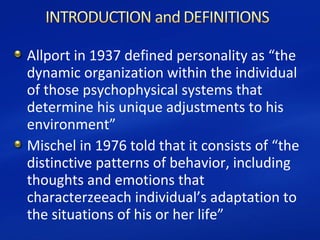
Allport in 1937 defined personality as “the
dynamic organization within the individual
of those psychophysical systems that
determine his unique adjustments to his
environment”
Mischel in 1976 told that it consists of “the
distinctive patterns of behavior, including
thoughts and emotions that
characterzeeach individual’s adaptation to
the situations of his or her life”
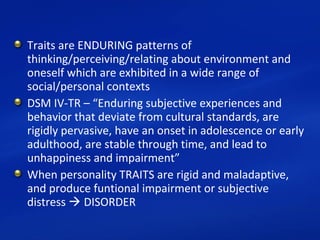
Traits are ENDURING patterns of
thinking/perceiving/relating about environment and
oneself which are exhibited in a wide range of
social/personal contexts
DSM IV-TR – “Enduring subjective experiences and
behavior that deviate from cultural standards, are
rigidly pervasive, have an onset in adolescence or early
adulthood, are stable through time, and lead to
unhappiness and impairment”
When personality TRAITS are rigid and maladaptive,
and produce funtional impairment or subjective
distress  DISORDER
 Categorical Classification -
ICD-10 (F60 Specific PD)-WHO
DSM-5-American Psychiatric Association
Millon’s description
 Additional classification – Severity, Social
functioning and Attribution
 Dimensional Classification - (ICD-11?)
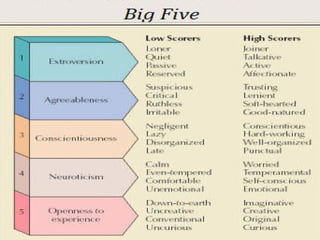
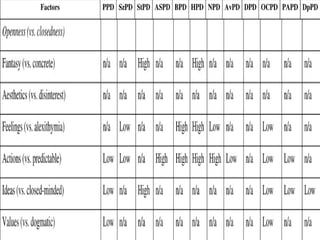
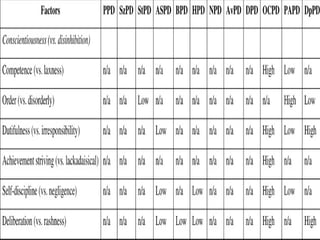
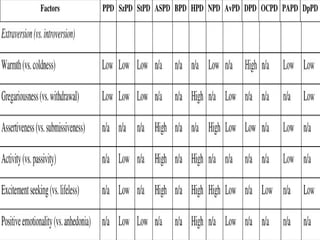
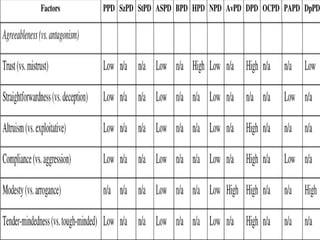
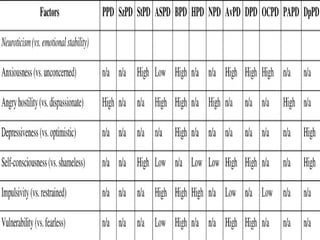
Thomas Widiger’s Five-factor model
a. Marked disharmonious attitude and behaviour
involving several areas of functioning
b. Enduring/long standing
c. Pervasive and maladaptive
d. Childhood to adulthood
e. Personal distress
f. Socio-occupational dysfunction
F60 Specific personality disorders
F60.0 Paranoid personality disorder
F60.1 Schizoid personality disorder
F60.2 Dissocial personality disorder
F60.3 Emotionally unstable personality disorder
.30 Impulsive type
.31 Borderline type
F60.4 Histrionic personality disorder
F60.5 Anankastic personality disorder
F60.6 Anxious [avoidant] personality disorder
F60.7 Dependent personality disorder
F60.8 Other specific personality disorders
F60.9 Personality disorder, unspecified
F61 Mixed and other personality disorders
F61.0 Mixed personality disorders
F61.1 Troublesome personality changes
Cluster A (odd disorders) “MAD CLUSTER”
Paranoid personality disorder (301.0): characterized
by a pattern of irrational suspicion and mistrust of
others, interpreting motivations as malevolent
Schizoid personality disorder (301.20): lack of interest
and detachment from social relationships, and
restricted emotional expression
Schizotypal personality disorder (301.22/F21 SSD ICD-
10): a pattern of extreme discomfort interacting
socially, distorted cognitions and perceptions
Cluster B (dramatic, emotional or erratic disorders)
“BAD CLUSTER”
Antisocial personality disorder(301.7/DISSOCIAL PD IN ICD-
10): a pervasive pattern of disregard for and violation of the
rights of others, lack of empathy
Borderline personality disorder(301.83): pervasive pattern of
instability in relationships, self-image, identity, behavior
and affects often leading to self-harm and impulsivity
Histrionic personality disorder(301.50): pervasive pattern
of attention-seeking behavior and excessive emotions
Narcissistic personality disorder(301.81/F60.81 OTHER PD ICD-
10): a pervasive pattern of grandiosity, need for admiration, and
a lack of empathy
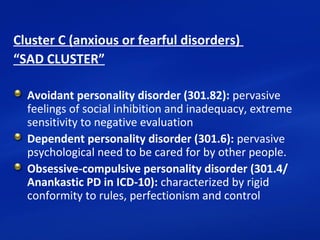
Cluster C (anxious or fearful disorders)
“SAD CLUSTER”
Avoidant personality disorder (301.82): pervasive 
feelings of social inhibition and inadequacy, extreme 
sensitivity to negative evaluation
Dependent personality disorder (301.6): pervasive 
psychological need to be cared for by other people.
Obsessive-compulsive personality disorder (301.4/
Anankastic PD in ICD-10): characterized by rigid 
conformity to rules, perfectionism and control
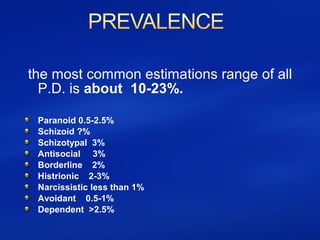
the most common estimations range of all
P.D. is about 10-23%.
Paranoid 0.5-2.5%
Schizoid ?%
Schizotypal 3%
Antisocial 3%
Borderline 2%
Histrionic 2-3%
Narcissistic less than 1%
Avoidant 0.5-1%
Dependent >2.5%
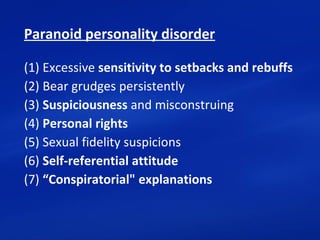
Paranoid personality disorder
(1) Excessive sensitivity to setbacks and rebuffs
(2) Bear grudges persistently
(3) Suspiciousness and misconstruing
(4) Personal rights 
(5) Sexual fidelity suspicions
(6) Self-referential attitude
(7) “Conspiratorial" explanations
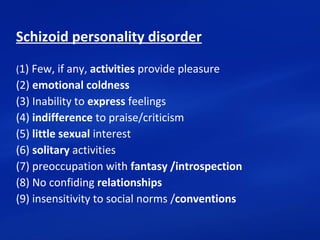
Schizoid personality disorder
(1) Few, if any, activities provide pleasure
(2) emotional coldness
(3) Inability to express feelings
(4) indifference to praise/criticism
(5) little sexual interest
(6) solitary activities
(7) preoccupation with fantasy /introspection
(8) No confiding relationships
(9) insensitivity to social norms /conventions
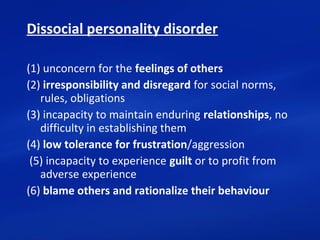
Dissocial personality disorder
(1) unconcern for the feelings of others
(2) irresponsibility and disregard for social norms, 
rules, obligations
(3) incapacity to maintain enduring relationships, no 
difficulty in establishing them
(4) low tolerance for frustration/aggression
 (5) incapacity to experience guilt or to profit from 
adverse experience 
(6) blame others and rationalize their behaviour
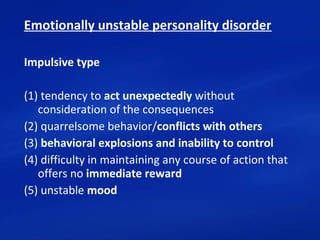
Emotionally unstable personality disorder
Impulsive type
(1) tendency to act unexpectedly without 
consideration of the consequences
(2) quarrelsome behavior/conflicts with others
(3) behavioral explosions and inability to control
(4) difficulty in maintaining any course of action that 
offers no immediate reward
(5) unstable mood
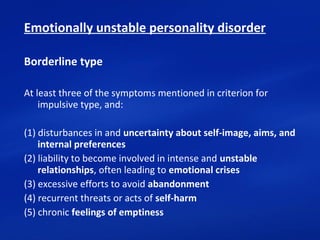
Emotionally unstable personality disorder
Borderline type
   
At least three of the symptoms mentioned in criterion for 
impulsive type, and: 
(1) disturbances in and uncertainty about self-image, aims, and
internal preferences 
(2) liability to become involved in intense and unstable
relationships, often leading to emotional crises
(3) excessive efforts to avoid abandonment
(4) recurrent threats or acts of self-harm
(5) chronic feelings of emptiness
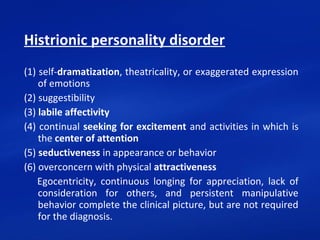
Histrionic personality disorder
(1) self-dramatization, theatricality, or exaggerated expression 
of emotions
(2) suggestibility
(3) labile affectivity
(4) continual seeking for excitement and activities in which is 
the center of attention
(5) seductiveness in appearance or behavior
(6) overconcern with physical attractiveness
      Egocentricity,  continuous  longing  for  appreciation,  lack  of 
consideration  for  others,  and  persistent  manipulative 
behavior complete the clinical picture, but are not required 
for the diagnosis.
Anankastic personality disorder
(1) feelings of excessive doubt and caution
(2) preoccupation with details, rules, order, organization, or
schedule
(3) perfectionism that interferes with completion
(4) conscientiousness and scrupulousness
(5) preoccupation with productivity to the exclusion of
pleasure and relationships
(6) pedantry and adherence to conventions
(7) rigidity/stubbornness/unwelcome thoughts and impulses
(8) unreasonable insistence that others submit to exactly way
of doing things, or unreasonable reluctance to way of doing
of them
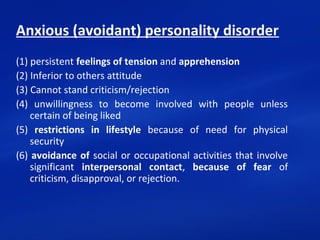
Anxious (avoidant) personality disorder
(1) persistent feelings of tension and apprehension
(2) Inferior to others attitude
(3) Cannot stand criticism/rejection
(4) unwillingness to become involved with people unless
certain of being liked
(5) restrictions in lifestyle because of need for physical
security
(6) avoidance of social or occupational activities that involve
significant interpersonal contact, because of fear of
criticism, disapproval, or rejection.
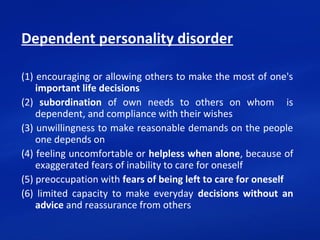
Dependent personality disorder
(1) encouraging or allowing others to make the most of one's
important life decisions
(2) subordination of own needs to others on whom is
dependent, and compliance with their wishes
(3) unwillingness to make reasonable demands on the people
one depends on
(4) feeling uncomfortable or helpless when alone, because of
exaggerated fears of inability to care for oneself
(5) preoccupation with fears of being left to care for oneself
(6) limited capacity to make everyday decisions without an
advice and reassurance from others
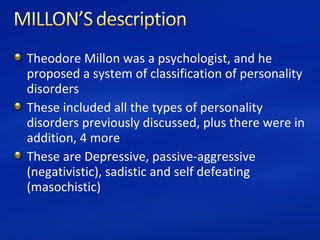
Theodore Millon was a psychologist, and he
proposed a system of classification of personality
disorders
These included all the types of personality
disorders previously discussed, plus there were in
addition, 4 more
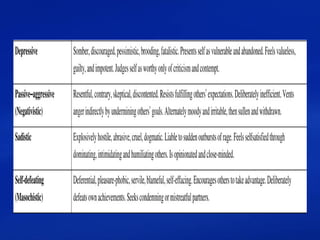
These are Depressive, passive-aggressive
(negativistic), sadistic and self defeating
(masochistic)
[21] Tyrer, P. (2000) Personality Disorders: Diagnosis, Management and Course. Second Edition. London:
Arnold Publishers Ltd., pp. 126–32.
There are several advantages to classifying
personality disorder by severity:
Addresses comorbidity
Represents the influence of personality disorder
on clinical outcome
This system accommodates the new diagnosis
of severe personality disorder, particularly
"dangerous and severe personality disorder"
(DSPD)
TYPE R - Do not recognize any abnormality
and defend valiantly their continued
occupancy of their personality role. This
group have been termed the Type R, or
treatment-resisting personality disorders
TYPE S - treatment-seeking ones, who are keen
on altering their personality disorders and
sometimes clamor for treatment
Cluster C are mostly Type S, Cluster A
personality disorders significantly more likely to
be Type R
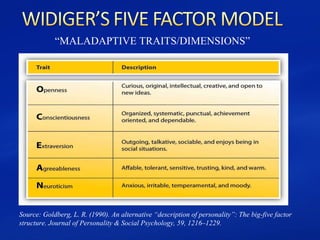
Source: Goldberg, L. R. (1990). An alternative “description of personality”: The big-five factor
structure. Journal of Personality & Social Psychology, 59, 1216–1229.
“MALADAPTIVE TRAITS/DIMENSIONS”
personality disorders classification

personality disorders classification

  • 1.
  • 2.
    Allport in 1937defined personality as “the dynamic organization within the individual of those psychophysical systems that determine his unique adjustments to his environment” Mischel in 1976 told that it consists of “the distinctive patterns of behavior, including thoughts and emotions that characterzeeach individual’s adaptation to the situations of his or her life”
  • 3.
    Traits are ENDURINGpatterns of thinking/perceiving/relating about environment and oneself which are exhibited in a wide range of social/personal contexts DSM IV-TR – “Enduring subjective experiences and behavior that deviate from cultural standards, are rigidly pervasive, have an onset in adolescence or early adulthood, are stable through time, and lead to unhappiness and impairment” When personality TRAITS are rigid and maladaptive, and produce funtional impairment or subjective distress  DISORDER
  • 4.
     Categorical Classification- ICD-10 (F60 Specific PD)-WHO DSM-5-American Psychiatric Association Millon’s description  Additional classification – Severity, Social functioning and Attribution  Dimensional Classification - (ICD-11?) Thomas Widiger’s Five-factor model
  • 5.
    a. Marked disharmoniousattitude and behaviour involving several areas of functioning b. Enduring/long standing c. Pervasive and maladaptive d. Childhood to adulthood e. Personal distress f. Socio-occupational dysfunction
  • 6.
    F60 Specific personalitydisorders F60.0 Paranoid personality disorder F60.1 Schizoid personality disorder F60.2 Dissocial personality disorder F60.3 Emotionally unstable personality disorder .30 Impulsive type .31 Borderline type F60.4 Histrionic personality disorder F60.5 Anankastic personality disorder F60.6 Anxious [avoidant] personality disorder F60.7 Dependent personality disorder F60.8 Other specific personality disorders F60.9 Personality disorder, unspecified F61 Mixed and other personality disorders F61.0 Mixed personality disorders F61.1 Troublesome personality changes
  • 7.
    Cluster A (odddisorders) “MAD CLUSTER” Paranoid personality disorder (301.0): characterized by a pattern of irrational suspicion and mistrust of others, interpreting motivations as malevolent Schizoid personality disorder (301.20): lack of interest and detachment from social relationships, and restricted emotional expression Schizotypal personality disorder (301.22/F21 SSD ICD- 10): a pattern of extreme discomfort interacting socially, distorted cognitions and perceptions
  • 8.
    Cluster B (dramatic,emotional or erratic disorders) “BAD CLUSTER” Antisocial personality disorder(301.7/DISSOCIAL PD IN ICD- 10): a pervasive pattern of disregard for and violation of the rights of others, lack of empathy Borderline personality disorder(301.83): pervasive pattern of instability in relationships, self-image, identity, behavior and affects often leading to self-harm and impulsivity Histrionic personality disorder(301.50): pervasive pattern of attention-seeking behavior and excessive emotions Narcissistic personality disorder(301.81/F60.81 OTHER PD ICD- 10): a pervasive pattern of grandiosity, need for admiration, and a lack of empathy
  • 9.
    Cluster C (anxiousor fearful disorders) “SAD CLUSTER” Avoidant personality disorder (301.82): pervasive  feelings of social inhibition and inadequacy, extreme  sensitivity to negative evaluation Dependent personality disorder (301.6): pervasive  psychological need to be cared for by other people. Obsessive-compulsive personality disorder (301.4/ Anankastic PD in ICD-10): characterized by rigid  conformity to rules, perfectionism and control
  • 10.
    the most commonestimations range of all P.D. is about 10-23%. Paranoid 0.5-2.5% Schizoid ?% Schizotypal 3% Antisocial 3% Borderline 2% Histrionic 2-3% Narcissistic less than 1% Avoidant 0.5-1% Dependent >2.5%
  • 11.
    Paranoid personality disorder (1) Excessive sensitivityto setbacks and rebuffs (2) Bear grudges persistently (3) Suspiciousness and misconstruing (4) Personal rights  (5) Sexual fidelity suspicions (6) Self-referential attitude (7) “Conspiratorial" explanations
  • 12.
    Schizoid personality disorder (1) Few, if any, activities provide pleasure (2) emotionalcoldness (3) Inability to express feelings (4) indifference to praise/criticism (5) little sexual interest (6) solitary activities (7) preoccupation with fantasy /introspection (8) No confiding relationships (9) insensitivity to social norms /conventions
  • 13.
    Dissocial personality disorder (1) unconcern for the feelingsof others (2) irresponsibility and disregard for social norms,  rules, obligations (3) incapacity to maintain enduring relationships, no  difficulty in establishing them (4) low tolerance for frustration/aggression  (5) incapacity to experience guilt or to profit from  adverse experience  (6) blame others and rationalize their behaviour
  • 14.
    Emotionally unstable personalitydisorder Impulsive type (1) tendency to act unexpectedly without  consideration of the consequences (2) quarrelsome behavior/conflicts with others (3) behavioral explosions and inability to control (4) difficulty in maintaining any course of action that  offers no immediate reward (5) unstable mood
  • 15.
    Emotionally unstable personalitydisorder Borderline type     At least three of the symptoms mentioned in criterion for  impulsive type, and:  (1) disturbances in and uncertainty about self-image, aims, and internal preferences  (2) liability to become involved in intense and unstable relationships, often leading to emotional crises (3) excessive efforts to avoid abandonment (4) recurrent threats or acts of self-harm (5) chronic feelings of emptiness
  • 16.
    Histrionic personality disorder (1) self-dramatization, theatricality, or exaggerated expression  of emotions (2) suggestibility (3) labileaffectivity (4) continual seeking for excitement and activities in which is  the center of attention (5) seductiveness in appearance or behavior (6) overconcern with physical attractiveness       Egocentricity,  continuous  longing  for  appreciation,  lack  of  consideration  for  others,  and  persistent  manipulative  behavior complete the clinical picture, but are not required  for the diagnosis.
  • 17.
    Anankastic personality disorder (1)feelings of excessive doubt and caution (2) preoccupation with details, rules, order, organization, or schedule (3) perfectionism that interferes with completion (4) conscientiousness and scrupulousness (5) preoccupation with productivity to the exclusion of pleasure and relationships (6) pedantry and adherence to conventions (7) rigidity/stubbornness/unwelcome thoughts and impulses (8) unreasonable insistence that others submit to exactly way of doing things, or unreasonable reluctance to way of doing of them
  • 18.
    Anxious (avoidant) personalitydisorder (1) persistent feelings of tension and apprehension (2) Inferior to others attitude (3) Cannot stand criticism/rejection (4) unwillingness to become involved with people unless certain of being liked (5) restrictions in lifestyle because of need for physical security (6) avoidance of social or occupational activities that involve significant interpersonal contact, because of fear of criticism, disapproval, or rejection.
  • 19.
    Dependent personality disorder (1)encouraging or allowing others to make the most of one's important life decisions (2) subordination of own needs to others on whom is dependent, and compliance with their wishes (3) unwillingness to make reasonable demands on the people one depends on (4) feeling uncomfortable or helpless when alone, because of exaggerated fears of inability to care for oneself (5) preoccupation with fears of being left to care for oneself (6) limited capacity to make everyday decisions without an advice and reassurance from others
  • 20.
    Theodore Millon wasa psychologist, and he proposed a system of classification of personality disorders These included all the types of personality disorders previously discussed, plus there were in addition, 4 more These are Depressive, passive-aggressive (negativistic), sadistic and self defeating (masochistic)
  • 22.
    [21] Tyrer, P.(2000) Personality Disorders: Diagnosis, Management and Course. Second Edition. London: Arnold Publishers Ltd., pp. 126–32.
  • 23.
    There are severaladvantages to classifying personality disorder by severity: Addresses comorbidity Represents the influence of personality disorder on clinical outcome This system accommodates the new diagnosis of severe personality disorder, particularly "dangerous and severe personality disorder" (DSPD)
  • 24.
    TYPE R -Do not recognize any abnormality and defend valiantly their continued occupancy of their personality role. This group have been termed the Type R, or treatment-resisting personality disorders TYPE S - treatment-seeking ones, who are keen on altering their personality disorders and sometimes clamor for treatment Cluster C are mostly Type S, Cluster A personality disorders significantly more likely to be Type R
  • 25.
    Source: Goldberg, L.R. (1990). An alternative “description of personality”: The big-five factor structure. Journal of Personality & Social Psychology, 59, 1216–1229. “MALADAPTIVE TRAITS/DIMENSIONS”