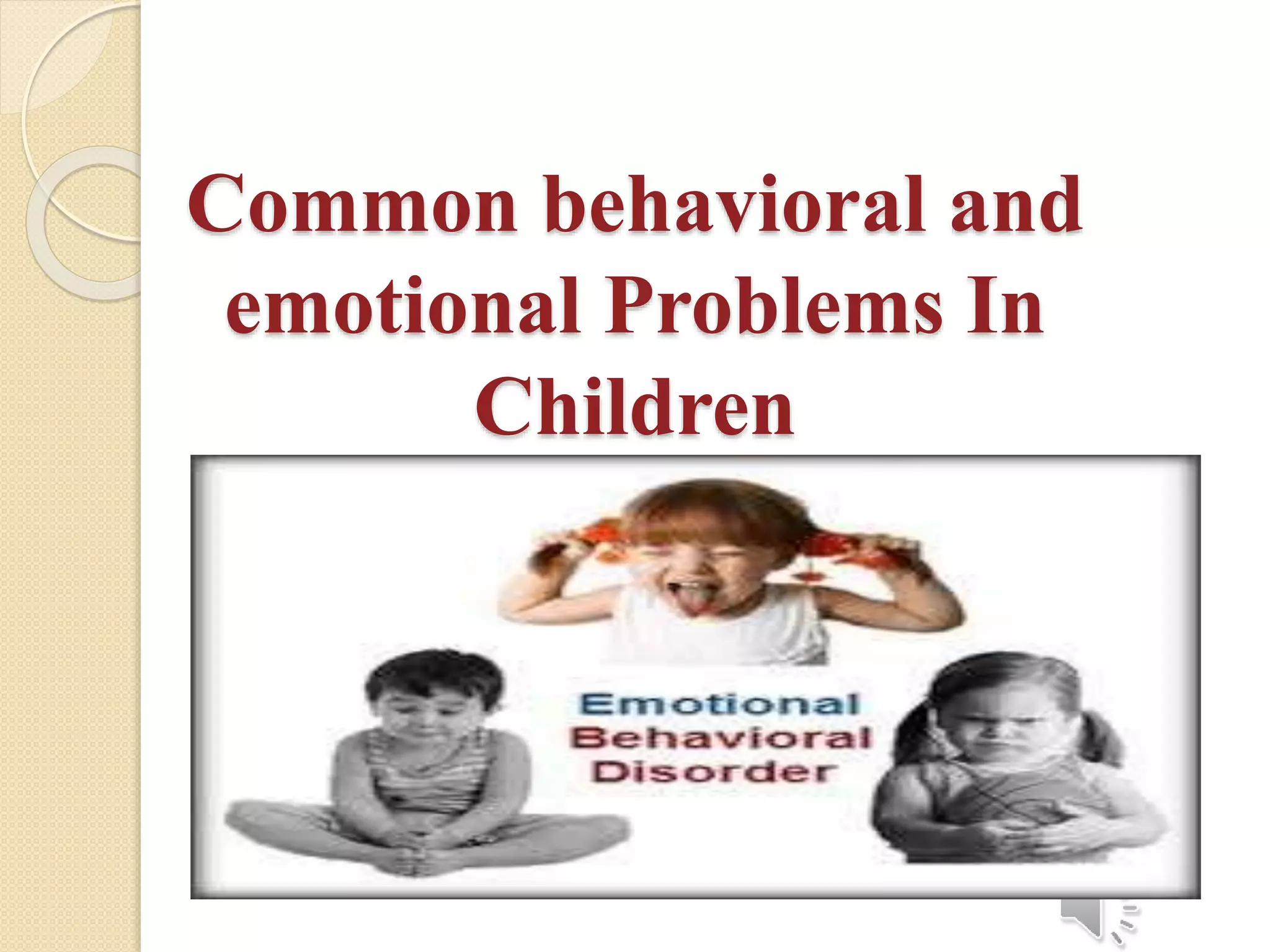
Common behavioral and
emotional Problems In
Children
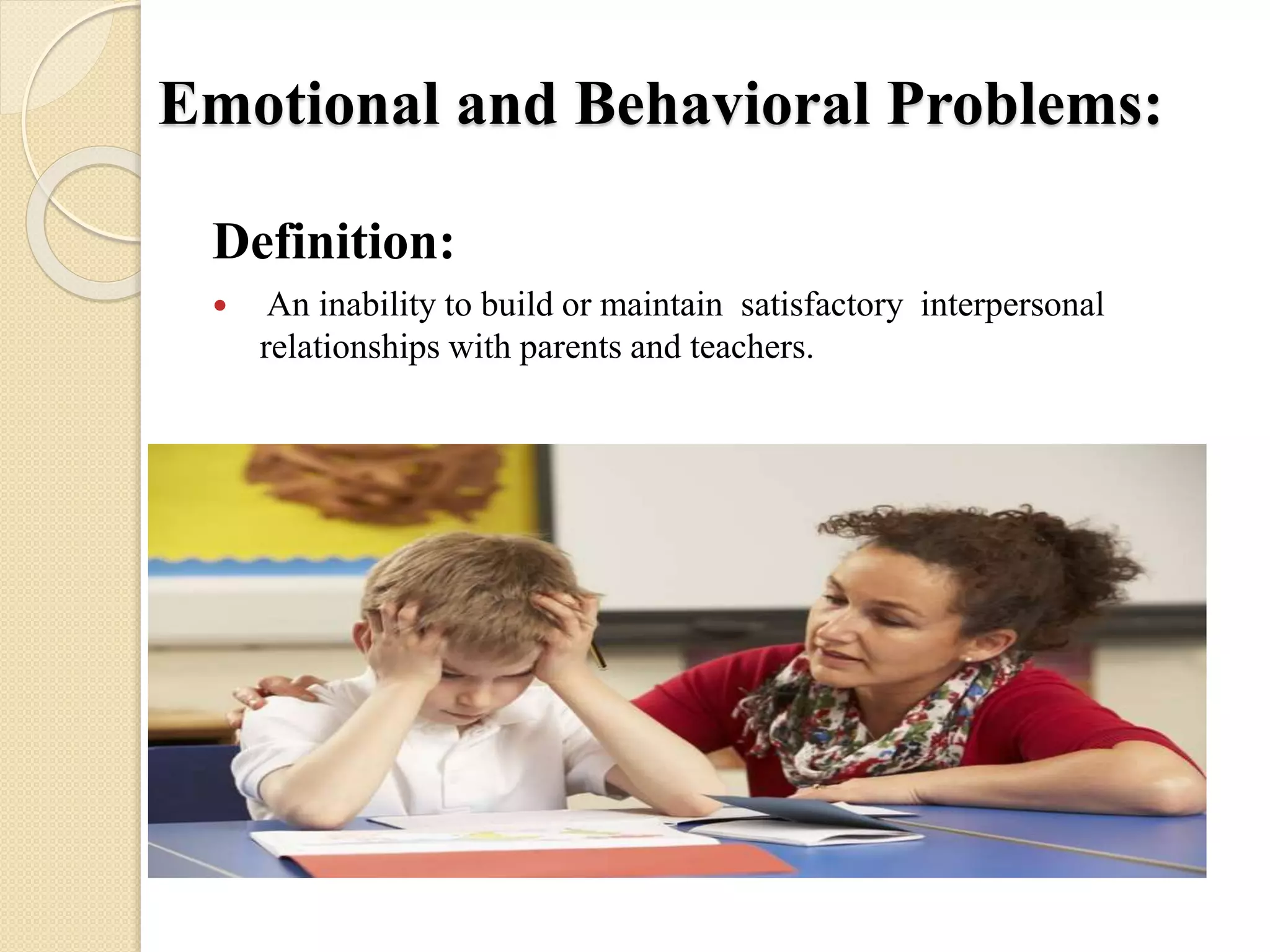
Emotional and Behavioral Problems:
Definition:
 An inability to build or maintain satisfactory interpersonal
relationships with parents and teachers.
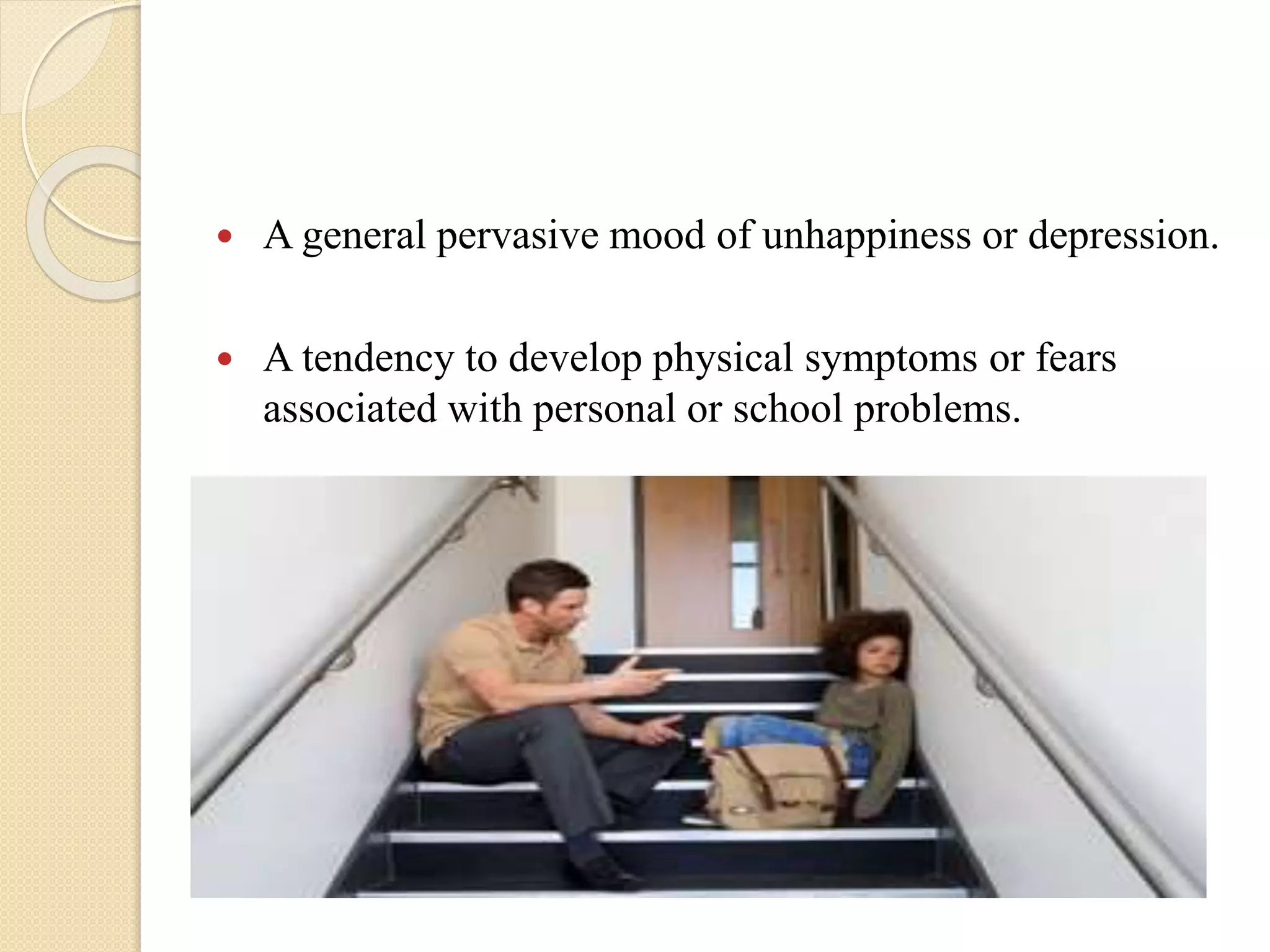
 A general pervasive mood of unhappiness or depression.
 A tendency to develop physical symptoms or fears
associated with personal or school problems.
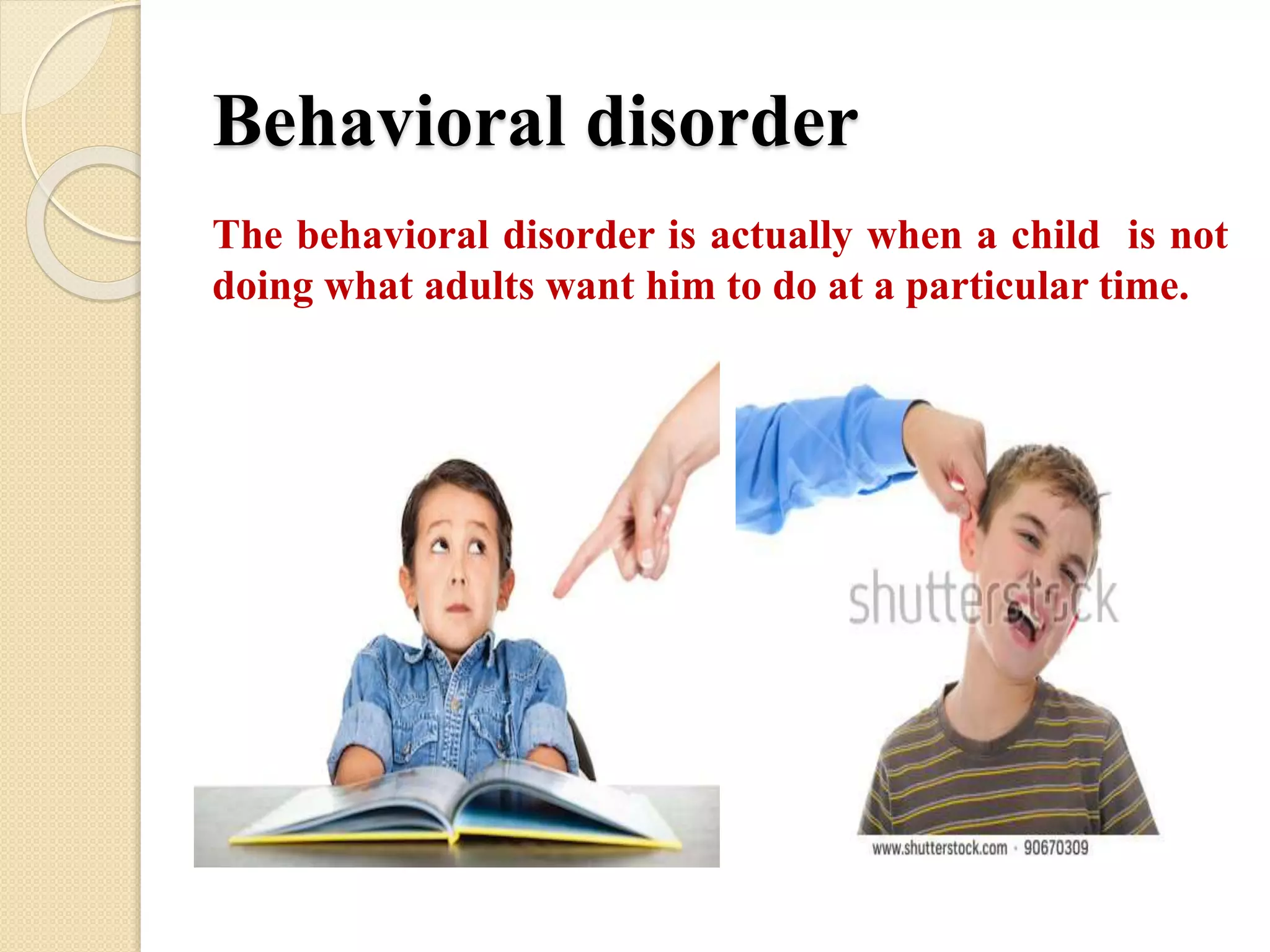
Behavioral disorder
The behavioral disorder is actually when a child is not
doing what adults want him to do at a particular time.
Where as;
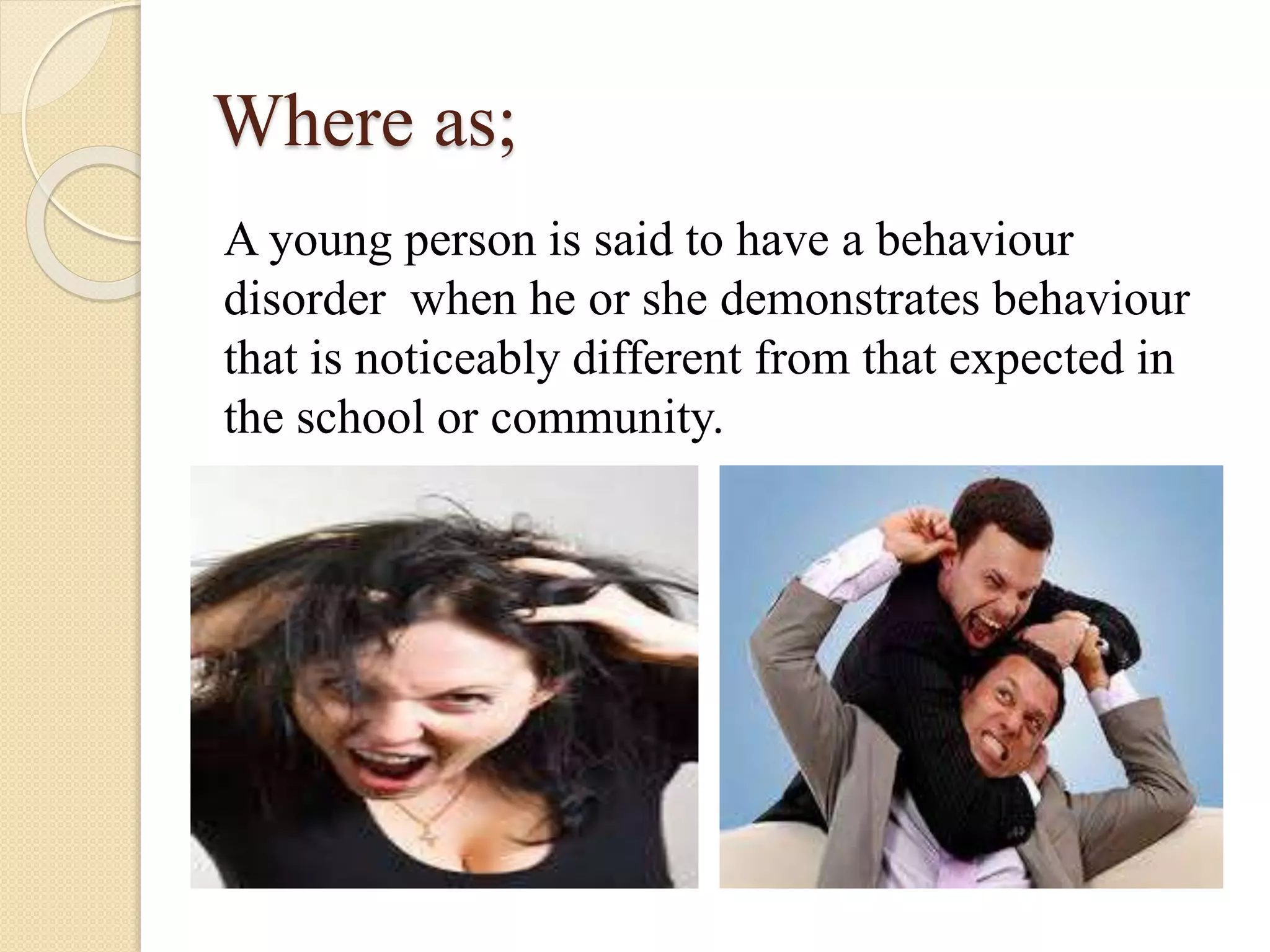
A young person is said to have a behaviour
disorder when he or she demonstrates behaviour
that is noticeably different from that expected in
the school or community.
Causes of emotional and
behavioral problem in children
There are various causes of emotional and
behavioral problems like;
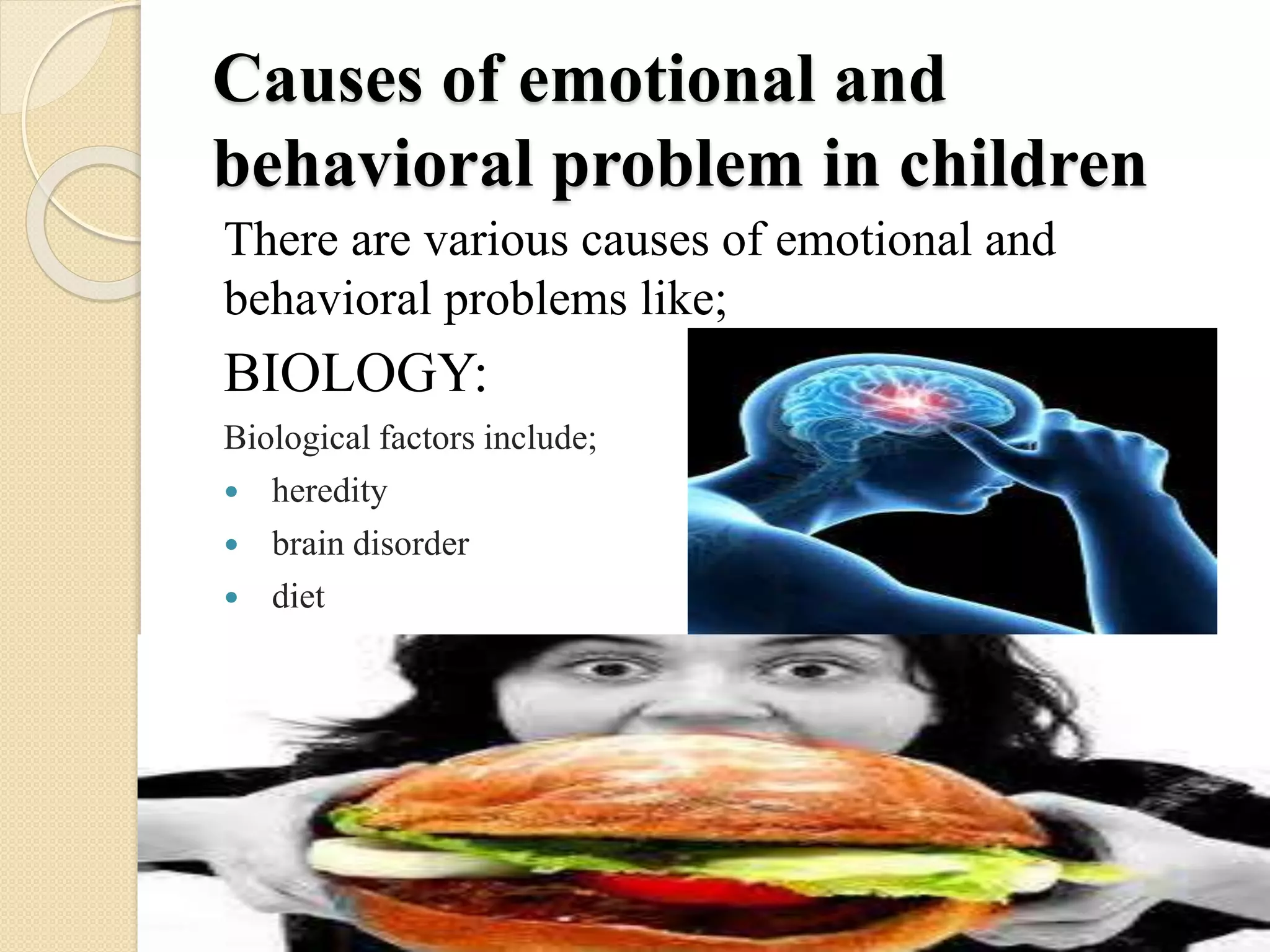
BIOLOGY:
Biological factors include;
 heredity
 brain disorder
 diet
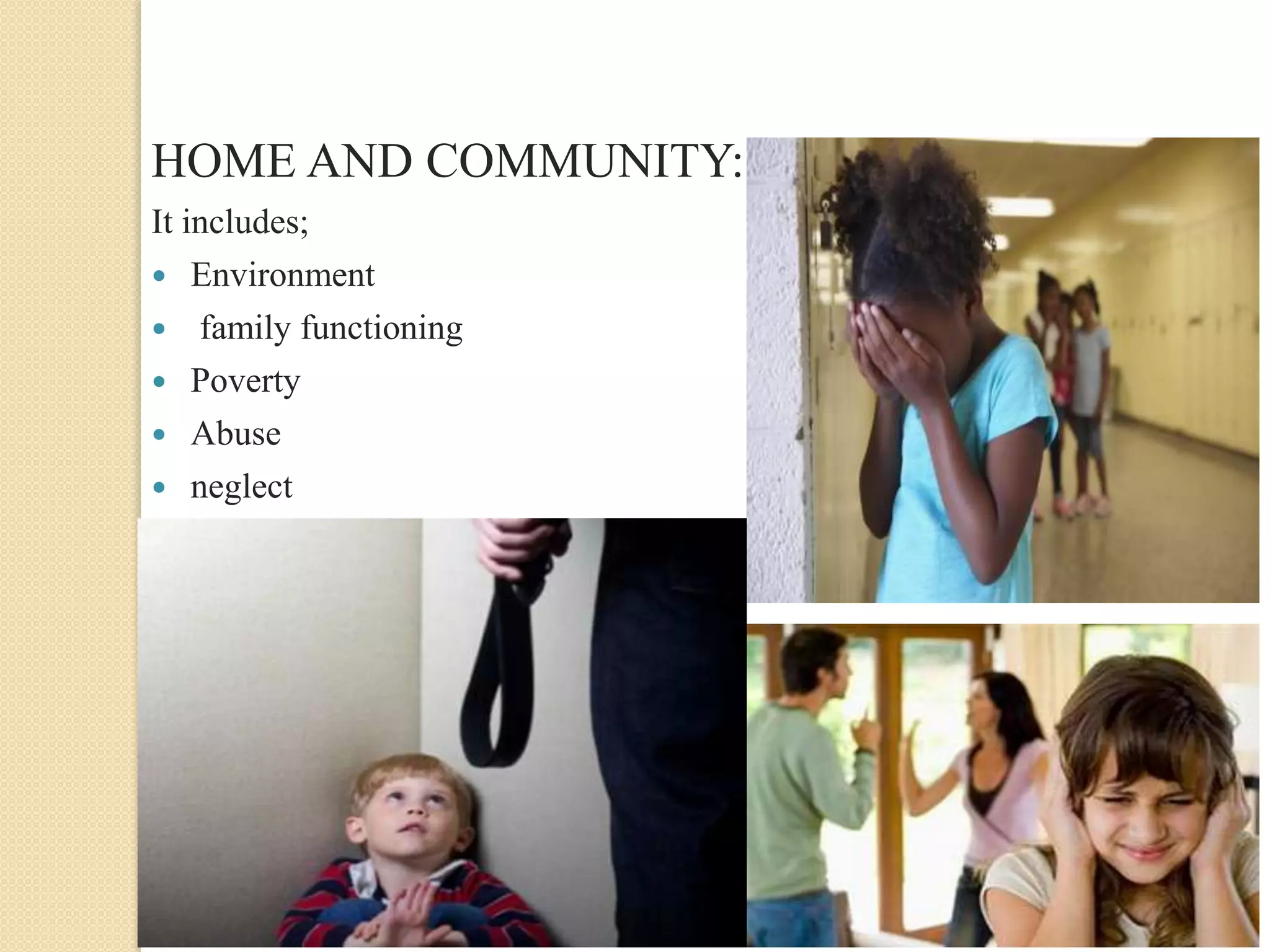
HOME AND COMMUNITY:
It includes;
 Environment
 family functioning
 Poverty
 Abuse
 neglect
Characteristics
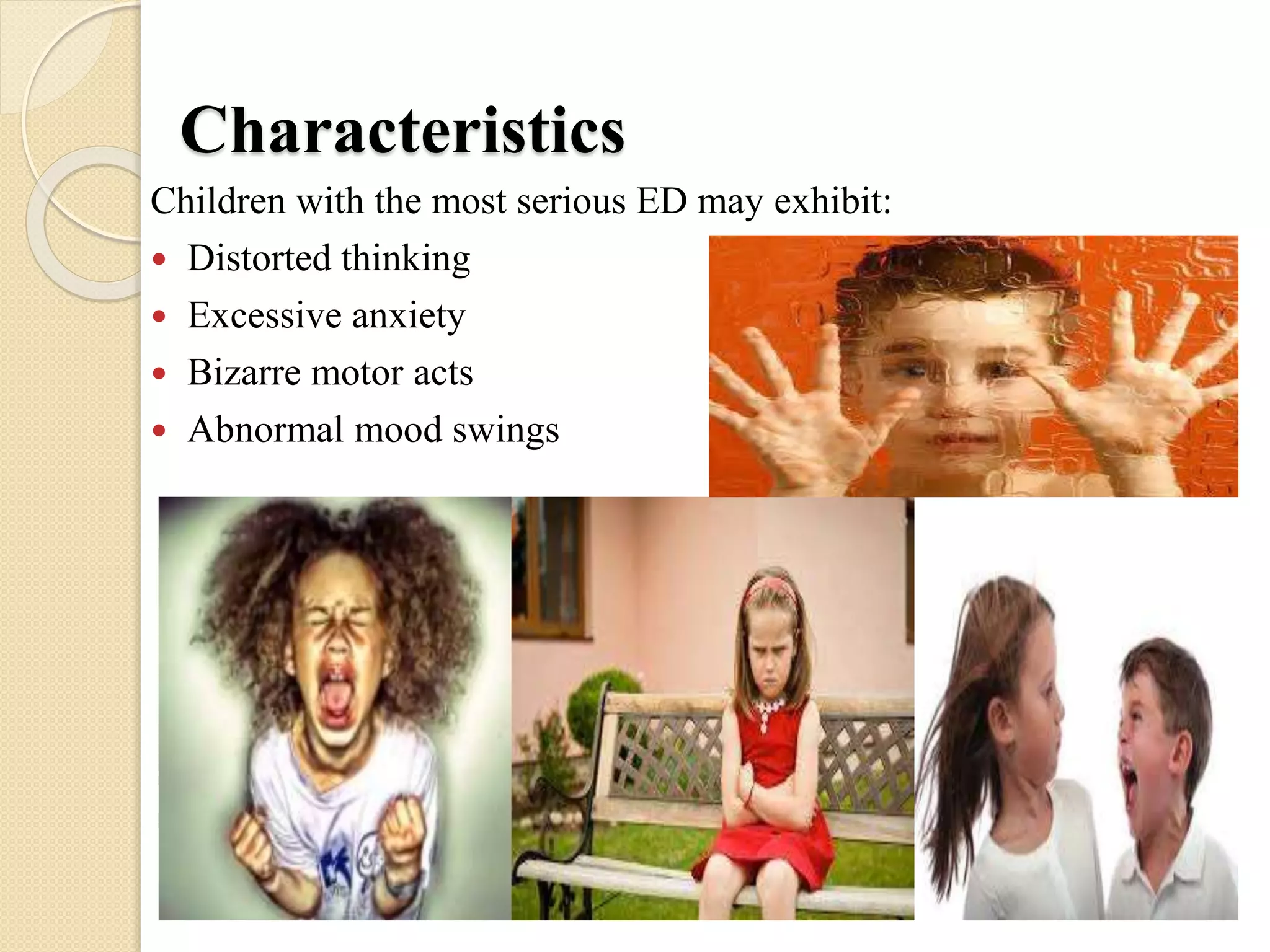
Children with the most serious ED may exhibit:
 Distorted thinking
 Excessive anxiety
 Bizarre motor acts
 Abnormal mood swings
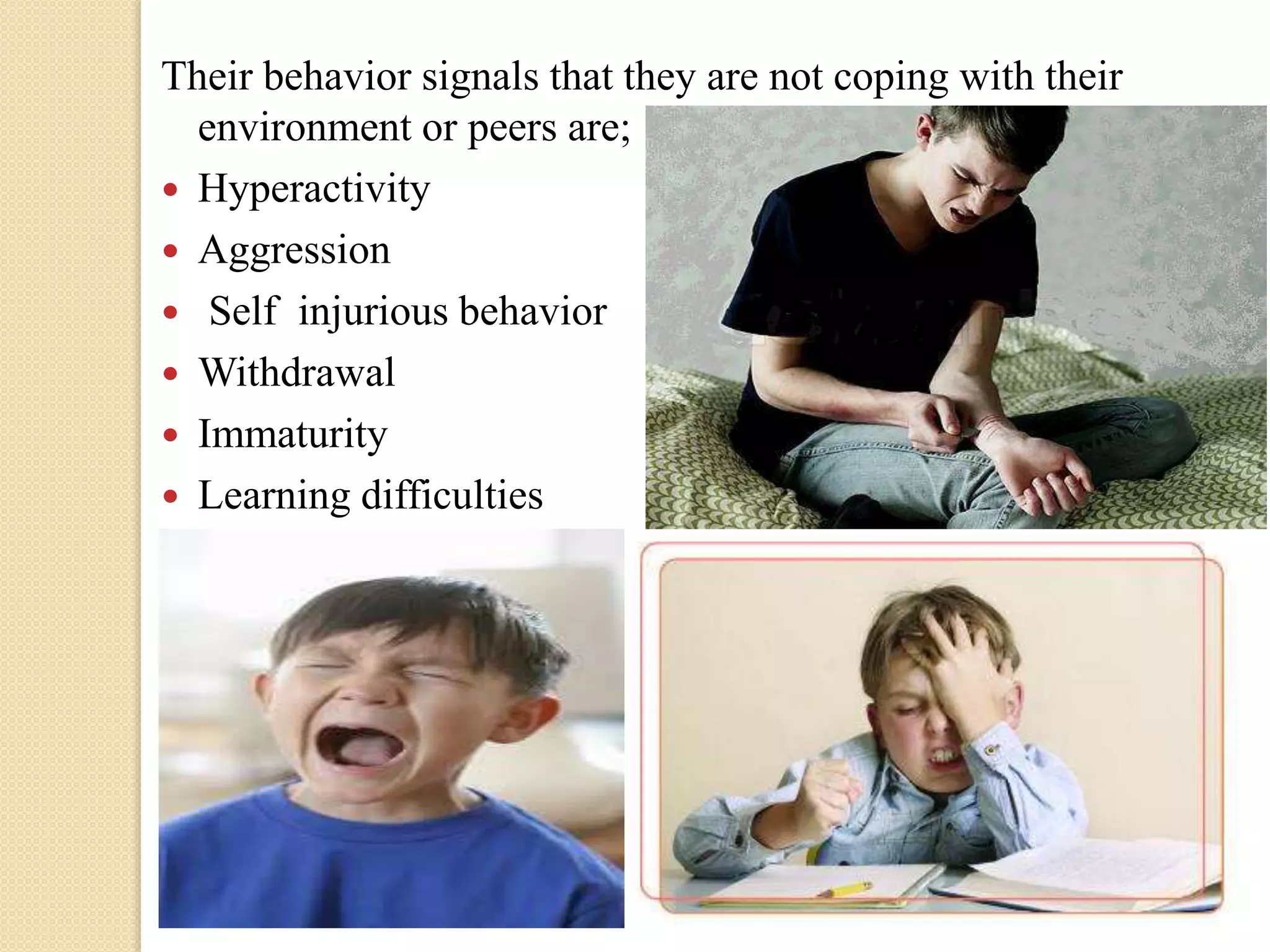
Their behavior signals that they are not coping with their
environment or peers are;
 Hyperactivity
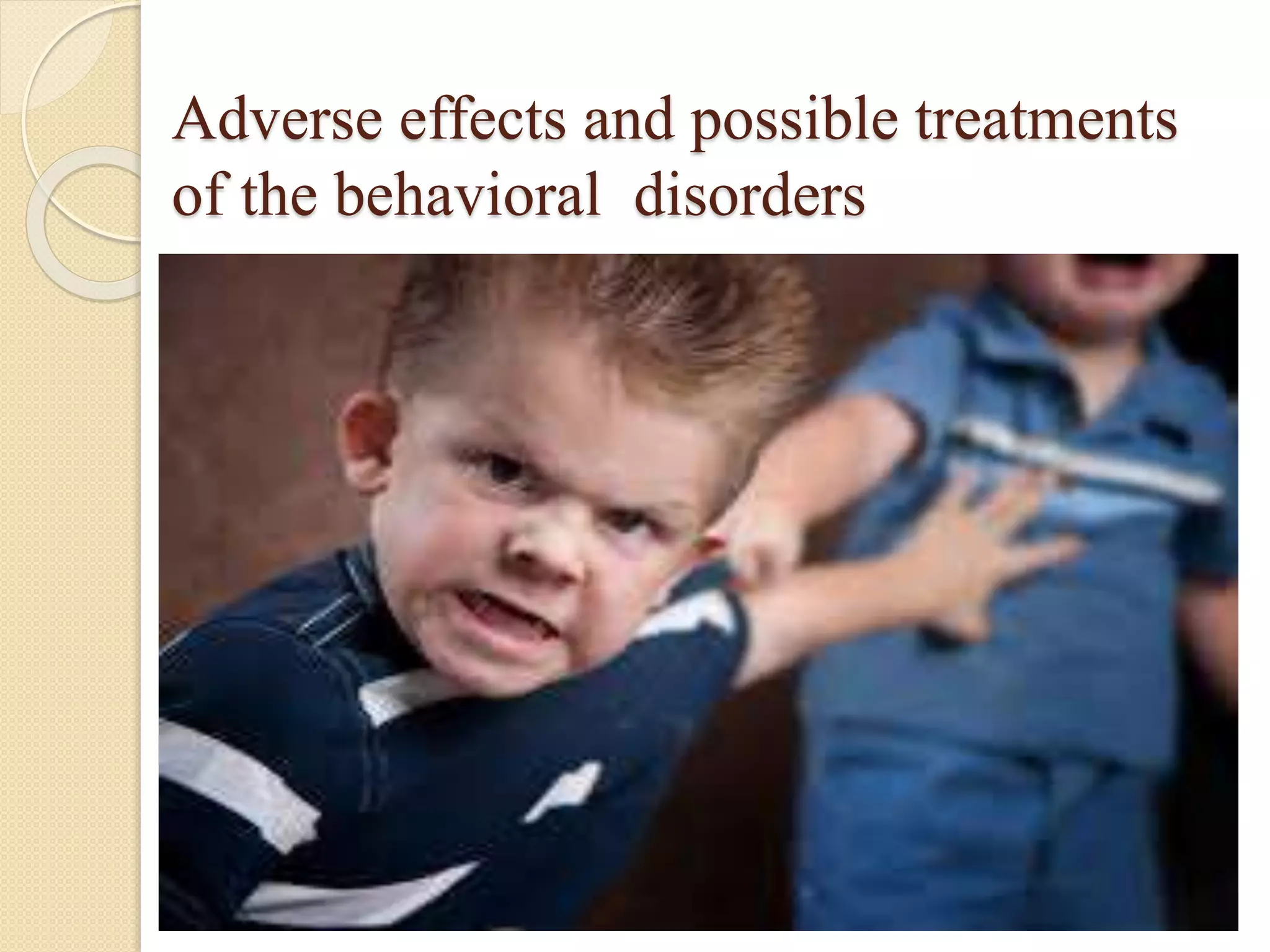
 Aggression
 Self injurious behavior
 Withdrawal
 Immaturity
 Learning difficulties
Adverse effects and possible treatments
of the behavioral disorders
Categories of Behavioral Disorders:-
Main types of behavioral disorders are;
1 ) Habit Disorders
2 ) Eating Disorders
Categories of Behaviour Disorders:-
1 ) Habit Disorders
(Tension releasing disorders)
• Finger (thumb) sucking and Nail biting
• Teeth grinding (Bruxism)
• Head banging and Head jerking
• Tics
a ) grimacing
b ) grunting
c ) scratching nose
d ) copropraxia
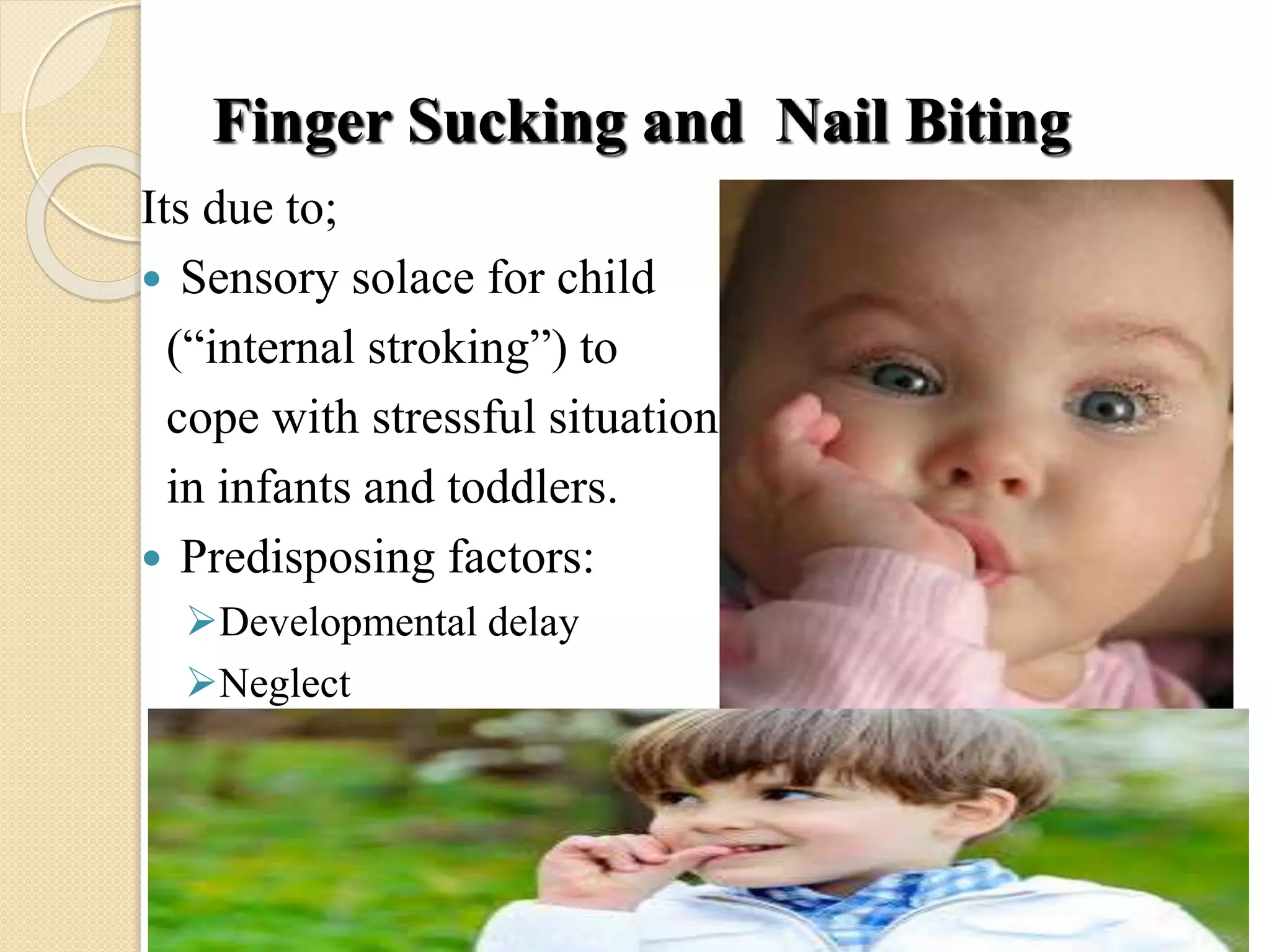
Finger Sucking and Nail Biting
Its due to;
 Sensory solace for child
(“internal stroking”) to
cope with stressful situation
in infants and toddlers.
 Predisposing factors:
Developmental delay
Neglect
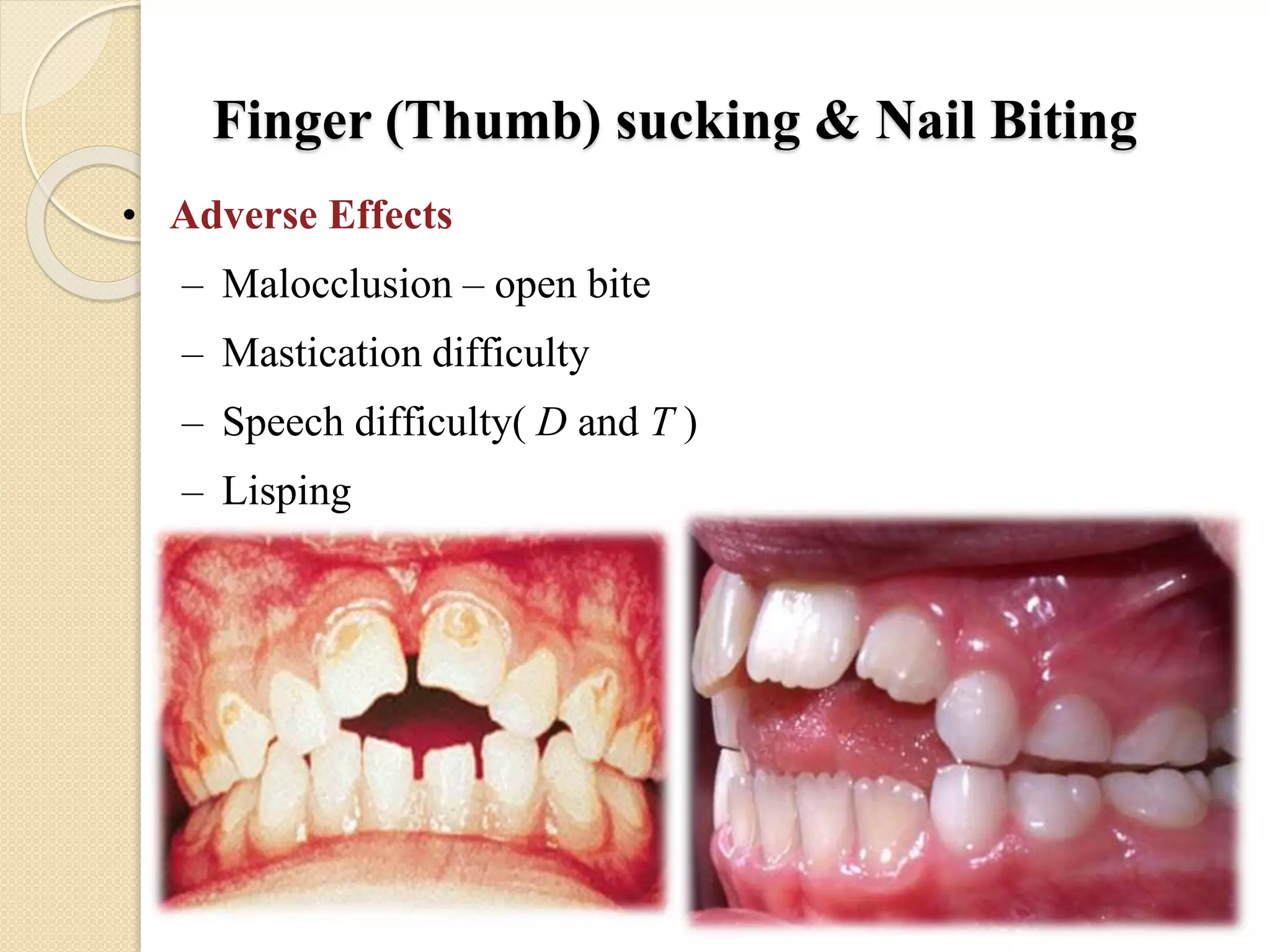
Finger (Thumb) sucking & Nail Biting
• Adverse Effects
– Malocclusion – open bite
– Mastication difficulty
– Speech difficulty( D and T )
– Lisping
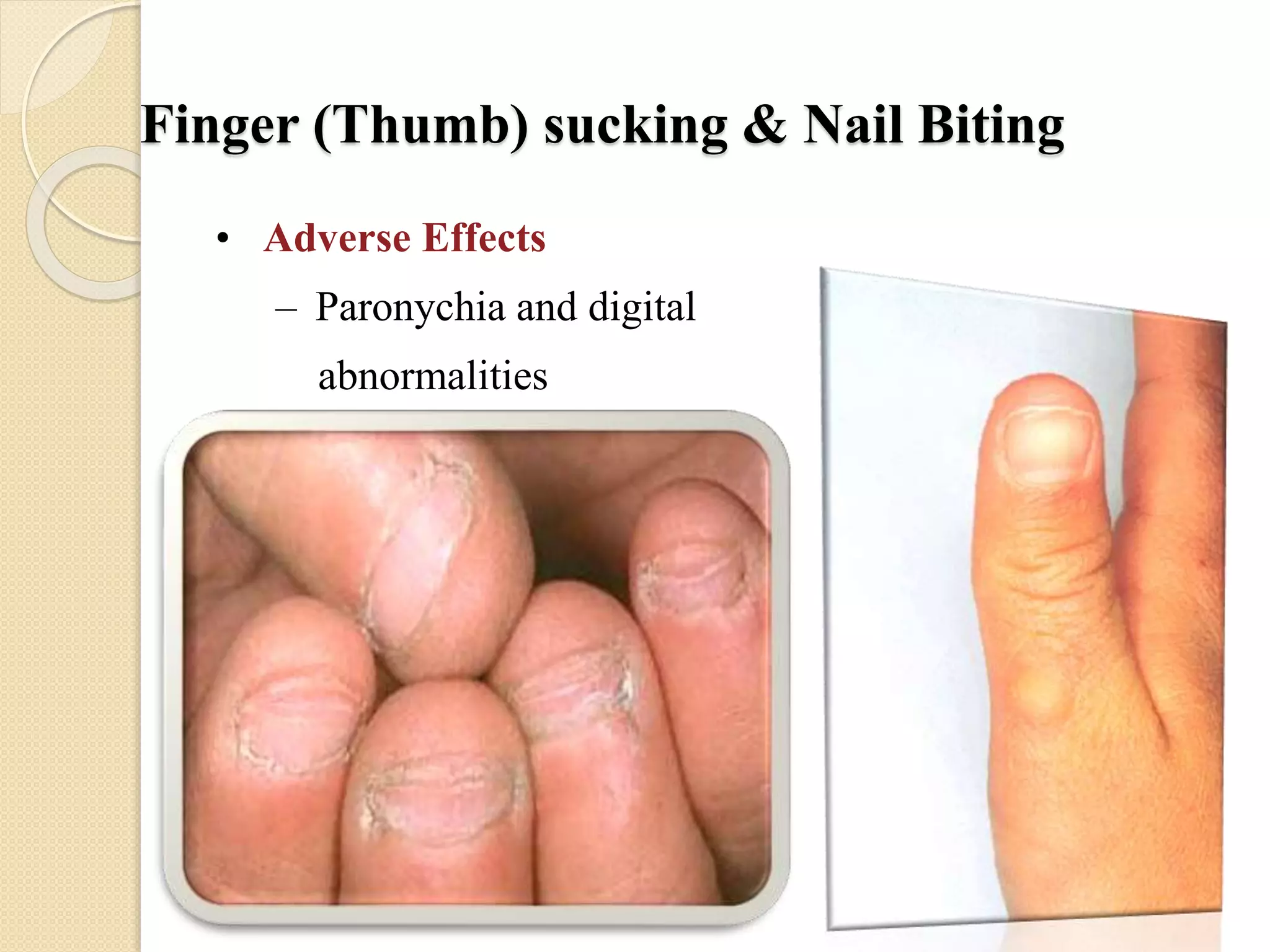
Finger (Thumb) sucking & Nail Biting
• Adverse Effects
– Paronychia and digital
abnormalities
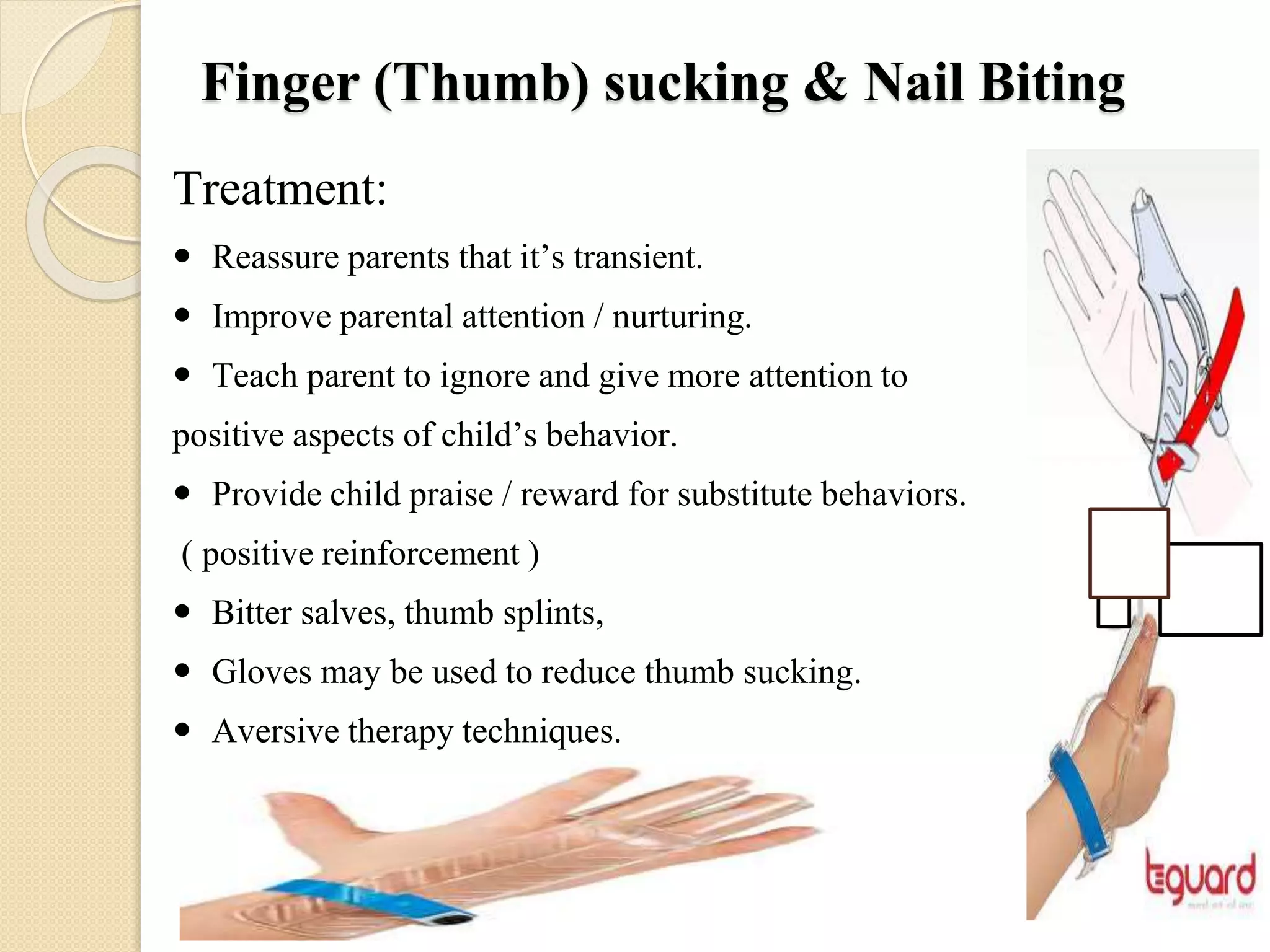
Finger (Thumb) sucking & Nail Biting
Treatment:
 Reassure parents that it’s transient.
 Improve parental attention / nurturing.
 Teach parent to ignore and give more attention to
positive aspects of child’s behavior.
 Provide child praise / reward for substitute behaviors.
( positive reinforcement )
 Bitter salves, thumb splints,
 Gloves may be used to reduce thumb sucking.
 Aversive therapy techniques.
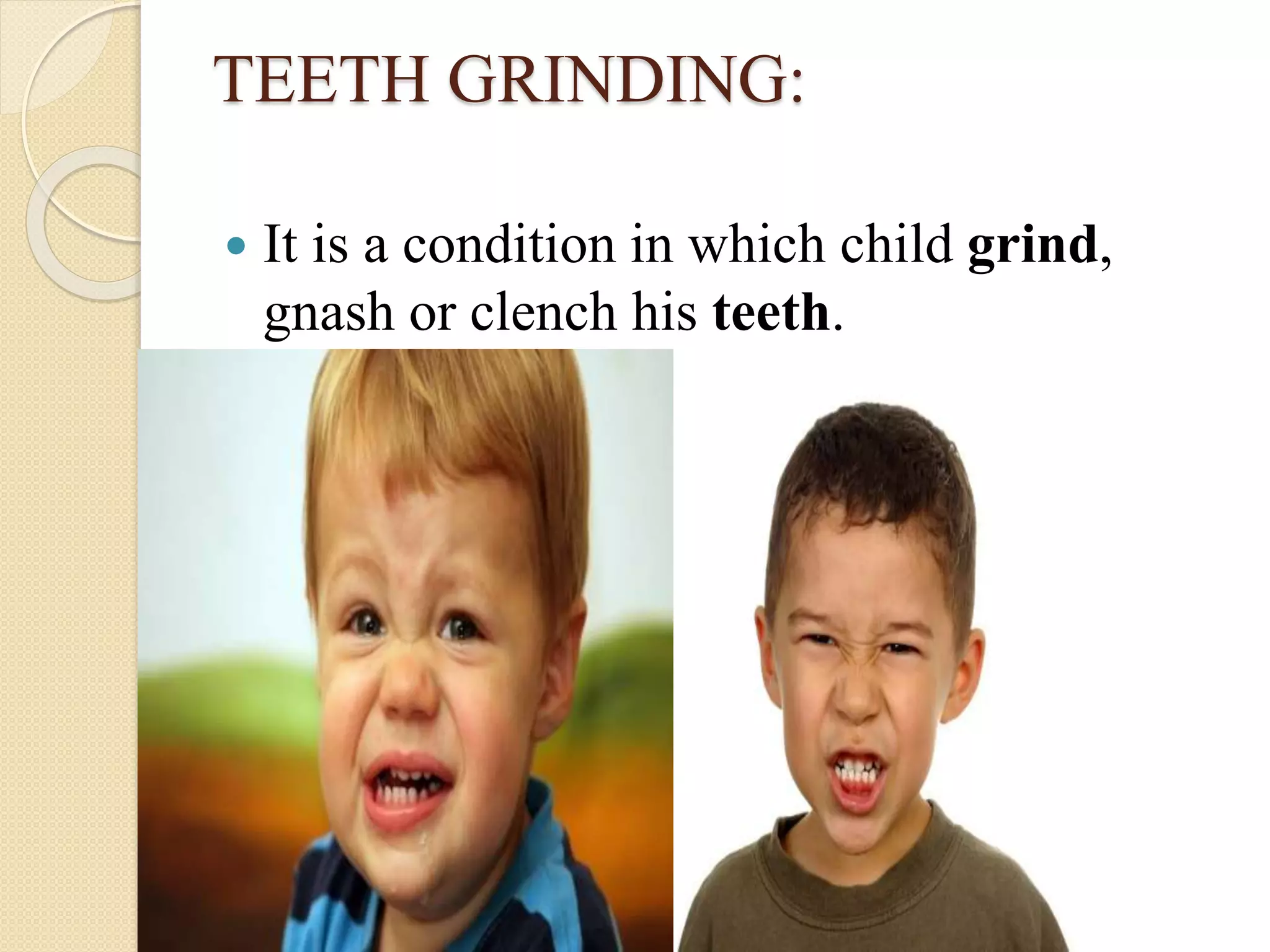
TEETH GRINDING:
 It is a condition in which child grind,
gnash or clench his teeth.
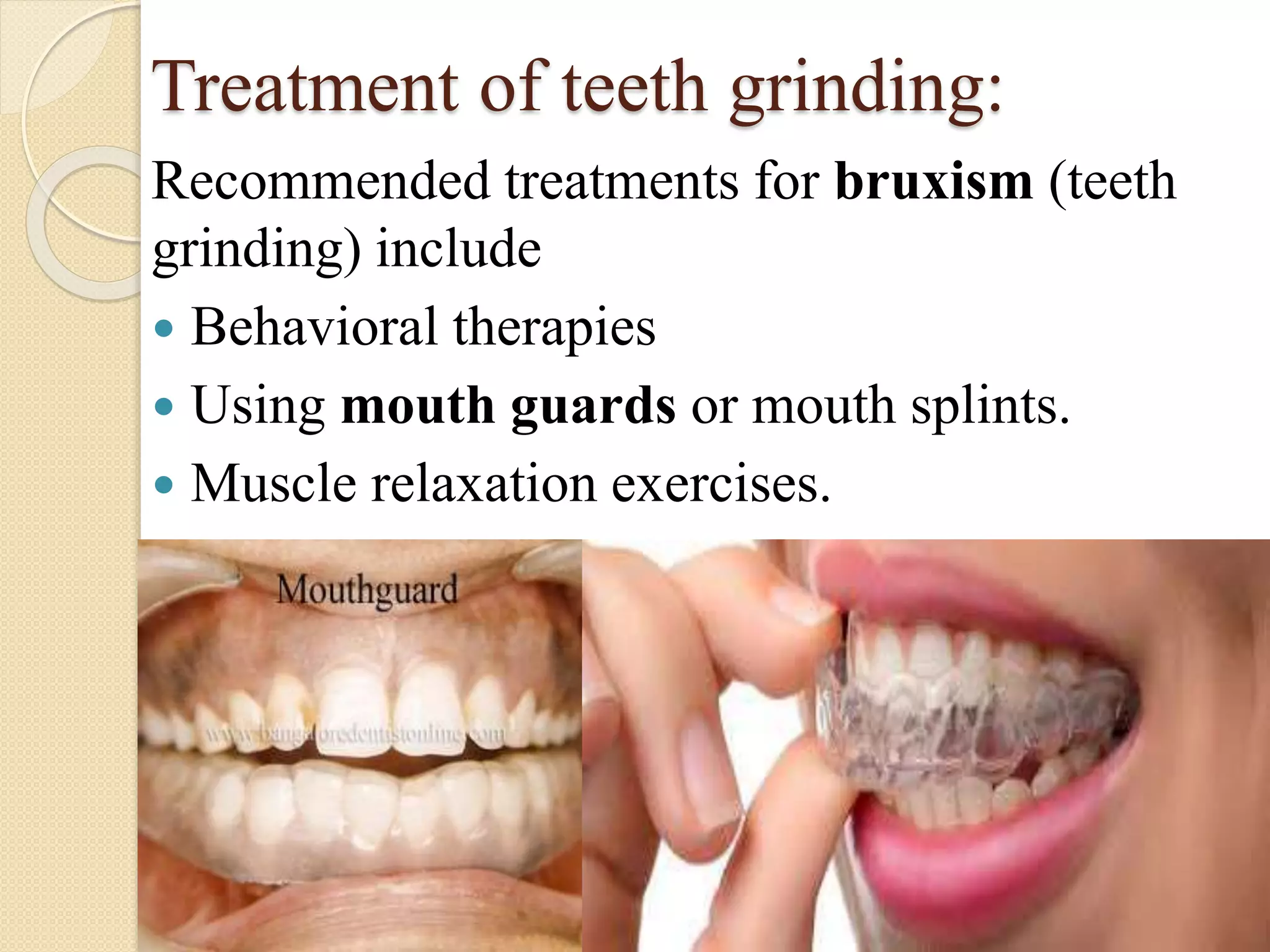
Treatment of teeth grinding:
Recommended treatments for bruxism (teeth
grinding) include
 Behavioral therapies
 Using mouth guards or mouth splints.
 Muscle relaxation exercises.
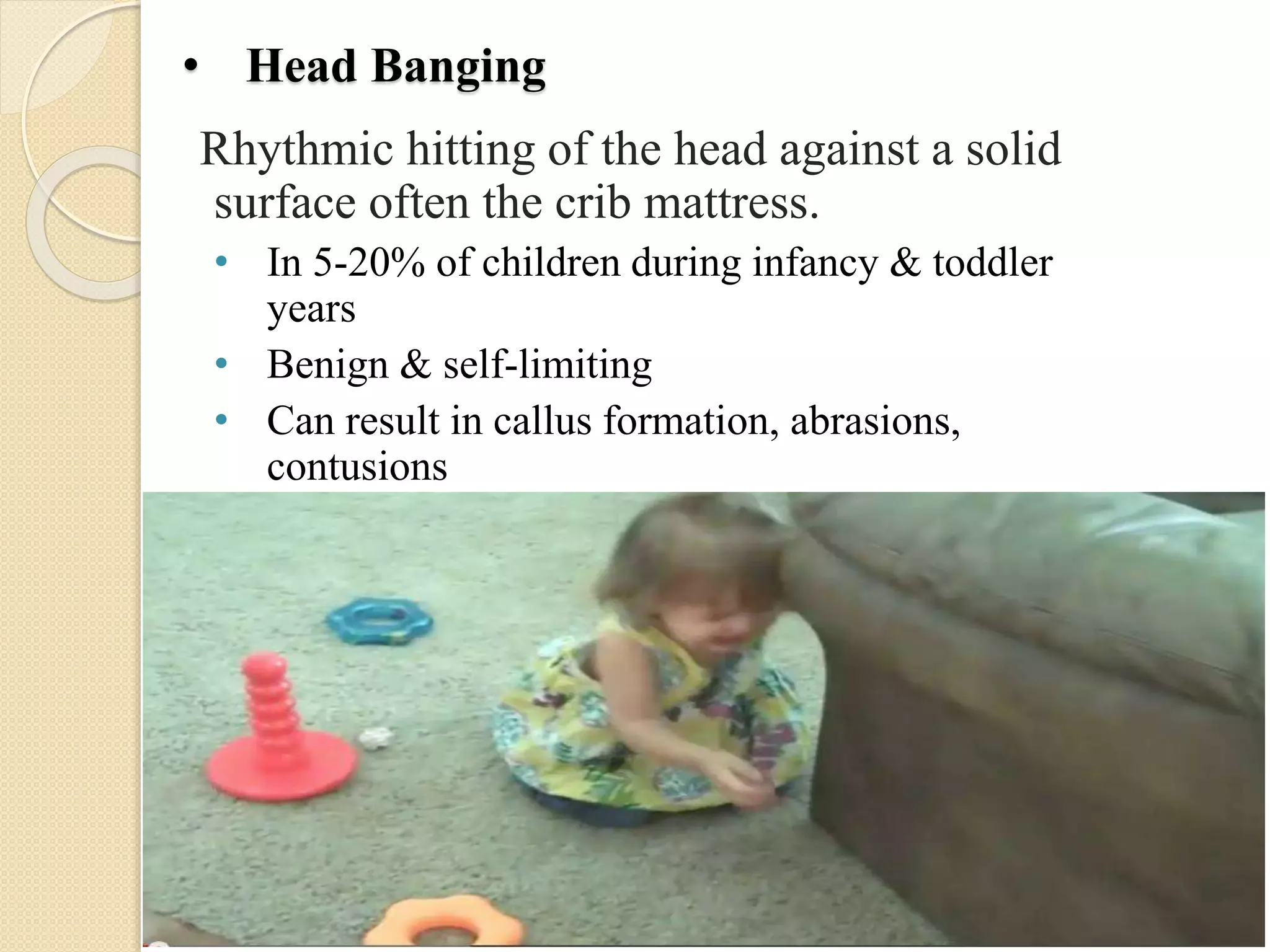
• Head Banging
Rhythmic hitting of the head against a solid
surface often the crib mattress.
• In 5-20% of children during infancy & toddler
years
• Benign & self-limiting
• Can result in callus formation, abrasions,
contusions
Head jerking
Head banging
Treatment:
◦ Assurance – significant
injury unlikely
◦ Parents should ignore
as concern and punishment
can reinforce it.
◦ Padding
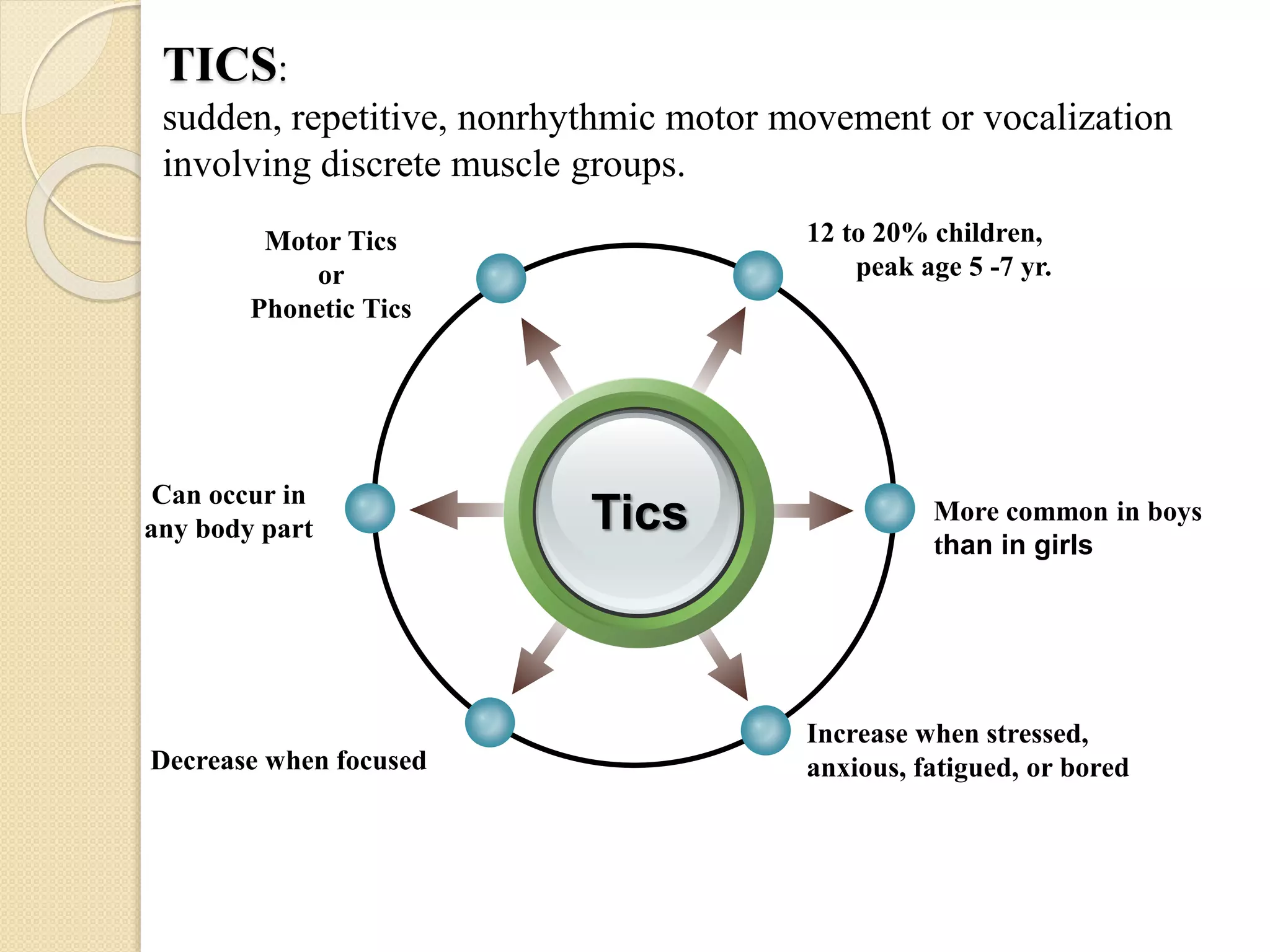
TICS:
sudden, repetitive, nonrhythmic motor movement or vocalization
involving discrete muscle groups.
Tics
12 to 20% children,
peak age 5 -7 yr.
Motor Tics
or
Phonetic Tics
More common in boys
than in girls
Increase when stressed,
anxious, fatigued, or bored
Can occur in
any body part
Decrease when focused
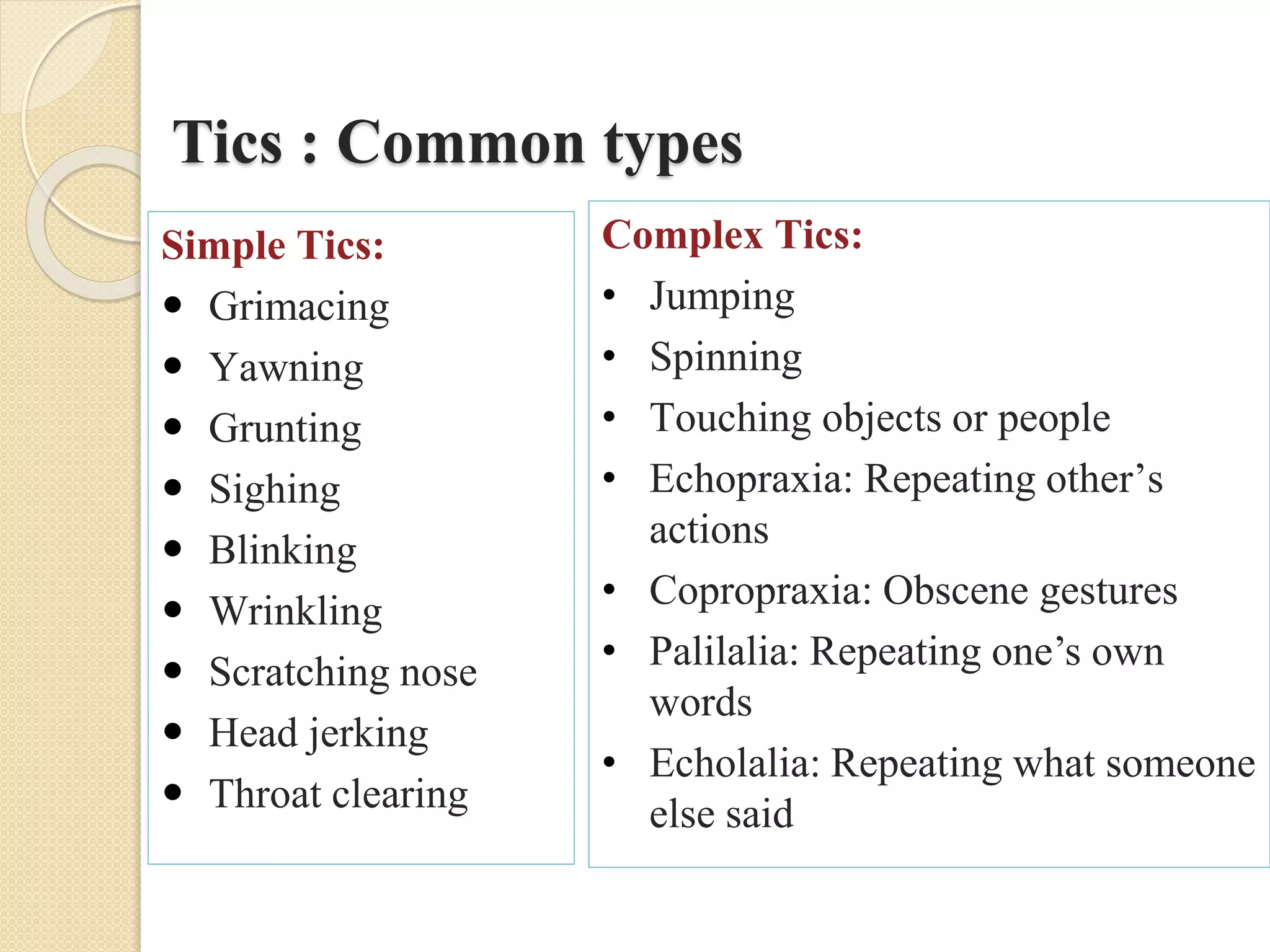
Tics : Common types
Simple Tics:
 Grimacing
 Yawning
 Grunting
 Sighing
 Blinking
 Wrinkling
 Scratching nose
 Head jerking
 Throat clearing
Complex Tics:
• Jumping
• Spinning
• Touching objects or people
• Echopraxia: Repeating other’s
actions
• Copropraxia: Obscene gestures
• Palilalia: Repeating one’s own
words
• Echolalia: Repeating what someone
else said
Few Examples Of Tics Orders
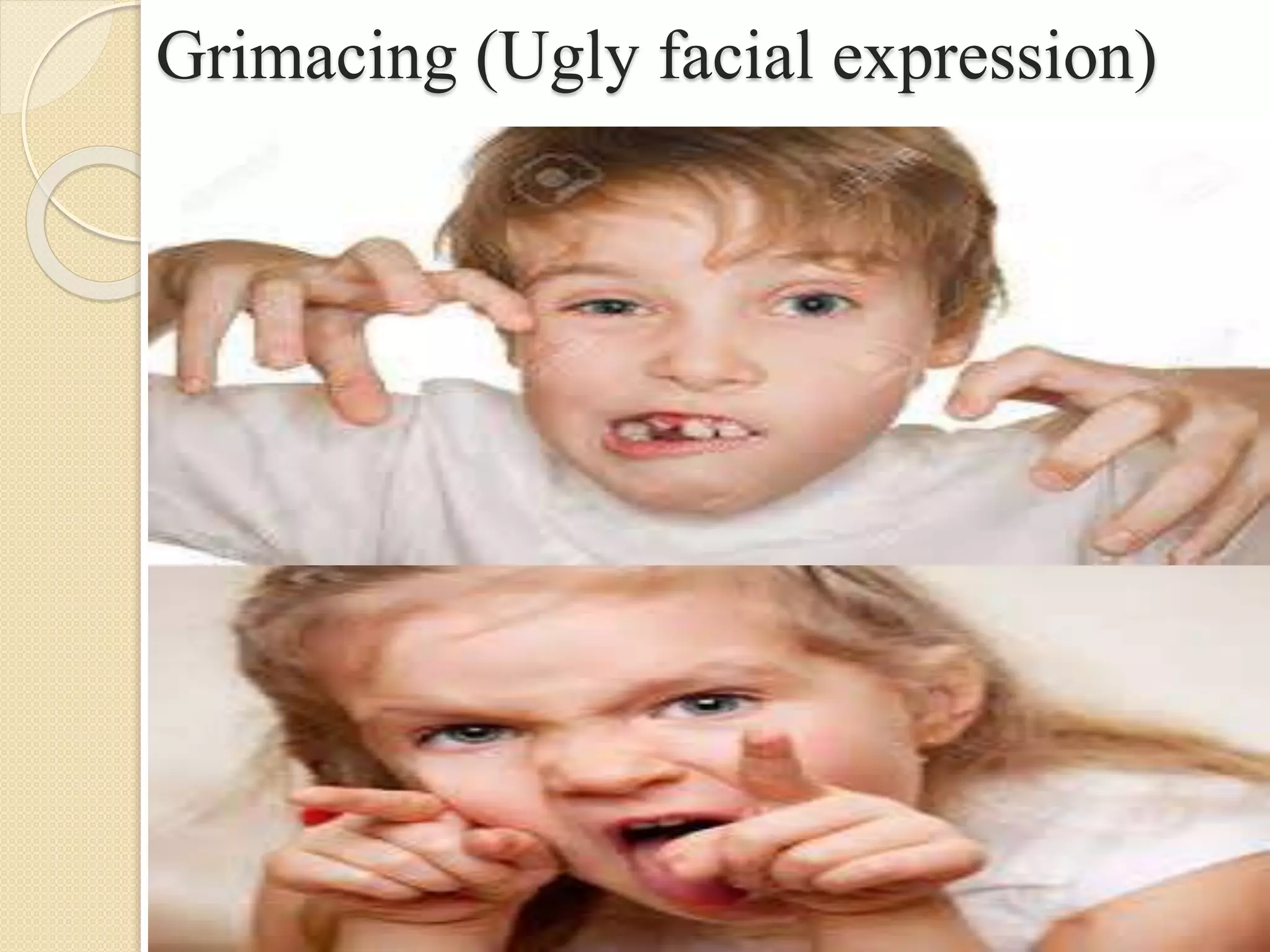
Grimacing (Ugly facial expression)
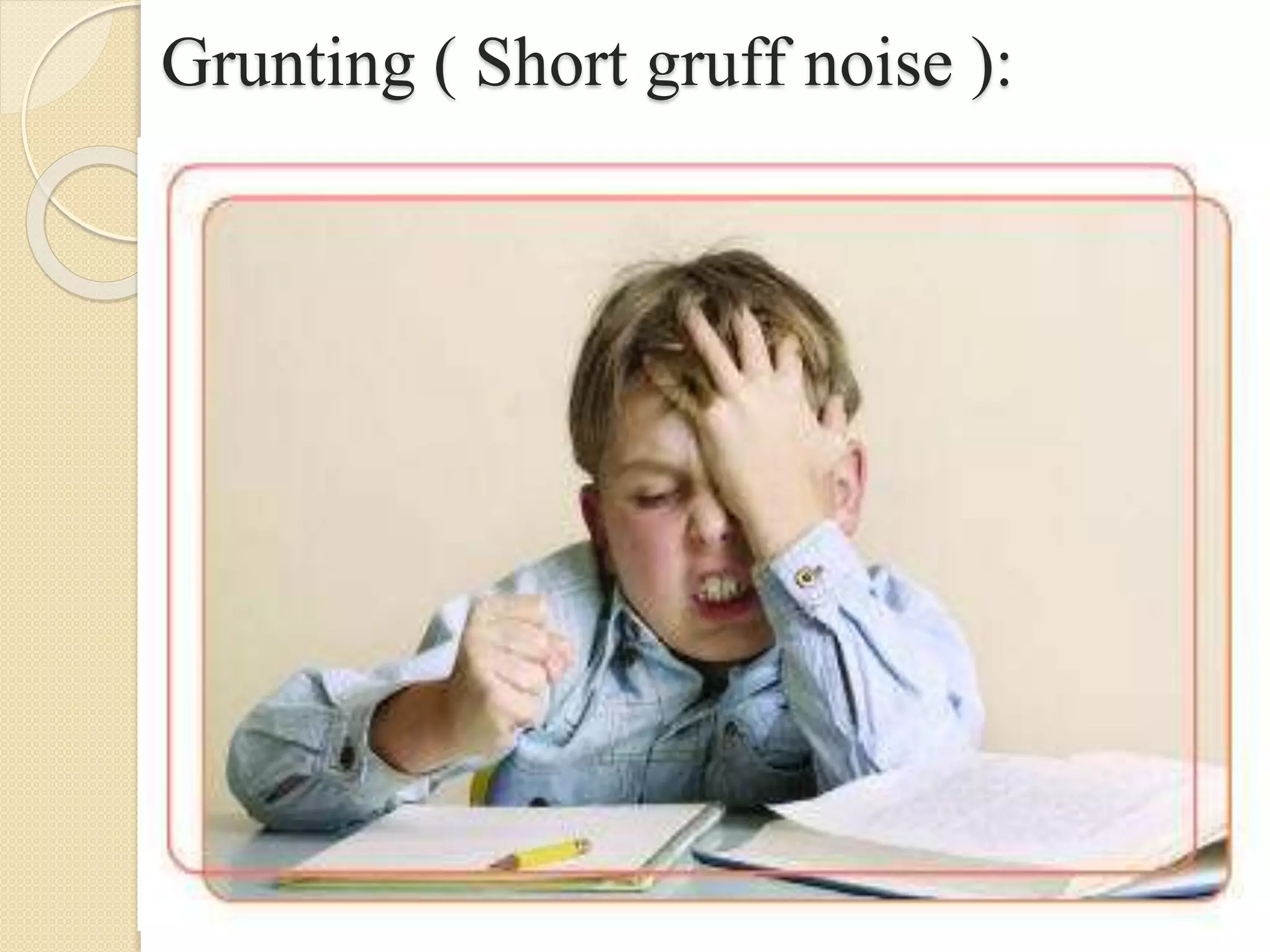
Grunting ( Short gruff noise ):
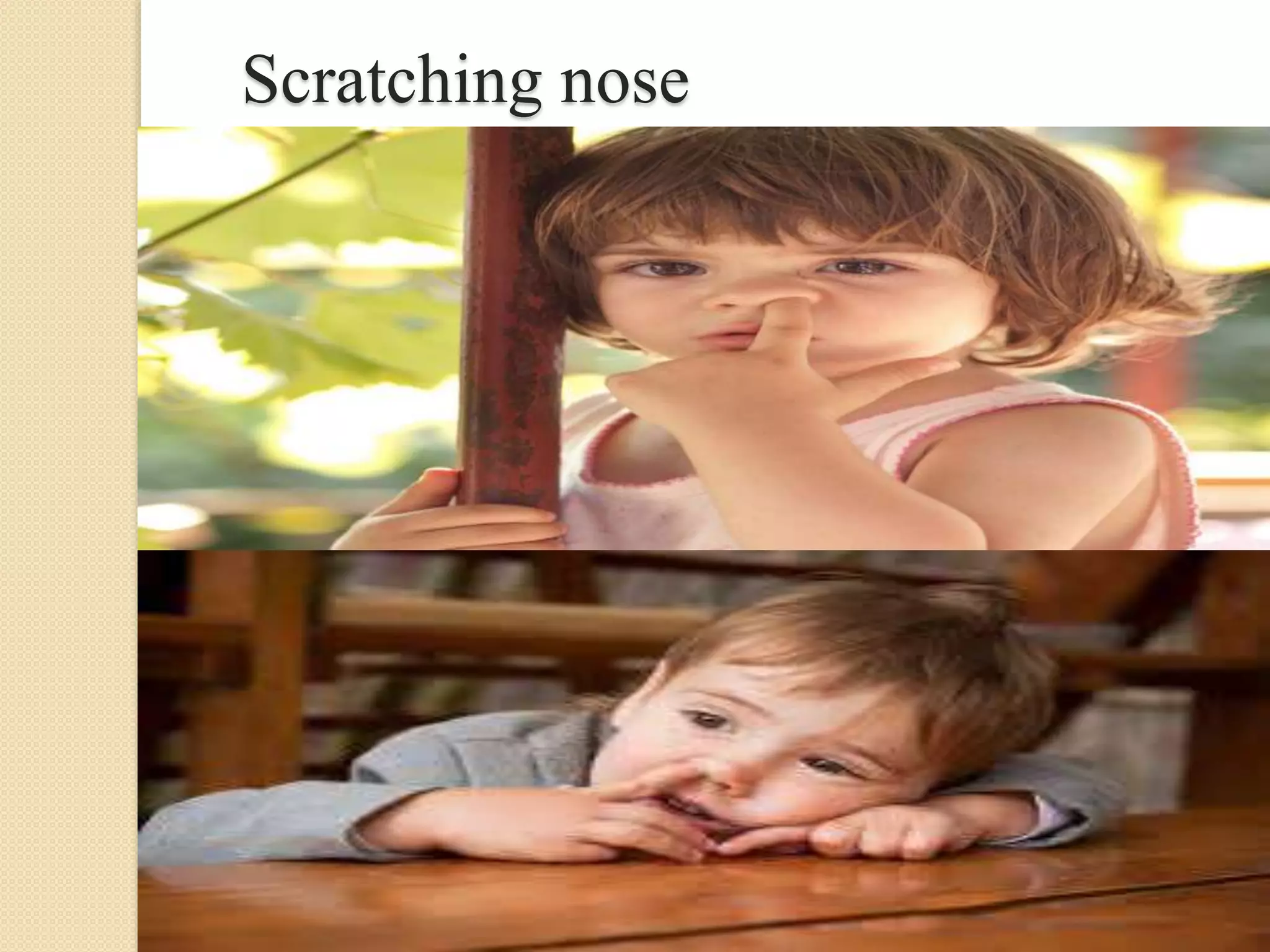
Scratching nose
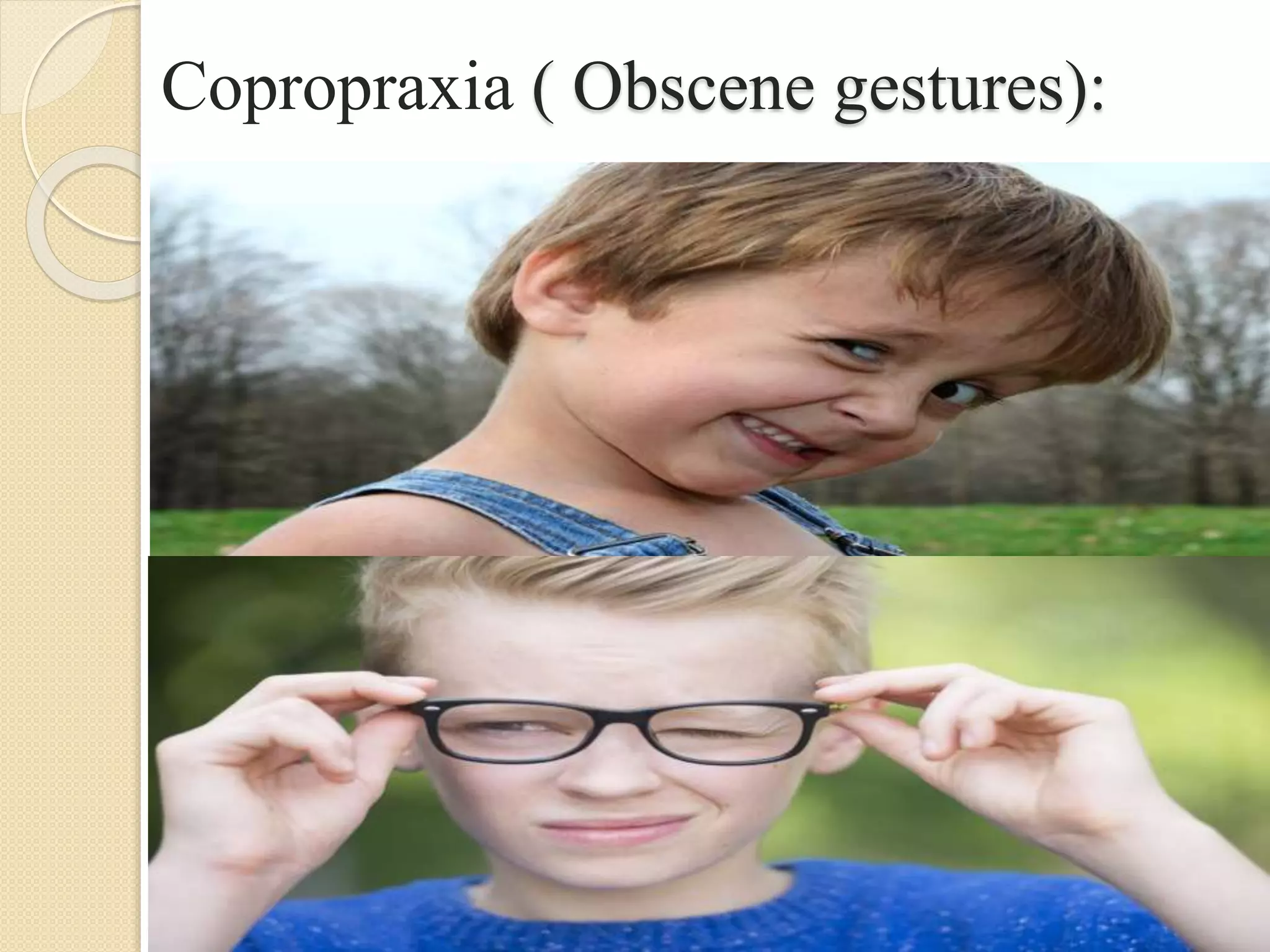
Copropraxia ( Obscene gestures):
How To Diagnose Tics Disorders
• The tics should occur many times a day
nearly every day or throughout a period
of more than 1 year;
• During this period there should never be
a tic-free period of more than 3
consecutive months;
• The onset should be before age 18 years;
(
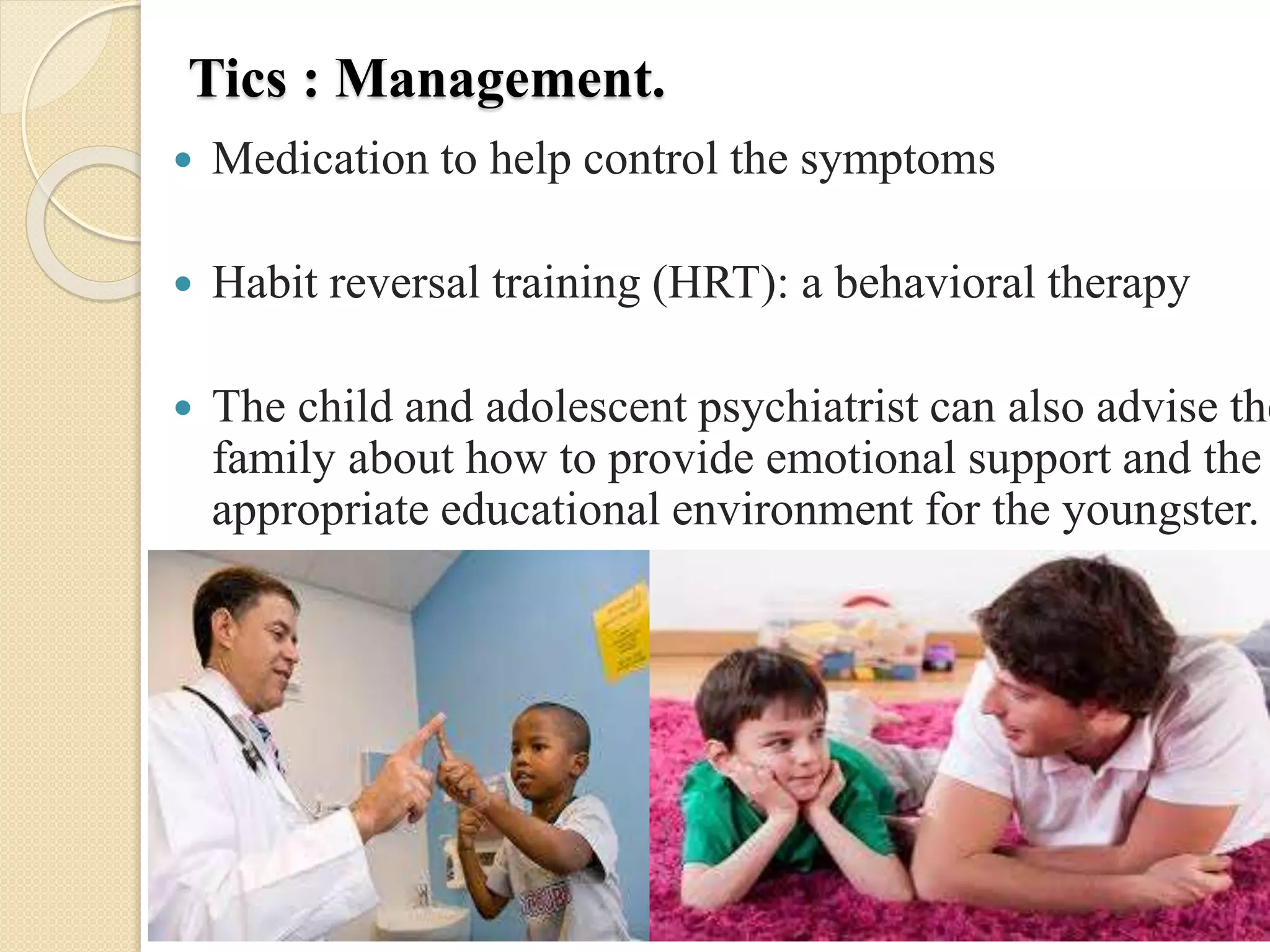
Tics : Management.
 Medication to help control the symptoms
 Habit reversal training (HRT): a behavioral therapy
 The child and adolescent psychiatrist can also advise the
family about how to provide emotional support and the
appropriate educational environment for the youngster.
Eating Disorders
• Pica
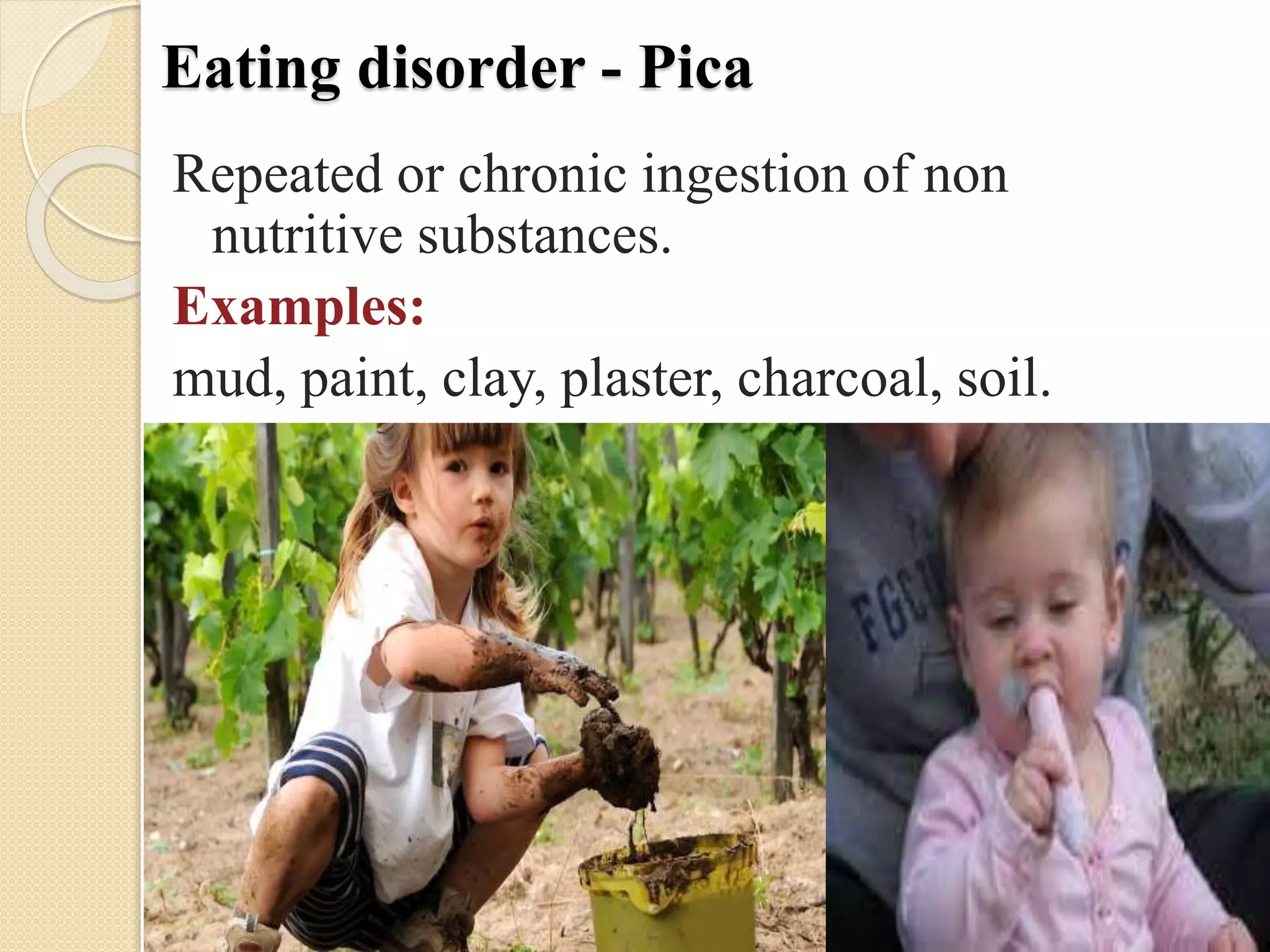
Eating disorder - Pica
Repeated or chronic ingestion of non
nutritive substances.
Examples:
mud, paint, clay, plaster, charcoal, soil.
Pica
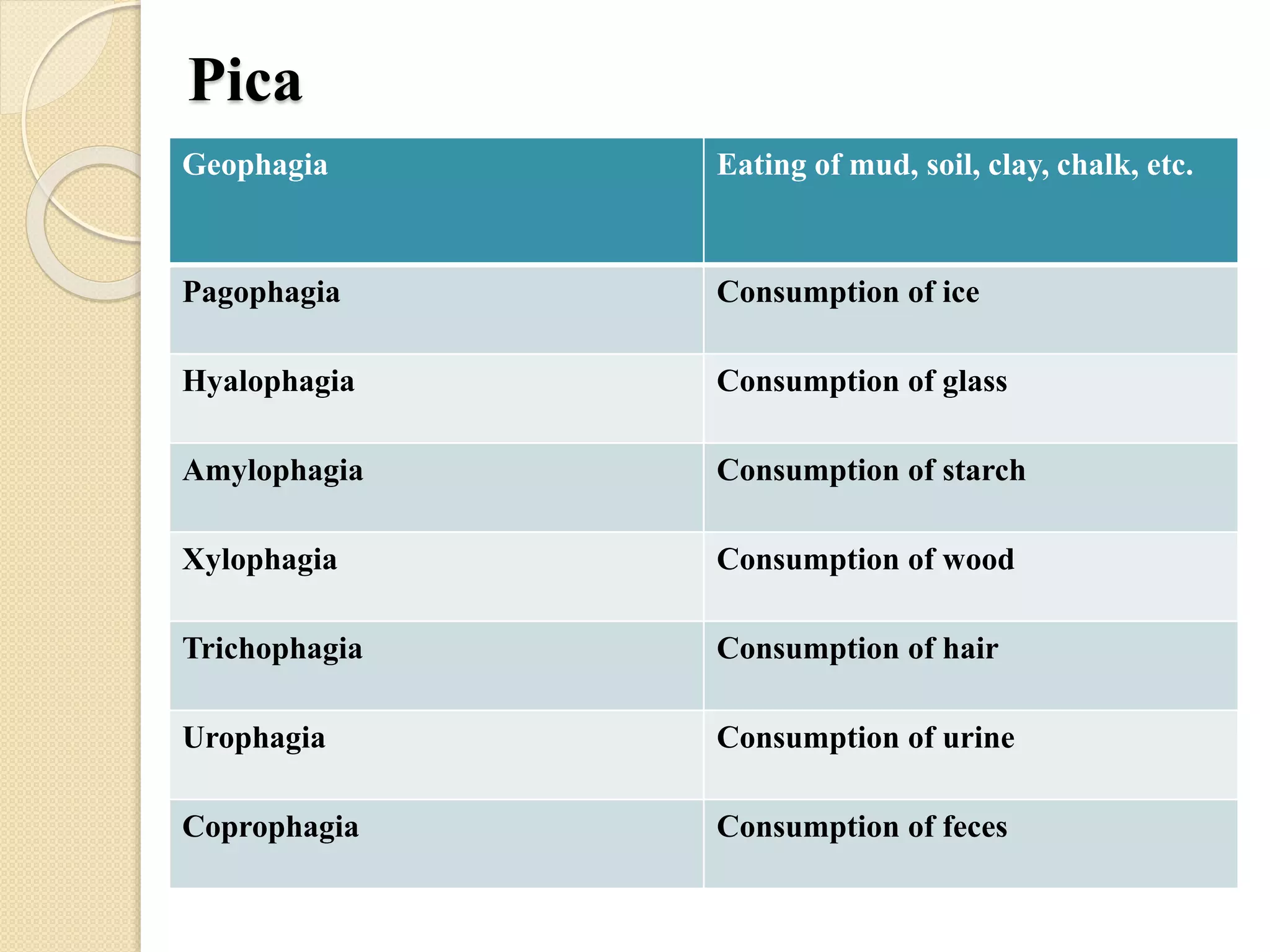
Geophagia Eating of mud, soil, clay, chalk, etc.
Pagophagia Consumption of ice
Hyalophagia Consumption of glass
Amylophagia Consumption of starch
Xylophagia Consumption of wood
Trichophagia Consumption of hair
Urophagia Consumption of urine
Coprophagia Consumption of feces
Pica
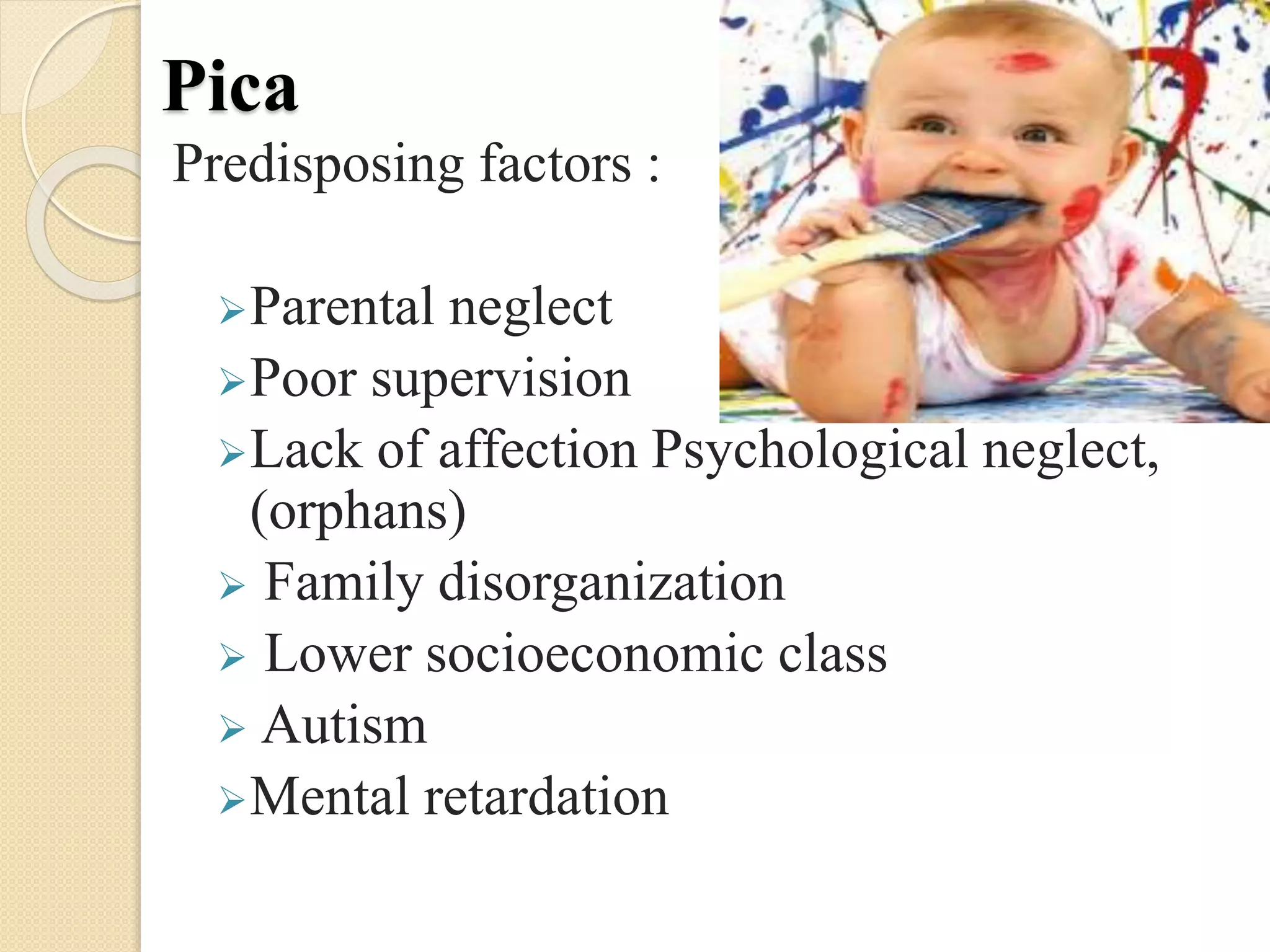
Predisposing factors :
Parental neglect
Poor supervision
Lack of affection Psychological neglect,
(orphans)
 Family disorganization
 Lower socioeconomic class
 Autism
Mental retardation
Pica
Screening indicated for:
 Iron deficiency anemia
 Worm infestations
 Lead poisoning
 Family dysfunction
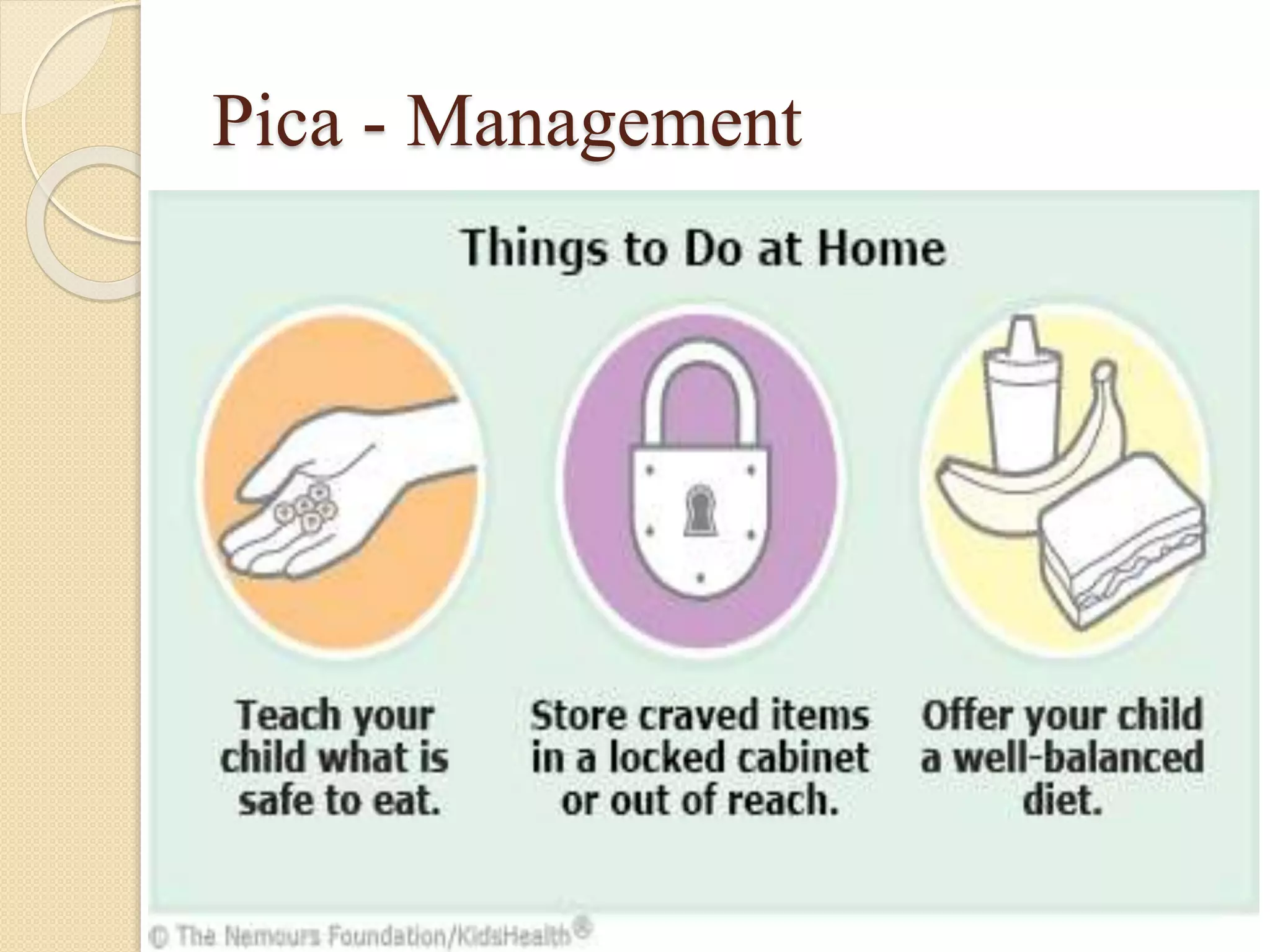
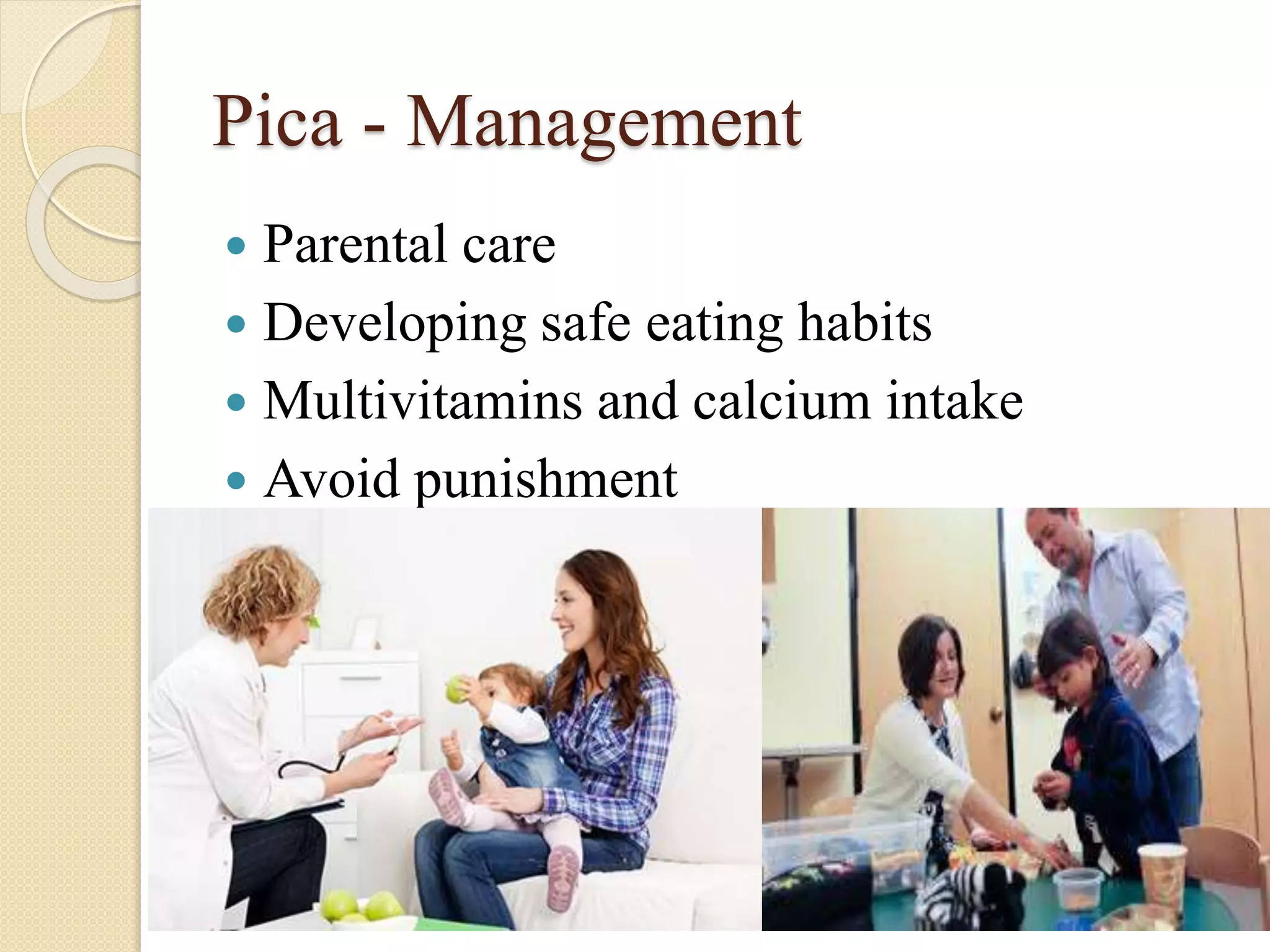
Pica - Management
Pica - Management
 Parental care
 Developing safe eating habits
 Multivitamins and calcium intake
 Avoid punishment
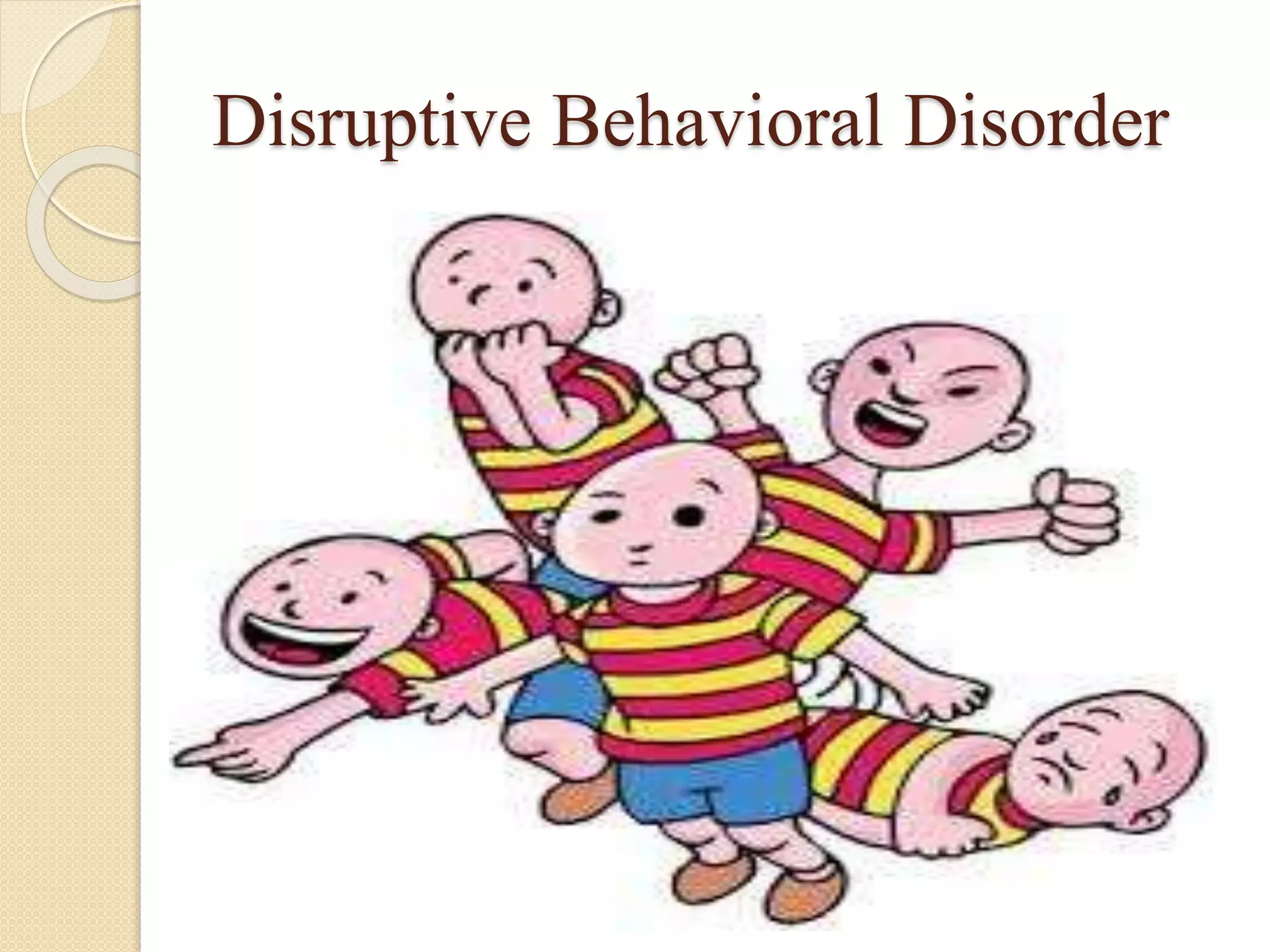
Disruptive Behavioral Disorder
Oppositional defiant disorder (ODD)
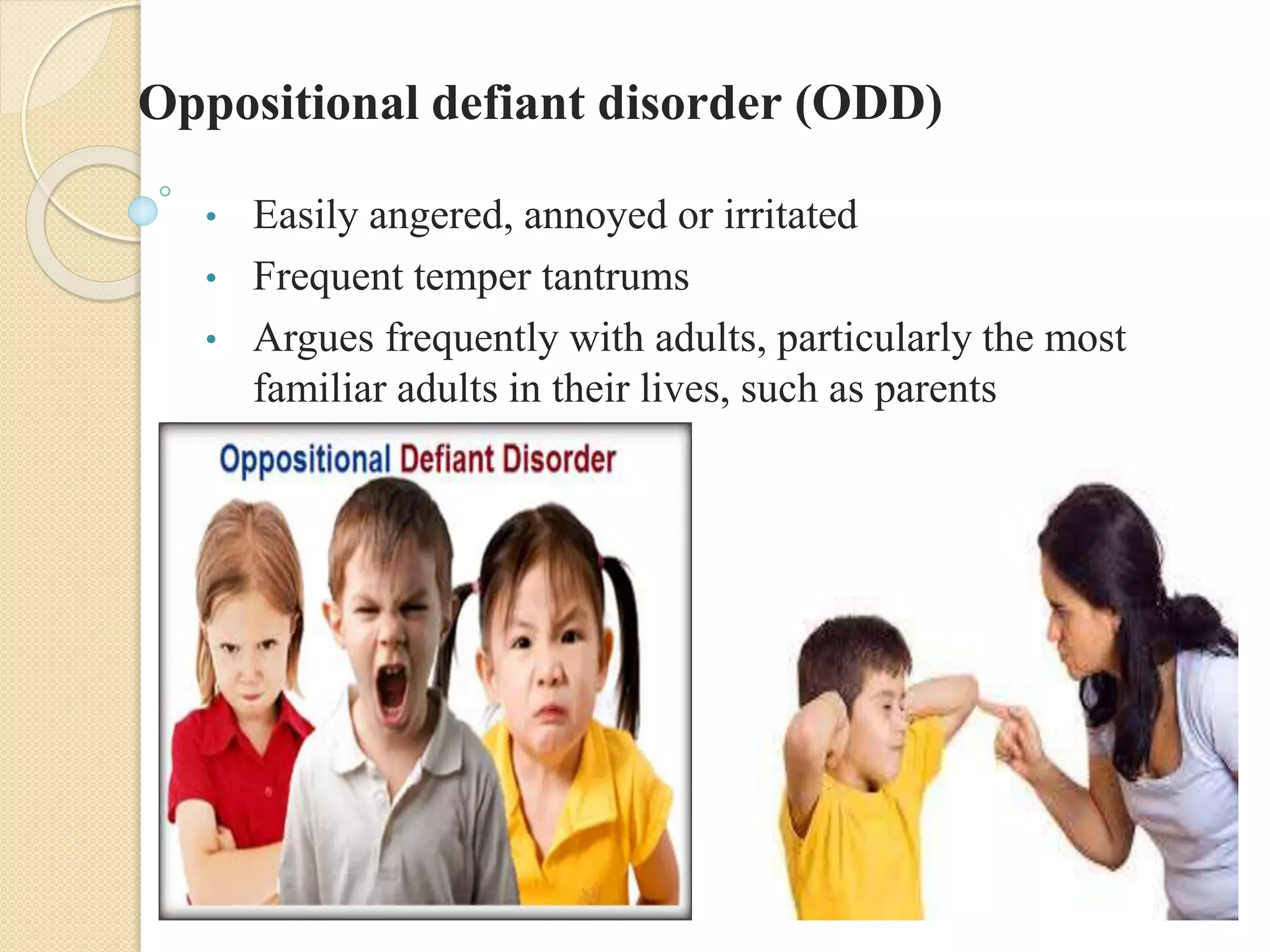
• Easily angered, annoyed or irritated
• Frequent temper tantrums
• Argues frequently with adults, particularly the most
familiar adults in their lives, such as parents
• Refuses to obey rules
Oppositional defiant disorder (ODD)
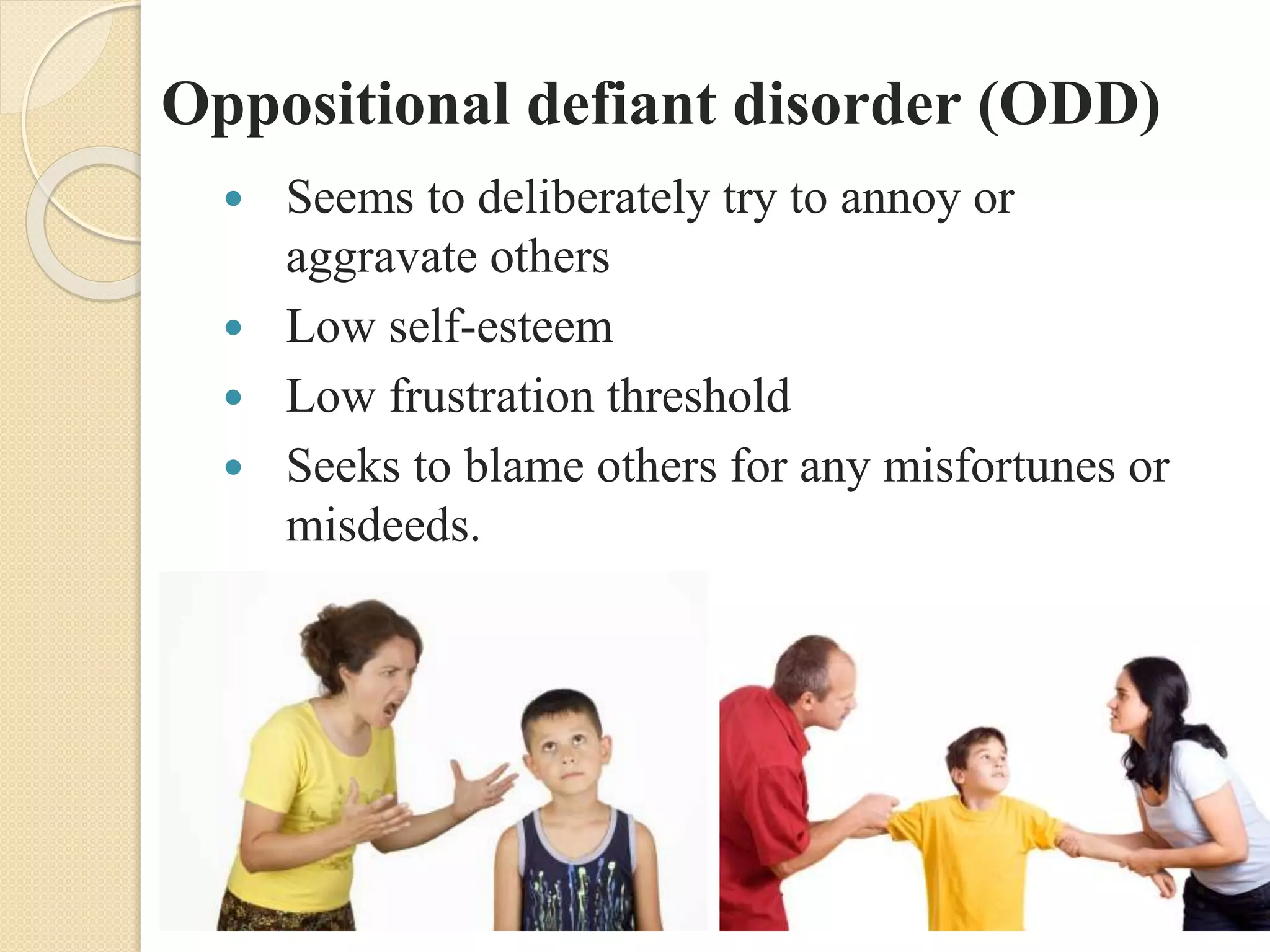
 Seems to deliberately try to annoy or
aggravate others
 Low self-esteem
 Low frustration threshold
 Seeks to blame others for any misfortunes or
misdeeds.
Conduct Disorders
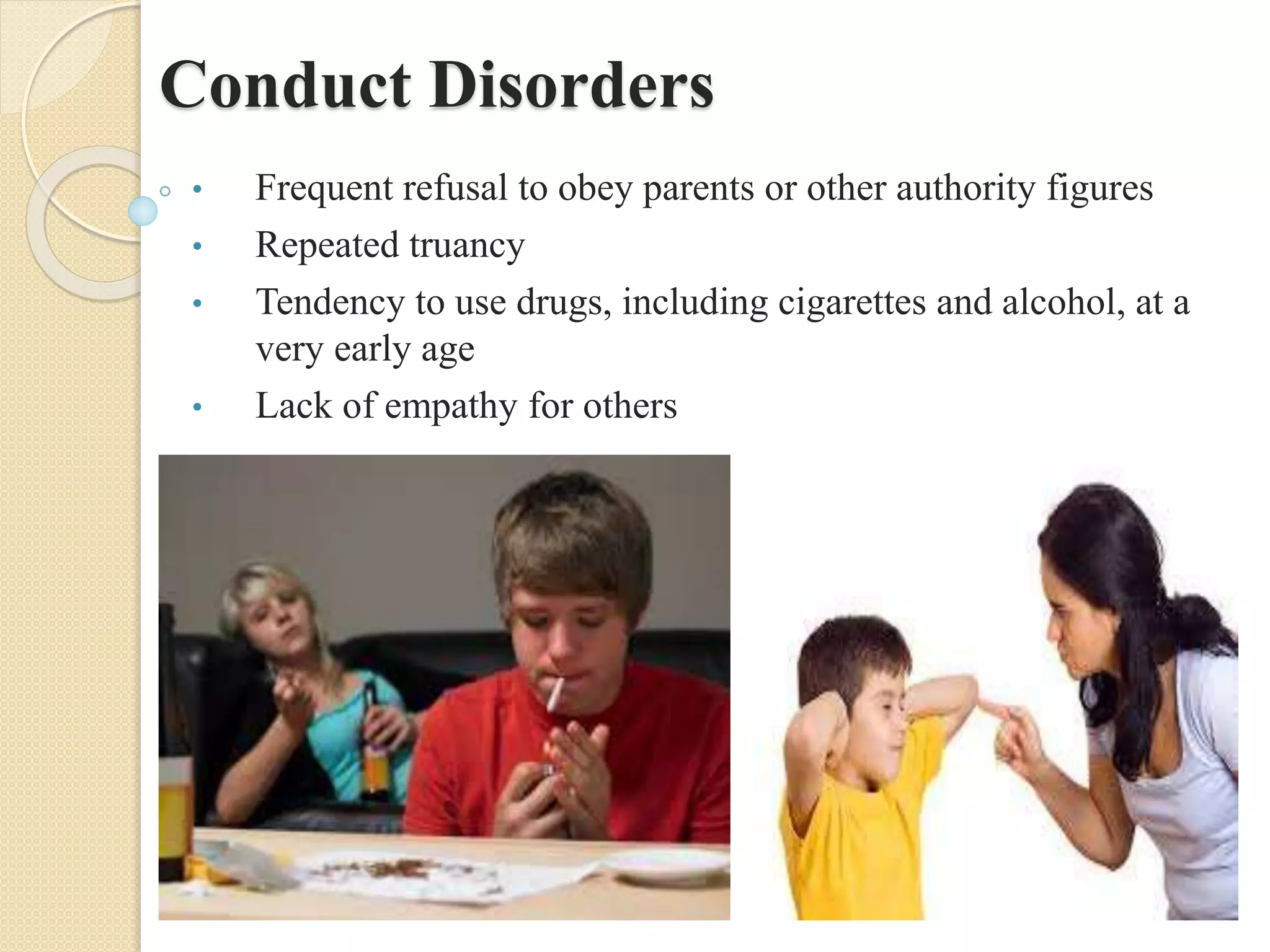
• Frequent refusal to obey parents or other authority figures
• Repeated truancy
• Tendency to use drugs, including cigarettes and alcohol, at a
very early age
• Lack of empathy for others
Conduct Disorders
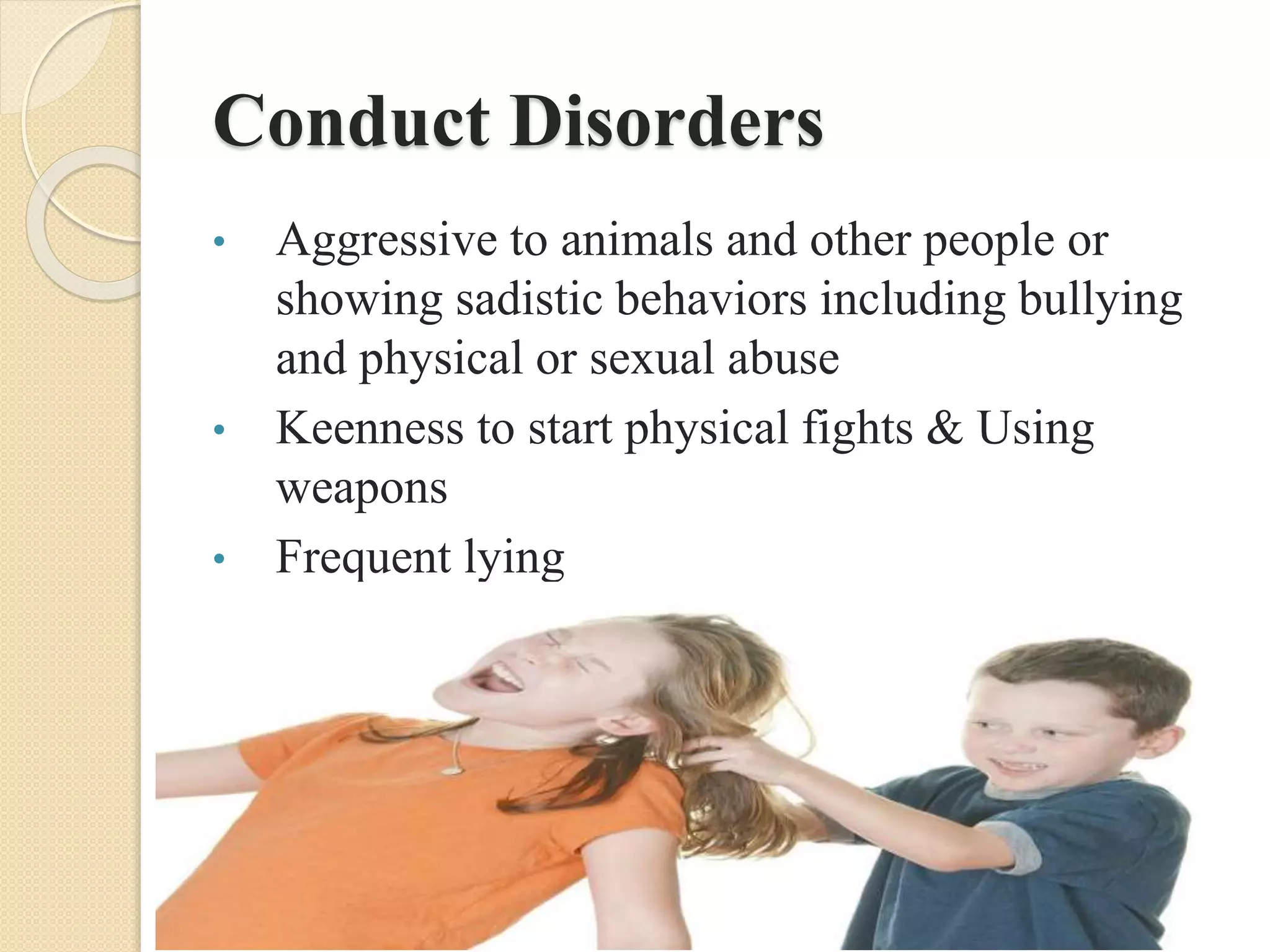
• Aggressive to animals and other people or
showing sadistic behaviors including bullying
and physical or sexual abuse
• Keenness to start physical fights & Using
weapons
• Frequent lying
Conduct Disorders
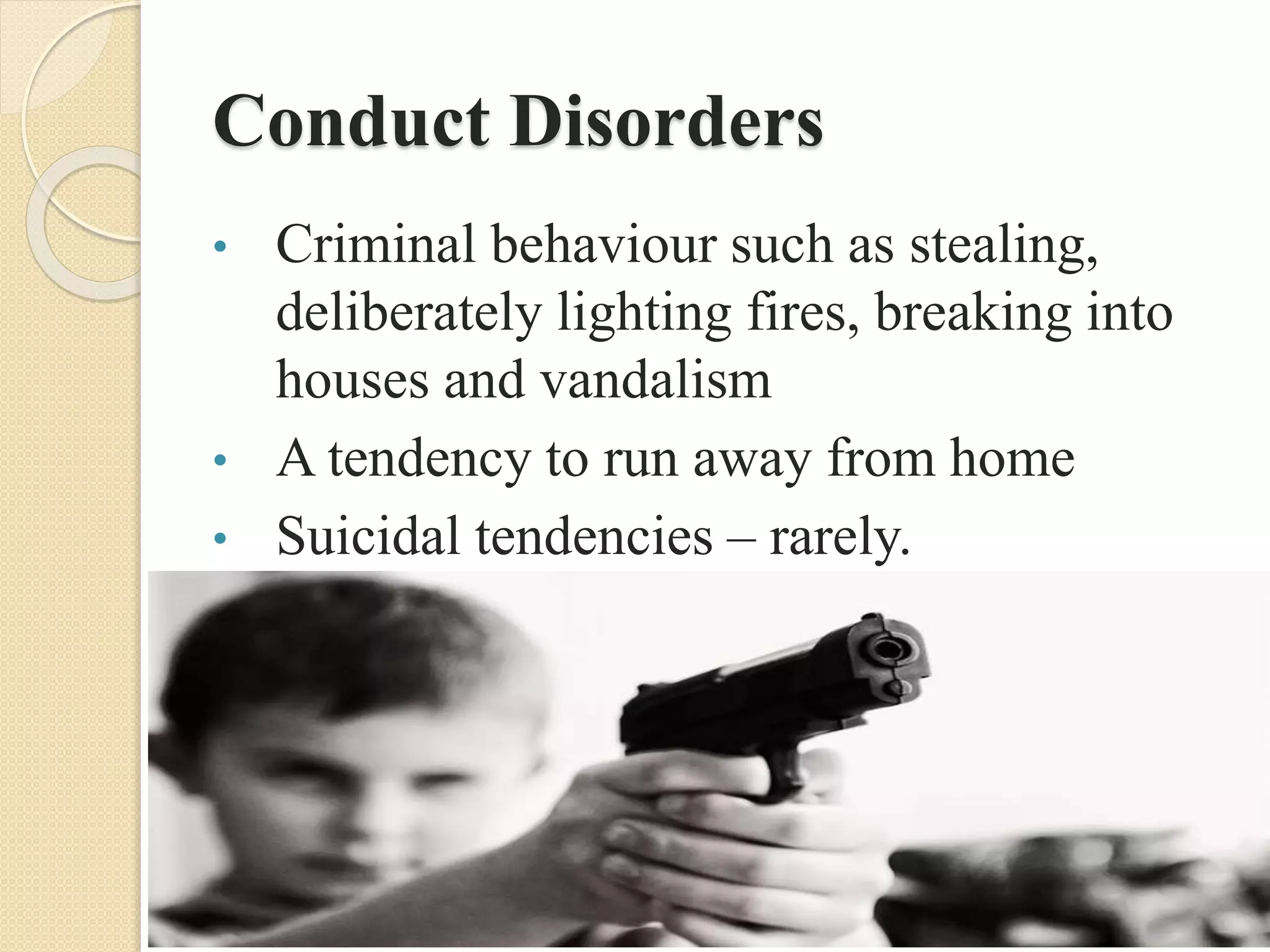
• Criminal behaviour such as stealing,
deliberately lighting fires, breaking into
houses and vandalism
• A tendency to run away from home
• Suicidal tendencies – rarely.
Strategies to minimize anger
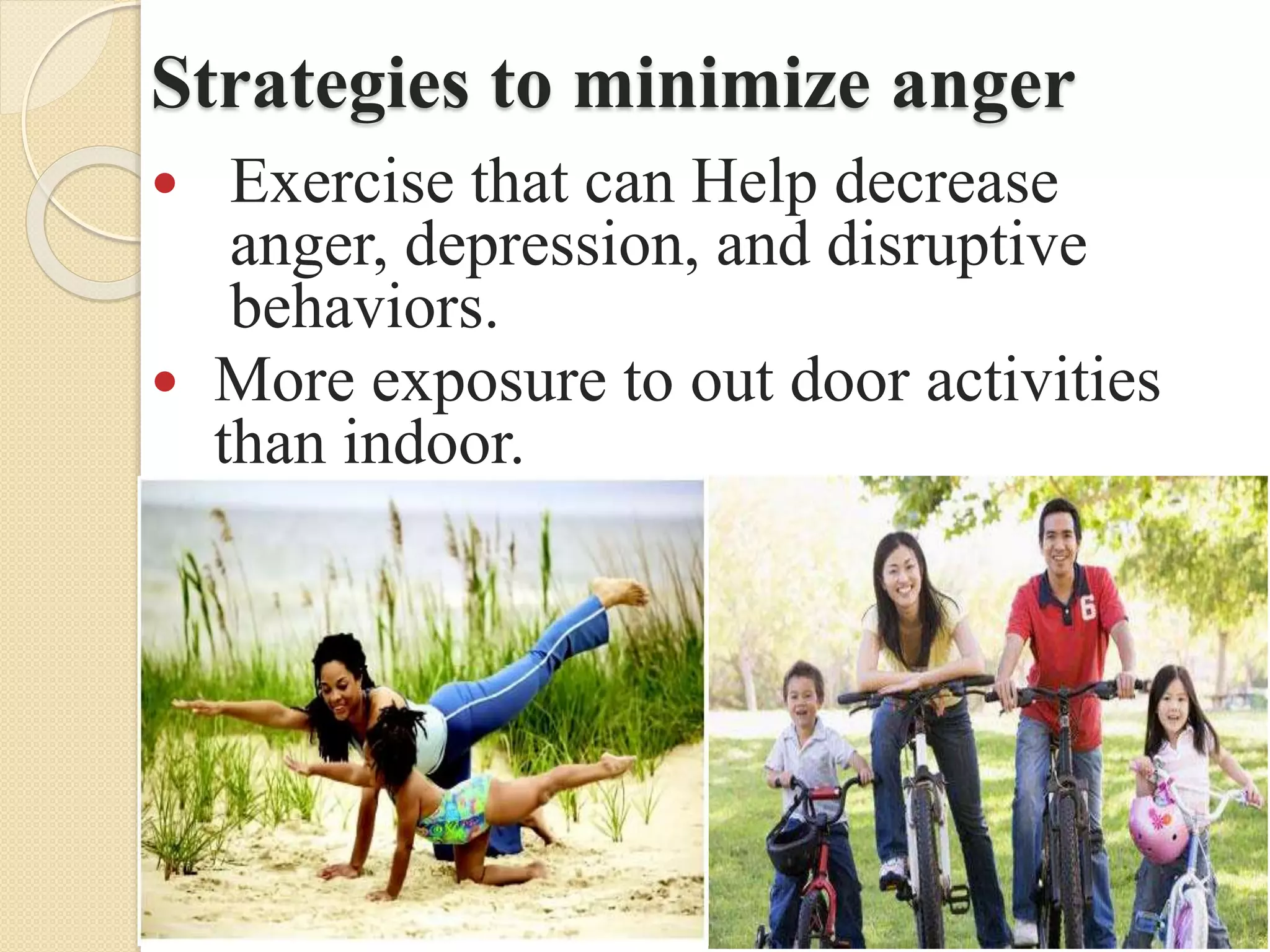
 Exercise that can Help decrease
anger, depression, and disruptive
behaviors.
 More exposure to out door activities
than indoor.
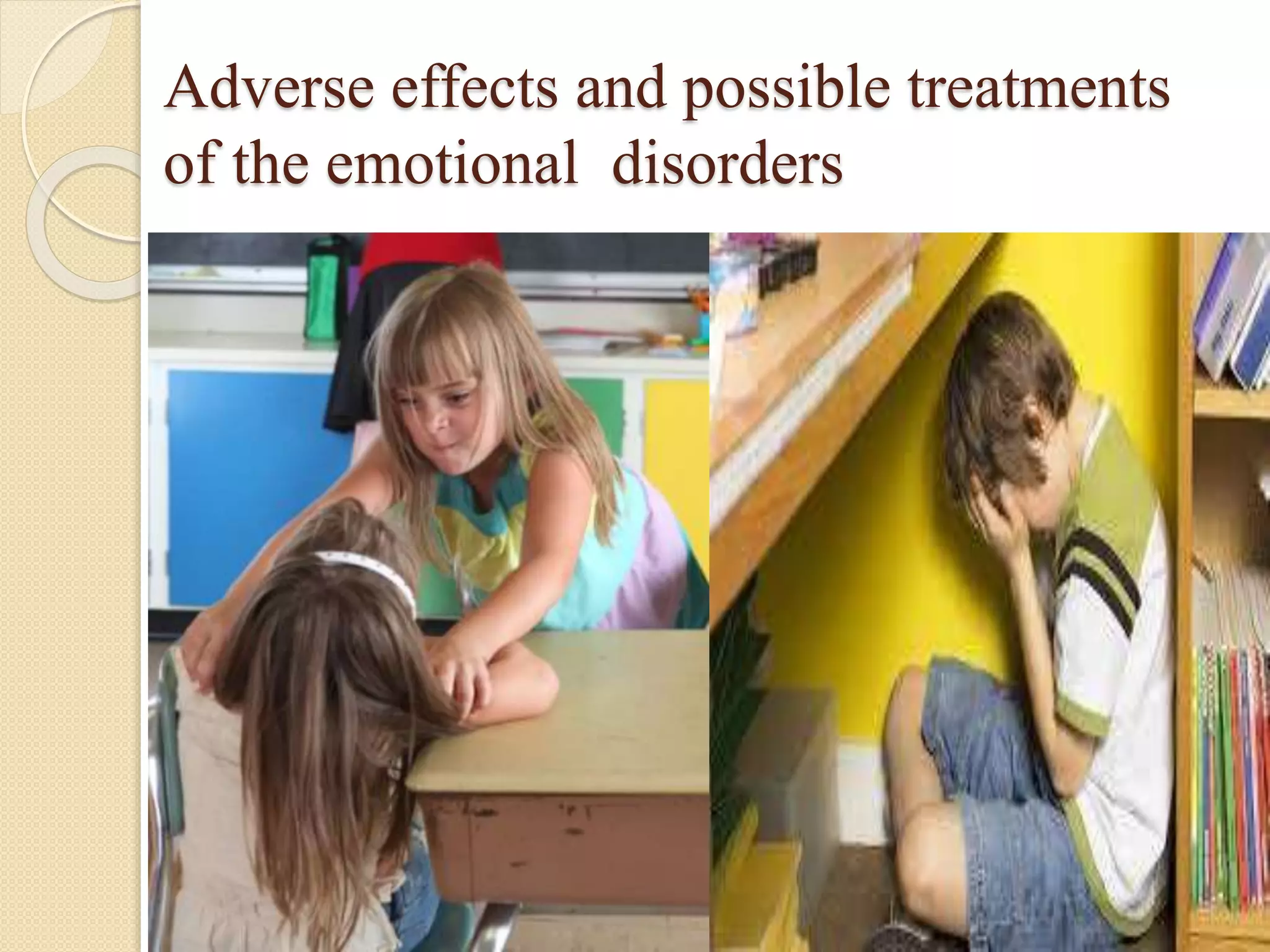
Adverse effects and possible treatments
of the emotional disorders
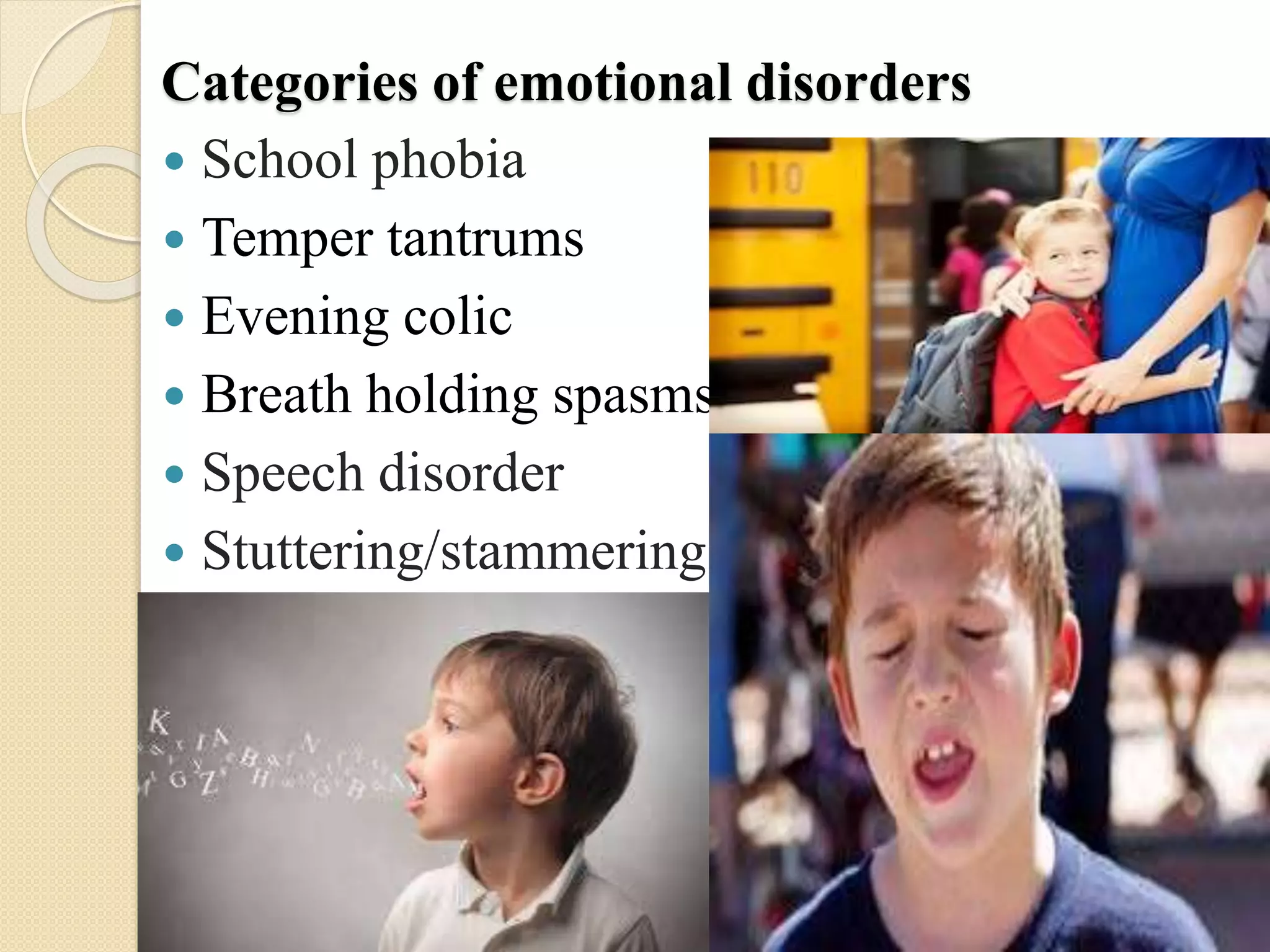
Categories of emotional disorders
 School phobia
 Temper tantrums
 Evening colic
 Breath holding spasms
 Speech disorder
 Stuttering/stammering
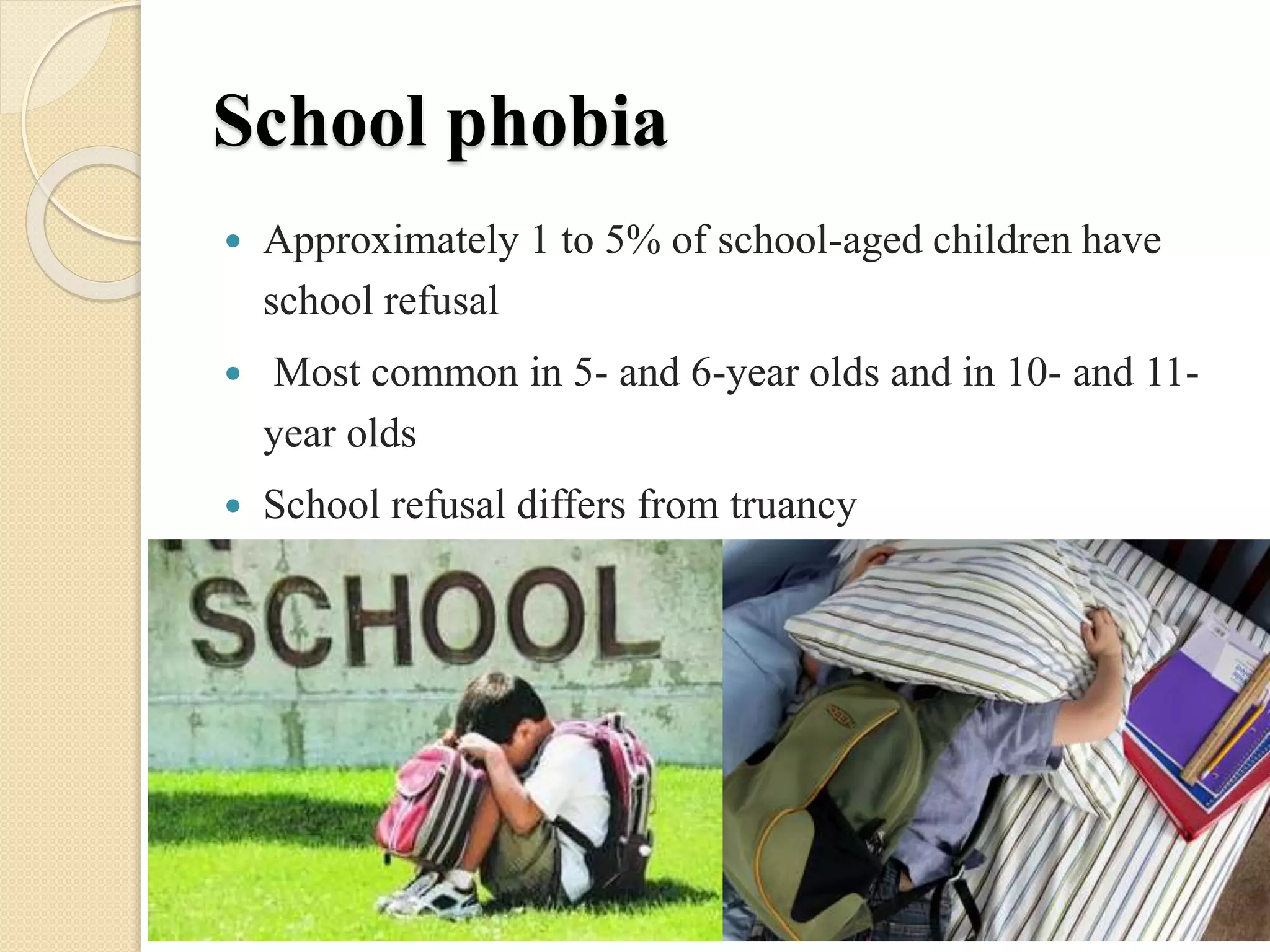
School phobia
 Approximately 1 to 5% of school-aged children have
school refusal
 Most common in 5- and 6-year olds and in 10- and 11-
year olds
 School refusal differs from truancy
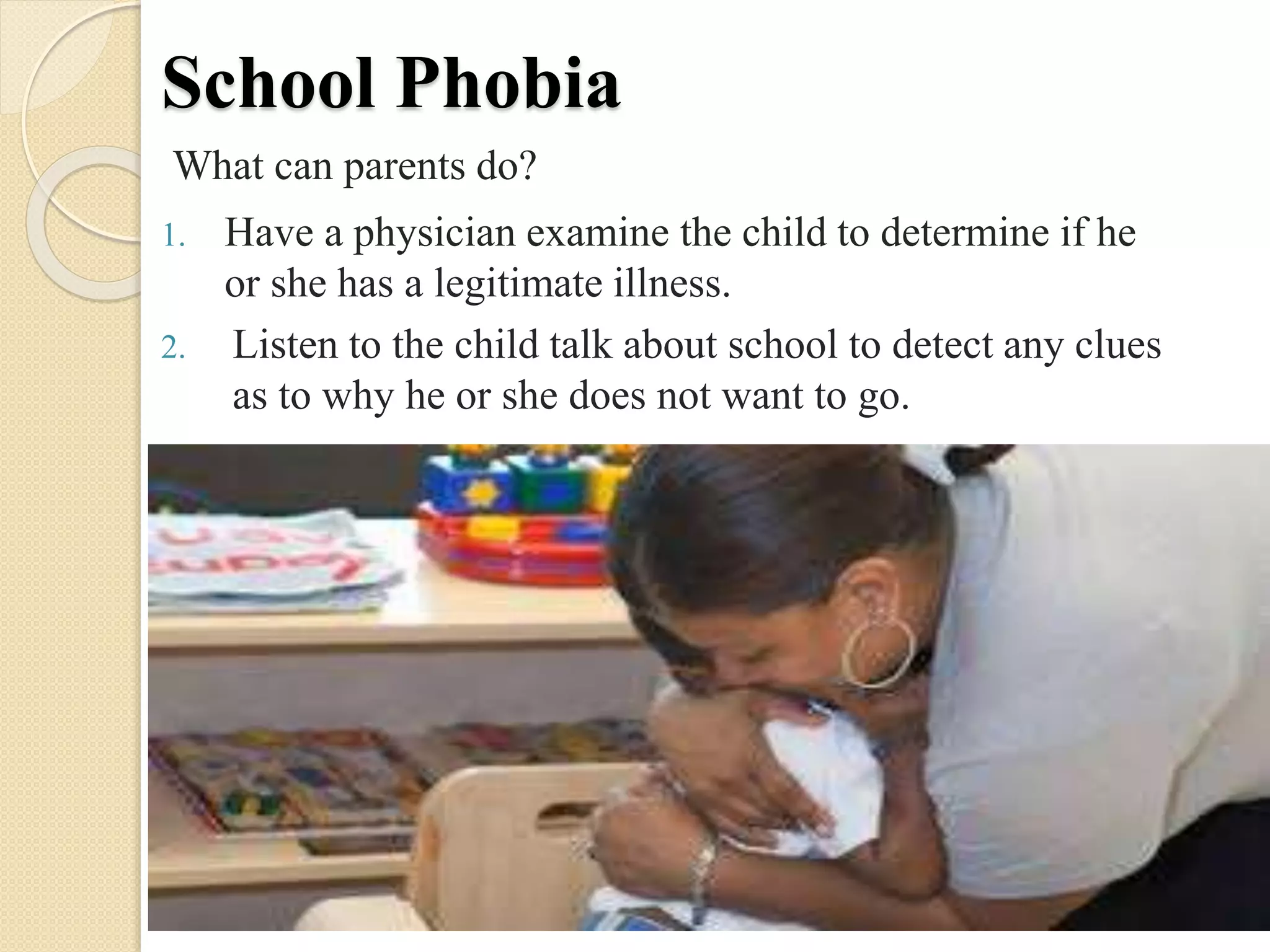
School Phobia
What can parents do?
1. Have a physician examine the child to determine if he
or she has a legitimate illness.
2. Listen to the child talk about school to detect any clues
as to why he or she does not want to go.
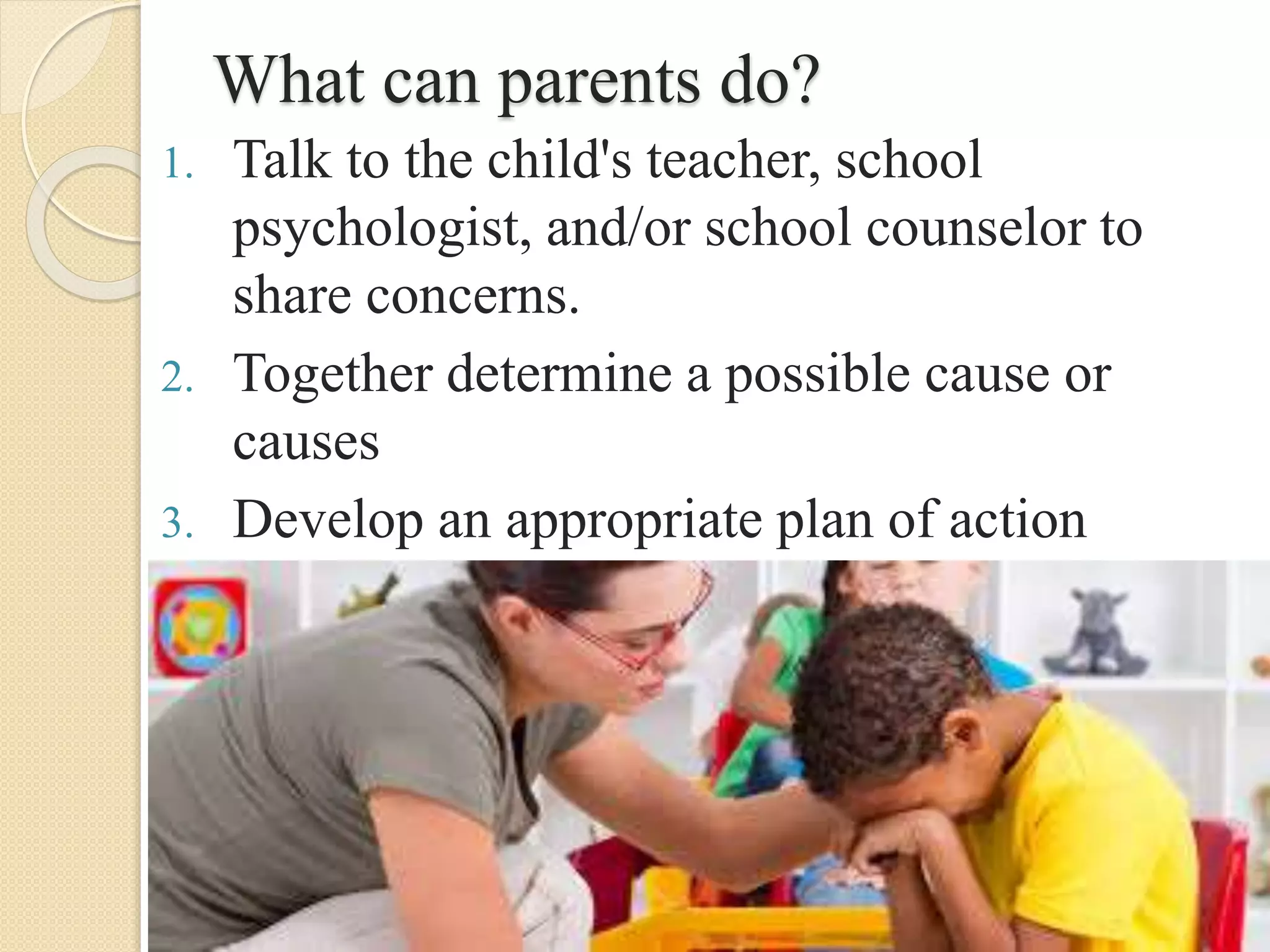
What can parents do?
1. Talk to the child's teacher, school
psychologist, and/or school counselor to
share concerns.
2. Together determine a possible cause or
causes
3. Develop an appropriate plan of action
School Phobia
 The goal is to have the child return to school and
attend class daily
 However, if the school phobia is extreme, a therapist or
psychiatrist's assistance may be necessary.
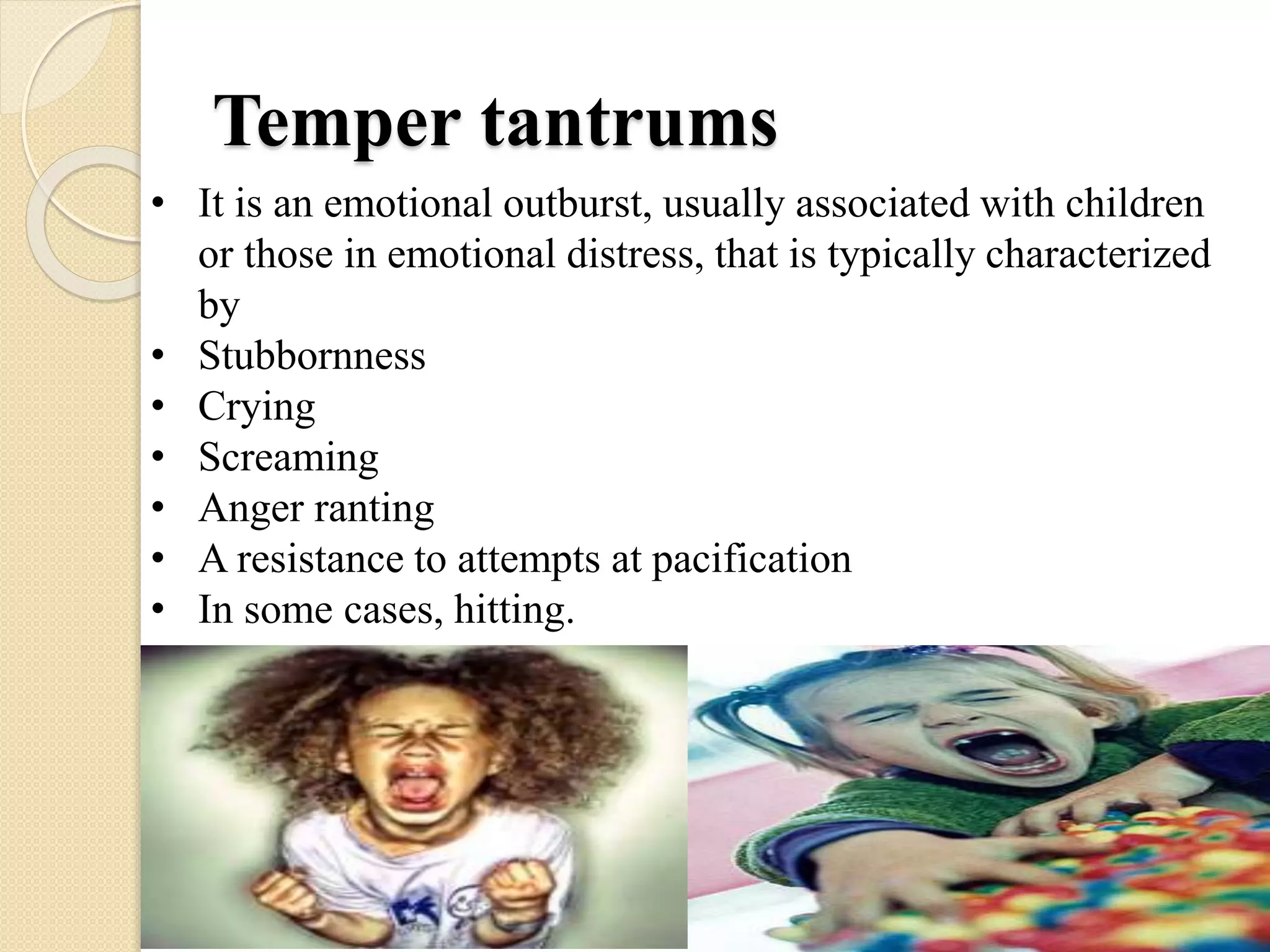
Temper tantrums
• It is an emotional outburst, usually associated with children
or those in emotional distress, that is typically characterized
by
• Stubbornness
• Crying
• Screaming
• Anger ranting
• A resistance to attempts at pacification
• In some cases, hitting.
Temper Tantrum - Causes
 In 18 months to 3 yrs olds due to
development of sense of autonomy.
 Child displays defiance, negativism /
oppositionalism by having temper tantrums.
 Normal part of child development.
 Gets reinforced when parents respond to it
by punitive anger.
 Child wrongly learns that temper tantrums
are a reasonable response to frustration.
Temper Tantrums
Precipitating factors
Hunger
Fatigue
Lack of sleep
Innate personality of child
Ineffective parental skills
Over pampering
Dysfunctional family / Family violence
School aversion
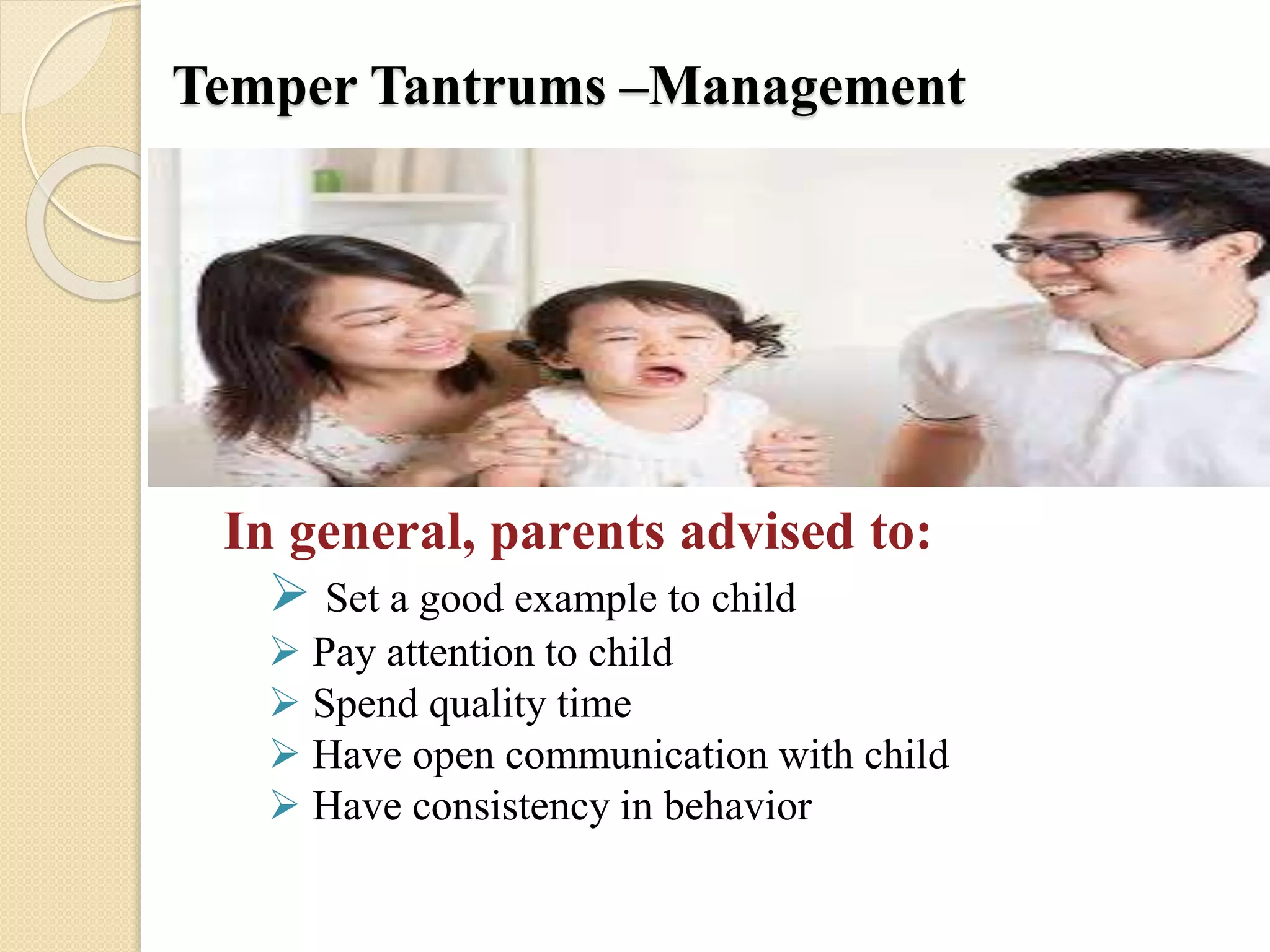
Temper Tantrums –Management
In general, parents advised to:
 Set a good example to child
 Pay attention to child
 Spend quality time
 Have open communication with child
 Have consistency in behavior
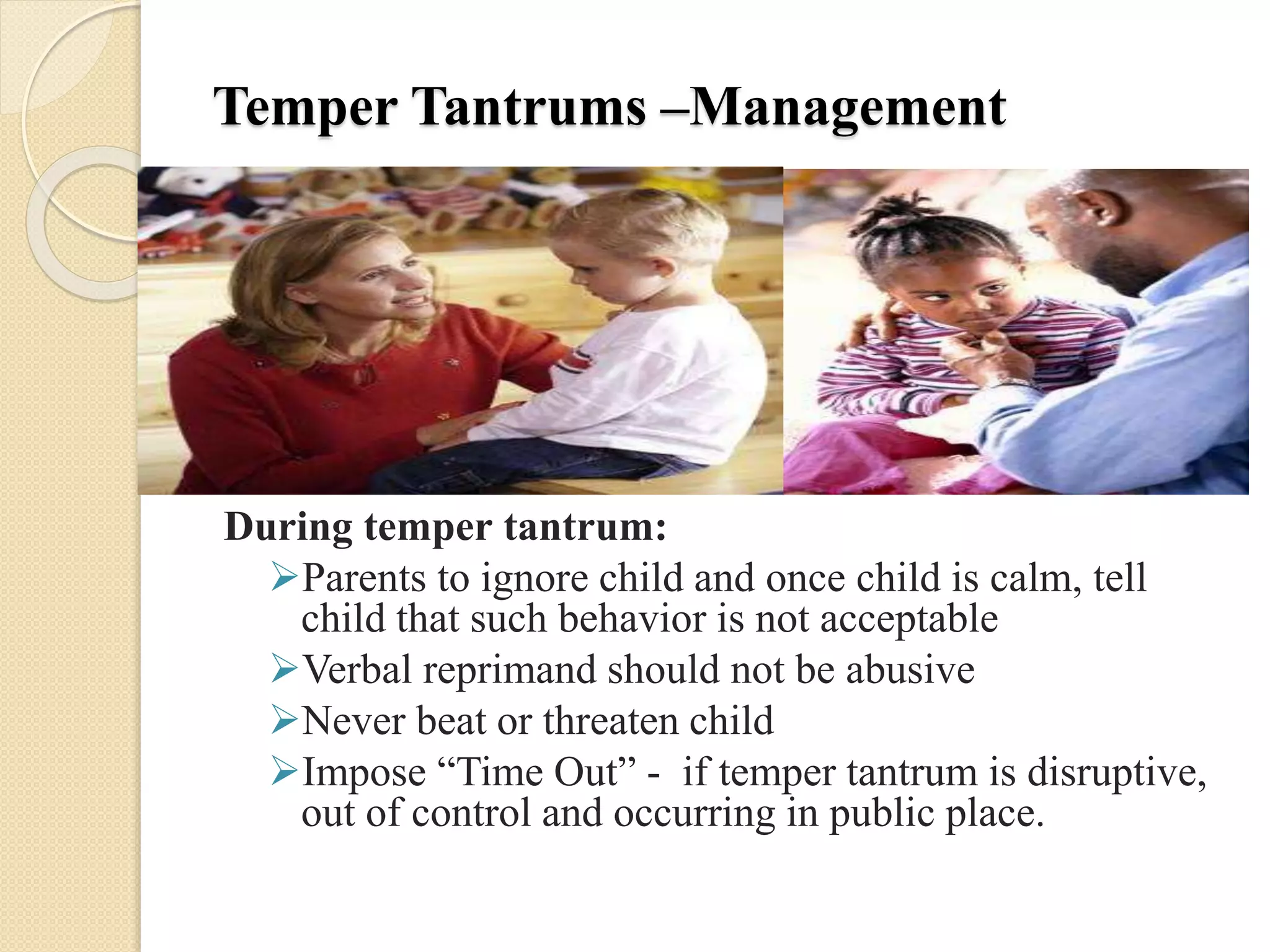
Temper Tantrums –Management
During temper tantrum:
Parents to ignore child and once child is calm, tell
child that such behavior is not acceptable
Verbal reprimand should not be abusive
Never beat or threaten child
Impose “Time Out” - if temper tantrum is disruptive,
out of control and occurring in public place.
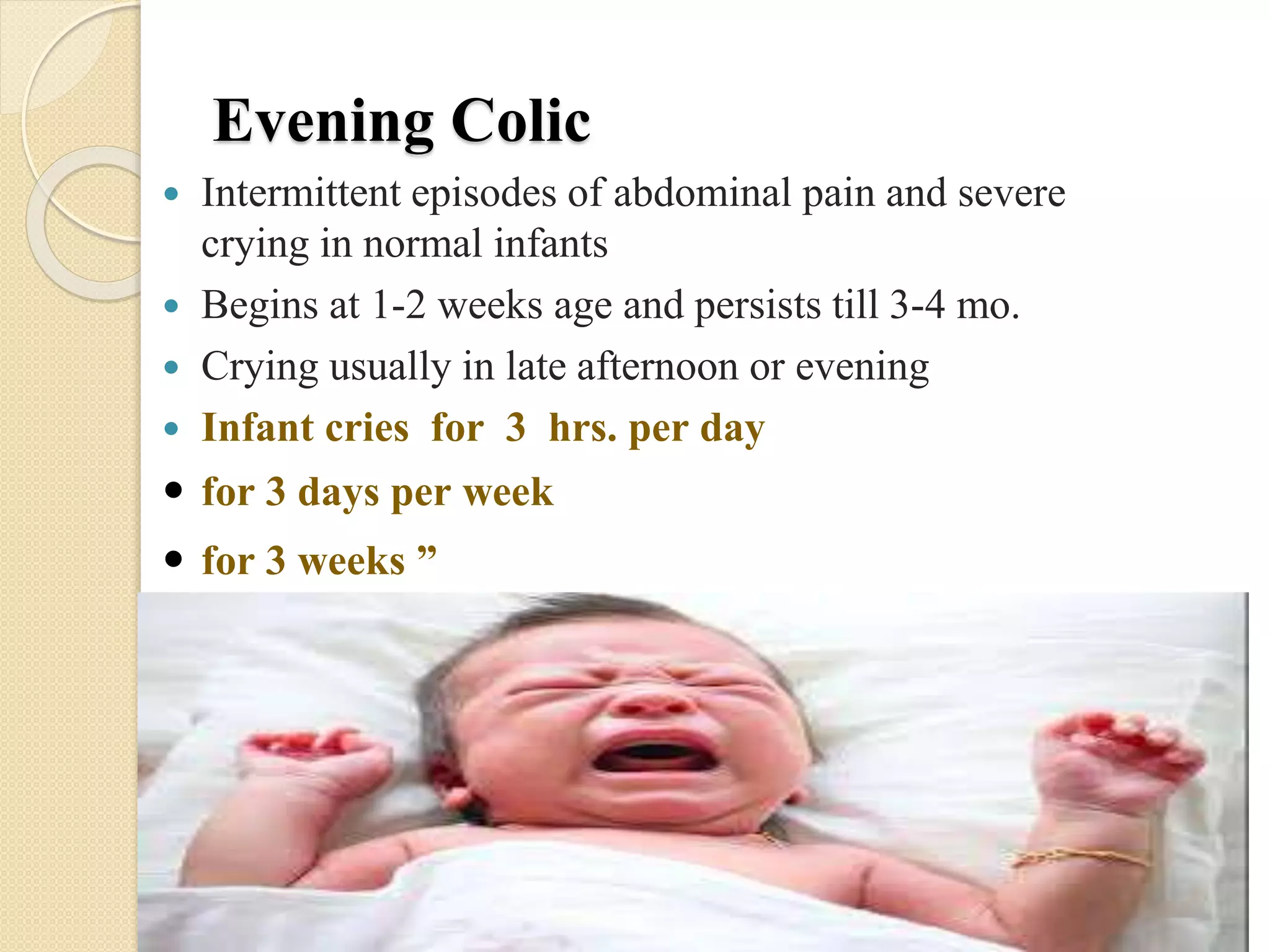
Evening Colic
 Intermittent episodes of abdominal pain and severe
crying in normal infants
 Begins at 1-2 weeks age and persists till 3-4 mo.
 Crying usually in late afternoon or evening
 Infant cries for 3 hrs. per day
 for 3 days per week
 for 3 weeks ”
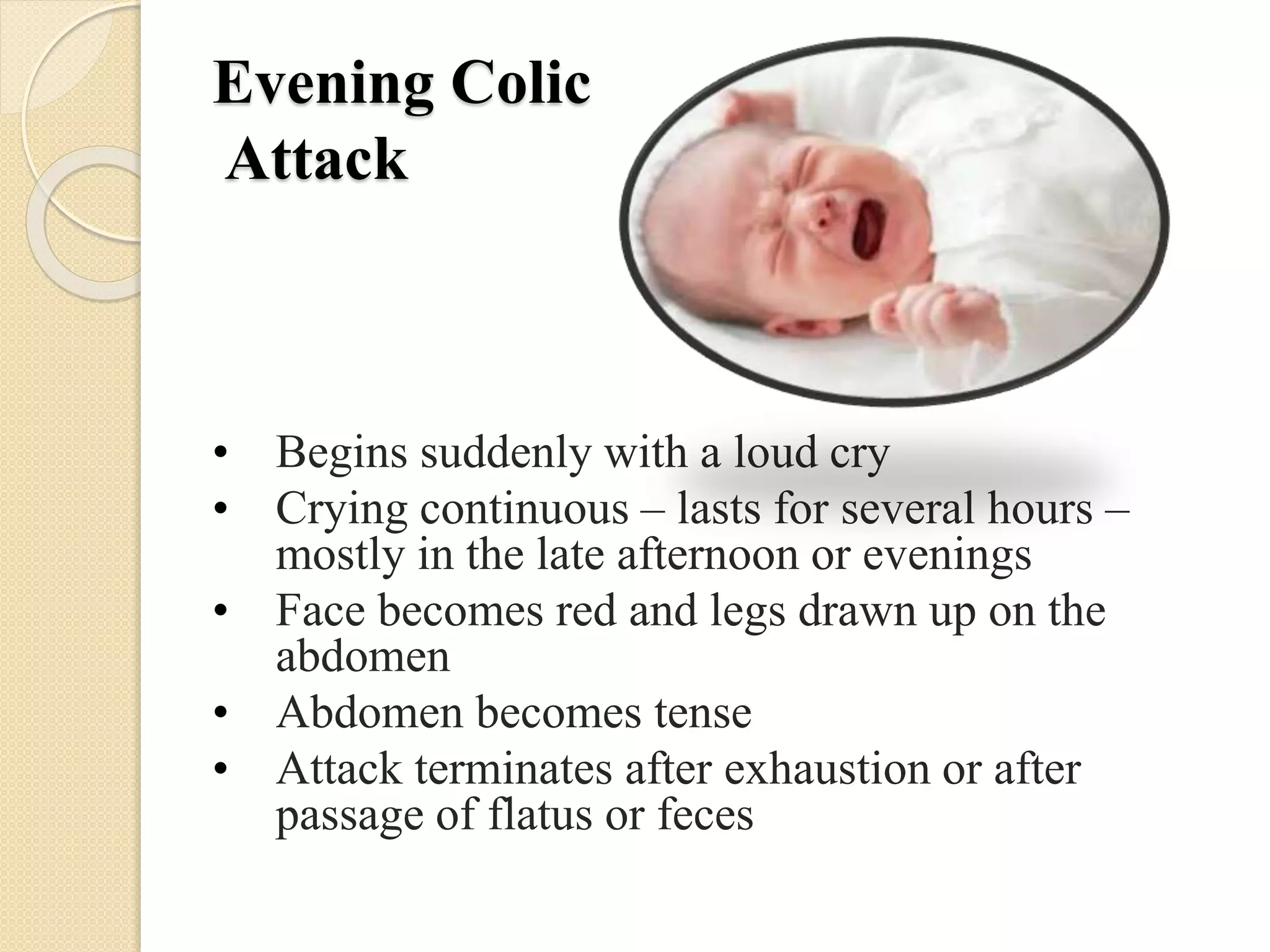
Evening Colic
Attack
• Begins suddenly with a loud cry
• Crying continuous – lasts for several hours –
mostly in the late afternoon or evenings
• Face becomes red and legs drawn up on the
abdomen
• Abdomen becomes tense
• Attack terminates after exhaustion or after
passage of flatus or feces
Evening Colic
Causes
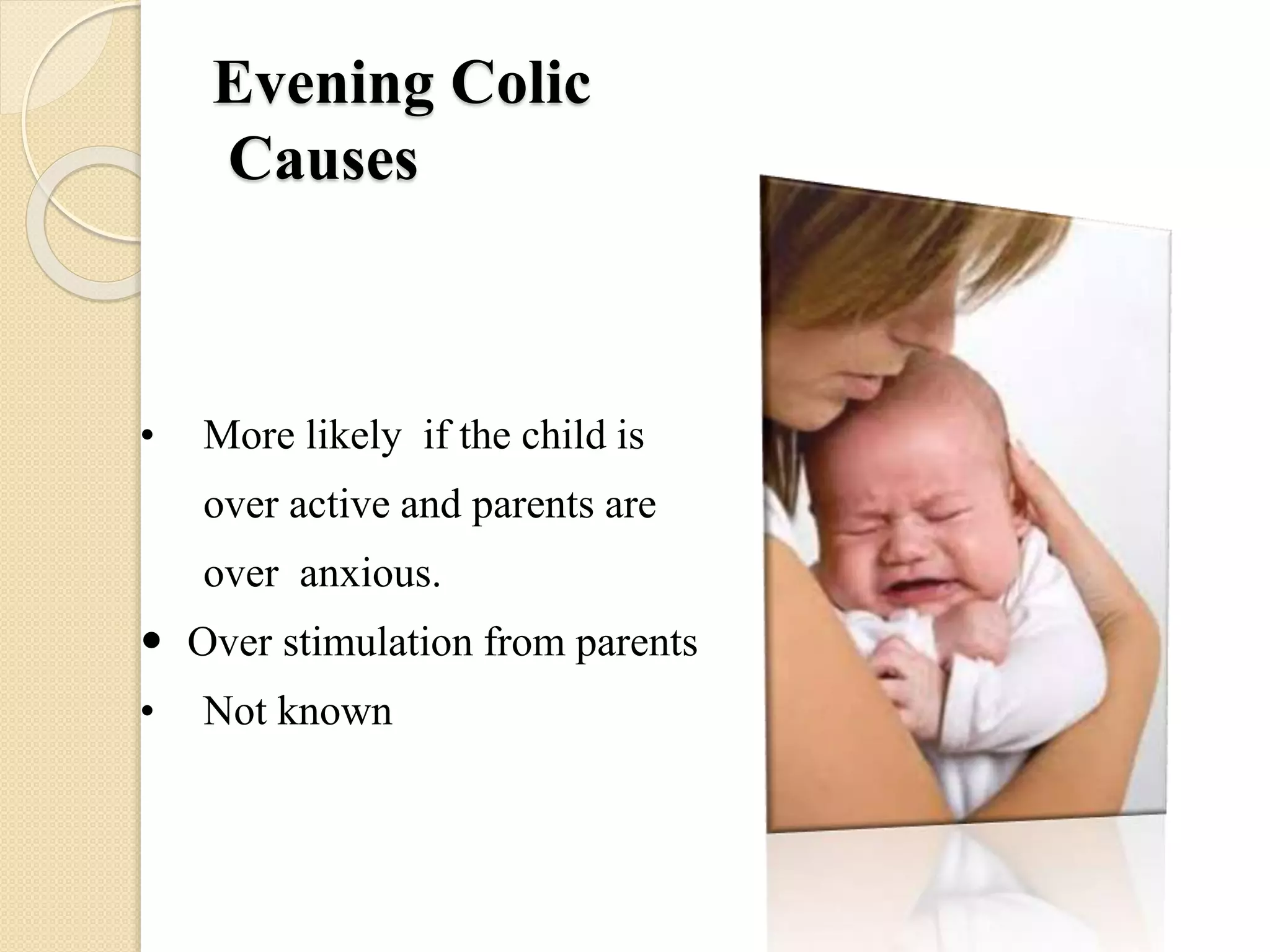
• More likely if the child is
over active and parents are
over anxious.
 Over stimulation from parents
• Not known
Evening Colic Management
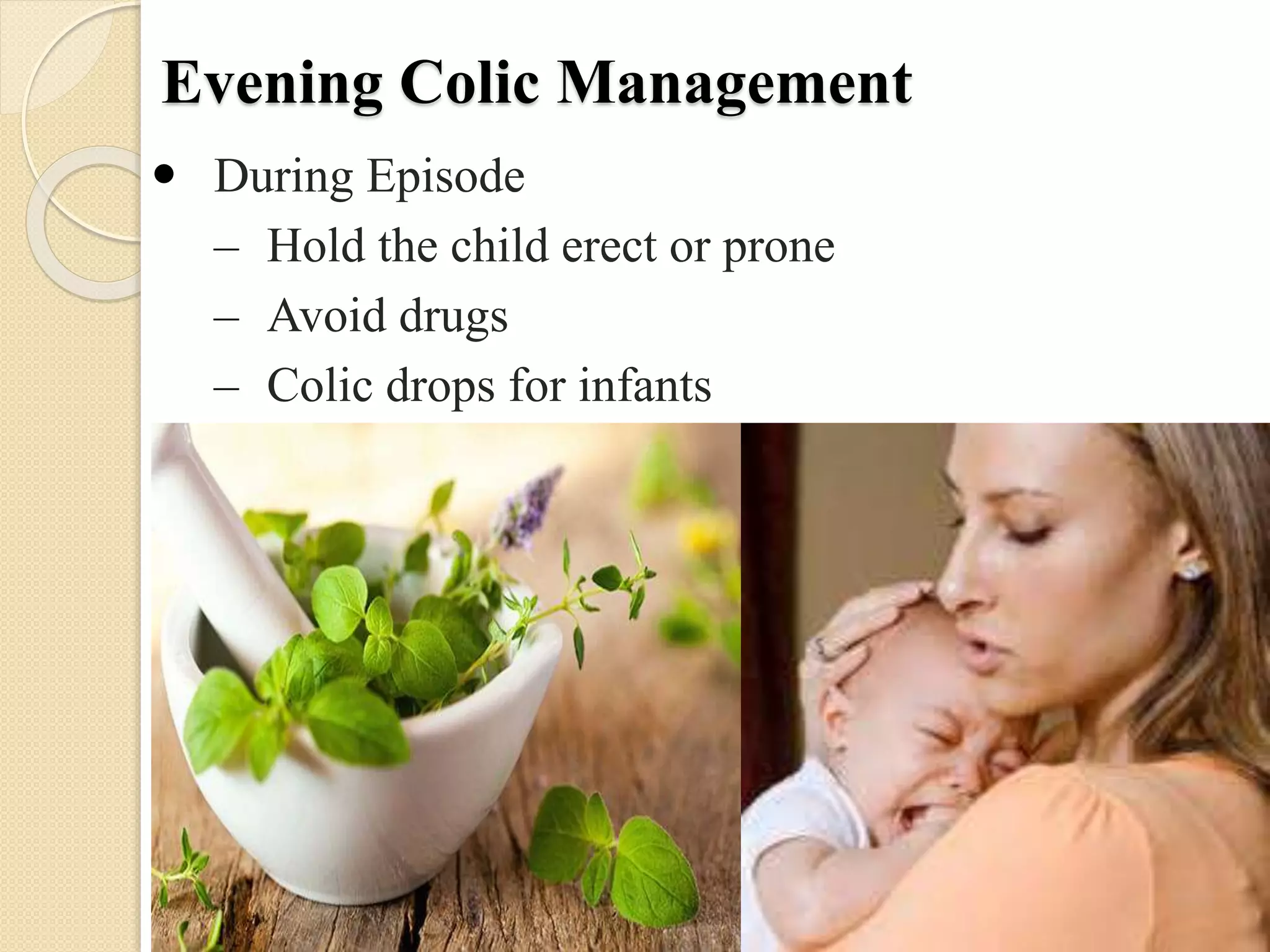
 During Episode
– Hold the child erect or prone
– Avoid drugs
– Colic drops for infants
Evening Colic Management
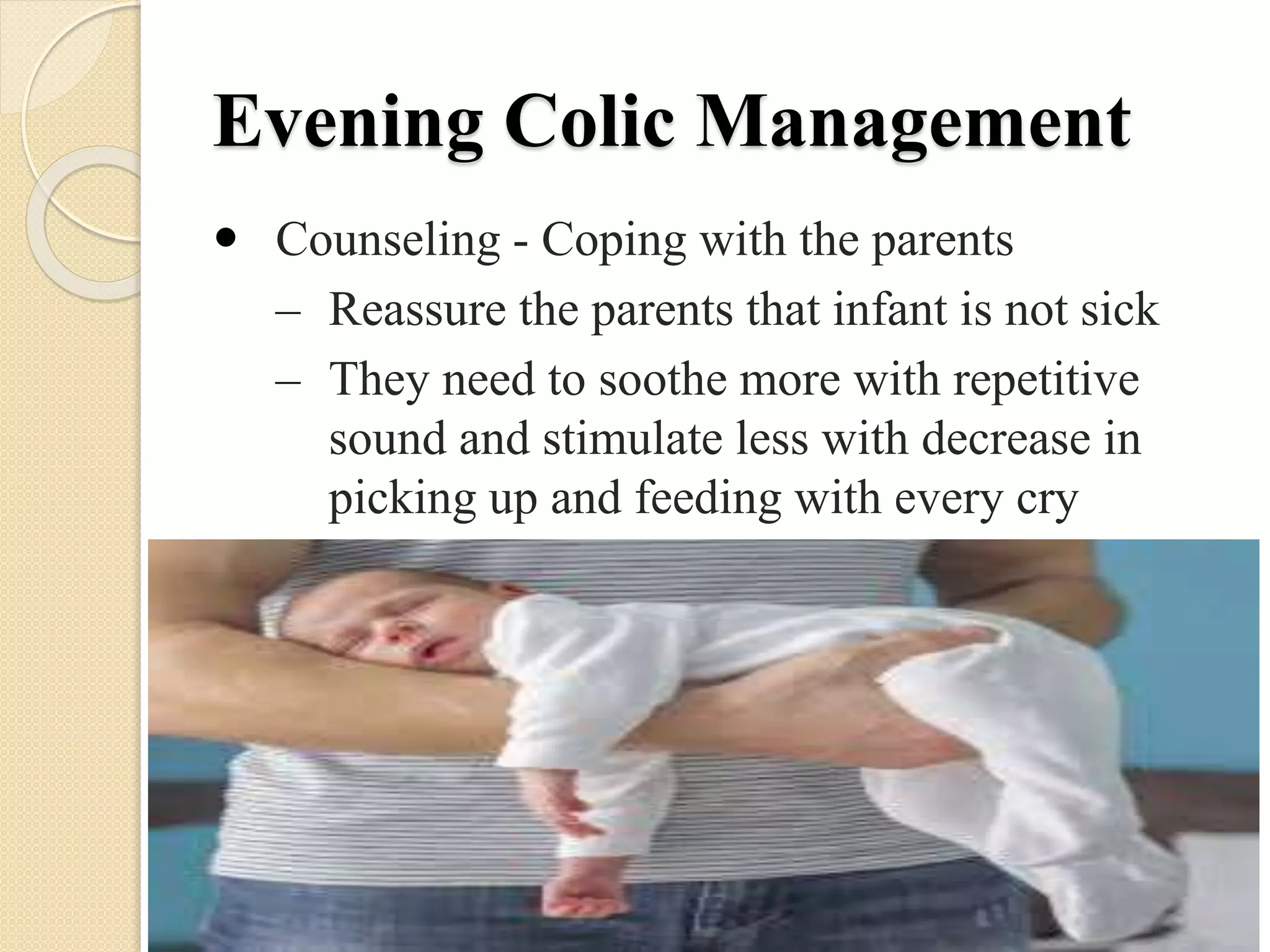
 Counseling - Coping with the parents
– Reassure the parents that infant is not sick
– They need to soothe more with repetitive
sound and stimulate less with decrease in
picking up and feeding with every cry
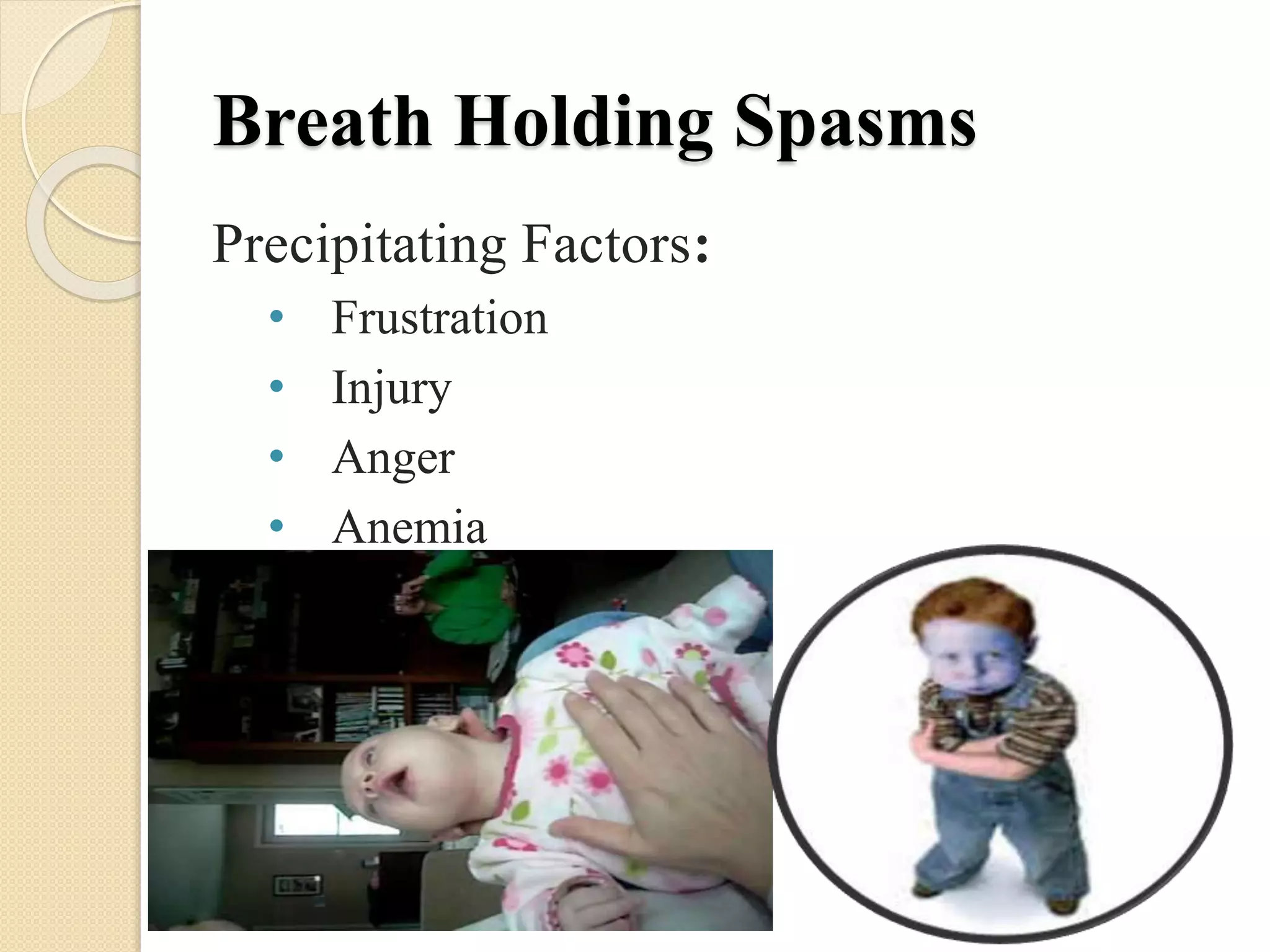
Breath Holding Spasms
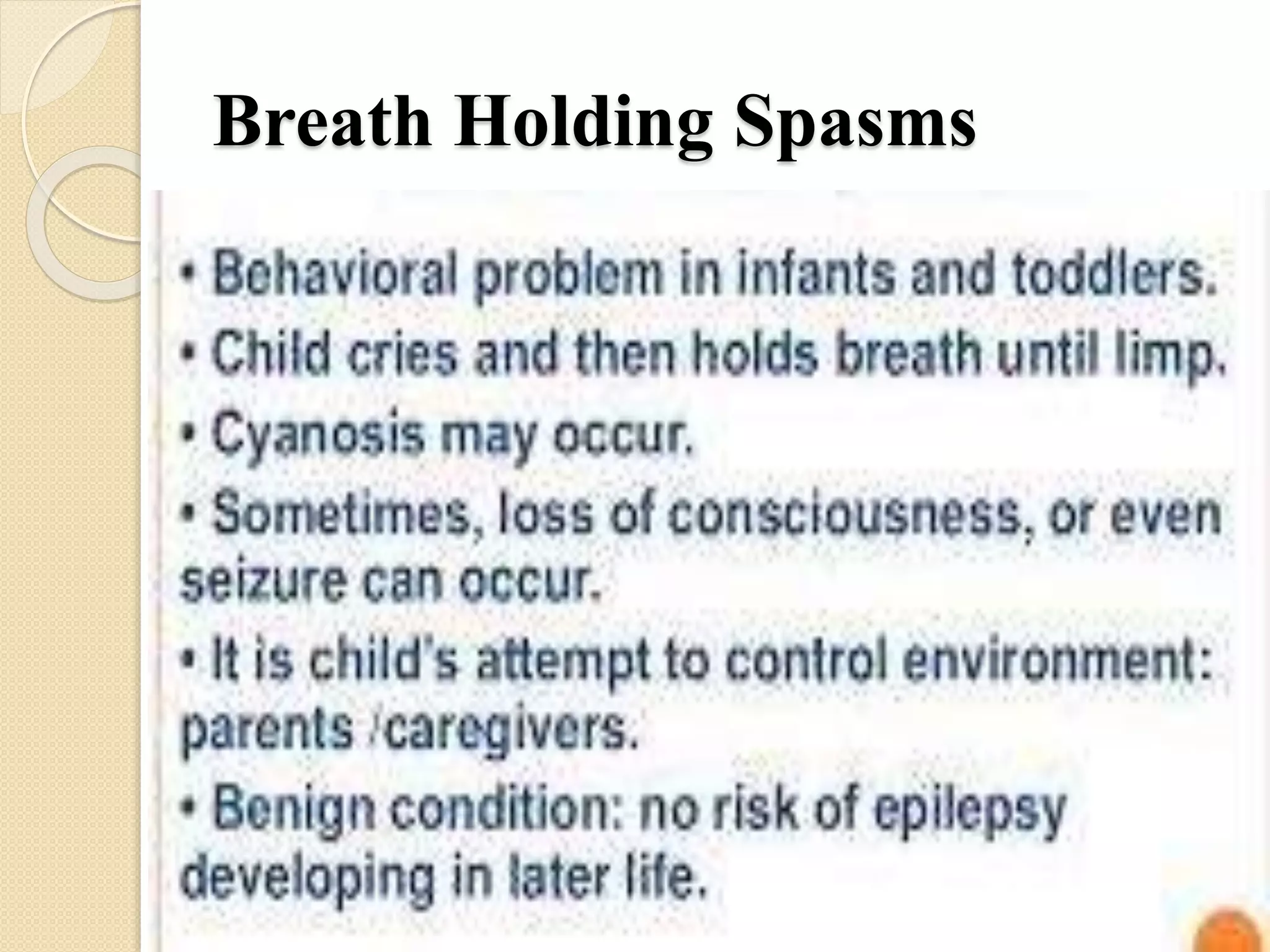
Precipitating Factors:
• Frustration
• Injury
• Anger
• Anemia
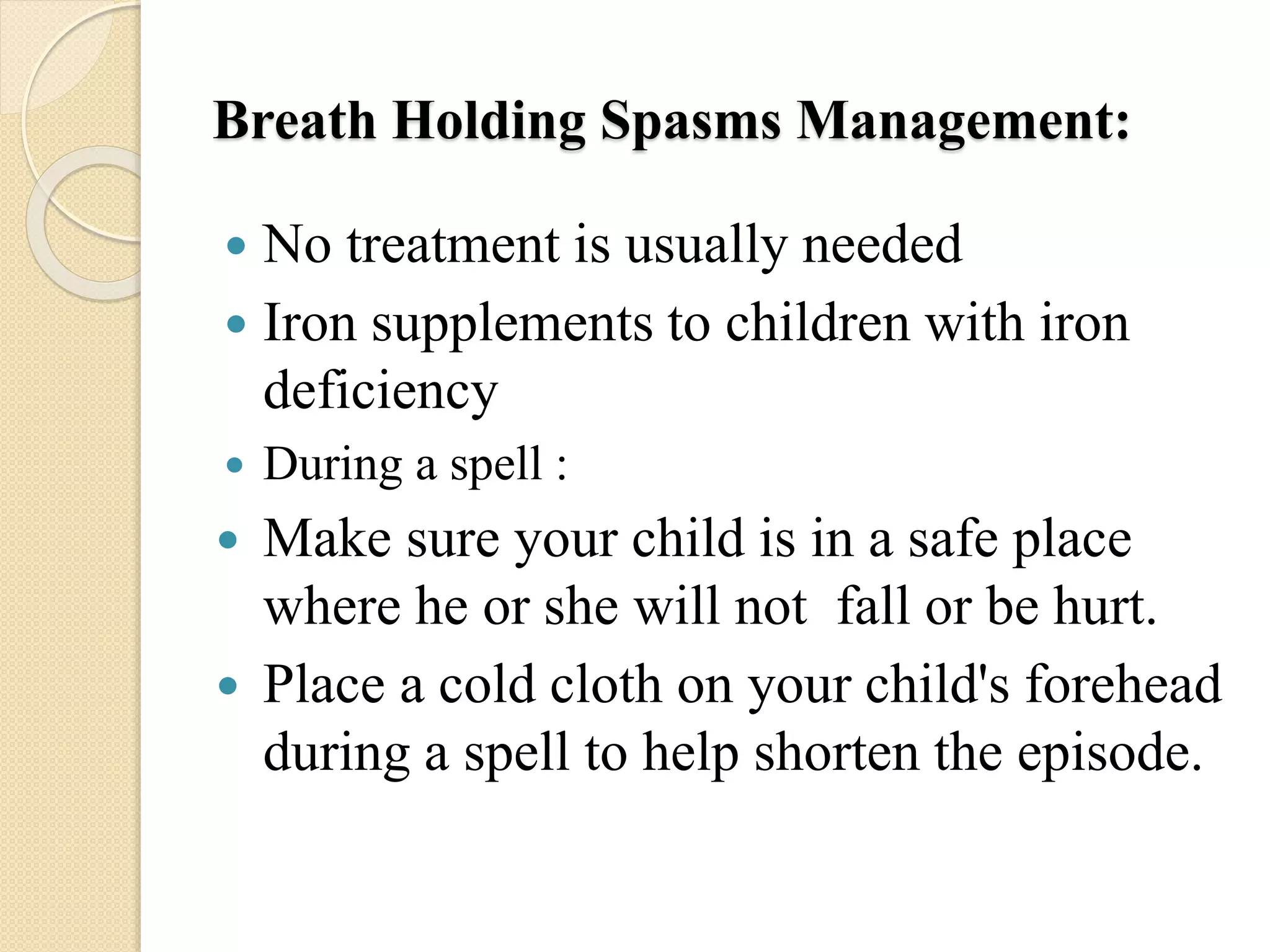
Breath Holding Spasms Management:
 No treatment is usually needed
 Iron supplements to children with iron
deficiency
 During a spell :
 Make sure your child is in a safe place
where he or she will not fall or be hurt.
 Place a cold cloth on your child's forehead
during a spell to help shorten the episode.
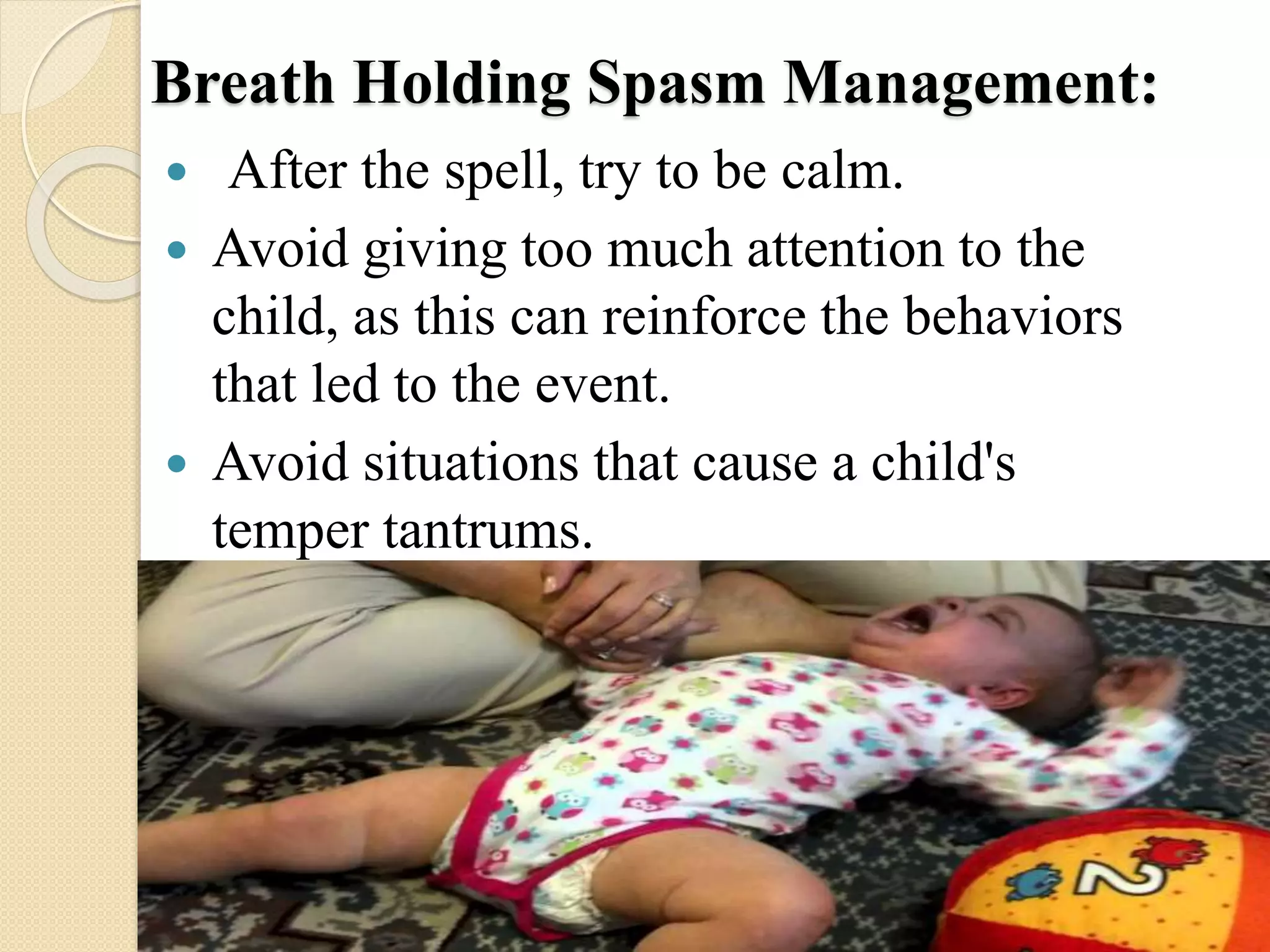
Breath Holding Spasm Management:
 After the spell, try to be calm.
 Avoid giving too much attention to the
child, as this can reinforce the behaviors
that led to the event.
 Avoid situations that cause a child's
temper tantrums.
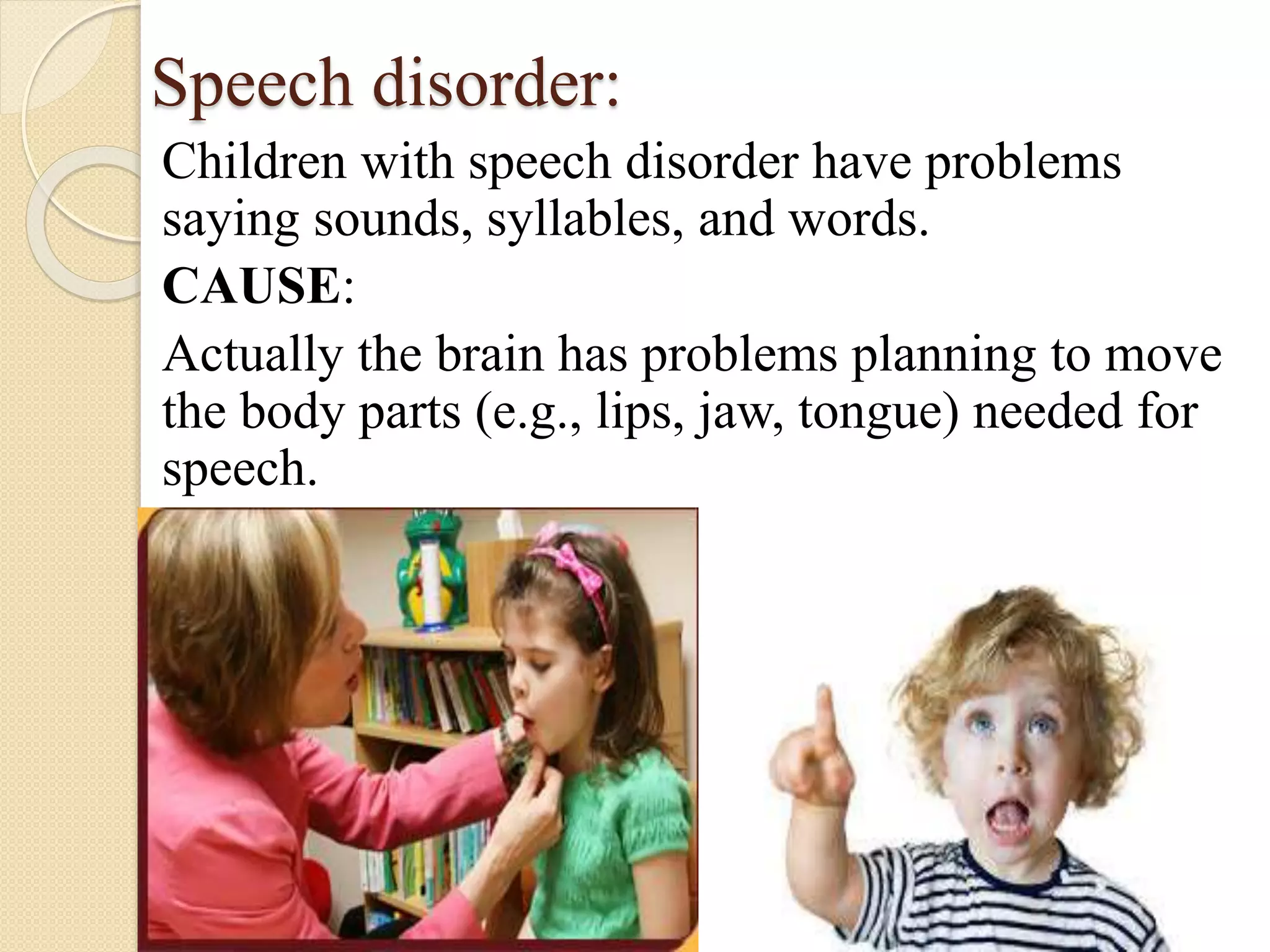
Speech disorder:
Children with speech disorder have problems
saying sounds, syllables, and words.
CAUSE:
Actually the brain has problems planning to move
the body parts (e.g., lips, jaw, tongue) needed for
speech.
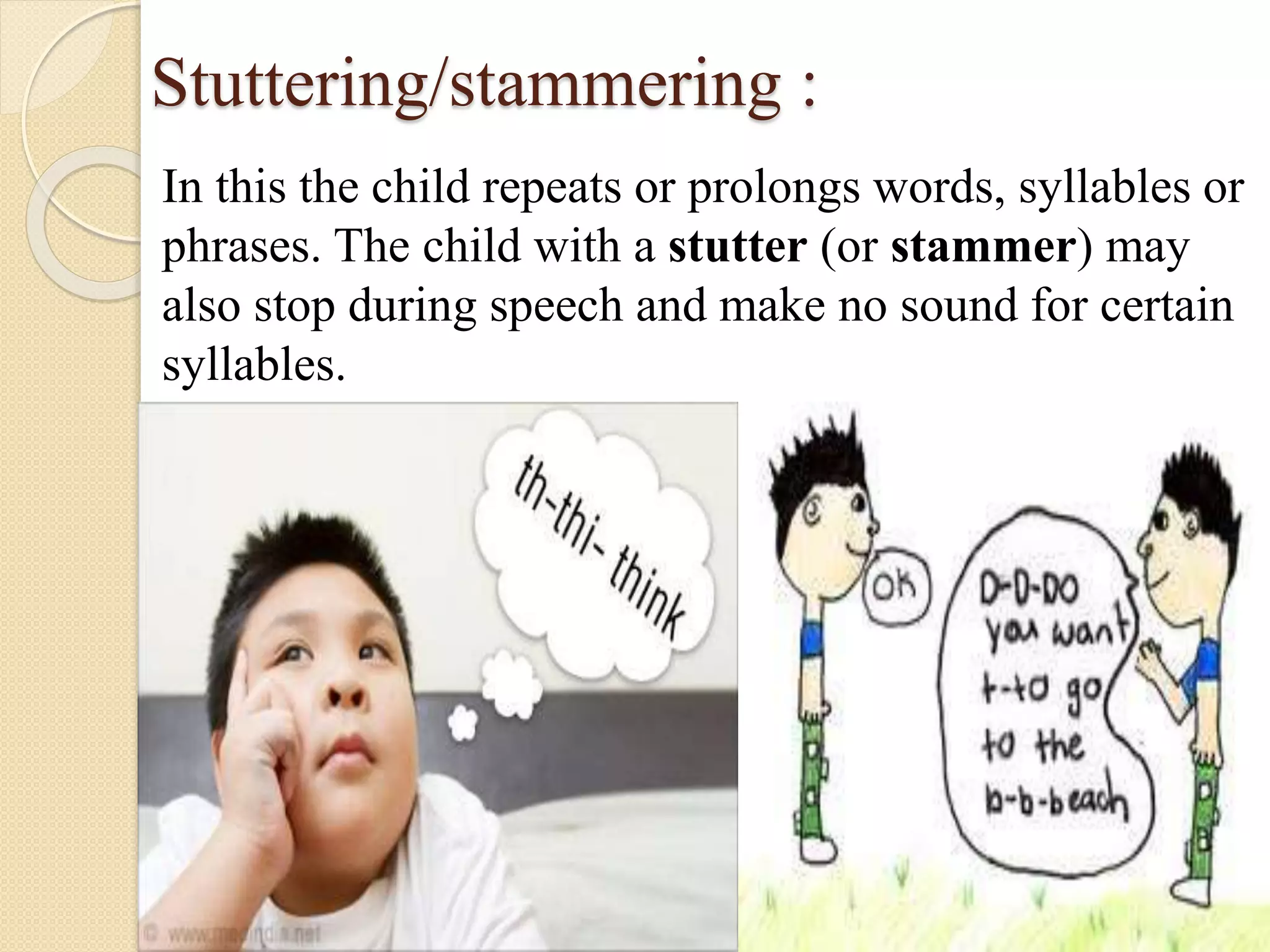
Stuttering/stammering :
In this the child repeats or prolongs words, syllables or
phrases. The child with a stutter (or stammer) may
also stop during speech and make no sound for certain
syllables.
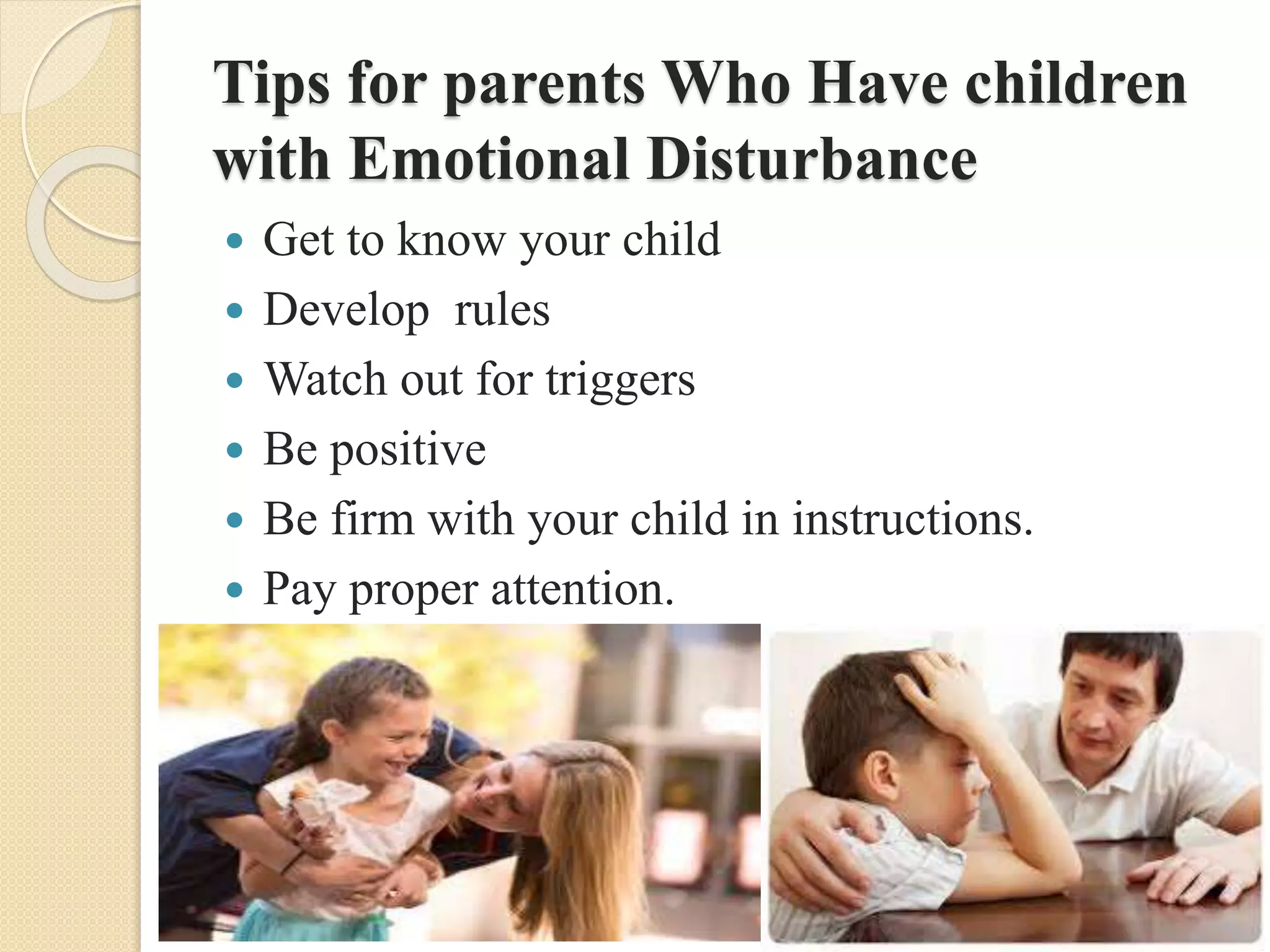
Tips for parents Who Have children
with Emotional Disturbance
 Get to know your child
 Develop rules
 Watch out for triggers
 Be positive
 Be firm with your child in instructions.
 Pay proper attention.
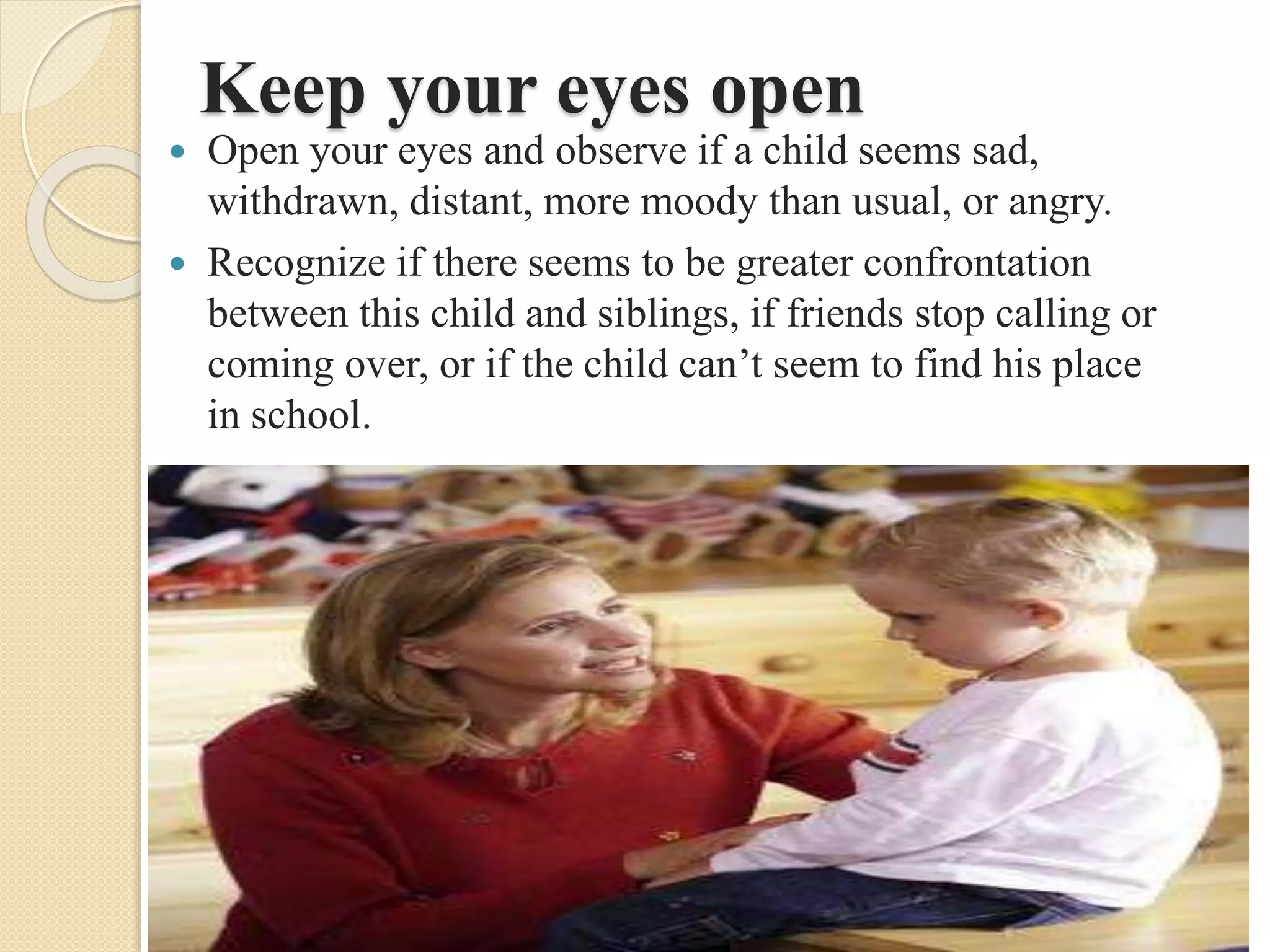
Keep your eyes open
 Open your eyes and observe if a child seems sad,
withdrawn, distant, more moody than usual, or angry.
 Recognize if there seems to be greater confrontation
between this child and siblings, if friends stop calling or
coming over, or if the child can’t seem to find his place
in school.
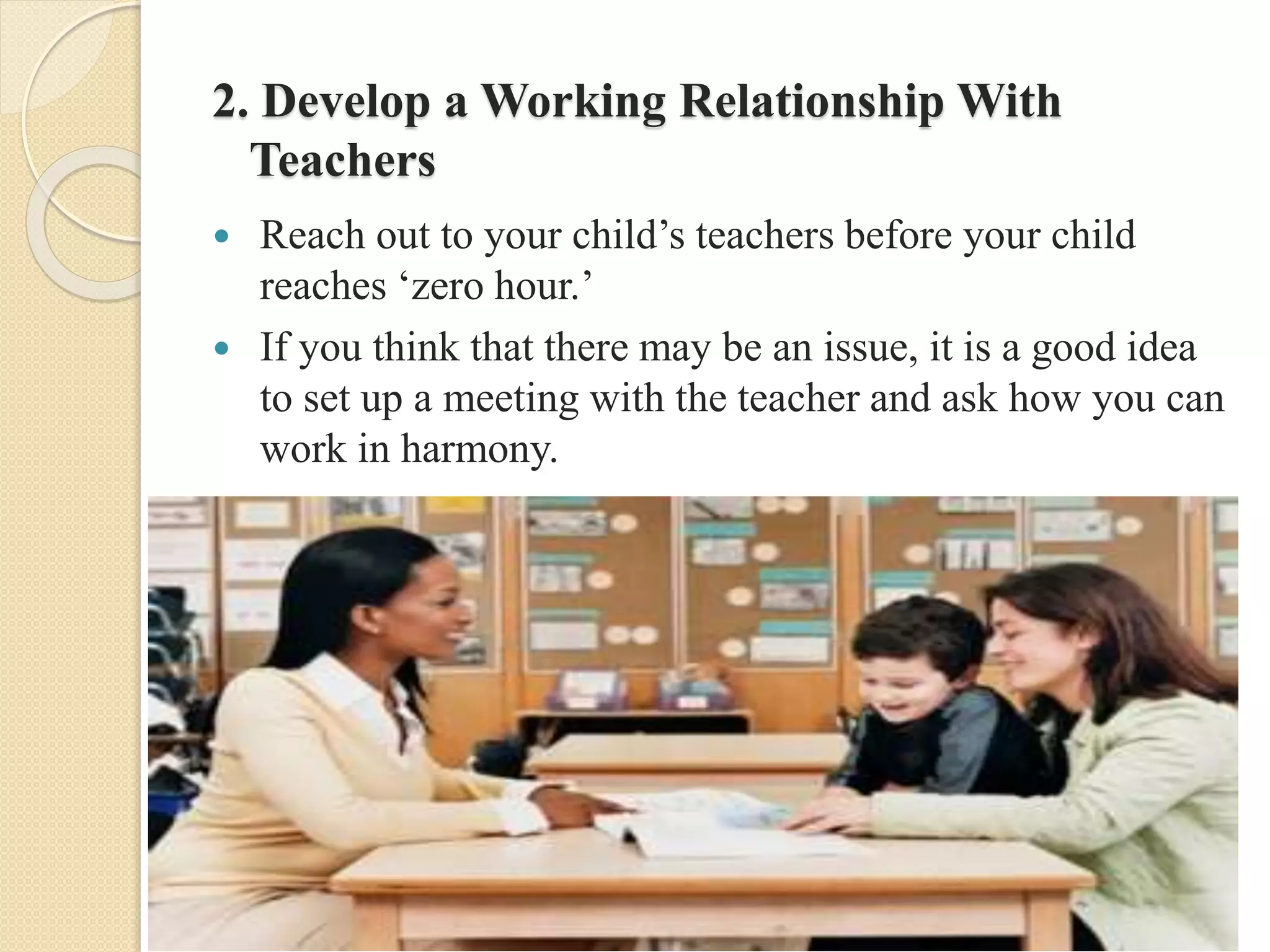
2. Develop a Working Relationship With
Teachers
 Reach out to your child’s teachers before your child
reaches ‘zero hour.’
 If you think that there may be an issue, it is a good idea
to set up a meeting with the teacher and ask how you can
work in harmony.
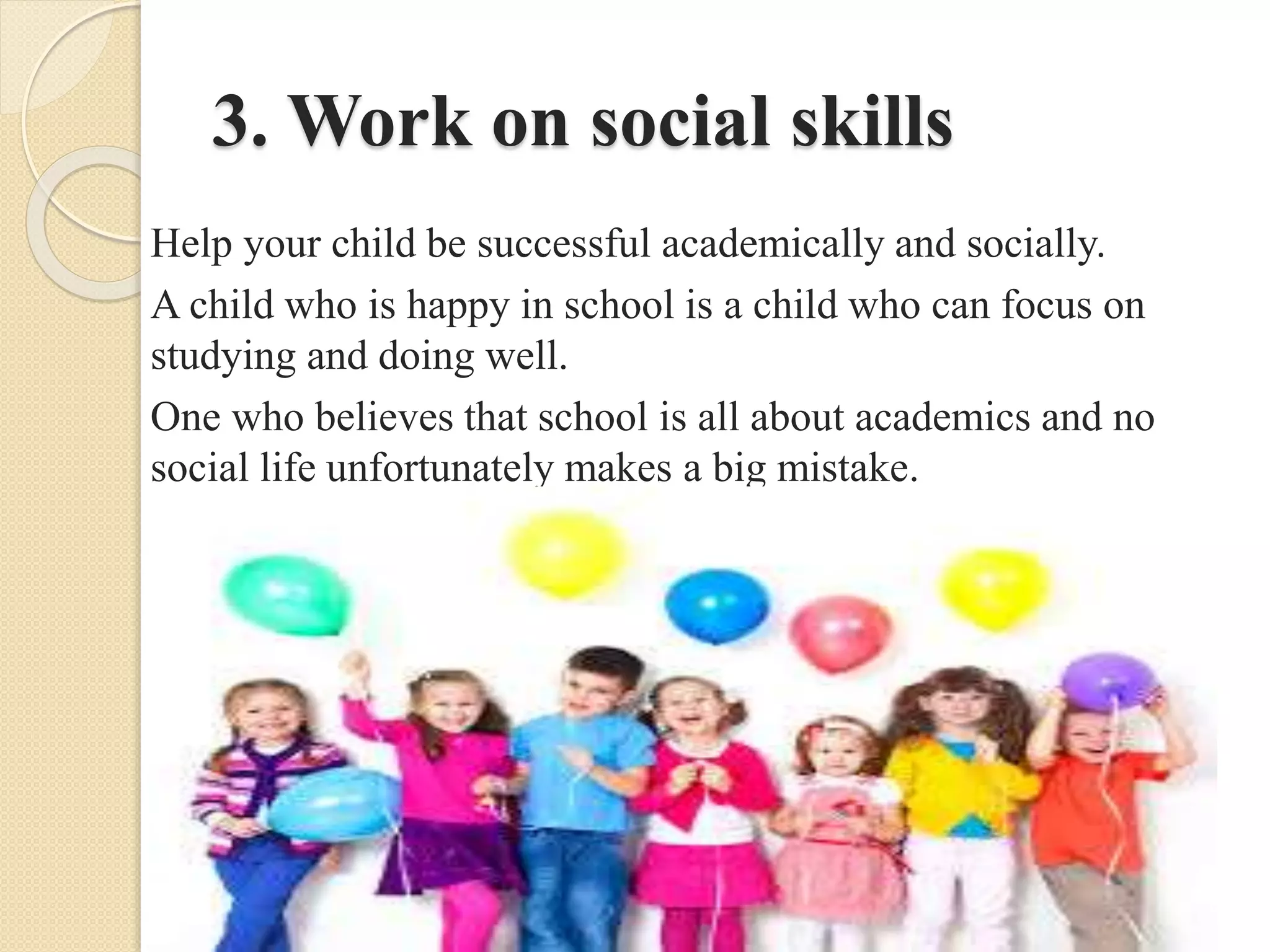
3. Work on social skills
Help your child be successful academically and socially.
A child who is happy in school is a child who can focus on
studying and doing well.
One who believes that school is all about academics and no
social life unfortunately makes a big mistake.
Cont…
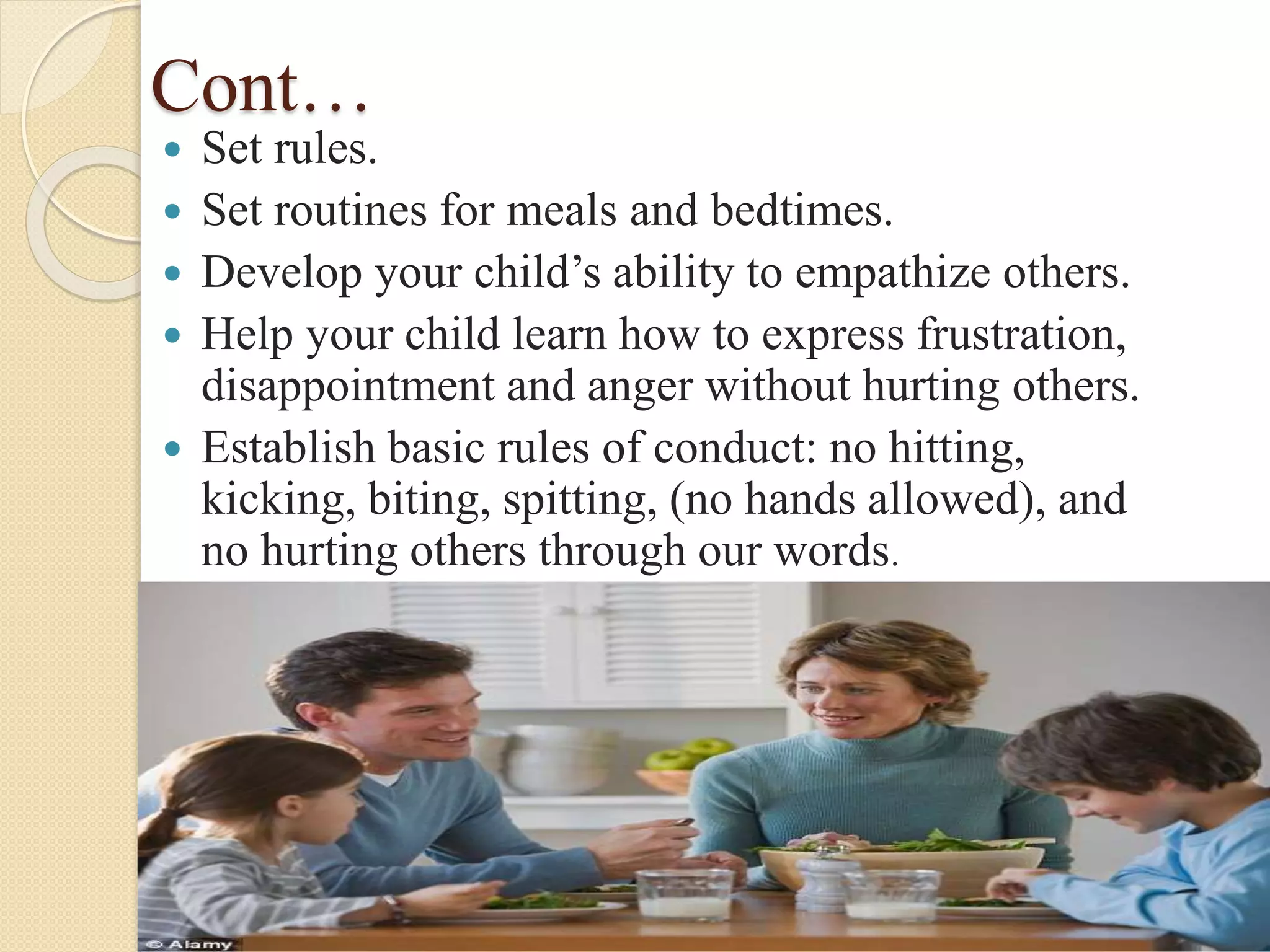
 Set rules.
 Set routines for meals and bedtimes.
 Develop your child’s ability to empathize others.
 Help your child learn how to express frustration,
disappointment and anger without hurting others.
 Establish basic rules of conduct: no hitting,
kicking, biting, spitting, (no hands allowed), and
no hurting others through our words.
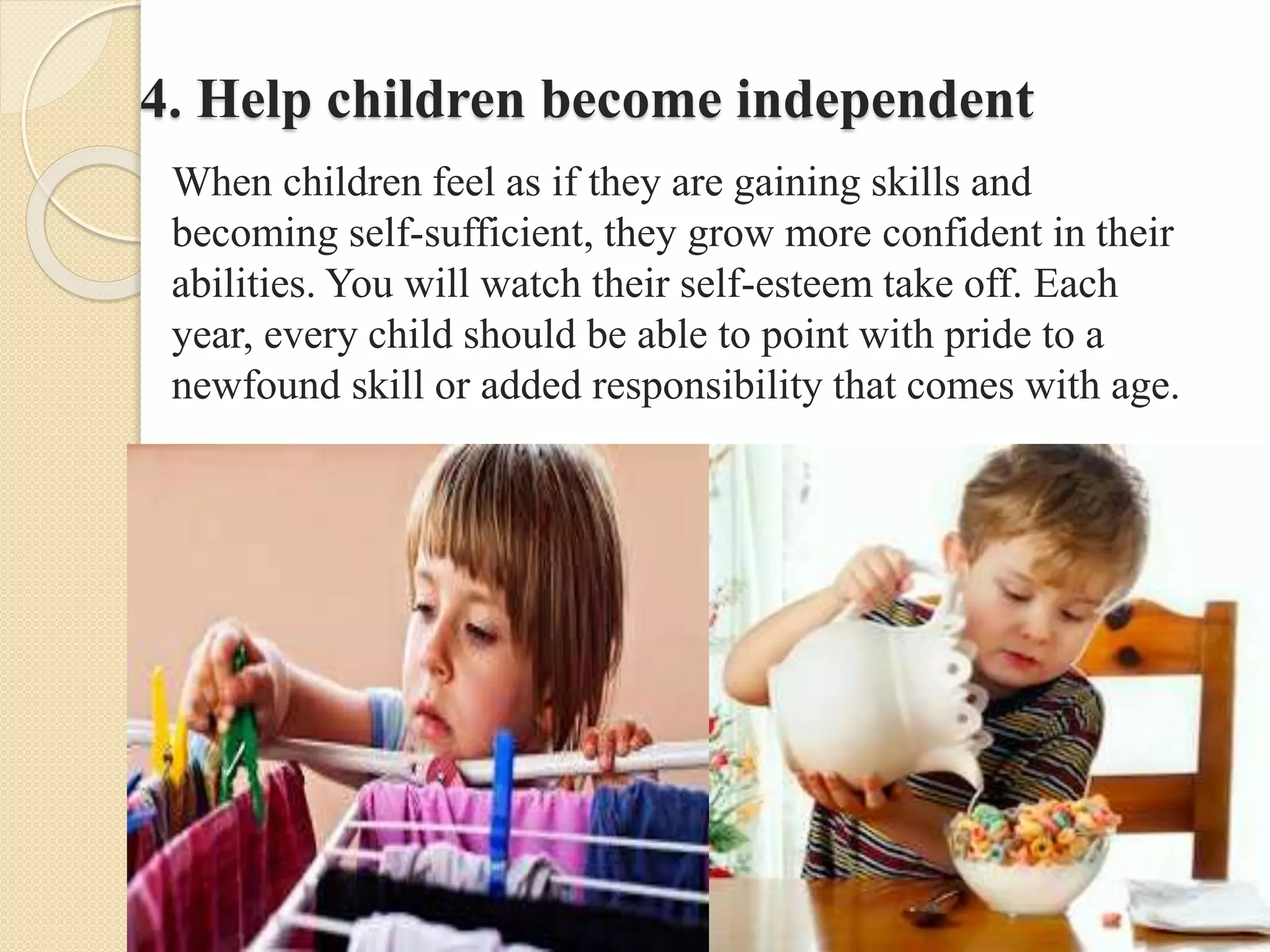
4. Help children become independent
When children feel as if they are gaining skills and
becoming self-sufficient, they grow more confident in their
abilities. You will watch their self-esteem take off. Each
year, every child should be able to point with pride to a
newfound skill or added responsibility that comes with age.
Cont…
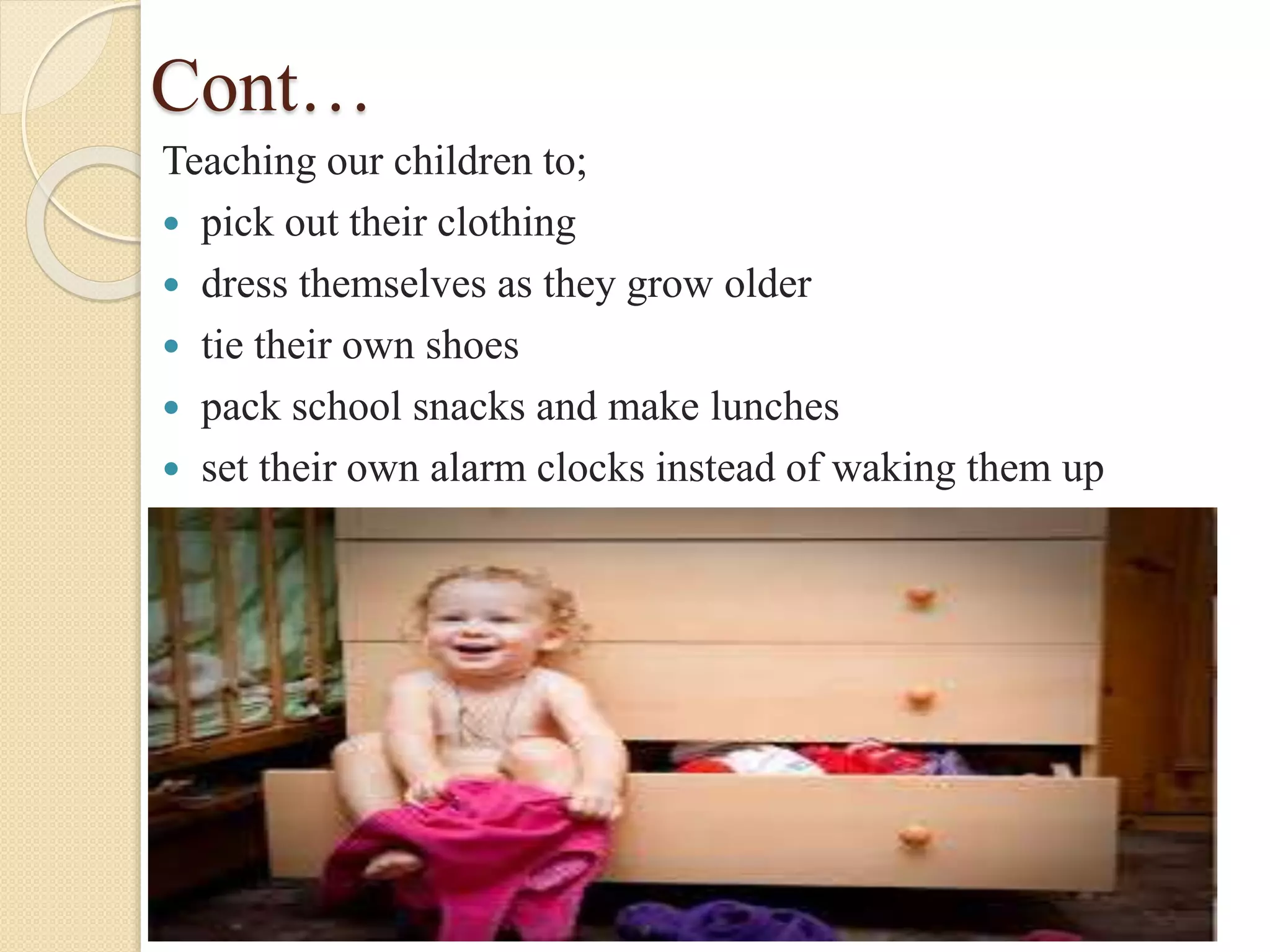
Teaching our children to;
 pick out their clothing
 dress themselves as they grow older
 tie their own shoes
 pack school snacks and make lunches
 set their own alarm clocks instead of waking them up
Cont…
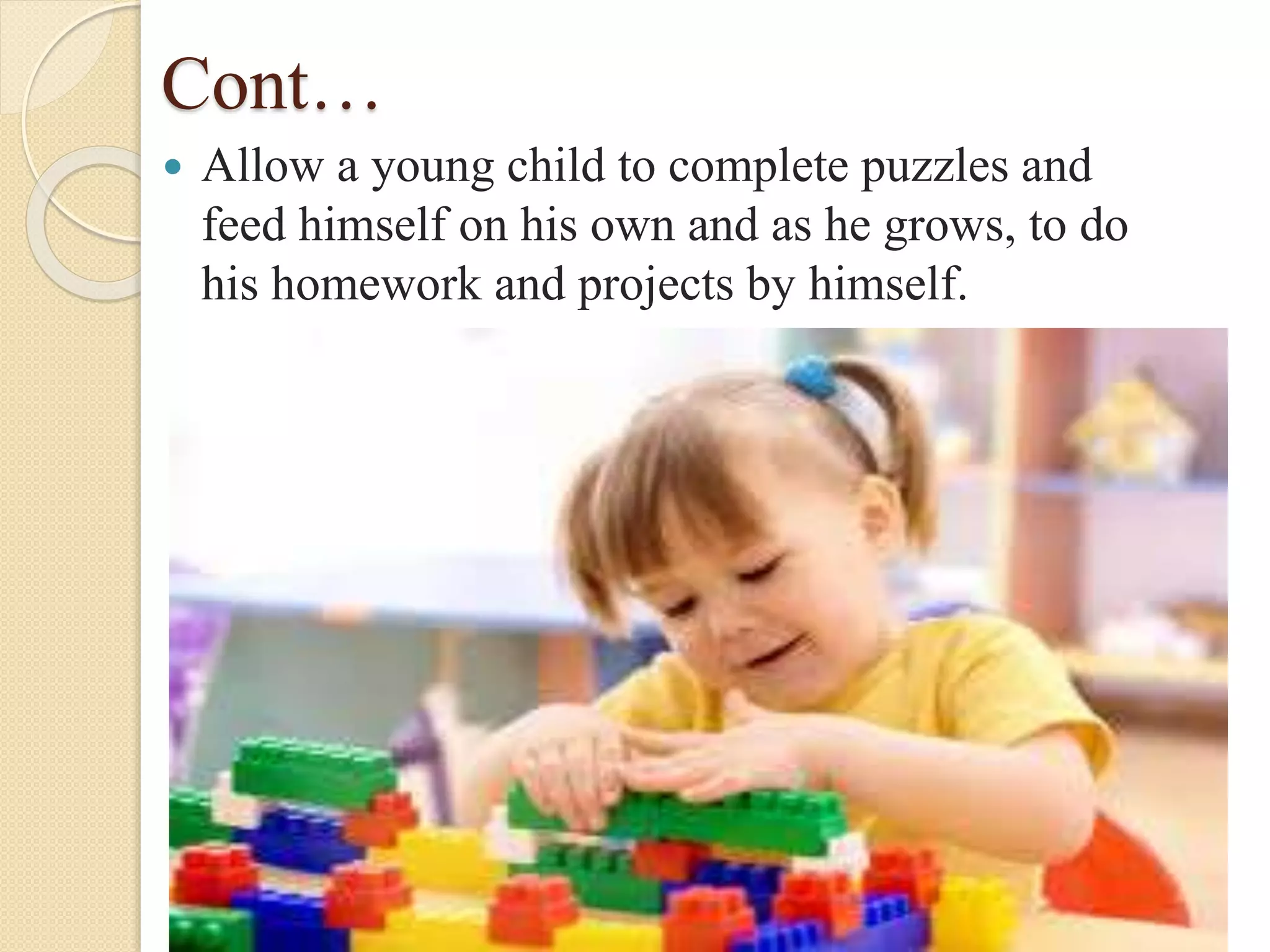
 Allow a young child to complete puzzles and
feed himself on his own and as he grows, to do
his homework and projects by himself.
Cont….
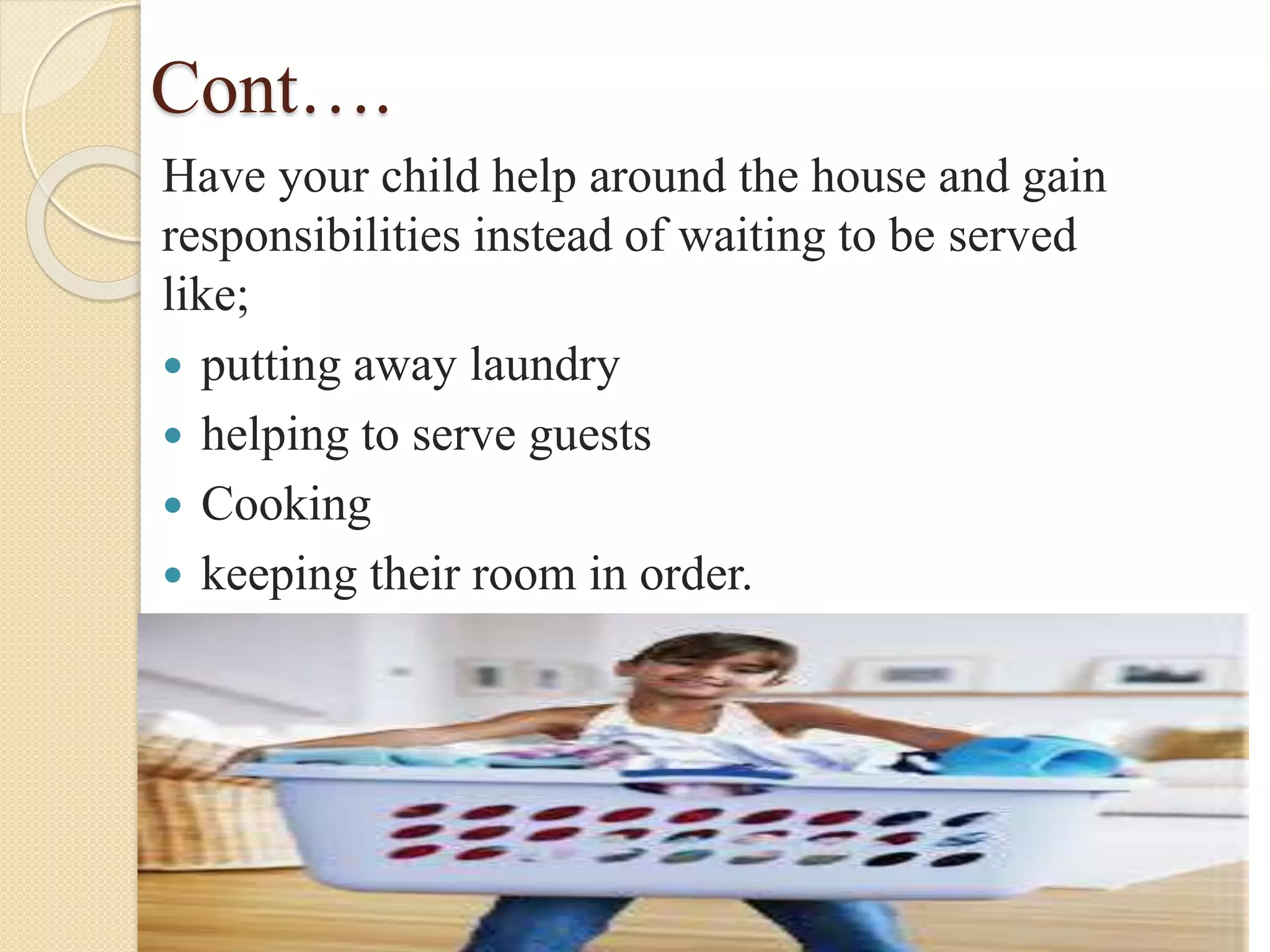
Have your child help around the house and gain
responsibilities instead of waiting to be served
like;
 putting away laundry
 helping to serve guests
 Cooking
 keeping their room in order.
5. Communicate with Each Child
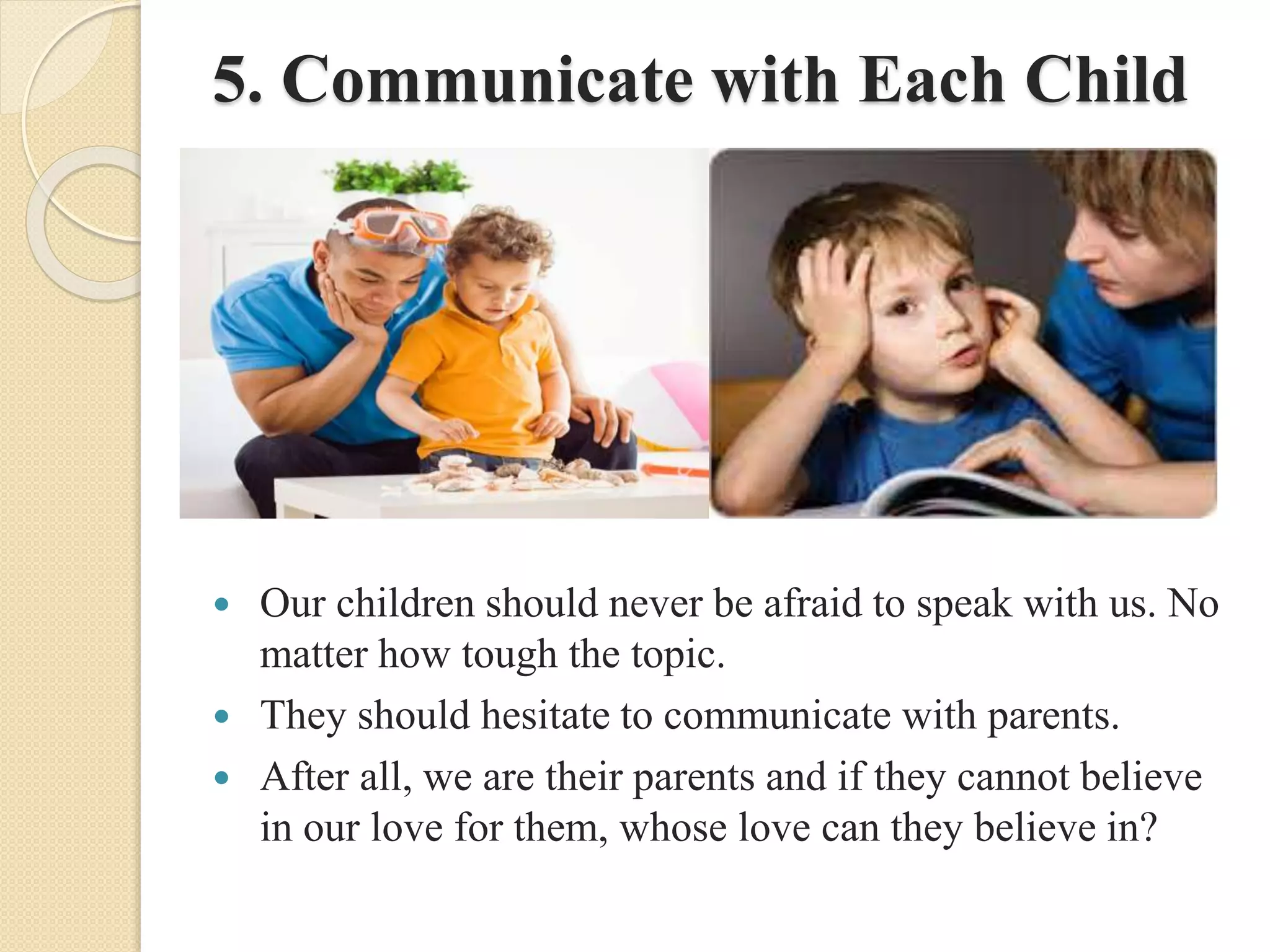
 Our children should never be afraid to speak with us. No
matter how tough the topic.
 They should hesitate to communicate with parents.
 After all, we are their parents and if they cannot believe
in our love for them, whose love can they believe in?
Cont…
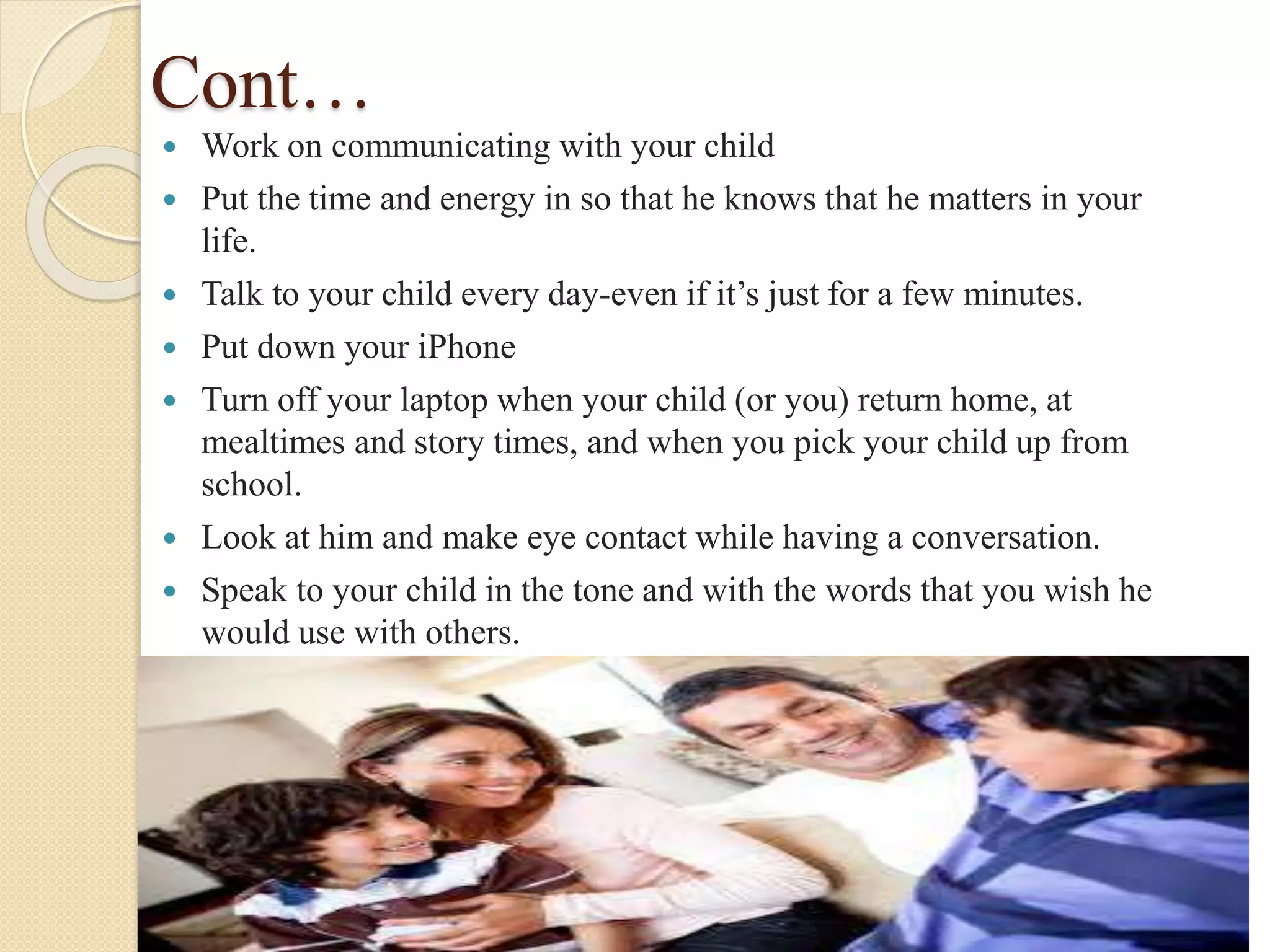
 Work on communicating with your child
 Put the time and energy in so that he knows that he matters in your
life.
 Talk to your child every day-even if it’s just for a few minutes.
 Put down your iPhone
 Turn off your laptop when your child (or you) return home, at
mealtimes and story times, and when you pick your child up from
school.
 Look at him and make eye contact while having a conversation.
 Speak to your child in the tone and with the words that you wish he
would use with others.
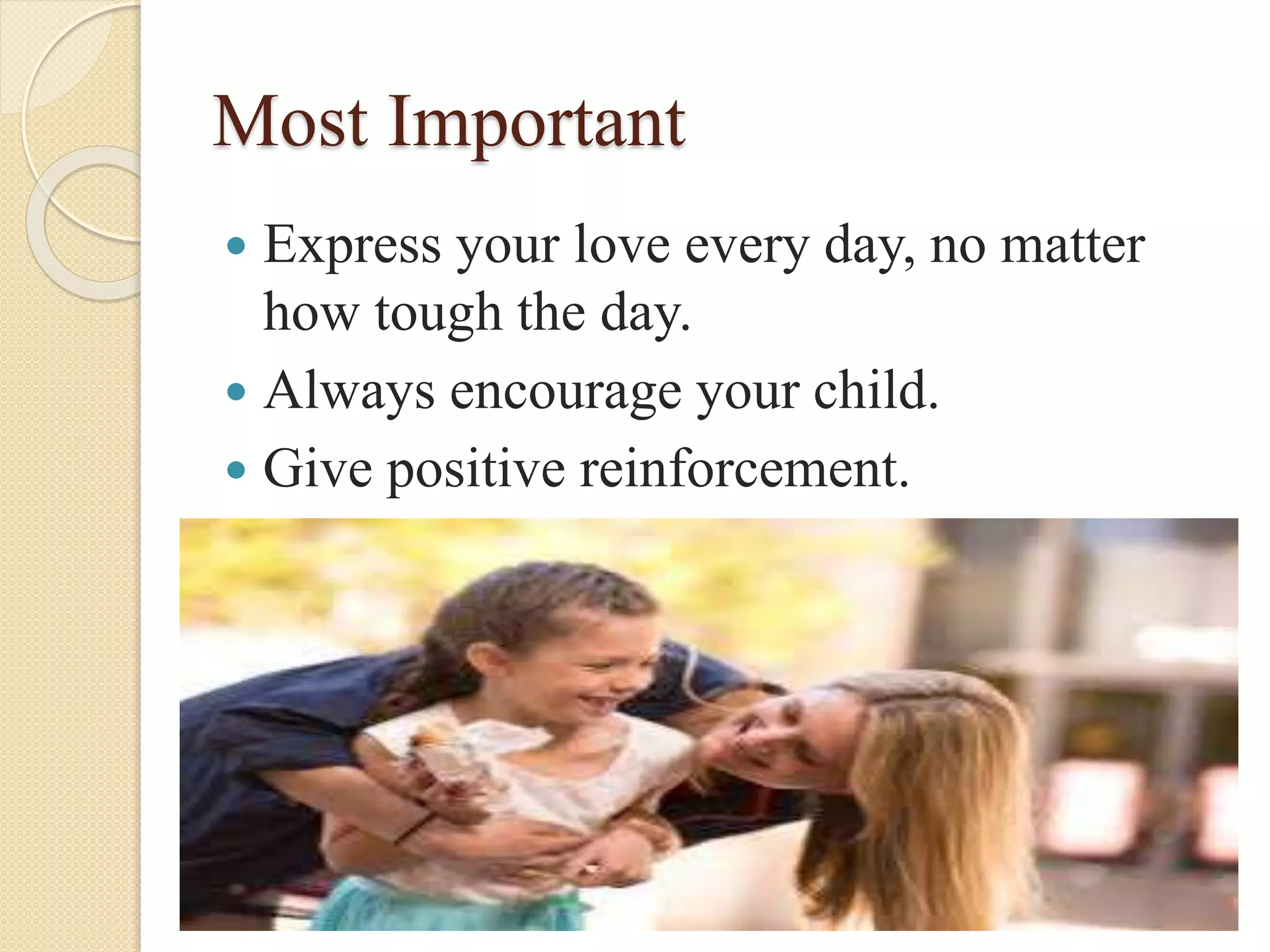
Most Important
 Express your love every day, no matter
how tough the day.
 Always encourage your child.
 Give positive reinforcement.
Common behavioral and emotional problems in children

Common behavioral and emotional problems in children

  • 1.
    Common behavioral and emotionalProblems In Children
  • 2.
    Emotional and BehavioralProblems: Definition:  An inability to build or maintain satisfactory interpersonal relationships with parents and teachers.
  • 3.
     A generalpervasive mood of unhappiness or depression.  A tendency to develop physical symptoms or fears associated with personal or school problems.
  • 4.
    Behavioral disorder The behavioraldisorder is actually when a child is not doing what adults want him to do at a particular time.
  • 5.
    Where as; A youngperson is said to have a behaviour disorder when he or she demonstrates behaviour that is noticeably different from that expected in the school or community.
  • 6.
    Causes of emotionaland behavioral problem in children There are various causes of emotional and behavioral problems like; BIOLOGY: Biological factors include;  heredity  brain disorder  diet
  • 7.
    HOME AND COMMUNITY: Itincludes;  Environment  family functioning  Poverty  Abuse  neglect
  • 8.
    Characteristics Children with themost serious ED may exhibit:  Distorted thinking  Excessive anxiety  Bizarre motor acts  Abnormal mood swings
  • 9.
    Their behavior signalsthat they are not coping with their environment or peers are;  Hyperactivity  Aggression  Self injurious behavior  Withdrawal  Immaturity  Learning difficulties
  • 10.
    Adverse effects andpossible treatments of the behavioral disorders
  • 11.
    Categories of BehavioralDisorders:- Main types of behavioral disorders are; 1 ) Habit Disorders 2 ) Eating Disorders
  • 12.
    Categories of BehaviourDisorders:- 1 ) Habit Disorders (Tension releasing disorders) • Finger (thumb) sucking and Nail biting • Teeth grinding (Bruxism) • Head banging and Head jerking • Tics a ) grimacing b ) grunting c ) scratching nose d ) copropraxia
  • 13.
    Finger Sucking andNail Biting Its due to;  Sensory solace for child (“internal stroking”) to cope with stressful situation in infants and toddlers.  Predisposing factors: Developmental delay Neglect
  • 14.
    Finger (Thumb) sucking& Nail Biting • Adverse Effects – Malocclusion – open bite – Mastication difficulty – Speech difficulty( D and T ) – Lisping
  • 15.
    Finger (Thumb) sucking& Nail Biting • Adverse Effects – Paronychia and digital abnormalities
  • 16.
    Finger (Thumb) sucking& Nail Biting Treatment:  Reassure parents that it’s transient.  Improve parental attention / nurturing.  Teach parent to ignore and give more attention to positive aspects of child’s behavior.  Provide child praise / reward for substitute behaviors. ( positive reinforcement )  Bitter salves, thumb splints,  Gloves may be used to reduce thumb sucking.  Aversive therapy techniques.
  • 17.
    TEETH GRINDING:  Itis a condition in which child grind, gnash or clench his teeth.
  • 18.
    Treatment of teethgrinding: Recommended treatments for bruxism (teeth grinding) include  Behavioral therapies  Using mouth guards or mouth splints.  Muscle relaxation exercises.
  • 19.
    • Head Banging Rhythmichitting of the head against a solid surface often the crib mattress. • In 5-20% of children during infancy & toddler years • Benign & self-limiting • Can result in callus formation, abrasions, contusions
  • 20.
  • 21.
    Head banging Treatment: ◦ Assurance– significant injury unlikely ◦ Parents should ignore as concern and punishment can reinforce it. ◦ Padding
  • 22.
    TICS: sudden, repetitive, nonrhythmicmotor movement or vocalization involving discrete muscle groups. Tics 12 to 20% children, peak age 5 -7 yr. Motor Tics or Phonetic Tics More common in boys than in girls Increase when stressed, anxious, fatigued, or bored Can occur in any body part Decrease when focused
  • 23.
    Tics : Commontypes Simple Tics:  Grimacing  Yawning  Grunting  Sighing  Blinking  Wrinkling  Scratching nose  Head jerking  Throat clearing Complex Tics: • Jumping • Spinning • Touching objects or people • Echopraxia: Repeating other’s actions • Copropraxia: Obscene gestures • Palilalia: Repeating one’s own words • Echolalia: Repeating what someone else said
  • 24.
    Few Examples OfTics Orders
  • 25.
  • 26.
    Grunting ( Shortgruff noise ):
  • 27.
  • 28.
  • 29.
    How To DiagnoseTics Disorders • The tics should occur many times a day nearly every day or throughout a period of more than 1 year; • During this period there should never be a tic-free period of more than 3 consecutive months; • The onset should be before age 18 years; (
  • 30.
    Tics : Management. Medication to help control the symptoms  Habit reversal training (HRT): a behavioral therapy  The child and adolescent psychiatrist can also advise the family about how to provide emotional support and the appropriate educational environment for the youngster.
  • 31.
  • 32.
    Eating disorder -Pica Repeated or chronic ingestion of non nutritive substances. Examples: mud, paint, clay, plaster, charcoal, soil.
  • 33.
    Pica Geophagia Eating ofmud, soil, clay, chalk, etc. Pagophagia Consumption of ice Hyalophagia Consumption of glass Amylophagia Consumption of starch Xylophagia Consumption of wood Trichophagia Consumption of hair Urophagia Consumption of urine Coprophagia Consumption of feces
  • 34.
    Pica Predisposing factors : Parentalneglect Poor supervision Lack of affection Psychological neglect, (orphans)  Family disorganization  Lower socioeconomic class  Autism Mental retardation
  • 35.
    Pica Screening indicated for: Iron deficiency anemia  Worm infestations  Lead poisoning  Family dysfunction
  • 36.
  • 37.
    Pica - Management Parental care  Developing safe eating habits  Multivitamins and calcium intake  Avoid punishment
  • 38.
  • 40.
    Oppositional defiant disorder(ODD) • Easily angered, annoyed or irritated • Frequent temper tantrums • Argues frequently with adults, particularly the most familiar adults in their lives, such as parents • Refuses to obey rules
  • 41.
    Oppositional defiant disorder(ODD)  Seems to deliberately try to annoy or aggravate others  Low self-esteem  Low frustration threshold  Seeks to blame others for any misfortunes or misdeeds.
  • 42.
    Conduct Disorders • Frequentrefusal to obey parents or other authority figures • Repeated truancy • Tendency to use drugs, including cigarettes and alcohol, at a very early age • Lack of empathy for others
  • 43.
    Conduct Disorders • Aggressiveto animals and other people or showing sadistic behaviors including bullying and physical or sexual abuse • Keenness to start physical fights & Using weapons • Frequent lying
  • 44.
    Conduct Disorders • Criminalbehaviour such as stealing, deliberately lighting fires, breaking into houses and vandalism • A tendency to run away from home • Suicidal tendencies – rarely.
  • 45.
    Strategies to minimizeanger  Exercise that can Help decrease anger, depression, and disruptive behaviors.  More exposure to out door activities than indoor.
  • 46.
    Adverse effects andpossible treatments of the emotional disorders
  • 47.
    Categories of emotionaldisorders  School phobia  Temper tantrums  Evening colic  Breath holding spasms  Speech disorder  Stuttering/stammering
  • 48.
    School phobia  Approximately1 to 5% of school-aged children have school refusal  Most common in 5- and 6-year olds and in 10- and 11- year olds  School refusal differs from truancy
  • 49.
    School Phobia What canparents do? 1. Have a physician examine the child to determine if he or she has a legitimate illness. 2. Listen to the child talk about school to detect any clues as to why he or she does not want to go.
  • 50.
    What can parentsdo? 1. Talk to the child's teacher, school psychologist, and/or school counselor to share concerns. 2. Together determine a possible cause or causes 3. Develop an appropriate plan of action
  • 51.
    School Phobia  Thegoal is to have the child return to school and attend class daily  However, if the school phobia is extreme, a therapist or psychiatrist's assistance may be necessary.
  • 52.
    Temper tantrums • Itis an emotional outburst, usually associated with children or those in emotional distress, that is typically characterized by • Stubbornness • Crying • Screaming • Anger ranting • A resistance to attempts at pacification • In some cases, hitting.
  • 53.
    Temper Tantrum -Causes  In 18 months to 3 yrs olds due to development of sense of autonomy.  Child displays defiance, negativism / oppositionalism by having temper tantrums.  Normal part of child development.  Gets reinforced when parents respond to it by punitive anger.  Child wrongly learns that temper tantrums are a reasonable response to frustration.
  • 54.
    Temper Tantrums Precipitating factors Hunger Fatigue Lackof sleep Innate personality of child Ineffective parental skills Over pampering Dysfunctional family / Family violence School aversion
  • 55.
    Temper Tantrums –Management Ingeneral, parents advised to:  Set a good example to child  Pay attention to child  Spend quality time  Have open communication with child  Have consistency in behavior
  • 56.
    Temper Tantrums –Management Duringtemper tantrum: Parents to ignore child and once child is calm, tell child that such behavior is not acceptable Verbal reprimand should not be abusive Never beat or threaten child Impose “Time Out” - if temper tantrum is disruptive, out of control and occurring in public place.
  • 57.
    Evening Colic  Intermittentepisodes of abdominal pain and severe crying in normal infants  Begins at 1-2 weeks age and persists till 3-4 mo.  Crying usually in late afternoon or evening  Infant cries for 3 hrs. per day  for 3 days per week  for 3 weeks ”
  • 58.
    Evening Colic Attack • Beginssuddenly with a loud cry • Crying continuous – lasts for several hours – mostly in the late afternoon or evenings • Face becomes red and legs drawn up on the abdomen • Abdomen becomes tense • Attack terminates after exhaustion or after passage of flatus or feces
  • 59.
    Evening Colic Causes • Morelikely if the child is over active and parents are over anxious.  Over stimulation from parents • Not known
  • 60.
    Evening Colic Management During Episode – Hold the child erect or prone – Avoid drugs – Colic drops for infants
  • 61.
    Evening Colic Management Counseling - Coping with the parents – Reassure the parents that infant is not sick – They need to soothe more with repetitive sound and stimulate less with decrease in picking up and feeding with every cry
  • 62.
  • 63.
    Breath Holding Spasms PrecipitatingFactors: • Frustration • Injury • Anger • Anemia
  • 64.
    Breath Holding SpasmsManagement:  No treatment is usually needed  Iron supplements to children with iron deficiency  During a spell :  Make sure your child is in a safe place where he or she will not fall or be hurt.  Place a cold cloth on your child's forehead during a spell to help shorten the episode.
  • 65.
    Breath Holding SpasmManagement:  After the spell, try to be calm.  Avoid giving too much attention to the child, as this can reinforce the behaviors that led to the event.  Avoid situations that cause a child's temper tantrums.
  • 66.
    Speech disorder: Children withspeech disorder have problems saying sounds, syllables, and words. CAUSE: Actually the brain has problems planning to move the body parts (e.g., lips, jaw, tongue) needed for speech.
  • 67.
    Stuttering/stammering : In thisthe child repeats or prolongs words, syllables or phrases. The child with a stutter (or stammer) may also stop during speech and make no sound for certain syllables.
  • 68.
    Tips for parentsWho Have children with Emotional Disturbance  Get to know your child  Develop rules  Watch out for triggers  Be positive  Be firm with your child in instructions.  Pay proper attention.
  • 69.
    Keep your eyesopen  Open your eyes and observe if a child seems sad, withdrawn, distant, more moody than usual, or angry.  Recognize if there seems to be greater confrontation between this child and siblings, if friends stop calling or coming over, or if the child can’t seem to find his place in school.
  • 70.
    2. Develop aWorking Relationship With Teachers  Reach out to your child’s teachers before your child reaches ‘zero hour.’  If you think that there may be an issue, it is a good idea to set up a meeting with the teacher and ask how you can work in harmony.
  • 71.
    3. Work onsocial skills Help your child be successful academically and socially. A child who is happy in school is a child who can focus on studying and doing well. One who believes that school is all about academics and no social life unfortunately makes a big mistake.
  • 72.
    Cont…  Set rules. Set routines for meals and bedtimes.  Develop your child’s ability to empathize others.  Help your child learn how to express frustration, disappointment and anger without hurting others.  Establish basic rules of conduct: no hitting, kicking, biting, spitting, (no hands allowed), and no hurting others through our words.
  • 73.
    4. Help childrenbecome independent When children feel as if they are gaining skills and becoming self-sufficient, they grow more confident in their abilities. You will watch their self-esteem take off. Each year, every child should be able to point with pride to a newfound skill or added responsibility that comes with age.
  • 74.
    Cont… Teaching our childrento;  pick out their clothing  dress themselves as they grow older  tie their own shoes  pack school snacks and make lunches  set their own alarm clocks instead of waking them up
  • 75.
    Cont…  Allow ayoung child to complete puzzles and feed himself on his own and as he grows, to do his homework and projects by himself.
  • 76.
    Cont…. Have your childhelp around the house and gain responsibilities instead of waiting to be served like;  putting away laundry  helping to serve guests  Cooking  keeping their room in order.
  • 77.
    5. Communicate withEach Child  Our children should never be afraid to speak with us. No matter how tough the topic.  They should hesitate to communicate with parents.  After all, we are their parents and if they cannot believe in our love for them, whose love can they believe in?
  • 78.
    Cont…  Work oncommunicating with your child  Put the time and energy in so that he knows that he matters in your life.  Talk to your child every day-even if it’s just for a few minutes.  Put down your iPhone  Turn off your laptop when your child (or you) return home, at mealtimes and story times, and when you pick your child up from school.  Look at him and make eye contact while having a conversation.  Speak to your child in the tone and with the words that you wish he would use with others.
  • 79.
    Most Important  Expressyour love every day, no matter how tough the day.  Always encourage your child.  Give positive reinforcement.