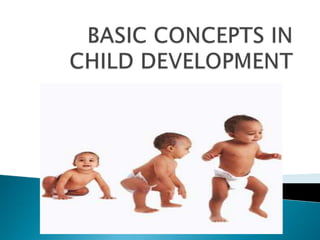
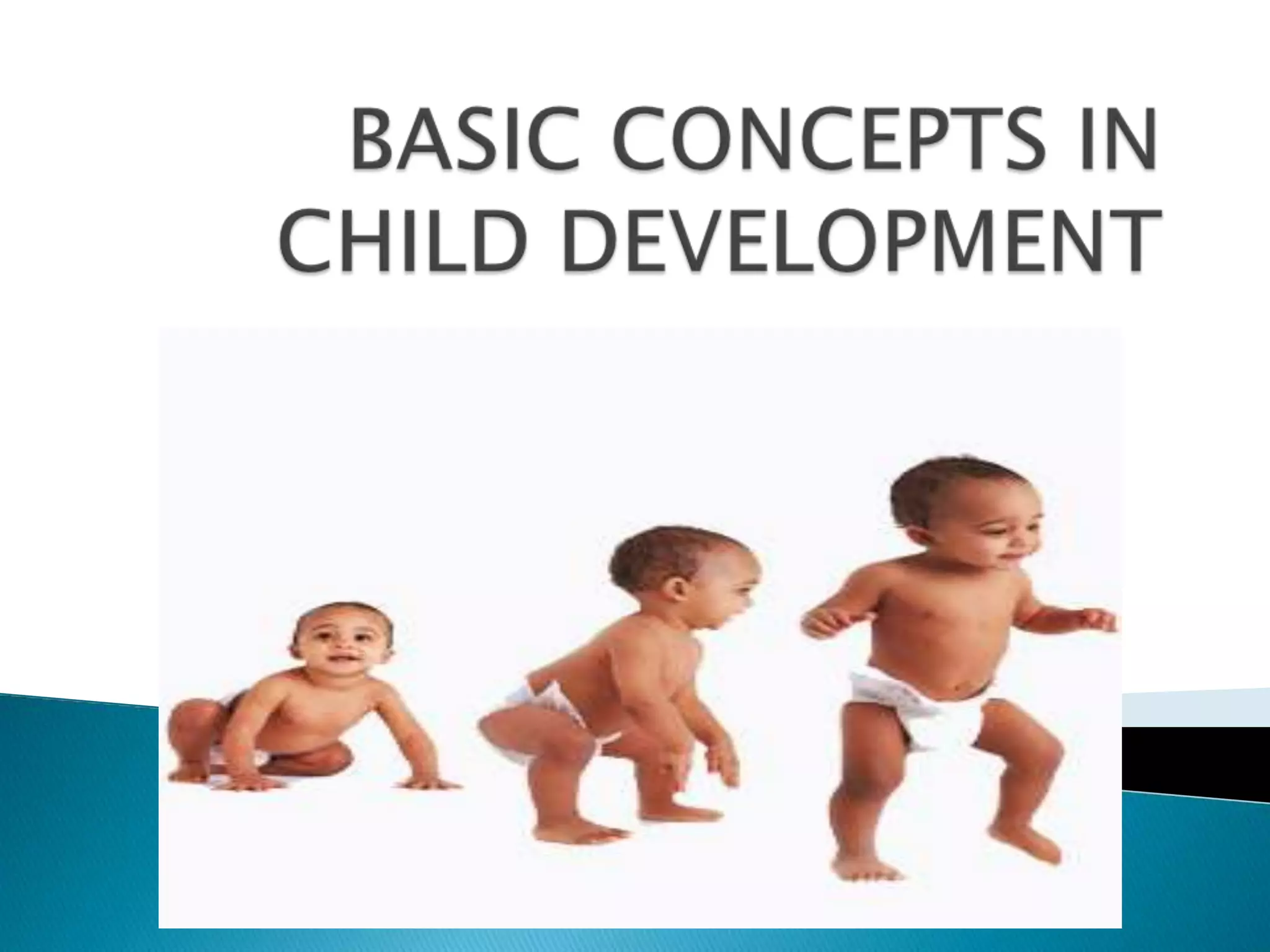
1. WHAT IS CHILD DEVELOPMENT?
 Child development refers to
  the biological and psychological and
  emotional changes that occur in human
  beings between birth and the end
  of adolescence then through adulthood, as
  the individual progresses from dependency to
  increasing autonomy.
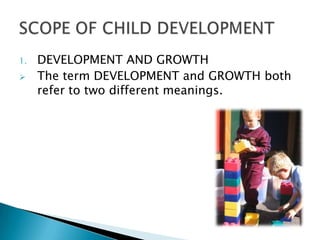
1.   DEVELOPMENT AND GROWTH
    The term DEVELOPMENT and GROWTH both
     refer to two different meanings.
a) DEVELOPMENT(qualitative)
 changes in a person’s physical and
  behavioural traits that emerge in orderly ways
  and last for a reasonable period of time.
 the changes are…
 PROGRESSIVE (results in acquisition of skills
                   and abilities that are complex,
                   finer and more efficient.)
 IN ORDER (there is an order in development.)
 LONG LASTING
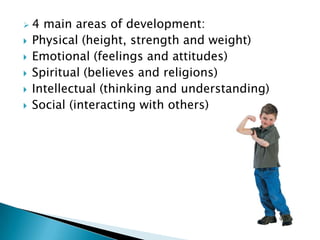
   4 main areas of development:
   Physical (height, strength and weight)
   Emotional (feelings and attitudes)
   Spiritual (believes and religions)
   Intellectual (thinking and understanding)
   Social (interacting with others)
b) GROWTH (quantitative)
 refers to physical increase in the size of the
  body. (increase in weight, height, etc..)
 refers to a quantitative change (can be
  measured)
 there is a change in form and increase in the
  complexity of body parts and their functioning,
  thinking abilities and social skills.
 Growth is only one aspect of the larger process
  of development.
c) The main areas of growth and development:
1. Physical (weight, height, muscles, systems,
  organs)

2. Emotional (extend trusting relationships to
 other adults and to children, show a strong
 sense of self as an individual, recognise
 feelings, label their own feelings)
3. Social (enjoy playing alongside other
 children, but won’t interact a great deal with
 them, show awareness of others’ feelings and
 might try to give basic help, look to adults for
 comfort.)

4. Spiritual (concerns the broad search for
 transcendental meaning that may be as
 simple as a young child’s inquiries into how
 the world came into being)
5. Intellectual
   The Sensorimotor Stage: A period of time between birth and age two
    during which an infant's knowledge of the world is limited to his or
    her sensory perceptions and motor activities. Behaviors are limited to
    simple motor responses caused by sensory stimuli.

    The Preoperational Stage: A period between ages two and six during
    which a child learns to use language. During this stage, children do
    not yet understand concrete logic, cannot mentally manipulate
    information and are unable to take the point of view of other people.

    The Concrete Operational Stage: A period between ages seven and
    eleven during which children gain a better understanding of mental
    operations. Children begin thinking logically about concrete events,
    but have difficulty understanding abstract or hypothetical concepts.

    The Formal Operational Stage: A period between age twelve to
    adulthood when people develop the ability to think about abstract
    concepts. Skills such as logical thought, deductive reasoning and
    systematic planning also emerge during this stage.
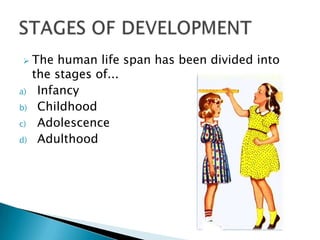
   The human life span has been divided into
     the stages of...
a)    Infancy
b)    Childhood
c)    Adolescence
d)    Adulthood
a) Infancy – from birth to 2 years of age
 the child is totally dependent on the caregiver
   for the fulfilment of her needs.
 the period of the most rapid growth and
   development.
  their skills and abilities increase.


b) Childhood – from 2 to 12 years of age
 acquire learning skills that will associated with
  schooling.
 learns about numbers, colours, shapes and the
  reasons for everyday events.
 thinking develops rapidly and her interest
   in the outside world grows by leaps and
  bounds.
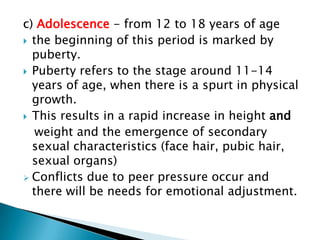
c) Adolescence - from 12 to 18 years of age
 the beginning of this period is marked by
  puberty.
 Puberty refers to the stage around 11-14
  years of age, when there is a spurt in physical
  growth.
 This results in a rapid increase in height and
   weight and the emergence of secondary
  sexual characteristics (face hair, pubic hair,
  sexual organs)
 Conflicts due to peer pressure occur and
  there will be needs for emotional adjustment.
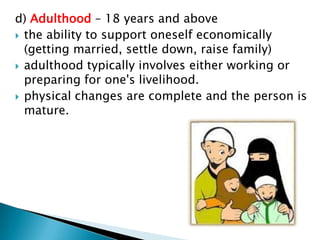
d) Adulthood – 18 years and above
 the ability to support oneself economically
  (getting married, settle down, raise family)
 adulthood typically involves either working or
  preparing for one's livelihood.
 physical changes are complete and the person is
  mature.
   http://psychology.about.com/od/developme
    ntalpsychology/ss/early-childhood-
    development_3.htm
   Thompson and Randall, retrieved from
    http://www.desmos.info/en/doc/Childrens_S
    piritual_Development.pdf
   http://www.preservearticles.com/201105206
    839/physical-growth-and-development-of-
    a-child.html

Basic concepts in child development

  • 2.
    1. WHAT ISCHILD DEVELOPMENT?  Child development refers to the biological and psychological and emotional changes that occur in human beings between birth and the end of adolescence then through adulthood, as the individual progresses from dependency to increasing autonomy.
  • 3.
    1. DEVELOPMENT AND GROWTH  The term DEVELOPMENT and GROWTH both refer to two different meanings.
  • 4.
    a) DEVELOPMENT(qualitative)  changesin a person’s physical and behavioural traits that emerge in orderly ways and last for a reasonable period of time.  the changes are…  PROGRESSIVE (results in acquisition of skills and abilities that are complex, finer and more efficient.)  IN ORDER (there is an order in development.)  LONG LASTING
  • 5.
    4 main areas of development:  Physical (height, strength and weight)  Emotional (feelings and attitudes)  Spiritual (believes and religions)  Intellectual (thinking and understanding)  Social (interacting with others)
  • 6.
    b) GROWTH (quantitative) refers to physical increase in the size of the body. (increase in weight, height, etc..)  refers to a quantitative change (can be measured)  there is a change in form and increase in the complexity of body parts and their functioning, thinking abilities and social skills.  Growth is only one aspect of the larger process of development.
  • 7.
    c) The mainareas of growth and development: 1. Physical (weight, height, muscles, systems, organs) 2. Emotional (extend trusting relationships to other adults and to children, show a strong sense of self as an individual, recognise feelings, label their own feelings)
  • 8.
    3. Social (enjoyplaying alongside other children, but won’t interact a great deal with them, show awareness of others’ feelings and might try to give basic help, look to adults for comfort.) 4. Spiritual (concerns the broad search for transcendental meaning that may be as simple as a young child’s inquiries into how the world came into being)
  • 9.
    5. Intellectual  The Sensorimotor Stage: A period of time between birth and age two during which an infant's knowledge of the world is limited to his or her sensory perceptions and motor activities. Behaviors are limited to simple motor responses caused by sensory stimuli.  The Preoperational Stage: A period between ages two and six during which a child learns to use language. During this stage, children do not yet understand concrete logic, cannot mentally manipulate information and are unable to take the point of view of other people.  The Concrete Operational Stage: A period between ages seven and eleven during which children gain a better understanding of mental operations. Children begin thinking logically about concrete events, but have difficulty understanding abstract or hypothetical concepts.  The Formal Operational Stage: A period between age twelve to adulthood when people develop the ability to think about abstract concepts. Skills such as logical thought, deductive reasoning and systematic planning also emerge during this stage.
  • 10.
    The human life span has been divided into the stages of... a) Infancy b) Childhood c) Adolescence d) Adulthood
  • 11.
    a) Infancy –from birth to 2 years of age  the child is totally dependent on the caregiver for the fulfilment of her needs.  the period of the most rapid growth and development.  their skills and abilities increase. b) Childhood – from 2 to 12 years of age  acquire learning skills that will associated with schooling.  learns about numbers, colours, shapes and the reasons for everyday events.  thinking develops rapidly and her interest in the outside world grows by leaps and bounds.
  • 12.
    c) Adolescence -from 12 to 18 years of age  the beginning of this period is marked by puberty.  Puberty refers to the stage around 11-14 years of age, when there is a spurt in physical growth.  This results in a rapid increase in height and weight and the emergence of secondary sexual characteristics (face hair, pubic hair, sexual organs)  Conflicts due to peer pressure occur and there will be needs for emotional adjustment.
  • 13.
    d) Adulthood –18 years and above  the ability to support oneself economically (getting married, settle down, raise family)  adulthood typically involves either working or preparing for one's livelihood.  physical changes are complete and the person is mature.
  • 15.
    http://psychology.about.com/od/developme ntalpsychology/ss/early-childhood- development_3.htm  Thompson and Randall, retrieved from http://www.desmos.info/en/doc/Childrens_S piritual_Development.pdf  http://www.preservearticles.com/201105206 839/physical-growth-and-development-of- a-child.html